IP Networking: Re-addressing & Planning IPv4 for Business.com LANs
VerifiedAdded on 2023/04/21
|12
|1946
|223
Report
AI Summary
This document provides a detailed IP address planning and documentation solution for Business.com, a software development company with a headquarters and two branches in Western Sydney. Task 1 focuses on documenting the existing network using IPv4 addressing (203.2.36.0/24), including the headquarter, branch A, and branch B, detailing IP address requirements and allocation plans for each sub-network. Task 2 involves re-engineering the network using a Class B network (163.36.0.0/16), incorporating VLANs for different departments at the headquarters (Software Development, Customer Design, Solution Support, Sales, and Finance), and addressing scalability, VPN configuration, security, and agility considerations. The report includes IP address assignments, subnet masks, broadcast addresses, default gateways, and host address ranges for each department and branch, along with a logical network design diagram. The solution aims to improve communication, security, and manageability across the network.

[Document title]
IP NETWORKING
DECEMBER 27, 2018
IP NETWORKING
DECEMBER 27, 2018

Paraphrase This Document
Need a fresh take? Get an instant paraphrase of this document with our AI Paraphraser

Table of Contents
TASK 1.....................................................................................................................2
Introduction.............................................................................................................2
The Head Quarter...................................................................................................2
IP addressing............................................................................................................2
IP address allocation plan.......................................................................................2
Address allocation for devices in the network......................................................2
Branch B...................................................................................................................3
IP address requirement for branch B....................................................................3
IP address assigning plan........................................................................................3
IP address allocation plan for network devices....................................................3
Branch A...................................................................................................................3
IP address allocation...............................................................................................3
IP address allocation plan.......................................................................................3
IP address allocation plan for the gadgets............................................................3
TASK 2.....................................................................................................................4
Local are network requirements............................................................................5
Head Quarter...........................................................................................................5
Software development department........................................................................6
Customer design department.................................................................................6
Solution support department..................................................................................6
Sales department.....................................................................................................7
Finance department.................................................................................................7
Logical network design diagram............................................................................8
Branch A...................................................................................................................8
IP address requirement...........................................................................................8
IP address allocation plan.......................................................................................8
IP address allocation plan for network devices....................................................8
TASK 1.....................................................................................................................2
Introduction.............................................................................................................2
The Head Quarter...................................................................................................2
IP addressing............................................................................................................2
IP address allocation plan.......................................................................................2
Address allocation for devices in the network......................................................2
Branch B...................................................................................................................3
IP address requirement for branch B....................................................................3
IP address assigning plan........................................................................................3
IP address allocation plan for network devices....................................................3
Branch A...................................................................................................................3
IP address allocation...............................................................................................3
IP address allocation plan.......................................................................................3
IP address allocation plan for the gadgets............................................................3
TASK 2.....................................................................................................................4
Local are network requirements............................................................................5
Head Quarter...........................................................................................................5
Software development department........................................................................6
Customer design department.................................................................................6
Solution support department..................................................................................6
Sales department.....................................................................................................7
Finance department.................................................................................................7
Logical network design diagram............................................................................8
Branch A...................................................................................................................8
IP address requirement...........................................................................................8
IP address allocation plan.......................................................................................8
IP address allocation plan for network devices....................................................8

Branch B...................................................................................................................9
IP address requirement for branch B....................................................................9
IP address assigning plan........................................................................................9
IP address allocation plan for network devices....................................................9
Conclusion................................................................................................................9
References..............................................................................................................10
IP address requirement for branch B....................................................................9
IP address assigning plan........................................................................................9
IP address allocation plan for network devices....................................................9
Conclusion................................................................................................................9
References..............................................................................................................10
⊘ This is a preview!⊘
Do you want full access?
Subscribe today to unlock all pages.

Trusted by 1+ million students worldwide

TASK 1
Introduction
Business.com has two branches that supply its services to the entire region; the business is
located in the Western Sydney region. The headquarters comprises several devices that range
from a printer, computer and among other devices that total up to 100 devices. There are 30
network devices in Branch A and then again branch B constitutes of 20 network devices. Due to
the new room for IP addressing, the network devices need to be re-addressed, the details bellow
stipulate how the re-addressing is to be performed (Baccelli, & Townsley, 2010).
The Head Quarter
IP addressing
IP allocations to devices and configurations will be done using the IP address 203.2.36.0 which
is able to accommodate more addresses up to a maximum of 255 addresses that can be used (Xia,
Wen, Foh, Niyato, & Xie, 2015).
IP address allocation plan
The allocation of the IP address in the network will be as follows. The addresses will lay in the
network 203.2.36.0 with the subnet mask as 255.255.255.0.The broadcast address of the
network in this case will be 203.2.36.255.The addresses for the host devices will lie between
address 203.2.36.1-203.2.36.254 with the default IP address as 203.2.36.1
This can be summarized as shown below
network : 203.2.36.0
subnet mask: 255.255.255.0
broadcasting address: 203.2.36.255
default gateway : 203.2.36.1
IP range addresses: 203.2.36.1 - 203.2.36.254
Address allocation for devices in the network
The range (203.2.36.2 - 203.2.36.254) will be the IP address of which the devices will be
connected to the headquarter network. Since the devices that are available at the headquarter are
around 100 in number then this creates room for expansion of the network.
Introduction
Business.com has two branches that supply its services to the entire region; the business is
located in the Western Sydney region. The headquarters comprises several devices that range
from a printer, computer and among other devices that total up to 100 devices. There are 30
network devices in Branch A and then again branch B constitutes of 20 network devices. Due to
the new room for IP addressing, the network devices need to be re-addressed, the details bellow
stipulate how the re-addressing is to be performed (Baccelli, & Townsley, 2010).
The Head Quarter
IP addressing
IP allocations to devices and configurations will be done using the IP address 203.2.36.0 which
is able to accommodate more addresses up to a maximum of 255 addresses that can be used (Xia,
Wen, Foh, Niyato, & Xie, 2015).
IP address allocation plan
The allocation of the IP address in the network will be as follows. The addresses will lay in the
network 203.2.36.0 with the subnet mask as 255.255.255.0.The broadcast address of the
network in this case will be 203.2.36.255.The addresses for the host devices will lie between
address 203.2.36.1-203.2.36.254 with the default IP address as 203.2.36.1
This can be summarized as shown below
network : 203.2.36.0
subnet mask: 255.255.255.0
broadcasting address: 203.2.36.255
default gateway : 203.2.36.1
IP range addresses: 203.2.36.1 - 203.2.36.254
Address allocation for devices in the network
The range (203.2.36.2 - 203.2.36.254) will be the IP address of which the devices will be
connected to the headquarter network. Since the devices that are available at the headquarter are
around 100 in number then this creates room for expansion of the network.
Paraphrase This Document
Need a fresh take? Get an instant paraphrase of this document with our AI Paraphraser

Branch B
IP address requirement for branch B
203.2.37.0 IP address configuration will be used to configure the devices in branch B, it will
offer a sum of 254 IP address that is usable.
IP address assigning plan
network address: 203.2.37.0
broadcast address: 203.2.37.255
default gateway network address: 203.2.37.1
subnet mask address: 255.255.255.0
host address network range: 203.2.37.1 - 203.2.37.254
IP address allocation plan for network devices
203.2.37.2 - 203.2.37.254 is the IP address range of which all the devices in the Branch B
network will be connected to the network. This will create room for the network expansion.
Branch A
IP address allocation
The IP allocation procedure in this section uses IP bit 24 meaning that the maximum number of
hosts in this section is 254.The network address of the network will be 203.2.38.0
IP address allocation plan
network address: 203.2.38.0
sub netting mask: 255.255.255.0
broadcasting address: 203.2.38.255
default gateway address: 203.2.38.1
host address range: 203.2.38.1 - 203.2.38.254
IP address allocation plan for the gadgets
203.2.38.2 - 203.2.38.254 will be the IP address range in which all the devices in the Branch A
network will be connected to it.
IP address requirement for branch B
203.2.37.0 IP address configuration will be used to configure the devices in branch B, it will
offer a sum of 254 IP address that is usable.
IP address assigning plan
network address: 203.2.37.0
broadcast address: 203.2.37.255
default gateway network address: 203.2.37.1
subnet mask address: 255.255.255.0
host address network range: 203.2.37.1 - 203.2.37.254
IP address allocation plan for network devices
203.2.37.2 - 203.2.37.254 is the IP address range of which all the devices in the Branch B
network will be connected to the network. This will create room for the network expansion.
Branch A
IP address allocation
The IP allocation procedure in this section uses IP bit 24 meaning that the maximum number of
hosts in this section is 254.The network address of the network will be 203.2.38.0
IP address allocation plan
network address: 203.2.38.0
sub netting mask: 255.255.255.0
broadcasting address: 203.2.38.255
default gateway address: 203.2.38.1
host address range: 203.2.38.1 - 203.2.38.254
IP address allocation plan for the gadgets
203.2.38.2 - 203.2.38.254 will be the IP address range in which all the devices in the Branch A
network will be connected to it.

The above figure represents the diagram for the network in the business.com
TASK 2
The activities in this stage will be to recreate the network that was created in task 1. This will be
done using class B network 163.36.0.0/16; which will be different from the class C network that
was used on task 1. The following is a brief description of the users that are will be found in each
department at headquarter (Bell, & Britton, 2009).
There will be 5 departments in the headquarter, the departments will include;
Department no of employees
Solution design 30
Customer support 21
Sales 15
Finance 9
TASK 2
The activities in this stage will be to recreate the network that was created in task 1. This will be
done using class B network 163.36.0.0/16; which will be different from the class C network that
was used on task 1. The following is a brief description of the users that are will be found in each
department at headquarter (Bell, & Britton, 2009).
There will be 5 departments in the headquarter, the departments will include;
Department no of employees
Solution design 30
Customer support 21
Sales 15
Finance 9
⊘ This is a preview!⊘
Do you want full access?
Subscribe today to unlock all pages.
Trusted by 1+ million students worldwide

Software development 3
The sum of employees in the headquarter will be 18, 100employees will be at branch A and
branch B will have 100 employees.
Local are network requirements
The functionalities of restructuring the Network in task one is to ensure that new devices such as
VoIP will be incorporated to the network. It is also to ensure that the communication and
security of the information is improved. This sections improves the functionality of the network
due to addition of some additional features.
Head Quarter
At the headquarter the network will be divided into 5 VLANs each department having its own
vlan 163.36.0.0 is the network address to be used, to the five department .The following are the
IP addresses that were assigned to each department in the network (Yalagandula & Mudigonda,
2012).
Software VLAN0 163.36.1.1
Customer VLAN1 163.36.2.1
Solution VLAN2 163.36.3.1
Finance VLAN3 163.36.4.1
Sales VLAN4 163.365.1
The following are the desired tasks that the re-engineered network is supposed to archive:
Scalability an increase in the number of employees will need a large IP addresses, the
network should be able to host all the IP addresses. In addition, the network should also
accommodate extra cross-over cables that integrate the devices to the Vlans (Basak,
Toshniwal, Maskalik, & Sequeira, 2010).
VPN configuration on the switches will allow the resources from the company or home
will be accessed easily.
The sum of employees in the headquarter will be 18, 100employees will be at branch A and
branch B will have 100 employees.
Local are network requirements
The functionalities of restructuring the Network in task one is to ensure that new devices such as
VoIP will be incorporated to the network. It is also to ensure that the communication and
security of the information is improved. This sections improves the functionality of the network
due to addition of some additional features.
Head Quarter
At the headquarter the network will be divided into 5 VLANs each department having its own
vlan 163.36.0.0 is the network address to be used, to the five department .The following are the
IP addresses that were assigned to each department in the network (Yalagandula & Mudigonda,
2012).
Software VLAN0 163.36.1.1
Customer VLAN1 163.36.2.1
Solution VLAN2 163.36.3.1
Finance VLAN3 163.36.4.1
Sales VLAN4 163.365.1
The following are the desired tasks that the re-engineered network is supposed to archive:
Scalability an increase in the number of employees will need a large IP addresses, the
network should be able to host all the IP addresses. In addition, the network should also
accommodate extra cross-over cables that integrate the devices to the Vlans (Basak,
Toshniwal, Maskalik, & Sequeira, 2010).
VPN configuration on the switches will allow the resources from the company or home
will be accessed easily.
Paraphrase This Document
Need a fresh take? Get an instant paraphrase of this document with our AI Paraphraser

Shield cable will be deployed for the outdoor access network while the Ethernet cables
will be used so as to elevate the performance of the network.
The network should increase the security since the switches will be configured using an
access denial protocol.
Agility- this will be achieved if the network is done either by the use of cross-over cables
and also enabling DHCP at each router.
Software development department
There are 32 employees working in the department. 163.36.1.1/16 is the Vlan that will be used
here.This is the address of the interface Vlan .It also acts as the default gateway of all the devices
within this department (Liu, Andrews & Iyer, 2009).
The following is the order in which the IP addresses will be distributed:
network address: 163.36.1.0
subnet mask: 255.255.240.0
broadcast address: 163.36.1.255
default gateway address: 163.36.1.1
host address range: 163.36.1.1 - 163.36.1.254
Customer design department
163.36.2.1/16 is the Vlan used where and the total employees where are 21.
The following is how the IP addresses are assigned:
network address: 163.36.2.0
subnet mask: 255.255.240.0
broadcast address: 163.26.2.240
default gateway address: 163.36.2.1
host address range: 163.36.1.1 - 163.36.1.240
Solution support department
163.36.3.1/16 is the IP address for the Vlan that was used, where the department is made up of
15 employees.
The following is how the IP addresses are assigned:
will be used so as to elevate the performance of the network.
The network should increase the security since the switches will be configured using an
access denial protocol.
Agility- this will be achieved if the network is done either by the use of cross-over cables
and also enabling DHCP at each router.
Software development department
There are 32 employees working in the department. 163.36.1.1/16 is the Vlan that will be used
here.This is the address of the interface Vlan .It also acts as the default gateway of all the devices
within this department (Liu, Andrews & Iyer, 2009).
The following is the order in which the IP addresses will be distributed:
network address: 163.36.1.0
subnet mask: 255.255.240.0
broadcast address: 163.36.1.255
default gateway address: 163.36.1.1
host address range: 163.36.1.1 - 163.36.1.254
Customer design department
163.36.2.1/16 is the Vlan used where and the total employees where are 21.
The following is how the IP addresses are assigned:
network address: 163.36.2.0
subnet mask: 255.255.240.0
broadcast address: 163.26.2.240
default gateway address: 163.36.2.1
host address range: 163.36.1.1 - 163.36.1.240
Solution support department
163.36.3.1/16 is the IP address for the Vlan that was used, where the department is made up of
15 employees.
The following is how the IP addresses are assigned:

network address: 163.36.3.0
subnet mask: 255.255.240.0
broadcast address: 163.36.3.255
default gateway address: 163.36.3.1
host address range: 163.36.3.1 - 163.36.3.240
Sales department
163.36.4.1/16 is the Vlan used where and the department is made up of 15 employees.
The following is how the IP addresses are assigned:
network address: 163.36.4.0
subnet mask: 255.255.240.0
broadcast address: 163.36.4.255
default gateway address: 163.36.4.1
host address range: 163.36.4.1 - 163.36.4.254
Finance department
163.36.5.1/16 is the Vlan used and the department comprises of 6 employees.
The following is how the IP addresses are assigned:
network address: 163.36.5.0
subnet mask: 255.255.240.0
broadcast address: 163.36.5.255
default gateway address: 163.36.5.1
host address range: 163.36.5.1 - 163.36.5.240
subnet mask: 255.255.240.0
broadcast address: 163.36.3.255
default gateway address: 163.36.3.1
host address range: 163.36.3.1 - 163.36.3.240
Sales department
163.36.4.1/16 is the Vlan used where and the department is made up of 15 employees.
The following is how the IP addresses are assigned:
network address: 163.36.4.0
subnet mask: 255.255.240.0
broadcast address: 163.36.4.255
default gateway address: 163.36.4.1
host address range: 163.36.4.1 - 163.36.4.254
Finance department
163.36.5.1/16 is the Vlan used and the department comprises of 6 employees.
The following is how the IP addresses are assigned:
network address: 163.36.5.0
subnet mask: 255.255.240.0
broadcast address: 163.36.5.255
default gateway address: 163.36.5.1
host address range: 163.36.5.1 - 163.36.5.240
⊘ This is a preview!⊘
Do you want full access?
Subscribe today to unlock all pages.
Trusted by 1+ million students worldwide

Logical network design diagram
The Local Area Network of the business.com company is depicted in the below logical network
diagram.
Figure 2
Branch A
IP address requirement
163.36.0.0 Will be the IP address that used.
IP address allocation plan
network address: 163.36.0.0
subnet mask: 255.255.240.0
broadcast address: 163.36.255.20
default gateway address: 163.36.1.1
host address range: 163.36.0.1 - 163.36.255.254
IP address allocation plan for network devices
163.36.0.1 - 163.36.255.254 will be the IP range of all the devices that will be connected to the
Network.
The Local Area Network of the business.com company is depicted in the below logical network
diagram.
Figure 2
Branch A
IP address requirement
163.36.0.0 Will be the IP address that used.
IP address allocation plan
network address: 163.36.0.0
subnet mask: 255.255.240.0
broadcast address: 163.36.255.20
default gateway address: 163.36.1.1
host address range: 163.36.0.1 - 163.36.255.254
IP address allocation plan for network devices
163.36.0.1 - 163.36.255.254 will be the IP range of all the devices that will be connected to the
Network.
Paraphrase This Document
Need a fresh take? Get an instant paraphrase of this document with our AI Paraphraser
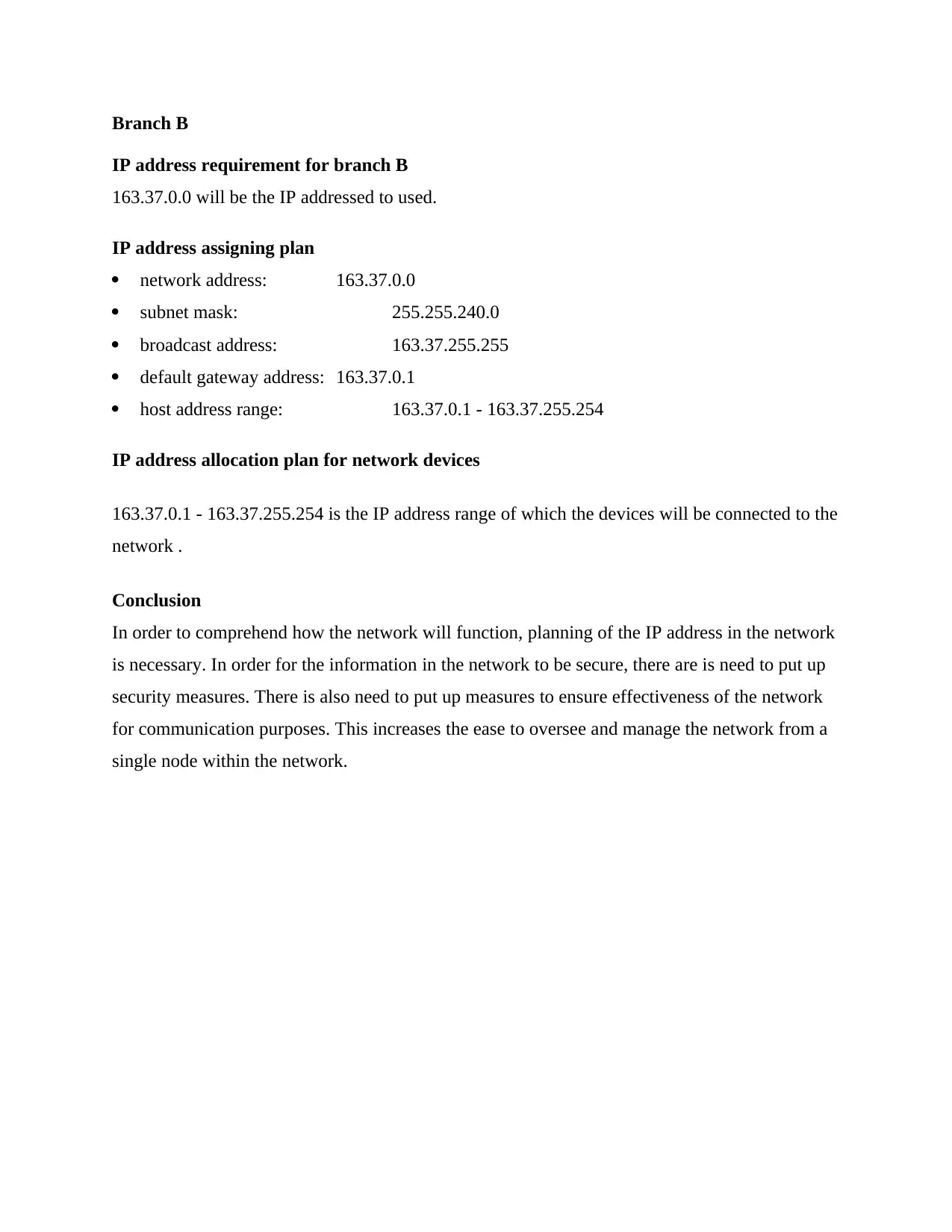
Branch B
IP address requirement for branch B
163.37.0.0 will be the IP addressed to used.
IP address assigning plan
network address: 163.37.0.0
subnet mask: 255.255.240.0
broadcast address: 163.37.255.255
default gateway address: 163.37.0.1
host address range: 163.37.0.1 - 163.37.255.254
IP address allocation plan for network devices
163.37.0.1 - 163.37.255.254 is the IP address range of which the devices will be connected to the
network .
Conclusion
In order to comprehend how the network will function, planning of the IP address in the network
is necessary. In order for the information in the network to be secure, there are is need to put up
security measures. There is also need to put up measures to ensure effectiveness of the network
for communication purposes. This increases the ease to oversee and manage the network from a
single node within the network.
IP address requirement for branch B
163.37.0.0 will be the IP addressed to used.
IP address assigning plan
network address: 163.37.0.0
subnet mask: 255.255.240.0
broadcast address: 163.37.255.255
default gateway address: 163.37.0.1
host address range: 163.37.0.1 - 163.37.255.254
IP address allocation plan for network devices
163.37.0.1 - 163.37.255.254 is the IP address range of which the devices will be connected to the
network .
Conclusion
In order to comprehend how the network will function, planning of the IP address in the network
is necessary. In order for the information in the network to be secure, there are is need to put up
security measures. There is also need to put up measures to ensure effectiveness of the network
for communication purposes. This increases the ease to oversee and manage the network from a
single node within the network.

References
Baccelli, E., & Townsley, M. (2010). IP addressing model in ad hoc networks (No. RFC 5889).
Basak, D., Toshniwal, R., Maskalik, S., & Sequeira, A. (2010). Virtualizing networking and
security in the cloud. ACM SIGOPS Operating Systems Review, 44(4), 86-94.
Bell, J. A., & Britton, E. G. (2009). U.S. Patent No. 5,923,854. Washington, DC: U.S. Patent and
Trademark Office.
Liu, C., Andrews, M. B., & Iyer, P. (2009). U.S. Patent No. 7,616,597. Washington, DC: U.S.
Patent and Trademark Office.
Xia, W., Wen, Y., Foh, C. H., Niyato, D., & Xie, H. (2015). A survey on software-defined
networking. IEEE Communications Surveys & Tutorials, 17(1), 27-51.
Yalagandula, P., & Mudigonda, J. (2012). U.S. Patent No. 8,175,107. Washington, DC: U.S.
Patent and Trademark Office.
Baccelli, E., & Townsley, M. (2010). IP addressing model in ad hoc networks (No. RFC 5889).
Basak, D., Toshniwal, R., Maskalik, S., & Sequeira, A. (2010). Virtualizing networking and
security in the cloud. ACM SIGOPS Operating Systems Review, 44(4), 86-94.
Bell, J. A., & Britton, E. G. (2009). U.S. Patent No. 5,923,854. Washington, DC: U.S. Patent and
Trademark Office.
Liu, C., Andrews, M. B., & Iyer, P. (2009). U.S. Patent No. 7,616,597. Washington, DC: U.S.
Patent and Trademark Office.
Xia, W., Wen, Y., Foh, C. H., Niyato, D., & Xie, H. (2015). A survey on software-defined
networking. IEEE Communications Surveys & Tutorials, 17(1), 27-51.
Yalagandula, P., & Mudigonda, J. (2012). U.S. Patent No. 8,175,107. Washington, DC: U.S.
Patent and Trademark Office.
⊘ This is a preview!⊘
Do you want full access?
Subscribe today to unlock all pages.
Trusted by 1+ million students worldwide

1 out of 12


Related Documents


Your All-in-One AI-Powered Toolkit for Academic Success.
+13062052269
info@desklib.com
Available 24*7 on WhatsApp / Email
![[object Object]](/_next/static/media/star-bottom.7253800d.svg)
Unlock your academic potential
Copyright © 2020–2026 A2Z Services. All Rights Reserved. Developed and managed by ZUCOL.