CPPDSM4028A & CPPDSM4057A: Real Estate Risk and Safety Analysis
VerifiedAdded on 2020/07/22
|34
|10196
|73
Homework Assignment
AI Summary
This document presents a completed assignment focusing on the identification and analysis of risks and opportunities within the real estate industry, specifically addressing the units CPPDSM4028A and CPPDSM4057A. The assignment covers key aspects such as collecting and assessing information on potential risks and opportunities, determining terms of reference, and developing structured plans for risk assessment. It also includes the analysis of identified risks and opportunities, developing assessment criteria, and documenting findings. Furthermore, the assignment addresses monitoring a safe workplace, providing information on safety policies and procedures, implementing consultative processes, and implementing hazard and risk control procedures. The document emphasizes the importance of OHS training and support within the real estate context, ensuring compliance with legislative and organizational requirements. This assessment requires students to demonstrate their understanding of risk management and workplace safety in the property sector.
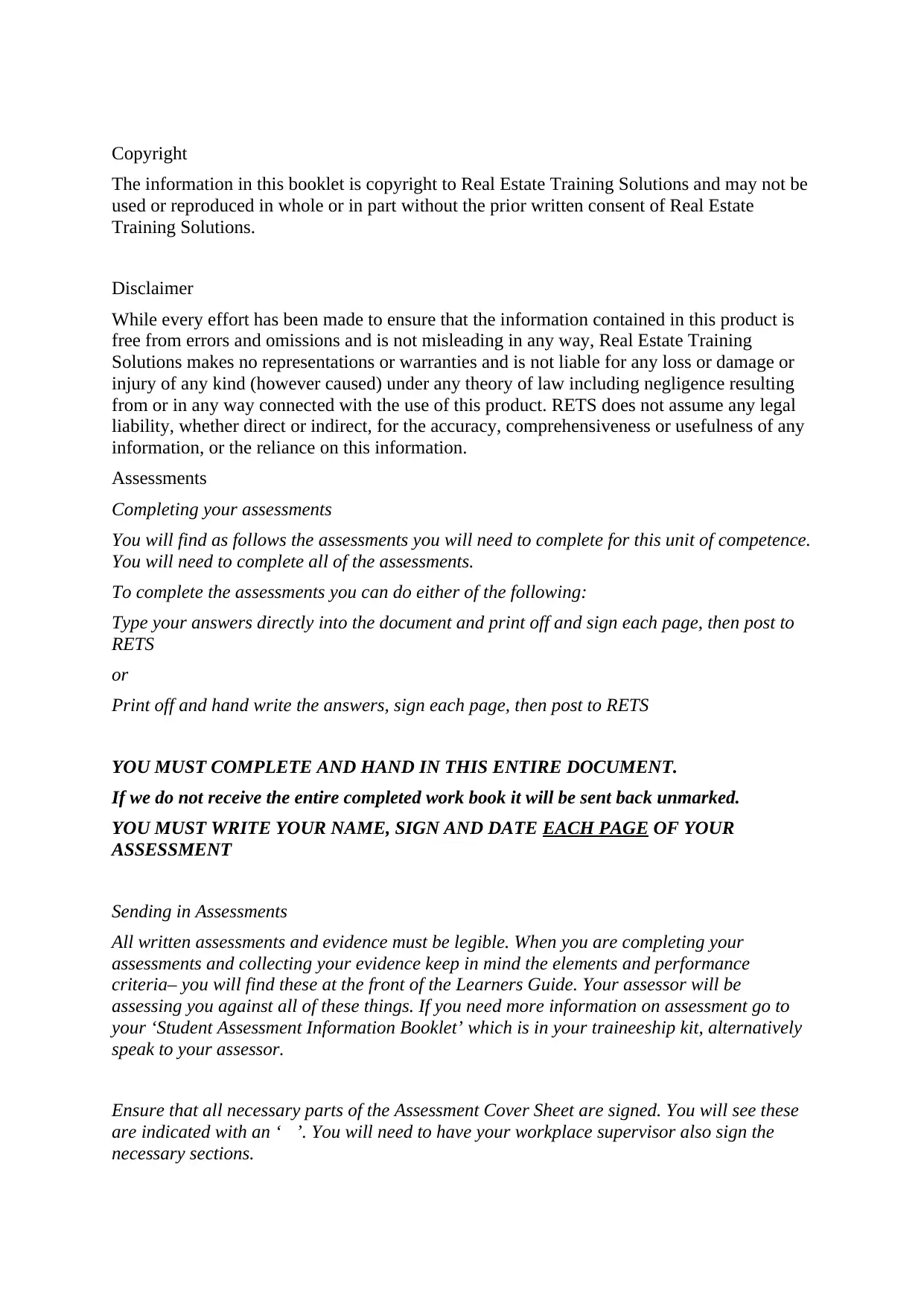
Copyright
The information in this booklet is copyright to Real Estate Training Solutions and may not be
used or reproduced in whole or in part without the prior written consent of Real Estate
Training Solutions.
Disclaimer
While every effort has been made to ensure that the information contained in this product is
free from errors and omissions and is not misleading in any way, Real Estate Training
Solutions makes no representations or warranties and is not liable for any loss or damage or
injury of any kind (however caused) under any theory of law including negligence resulting
from or in any way connected with the use of this product. RETS does not assume any legal
liability, whether direct or indirect, for the accuracy, comprehensiveness or usefulness of any
information, or the reliance on this information.
Assessments
Completing your assessments
You will find as follows the assessments you will need to complete for this unit of competence.
You will need to complete all of the assessments.
To complete the assessments you can do either of the following:
Type your answers directly into the document and print off and sign each page, then post to
RETS
or
Print off and hand write the answers, sign each page, then post to RETS
YOU MUST COMPLETE AND HAND IN THIS ENTIRE DOCUMENT.
If we do not receive the entire completed work book it will be sent back unmarked.
YOU MUST WRITE YOUR NAME, SIGN AND DATE EACH PAGE OF YOUR
ASSESSMENT
Sending in Assessments
All written assessments and evidence must be legible. When you are completing your
assessments and collecting your evidence keep in mind the elements and performance
criteria– you will find these at the front of the Learners Guide. Your assessor will be
assessing you against all of these things. If you need more information on assessment go to
your ‘Student Assessment Information Booklet’ which is in your traineeship kit, alternatively
speak to your assessor.
Ensure that all necessary parts of the Assessment Cover Sheet are signed. You will see these
are indicated with an ‘’. You will need to have your workplace supervisor also sign the
necessary sections.
The information in this booklet is copyright to Real Estate Training Solutions and may not be
used or reproduced in whole or in part without the prior written consent of Real Estate
Training Solutions.
Disclaimer
While every effort has been made to ensure that the information contained in this product is
free from errors and omissions and is not misleading in any way, Real Estate Training
Solutions makes no representations or warranties and is not liable for any loss or damage or
injury of any kind (however caused) under any theory of law including negligence resulting
from or in any way connected with the use of this product. RETS does not assume any legal
liability, whether direct or indirect, for the accuracy, comprehensiveness or usefulness of any
information, or the reliance on this information.
Assessments
Completing your assessments
You will find as follows the assessments you will need to complete for this unit of competence.
You will need to complete all of the assessments.
To complete the assessments you can do either of the following:
Type your answers directly into the document and print off and sign each page, then post to
RETS
or
Print off and hand write the answers, sign each page, then post to RETS
YOU MUST COMPLETE AND HAND IN THIS ENTIRE DOCUMENT.
If we do not receive the entire completed work book it will be sent back unmarked.
YOU MUST WRITE YOUR NAME, SIGN AND DATE EACH PAGE OF YOUR
ASSESSMENT
Sending in Assessments
All written assessments and evidence must be legible. When you are completing your
assessments and collecting your evidence keep in mind the elements and performance
criteria– you will find these at the front of the Learners Guide. Your assessor will be
assessing you against all of these things. If you need more information on assessment go to
your ‘Student Assessment Information Booklet’ which is in your traineeship kit, alternatively
speak to your assessor.
Ensure that all necessary parts of the Assessment Cover Sheet are signed. You will see these
are indicated with an ‘’. You will need to have your workplace supervisor also sign the
necessary sections.

Paraphrase This Document
Need a fresh take? Get an instant paraphrase of this document with our AI Paraphraser
Remember: if you are posting your assessments and evidence always keep a copy or scan of
all of your work. RETS is not responsible for any material that is lost in the post or does
not reach our office.
Identifying what you have already done
Before you begin, look through this guide carefully to get an idea of the topics covered. You
may have already developed some of the skills and knowledge covered in this unit of
competency, through your work or in a previous learning program.
If you can demonstrate that you already have the skills and knowledge required to complete
this unit of competency, you may not need to undertake all of the learning. You may be able
to have your prior learning recognised through a process called Recognition of Prior Learning
(RPL) or Recognition of Current Competency (RCC). If you think you may be eligible for
RPL or RCC, try to find as much evidence as you can to show that you have the particular
skills and knowledge relevant to this unit of competency.
Evidence to show your skills and knowledge may include:
qualification documents
evidence of employment, for example, pay slips, position description
work references
work samples, for example, letters, memos
other training, for example, on the job training, computer training, and communication skills
workshops
If you feel you may be eligible for RPL speak to your tutor
all of your work. RETS is not responsible for any material that is lost in the post or does
not reach our office.
Identifying what you have already done
Before you begin, look through this guide carefully to get an idea of the topics covered. You
may have already developed some of the skills and knowledge covered in this unit of
competency, through your work or in a previous learning program.
If you can demonstrate that you already have the skills and knowledge required to complete
this unit of competency, you may not need to undertake all of the learning. You may be able
to have your prior learning recognised through a process called Recognition of Prior Learning
(RPL) or Recognition of Current Competency (RCC). If you think you may be eligible for
RPL or RCC, try to find as much evidence as you can to show that you have the particular
skills and knowledge relevant to this unit of competency.
Evidence to show your skills and knowledge may include:
qualification documents
evidence of employment, for example, pay slips, position description
work references
work samples, for example, letters, memos
other training, for example, on the job training, computer training, and communication skills
workshops
If you feel you may be eligible for RPL speak to your tutor
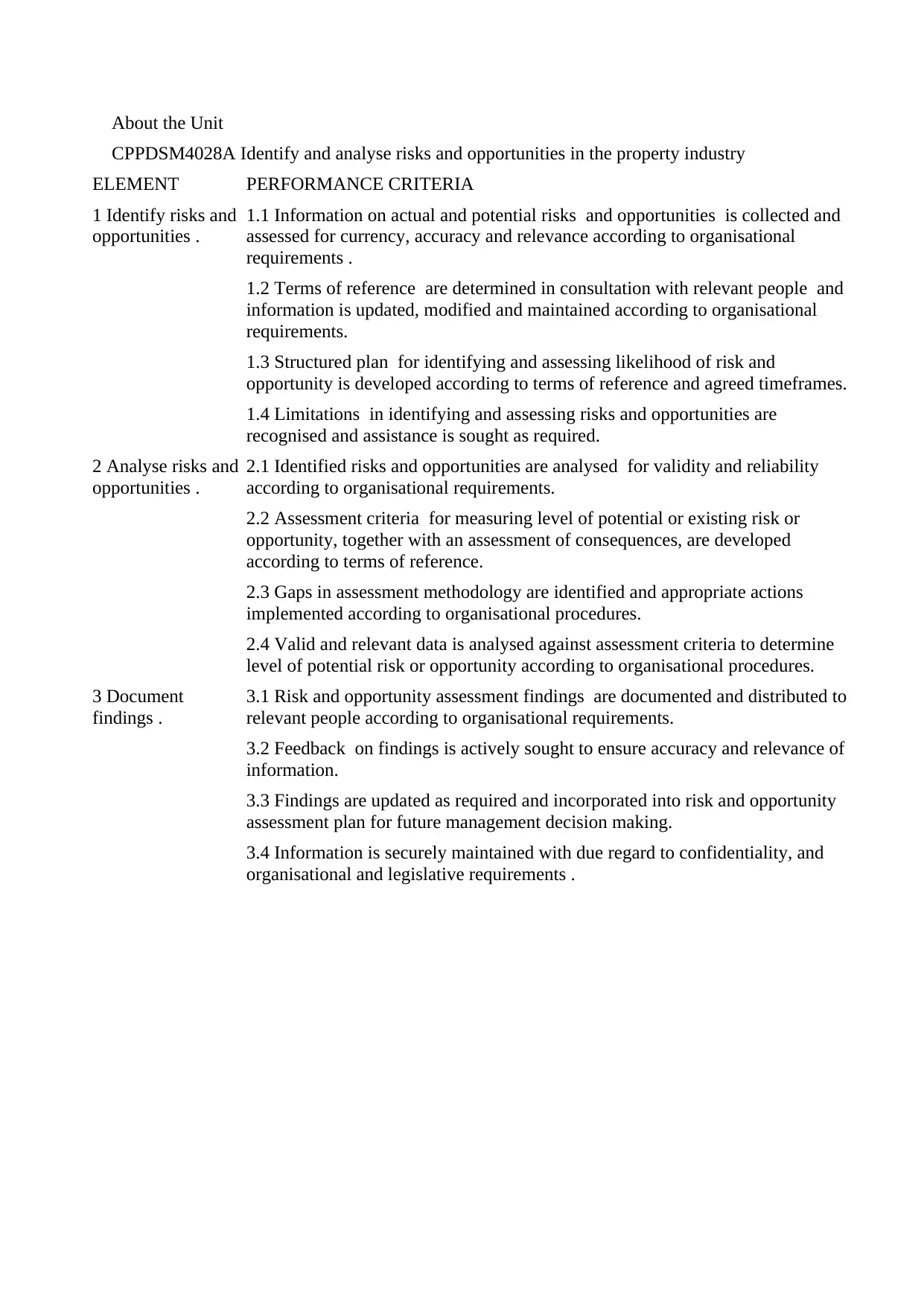
About the Unit
CPPDSM4028A Identify and analyse risks and opportunities in the property industry
ELEMENT PERFORMANCE CRITERIA
1 Identify risks and
opportunities .
1.1 Information on actual and potential risks and opportunities is collected and
assessed for currency, accuracy and relevance according to organisational
requirements .
1.2 Terms of reference are determined in consultation with relevant people and
information is updated, modified and maintained according to organisational
requirements.
1.3 Structured plan for identifying and assessing likelihood of risk and
opportunity is developed according to terms of reference and agreed timeframes.
1.4 Limitations in identifying and assessing risks and opportunities are
recognised and assistance is sought as required.
2 Analyse risks and
opportunities .
2.1 Identified risks and opportunities are analysed for validity and reliability
according to organisational requirements.
2.2 Assessment criteria for measuring level of potential or existing risk or
opportunity, together with an assessment of consequences, are developed
according to terms of reference.
2.3 Gaps in assessment methodology are identified and appropriate actions
implemented according to organisational procedures.
2.4 Valid and relevant data is analysed against assessment criteria to determine
level of potential risk or opportunity according to organisational procedures.
3 Document
findings .
3.1 Risk and opportunity assessment findings are documented and distributed to
relevant people according to organisational requirements.
3.2 Feedback on findings is actively sought to ensure accuracy and relevance of
information.
3.3 Findings are updated as required and incorporated into risk and opportunity
assessment plan for future management decision making.
3.4 Information is securely maintained with due regard to confidentiality, and
organisational and legislative requirements .
CPPDSM4028A Identify and analyse risks and opportunities in the property industry
ELEMENT PERFORMANCE CRITERIA
1 Identify risks and
opportunities .
1.1 Information on actual and potential risks and opportunities is collected and
assessed for currency, accuracy and relevance according to organisational
requirements .
1.2 Terms of reference are determined in consultation with relevant people and
information is updated, modified and maintained according to organisational
requirements.
1.3 Structured plan for identifying and assessing likelihood of risk and
opportunity is developed according to terms of reference and agreed timeframes.
1.4 Limitations in identifying and assessing risks and opportunities are
recognised and assistance is sought as required.
2 Analyse risks and
opportunities .
2.1 Identified risks and opportunities are analysed for validity and reliability
according to organisational requirements.
2.2 Assessment criteria for measuring level of potential or existing risk or
opportunity, together with an assessment of consequences, are developed
according to terms of reference.
2.3 Gaps in assessment methodology are identified and appropriate actions
implemented according to organisational procedures.
2.4 Valid and relevant data is analysed against assessment criteria to determine
level of potential risk or opportunity according to organisational procedures.
3 Document
findings .
3.1 Risk and opportunity assessment findings are documented and distributed to
relevant people according to organisational requirements.
3.2 Feedback on findings is actively sought to ensure accuracy and relevance of
information.
3.3 Findings are updated as required and incorporated into risk and opportunity
assessment plan for future management decision making.
3.4 Information is securely maintained with due regard to confidentiality, and
organisational and legislative requirements .
⊘ This is a preview!⊘
Do you want full access?
Subscribe today to unlock all pages.

Trusted by 1+ million students worldwide
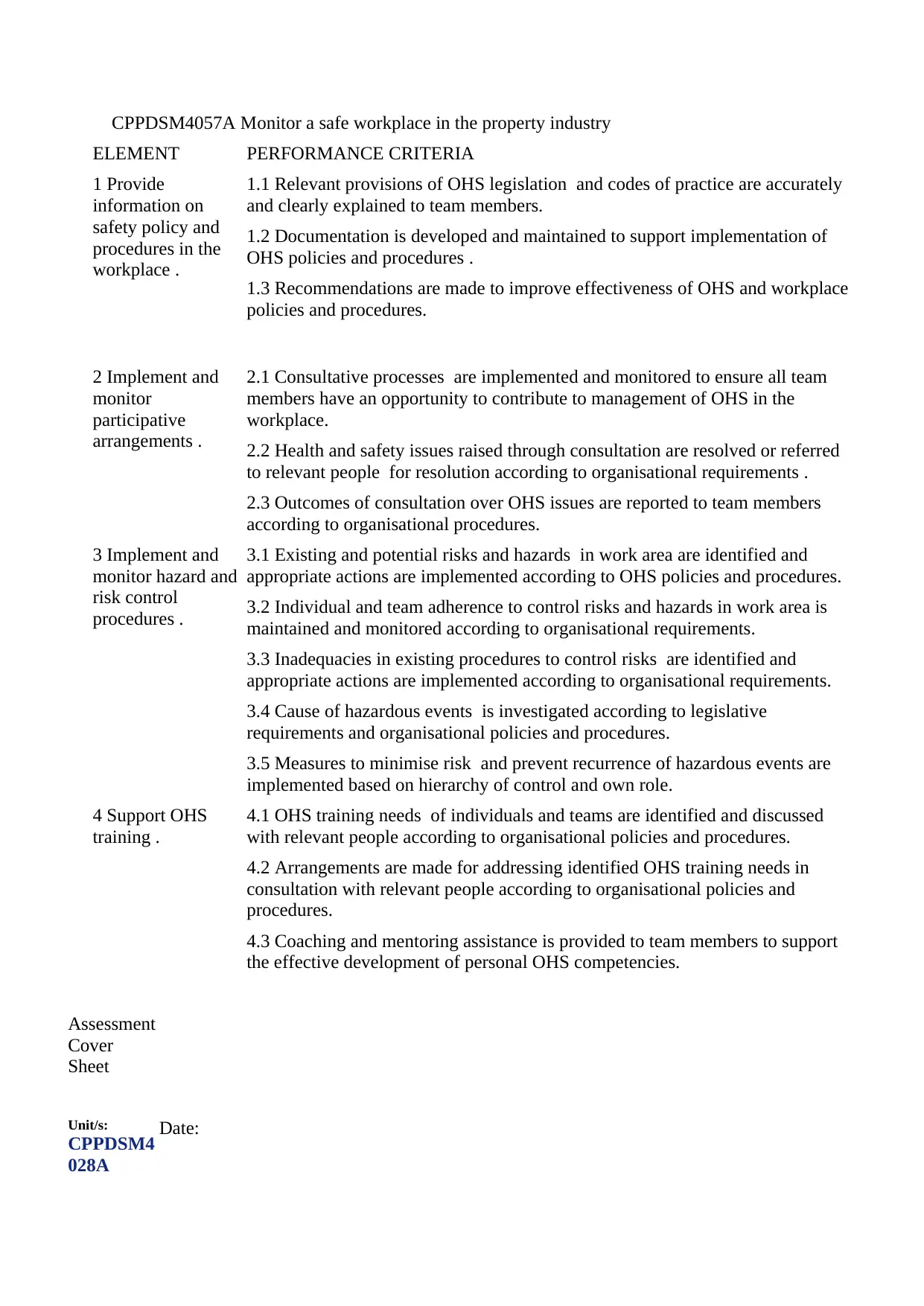
CPPDSM4057A Monitor a safe workplace in the property industry
ELEMENT PERFORMANCE CRITERIA
1 Provide
information on
safety policy and
procedures in the
workplace .
1.1 Relevant provisions of OHS legislation and codes of practice are accurately
and clearly explained to team members.
1.2 Documentation is developed and maintained to support implementation of
OHS policies and procedures .
1.3 Recommendations are made to improve effectiveness of OHS and workplace
policies and procedures.
2 Implement and
monitor
participative
arrangements .
2.1 Consultative processes are implemented and monitored to ensure all team
members have an opportunity to contribute to management of OHS in the
workplace.
2.2 Health and safety issues raised through consultation are resolved or referred
to relevant people for resolution according to organisational requirements .
2.3 Outcomes of consultation over OHS issues are reported to team members
according to organisational procedures.
3 Implement and
monitor hazard and
risk control
procedures .
3.1 Existing and potential risks and hazards in work area are identified and
appropriate actions are implemented according to OHS policies and procedures.
3.2 Individual and team adherence to control risks and hazards in work area is
maintained and monitored according to organisational requirements.
3.3 Inadequacies in existing procedures to control risks are identified and
appropriate actions are implemented according to organisational requirements.
3.4 Cause of hazardous events is investigated according to legislative
requirements and organisational policies and procedures.
3.5 Measures to minimise risk and prevent recurrence of hazardous events are
implemented based on hierarchy of control and own role.
4 Support OHS
training .
4.1 OHS training needs of individuals and teams are identified and discussed
with relevant people according to organisational policies and procedures.
4.2 Arrangements are made for addressing identified OHS training needs in
consultation with relevant people according to organisational policies and
procedures.
4.3 Coaching and mentoring assistance is provided to team members to support
the effective development of personal OHS competencies.
Assessment
Cover
Sheet
Unit/s:
CPPDSM4
028A
Date:
ELEMENT PERFORMANCE CRITERIA
1 Provide
information on
safety policy and
procedures in the
workplace .
1.1 Relevant provisions of OHS legislation and codes of practice are accurately
and clearly explained to team members.
1.2 Documentation is developed and maintained to support implementation of
OHS policies and procedures .
1.3 Recommendations are made to improve effectiveness of OHS and workplace
policies and procedures.
2 Implement and
monitor
participative
arrangements .
2.1 Consultative processes are implemented and monitored to ensure all team
members have an opportunity to contribute to management of OHS in the
workplace.
2.2 Health and safety issues raised through consultation are resolved or referred
to relevant people for resolution according to organisational requirements .
2.3 Outcomes of consultation over OHS issues are reported to team members
according to organisational procedures.
3 Implement and
monitor hazard and
risk control
procedures .
3.1 Existing and potential risks and hazards in work area are identified and
appropriate actions are implemented according to OHS policies and procedures.
3.2 Individual and team adherence to control risks and hazards in work area is
maintained and monitored according to organisational requirements.
3.3 Inadequacies in existing procedures to control risks are identified and
appropriate actions are implemented according to organisational requirements.
3.4 Cause of hazardous events is investigated according to legislative
requirements and organisational policies and procedures.
3.5 Measures to minimise risk and prevent recurrence of hazardous events are
implemented based on hierarchy of control and own role.
4 Support OHS
training .
4.1 OHS training needs of individuals and teams are identified and discussed
with relevant people according to organisational policies and procedures.
4.2 Arrangements are made for addressing identified OHS training needs in
consultation with relevant people according to organisational policies and
procedures.
4.3 Coaching and mentoring assistance is provided to team members to support
the effective development of personal OHS competencies.
Assessment
Cover
Sheet
Unit/s:
CPPDSM4
028A
Date:
Paraphrase This Document
Need a fresh take? Get an instant paraphrase of this document with our AI Paraphraser

Identify
and
analyse
risks and
opportuniti
es in the
property
industry
CPPDSM4
057A
Monitor a
safe
workplace
in the
property
industry
TO BE
COMPLET
ED BY
ALL
STUDENT
S:
Participant’s
Declaration:
I declare
that the
material
enclosed in
this
Assessment
is my own
work.
I have
reviewed
the
assessment
for this unit
of
competence
and believe
that I have
satisfactoril
y met the
requirement
s for
competence
Supervisor’
s
Declaration
:
To the best
of my
knowledge
I verify that
the material
provided in
the attached
Assessment
Task is the
original
work of the
trainee.
and
analyse
risks and
opportuniti
es in the
property
industry
CPPDSM4
057A
Monitor a
safe
workplace
in the
property
industry
TO BE
COMPLET
ED BY
ALL
STUDENT
S:
Participant’s
Declaration:
I declare
that the
material
enclosed in
this
Assessment
is my own
work.
I have
reviewed
the
assessment
for this unit
of
competence
and believe
that I have
satisfactoril
y met the
requirement
s for
competence
Supervisor’
s
Declaration
:
To the best
of my
knowledge
I verify that
the material
provided in
the attached
Assessment
Task is the
original
work of the
trainee.

.
Student’s
Signature: Date: Supervisor’s Signature:
TO BE
COMPLET
ED BY
ALL
TRAINEES
:
Trainee
Declaration
In
accordance
with my
training
plan I
acknowledg
e that I
have been
released
from my
duties to
work on my
training/lear
ning/assess
ment
activities
for this unit
of
competency
for a
minimum
of 3 hours
per week
averaged
over a four
week cycle
Supervisor’
s
Declaration
:
In
accordance
with my
employees
training
plan I
acknowledg
e that I
have
released
this
employee
from their
duties to
work on
their
training/lear
ning/assess
ment
activities
for this unit
of
competency
for a
minimum
of 3 hours
per week
averaged
over a four
week cycle
Student’s Date: Supervisor’s Signature:
Student’s
Signature: Date: Supervisor’s Signature:
TO BE
COMPLET
ED BY
ALL
TRAINEES
:
Trainee
Declaration
In
accordance
with my
training
plan I
acknowledg
e that I
have been
released
from my
duties to
work on my
training/lear
ning/assess
ment
activities
for this unit
of
competency
for a
minimum
of 3 hours
per week
averaged
over a four
week cycle
Supervisor’
s
Declaration
:
In
accordance
with my
employees
training
plan I
acknowledg
e that I
have
released
this
employee
from their
duties to
work on
their
training/lear
ning/assess
ment
activities
for this unit
of
competency
for a
minimum
of 3 hours
per week
averaged
over a four
week cycle
Student’s Date: Supervisor’s Signature:
⊘ This is a preview!⊘
Do you want full access?
Subscribe today to unlock all pages.
Trusted by 1+ million students worldwide

Signature:
Supervisors of
Trainees must
complete this
section
Please refer
to and use
the students
training
plan in
conjunction
with this
document.
The
trainees
designated
supervisor
is to print
their name,
sign and
date at the
below if
they
consider the
trainee is
competent
in this unit.
RETS
cannot
confirm
competency
of a trainee
until the
supervisor
agrees that
competency
in the
workplace
in this unit
has been
demonstrate
d. If this is
not filled in
the
assessment
will be
automatical
Supervisors of
Trainees must
complete this
section
Please refer
to and use
the students
training
plan in
conjunction
with this
document.
The
trainees
designated
supervisor
is to print
their name,
sign and
date at the
below if
they
consider the
trainee is
competent
in this unit.
RETS
cannot
confirm
competency
of a trainee
until the
supervisor
agrees that
competency
in the
workplace
in this unit
has been
demonstrate
d. If this is
not filled in
the
assessment
will be
automatical
Paraphrase This Document
Need a fresh take? Get an instant paraphrase of this document with our AI Paraphraser
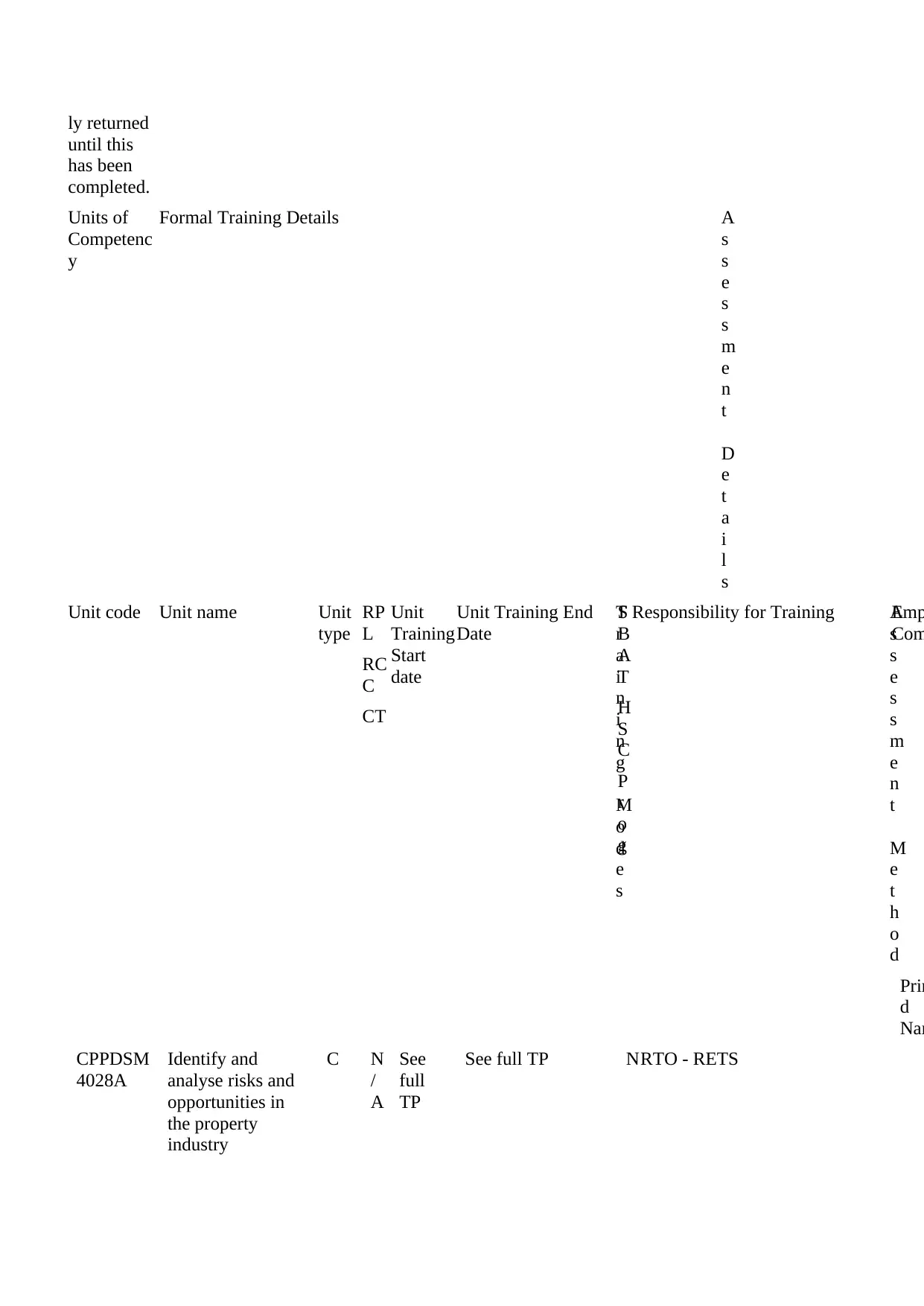
ly returned
until this
has been
completed.
Units of
Competenc
y
Formal Training Details A
s
s
e
s
s
m
e
n
t
D
e
t
a
i
l
s
Unit code Unit name Unit
type
RP
L
RC
C
CT
Unit
Training
Start
date
Unit Training End
Date
T
r
a
i
n
i
n
g
M
o
d
e
s
S
B
A
T
H
S
C
P
r
o
g
Responsibility for Training A
s
s
e
s
s
m
e
n
t
M
e
t
h
o
d
Emp
Com
Prin
d
Nam
CPPDSM
4028A
Identify and
analyse risks and
opportunities in
the property
industry
C N
/
A
See
full
TP
See full TP NRTO - RETS
until this
has been
completed.
Units of
Competenc
y
Formal Training Details A
s
s
e
s
s
m
e
n
t
D
e
t
a
i
l
s
Unit code Unit name Unit
type
RP
L
RC
C
CT
Unit
Training
Start
date
Unit Training End
Date
T
r
a
i
n
i
n
g
M
o
d
e
s
S
B
A
T
H
S
C
P
r
o
g
Responsibility for Training A
s
s
e
s
s
m
e
n
t
M
e
t
h
o
d
Emp
Com
Prin
d
Nam
CPPDSM
4028A
Identify and
analyse risks and
opportunities in
the property
industry
C N
/
A
See
full
TP
See full TP NRTO - RETS

CPPDSM
4057A
Monitor a safe
workplace in the
property industry
C N
/
A
See
full
TP
See full TP NRTO - RETS
If you are
unable to
confirm
that the
trainee is
competent
in the
workplace
at this time
please
indicate
below:
I
am unable
to
determine
trainee
competence
at this time
Signed____
_________
_________
_____
Date______
_________
_
4057A
Monitor a safe
workplace in the
property industry
C N
/
A
See
full
TP
See full TP NRTO - RETS
If you are
unable to
confirm
that the
trainee is
competent
in the
workplace
at this time
please
indicate
below:
I
am unable
to
determine
trainee
competence
at this time
Signed____
_________
_________
_____
Date______
_________
_
⊘ This is a preview!⊘
Do you want full access?
Subscribe today to unlock all pages.
Trusted by 1+ million students worldwide

Paraphrase This Document
Need a fresh take? Get an instant paraphrase of this document with our AI Paraphraser
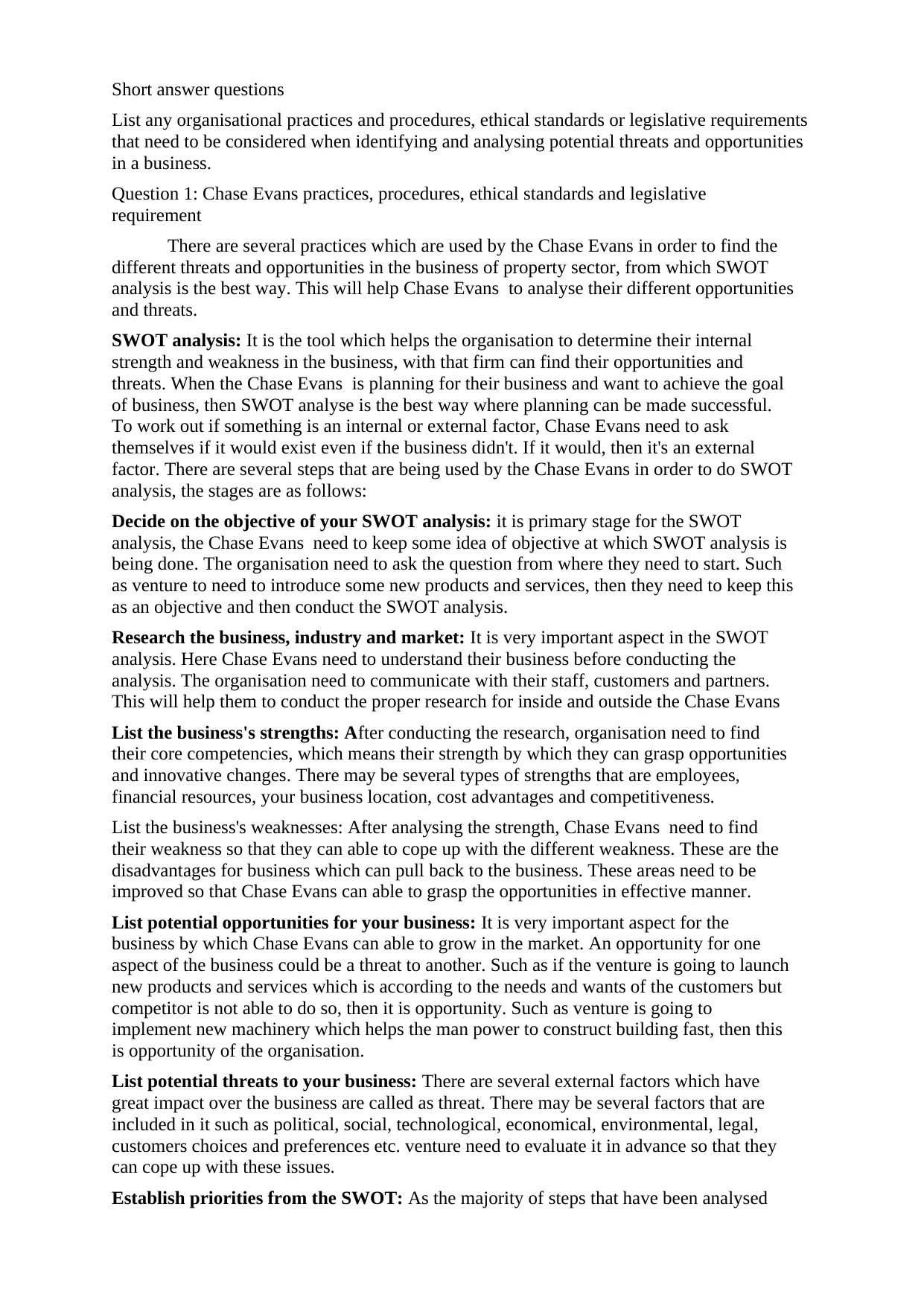
Short answer questions
List any organisational practices and procedures, ethical standards or legislative requirements
that need to be considered when identifying and analysing potential threats and opportunities
in a business.
Question 1: Chase Evans practices, procedures, ethical standards and legislative
requirement
There are several practices which are used by the Chase Evans in order to find the
different threats and opportunities in the business of property sector, from which SWOT
analysis is the best way. This will help Chase Evans to analyse their different opportunities
and threats.
SWOT analysis: It is the tool which helps the organisation to determine their internal
strength and weakness in the business, with that firm can find their opportunities and
threats. When the Chase Evans is planning for their business and want to achieve the goal
of business, then SWOT analyse is the best way where planning can be made successful.
To work out if something is an internal or external factor, Chase Evans need to ask
themselves if it would exist even if the business didn't. If it would, then it's an external
factor. There are several steps that are being used by the Chase Evans in order to do SWOT
analysis, the stages are as follows:
Decide on the objective of your SWOT analysis: it is primary stage for the SWOT
analysis, the Chase Evans need to keep some idea of objective at which SWOT analysis is
being done. The organisation need to ask the question from where they need to start. Such
as venture to need to introduce some new products and services, then they need to keep this
as an objective and then conduct the SWOT analysis.
Research the business, industry and market: It is very important aspect in the SWOT
analysis. Here Chase Evans need to understand their business before conducting the
analysis. The organisation need to communicate with their staff, customers and partners.
This will help them to conduct the proper research for inside and outside the Chase Evans
List the business's strengths: After conducting the research, organisation need to find
their core competencies, which means their strength by which they can grasp opportunities
and innovative changes. There may be several types of strengths that are employees,
financial resources, your business location, cost advantages and competitiveness.
List the business's weaknesses: After analysing the strength, Chase Evans need to find
their weakness so that they can able to cope up with the different weakness. These are the
disadvantages for business which can pull back to the business. These areas need to be
improved so that Chase Evans can able to grasp the opportunities in effective manner.
List potential opportunities for your business: It is very important aspect for the
business by which Chase Evans can able to grow in the market. An opportunity for one
aspect of the business could be a threat to another. Such as if the venture is going to launch
new products and services which is according to the needs and wants of the customers but
competitor is not able to do so, then it is opportunity. Such as venture is going to
implement new machinery which helps the man power to construct building fast, then this
is opportunity of the organisation.
List potential threats to your business: There are several external factors which have
great impact over the business are called as threat. There may be several factors that are
included in it such as political, social, technological, economical, environmental, legal,
customers choices and preferences etc. venture need to evaluate it in advance so that they
can cope up with these issues.
Establish priorities from the SWOT: As the majority of steps that have been analysed
List any organisational practices and procedures, ethical standards or legislative requirements
that need to be considered when identifying and analysing potential threats and opportunities
in a business.
Question 1: Chase Evans practices, procedures, ethical standards and legislative
requirement
There are several practices which are used by the Chase Evans in order to find the
different threats and opportunities in the business of property sector, from which SWOT
analysis is the best way. This will help Chase Evans to analyse their different opportunities
and threats.
SWOT analysis: It is the tool which helps the organisation to determine their internal
strength and weakness in the business, with that firm can find their opportunities and
threats. When the Chase Evans is planning for their business and want to achieve the goal
of business, then SWOT analyse is the best way where planning can be made successful.
To work out if something is an internal or external factor, Chase Evans need to ask
themselves if it would exist even if the business didn't. If it would, then it's an external
factor. There are several steps that are being used by the Chase Evans in order to do SWOT
analysis, the stages are as follows:
Decide on the objective of your SWOT analysis: it is primary stage for the SWOT
analysis, the Chase Evans need to keep some idea of objective at which SWOT analysis is
being done. The organisation need to ask the question from where they need to start. Such
as venture to need to introduce some new products and services, then they need to keep this
as an objective and then conduct the SWOT analysis.
Research the business, industry and market: It is very important aspect in the SWOT
analysis. Here Chase Evans need to understand their business before conducting the
analysis. The organisation need to communicate with their staff, customers and partners.
This will help them to conduct the proper research for inside and outside the Chase Evans
List the business's strengths: After conducting the research, organisation need to find
their core competencies, which means their strength by which they can grasp opportunities
and innovative changes. There may be several types of strengths that are employees,
financial resources, your business location, cost advantages and competitiveness.
List the business's weaknesses: After analysing the strength, Chase Evans need to find
their weakness so that they can able to cope up with the different weakness. These are the
disadvantages for business which can pull back to the business. These areas need to be
improved so that Chase Evans can able to grasp the opportunities in effective manner.
List potential opportunities for your business: It is very important aspect for the
business by which Chase Evans can able to grow in the market. An opportunity for one
aspect of the business could be a threat to another. Such as if the venture is going to launch
new products and services which is according to the needs and wants of the customers but
competitor is not able to do so, then it is opportunity. Such as venture is going to
implement new machinery which helps the man power to construct building fast, then this
is opportunity of the organisation.
List potential threats to your business: There are several external factors which have
great impact over the business are called as threat. There may be several factors that are
included in it such as political, social, technological, economical, environmental, legal,
customers choices and preferences etc. venture need to evaluate it in advance so that they
can cope up with these issues.
Establish priorities from the SWOT: As the majority of steps that have been analysed
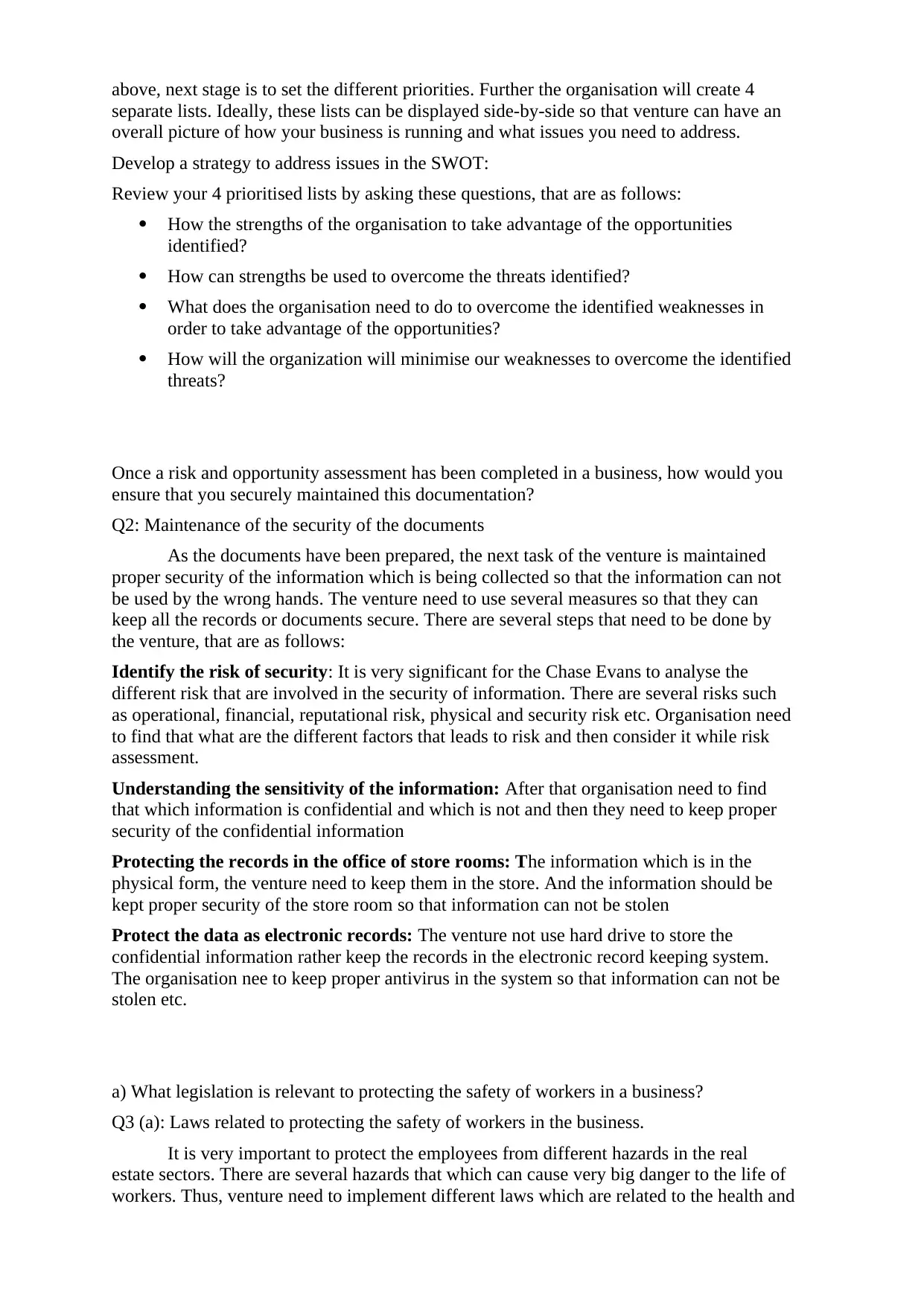
above, next stage is to set the different priorities. Further the organisation will create 4
separate lists. Ideally, these lists can be displayed side-by-side so that venture can have an
overall picture of how your business is running and what issues you need to address.
Develop a strategy to address issues in the SWOT:
Review your 4 prioritised lists by asking these questions, that are as follows:
How the strengths of the organisation to take advantage of the opportunities
identified?
How can strengths be used to overcome the threats identified?
What does the organisation need to do to overcome the identified weaknesses in
order to take advantage of the opportunities?
How will the organization will minimise our weaknesses to overcome the identified
threats?
Once a risk and opportunity assessment has been completed in a business, how would you
ensure that you securely maintained this documentation?
Q2: Maintenance of the security of the documents
As the documents have been prepared, the next task of the venture is maintained
proper security of the information which is being collected so that the information can not
be used by the wrong hands. The venture need to use several measures so that they can
keep all the records or documents secure. There are several steps that need to be done by
the venture, that are as follows:
Identify the risk of security: It is very significant for the Chase Evans to analyse the
different risk that are involved in the security of information. There are several risks such
as operational, financial, reputational risk, physical and security risk etc. Organisation need
to find that what are the different factors that leads to risk and then consider it while risk
assessment.
Understanding the sensitivity of the information: After that organisation need to find
that which information is confidential and which is not and then they need to keep proper
security of the confidential information
Protecting the records in the office of store rooms: The information which is in the
physical form, the venture need to keep them in the store. And the information should be
kept proper security of the store room so that information can not be stolen
Protect the data as electronic records: The venture not use hard drive to store the
confidential information rather keep the records in the electronic record keeping system.
The organisation nee to keep proper antivirus in the system so that information can not be
stolen etc.
a) What legislation is relevant to protecting the safety of workers in a business?
Q3 (a): Laws related to protecting the safety of workers in the business.
It is very important to protect the employees from different hazards in the real
estate sectors. There are several hazards that which can cause very big danger to the life of
workers. Thus, venture need to implement different laws which are related to the health and
separate lists. Ideally, these lists can be displayed side-by-side so that venture can have an
overall picture of how your business is running and what issues you need to address.
Develop a strategy to address issues in the SWOT:
Review your 4 prioritised lists by asking these questions, that are as follows:
How the strengths of the organisation to take advantage of the opportunities
identified?
How can strengths be used to overcome the threats identified?
What does the organisation need to do to overcome the identified weaknesses in
order to take advantage of the opportunities?
How will the organization will minimise our weaknesses to overcome the identified
threats?
Once a risk and opportunity assessment has been completed in a business, how would you
ensure that you securely maintained this documentation?
Q2: Maintenance of the security of the documents
As the documents have been prepared, the next task of the venture is maintained
proper security of the information which is being collected so that the information can not
be used by the wrong hands. The venture need to use several measures so that they can
keep all the records or documents secure. There are several steps that need to be done by
the venture, that are as follows:
Identify the risk of security: It is very significant for the Chase Evans to analyse the
different risk that are involved in the security of information. There are several risks such
as operational, financial, reputational risk, physical and security risk etc. Organisation need
to find that what are the different factors that leads to risk and then consider it while risk
assessment.
Understanding the sensitivity of the information: After that organisation need to find
that which information is confidential and which is not and then they need to keep proper
security of the confidential information
Protecting the records in the office of store rooms: The information which is in the
physical form, the venture need to keep them in the store. And the information should be
kept proper security of the store room so that information can not be stolen
Protect the data as electronic records: The venture not use hard drive to store the
confidential information rather keep the records in the electronic record keeping system.
The organisation nee to keep proper antivirus in the system so that information can not be
stolen etc.
a) What legislation is relevant to protecting the safety of workers in a business?
Q3 (a): Laws related to protecting the safety of workers in the business.
It is very important to protect the employees from different hazards in the real
estate sectors. There are several hazards that which can cause very big danger to the life of
workers. Thus, venture need to implement different laws which are related to the health and
⊘ This is a preview!⊘
Do you want full access?
Subscribe today to unlock all pages.
Trusted by 1+ million students worldwide

1 out of 34


Related Documents


Your All-in-One AI-Powered Toolkit for Academic Success.
+13062052269
info@desklib.com
Available 24*7 on WhatsApp / Email
![[object Object]](/_next/static/media/star-bottom.7253800d.svg)
Unlock your academic potential
Copyright © 2020–2026 A2Z Services. All Rights Reserved. Developed and managed by ZUCOL.