RPL in Higher Education: Analysis, Models, and Recommendations
VerifiedAdded on 2021/05/31
|16
|3409
|94
Report
AI Summary
This report on Recognition of Prior Learning (RPL) examines its key purposes, objectives, and the misconceptions surrounding it. It explores the implementation of RPL within the National Qualifications Framework (NQF), focusing on its role in enhancing skills and knowledge for employment and personal development in South Africa. The report includes a case study of a successful international RPL model and discusses both internal and external barriers to RPL implementation. It also presents a project description with factors like community development, population grouping, and processes involved. Furthermore, the report highlights the role players in RPL, including assessors, moderators, and learning institutions, and emphasizes the importance of RPL in promoting equity, inclusion, and organizational efficiency. The report concludes with a discussion of RPL processes, its benefits, and the misconceptions associated with it, offering insights into its impact on individuals and organizations. The report is a comprehensive overview of RPL, providing valuable information for higher education professionals and learners alike.
Running head: RECOGNITION OF PRIOR LEARNING
Recognition of Prior Learning
Name of the University:
Name of the Student:
Author Note:
Recognition of Prior Learning
Name of the University:
Name of the Student:
Author Note:

Paraphrase This Document
Need a fresh take? Get an instant paraphrase of this document with our AI Paraphraser
1RECOGNITION OF PRIOR LEARNING
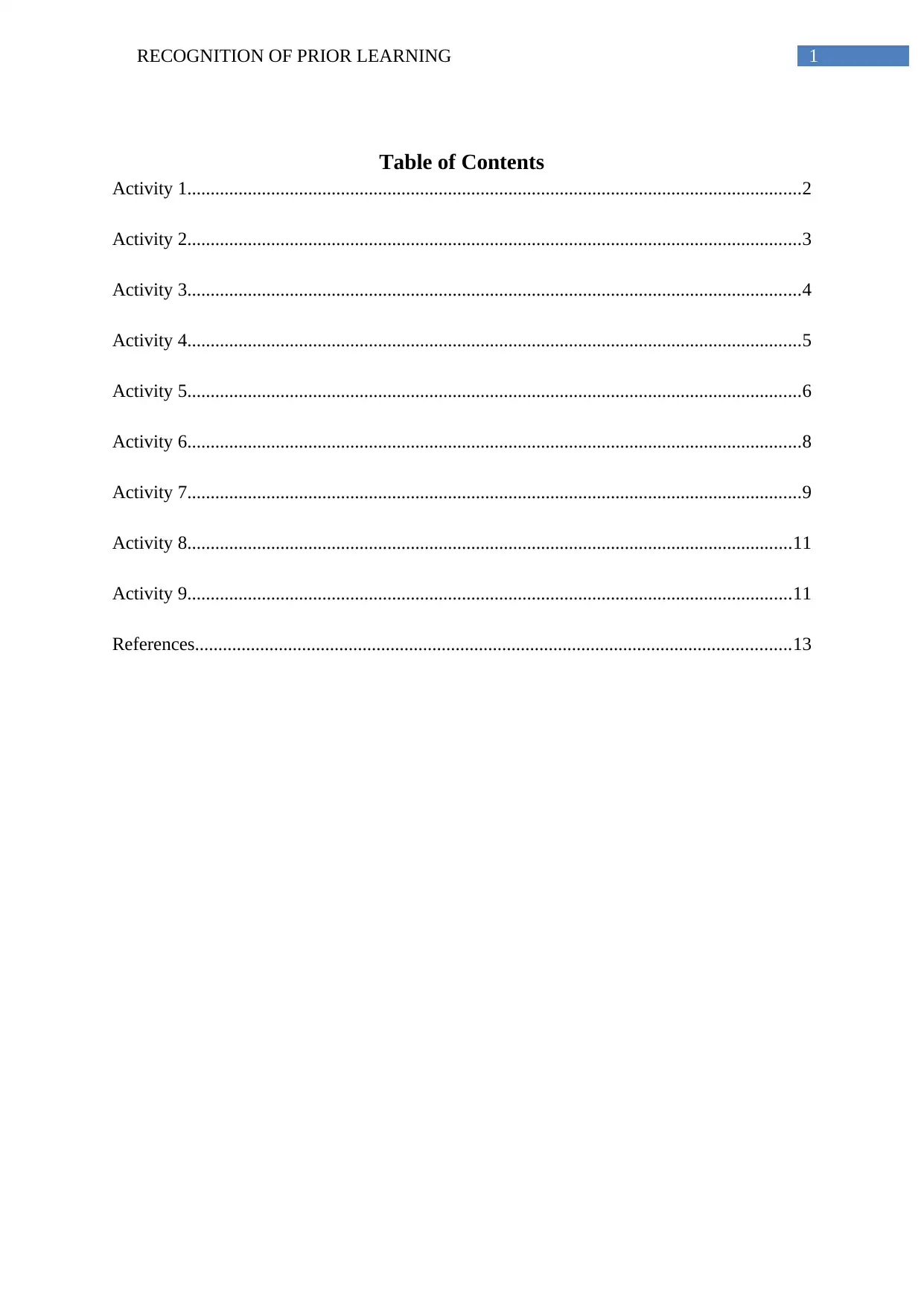
Table of Contents
Activity 1....................................................................................................................................2
Activity 2....................................................................................................................................3
Activity 3....................................................................................................................................4
Activity 4....................................................................................................................................5
Activity 5....................................................................................................................................6
Activity 6....................................................................................................................................8
Activity 7....................................................................................................................................9
Activity 8..................................................................................................................................11
Activity 9..................................................................................................................................11
References................................................................................................................................13
Table of Contents
Activity 1....................................................................................................................................2
Activity 2....................................................................................................................................3
Activity 3....................................................................................................................................4
Activity 4....................................................................................................................................5
Activity 5....................................................................................................................................6
Activity 6....................................................................................................................................8
Activity 7....................................................................................................................................9
Activity 8..................................................................................................................................11
Activity 9..................................................................................................................................11
References................................................................................................................................13
2RECOGNITION OF PRIOR LEARNING
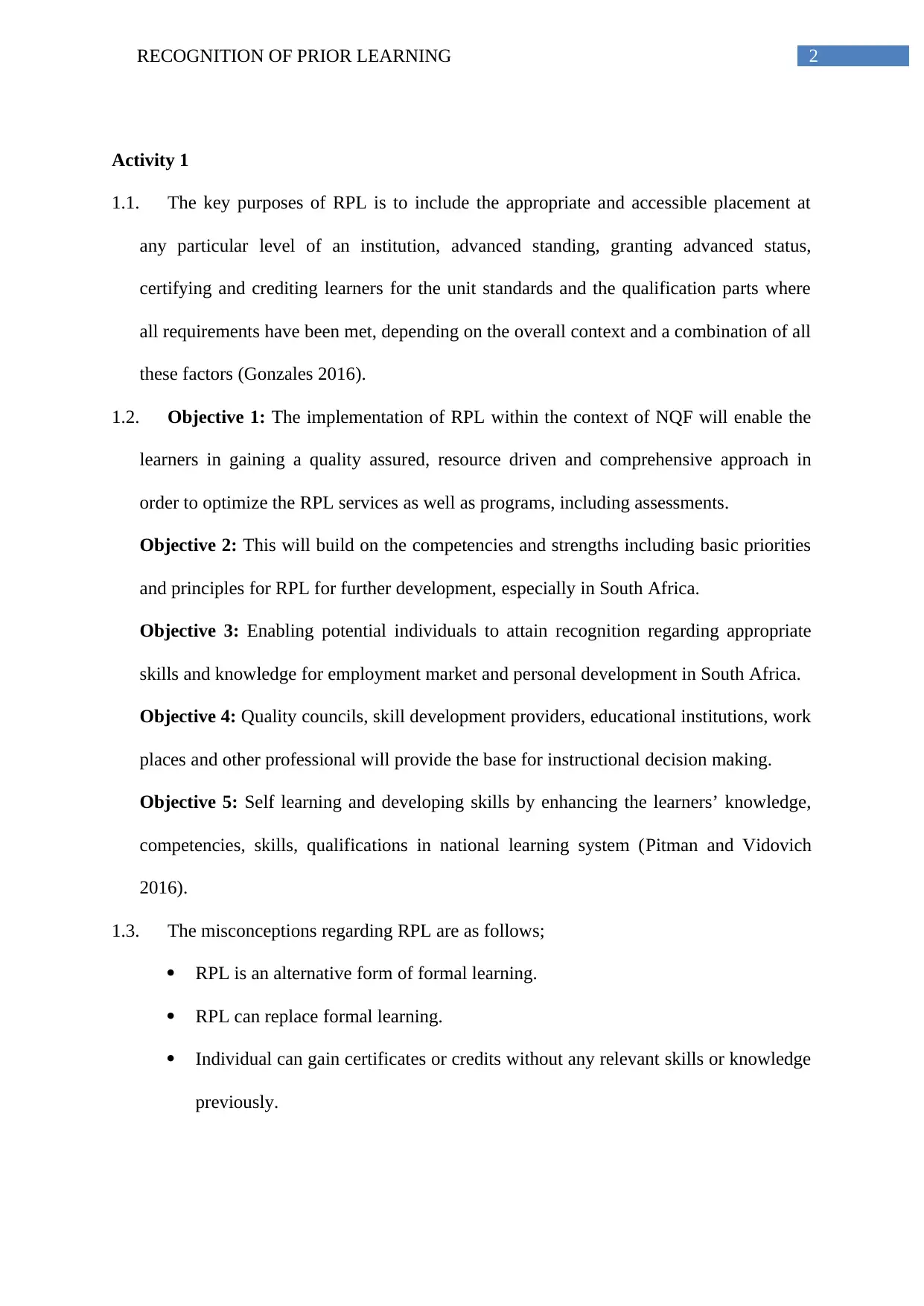
Activity 1
1.1. The key purposes of RPL is to include the appropriate and accessible placement at
any particular level of an institution, advanced standing, granting advanced status,
certifying and crediting learners for the unit standards and the qualification parts where
all requirements have been met, depending on the overall context and a combination of all
these factors (Gonzales 2016).
1.2. Objective 1: The implementation of RPL within the context of NQF will enable the
learners in gaining a quality assured, resource driven and comprehensive approach in
order to optimize the RPL services as well as programs, including assessments.
Objective 2: This will build on the competencies and strengths including basic priorities
and principles for RPL for further development, especially in South Africa.
Objective 3: Enabling potential individuals to attain recognition regarding appropriate
skills and knowledge for employment market and personal development in South Africa.
Objective 4: Quality councils, skill development providers, educational institutions, work
places and other professional will provide the base for instructional decision making.
Objective 5: Self learning and developing skills by enhancing the learners’ knowledge,
competencies, skills, qualifications in national learning system (Pitman and Vidovich
2016).
1.3. The misconceptions regarding RPL are as follows;
RPL is an alternative form of formal learning.
RPL can replace formal learning.
Individual can gain certificates or credits without any relevant skills or knowledge
previously.
Activity 1
1.1. The key purposes of RPL is to include the appropriate and accessible placement at
any particular level of an institution, advanced standing, granting advanced status,
certifying and crediting learners for the unit standards and the qualification parts where
all requirements have been met, depending on the overall context and a combination of all
these factors (Gonzales 2016).
1.2. Objective 1: The implementation of RPL within the context of NQF will enable the
learners in gaining a quality assured, resource driven and comprehensive approach in
order to optimize the RPL services as well as programs, including assessments.
Objective 2: This will build on the competencies and strengths including basic priorities
and principles for RPL for further development, especially in South Africa.
Objective 3: Enabling potential individuals to attain recognition regarding appropriate
skills and knowledge for employment market and personal development in South Africa.
Objective 4: Quality councils, skill development providers, educational institutions, work
places and other professional will provide the base for instructional decision making.
Objective 5: Self learning and developing skills by enhancing the learners’ knowledge,
competencies, skills, qualifications in national learning system (Pitman and Vidovich
2016).
1.3. The misconceptions regarding RPL are as follows;
RPL is an alternative form of formal learning.
RPL can replace formal learning.
Individual can gain certificates or credits without any relevant skills or knowledge
previously.
⊘ This is a preview!⊘
Do you want full access?
Subscribe today to unlock all pages.

Trusted by 1+ million students worldwide
3RECOGNITION OF PRIOR LEARNING
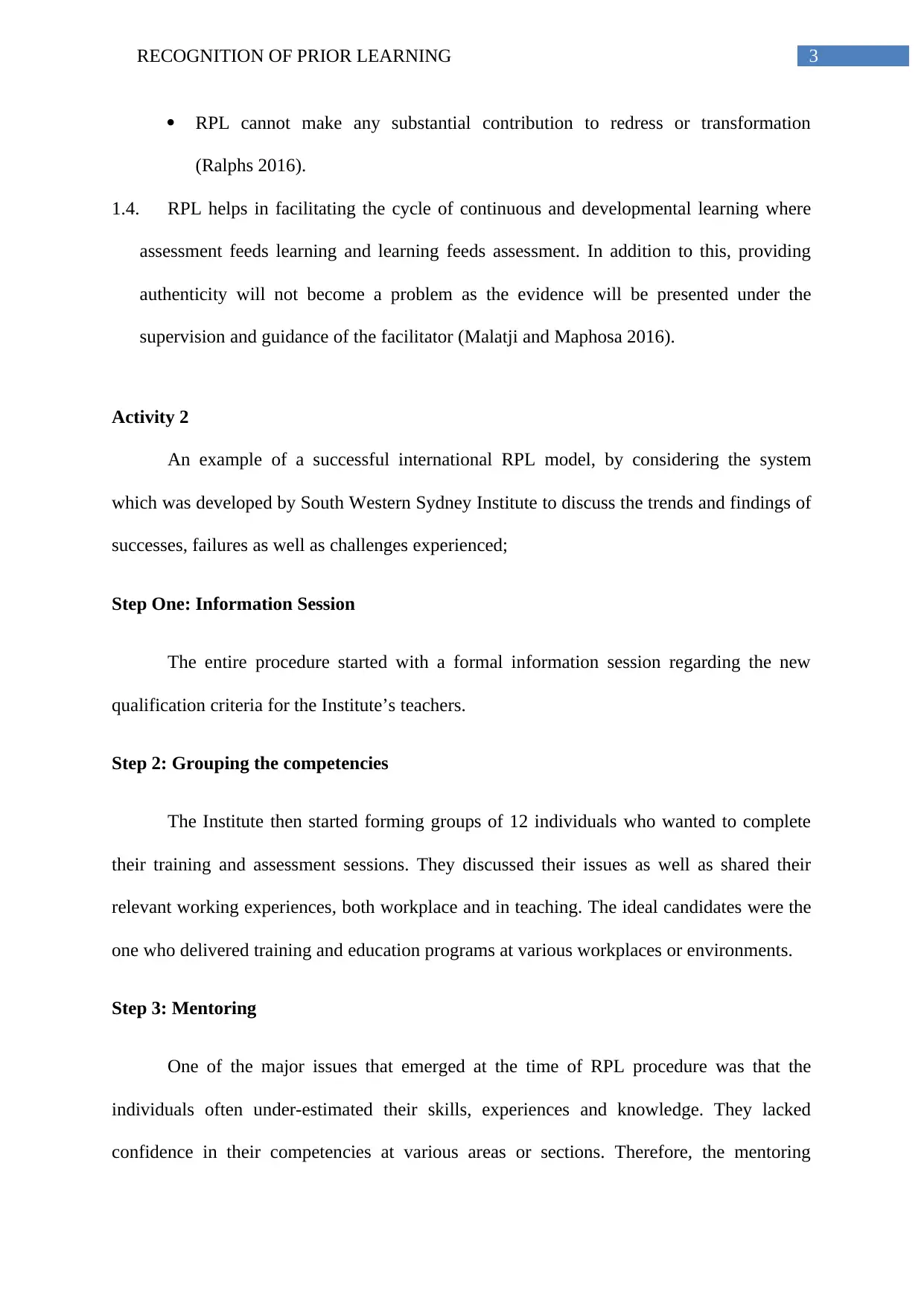
RPL cannot make any substantial contribution to redress or transformation
(Ralphs 2016).
1.4. RPL helps in facilitating the cycle of continuous and developmental learning where
assessment feeds learning and learning feeds assessment. In addition to this, providing
authenticity will not become a problem as the evidence will be presented under the
supervision and guidance of the facilitator (Malatji and Maphosa 2016).
Activity 2
An example of a successful international RPL model, by considering the system
which was developed by South Western Sydney Institute to discuss the trends and findings of
successes, failures as well as challenges experienced;
Step One: Information Session
The entire procedure started with a formal information session regarding the new
qualification criteria for the Institute’s teachers.
Step 2: Grouping the competencies
The Institute then started forming groups of 12 individuals who wanted to complete
their training and assessment sessions. They discussed their issues as well as shared their
relevant working experiences, both workplace and in teaching. The ideal candidates were the
one who delivered training and education programs at various workplaces or environments.
Step 3: Mentoring
One of the major issues that emerged at the time of RPL procedure was that the
individuals often under-estimated their skills, experiences and knowledge. They lacked
confidence in their competencies at various areas or sections. Therefore, the mentoring
RPL cannot make any substantial contribution to redress or transformation
(Ralphs 2016).
1.4. RPL helps in facilitating the cycle of continuous and developmental learning where
assessment feeds learning and learning feeds assessment. In addition to this, providing
authenticity will not become a problem as the evidence will be presented under the
supervision and guidance of the facilitator (Malatji and Maphosa 2016).
Activity 2
An example of a successful international RPL model, by considering the system
which was developed by South Western Sydney Institute to discuss the trends and findings of
successes, failures as well as challenges experienced;
Step One: Information Session
The entire procedure started with a formal information session regarding the new
qualification criteria for the Institute’s teachers.
Step 2: Grouping the competencies
The Institute then started forming groups of 12 individuals who wanted to complete
their training and assessment sessions. They discussed their issues as well as shared their
relevant working experiences, both workplace and in teaching. The ideal candidates were the
one who delivered training and education programs at various workplaces or environments.
Step 3: Mentoring
One of the major issues that emerged at the time of RPL procedure was that the
individuals often under-estimated their skills, experiences and knowledge. They lacked
confidence in their competencies at various areas or sections. Therefore, the mentoring
Paraphrase This Document
Need a fresh take? Get an instant paraphrase of this document with our AI Paraphraser
4RECOGNITION OF PRIOR LEARNING
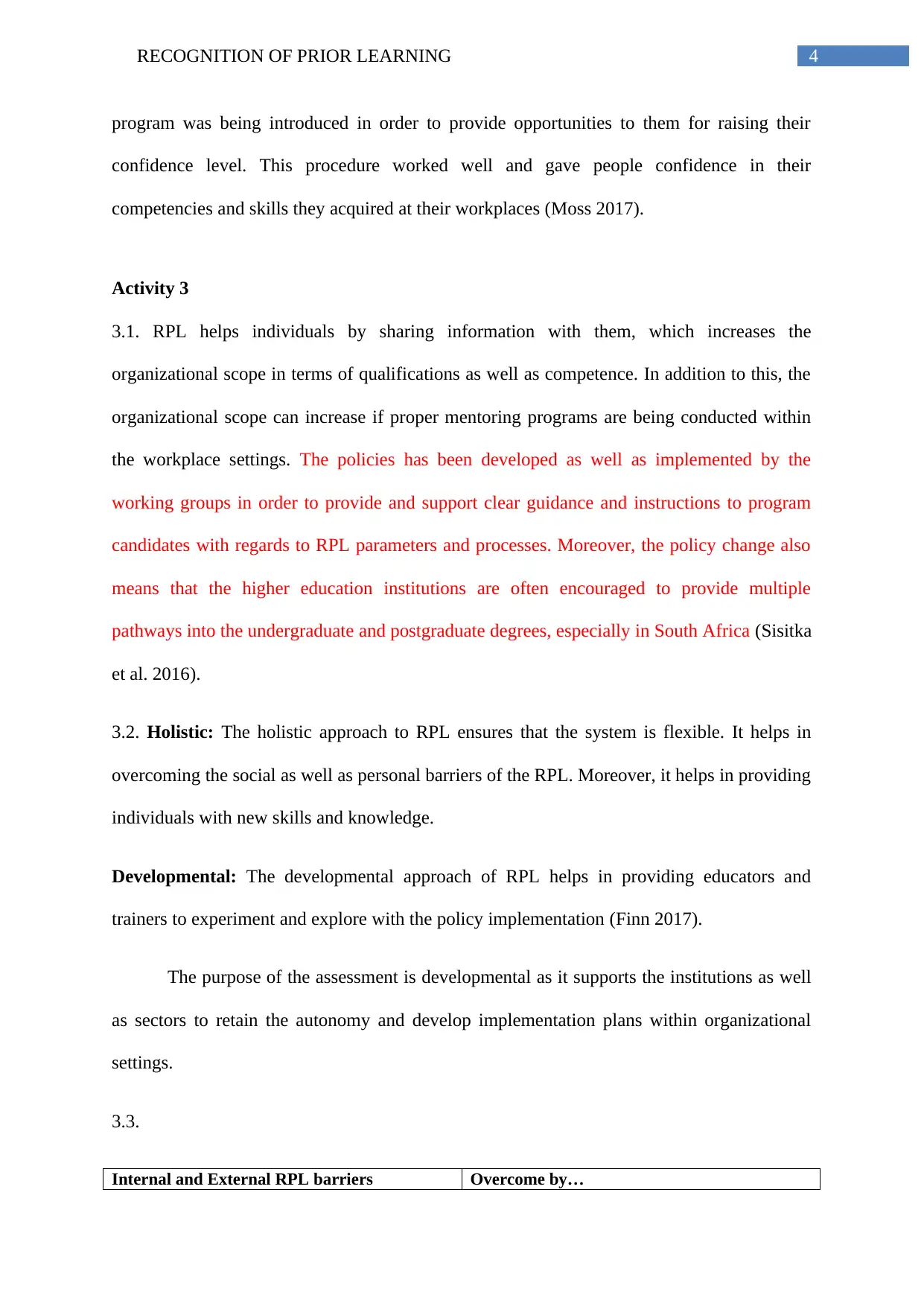
program was being introduced in order to provide opportunities to them for raising their
confidence level. This procedure worked well and gave people confidence in their
competencies and skills they acquired at their workplaces (Moss 2017).
Activity 3
3.1. RPL helps individuals by sharing information with them, which increases the
organizational scope in terms of qualifications as well as competence. In addition to this, the
organizational scope can increase if proper mentoring programs are being conducted within
the workplace settings. The policies has been developed as well as implemented by the
working groups in order to provide and support clear guidance and instructions to program
candidates with regards to RPL parameters and processes. Moreover, the policy change also
means that the higher education institutions are often encouraged to provide multiple
pathways into the undergraduate and postgraduate degrees, especially in South Africa (Sisitka
et al. 2016).
3.2. Holistic: The holistic approach to RPL ensures that the system is flexible. It helps in
overcoming the social as well as personal barriers of the RPL. Moreover, it helps in providing
individuals with new skills and knowledge.
Developmental: The developmental approach of RPL helps in providing educators and
trainers to experiment and explore with the policy implementation (Finn 2017).
The purpose of the assessment is developmental as it supports the institutions as well
as sectors to retain the autonomy and develop implementation plans within organizational
settings.
3.3.
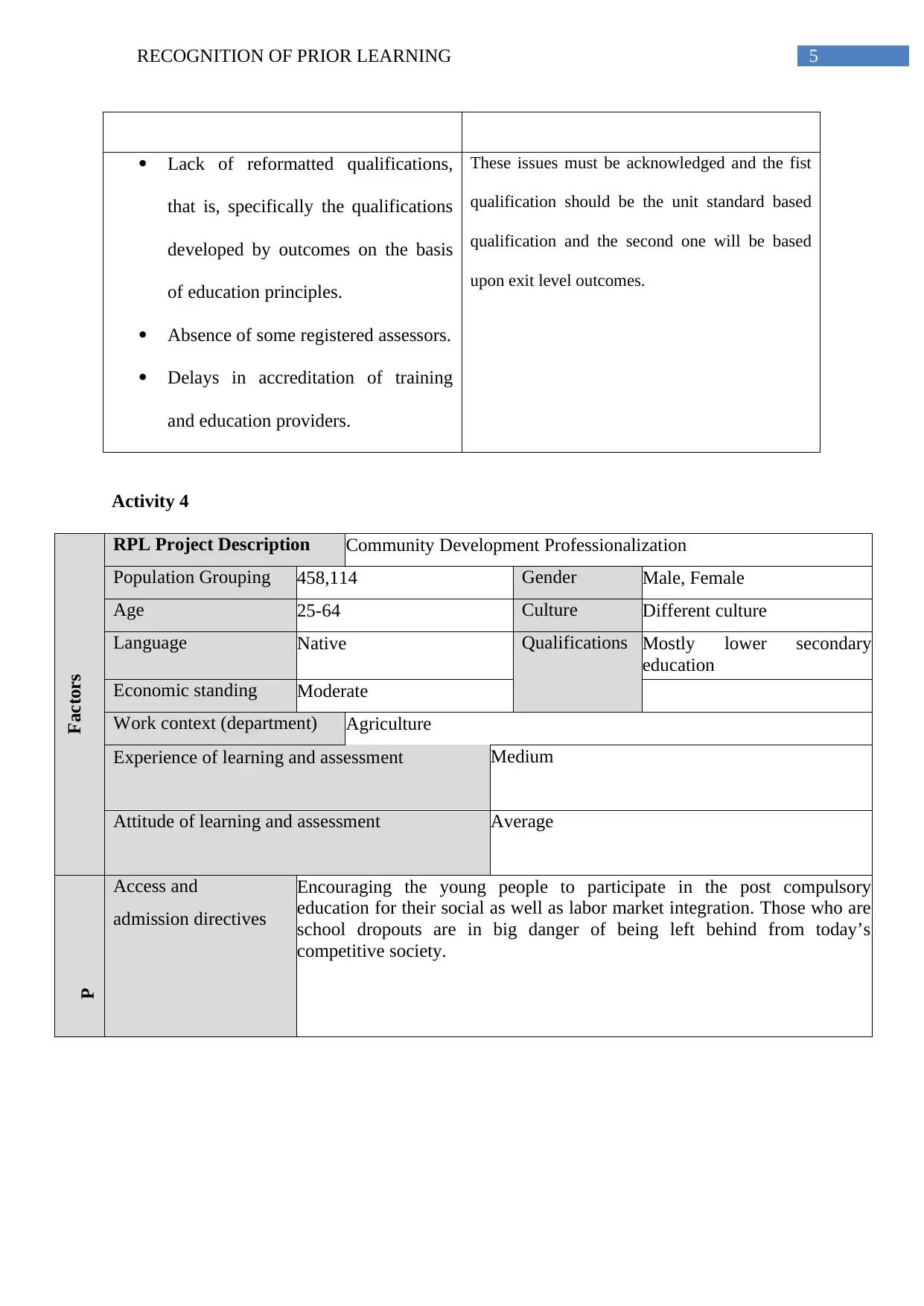
Internal and External RPL barriers Overcome by…
program was being introduced in order to provide opportunities to them for raising their
confidence level. This procedure worked well and gave people confidence in their
competencies and skills they acquired at their workplaces (Moss 2017).
Activity 3
3.1. RPL helps individuals by sharing information with them, which increases the
organizational scope in terms of qualifications as well as competence. In addition to this, the
organizational scope can increase if proper mentoring programs are being conducted within
the workplace settings. The policies has been developed as well as implemented by the
working groups in order to provide and support clear guidance and instructions to program
candidates with regards to RPL parameters and processes. Moreover, the policy change also
means that the higher education institutions are often encouraged to provide multiple
pathways into the undergraduate and postgraduate degrees, especially in South Africa (Sisitka
et al. 2016).
3.2. Holistic: The holistic approach to RPL ensures that the system is flexible. It helps in
overcoming the social as well as personal barriers of the RPL. Moreover, it helps in providing
individuals with new skills and knowledge.
Developmental: The developmental approach of RPL helps in providing educators and
trainers to experiment and explore with the policy implementation (Finn 2017).
The purpose of the assessment is developmental as it supports the institutions as well
as sectors to retain the autonomy and develop implementation plans within organizational
settings.
3.3.
Internal and External RPL barriers Overcome by…
5RECOGNITION OF PRIOR LEARNING
Lack of reformatted qualifications,
that is, specifically the qualifications
developed by outcomes on the basis
of education principles.
Absence of some registered assessors.
Delays in accreditation of training
and education providers.
These issues must be acknowledged and the fist
qualification should be the unit standard based
qualification and the second one will be based
upon exit level outcomes.
Activity 4
Factors
RPL Project Description Community Development Professionalization
Population Grouping 458,114 Gender Male, Female
Age 25-64 Culture Different culture
Language Native Qualifications Mostly lower secondary
education
Economic standing Moderate
Work context (department) Agriculture
Experience of learning and assessment Medium
Attitude of learning and assessment Average
P
Access and
admission directives
Encouraging the young people to participate in the post compulsory
education for their social as well as labor market integration. Those who are
school dropouts are in big danger of being left behind from today’s
competitive society.
Lack of reformatted qualifications,
that is, specifically the qualifications
developed by outcomes on the basis
of education principles.
Absence of some registered assessors.
Delays in accreditation of training
and education providers.
These issues must be acknowledged and the fist
qualification should be the unit standard based
qualification and the second one will be based
upon exit level outcomes.
Activity 4
Factors
RPL Project Description Community Development Professionalization
Population Grouping 458,114 Gender Male, Female
Age 25-64 Culture Different culture
Language Native Qualifications Mostly lower secondary
education
Economic standing Moderate
Work context (department) Agriculture
Experience of learning and assessment Medium
Attitude of learning and assessment Average
P
Access and
admission directives
Encouraging the young people to participate in the post compulsory
education for their social as well as labor market integration. Those who are
school dropouts are in big danger of being left behind from today’s
competitive society.
⊘ This is a preview!⊘
Do you want full access?
Subscribe today to unlock all pages.
Trusted by 1+ million students worldwide
6RECOGNITION OF PRIOR LEARNING
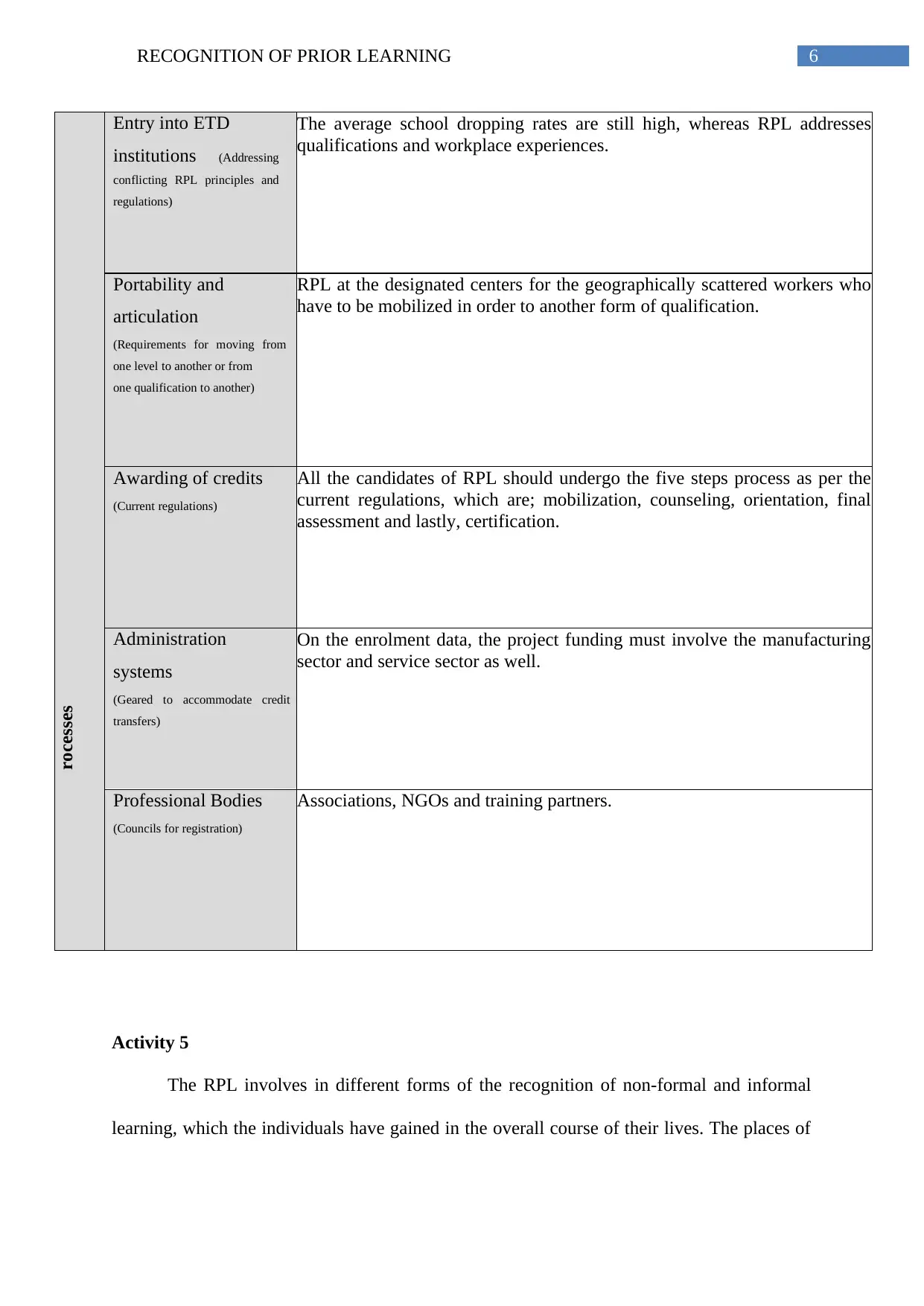
rocesses
Entry into ETD
institutions (Addressing
conflicting RPL principles and
regulations)
The average school dropping rates are still high, whereas RPL addresses
qualifications and workplace experiences.
Portability and
articulation
(Requirements for moving from
one level to another or from
one qualification to another)
RPL at the designated centers for the geographically scattered workers who
have to be mobilized in order to another form of qualification.
Awarding of credits
(Current regulations)
All the candidates of RPL should undergo the five steps process as per the
current regulations, which are; mobilization, counseling, orientation, final
assessment and lastly, certification.
Administration
systems
(Geared to accommodate credit
transfers)
On the enrolment data, the project funding must involve the manufacturing
sector and service sector as well.
Professional Bodies
(Councils for registration)
Associations, NGOs and training partners.
Activity 5
The RPL involves in different forms of the recognition of non-formal and informal
learning, which the individuals have gained in the overall course of their lives. The places of
rocesses
Entry into ETD
institutions (Addressing
conflicting RPL principles and
regulations)
The average school dropping rates are still high, whereas RPL addresses
qualifications and workplace experiences.
Portability and
articulation
(Requirements for moving from
one level to another or from
one qualification to another)
RPL at the designated centers for the geographically scattered workers who
have to be mobilized in order to another form of qualification.
Awarding of credits
(Current regulations)
All the candidates of RPL should undergo the five steps process as per the
current regulations, which are; mobilization, counseling, orientation, final
assessment and lastly, certification.
Administration
systems
(Geared to accommodate credit
transfers)
On the enrolment data, the project funding must involve the manufacturing
sector and service sector as well.
Professional Bodies
(Councils for registration)
Associations, NGOs and training partners.
Activity 5
The RPL involves in different forms of the recognition of non-formal and informal
learning, which the individuals have gained in the overall course of their lives. The places of
Paraphrase This Document
Need a fresh take? Get an instant paraphrase of this document with our AI Paraphraser
7RECOGNITION OF PRIOR LEARNING
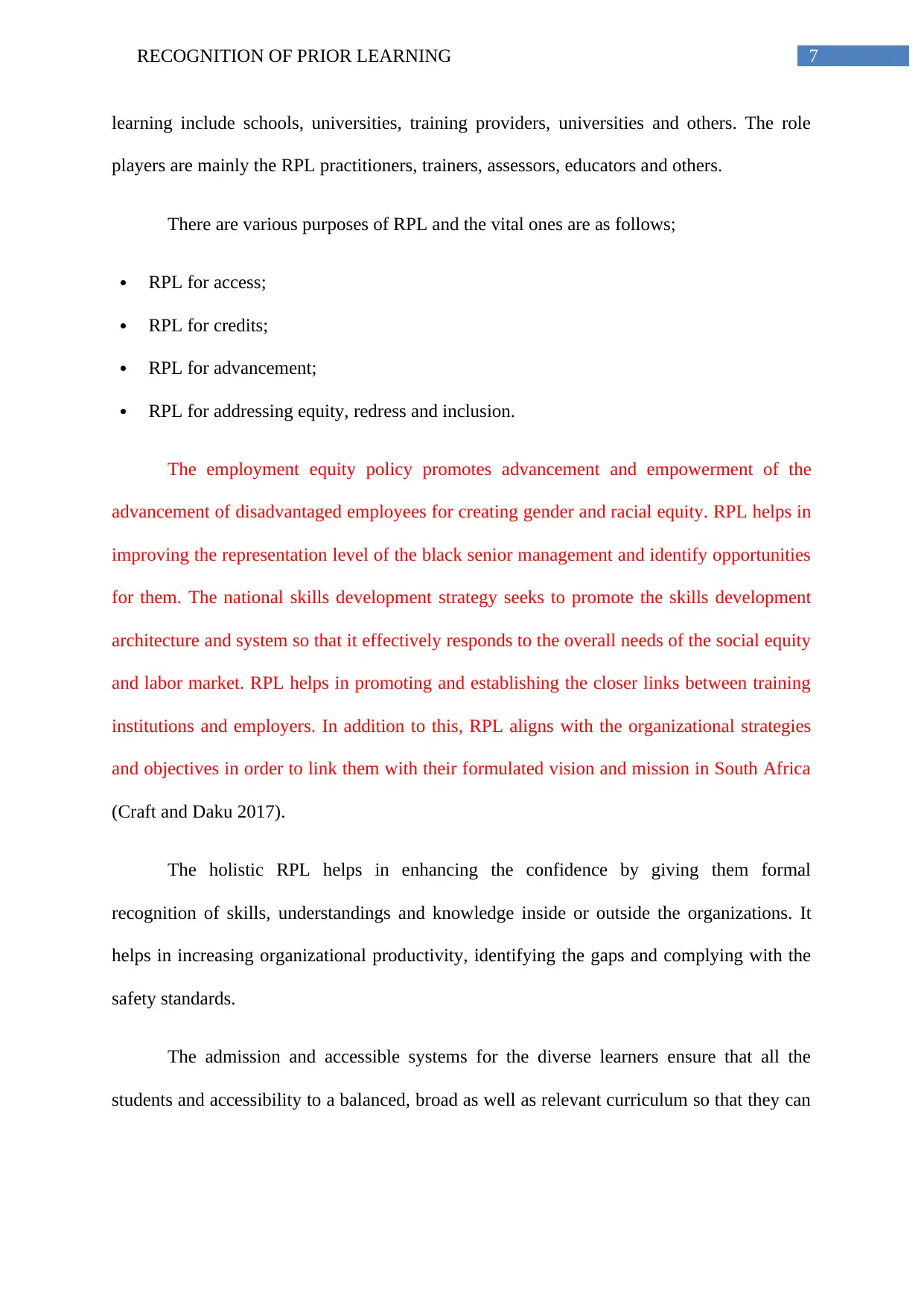
learning include schools, universities, training providers, universities and others. The role
players are mainly the RPL practitioners, trainers, assessors, educators and others.
There are various purposes of RPL and the vital ones are as follows;
RPL for access;
RPL for credits;
RPL for advancement;
RPL for addressing equity, redress and inclusion.
The employment equity policy promotes advancement and empowerment of the
advancement of disadvantaged employees for creating gender and racial equity. RPL helps in
improving the representation level of the black senior management and identify opportunities
for them. The national skills development strategy seeks to promote the skills development
architecture and system so that it effectively responds to the overall needs of the social equity
and labor market. RPL helps in promoting and establishing the closer links between training
institutions and employers. In addition to this, RPL aligns with the organizational strategies
and objectives in order to link them with their formulated vision and mission in South Africa
(Craft and Daku 2017).
The holistic RPL helps in enhancing the confidence by giving them formal
recognition of skills, understandings and knowledge inside or outside the organizations. It
helps in increasing organizational productivity, identifying the gaps and complying with the
safety standards.
The admission and accessible systems for the diverse learners ensure that all the
students and accessibility to a balanced, broad as well as relevant curriculum so that they can
learning include schools, universities, training providers, universities and others. The role
players are mainly the RPL practitioners, trainers, assessors, educators and others.
There are various purposes of RPL and the vital ones are as follows;
RPL for access;
RPL for credits;
RPL for advancement;
RPL for addressing equity, redress and inclusion.
The employment equity policy promotes advancement and empowerment of the
advancement of disadvantaged employees for creating gender and racial equity. RPL helps in
improving the representation level of the black senior management and identify opportunities
for them. The national skills development strategy seeks to promote the skills development
architecture and system so that it effectively responds to the overall needs of the social equity
and labor market. RPL helps in promoting and establishing the closer links between training
institutions and employers. In addition to this, RPL aligns with the organizational strategies
and objectives in order to link them with their formulated vision and mission in South Africa
(Craft and Daku 2017).
The holistic RPL helps in enhancing the confidence by giving them formal
recognition of skills, understandings and knowledge inside or outside the organizations. It
helps in increasing organizational productivity, identifying the gaps and complying with the
safety standards.
The admission and accessible systems for the diverse learners ensure that all the
students and accessibility to a balanced, broad as well as relevant curriculum so that they can
8RECOGNITION OF PRIOR LEARNING
enhance self efficacy and reach full potential. It also ensures that all the teachers are aware of
the individual needs of the students (Hlongwane 2018).
Quality assurance mechanisms, monitoring of the issues and reviews help in
identifying as well as assessing the students and their diverse needs or demands as early as
possible.
The reporting and recording procedures should involve; monitoring the teachers’
movement, their teaching abilities, how are they handling the issues of the diverse
community and others (Eriksson et al. 2018).
Activity 6
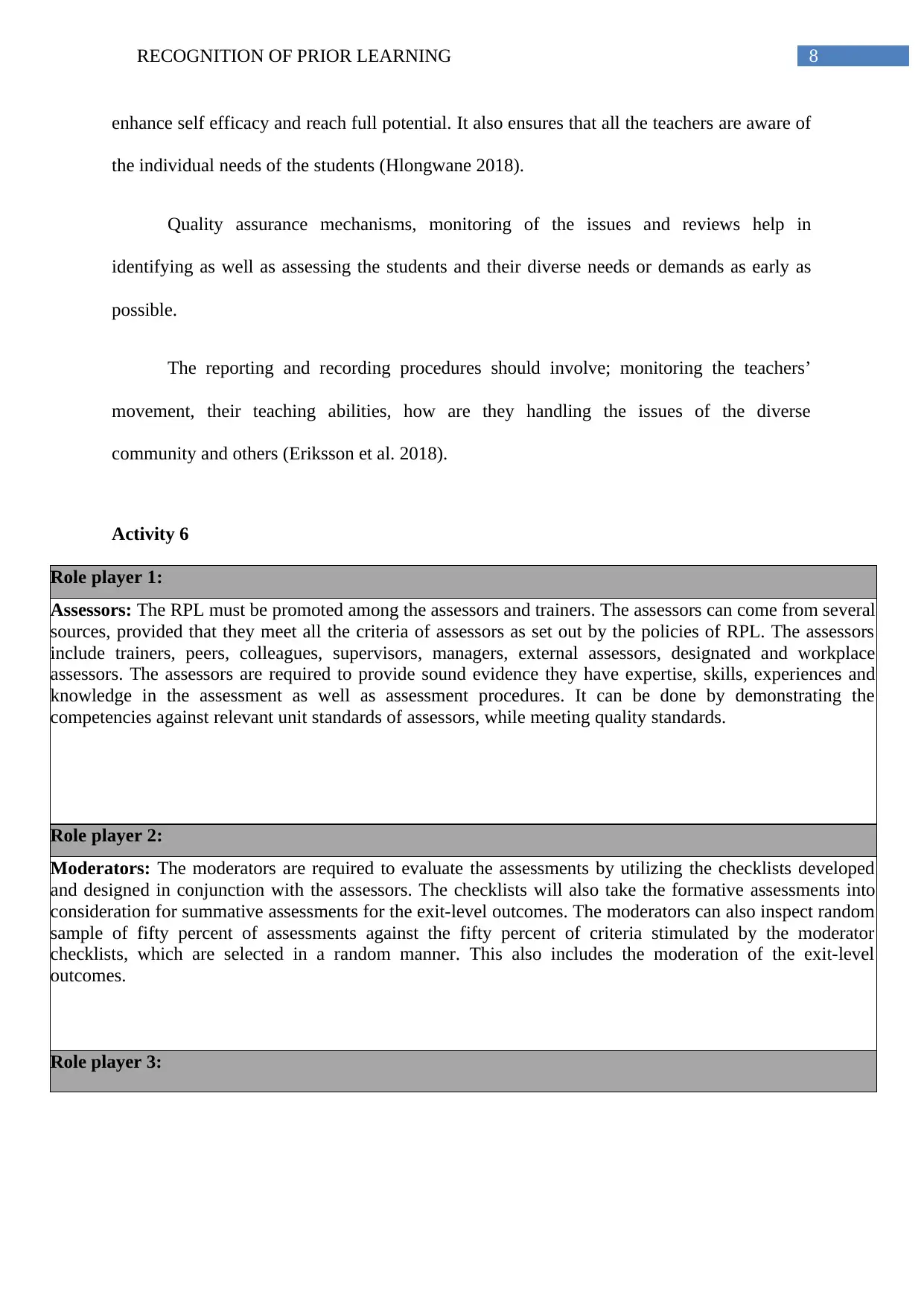
Role player 1:
Assessors: The RPL must be promoted among the assessors and trainers. The assessors can come from several
sources, provided that they meet all the criteria of assessors as set out by the policies of RPL. The assessors
include trainers, peers, colleagues, supervisors, managers, external assessors, designated and workplace
assessors. The assessors are required to provide sound evidence they have expertise, skills, experiences and
knowledge in the assessment as well as assessment procedures. It can be done by demonstrating the
competencies against relevant unit standards of assessors, while meeting quality standards.
Role player 2:
Moderators: The moderators are required to evaluate the assessments by utilizing the checklists developed
and designed in conjunction with the assessors. The checklists will also take the formative assessments into
consideration for summative assessments for the exit-level outcomes. The moderators can also inspect random
sample of fifty percent of assessments against the fifty percent of criteria stimulated by the moderator
checklists, which are selected in a random manner. This also includes the moderation of the exit-level
outcomes.
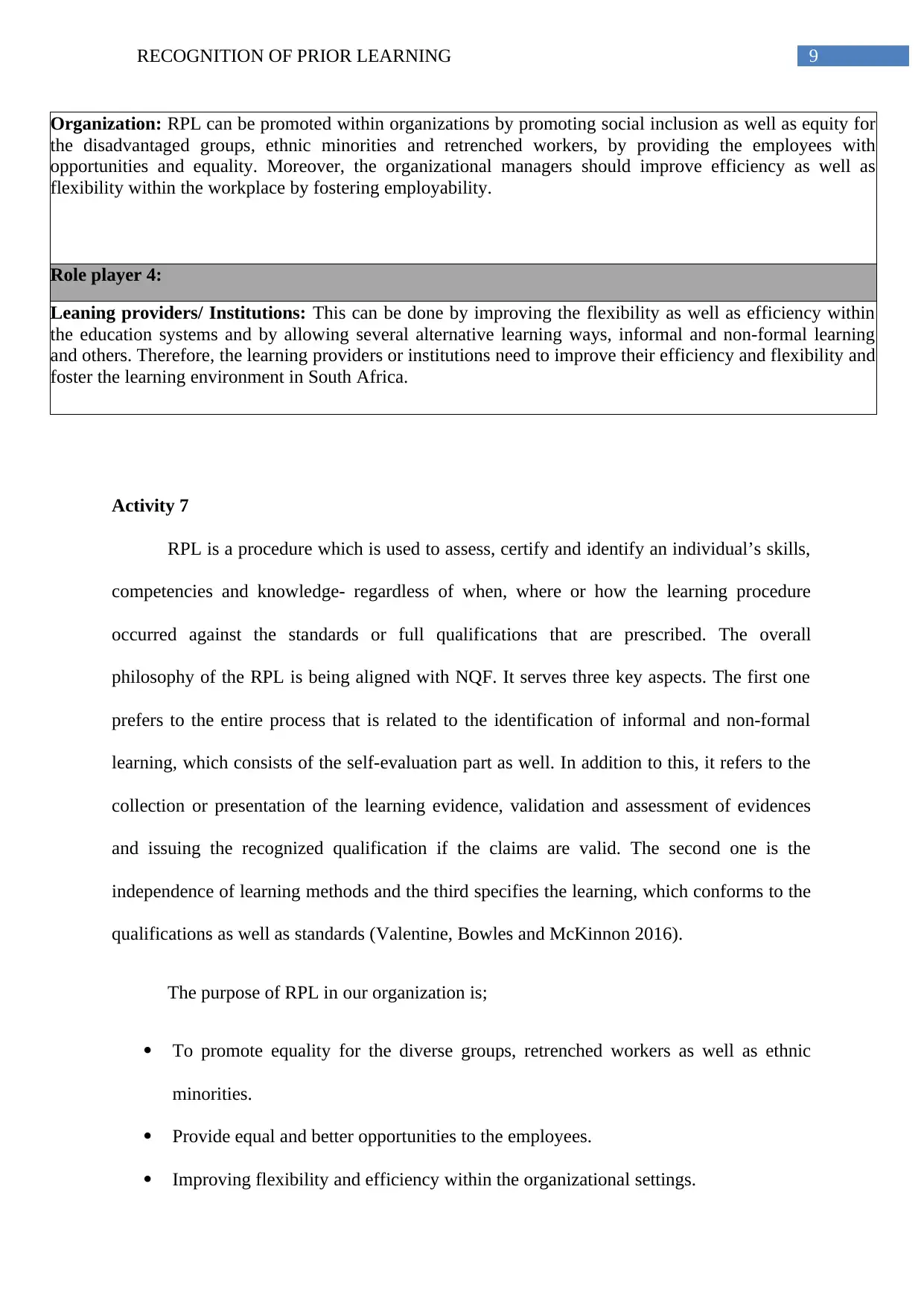
Role player 3:
enhance self efficacy and reach full potential. It also ensures that all the teachers are aware of
the individual needs of the students (Hlongwane 2018).
Quality assurance mechanisms, monitoring of the issues and reviews help in
identifying as well as assessing the students and their diverse needs or demands as early as
possible.
The reporting and recording procedures should involve; monitoring the teachers’
movement, their teaching abilities, how are they handling the issues of the diverse
community and others (Eriksson et al. 2018).
Activity 6
Role player 1:
Assessors: The RPL must be promoted among the assessors and trainers. The assessors can come from several
sources, provided that they meet all the criteria of assessors as set out by the policies of RPL. The assessors
include trainers, peers, colleagues, supervisors, managers, external assessors, designated and workplace
assessors. The assessors are required to provide sound evidence they have expertise, skills, experiences and
knowledge in the assessment as well as assessment procedures. It can be done by demonstrating the
competencies against relevant unit standards of assessors, while meeting quality standards.
Role player 2:
Moderators: The moderators are required to evaluate the assessments by utilizing the checklists developed
and designed in conjunction with the assessors. The checklists will also take the formative assessments into
consideration for summative assessments for the exit-level outcomes. The moderators can also inspect random
sample of fifty percent of assessments against the fifty percent of criteria stimulated by the moderator
checklists, which are selected in a random manner. This also includes the moderation of the exit-level
outcomes.
Role player 3:
⊘ This is a preview!⊘
Do you want full access?
Subscribe today to unlock all pages.
Trusted by 1+ million students worldwide
9RECOGNITION OF PRIOR LEARNING
Organization: RPL can be promoted within organizations by promoting social inclusion as well as equity for
the disadvantaged groups, ethnic minorities and retrenched workers, by providing the employees with
opportunities and equality. Moreover, the organizational managers should improve efficiency as well as
flexibility within the workplace by fostering employability.
Role player 4:
Leaning providers/ Institutions: This can be done by improving the flexibility as well as efficiency within
the education systems and by allowing several alternative learning ways, informal and non-formal learning
and others. Therefore, the learning providers or institutions need to improve their efficiency and flexibility and
foster the learning environment in South Africa.
Activity 7
RPL is a procedure which is used to assess, certify and identify an individual’s skills,
competencies and knowledge- regardless of when, where or how the learning procedure
occurred against the standards or full qualifications that are prescribed. The overall
philosophy of the RPL is being aligned with NQF. It serves three key aspects. The first one
prefers to the entire process that is related to the identification of informal and non-formal
learning, which consists of the self-evaluation part as well. In addition to this, it refers to the
collection or presentation of the learning evidence, validation and assessment of evidences
and issuing the recognized qualification if the claims are valid. The second one is the
independence of learning methods and the third specifies the learning, which conforms to the
qualifications as well as standards (Valentine, Bowles and McKinnon 2016).
The purpose of RPL in our organization is;
To promote equality for the diverse groups, retrenched workers as well as ethnic
minorities.
Provide equal and better opportunities to the employees.
Improving flexibility and efficiency within the organizational settings.
Organization: RPL can be promoted within organizations by promoting social inclusion as well as equity for
the disadvantaged groups, ethnic minorities and retrenched workers, by providing the employees with
opportunities and equality. Moreover, the organizational managers should improve efficiency as well as
flexibility within the workplace by fostering employability.
Role player 4:
Leaning providers/ Institutions: This can be done by improving the flexibility as well as efficiency within
the education systems and by allowing several alternative learning ways, informal and non-formal learning
and others. Therefore, the learning providers or institutions need to improve their efficiency and flexibility and
foster the learning environment in South Africa.
Activity 7
RPL is a procedure which is used to assess, certify and identify an individual’s skills,
competencies and knowledge- regardless of when, where or how the learning procedure
occurred against the standards or full qualifications that are prescribed. The overall
philosophy of the RPL is being aligned with NQF. It serves three key aspects. The first one
prefers to the entire process that is related to the identification of informal and non-formal
learning, which consists of the self-evaluation part as well. In addition to this, it refers to the
collection or presentation of the learning evidence, validation and assessment of evidences
and issuing the recognized qualification if the claims are valid. The second one is the
independence of learning methods and the third specifies the learning, which conforms to the
qualifications as well as standards (Valentine, Bowles and McKinnon 2016).
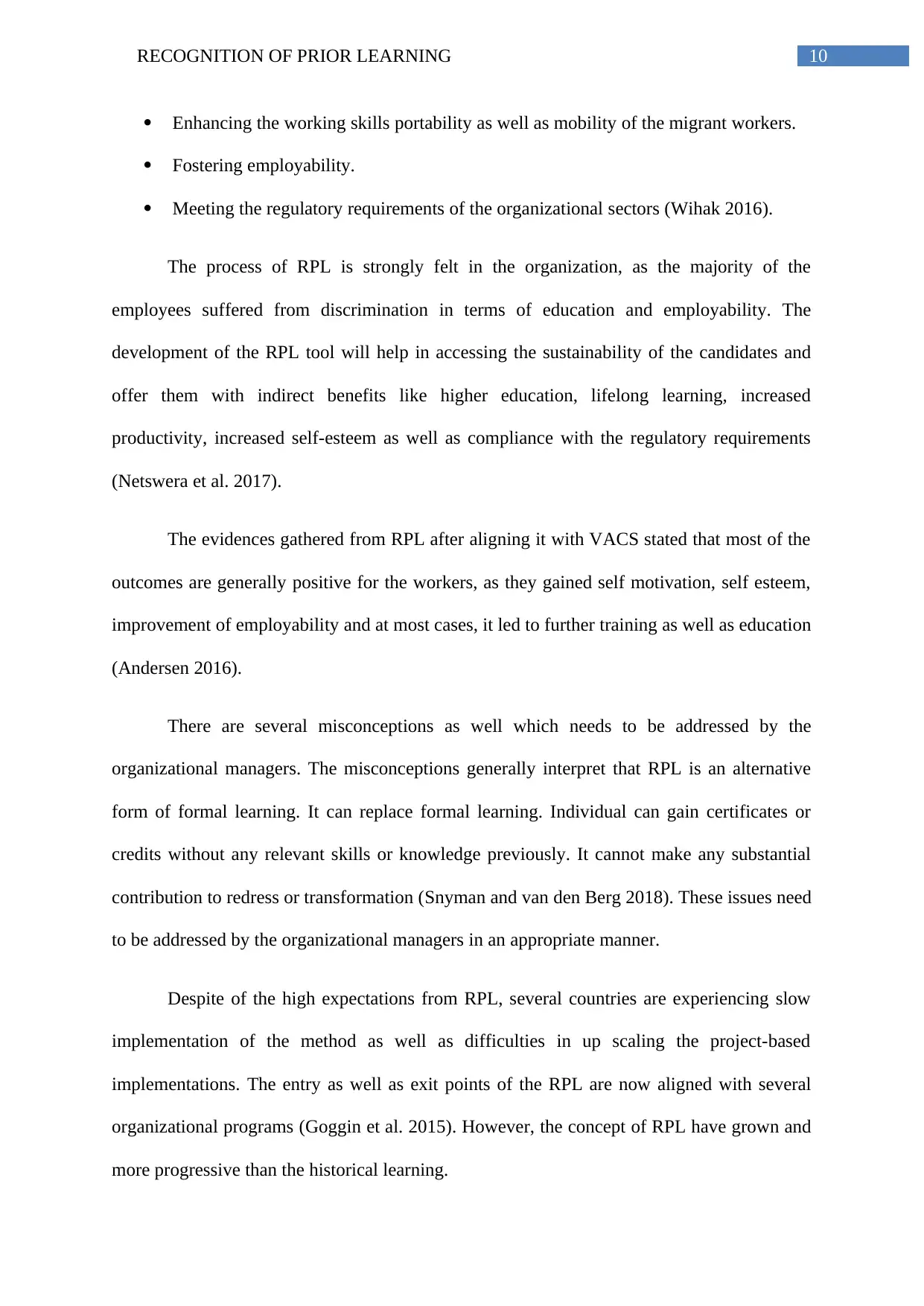
The purpose of RPL in our organization is;
To promote equality for the diverse groups, retrenched workers as well as ethnic
minorities.
Provide equal and better opportunities to the employees.
Improving flexibility and efficiency within the organizational settings.
Paraphrase This Document
Need a fresh take? Get an instant paraphrase of this document with our AI Paraphraser
10RECOGNITION OF PRIOR LEARNING
Enhancing the working skills portability as well as mobility of the migrant workers.
Fostering employability.
Meeting the regulatory requirements of the organizational sectors (Wihak 2016).
The process of RPL is strongly felt in the organization, as the majority of the
employees suffered from discrimination in terms of education and employability. The
development of the RPL tool will help in accessing the sustainability of the candidates and
offer them with indirect benefits like higher education, lifelong learning, increased
productivity, increased self-esteem as well as compliance with the regulatory requirements
(Netswera et al. 2017).
The evidences gathered from RPL after aligning it with VACS stated that most of the
outcomes are generally positive for the workers, as they gained self motivation, self esteem,
improvement of employability and at most cases, it led to further training as well as education
(Andersen 2016).
There are several misconceptions as well which needs to be addressed by the
organizational managers. The misconceptions generally interpret that RPL is an alternative
form of formal learning. It can replace formal learning. Individual can gain certificates or
credits without any relevant skills or knowledge previously. It cannot make any substantial
contribution to redress or transformation (Snyman and van den Berg 2018). These issues need
to be addressed by the organizational managers in an appropriate manner.
Despite of the high expectations from RPL, several countries are experiencing slow
implementation of the method as well as difficulties in up scaling the project-based
implementations. The entry as well as exit points of the RPL are now aligned with several
organizational programs (Goggin et al. 2015). However, the concept of RPL have grown and
more progressive than the historical learning.
Enhancing the working skills portability as well as mobility of the migrant workers.
Fostering employability.
Meeting the regulatory requirements of the organizational sectors (Wihak 2016).
The process of RPL is strongly felt in the organization, as the majority of the
employees suffered from discrimination in terms of education and employability. The
development of the RPL tool will help in accessing the sustainability of the candidates and
offer them with indirect benefits like higher education, lifelong learning, increased
productivity, increased self-esteem as well as compliance with the regulatory requirements
(Netswera et al. 2017).
The evidences gathered from RPL after aligning it with VACS stated that most of the
outcomes are generally positive for the workers, as they gained self motivation, self esteem,
improvement of employability and at most cases, it led to further training as well as education
(Andersen 2016).
There are several misconceptions as well which needs to be addressed by the
organizational managers. The misconceptions generally interpret that RPL is an alternative
form of formal learning. It can replace formal learning. Individual can gain certificates or
credits without any relevant skills or knowledge previously. It cannot make any substantial
contribution to redress or transformation (Snyman and van den Berg 2018). These issues need
to be addressed by the organizational managers in an appropriate manner.
Despite of the high expectations from RPL, several countries are experiencing slow
implementation of the method as well as difficulties in up scaling the project-based
implementations. The entry as well as exit points of the RPL are now aligned with several
organizational programs (Goggin et al. 2015). However, the concept of RPL have grown and
more progressive than the historical learning.
11RECOGNITION OF PRIOR LEARNING
Activity 8
Mr. Khosa needs to follow the overall procedures of RPL philosophy which includes
three specific aspects. The first one prefers to the entire process that is related to the
identification of informal and non-formal learning, which consists of the self-evaluation part
as well. In addition to this, it refers to the collection or presentation of the learning evidence,
validation and assessment of evidences and issuing the recognized qualification if the claims
are valid. The second one is the independence of learning methods and the third specifies the
learning, which conforms to the qualifications as well as standards.
He can overcome the barriers by deleting the misconceptions he has in his mind,
regarding RPL. This can be done by making him understand that RPL is a concept, which is
continuously evolving. Moreover, the differing definitions and confusing languages may
hinder effective and efficient discussions regarding RPL as it acts as a barrier to the effective
implementation of this concept. It is also important to make him understand the core purposes
of the RPL procedure, which will in turn benefit him on the long run.
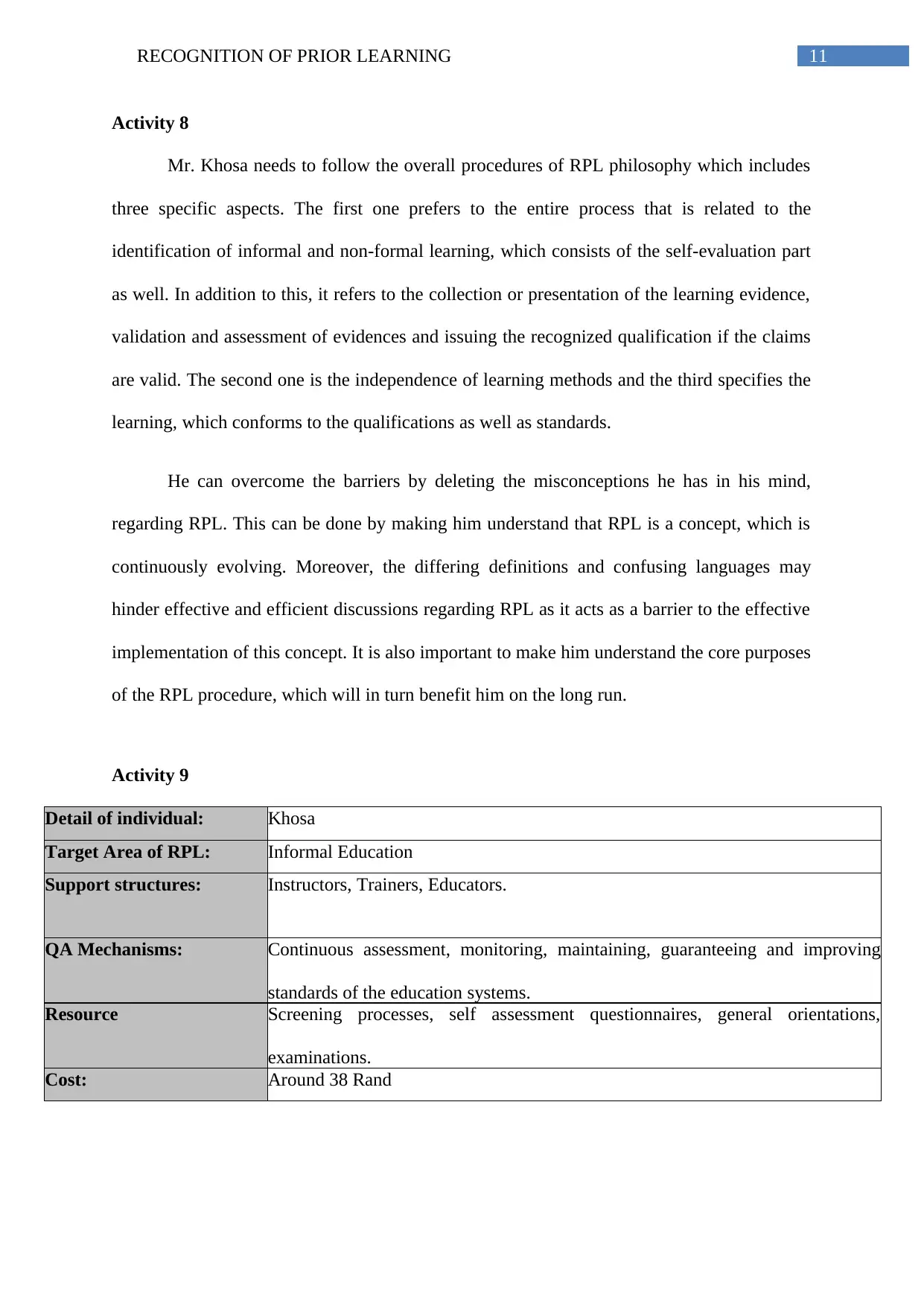
Activity 9
Detail of individual: Khosa
Target Area of RPL: Informal Education
Support structures: Instructors, Trainers, Educators.
QA Mechanisms: Continuous assessment, monitoring, maintaining, guaranteeing and improving
standards of the education systems.
Resource Screening processes, self assessment questionnaires, general orientations,
examinations.
Cost: Around 38 Rand
Activity 8
Mr. Khosa needs to follow the overall procedures of RPL philosophy which includes
three specific aspects. The first one prefers to the entire process that is related to the
identification of informal and non-formal learning, which consists of the self-evaluation part
as well. In addition to this, it refers to the collection or presentation of the learning evidence,
validation and assessment of evidences and issuing the recognized qualification if the claims
are valid. The second one is the independence of learning methods and the third specifies the
learning, which conforms to the qualifications as well as standards.
He can overcome the barriers by deleting the misconceptions he has in his mind,
regarding RPL. This can be done by making him understand that RPL is a concept, which is
continuously evolving. Moreover, the differing definitions and confusing languages may
hinder effective and efficient discussions regarding RPL as it acts as a barrier to the effective
implementation of this concept. It is also important to make him understand the core purposes
of the RPL procedure, which will in turn benefit him on the long run.
Activity 9
Detail of individual: Khosa
Target Area of RPL: Informal Education
Support structures: Instructors, Trainers, Educators.
QA Mechanisms: Continuous assessment, monitoring, maintaining, guaranteeing and improving
standards of the education systems.
Resource Screening processes, self assessment questionnaires, general orientations,
examinations.
Cost: Around 38 Rand
⊘ This is a preview!⊘
Do you want full access?
Subscribe today to unlock all pages.
Trusted by 1+ million students worldwide

1 out of 16


Related Documents


Your All-in-One AI-Powered Toolkit for Academic Success.
+13062052269
info@desklib.com
Available 24*7 on WhatsApp / Email
![[object Object]](/_next/static/media/star-bottom.7253800d.svg)
Unlock your academic potential
Copyright © 2020–2026 A2Z Services. All Rights Reserved. Developed and managed by ZUCOL.