Capstone Report: Recruitment Process, Strategies, and Candidate Traits

Verified

Added on  2023/06/04

|11
|2119
|348
Report
AI Summary
This capstone report provides a comprehensive analysis of the recruitment process, focusing on the challenges faced by organizations like Ellard Williams. The report begins with an executive summary highlighting the importance of recruitment within human resource management, followed by an introduction that emphasizes the role of effective recruitment strategies in organizational success. It identifies critical mistakes to avoid in the recruitment process, such as poor job descriptions, bias in selection, over-reliance on interviews, and rejecting overqualified candidates. The report then outlines a general recruitment procedure, including vacancy identification, job description preparation, advertisement, response management, shortlisting, testing and interviews, and candidate selection. Furthermore, it suggests three critical strategies to broaden the talent base: finding a platform and creating a community, utilizing social media, and looking internally. The report concludes by detailing the traits and characteristics of good and qualified candidates, such as confidence, passion, reliability, technical skills, hard work, and proactiveness. The analysis underscores the significance of a well-defined recruitment process in achieving a competitive edge and reducing employee-related issues.
Document Page
Running head: RECRUITMENT PROCESS
RECRUITMENT PROCESS
Name of the Student
Name of the University
Author Note
tabler-icon-diamond-filled.svg

Paraphrase This Document

Need a fresh take? Get an instant paraphrase of this document with our AI Paraphraser
Document Page
1RECRUITMENT PROCESS
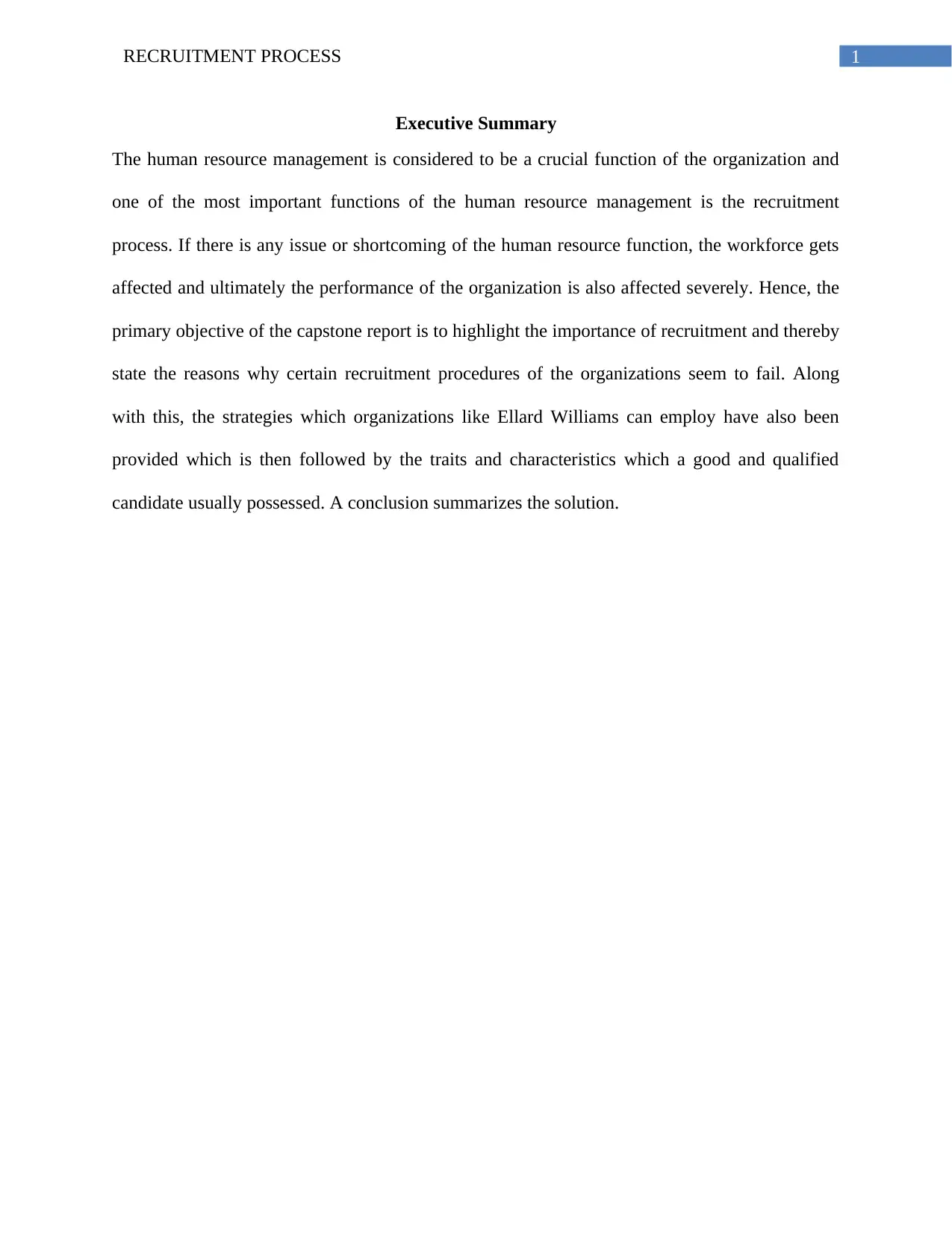
Executive Summary
The human resource management is considered to be a crucial function of the organization and
one of the most important functions of the human resource management is the recruitment
process. If there is any issue or shortcoming of the human resource function, the workforce gets
affected and ultimately the performance of the organization is also affected severely. Hence, the
primary objective of the capstone report is to highlight the importance of recruitment and thereby
state the reasons why certain recruitment procedures of the organizations seem to fail. Along
with this, the strategies which organizations like Ellard Williams can employ have also been
provided which is then followed by the traits and characteristics which a good and qualified
candidate usually possessed. A conclusion summarizes the solution.
Document Page
2RECRUITMENT PROCESS
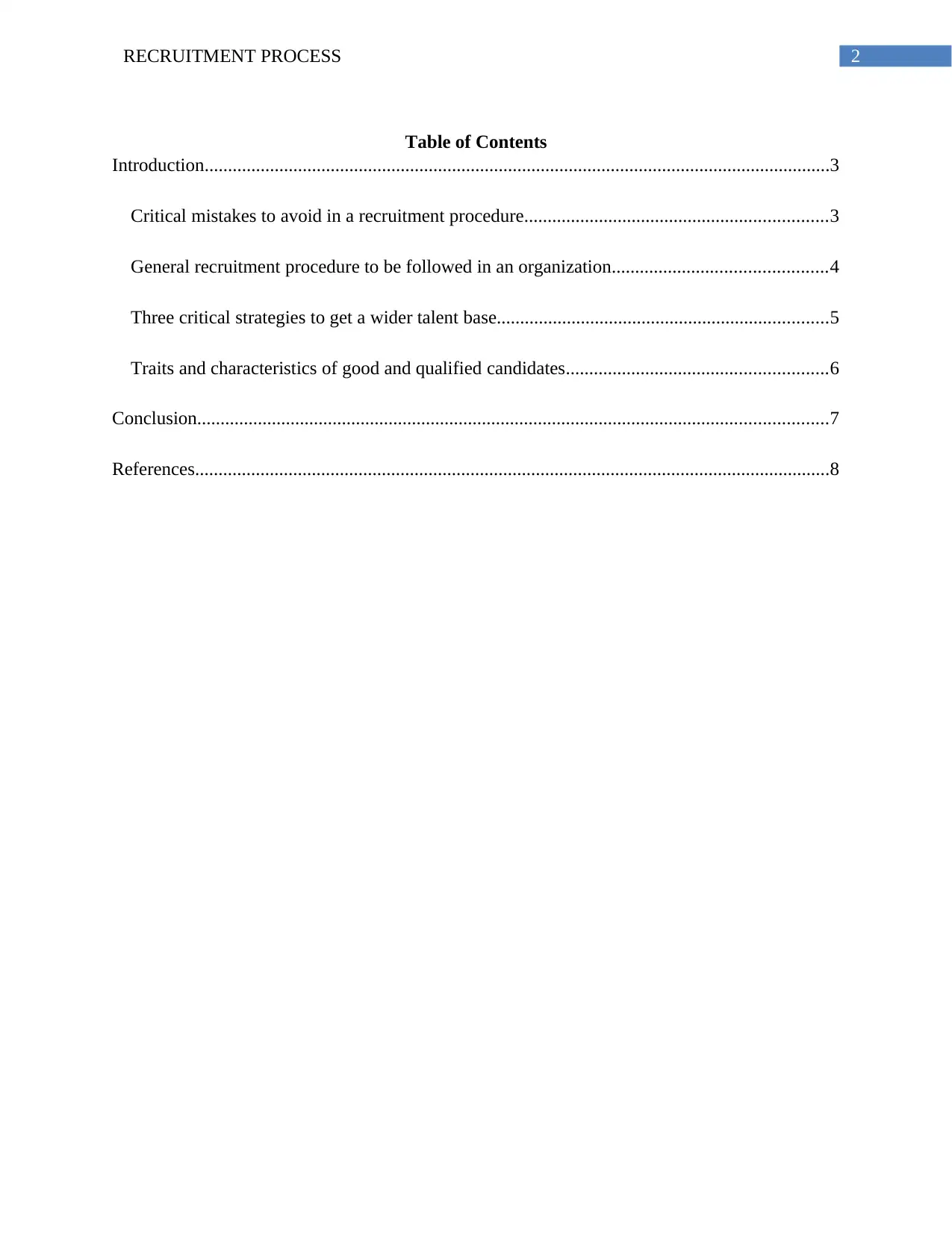
Table of Contents
Introduction......................................................................................................................................3
Critical mistakes to avoid in a recruitment procedure.................................................................3
General recruitment procedure to be followed in an organization..............................................4
Three critical strategies to get a wider talent base.......................................................................5
Traits and characteristics of good and qualified candidates........................................................6
Conclusion.......................................................................................................................................7
References........................................................................................................................................8
Document Page
3RECRUITMENT PROCESS
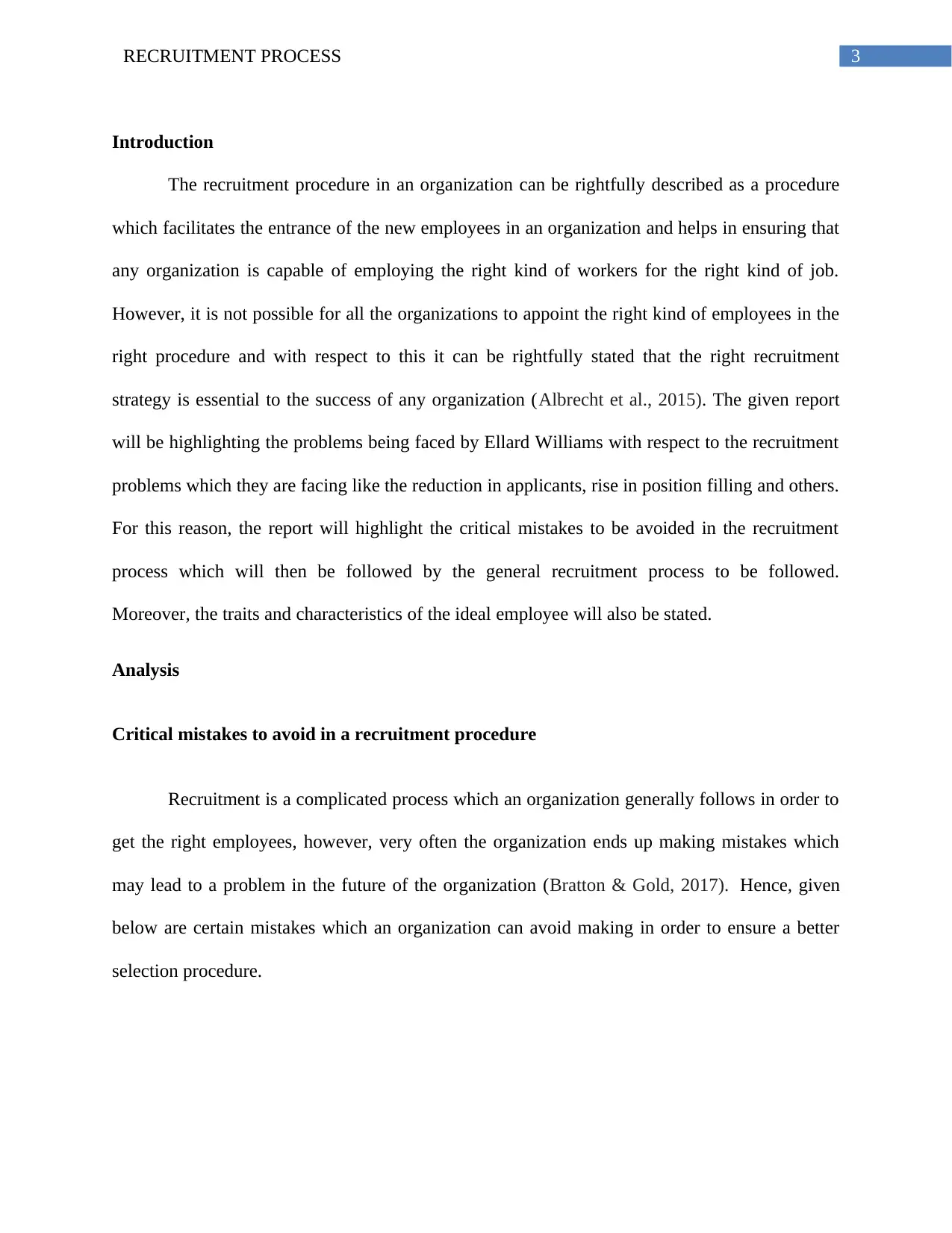
Introduction
The recruitment procedure in an organization can be rightfully described as a procedure
which facilitates the entrance of the new employees in an organization and helps in ensuring that
any organization is capable of employing the right kind of workers for the right kind of job.
However, it is not possible for all the organizations to appoint the right kind of employees in the
right procedure and with respect to this it can be rightfully stated that the right recruitment
strategy is essential to the success of any organization (Albrecht et al., 2015). The given report
will be highlighting the problems being faced by Ellard Williams with respect to the recruitment
problems which they are facing like the reduction in applicants, rise in position filling and others.
For this reason, the report will highlight the critical mistakes to be avoided in the recruitment
process which will then be followed by the general recruitment process to be followed.
Moreover, the traits and characteristics of the ideal employee will also be stated.
Analysis
Critical mistakes to avoid in a recruitment procedure
Recruitment is a complicated process which an organization generally follows in order to
get the right employees, however, very often the organization ends up making mistakes which
may lead to a problem in the future of the organization (Bratton & Gold, 2017). Hence, given
below are certain mistakes which an organization can avoid making in order to ensure a better
selection procedure.
tabler-icon-diamond-filled.svg

Paraphrase This Document

Need a fresh take? Get an instant paraphrase of this document with our AI Paraphraser
Document Page
4RECRUITMENT PROCESS
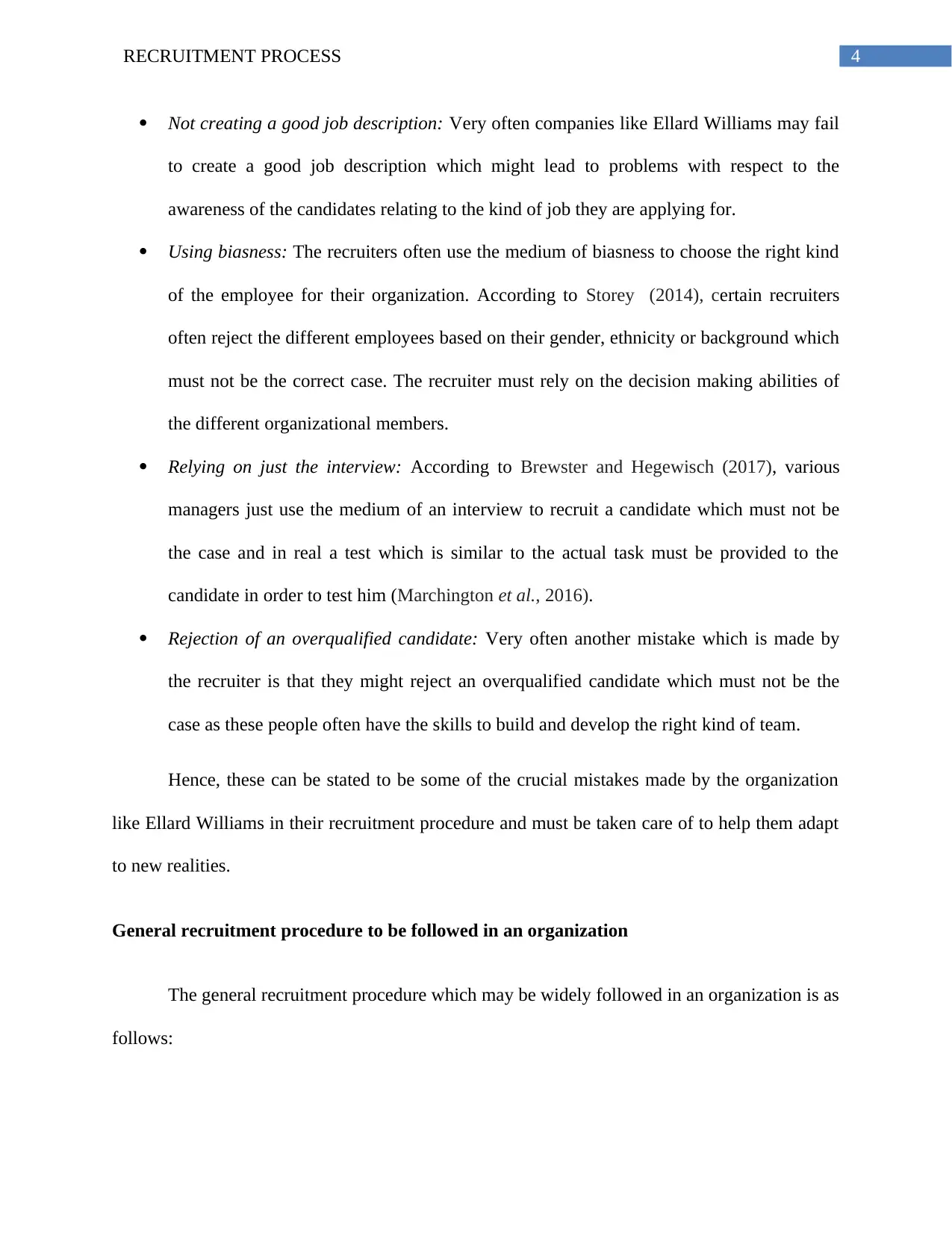
Not creating a good job description: Very often companies like Ellard Williams may fail
to create a good job description which might lead to problems with respect to the
awareness of the candidates relating to the kind of job they are applying for.
Using biasness: The recruiters often use the medium of biasness to choose the right kind
of the employee for their organization. According to Storey (2014), certain recruiters
often reject the different employees based on their gender, ethnicity or background which
must not be the correct case. The recruiter must rely on the decision making abilities of
the different organizational members.
Relying on just the interview: According to Brewster and Hegewisch (2017), various
managers just use the medium of an interview to recruit a candidate which must not be
the case and in real a test which is similar to the actual task must be provided to the
candidate in order to test him (Marchington et al., 2016).
Rejection of an overqualified candidate: Very often another mistake which is made by
the recruiter is that they might reject an overqualified candidate which must not be the
case as these people often have the skills to build and develop the right kind of team.
Hence, these can be stated to be some of the crucial mistakes made by the organization
like Ellard Williams in their recruitment procedure and must be taken care of to help them adapt
to new realities.
General recruitment procedure to be followed in an organization
The general recruitment procedure which may be widely followed in an organization is as
follows:
Document Page
5RECRUITMENT PROCESS
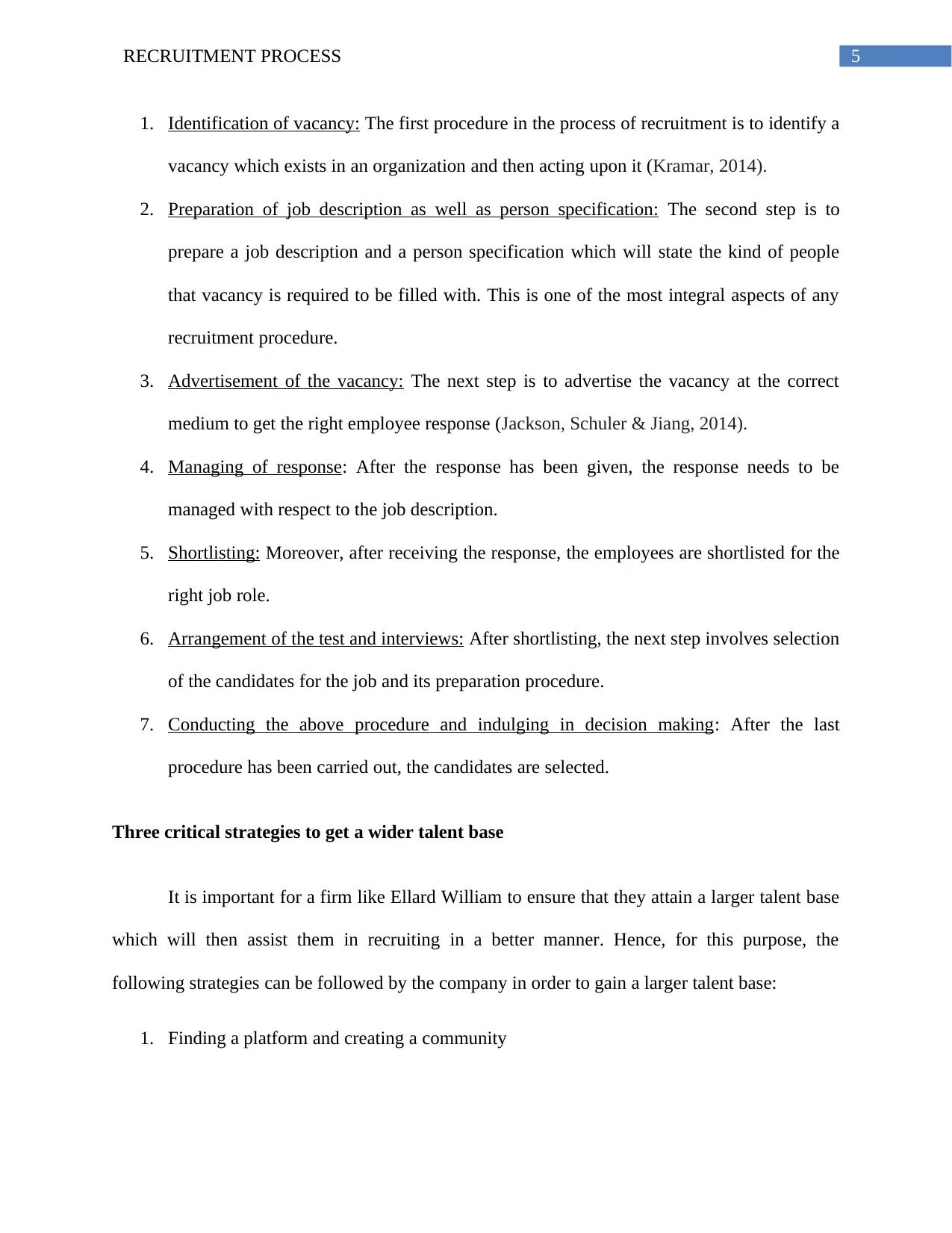
1. Identification of vacancy: The first procedure in the process of recruitment is to identify a
vacancy which exists in an organization and then acting upon it (Kramar, 2014).
2. Preparation of job description as well as person specification: The second step is to
prepare a job description and a person specification which will state the kind of people
that vacancy is required to be filled with. This is one of the most integral aspects of any
recruitment procedure.
3. Advertisement of the vacancy: The next step is to advertise the vacancy at the correct
medium to get the right employee response (Jackson, Schuler & Jiang, 2014).
4. Managing of response: After the response has been given, the response needs to be
managed with respect to the job description.
5. Shortlisting: Moreover, after receiving the response, the employees are shortlisted for the
right job role.
6. Arrangement of the test and interviews: After shortlisting, the next step involves selection
of the candidates for the job and its preparation procedure.
7. Conducting the above procedure and indulging in decision making: After the last
procedure has been carried out, the candidates are selected.
Three critical strategies to get a wider talent base
It is important for a firm like Ellard William to ensure that they attain a larger talent base
which will then assist them in recruiting in a better manner. Hence, for this purpose, the
following strategies can be followed by the company in order to gain a larger talent base:
1. Finding a platform and creating a community
Document Page
6RECRUITMENT PROCESS
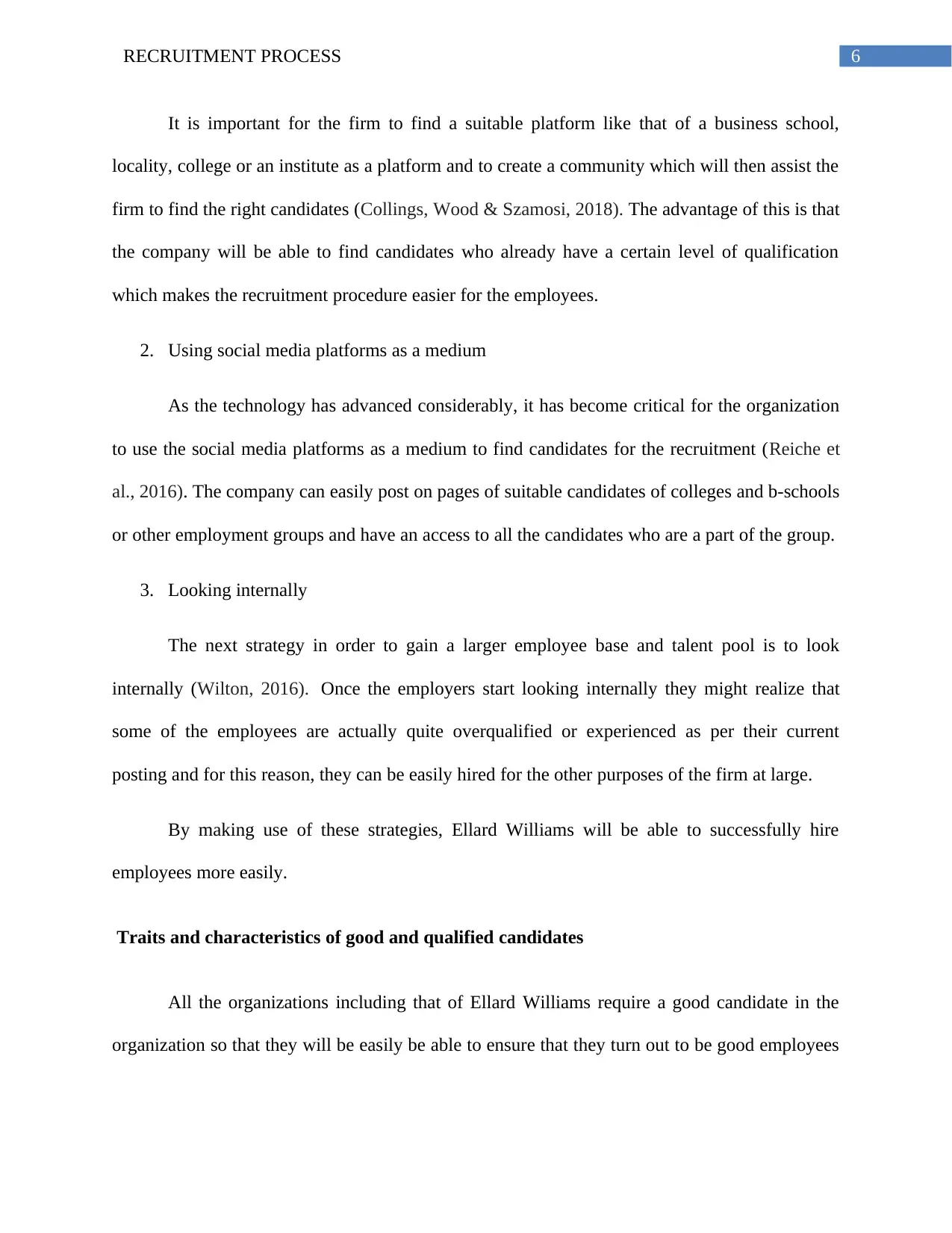
It is important for the firm to find a suitable platform like that of a business school,
locality, college or an institute as a platform and to create a community which will then assist the
firm to find the right candidates (Collings, Wood & Szamosi, 2018). The advantage of this is that
the company will be able to find candidates who already have a certain level of qualification
which makes the recruitment procedure easier for the employees.
2. Using social media platforms as a medium
As the technology has advanced considerably, it has become critical for the organization
to use the social media platforms as a medium to find candidates for the recruitment (Reiche et
al., 2016). The company can easily post on pages of suitable candidates of colleges and b-schools
or other employment groups and have an access to all the candidates who are a part of the group.
3. Looking internally
The next strategy in order to gain a larger employee base and talent pool is to look
internally (Wilton, 2016). Once the employers start looking internally they might realize that
some of the employees are actually quite overqualified or experienced as per their current
posting and for this reason, they can be easily hired for the other purposes of the firm at large.
By making use of these strategies, Ellard Williams will be able to successfully hire
employees more easily.
Traits and characteristics of good and qualified candidates
All the organizations including that of Ellard Williams require a good candidate in the
organization so that they will be easily be able to ensure that they turn out to be good employees
tabler-icon-diamond-filled.svg

Paraphrase This Document

Need a fresh take? Get an instant paraphrase of this document with our AI Paraphraser
Document Page
7RECRUITMENT PROCESS
for the organization at large (Chelladurai & Kerwin, 2017). Hence, given below are certain
traits and characteristics which are associated with qualified candidates:
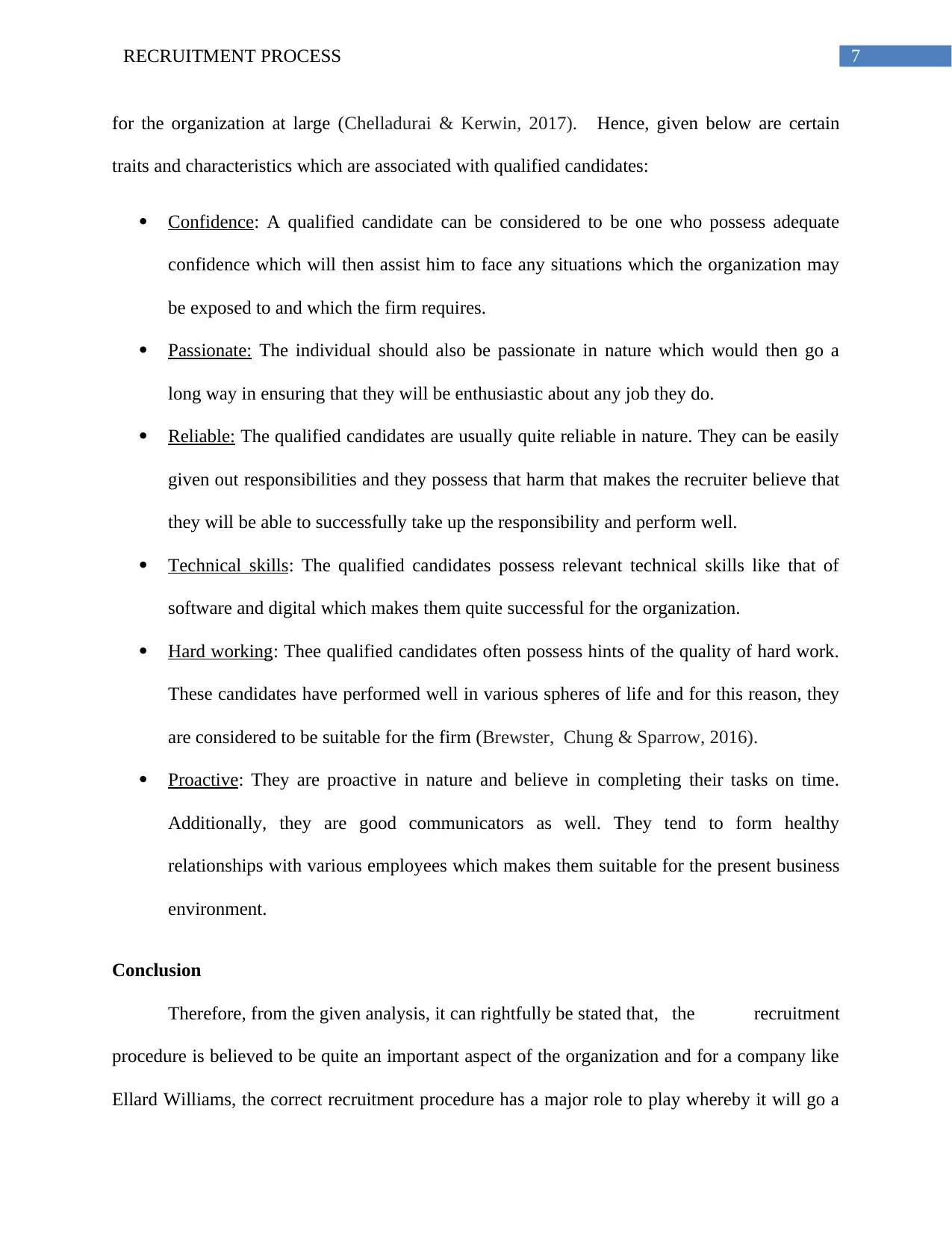
Confidence: A qualified candidate can be considered to be one who possess adequate
confidence which will then assist him to face any situations which the organization may
be exposed to and which the firm requires.
Passionate: The individual should also be passionate in nature which would then go a
long way in ensuring that they will be enthusiastic about any job they do.
Reliable: The qualified candidates are usually quite reliable in nature. They can be easily
given out responsibilities and they possess that harm that makes the recruiter believe that
they will be able to successfully take up the responsibility and perform well.
Technical skills: The qualified candidates possess relevant technical skills like that of
software and digital which makes them quite successful for the organization.
Hard working: Thee qualified candidates often possess hints of the quality of hard work.
These candidates have performed well in various spheres of life and for this reason, they
are considered to be suitable for the firm (Brewster, Chung & Sparrow, 2016).
Proactive: They are proactive in nature and believe in completing their tasks on time.
Additionally, they are good communicators as well. They tend to form healthy
relationships with various employees which makes them suitable for the present business
environment.
Conclusion
Therefore, from the given analysis, it can rightfully be stated that, the recruitment
procedure is believed to be quite an important aspect of the organization and for a company like
Ellard Williams, the correct recruitment procedure has a major role to play whereby it will go a
Document Page
8RECRUITMENT PROCESS
long way in ensuring that the company is successfully able to reduce its employee related issues
and achieve a competitive edge.
Document Page
9RECRUITMENT PROCESS
References
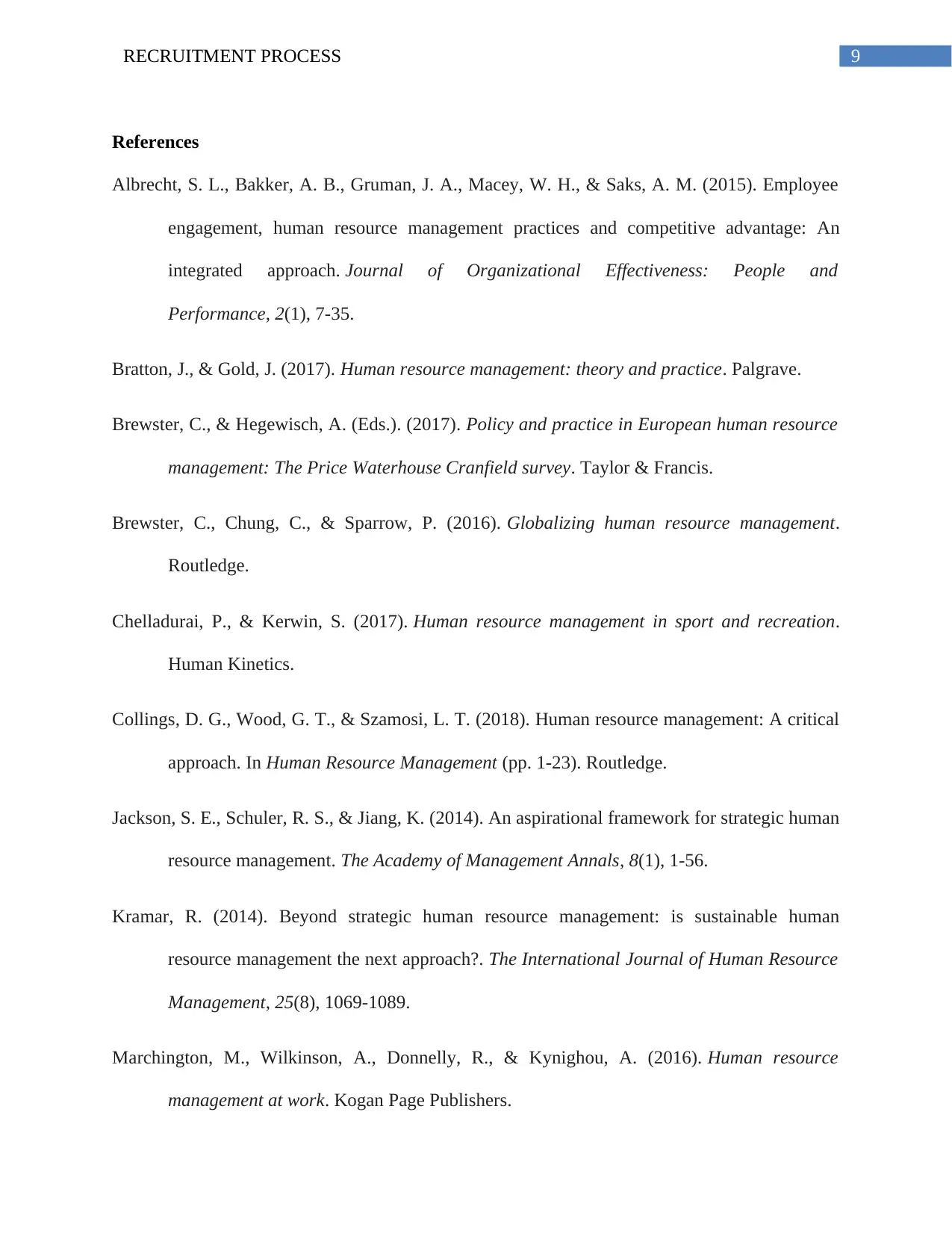
Albrecht, S. L., Bakker, A. B., Gruman, J. A., Macey, W. H., & Saks, A. M. (2015). Employee
engagement, human resource management practices and competitive advantage: An
integrated approach. Journal of Organizational Effectiveness: People and
Performance, 2(1), 7-35.
Bratton, J., & Gold, J. (2017). Human resource management: theory and practice. Palgrave.
Brewster, C., & Hegewisch, A. (Eds.). (2017). Policy and practice in European human resource
management: The Price Waterhouse Cranfield survey. Taylor & Francis.
Brewster, C., Chung, C., & Sparrow, P. (2016). Globalizing human resource management.
Routledge.
Chelladurai, P., & Kerwin, S. (2017). Human resource management in sport and recreation.
Human Kinetics.
Collings, D. G., Wood, G. T., & Szamosi, L. T. (2018). Human resource management: A critical
approach. In Human Resource Management (pp. 1-23). Routledge.
Jackson, S. E., Schuler, R. S., & Jiang, K. (2014). An aspirational framework for strategic human
resource management. The Academy of Management Annals, 8(1), 1-56.
Kramar, R. (2014). Beyond strategic human resource management: is sustainable human
resource management the next approach?. The International Journal of Human Resource
Management, 25(8), 1069-1089.
Marchington, M., Wilkinson, A., Donnelly, R., & Kynighou, A. (2016). Human resource
management at work. Kogan Page Publishers.
tabler-icon-diamond-filled.svg

Paraphrase This Document

Need a fresh take? Get an instant paraphrase of this document with our AI Paraphraser
Document Page
10RECRUITMENT PROCESS
Reiche, B. S., Stahl, G. K., Mendenhall, M. E., & Oddou, G. R. (Eds.). (2016). Readings and
cases in international human resource management. Taylor & Francis.
Storey, J. (2014). New Perspectives on Human Resource Management (Routledge Revivals).
Routledge.
Wilton, N. (2016). An introduction to human resource management. Sage.
chevron_up_icon
1 out of 11
circle_padding
hide_on_mobile
zoom_out_icon
[object Object]