Recruitment and Selection Report: Analysis of Turnover and Methods

Verified

Added on  2019/09/30

|9
|2030
|274
Report
AI Summary
This report provides a comprehensive analysis of recruitment and selection practices within a manufacturing firm. It begins by addressing a significant turnover rate of 37%, exploring its implications and the need for further investigation into the qualifications and experience of departing employees. The report then delves into the types of turnover, emphasizing the distinction between voluntary and involuntary departures and their impact on productivity. The analysis extends to the criteria for establishing effective cutoff scores in the selection process, highlighting the importance of aligning these scores with the company's current needs and applicant pool size. The report also identifies and justifies various selection methods, including the use of resumes, numerical ability tests, aptitude tests, interviews, and personality inventories. Finally, the report includes calculations to determine selection ratios and adverse impact, offering a practical application of the concepts discussed throughout the analysis. The report concludes with a set of references used to support the analysis and findings.

Document Page
RECRUITMENT AND SELECTION
tabler-icon-diamond-filled.svg

Paraphrase This Document

Need a fresh take? Get an instant paraphrase of this document with our AI Paraphraser
Document Page
Table of Contents
QUESTION 1..................................................................................................................................1
1. Is 37% of turnover is the cause of concern..............................................................................1
2. Additional data to be gathered regarding turnover..................................................................1
3. Turnover is problematic...........................................................................................................2
QUESTION 2..................................................................................................................................3
Criteria of good cutoff.................................................................................................................3
QUESTION 3..................................................................................................................................4
Part 1: Identifying the selection methods with justification........................................................4
Part 2: Calculation.......................................................................................................................5
REFERENCE..................................................................................................................................7
Document Page
QUESTION 1
1. Is 37% of turnover is the cause of concern
Turnover rate depicts the percentage of employees who have left the firm during a
specific period of time. In other words, it can be said that, this percentage showcase the number
of employees who have been fired by the company. However, this also means that the same
percentage of employee firm will have to rehire in order to maintain the continuity of the
manufacturing firm’s operation.
In this regard, it can be said that the turnover rate of 37% is a major cause of concern.
When this is seen in a technical way then it depicts that out of 100 employees 37 employees have
left the firm. This indicates that there are high chances that a huge number of productive
employees have left the company (Patterson and et.al., 2018).
However, with an aim to find out whether the given percentage is the cause of concern, I
would go through the qualification as well as the work experience of employees who have left
the company. I will compare this data with the employees who are currently working in the
company. If on comparison it is identified that employees who have left have better qualification
then the current workers, then the given thing is regarded as a major matter of concern.
2. Additional data to be gathered regarding turnover
The additional data that I would gather in relation to the specific turnover in the country
is related to the basic nature of turnover. For example, when an employee leaves the company
due to his/her own wish then it is called by the name of voluntary turnover. On the other hand,
when a company forces any employees with regard to leave the firm then it comes under the
category of involuntary turnover. In addition to this, the internal transfer is being regarded as
1
Document Page
another form of turnover. In this form, employees transfer to a new position in the same
organization. On the other hand, when an employee leaves the firm after reaching the specified
retirement age then it is called as retirement turnover.
Among these all given nature of turnover, involuntary turnover is being regarded as a
beneficial aspect for the company. This is because, in involuntary turnover, the company has the
power to lay off specific employee from the firm. The reason for lay off could be not working
properly and affecting the environment of the company. Such type of employees does not prove
as beneficial for the firm. Thus, if these people will leave the firm then the productivity of the
company will be enhanced (Patterson, 2018).
3. Turnover is problematic
On the basis of analysis, it is identified that the turnover rate of non-exempt staff is 42%.
In this regard, it can be said that non-exempt staff is the type of staff who are entitled to get
minimum pay as well as extra pay for overtime. The possible causes for the turnover of
nonexempt staff could be not getting the minimum pay, not getting pay for the overtime time and
not getting the opportunity for skill development. These all have a direct impact on the
motivation as well as the satisfaction level of employees. Thus, if proper measures are not taken
then the impact of the same can be seen on the overall operation of the firm. However, the
turnover of nonexempt staff can be eliminated by forming the policies in relation to the payment.
Here, strict action will be taken against the individual who has stopped the payment of these
employees. Further, I will also prepare a sheet which gives detailed regarding how many hours
an individual has worked and is payment has been made to him/her not. On the other hand,
effort should also be made in terms of arranging training and development activity for these
2
tabler-icon-diamond-filled.svg

Paraphrase This Document

Need a fresh take? Get an instant paraphrase of this document with our AI Paraphraser
Document Page
employees on a monthly basis. It is through this way only the problem in relation to the turnover
of the employee can be resolved (Farndale, Nikandrou & Panayotopoulou, 2018).
QUESTION 2
Criteria of good cutoff
Cut off score is basically established score which is used with an aim to filter unqualified
candidate in the specific test assessment. In the employee selection process, the cut-off score has
significant importance. This is because, in this way, an employer can easily filter out the
candidates who have applied for a specific job. Thus, this takes to make the work of the
employer’s selection of a candidate for the job quite easier as well as effective.
In this regard, the court state that the criteria for setting the cut-off score for the selection
procedure of the company should be totally based on the company current situation. For
example, if a company has a large number of a vacant position in relation to the specific post
then in the given situation a firm should go for the standard cut off rate. This is because, if in the
given situation if the company will opt for the hard cut off score then there are chances that a
firm is not able to meet the needs and demands in relation to the employees. This thing will have
an ultimate impact on the overall productivity of a firm in an effectual manner (Rabin, 2018).
In addition to this, another method for setting cut off score for the company is based on
the size of the applicant pool. For example, if a firm has identified that there are so many
candidates who have applied for the specific post. Then in this situation, it should raise its cut off
rate. Here, it is through given way only a manager is able to get the best people from the
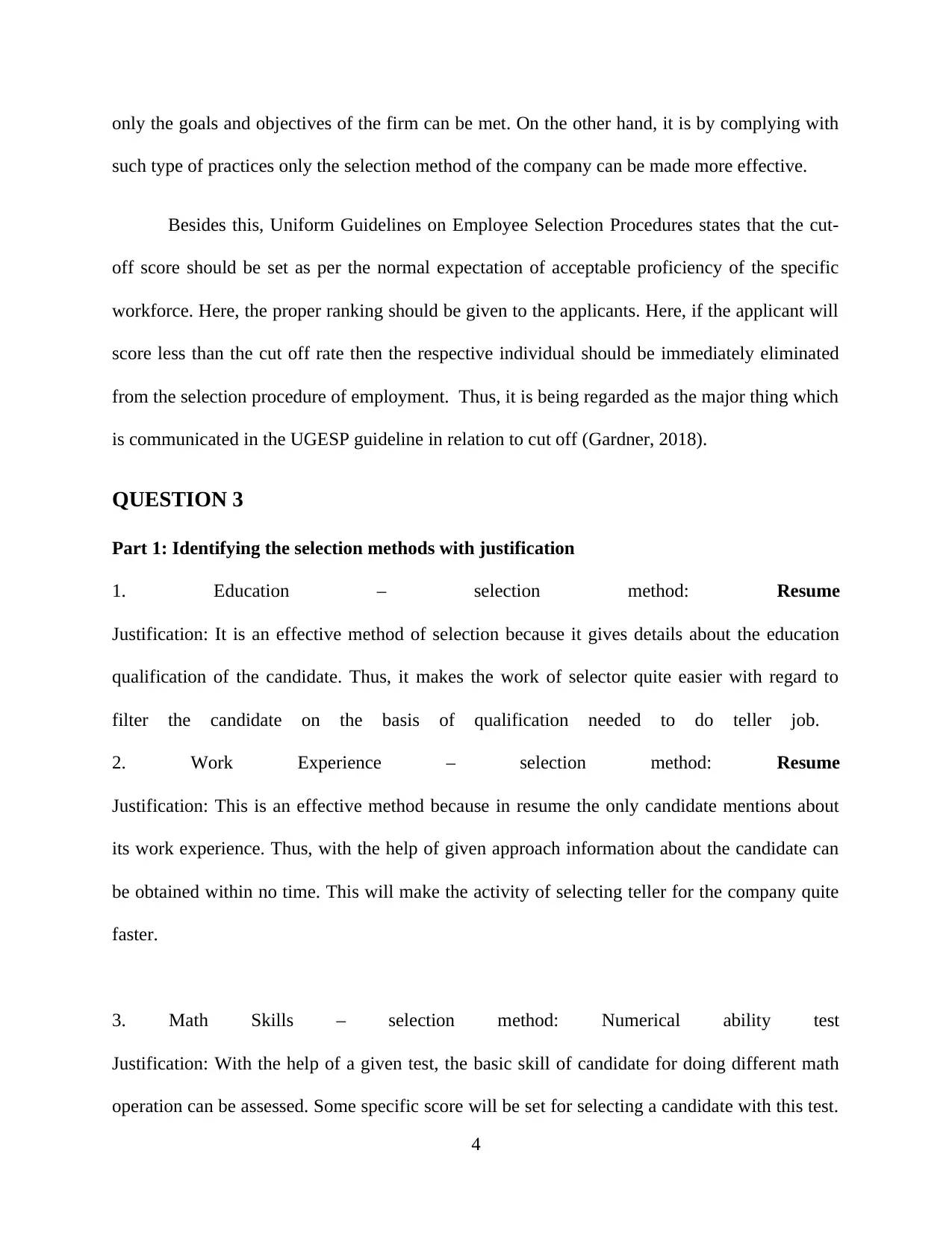
available pool. However, its reverse approach should be followed when the number of the
applicant who has applied for the job is very less. Thus, it is through a given type of measures
3
Document Page
only the goals and objectives of the firm can be met. On the other hand, it is by complying with
such type of practices only the selection method of the company can be made more effective.
Besides this, Uniform Guidelines on Employee Selection Procedures states that the cut-
off score should be set as per the normal expectation of acceptable proficiency of the specific
workforce. Here, the proper ranking should be given to the applicants. Here, if the applicant will
score less than the cut off rate then the respective individual should be immediately eliminated
from the selection procedure of employment. Thus, it is being regarded as the major thing which
is communicated in the UGESP guideline in relation to cut off (Gardner, 2018).
QUESTION 3
Part 1: Identifying the selection methods with justification
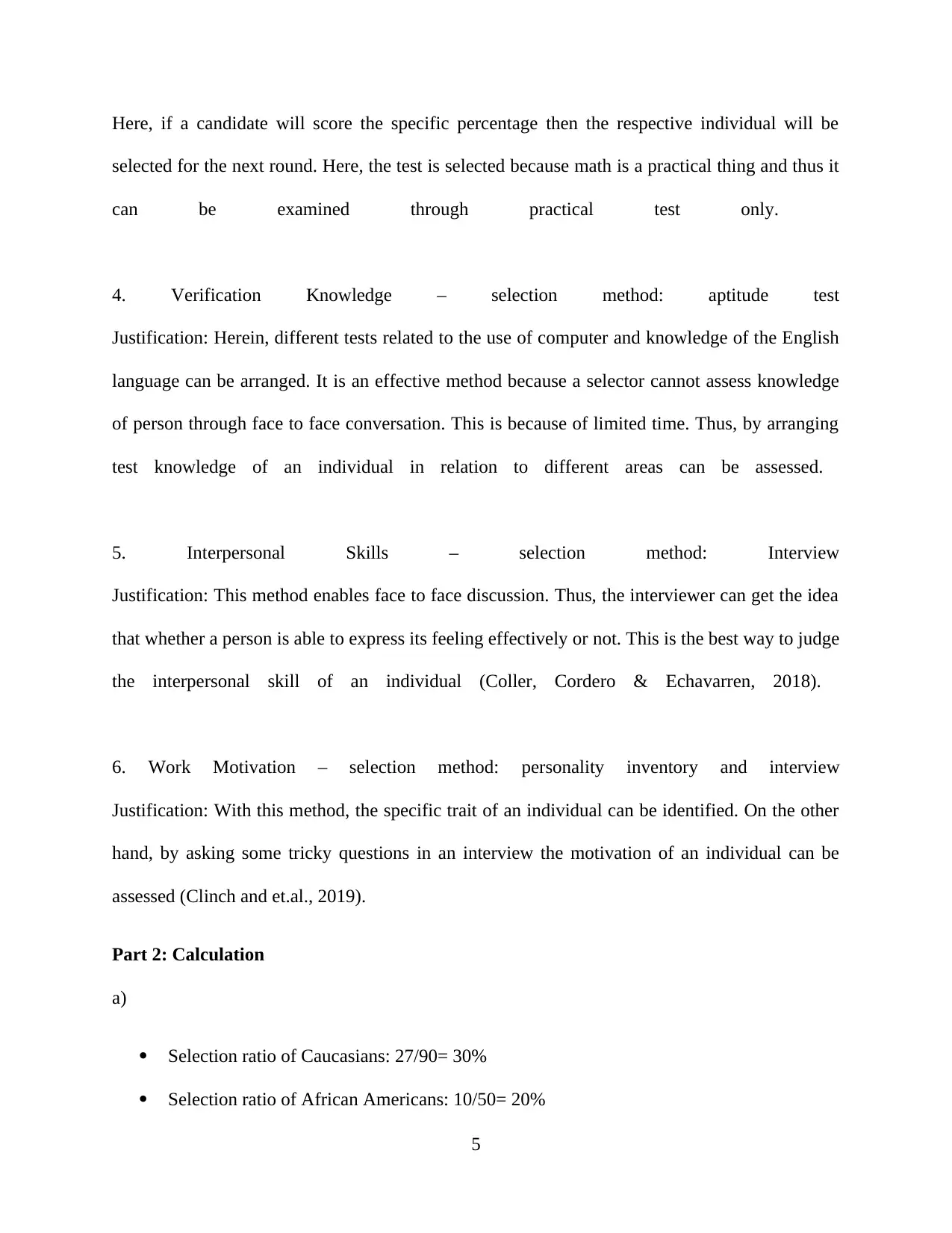
1. Education selection method: Resume
Justification: It is an effective method of selection because it gives details about the education
qualification of the candidate. Thus, it makes the work of selector quite easier with regard to
filter the candidate on the basis of qualification needed to do teller job.
2. Work Experience selection method: Resume
Justification: This is an effective method because in resume the only candidate mentions about
its work experience. Thus, with the help of given approach information about the candidate can
be obtained within no time. This will make the activity of selecting teller for the company quite
faster.
3. Math Skills selection method: Numerical ability test
Justification: With the help of a given test, the basic skill of candidate for doing different math
operation can be assessed. Some specific score will be set for selecting a candidate with this test.
4
Document Page
Here, if a candidate will score the specific percentage then the respective individual will be
selected for the next round. Here, the test is selected because math is a practical thing and thus it
can be examined through practical test only.
4. Verification Knowledge selection method: aptitude test
Justification: Herein, different tests related to the use of computer and knowledge of the English
language can be arranged. It is an effective method because a selector cannot assess knowledge
of person through face to face conversation. This is because of limited time. Thus, by arranging
test knowledge of an individual in relation to different areas can be assessed.
5. Interpersonal Skills selection method: Interview
Justification: This method enables face to face discussion. Thus, the interviewer can get the idea
that whether a person is able to express its feeling effectively or not. This is the best way to judge
the interpersonal skill of an individual (Coller, Cordero & Echavarren, 2018).
6. Work Motivation selection method: personality inventory and interview
Justification: With this method, the specific trait of an individual can be identified. On the other
hand, by asking some tricky questions in an interview the motivation of an individual can be
assessed (Clinch and et.al., 2019).
Part 2: Calculation
a)
Selection ratio of Caucasians: 27/90= 30%
Selection ratio of African Americans: 10/50= 20%
5
tabler-icon-diamond-filled.svg

Paraphrase This Document

Need a fresh take? Get an instant paraphrase of this document with our AI Paraphraser
Document Page
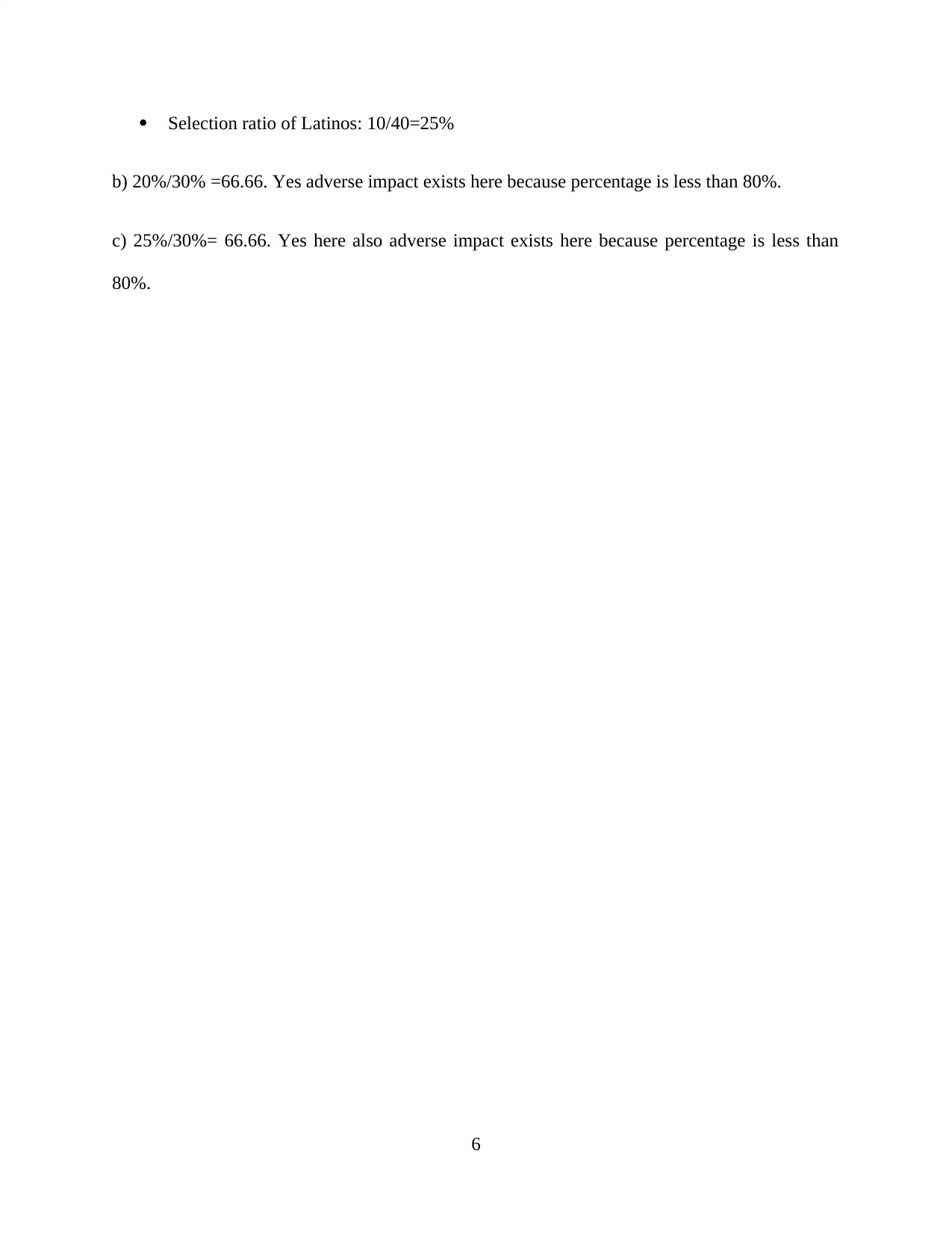
Selection ratio of Latinos: 10/40=25%
b) 20%/30% =66.66. Yes adverse impact exists here because percentage is less than 80%.
c) 25%/30%= 66.66. Yes here also adverse impact exists here because percentage is less than
80%.
6
Document Page
REFERENCE
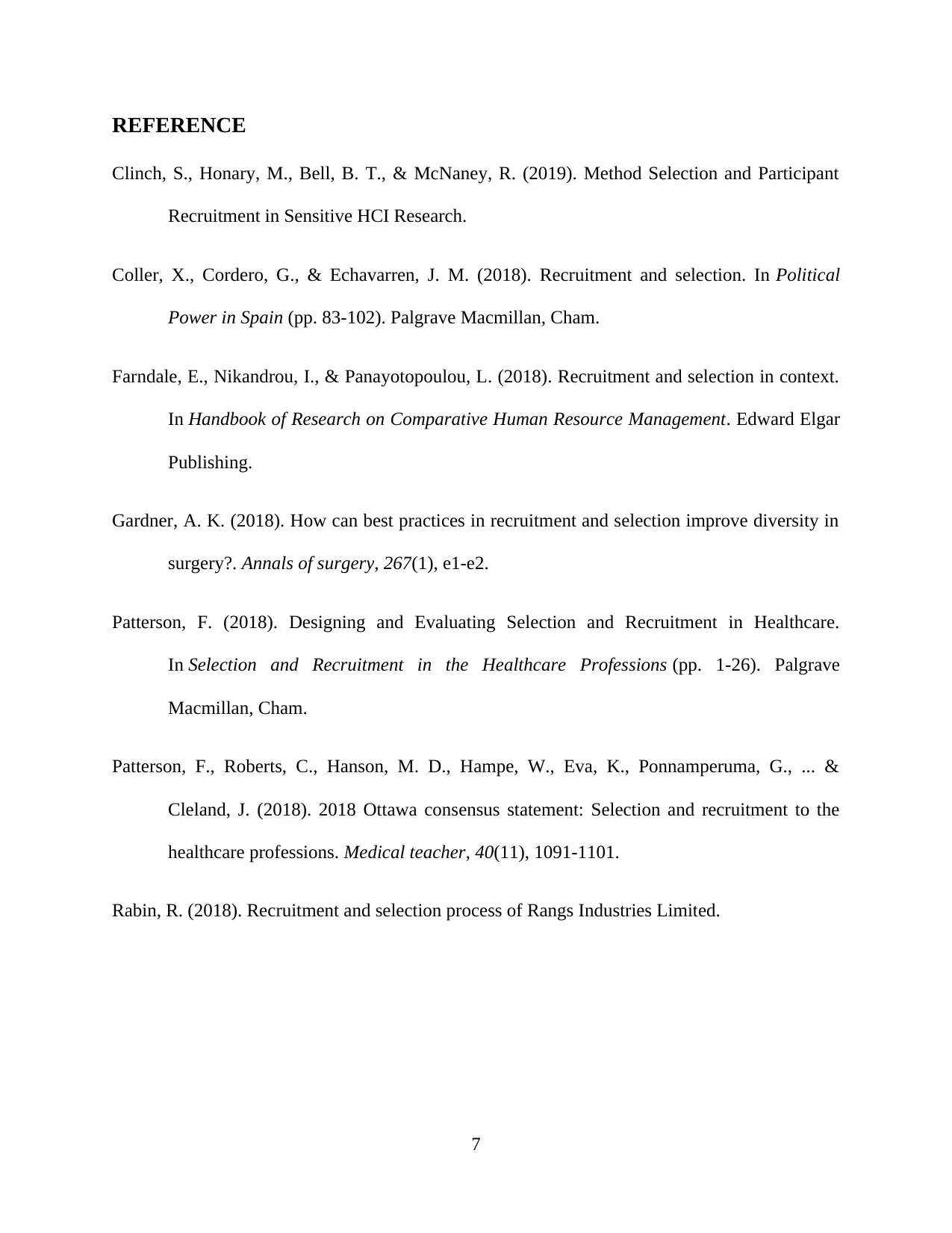
Clinch, S., Honary, M., Bell, B. T., & McNaney, R. (2019). Method Selection and Participant
Recruitment in Sensitive HCI Research.
Coller, X., Cordero, G., & Echavarren, J. M. (2018). Recruitment and selection. In Political
Power in Spain (pp. 83-102). Palgrave Macmillan, Cham.
Farndale, E., Nikandrou, I., & Panayotopoulou, L. (2018). Recruitment and selection in context.
In Handbook of Research on Comparative Human Resource Management. Edward Elgar
Publishing.
Gardner, A. K. (2018). How can best practices in recruitment and selection improve diversity in
surgery?. Annals of surgery, 267(1), e1-e2.
Patterson, F. (2018). Designing and Evaluating Selection and Recruitment in Healthcare.
In Selection and Recruitment in the Healthcare Professions (pp. 1-26). Palgrave
Macmillan, Cham.
Patterson, F., Roberts, C., Hanson, M. D., Hampe, W., Eva, K., Ponnamperuma, G., ... &
Cleland, J. (2018). 2018 Ottawa consensus statement: Selection and recruitment to the
healthcare professions. Medical teacher, 40(11), 1091-1101.
Rabin, R. (2018). Recruitment and selection process of Rangs Industries Limited.
7
chevron_up_icon
1 out of 9
circle_padding
hide_on_mobile
zoom_out_icon
[object Object]