Significance of Recruitment and Selection in Succession Planning
VerifiedAdded on 2020/01/28
|51
|19261
|119
Dissertation
AI Summary
This dissertation investigates the significance of recruitment and selection in organizational succession planning, using a case study of Company X. The study examines the practices involved in succession planning, the role of recruitment and selection within this process, and recommendations for improvement. The research delves into the current understanding of succession planning, particularly within the retail sector, highlighting the importance of strategic human resource functions in developing a competitive edge. The methodology includes a literature review, research design, data collection through interviews with company managers, thematic analysis, and ethical considerations. The findings aim to determine the impact of effective recruitment and selection on leadership development and overall organizational performance, offering insights into how companies can enhance their succession planning practices to build a strong leadership pipeline and achieve long-term business objectives. The study also addresses the challenges of time and cost associated with data collection.
Dissertation
Topic:
To Determine the Significance of Recruitment and Selection in the
Succession Planning of an Organization:
Case Study of Company X.
Topic:
To Determine the Significance of Recruitment and Selection in the
Succession Planning of an Organization:
Case Study of Company X.

Paraphrase This Document
Need a fresh take? Get an instant paraphrase of this document with our AI Paraphraser
TABLE OF CONTENTS
CHAPTER 1: INTRODUCTION....................................................................................................1
1.1 Background of the study...................................................................................................1
1.2 Research rationale............................................................................................................2
1.3 Research problem.............................................................................................................3
1.4 Research aims and objectives...........................................................................................4
1.5 Research questions...........................................................................................................4
CHAPTER 2: LITERATURE REVIEW.........................................................................................5
2.1 Introduction......................................................................................................................5
2.2 Practices involves in succession planning........................................................................5
2.3 The role of recruitment and selection in succession planning .......................................10
2.4 Ways to enhance succession planning practises ............................................................14
CHAPTER 3: RESEACH METHODOLOGY..............................................................................18
3.1 Introduction....................................................................................................................18
3.2 Research design..............................................................................................................18
3.3 Research philosophy.......................................................................................................19
3.4 Data collection................................................................................................................19
3.5 Research approach..........................................................................................................20
3.6 Sampling.........................................................................................................................21
3.7 Data analysis...................................................................................................................22
3.8 Reliability and validity...................................................................................................22
3.9 Ethical consideration......................................................................................................23
3.10 Research limitations.....................................................................................................24
CHAPTER 4: DATA ANALYSIS ...............................................................................................25
4.1 Introduction....................................................................................................................25
4.2 Thematic analysis...........................................................................................................25
CHAPTER 5: CONCLUSION AND RECOMMENDATIONS...................................................31
5.1 Introduction ...................................................................................................................31
5.2 Conclusion......................................................................................................................31
5.3 Recommendation............................................................................................................32
CHAPTER 1: INTRODUCTION....................................................................................................1
1.1 Background of the study...................................................................................................1
1.2 Research rationale............................................................................................................2
1.3 Research problem.............................................................................................................3
1.4 Research aims and objectives...........................................................................................4
1.5 Research questions...........................................................................................................4
CHAPTER 2: LITERATURE REVIEW.........................................................................................5
2.1 Introduction......................................................................................................................5
2.2 Practices involves in succession planning........................................................................5
2.3 The role of recruitment and selection in succession planning .......................................10
2.4 Ways to enhance succession planning practises ............................................................14
CHAPTER 3: RESEACH METHODOLOGY..............................................................................18
3.1 Introduction....................................................................................................................18
3.2 Research design..............................................................................................................18
3.3 Research philosophy.......................................................................................................19
3.4 Data collection................................................................................................................19
3.5 Research approach..........................................................................................................20
3.6 Sampling.........................................................................................................................21
3.7 Data analysis...................................................................................................................22
3.8 Reliability and validity...................................................................................................22
3.9 Ethical consideration......................................................................................................23
3.10 Research limitations.....................................................................................................24
CHAPTER 4: DATA ANALYSIS ...............................................................................................25
4.1 Introduction....................................................................................................................25
4.2 Thematic analysis...........................................................................................................25
CHAPTER 5: CONCLUSION AND RECOMMENDATIONS...................................................31
5.1 Introduction ...................................................................................................................31
5.2 Conclusion......................................................................................................................31
5.3 Recommendation............................................................................................................32

REFERENCES..............................................................................................................................34
APPENDIX....................................................................................................................................38
Interview Questions..............................................................................................................38
Transcript..............................................................................................................................39
APPENDIX....................................................................................................................................38
Interview Questions..............................................................................................................38
Transcript..............................................................................................................................39
⊘ This is a preview!⊘
Do you want full access?
Subscribe today to unlock all pages.

Trusted by 1+ million students worldwide
CHAPTER 1: INTRODUCTION
1.1 Background of the study
Globalization has made the business operations complex and highly competitive. Every
business unit in the present era focuses on developing a sustainable market position and develop
high growth and development aspects. Recruitment and selection functions play a crucial role in
the success of a business unit (Cappelli and Keller, 2014). Competitive workforce develops
internal strength for the business which will helps in enhancing working growth and profitability
within the environment. In the present era companies has developed strategic means of hiring
new employees and focus on enhancing their talent for the growth of the company. Strategies
such as succession planning, career development, international assignments, global leadership
has contributed widely in the success of business operations.
Retail market is one of the most volatile and dynamic industry of the economy. The level
of competition for the industry is high and fierce. Employees are the face of the companies who
widely contributes in attaining the core objectives of sales maximization and profitability.
Strategic human resource functions have helped the industry in developing a competitive edge in
the market (Galbraith, Smith and Walker, 2012). Succession planning is the process
implemented by the commercial units to enhance potential of employees for filling key
leadership positions in the business enterprise. This strategy has played a successful role in
organizational growth and development. The concept has widely been accepted in retail sector as
well because it helps the companies in motivating, developing and retaining the organizational
workforce. However Dries (2013), analysed a major issue which is that the organizational
management is unaware about the role of recruitment and selection process in successful
succession planning.
The present study will analyse and undertake an in-depth study to analyse and understand
the role of recruitment and selection in succession planning of the companies. To carry out the
research efficiently company X which is a well established retail giant of UK has been
undertaken In addition, the report will analyse different aspects of human resource functions and
identify its individual contribution for strategic business development. Application of theoretical
framework and strategic business analysis will help in determining the significance of
recruitment and selection in the succession planning of an organization.
1
1.1 Background of the study
Globalization has made the business operations complex and highly competitive. Every
business unit in the present era focuses on developing a sustainable market position and develop
high growth and development aspects. Recruitment and selection functions play a crucial role in
the success of a business unit (Cappelli and Keller, 2014). Competitive workforce develops
internal strength for the business which will helps in enhancing working growth and profitability
within the environment. In the present era companies has developed strategic means of hiring
new employees and focus on enhancing their talent for the growth of the company. Strategies
such as succession planning, career development, international assignments, global leadership
has contributed widely in the success of business operations.
Retail market is one of the most volatile and dynamic industry of the economy. The level
of competition for the industry is high and fierce. Employees are the face of the companies who
widely contributes in attaining the core objectives of sales maximization and profitability.
Strategic human resource functions have helped the industry in developing a competitive edge in
the market (Galbraith, Smith and Walker, 2012). Succession planning is the process
implemented by the commercial units to enhance potential of employees for filling key
leadership positions in the business enterprise. This strategy has played a successful role in
organizational growth and development. The concept has widely been accepted in retail sector as
well because it helps the companies in motivating, developing and retaining the organizational
workforce. However Dries (2013), analysed a major issue which is that the organizational
management is unaware about the role of recruitment and selection process in successful
succession planning.
The present study will analyse and undertake an in-depth study to analyse and understand
the role of recruitment and selection in succession planning of the companies. To carry out the
research efficiently company X which is a well established retail giant of UK has been
undertaken In addition, the report will analyse different aspects of human resource functions and
identify its individual contribution for strategic business development. Application of theoretical
framework and strategic business analysis will help in determining the significance of
recruitment and selection in the succession planning of an organization.
1
Paraphrase This Document
Need a fresh take? Get an instant paraphrase of this document with our AI Paraphraser
In modern era, employees are termed as one of the biggest assets of any organization. It
can be stated that two companies can have same technology and financial resources but what
makes one company differ from another is its human resources. Now a days succession planning
has become an integrated part of businesses overall strategies. It is very important for companies
to determine what are the practises involved in the process of succession planning (Galbraith,
Smith and Walker, 2012). One of the main advantage of this is that it will help in developing
some effective leaders for future. It has been also observed that recruitment and selection plays
an very important role in the overall process of such kind of planning. Recruitment is termed as
the process of inviting application for the vacant position in organization whereas selection is
defined as the choosing the best and most eligible candidate among the applicants. Succession
planning is the process in which companies develop human resources internally. Therefore, it
can be stated that process of recruitment and selection becomes very important as if a company
do not hire skilled and capable candidates then it becomes very difficult to choose the workers
which can be developed as future leaders. X company is one of the leading organization in retail
sector of the world. Further the company provides range of products and services to its
customers. It has been observed that the retail sector is highly competitive and it is not easy for
companies to retain their customers. Therefore, one of the best way to gain competitive edge
over other market players is to have a team of effective and highly productive employees. The
main reason behind selecting X company is that it will help in carrying out in depth analysis of
the role of recruitment and selection within organization. Other than this it will also help in
identifying some practices which has been adopted by X company for succession planning.
In order to collect the data, 10 managers of X company will be taken into consideration.
One of the major reason behind selecting the above stated sample is that the managers are the
one which takes care of the recruitment and selection process in organization. Further the
practices of succession planning are also determined by managers only. Thus, it can be stated
that five managers will be the most appropriate sample which will assist in getting most reliable
and accurate data regrading the topic of the study.
Other than this, it is also required by organizations to identify some of the ways through
which they can enhance their succession planning. This will increase overall productivity of
businesses and will also assists in getting competitive advantage in long run. The competition
among retail sector is so intense that most of the companies are finding it very difficult to
2
can be stated that two companies can have same technology and financial resources but what
makes one company differ from another is its human resources. Now a days succession planning
has become an integrated part of businesses overall strategies. It is very important for companies
to determine what are the practises involved in the process of succession planning (Galbraith,
Smith and Walker, 2012). One of the main advantage of this is that it will help in developing
some effective leaders for future. It has been also observed that recruitment and selection plays
an very important role in the overall process of such kind of planning. Recruitment is termed as
the process of inviting application for the vacant position in organization whereas selection is
defined as the choosing the best and most eligible candidate among the applicants. Succession
planning is the process in which companies develop human resources internally. Therefore, it
can be stated that process of recruitment and selection becomes very important as if a company
do not hire skilled and capable candidates then it becomes very difficult to choose the workers
which can be developed as future leaders. X company is one of the leading organization in retail
sector of the world. Further the company provides range of products and services to its
customers. It has been observed that the retail sector is highly competitive and it is not easy for
companies to retain their customers. Therefore, one of the best way to gain competitive edge
over other market players is to have a team of effective and highly productive employees. The
main reason behind selecting X company is that it will help in carrying out in depth analysis of
the role of recruitment and selection within organization. Other than this it will also help in
identifying some practices which has been adopted by X company for succession planning.
In order to collect the data, 10 managers of X company will be taken into consideration.
One of the major reason behind selecting the above stated sample is that the managers are the
one which takes care of the recruitment and selection process in organization. Further the
practices of succession planning are also determined by managers only. Thus, it can be stated
that five managers will be the most appropriate sample which will assist in getting most reliable
and accurate data regrading the topic of the study.
Other than this, it is also required by organizations to identify some of the ways through
which they can enhance their succession planning. This will increase overall productivity of
businesses and will also assists in getting competitive advantage in long run. The competition
among retail sector is so intense that most of the companies are finding it very difficult to
2
survive. Thus, effective and efficient human resources are the one which can provide competitive
edge to an organization and encourage people in market to choose its products and services over
other market players. The process of succession planning involves five major step and a
company needs to be very careful during each and every stage.
At the time of selecting people which can be developed as a future leaders companies
needs to have a fair and transparent policy. Further, they are also required to ensure the fact that
there is no biasness done employees and all are provided with equal opportunities for growth. It
is very essential for businesses to understand the role of recruitment and selection in succession
planning as, hiring skilled employees will help in implementing the plan in desired manner.
Along with this, it will also assist organizations in getting desirable and most favourable
outcomes.
1.2 Research rationale
Employee engagement in organizational planning and development has helped the
companies in creating a well developed impact on growth aspects of the firms. Global factors
and employee efficiency is developed through processes such as succession planning, career
development etc (Gilding, Gregory and Cosson, 2015). Analysing the role of recruitment and
selection process in these processes will help the businesses in enhancing business efficiency and
competitiveness. The present research will identify what role does the process of recruitment and
selection plays in the succession planning. It has been critically analysed that hiring right person
for right job and developing them effectively helps in enhancing organizational performance for
future (Durst and Wilhelm, 2012). However management in the present have not developed a
significant link between the process of employee recruitment and succession planning.
Companies treat the two process individually rather that one integrated process. Companies by
understanding the link between succession planning and recruitment and selection process may
develop strategic growth aspects for business units. The report will investigate the proposed
aspects in order to determine the he significance of recruitment and selection in the succession
planning of an organization and its impact on organizational performance as well. The main
purpose behind carrying out this research will be to identify what role does the process of
recruitment and selection plays in the succession planning. It has been observed that companies
are required to be very careful at the time of hiring employees. Further organizations needs to
focus on bigger picture at the time of selecting candidates. When succession planning is made,
3
edge to an organization and encourage people in market to choose its products and services over
other market players. The process of succession planning involves five major step and a
company needs to be very careful during each and every stage.
At the time of selecting people which can be developed as a future leaders companies
needs to have a fair and transparent policy. Further, they are also required to ensure the fact that
there is no biasness done employees and all are provided with equal opportunities for growth. It
is very essential for businesses to understand the role of recruitment and selection in succession
planning as, hiring skilled employees will help in implementing the plan in desired manner.
Along with this, it will also assist organizations in getting desirable and most favourable
outcomes.
1.2 Research rationale
Employee engagement in organizational planning and development has helped the
companies in creating a well developed impact on growth aspects of the firms. Global factors
and employee efficiency is developed through processes such as succession planning, career
development etc (Gilding, Gregory and Cosson, 2015). Analysing the role of recruitment and
selection process in these processes will help the businesses in enhancing business efficiency and
competitiveness. The present research will identify what role does the process of recruitment and
selection plays in the succession planning. It has been critically analysed that hiring right person
for right job and developing them effectively helps in enhancing organizational performance for
future (Durst and Wilhelm, 2012). However management in the present have not developed a
significant link between the process of employee recruitment and succession planning.
Companies treat the two process individually rather that one integrated process. Companies by
understanding the link between succession planning and recruitment and selection process may
develop strategic growth aspects for business units. The report will investigate the proposed
aspects in order to determine the he significance of recruitment and selection in the succession
planning of an organization and its impact on organizational performance as well. The main
purpose behind carrying out this research will be to identify what role does the process of
recruitment and selection plays in the succession planning. It has been observed that companies
are required to be very careful at the time of hiring employees. Further organizations needs to
focus on bigger picture at the time of selecting candidates. When succession planning is made,
3
⊘ This is a preview!⊘
Do you want full access?
Subscribe today to unlock all pages.
Trusted by 1+ million students worldwide
the existing leaders select some personnels and then train them to become future leaders.
Therefore, companies need to ensure the fact that only those candidates which are qualified and
have right amount of skill set are selected.
1.3 Research problem
Companies in the present era has analysed the significance of employees and their
contribution towards the success of the organization. Recruitment and selection plays a
significant role in human resource management functions such as succession planning. It has
been evaluated that companies are unaware about the role of recruitment and selection in
succession planning which has restricted the integration of the business process in an effective
manner. Companies are unable to attain the long term business objectives and leadership
planning through this which results in failure of the entire succession plan and creates huge loss
to entire organization. This research will help organizations in understanding the role of
recruitment and selection in succession planning. The issue here is that most of the companies
are not aware about the role and significance of recruitment and selection in succession planning.
Further most of the organizations hire candidates by keeping short term objectives in mind. At
the time of succession planning it becomes very difficult for businesses to determine potential
employees who can be trained and developed as future leaders. Thus, it direct results in failure of
the entire succession plan and creates huge loss to entire organization. This research will help
organizations to understand the role of recruitment and selection in succession planning. In
addition to this, it will also help them to become aware about the practices involved in
succession planning and the ways through which companies can enhanced the same.
1.4 Research aims and objectives
The aim of the present study is “To determine the significance of recruitment and
selection in the succession planning of an organization”. In order to carry out the research
successfully the case analysis of company X has been taken into consideration. Research
objectives help in effectively structuring and formatting the research. Objectives for the present
study have been discussed henceforth.
Objectives:
To evaluate the practices involved in succession planning within organization.
To determine the role of recruitment and selection in succession planning in X company
4
Therefore, companies need to ensure the fact that only those candidates which are qualified and
have right amount of skill set are selected.
1.3 Research problem
Companies in the present era has analysed the significance of employees and their
contribution towards the success of the organization. Recruitment and selection plays a
significant role in human resource management functions such as succession planning. It has
been evaluated that companies are unaware about the role of recruitment and selection in
succession planning which has restricted the integration of the business process in an effective
manner. Companies are unable to attain the long term business objectives and leadership
planning through this which results in failure of the entire succession plan and creates huge loss
to entire organization. This research will help organizations in understanding the role of
recruitment and selection in succession planning. The issue here is that most of the companies
are not aware about the role and significance of recruitment and selection in succession planning.
Further most of the organizations hire candidates by keeping short term objectives in mind. At
the time of succession planning it becomes very difficult for businesses to determine potential
employees who can be trained and developed as future leaders. Thus, it direct results in failure of
the entire succession plan and creates huge loss to entire organization. This research will help
organizations to understand the role of recruitment and selection in succession planning. In
addition to this, it will also help them to become aware about the practices involved in
succession planning and the ways through which companies can enhanced the same.
1.4 Research aims and objectives
The aim of the present study is “To determine the significance of recruitment and
selection in the succession planning of an organization”. In order to carry out the research
successfully the case analysis of company X has been taken into consideration. Research
objectives help in effectively structuring and formatting the research. Objectives for the present
study have been discussed henceforth.
Objectives:
To evaluate the practices involved in succession planning within organization.
To determine the role of recruitment and selection in succession planning in X company
4
Paraphrase This Document
Need a fresh take? Get an instant paraphrase of this document with our AI Paraphraser
To recommended ways through which X company can enhance its succession planning
practices
1.5 Research questions
In order to attain the research aim for the study in a successful manner, research questions
are developed. They help the researcher in managing the research objectives and minimize the
risk of deviating from the aim. The research questions for the present study are as follows:
What practices effect the succession planning in the business unit?
How does recruitment and selection affect succession planning of the company?
What are the ways through which practices of succession planning can be enhanced?
Limitations and challenges
The scholar will face some limitations and challenges at the time of data collection. One
of the major among those will be time. It can be stated that the data will be collected by the
managers of X company regarding the significance of recruitment and selection in the succession
planning of an organization. Thus, approaching five manager will take lot of time which is one of
the major limitation. Other than this, cost is another limitation as it can be said that approaching
and collecting data form the managers of X company will be costly. Therefore, it can be said that
time and cost will be the two major limitations of this research. Other than this, may be possible
that the managers of company may disagree to provide information. In such situation the aim and
objectives of the research will be communicated to managers.
5
practices
1.5 Research questions
In order to attain the research aim for the study in a successful manner, research questions
are developed. They help the researcher in managing the research objectives and minimize the
risk of deviating from the aim. The research questions for the present study are as follows:
What practices effect the succession planning in the business unit?
How does recruitment and selection affect succession planning of the company?
What are the ways through which practices of succession planning can be enhanced?
Limitations and challenges
The scholar will face some limitations and challenges at the time of data collection. One
of the major among those will be time. It can be stated that the data will be collected by the
managers of X company regarding the significance of recruitment and selection in the succession
planning of an organization. Thus, approaching five manager will take lot of time which is one of
the major limitation. Other than this, cost is another limitation as it can be said that approaching
and collecting data form the managers of X company will be costly. Therefore, it can be said that
time and cost will be the two major limitations of this research. Other than this, may be possible
that the managers of company may disagree to provide information. In such situation the aim and
objectives of the research will be communicated to managers.
5
CHAPTER 2: LITERATURE REVIEW
2.1 Introduction
In this part of dissertation it focuses upon the views and opinions of different authors so
that best results can be carried out. Further, through identifying the opinions of different authors,
it helps researcher to improve its skills and knowledge regarding the research topic. It involves
different researches in order to assess the literature and assess crucial information in order to
carry out the study. With the help of literature review it assists in filling the gap that has been
identified within the previous studies (Boella and Goss-Turner, 2013). It also examines the views
and opinions of researcher in critical manner so that strong subject base can be developed which
can be reviewed by the researcher in future time. In the current literature review it covers the
different section that involves the practices of succession planning, role of recruitment and
selection and improves the succession planning practices. It is one of the most important chapters
of dissertation which highlights the views and opinions of various author. It can be stated that,
Literature review play a significant role in getting favourable outcomes for the study. Other than
this, by understanding the view of various authors, a scholar enhances his knowledge regarding
the topic of the study. Some of the major topic which has been covered in this section are
practices involved in succession planning, role of recruitment and selection along with ways to
enhance succession planning practices.
2.2 Practices involves in succession planning
According to the opinion of McCracken, Currie and Harrison (2015), succession planning
can be termed as the process of assessing and evaluating the skills and abilities of internal
employees of firm in order to fill the business leadership positions. Thus, it helps in improving
the availability of experiences and capable workers who are ready to undertake such roles and
thus overcome the issues faced by the organization (McCracken, Currie and Harrison, 2015). It is
a crucial decision which needs to be taken by the top management of firm in order to attain
growth and success of firm. However, O'Meara (2013), argued that succession planning is a
useful method that helps firm to develop strong relationship among employees and management
in order to bring continuous growth and success. Succession planning is carried out which helps
in improving the connection of employees as they are able to plan and design its growth level in
order to enhance success. Through adopting such method of internal filling of job vacancies
6
2.1 Introduction
In this part of dissertation it focuses upon the views and opinions of different authors so
that best results can be carried out. Further, through identifying the opinions of different authors,
it helps researcher to improve its skills and knowledge regarding the research topic. It involves
different researches in order to assess the literature and assess crucial information in order to
carry out the study. With the help of literature review it assists in filling the gap that has been
identified within the previous studies (Boella and Goss-Turner, 2013). It also examines the views
and opinions of researcher in critical manner so that strong subject base can be developed which
can be reviewed by the researcher in future time. In the current literature review it covers the
different section that involves the practices of succession planning, role of recruitment and
selection and improves the succession planning practices. It is one of the most important chapters
of dissertation which highlights the views and opinions of various author. It can be stated that,
Literature review play a significant role in getting favourable outcomes for the study. Other than
this, by understanding the view of various authors, a scholar enhances his knowledge regarding
the topic of the study. Some of the major topic which has been covered in this section are
practices involved in succession planning, role of recruitment and selection along with ways to
enhance succession planning practices.
2.2 Practices involves in succession planning
According to the opinion of McCracken, Currie and Harrison (2015), succession planning
can be termed as the process of assessing and evaluating the skills and abilities of internal
employees of firm in order to fill the business leadership positions. Thus, it helps in improving
the availability of experiences and capable workers who are ready to undertake such roles and
thus overcome the issues faced by the organization (McCracken, Currie and Harrison, 2015). It is
a crucial decision which needs to be taken by the top management of firm in order to attain
growth and success of firm. However, O'Meara (2013), argued that succession planning is a
useful method that helps firm to develop strong relationship among employees and management
in order to bring continuous growth and success. Succession planning is carried out which helps
in improving the connection of employees as they are able to plan and design its growth level in
order to enhance success. Through adopting such method of internal filling of job vacancies
6
⊘ This is a preview!⊘
Do you want full access?
Subscribe today to unlock all pages.
Trusted by 1+ million students worldwide
through transfers and promotions it helps business to save a lot of time and cost and thus ensures
to achieve desired objectives effectively and efficiently (O'Meara, 2013).
As per the view of Armstrong and Taylor (2014), it is essential for each and every
organization to possess certain leaders in order to lead the business enterprise and assists
workforce in regard to achieve organization aims and objectives. Main benefit of succession
planning is to assess the capable and skilled employees within business and provide them
opportunities in order to flourish their talent through becoming leaders (Armstrong and Taylor,
2014). However, Lounsbury and et. al., (2016), argued that in the process of succession planning
seniors leaders are personally gets involved which assist businesses to get the desired results. In
addition to this, all the senior leader takes responsibility of growing some new leaders within
workplace which is very beneficial for the growth of company. It assesses that top management
works with other level workers in order to plan their succession so that they can enhance their
business opportunity towards growth level. Now a days succession planning has become one of
the most important and integrated part of businesses overall strategies (Lounsbury and et. al.,
2016). Along with this, it has been also identified that it encourages employees to give their best
efforts as they start thinking that their organization is really taking care of them.
Furthermore, the process of succession planning involves senior management leaders in
order to develop a working relationship with human resources. Thus, it helps leaders in
understanding the practices of individuals and provides them the best guidance so that they can
improve their skills and obtain high positions. However, Verma, Verma and Srivastava (2014),
argued that the effectiveness of such kind of planning depends on the short and long terms goals
of businesses. Succession planning within business identifies the skills and competencies of
individuals so that they can enhance their job role within firm. The process of succession
planning includes six key stages which are identification of key positions, identification of
competencies, identification of potential candidates, framing of learning and development plan
and implementation and evaluation of the plan (Verma, Verma and Srivastava, 2014). During the
first stage the key positions of within companies are identified and two important things which
are required to be taken into consideration are retention rate and criticality. Organizations are
required to ensure the fact that their key positions are not vacant as it will directly lower down
the overall productivity and efficiency of business. As per the view of Cappelli and Keller
7
to achieve desired objectives effectively and efficiently (O'Meara, 2013).
As per the view of Armstrong and Taylor (2014), it is essential for each and every
organization to possess certain leaders in order to lead the business enterprise and assists
workforce in regard to achieve organization aims and objectives. Main benefit of succession
planning is to assess the capable and skilled employees within business and provide them
opportunities in order to flourish their talent through becoming leaders (Armstrong and Taylor,
2014). However, Lounsbury and et. al., (2016), argued that in the process of succession planning
seniors leaders are personally gets involved which assist businesses to get the desired results. In
addition to this, all the senior leader takes responsibility of growing some new leaders within
workplace which is very beneficial for the growth of company. It assesses that top management
works with other level workers in order to plan their succession so that they can enhance their
business opportunity towards growth level. Now a days succession planning has become one of
the most important and integrated part of businesses overall strategies (Lounsbury and et. al.,
2016). Along with this, it has been also identified that it encourages employees to give their best
efforts as they start thinking that their organization is really taking care of them.
Furthermore, the process of succession planning involves senior management leaders in
order to develop a working relationship with human resources. Thus, it helps leaders in
understanding the practices of individuals and provides them the best guidance so that they can
improve their skills and obtain high positions. However, Verma, Verma and Srivastava (2014),
argued that the effectiveness of such kind of planning depends on the short and long terms goals
of businesses. Succession planning within business identifies the skills and competencies of
individuals so that they can enhance their job role within firm. The process of succession
planning includes six key stages which are identification of key positions, identification of
competencies, identification of potential candidates, framing of learning and development plan
and implementation and evaluation of the plan (Verma, Verma and Srivastava, 2014). During the
first stage the key positions of within companies are identified and two important things which
are required to be taken into consideration are retention rate and criticality. Organizations are
required to ensure the fact that their key positions are not vacant as it will directly lower down
the overall productivity and efficiency of business. As per the view of Cappelli and Keller
7
Paraphrase This Document
Need a fresh take? Get an instant paraphrase of this document with our AI Paraphraser
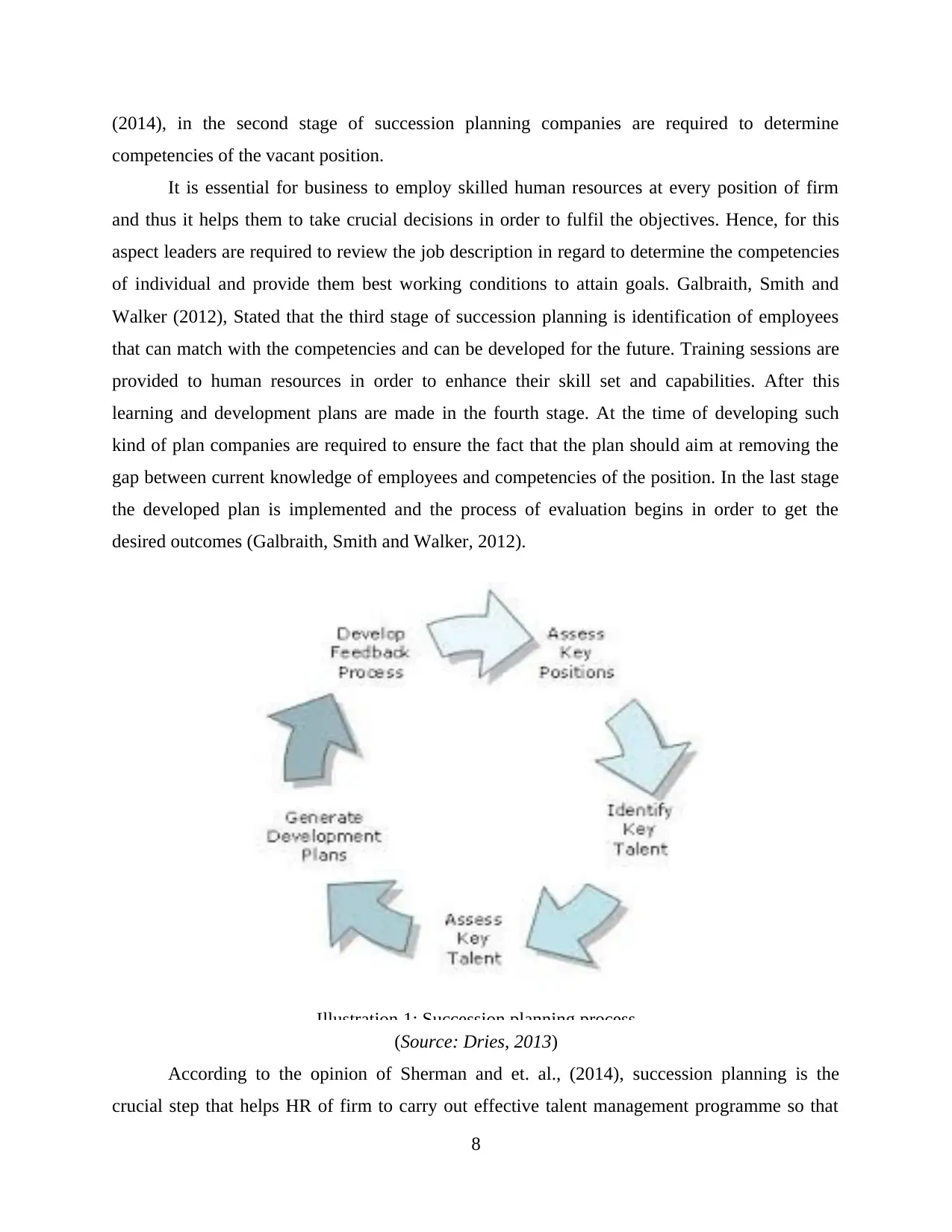
(2014), in the second stage of succession planning companies are required to determine
competencies of the vacant position.
It is essential for business to employ skilled human resources at every position of firm
and thus it helps them to take crucial decisions in order to fulfil the objectives. Hence, for this
aspect leaders are required to review the job description in regard to determine the competencies
of individual and provide them best working conditions to attain goals. Galbraith, Smith and
Walker (2012), Stated that the third stage of succession planning is identification of employees
that can match with the competencies and can be developed for the future. Training sessions are
provided to human resources in order to enhance their skill set and capabilities. After this
learning and development plans are made in the fourth stage. At the time of developing such
kind of plan companies are required to ensure the fact that the plan should aim at removing the
gap between current knowledge of employees and competencies of the position. In the last stage
the developed plan is implemented and the process of evaluation begins in order to get the
desired outcomes (Galbraith, Smith and Walker, 2012).
(Source: Dries, 2013)
According to the opinion of Sherman and et. al., (2014), succession planning is the
crucial step that helps HR of firm to carry out effective talent management programme so that
8
Illustration 1: Succession planning process
competencies of the vacant position.
It is essential for business to employ skilled human resources at every position of firm
and thus it helps them to take crucial decisions in order to fulfil the objectives. Hence, for this
aspect leaders are required to review the job description in regard to determine the competencies
of individual and provide them best working conditions to attain goals. Galbraith, Smith and
Walker (2012), Stated that the third stage of succession planning is identification of employees
that can match with the competencies and can be developed for the future. Training sessions are
provided to human resources in order to enhance their skill set and capabilities. After this
learning and development plans are made in the fourth stage. At the time of developing such
kind of plan companies are required to ensure the fact that the plan should aim at removing the
gap between current knowledge of employees and competencies of the position. In the last stage
the developed plan is implemented and the process of evaluation begins in order to get the
desired outcomes (Galbraith, Smith and Walker, 2012).
(Source: Dries, 2013)
According to the opinion of Sherman and et. al., (2014), succession planning is the
crucial step that helps HR of firm to carry out effective talent management programme so that
8
Illustration 1: Succession planning process
skilled and potential candidates can be identified and provide them opportunities to showcase
their talent. It helps in providing individuals to different job positions within organization so that
they can improve their ability and attain desired success (Sherman and et. al., 2014). Main aim of
adopting succession planning within organization helps leaders to identify internal talents and
provide them opportunities through transfers and promotions to capture leadership positions.
However, Gilding, Gregory and Cosson (2015), argued that it is the best method as compared to
external recruitment technique and also saves a lot of time and cost of company to recruit skilled
and potential candidates for vacant positions. Top management undertakes effective external
recruitment methods such as new talent from outside, recruitment agencies etc. which helps in
attracting best talents and plan succession planning towards business success. Thus, top
management carries out internal recruitment and fills the job positions in order to attain growth
and success within firm (Gilding, Gregory and Cosson, 2015).
Further, it is also essential for managers to carry out succession planning process as it
helps firm to manage talent within enterprise and thus retain them for long term within firm. It is
the best method through which potential candidates who are dissatisfied from their promotion
and recognition given by firm can be motivated through succession planning. Also, management
is required to involve employees in decision making so that suitable employees could be moved
forward towards the leadership position and attain desired success (Durst and Wilhelm, 2012). It
helps in maintaining flexible working environment within organization and provides best
practices to employees to accomplish organizational goals.
Succession planning is termed as the decision and action plan taken by organization to promote
the development of human resources within organization. In modern era, it has become very
essential for the growth and success of companies. As per the view of Armstrong and Taylor,
(2014) succession planning is a approach using which businesses try to build leadership pipeline
to ensure the continuity of leadership within organization (Armstrong and Taylor, 2014). Every
company required some leaders which can lead its human resources and help in accomplishment
of its aim and objectives. One of the main advantage of such kind of planning is that it assists
company to identify capable employees and then develop them into most effective leaders. In
accordance with Zepeda, Bengtson and Parylo, (2012) in the process of succession planning
seniors leaders are personally gets involved which assist businesses to get the desired results (
Zepeda, Bengtson and Parylo, 2012). In addition to this, all the seniors’ leader takes
9
their talent. It helps in providing individuals to different job positions within organization so that
they can improve their ability and attain desired success (Sherman and et. al., 2014). Main aim of
adopting succession planning within organization helps leaders to identify internal talents and
provide them opportunities through transfers and promotions to capture leadership positions.
However, Gilding, Gregory and Cosson (2015), argued that it is the best method as compared to
external recruitment technique and also saves a lot of time and cost of company to recruit skilled
and potential candidates for vacant positions. Top management undertakes effective external
recruitment methods such as new talent from outside, recruitment agencies etc. which helps in
attracting best talents and plan succession planning towards business success. Thus, top
management carries out internal recruitment and fills the job positions in order to attain growth
and success within firm (Gilding, Gregory and Cosson, 2015).
Further, it is also essential for managers to carry out succession planning process as it
helps firm to manage talent within enterprise and thus retain them for long term within firm. It is
the best method through which potential candidates who are dissatisfied from their promotion
and recognition given by firm can be motivated through succession planning. Also, management
is required to involve employees in decision making so that suitable employees could be moved
forward towards the leadership position and attain desired success (Durst and Wilhelm, 2012). It
helps in maintaining flexible working environment within organization and provides best
practices to employees to accomplish organizational goals.
Succession planning is termed as the decision and action plan taken by organization to promote
the development of human resources within organization. In modern era, it has become very
essential for the growth and success of companies. As per the view of Armstrong and Taylor,
(2014) succession planning is a approach using which businesses try to build leadership pipeline
to ensure the continuity of leadership within organization (Armstrong and Taylor, 2014). Every
company required some leaders which can lead its human resources and help in accomplishment
of its aim and objectives. One of the main advantage of such kind of planning is that it assists
company to identify capable employees and then develop them into most effective leaders. In
accordance with Zepeda, Bengtson and Parylo, (2012) in the process of succession planning
seniors leaders are personally gets involved which assist businesses to get the desired results (
Zepeda, Bengtson and Parylo, 2012). In addition to this, all the seniors’ leader takes
9
⊘ This is a preview!⊘
Do you want full access?
Subscribe today to unlock all pages.
Trusted by 1+ million students worldwide

1 out of 51


Related Documents


Your All-in-One AI-Powered Toolkit for Academic Success.
+13062052269
info@desklib.com
Available 24*7 on WhatsApp / Email
![[object Object]](/_next/static/media/star-bottom.7253800d.svg)
Unlock your academic potential
Copyright © 2020–2026 A2Z Services. All Rights Reserved. Developed and managed by ZUCOL.