Marketing Proposal & Plan: Red Bull's Strategy in Australia (MKTG6002)
VerifiedAdded on 2020/03/01
|22
|4912
|115
Report
AI Summary
This report presents a comprehensive marketing plan for Red Bull in the Australian market, analyzing various facets crucial for its success. It begins with an introduction outlining the assignment's objectives, followed by an overview of Red Bull's credentials, including company background and market acquisition history. A detailed situation analysis is conducted, encompassing SMART objectives and market trends, particularly digitalization and sustainability. Environmental analysis, including SWOT and PEST analyses, provides insights into internal strengths and weaknesses, as well as external political, economic, social, and technological factors. The competitive strategy is evaluated using Porter's Five Forces. The marketing strategy is dissected through the 7Ps marketing mix and STP analysis, segmenting, targeting, and positioning the brand. The financial plan, including budget estimations, is also included. The report concludes with an evaluation of the marketing mix's impact on consumer behavior and the role of marketing in embedding sustainability and social justice principles. Finally, a reflexive activity discusses the outcomes of the social enterprise investigation.

MKTG6002 MARKETING
PROPOSAL MARKETING PLAN
STUDENT NAME
STUDENT ID
PROPOSAL MARKETING PLAN
STUDENT NAME
STUDENT ID

Paraphrase This Document
Need a fresh take? Get an instant paraphrase of this document with our AI Paraphraser
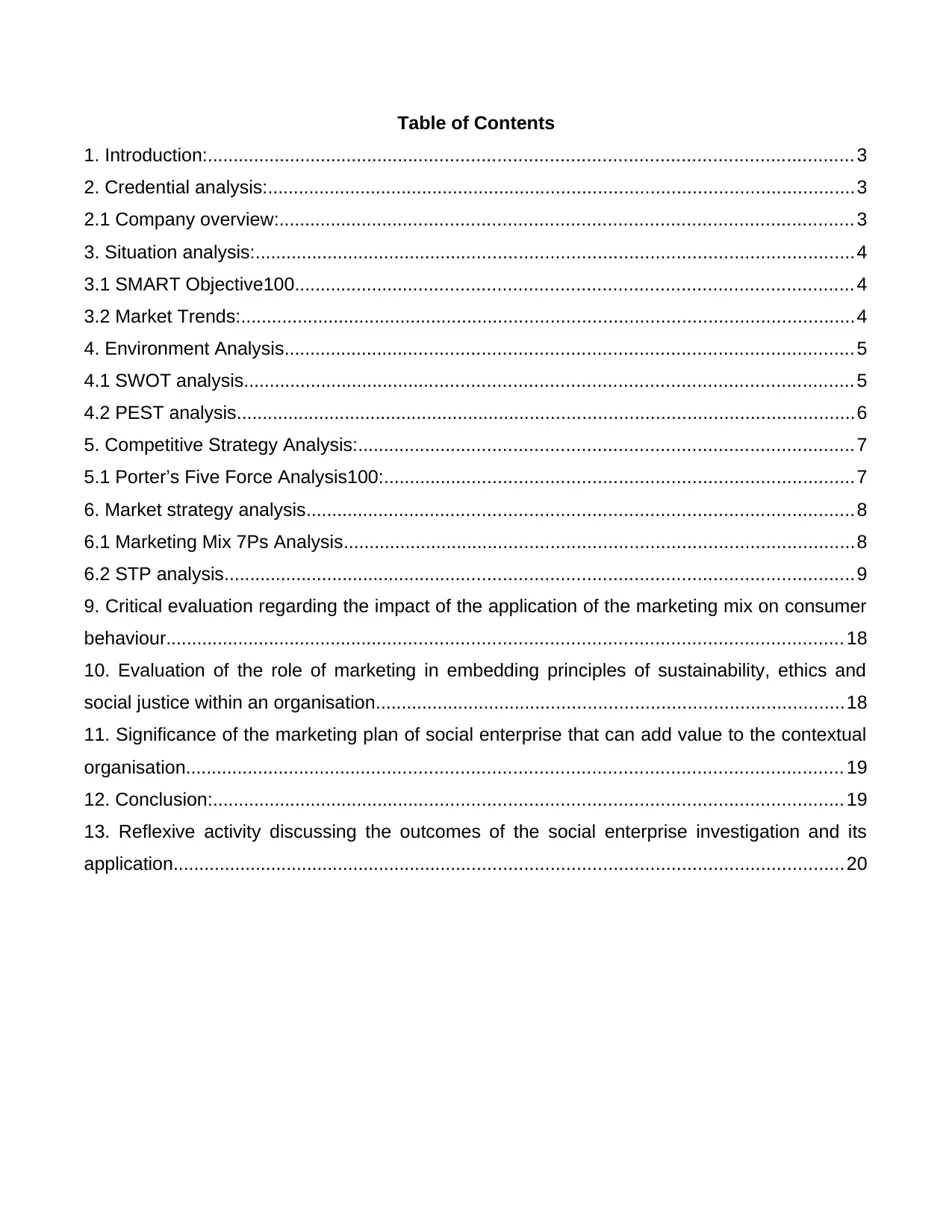
Table of Contents
1. Introduction:............................................................................................................................ 3
2. Credential analysis:.................................................................................................................3
2.1 Company overview:.............................................................................................................. 3
3. Situation analysis:...................................................................................................................4
3.1 SMART Objective100........................................................................................................... 4
3.2 Market Trends:......................................................................................................................4
4. Environment Analysis............................................................................................................. 5
4.1 SWOT analysis..................................................................................................................... 5
4.2 PEST analysis.......................................................................................................................6
5. Competitive Strategy Analysis:............................................................................................... 7
5.1 Porter’s Five Force Analysis100:..........................................................................................7
6. Market strategy analysis.........................................................................................................8
6.1 Marketing Mix 7Ps Analysis..................................................................................................8
6.2 STP analysis.........................................................................................................................9
9. Critical evaluation regarding the impact of the application of the marketing mix on consumer
behaviour.................................................................................................................................. 18
10. Evaluation of the role of marketing in embedding principles of sustainability, ethics and
social justice within an organisation..........................................................................................18
11. Significance of the marketing plan of social enterprise that can add value to the contextual
organisation.............................................................................................................................. 19
12. Conclusion:......................................................................................................................... 19
13. Reflexive activity discussing the outcomes of the social enterprise investigation and its
application.................................................................................................................................20
1. Introduction:............................................................................................................................ 3
2. Credential analysis:.................................................................................................................3
2.1 Company overview:.............................................................................................................. 3
3. Situation analysis:...................................................................................................................4
3.1 SMART Objective100........................................................................................................... 4
3.2 Market Trends:......................................................................................................................4
4. Environment Analysis............................................................................................................. 5
4.1 SWOT analysis..................................................................................................................... 5
4.2 PEST analysis.......................................................................................................................6
5. Competitive Strategy Analysis:............................................................................................... 7
5.1 Porter’s Five Force Analysis100:..........................................................................................7
6. Market strategy analysis.........................................................................................................8
6.1 Marketing Mix 7Ps Analysis..................................................................................................8
6.2 STP analysis.........................................................................................................................9
9. Critical evaluation regarding the impact of the application of the marketing mix on consumer
behaviour.................................................................................................................................. 18
10. Evaluation of the role of marketing in embedding principles of sustainability, ethics and
social justice within an organisation..........................................................................................18
11. Significance of the marketing plan of social enterprise that can add value to the contextual
organisation.............................................................................................................................. 19
12. Conclusion:......................................................................................................................... 19
13. Reflexive activity discussing the outcomes of the social enterprise investigation and its
application.................................................................................................................................20
1. Introduction:
The aim of this assignment is to understand the different aspects of a marketing plan. The
application of the marketing theory into a real life scenario is also covered in this assignment.
With a view to clearly understand the different theories and models associated with the
marketing, an illustration of the Red Bull in Australia is drawn. In the beginning of the
contextual marketing plan, the credentials of the chosen organisation are proffered which is
followed by the situation analysis as the evaluation of the SMART objective. As the assignment
precedes the environmental analysis, the competitive strategy analysis, marketing strategy
analysis, financial analysis as well as monitoring and control are discussed.
2. Credential analysis:
2.1 Company overview:
Figure 2: Red Bull Logo
(Source: Red Bull, 2017)
Red Bull GMbH is an Australian energy drink seller company that is established in the year
1987. In the due course of the history, the organisation has secured many a number of
achievements. As per the marketing statistics noted during the year of 2013 5.387 billion cans
have been sold (Gorse et al. 2017, p.12). The organisation slow but steadily acquire the global
market. At the present day, they are the market leader in the contextual sector of energy
drinks. Apart from manufacturing the energy drinks, the contextual organisation has marketed
a number of additional products such as publishing sports magazine and mobile phone
service. Their dedication helps them to achieve the huge success. Presently approximately 30
billion cans are sold in 160 countries (Red Bull, 2017). This is also considered as the best
sports drinks by many sports person.
Chronological list of market acquisition
Year Available in country Significant market
The aim of this assignment is to understand the different aspects of a marketing plan. The
application of the marketing theory into a real life scenario is also covered in this assignment.
With a view to clearly understand the different theories and models associated with the
marketing, an illustration of the Red Bull in Australia is drawn. In the beginning of the
contextual marketing plan, the credentials of the chosen organisation are proffered which is
followed by the situation analysis as the evaluation of the SMART objective. As the assignment
precedes the environmental analysis, the competitive strategy analysis, marketing strategy
analysis, financial analysis as well as monitoring and control are discussed.
2. Credential analysis:
2.1 Company overview:
Figure 2: Red Bull Logo
(Source: Red Bull, 2017)
Red Bull GMbH is an Australian energy drink seller company that is established in the year
1987. In the due course of the history, the organisation has secured many a number of
achievements. As per the marketing statistics noted during the year of 2013 5.387 billion cans
have been sold (Gorse et al. 2017, p.12). The organisation slow but steadily acquire the global
market. At the present day, they are the market leader in the contextual sector of energy
drinks. Apart from manufacturing the energy drinks, the contextual organisation has marketed
a number of additional products such as publishing sports magazine and mobile phone
service. Their dedication helps them to achieve the huge success. Presently approximately 30
billion cans are sold in 160 countries (Red Bull, 2017). This is also considered as the best
sports drinks by many sports person.
Chronological list of market acquisition
Year Available in country Significant market
⊘ This is a preview!⊘
Do you want full access?
Subscribe today to unlock all pages.

Trusted by 1+ million students worldwide
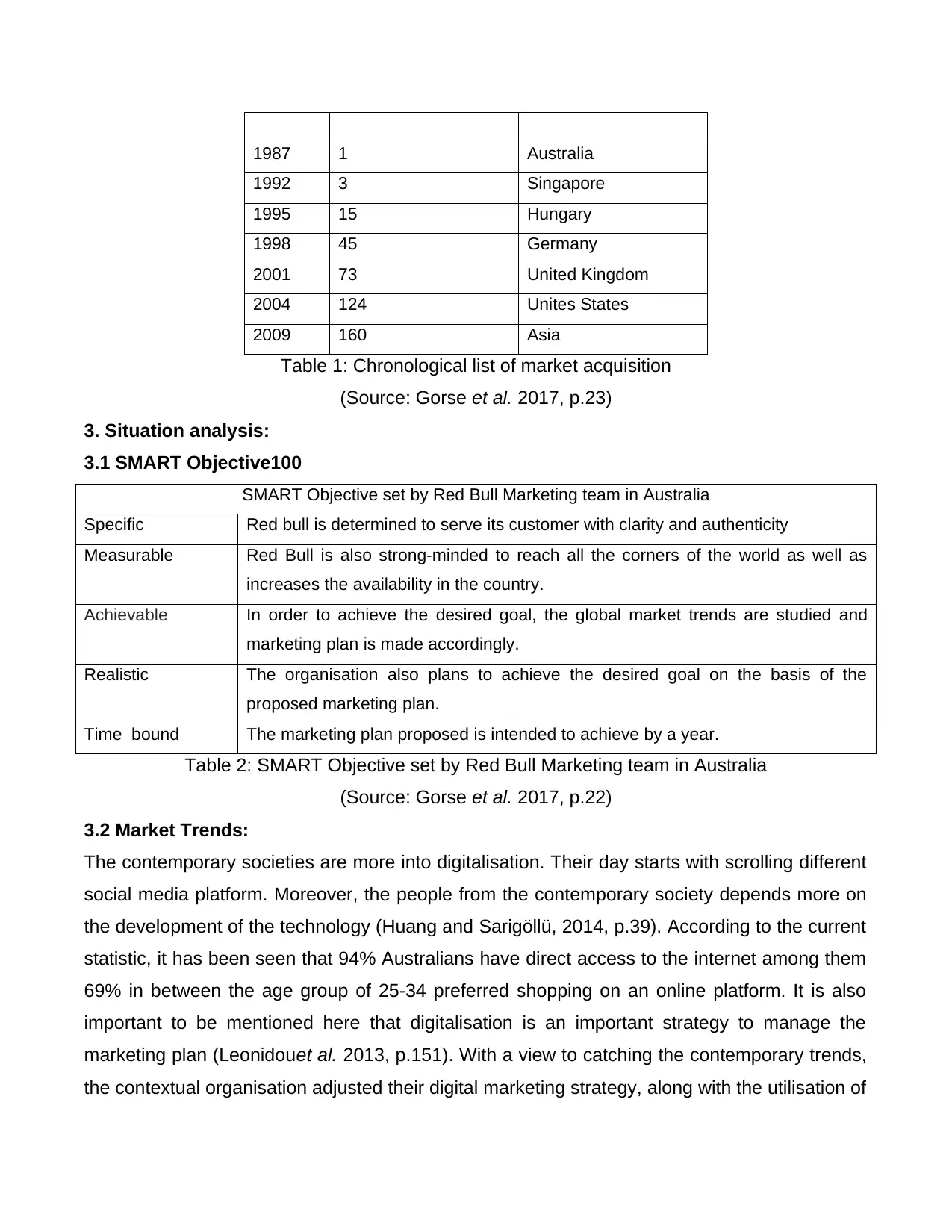
1987 1 Australia
1992 3 Singapore
1995 15 Hungary
1998 45 Germany
2001 73 United Kingdom
2004 124 Unites States
2009 160 Asia
Table 1: Chronological list of market acquisition
(Source: Gorse et al. 2017, p.23)
3. Situation analysis:
3.1 SMART Objective100
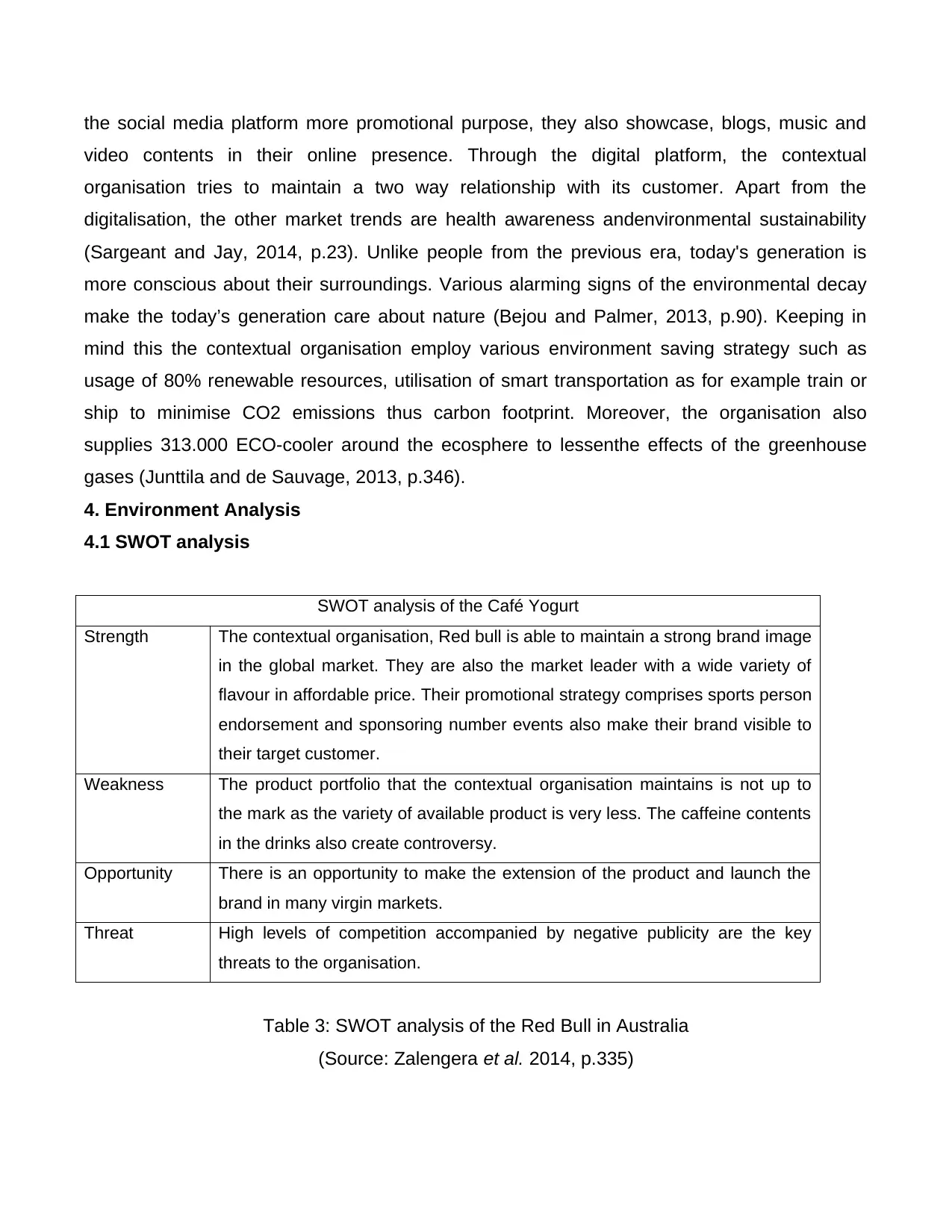
SMART Objective set by Red Bull Marketing team in Australia
Specific Red bull is determined to serve its customer with clarity and authenticity
Measurable Red Bull is also strong-minded to reach all the corners of the world as well as
increases the availability in the country.
Achievable In order to achieve the desired goal, the global market trends are studied and
marketing plan is made accordingly.
Realistic The organisation also plans to achieve the desired goal on the basis of the
proposed marketing plan.
Time bound The marketing plan proposed is intended to achieve by a year.
Table 2: SMART Objective set by Red Bull Marketing team in Australia
(Source: Gorse et al. 2017, p.22)
3.2 Market Trends:
The contemporary societies are more into digitalisation. Their day starts with scrolling different
social media platform. Moreover, the people from the contemporary society depends more on
the development of the technology (Huang and Sarigöllü, 2014, p.39). According to the current
statistic, it has been seen that 94% Australians have direct access to the internet among them
69% in between the age group of 25-34 preferred shopping on an online platform. It is also
important to be mentioned here that digitalisation is an important strategy to manage the
marketing plan (Leonidouet al. 2013, p.151). With a view to catching the contemporary trends,
the contextual organisation adjusted their digital marketing strategy, along with the utilisation of
1992 3 Singapore
1995 15 Hungary
1998 45 Germany
2001 73 United Kingdom
2004 124 Unites States
2009 160 Asia
Table 1: Chronological list of market acquisition
(Source: Gorse et al. 2017, p.23)
3. Situation analysis:
3.1 SMART Objective100
SMART Objective set by Red Bull Marketing team in Australia
Specific Red bull is determined to serve its customer with clarity and authenticity
Measurable Red Bull is also strong-minded to reach all the corners of the world as well as
increases the availability in the country.
Achievable In order to achieve the desired goal, the global market trends are studied and
marketing plan is made accordingly.
Realistic The organisation also plans to achieve the desired goal on the basis of the
proposed marketing plan.
Time bound The marketing plan proposed is intended to achieve by a year.
Table 2: SMART Objective set by Red Bull Marketing team in Australia
(Source: Gorse et al. 2017, p.22)
3.2 Market Trends:
The contemporary societies are more into digitalisation. Their day starts with scrolling different
social media platform. Moreover, the people from the contemporary society depends more on
the development of the technology (Huang and Sarigöllü, 2014, p.39). According to the current
statistic, it has been seen that 94% Australians have direct access to the internet among them
69% in between the age group of 25-34 preferred shopping on an online platform. It is also
important to be mentioned here that digitalisation is an important strategy to manage the
marketing plan (Leonidouet al. 2013, p.151). With a view to catching the contemporary trends,
the contextual organisation adjusted their digital marketing strategy, along with the utilisation of
Paraphrase This Document
Need a fresh take? Get an instant paraphrase of this document with our AI Paraphraser
the social media platform more promotional purpose, they also showcase, blogs, music and
video contents in their online presence. Through the digital platform, the contextual
organisation tries to maintain a two way relationship with its customer. Apart from the
digitalisation, the other market trends are health awareness andenvironmental sustainability
(Sargeant and Jay, 2014, p.23). Unlike people from the previous era, today's generation is
more conscious about their surroundings. Various alarming signs of the environmental decay
make the today’s generation care about nature (Bejou and Palmer, 2013, p.90). Keeping in
mind this the contextual organisation employ various environment saving strategy such as
usage of 80% renewable resources, utilisation of smart transportation as for example train or
ship to minimise CO2 emissions thus carbon footprint. Moreover, the organisation also
supplies 313.000 ECO-cooler around the ecosphere to lessenthe effects of the greenhouse
gases (Junttila and de Sauvage, 2013, p.346).
4. Environment Analysis
4.1 SWOT analysis
SWOT analysis of the Café Yogurt
Strength The contextual organisation, Red bull is able to maintain a strong brand image
in the global market. They are also the market leader with a wide variety of
flavour in affordable price. Their promotional strategy comprises sports person
endorsement and sponsoring number events also make their brand visible to
their target customer.
Weakness The product portfolio that the contextual organisation maintains is not up to
the mark as the variety of available product is very less. The caffeine contents
in the drinks also create controversy.
Opportunity There is an opportunity to make the extension of the product and launch the
brand in many virgin markets.
Threat High levels of competition accompanied by negative publicity are the key
threats to the organisation.
Table 3: SWOT analysis of the Red Bull in Australia
(Source: Zalengera et al. 2014, p.335)
video contents in their online presence. Through the digital platform, the contextual
organisation tries to maintain a two way relationship with its customer. Apart from the
digitalisation, the other market trends are health awareness andenvironmental sustainability
(Sargeant and Jay, 2014, p.23). Unlike people from the previous era, today's generation is
more conscious about their surroundings. Various alarming signs of the environmental decay
make the today’s generation care about nature (Bejou and Palmer, 2013, p.90). Keeping in
mind this the contextual organisation employ various environment saving strategy such as
usage of 80% renewable resources, utilisation of smart transportation as for example train or
ship to minimise CO2 emissions thus carbon footprint. Moreover, the organisation also
supplies 313.000 ECO-cooler around the ecosphere to lessenthe effects of the greenhouse
gases (Junttila and de Sauvage, 2013, p.346).
4. Environment Analysis
4.1 SWOT analysis
SWOT analysis of the Café Yogurt
Strength The contextual organisation, Red bull is able to maintain a strong brand image
in the global market. They are also the market leader with a wide variety of
flavour in affordable price. Their promotional strategy comprises sports person
endorsement and sponsoring number events also make their brand visible to
their target customer.
Weakness The product portfolio that the contextual organisation maintains is not up to
the mark as the variety of available product is very less. The caffeine contents
in the drinks also create controversy.
Opportunity There is an opportunity to make the extension of the product and launch the
brand in many virgin markets.
Threat High levels of competition accompanied by negative publicity are the key
threats to the organisation.
Table 3: SWOT analysis of the Red Bull in Australia
(Source: Zalengera et al. 2014, p.335)
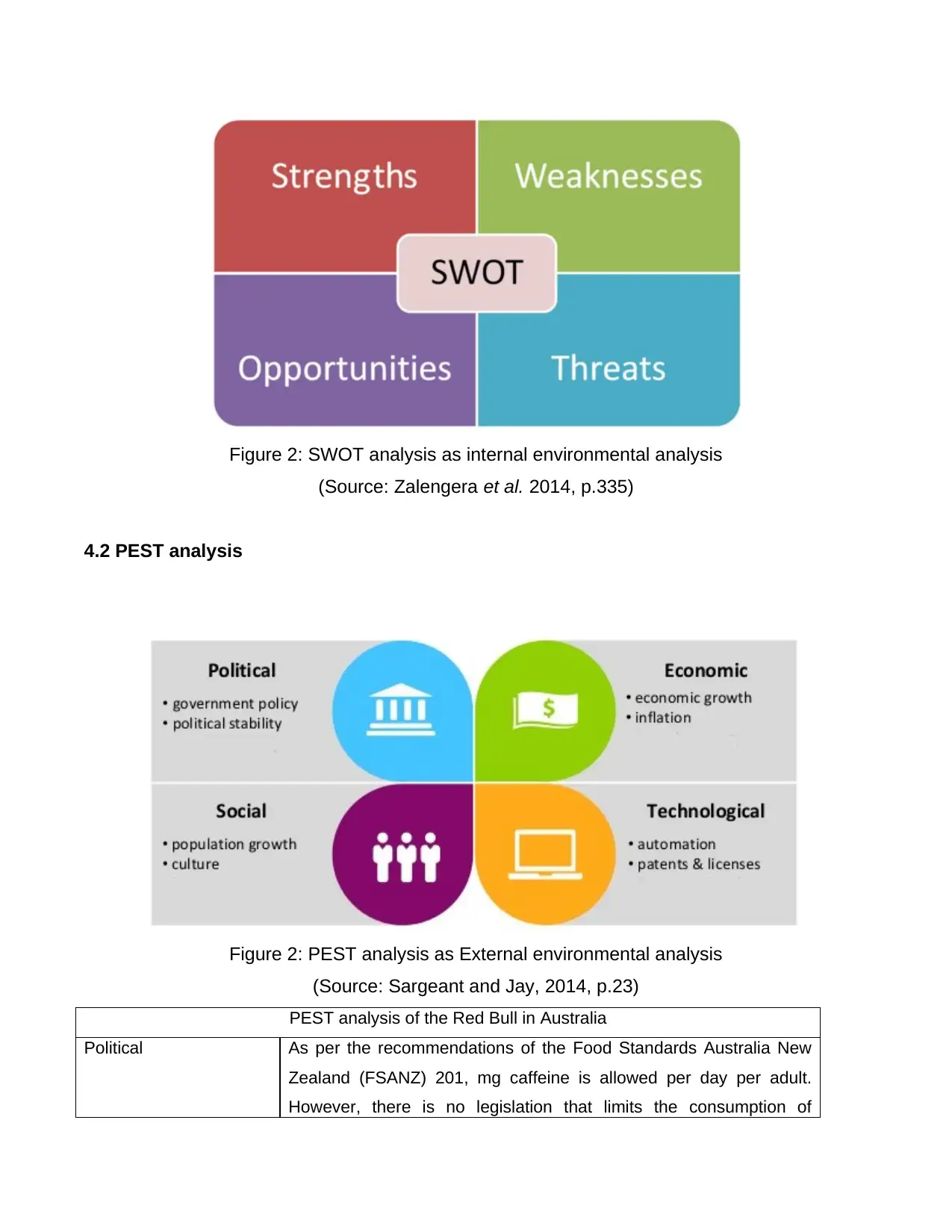
Figure 2: SWOT analysis as internal environmental analysis
(Source: Zalengera et al. 2014, p.335)
4.2 PEST analysis
Figure 2: PEST analysis as External environmental analysis
(Source: Sargeant and Jay, 2014, p.23)
PEST analysis of the Red Bull in Australia
Political As per the recommendations of the Food Standards Australia New
Zealand (FSANZ) 201, mg caffeine is allowed per day per adult.
However, there is no legislation that limits the consumption of
(Source: Zalengera et al. 2014, p.335)
4.2 PEST analysis
Figure 2: PEST analysis as External environmental analysis
(Source: Sargeant and Jay, 2014, p.23)
PEST analysis of the Red Bull in Australia
Political As per the recommendations of the Food Standards Australia New
Zealand (FSANZ) 201, mg caffeine is allowed per day per adult.
However, there is no legislation that limits the consumption of
⊘ This is a preview!⊘
Do you want full access?
Subscribe today to unlock all pages.
Trusted by 1+ million students worldwide
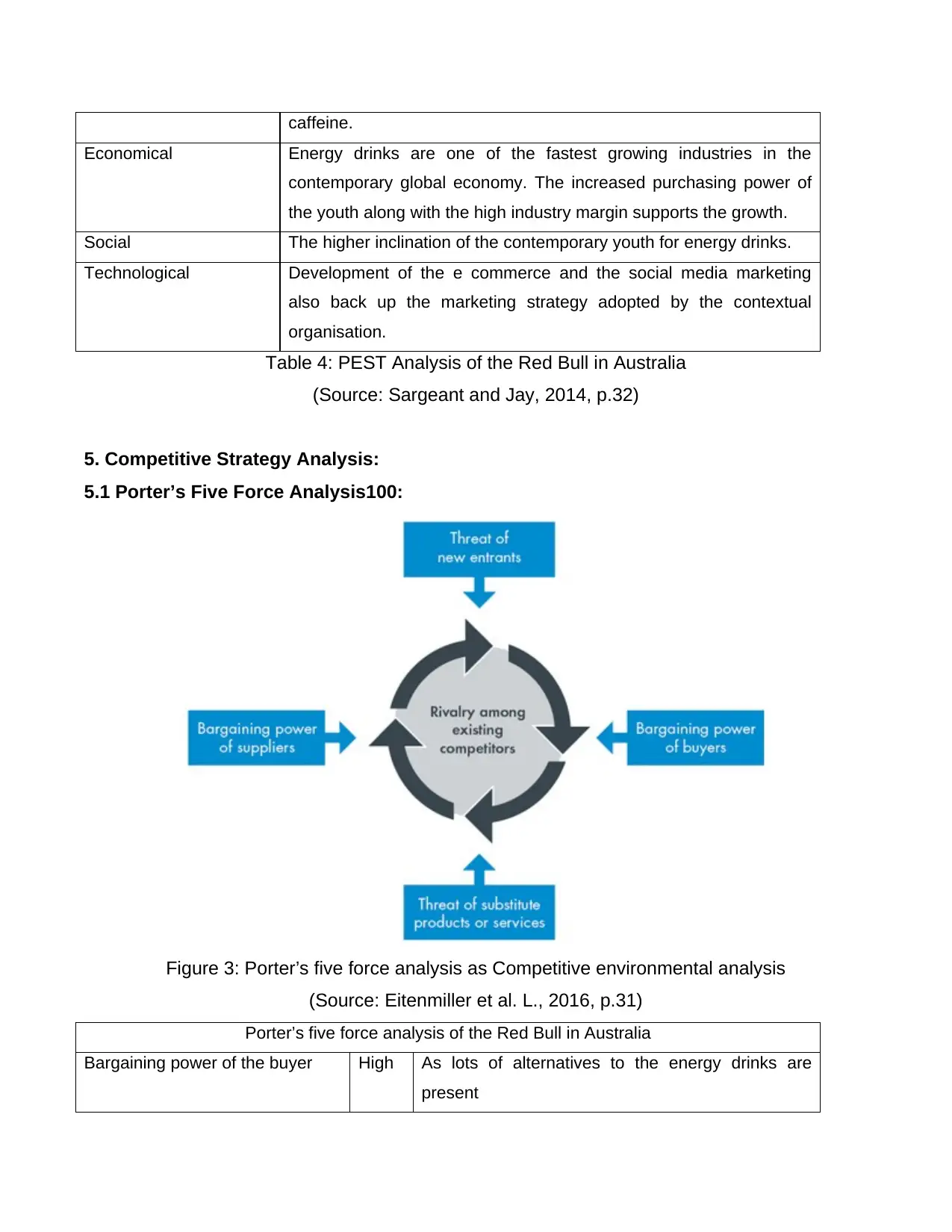
caffeine.
Economical Energy drinks are one of the fastest growing industries in the
contemporary global economy. The increased purchasing power of
the youth along with the high industry margin supports the growth.
Social The higher inclination of the contemporary youth for energy drinks.
Technological Development of the e commerce and the social media marketing
also back up the marketing strategy adopted by the contextual
organisation.
Table 4: PEST Analysis of the Red Bull in Australia
(Source: Sargeant and Jay, 2014, p.32)
5. Competitive Strategy Analysis:
5.1 Porter’s Five Force Analysis100:
Figure 3: Porter’s five force analysis as Competitive environmental analysis
(Source: Eitenmiller et al. L., 2016, p.31)
Porter’s five force analysis of the Red Bull in Australia
Bargaining power of the buyer High As lots of alternatives to the energy drinks are
present
Economical Energy drinks are one of the fastest growing industries in the
contemporary global economy. The increased purchasing power of
the youth along with the high industry margin supports the growth.
Social The higher inclination of the contemporary youth for energy drinks.
Technological Development of the e commerce and the social media marketing
also back up the marketing strategy adopted by the contextual
organisation.
Table 4: PEST Analysis of the Red Bull in Australia
(Source: Sargeant and Jay, 2014, p.32)
5. Competitive Strategy Analysis:
5.1 Porter’s Five Force Analysis100:
Figure 3: Porter’s five force analysis as Competitive environmental analysis
(Source: Eitenmiller et al. L., 2016, p.31)
Porter’s five force analysis of the Red Bull in Australia
Bargaining power of the buyer High As lots of alternatives to the energy drinks are
present
Paraphrase This Document
Need a fresh take? Get an instant paraphrase of this document with our AI Paraphraser
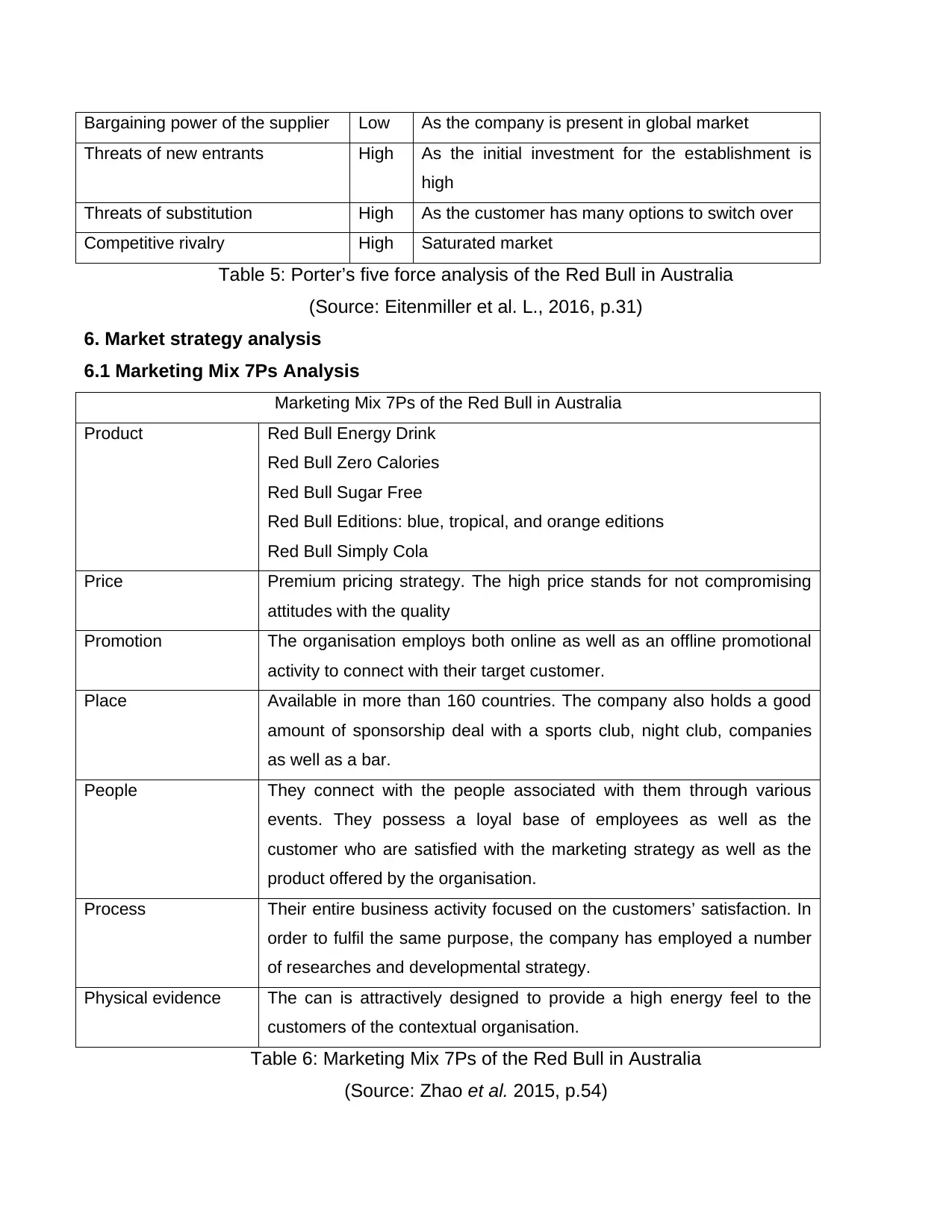
Bargaining power of the supplier Low As the company is present in global market
Threats of new entrants High As the initial investment for the establishment is
high
Threats of substitution High As the customer has many options to switch over
Competitive rivalry High Saturated market
Table 5: Porter’s five force analysis of the Red Bull in Australia
(Source: Eitenmiller et al. L., 2016, p.31)
6. Market strategy analysis
6.1 Marketing Mix 7Ps Analysis
Marketing Mix 7Ps of the Red Bull in Australia
Product Red Bull Energy Drink
Red Bull Zero Calories
Red Bull Sugar Free
Red Bull Editions: blue, tropical, and orange editions
Red Bull Simply Cola
Price Premium pricing strategy. The high price stands for not compromising
attitudes with the quality
Promotion The organisation employs both online as well as an offline promotional
activity to connect with their target customer.
Place Available in more than 160 countries. The company also holds a good
amount of sponsorship deal with a sports club, night club, companies
as well as a bar.
People They connect with the people associated with them through various
events. They possess a loyal base of employees as well as the
customer who are satisfied with the marketing strategy as well as the
product offered by the organisation.
Process Their entire business activity focused on the customers’ satisfaction. In
order to fulfil the same purpose, the company has employed a number
of researches and developmental strategy.
Physical evidence The can is attractively designed to provide a high energy feel to the
customers of the contextual organisation.
Table 6: Marketing Mix 7Ps of the Red Bull in Australia
(Source: Zhao et al. 2015, p.54)
Threats of new entrants High As the initial investment for the establishment is
high
Threats of substitution High As the customer has many options to switch over
Competitive rivalry High Saturated market
Table 5: Porter’s five force analysis of the Red Bull in Australia
(Source: Eitenmiller et al. L., 2016, p.31)
6. Market strategy analysis
6.1 Marketing Mix 7Ps Analysis
Marketing Mix 7Ps of the Red Bull in Australia
Product Red Bull Energy Drink
Red Bull Zero Calories
Red Bull Sugar Free
Red Bull Editions: blue, tropical, and orange editions
Red Bull Simply Cola
Price Premium pricing strategy. The high price stands for not compromising
attitudes with the quality
Promotion The organisation employs both online as well as an offline promotional
activity to connect with their target customer.
Place Available in more than 160 countries. The company also holds a good
amount of sponsorship deal with a sports club, night club, companies
as well as a bar.
People They connect with the people associated with them through various
events. They possess a loyal base of employees as well as the
customer who are satisfied with the marketing strategy as well as the
product offered by the organisation.
Process Their entire business activity focused on the customers’ satisfaction. In
order to fulfil the same purpose, the company has employed a number
of researches and developmental strategy.
Physical evidence The can is attractively designed to provide a high energy feel to the
customers of the contextual organisation.
Table 6: Marketing Mix 7Ps of the Red Bull in Australia
(Source: Zhao et al. 2015, p.54)
6.2 STP analysis
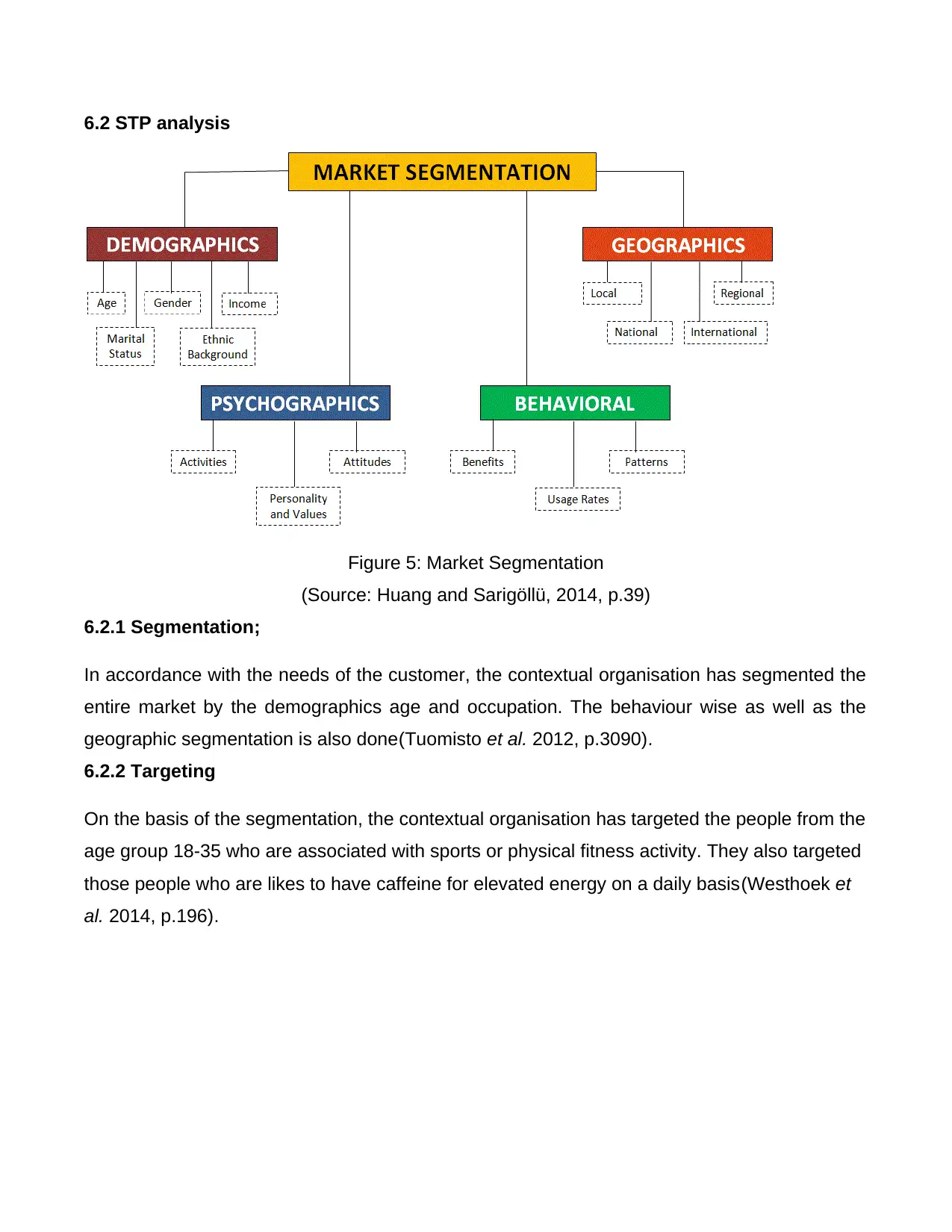
Figure 5: Market Segmentation
(Source: Huang and Sarigöllü, 2014, p.39)
6.2.1 Segmentation;
In accordance with the needs of the customer, the contextual organisation has segmented the
entire market by the demographics age and occupation. The behaviour wise as well as the
geographic segmentation is also done(Tuomisto et al. 2012, p.3090).
6.2.2 Targeting
On the basis of the segmentation, the contextual organisation has targeted the people from the
age group 18-35 who are associated with sports or physical fitness activity. They also targeted
those people who are likes to have caffeine for elevated energy on a daily basis(Westhoek et
al. 2014, p.196).
Figure 5: Market Segmentation
(Source: Huang and Sarigöllü, 2014, p.39)
6.2.1 Segmentation;
In accordance with the needs of the customer, the contextual organisation has segmented the
entire market by the demographics age and occupation. The behaviour wise as well as the
geographic segmentation is also done(Tuomisto et al. 2012, p.3090).
6.2.2 Targeting
On the basis of the segmentation, the contextual organisation has targeted the people from the
age group 18-35 who are associated with sports or physical fitness activity. They also targeted
those people who are likes to have caffeine for elevated energy on a daily basis(Westhoek et
al. 2014, p.196).
⊘ This is a preview!⊘
Do you want full access?
Subscribe today to unlock all pages.
Trusted by 1+ million students worldwide
High
price
High brand image
Low
price
Low brand image
6.2.3 Positioning
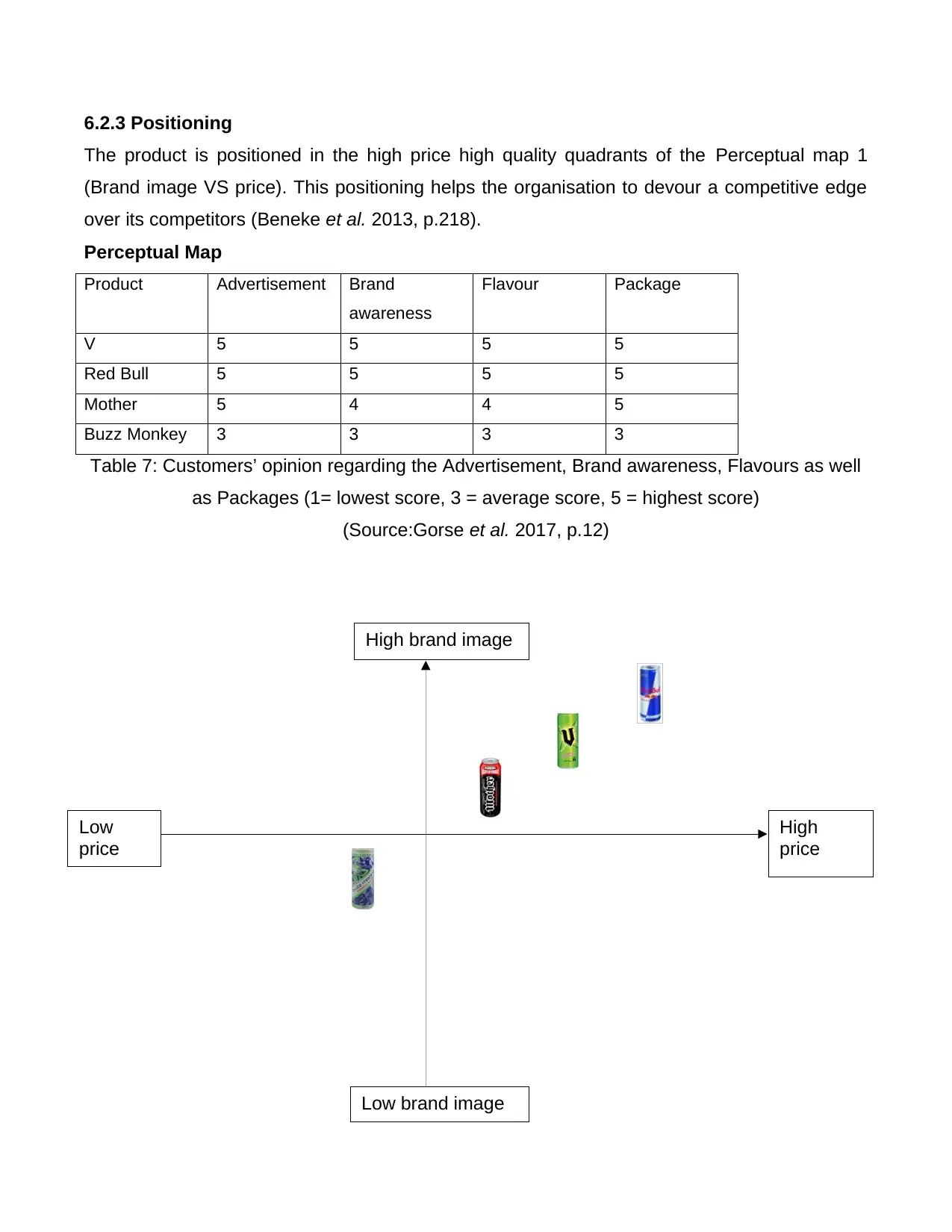
The product is positioned in the high price high quality quadrants of the Perceptual map 1
(Brand image VS price). This positioning helps the organisation to devour a competitive edge
over its competitors (Beneke et al. 2013, p.218).
Perceptual Map
Product Advertisement Brand
awareness
Flavour Package
V 5 5 5 5
Red Bull 5 5 5 5
Mother 5 4 4 5
Buzz Monkey 3 3 3 3
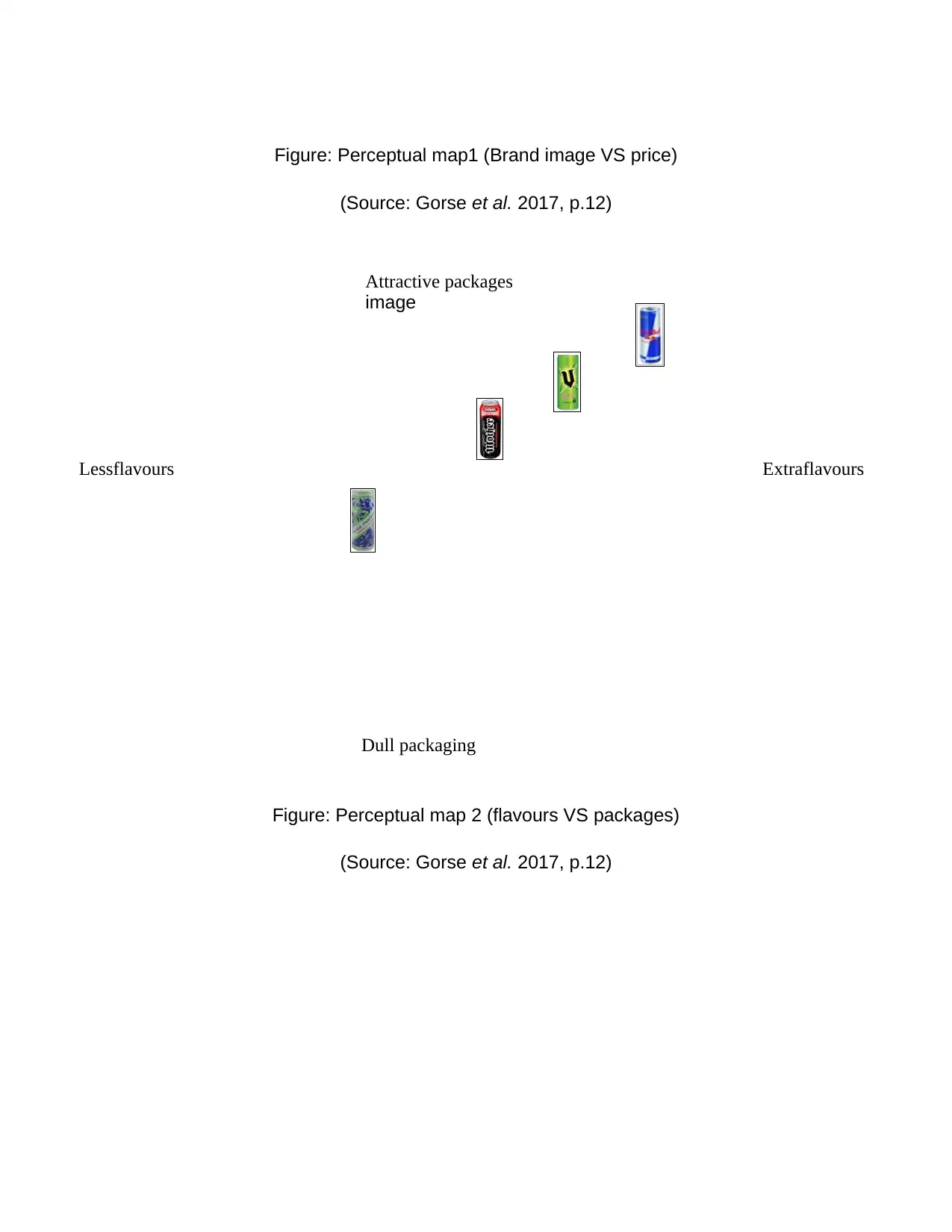
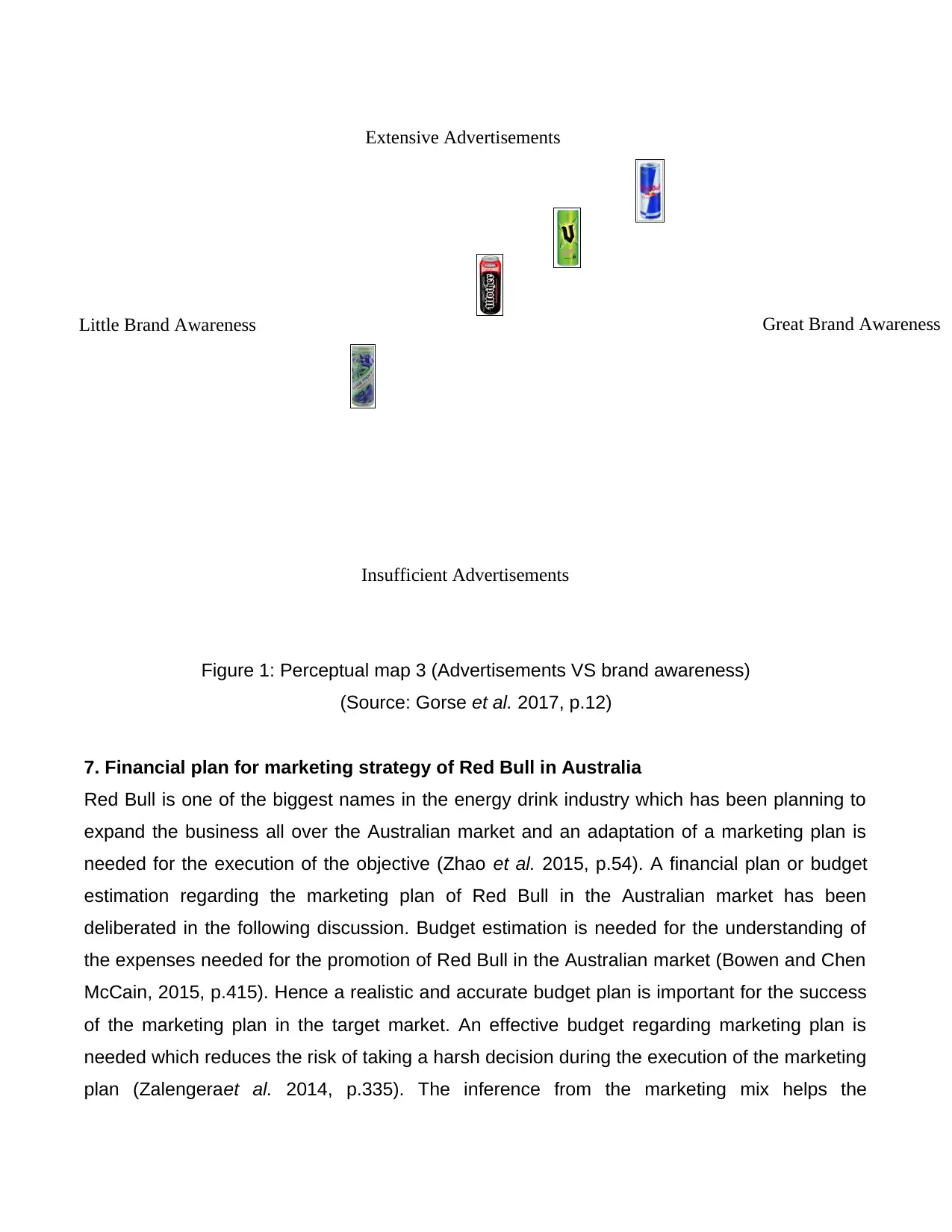
Table 7: Customers’ opinion regarding the Advertisement, Brand awareness, Flavours as well
as Packages (1= lowest score, 3 = average score, 5 = highest score)
(Source:Gorse et al. 2017, p.12)
price
High brand image
Low
price
Low brand image
6.2.3 Positioning
The product is positioned in the high price high quality quadrants of the Perceptual map 1
(Brand image VS price). This positioning helps the organisation to devour a competitive edge
over its competitors (Beneke et al. 2013, p.218).
Perceptual Map
Product Advertisement Brand
awareness
Flavour Package
V 5 5 5 5
Red Bull 5 5 5 5
Mother 5 4 4 5
Buzz Monkey 3 3 3 3
Table 7: Customers’ opinion regarding the Advertisement, Brand awareness, Flavours as well
as Packages (1= lowest score, 3 = average score, 5 = highest score)
(Source:Gorse et al. 2017, p.12)
Paraphrase This Document
Need a fresh take? Get an instant paraphrase of this document with our AI Paraphraser
Extraflavours
Attractive packages
image
Lessflavours
Dull packaging
Figure: Perceptual map1 (Brand image VS price)
(Source: Gorse et al. 2017, p.12)
Figure: Perceptual map 2 (flavours VS packages)
(Source: Gorse et al. 2017, p.12)
Attractive packages
image
Lessflavours
Dull packaging
Figure: Perceptual map1 (Brand image VS price)
(Source: Gorse et al. 2017, p.12)
Figure: Perceptual map 2 (flavours VS packages)
(Source: Gorse et al. 2017, p.12)
Great Brand Awareness
Extensive Advertisements
Little Brand Awareness
Insufficient Advertisements
Figure 1: Perceptual map 3 (Advertisements VS brand awareness)
(Source: Gorse et al. 2017, p.12)
7. Financial plan for marketing strategy of Red Bull in Australia
Red Bull is one of the biggest names in the energy drink industry which has been planning to
expand the business all over the Australian market and an adaptation of a marketing plan is
needed for the execution of the objective (Zhao et al. 2015, p.54). A financial plan or budget
estimation regarding the marketing plan of Red Bull in the Australian market has been
deliberated in the following discussion. Budget estimation is needed for the understanding of
the expenses needed for the promotion of Red Bull in the Australian market (Bowen and Chen
McCain, 2015, p.415). Hence a realistic and accurate budget plan is important for the success
of the marketing plan in the target market. An effective budget regarding marketing plan is
needed which reduces the risk of taking a harsh decision during the execution of the marketing
plan (Zalengeraet al. 2014, p.335). The inference from the marketing mix helps the
Extensive Advertisements
Little Brand Awareness
Insufficient Advertisements
Figure 1: Perceptual map 3 (Advertisements VS brand awareness)
(Source: Gorse et al. 2017, p.12)
7. Financial plan for marketing strategy of Red Bull in Australia
Red Bull is one of the biggest names in the energy drink industry which has been planning to
expand the business all over the Australian market and an adaptation of a marketing plan is
needed for the execution of the objective (Zhao et al. 2015, p.54). A financial plan or budget
estimation regarding the marketing plan of Red Bull in the Australian market has been
deliberated in the following discussion. Budget estimation is needed for the understanding of
the expenses needed for the promotion of Red Bull in the Australian market (Bowen and Chen
McCain, 2015, p.415). Hence a realistic and accurate budget plan is important for the success
of the marketing plan in the target market. An effective budget regarding marketing plan is
needed which reduces the risk of taking a harsh decision during the execution of the marketing
plan (Zalengeraet al. 2014, p.335). The inference from the marketing mix helps the
⊘ This is a preview!⊘
Do you want full access?
Subscribe today to unlock all pages.
Trusted by 1+ million students worldwide

1 out of 22


Related Documents


Your All-in-One AI-Powered Toolkit for Academic Success.
+13062052269
info@desklib.com
Available 24*7 on WhatsApp / Email
![[object Object]](/_next/static/media/star-bottom.7253800d.svg)
Unlock your academic potential
Copyright © 2020–2026 A2Z Services. All Rights Reserved. Developed and managed by ZUCOL.