Laws and Challenges of Prisoner Reentry into the Community: Report
VerifiedAdded on 2020/04/13
|7
|1344
|47
Report
AI Summary
This report delves into the legal framework governing the reentry of prisoners into society, focusing on the roles of probation and parole. It explores the challenges and risks associated with reintegration, including societal attitudes, potential for recidivism, and the importance of correctional homes in preparing inmates for release. The report highlights the need for societal support, employment opportunities, and awareness programs to facilitate successful reentry. It emphasizes the role of correctional facilities in reforming inmates, addressing their criminal mentality, and providing them with the tools for a crime-free life. The conclusion stresses the importance of prisoner self-realization and societal cooperation to ensure a smooth transition and prevent adverse effects of prolonged incarceration.
Running head REENTRY OF PRISONERS INTO THE COMMUNITY
REENTRY OF PRISONERS INTO THE COMMUNITY
Name of Student-
Name of University-
Author note-
REENTRY OF PRISONERS INTO THE COMMUNITY
Name of Student-
Name of University-
Author note-
Paraphrase This Document
Need a fresh take? Get an instant paraphrase of this document with our AI Paraphraser

1
REENTRY OF PRISONERS INTO THE COMMUNITY
Executive Summary
This report will focus on the laws relating to the reentry of prisoners into the society. The report
will give a detailed discussion of the various reasons for the reentry of the prisoners and also the
factors on which the rehabilitation of the prisoners depends and makes it last after the reentry in
the community. Apart from this, the report will also state the problems and advantages of such
reentry of prisoners.
REENTRY OF PRISONERS INTO THE COMMUNITY
Executive Summary
This report will focus on the laws relating to the reentry of prisoners into the society. The report
will give a detailed discussion of the various reasons for the reentry of the prisoners and also the
factors on which the rehabilitation of the prisoners depends and makes it last after the reentry in
the community. Apart from this, the report will also state the problems and advantages of such
reentry of prisoners.

2
REENTRY OF PRISONERS INTO THE COMMUNITY
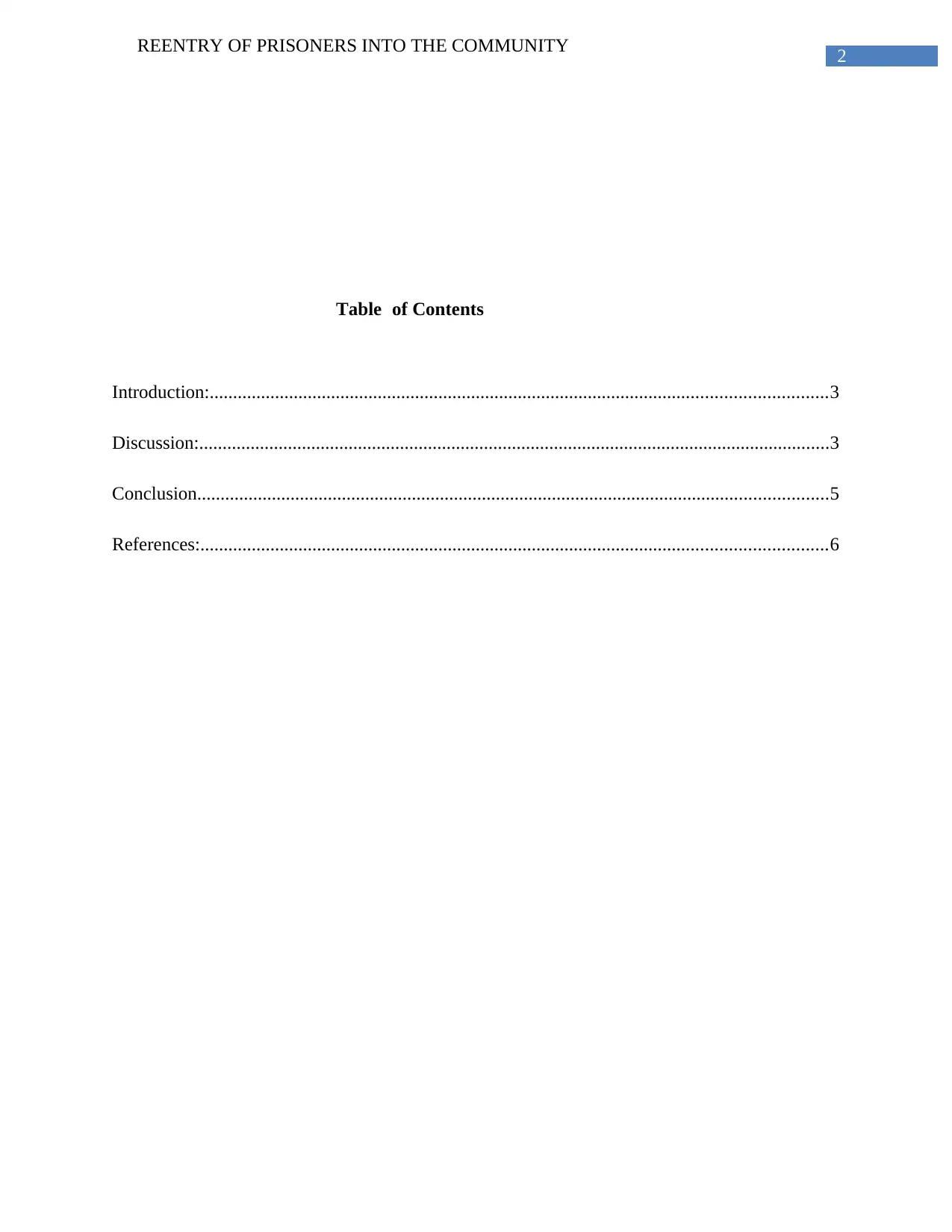
Table of Contents
Introduction:....................................................................................................................................3
Discussion:.......................................................................................................................................3
Conclusion.......................................................................................................................................5
References:......................................................................................................................................6
REENTRY OF PRISONERS INTO THE COMMUNITY
Table of Contents
Introduction:....................................................................................................................................3
Discussion:.......................................................................................................................................3
Conclusion.......................................................................................................................................5
References:......................................................................................................................................6
⊘ This is a preview!⊘
Do you want full access?
Subscribe today to unlock all pages.

Trusted by 1+ million students worldwide

3
REENTRY OF PRISONERS INTO THE COMMUNITY
Introduction:
People who break the law are punished by the law. The punishment is based on the
severity of the offence a person commits. Where some people are given warning or imposed with
fines, others are imprisoned in jail. Imprisonment is basically for those whose offences are so
severe that their presence in the society becomes very dangerous for the others. However, all
these prisoners are given chances to rectify themselves and go back to the society and lead a
normal life. The report intends to discuss the provisions of the law of Probation and Parole,
which deals with various aspects of such reentry and how far the re-entry of the prisoners in the
community can be considered to be an effective option.
Discussion:
The law relating to Probation and Parole deals with the reentry of a prisoner back into the
society (Maruschak & Parks, 2012). Probation means the release of a prisoner from jail after he
has spent a certain term of his sentence and before the completion of the actual sentence,
provided the prisoner show signs of rectification during his time in prison. On the other hand,
parole is the release of a prisoner after serving a part of his sentence in a prison on the promise of
good behavior. However, in case of parole, the release does not end the sentence. The sentence
continues and after the release if the prisoner fails to behave in the way expected, he is sent back
to prison for the rest of his life (Goode, 2013). There are certain risks associated with the return
of an offender back in the society. There can be risks of the prisoner committing the same
offence again or a new offence and can also harm the society. Apart from the potential risks due
to the prisoner’s re-entry into the society, there are certain problems, which both the prisoner and
the society might face. The society does not see a returning prisoner with good eyes and hence,
they often tend to avoid the person, instead of helping him to rectify, as the society marks the
REENTRY OF PRISONERS INTO THE COMMUNITY
Introduction:
People who break the law are punished by the law. The punishment is based on the
severity of the offence a person commits. Where some people are given warning or imposed with
fines, others are imprisoned in jail. Imprisonment is basically for those whose offences are so
severe that their presence in the society becomes very dangerous for the others. However, all
these prisoners are given chances to rectify themselves and go back to the society and lead a
normal life. The report intends to discuss the provisions of the law of Probation and Parole,
which deals with various aspects of such reentry and how far the re-entry of the prisoners in the
community can be considered to be an effective option.
Discussion:
The law relating to Probation and Parole deals with the reentry of a prisoner back into the
society (Maruschak & Parks, 2012). Probation means the release of a prisoner from jail after he
has spent a certain term of his sentence and before the completion of the actual sentence,
provided the prisoner show signs of rectification during his time in prison. On the other hand,
parole is the release of a prisoner after serving a part of his sentence in a prison on the promise of
good behavior. However, in case of parole, the release does not end the sentence. The sentence
continues and after the release if the prisoner fails to behave in the way expected, he is sent back
to prison for the rest of his life (Goode, 2013). There are certain risks associated with the return
of an offender back in the society. There can be risks of the prisoner committing the same
offence again or a new offence and can also harm the society. Apart from the potential risks due
to the prisoner’s re-entry into the society, there are certain problems, which both the prisoner and
the society might face. The society does not see a returning prisoner with good eyes and hence,
they often tend to avoid the person, instead of helping him to rectify, as the society marks the
Paraphrase This Document
Need a fresh take? Get an instant paraphrase of this document with our AI Paraphraser

4
REENTRY OF PRISONERS INTO THE COMMUNITY
person as a prisoner. The prisoner faces humiliation and ignorance, after his release from prison
and due to such reasons, he might hesitates to rejoin the society in a new way and start a new
fresh life. These attitudes of the society, provokes the prisoner to go back to his old way of
living, leaving no other option.
The prisoners are all human beings and they belong to the society like everyone else.
Most of these prisoners commit crime, either, due to lack of opportunities in life, intoxication,
mental distress and due to lack of money and proper lifestyle. The risks and problems of a
prisoner re-entering the society, could definitely, be anticipated. Proper planning can be made in
this behave to remove such risks and problems (Cochran et al., 2014). If the society engages in
activities to remove poverty or to make awareness of the bad effects of drugs and alcohol it can
help the weaker portion of the society and reduce the potential number of criminals in the
society. Not only so, but this can help the returning prisoner to have a better life, once they are
back to the society. Apart from this, the laws can also include new provisions like giving proper
employment to the returning prisoner, so that he can earn money in an honest way, instead of
going back to the old way of living, that is, “crime”.
The correctional homes have a major role-playing in preparing the prisoners for re-
entry in the society. The function of the correctional homes is to reform the inmates, so that they
can change themselves and make themselves worthy of rejoining the society. The correctional
homes can, through various activities, treatment and understanding, prepare the inmates for their
re-entry. The correctional homes, instead of punishing the inmates, takes in account the actual
reason behind the criminal mentality of a prisoner. Criminality is a mentality and these homes,
run by various experts, reform the prisoners mentally, by removing the criminal nature of the
prisoner, reforming him from within (Stathopoulos & Quadara 2014). When rectification or
REENTRY OF PRISONERS INTO THE COMMUNITY
person as a prisoner. The prisoner faces humiliation and ignorance, after his release from prison
and due to such reasons, he might hesitates to rejoin the society in a new way and start a new
fresh life. These attitudes of the society, provokes the prisoner to go back to his old way of
living, leaving no other option.
The prisoners are all human beings and they belong to the society like everyone else.
Most of these prisoners commit crime, either, due to lack of opportunities in life, intoxication,
mental distress and due to lack of money and proper lifestyle. The risks and problems of a
prisoner re-entering the society, could definitely, be anticipated. Proper planning can be made in
this behave to remove such risks and problems (Cochran et al., 2014). If the society engages in
activities to remove poverty or to make awareness of the bad effects of drugs and alcohol it can
help the weaker portion of the society and reduce the potential number of criminals in the
society. Not only so, but this can help the returning prisoner to have a better life, once they are
back to the society. Apart from this, the laws can also include new provisions like giving proper
employment to the returning prisoner, so that he can earn money in an honest way, instead of
going back to the old way of living, that is, “crime”.
The correctional homes have a major role-playing in preparing the prisoners for re-
entry in the society. The function of the correctional homes is to reform the inmates, so that they
can change themselves and make themselves worthy of rejoining the society. The correctional
homes can, through various activities, treatment and understanding, prepare the inmates for their
re-entry. The correctional homes, instead of punishing the inmates, takes in account the actual
reason behind the criminal mentality of a prisoner. Criminality is a mentality and these homes,
run by various experts, reform the prisoners mentally, by removing the criminal nature of the
prisoner, reforming him from within (Stathopoulos & Quadara 2014). When rectification or

5
REENTRY OF PRISONERS INTO THE COMMUNITY
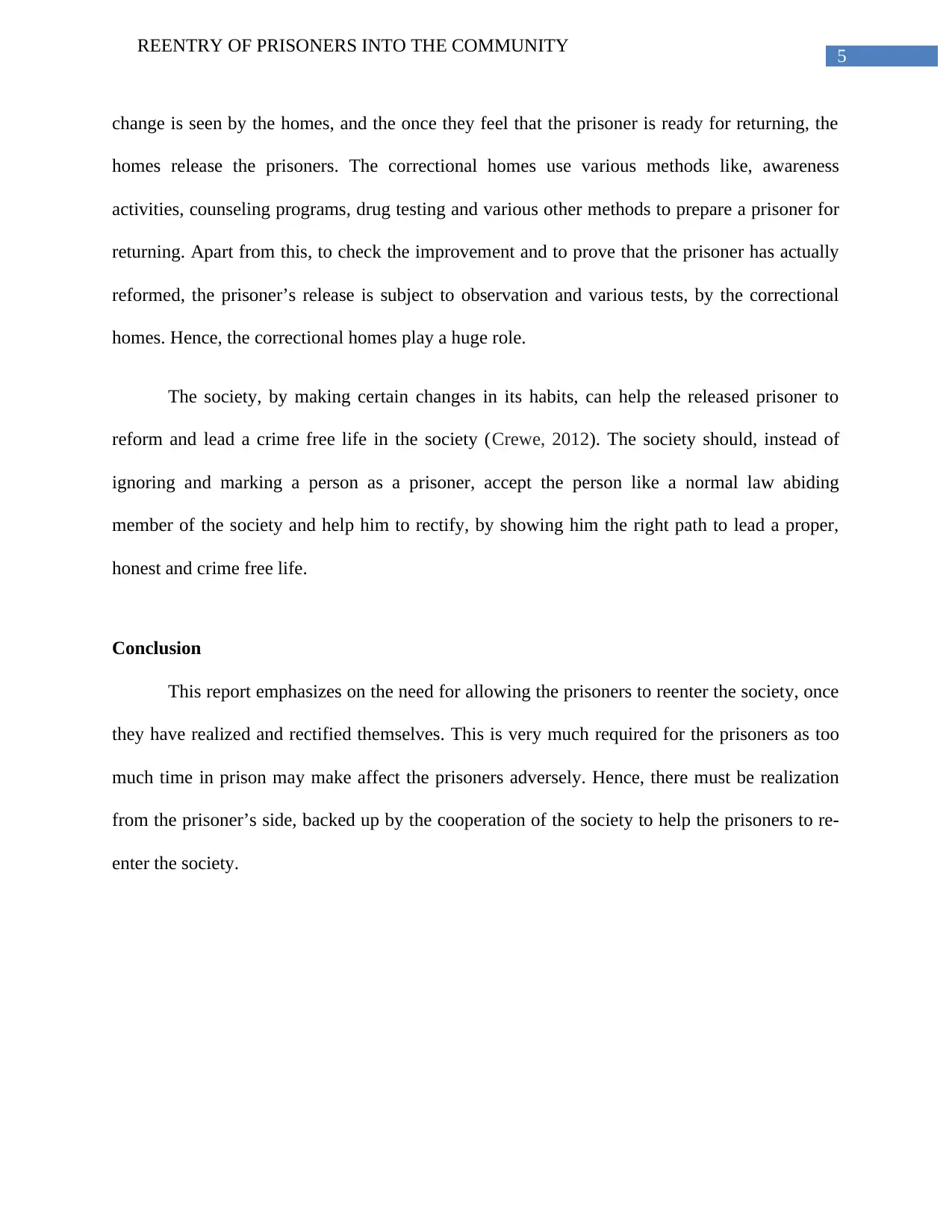
change is seen by the homes, and the once they feel that the prisoner is ready for returning, the
homes release the prisoners. The correctional homes use various methods like, awareness
activities, counseling programs, drug testing and various other methods to prepare a prisoner for
returning. Apart from this, to check the improvement and to prove that the prisoner has actually
reformed, the prisoner’s release is subject to observation and various tests, by the correctional
homes. Hence, the correctional homes play a huge role.
The society, by making certain changes in its habits, can help the released prisoner to
reform and lead a crime free life in the society (Crewe, 2012). The society should, instead of
ignoring and marking a person as a prisoner, accept the person like a normal law abiding
member of the society and help him to rectify, by showing him the right path to lead a proper,
honest and crime free life.
Conclusion
This report emphasizes on the need for allowing the prisoners to reenter the society, once
they have realized and rectified themselves. This is very much required for the prisoners as too
much time in prison may make affect the prisoners adversely. Hence, there must be realization
from the prisoner’s side, backed up by the cooperation of the society to help the prisoners to re-
enter the society.
REENTRY OF PRISONERS INTO THE COMMUNITY
change is seen by the homes, and the once they feel that the prisoner is ready for returning, the
homes release the prisoners. The correctional homes use various methods like, awareness
activities, counseling programs, drug testing and various other methods to prepare a prisoner for
returning. Apart from this, to check the improvement and to prove that the prisoner has actually
reformed, the prisoner’s release is subject to observation and various tests, by the correctional
homes. Hence, the correctional homes play a huge role.
The society, by making certain changes in its habits, can help the released prisoner to
reform and lead a crime free life in the society (Crewe, 2012). The society should, instead of
ignoring and marking a person as a prisoner, accept the person like a normal law abiding
member of the society and help him to rectify, by showing him the right path to lead a proper,
honest and crime free life.
Conclusion
This report emphasizes on the need for allowing the prisoners to reenter the society, once
they have realized and rectified themselves. This is very much required for the prisoners as too
much time in prison may make affect the prisoners adversely. Hence, there must be realization
from the prisoner’s side, backed up by the cooperation of the society to help the prisoners to re-
enter the society.
⊘ This is a preview!⊘
Do you want full access?
Subscribe today to unlock all pages.

Trusted by 1+ million students worldwide

6
REENTRY OF PRISONERS INTO THE COMMUNITY
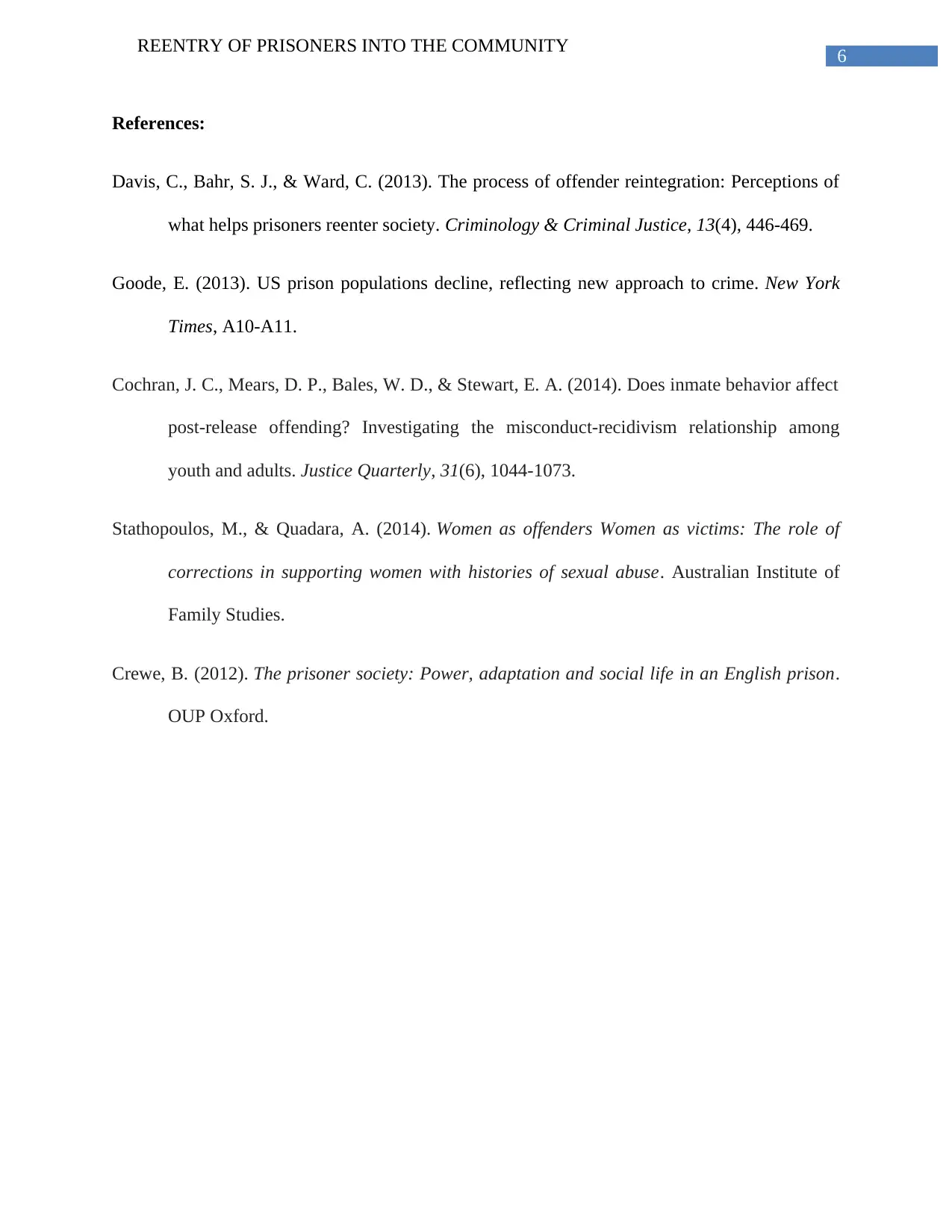
References:
Davis, C., Bahr, S. J., & Ward, C. (2013). The process of offender reintegration: Perceptions of
what helps prisoners reenter society. Criminology & Criminal Justice, 13(4), 446-469.
Goode, E. (2013). US prison populations decline, reflecting new approach to crime. New York
Times, A10-A11.
Cochran, J. C., Mears, D. P., Bales, W. D., & Stewart, E. A. (2014). Does inmate behavior affect
post-release offending? Investigating the misconduct-recidivism relationship among
youth and adults. Justice Quarterly, 31(6), 1044-1073.
Stathopoulos, M., & Quadara, A. (2014). Women as offenders Women as victims: The role of
corrections in supporting women with histories of sexual abuse. Australian Institute of
Family Studies.
Crewe, B. (2012). The prisoner society: Power, adaptation and social life in an English prison.
OUP Oxford.
REENTRY OF PRISONERS INTO THE COMMUNITY
References:
Davis, C., Bahr, S. J., & Ward, C. (2013). The process of offender reintegration: Perceptions of
what helps prisoners reenter society. Criminology & Criminal Justice, 13(4), 446-469.
Goode, E. (2013). US prison populations decline, reflecting new approach to crime. New York
Times, A10-A11.
Cochran, J. C., Mears, D. P., Bales, W. D., & Stewart, E. A. (2014). Does inmate behavior affect
post-release offending? Investigating the misconduct-recidivism relationship among
youth and adults. Justice Quarterly, 31(6), 1044-1073.
Stathopoulos, M., & Quadara, A. (2014). Women as offenders Women as victims: The role of
corrections in supporting women with histories of sexual abuse. Australian Institute of
Family Studies.
Crewe, B. (2012). The prisoner society: Power, adaptation and social life in an English prison.
OUP Oxford.
1 out of 7
Related Documents
Your All-in-One AI-Powered Toolkit for Academic Success.
+13062052269
info@desklib.com
Available 24*7 on WhatsApp / Email
Unlock your academic potential
Copyright © 2020–2026 A2Z Services. All Rights Reserved. Developed and managed by ZUCOL.