Reflection on Two Registered Nurse Standards of Practice Essay

Verified

Added on  2023/06/04

|8
|2002
|111
Essay
AI Summary
This essay delves into the critical role of nursing standards of practice in Australia, focusing on two key standards: engaging in professional and therapeutic relationships and maintaining the capability for practice. The author, a nursing student, reflects on these standards, drawing on their clinical experiences to illustrate their relevance. The essay explores the importance of building trust, effective communication, and respecting patient values within therapeutic relationships. It also examines the necessity of continuous professional development, accountability, and informed decision-making to maintain practice capability. The student emphasizes how adhering to these standards enhances patient care, promotes safe practice, and contributes to the overall quality of the nursing profession. The essay references relevant literature to support its arguments and concludes by highlighting the significance of these standards in shaping competent and ethical nursing practice, both currently and in the future.
Document Page
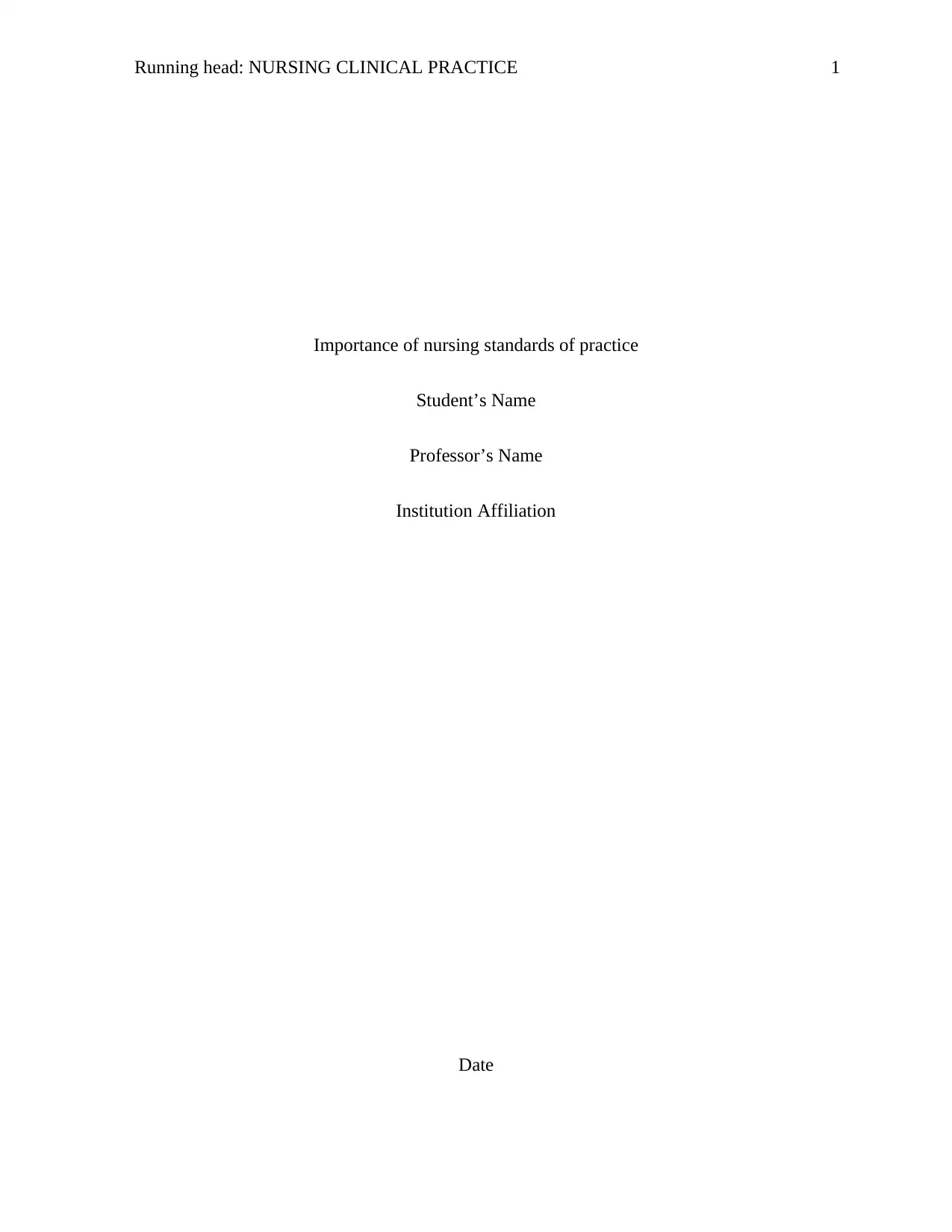
Running head: NURSING CLINICAL PRACTICE 1
Importance of nursing standards of practice
Student’s Name
Professor’s Name
Institution Affiliation
Date
tabler-icon-diamond-filled.svg

Paraphrase This Document

Need a fresh take? Get an instant paraphrase of this document with our AI Paraphraser
Document Page
NURSING CLINICAL PRACTICE 2
Introduction
The introduction, development, and application of standard practices for nurses in
Australia have an aim of achieving quality practice and protecting the public. The standards
ensure there is the attainment of high quality of service provision by the nurses in the healthcare
sector. The application of the nursing standards of practice in place of work assists the nurses to
strengthen their capabilities of working independently and also guides the beneficiaries of the
health care services. Registered nurses should ensure that their practice reflects an understanding
of the social, cultural and spiritual aspect of the community. Registered nurses are required to
observe the set standards for practice as they carry out their role. Nursing standards of practice
are set by the Nursing and Midwifery Board of Australia to help in harmonizing the nursing
practice in providing health care. The two nursing standards of practices to be discussed are;
standard 2- engaging in a professional and therapeutic relationship and standard 3- maintaining
the capability for practice. These standards are interrelated and the nurses have a responsibility to
ensure they apply these standards in daily activities.
Standard 2: Engaging in professional and therapeutic relationships
The practices of a registered nurse are based on a firm engagement of actual professional
and therapeutic relationships. The practices may include shared liberality in the framework of
common respect and trust for a professional relationship. The nurse an obligation to engage the
patient in care provision and develop a therapeutic relationship (Twigg, & McCullough, 2014).
According to this standard, the nurse is supposed to recognize that the patient they are providing
care to have more knowledge and experience about their own life. Therefore, the nurse should
treat the patient as an expert of his or her own life during service delivery. The nurse to ask the
patent appropriately and relevant questions during assessment regarding the health care. The
Document Page
NURSING CLINICAL PRACTICE 3
standard is very important because it acts as a guide for the nurses and helps them to define their
responsibilities. It will also be used in future in case difference arises in the course of service
delivery (Curran, 2014).
A registered nurse has to create and maintain a healthy relationship in a way that
distinguishes the personal and professional attributes in the workplace. This can be done through
a mature and confidential interaction with patients, keenly listening to issues raised by the
patients, building a professional relationship, and efficient reporting and documentation of
issues. This will help the nurse to understand the means to sustain a healthy relationship in the
workplace. Effective communication and respecting the patient values, dignity, beliefs, rights
and culture is necessary for the nurses in their line of duty. Nurses can strength this practice by
improving the ability to carry out the patient assessment, ensuring they are accountable for their
actions, understanding their limits and solving problems that are with integrity. This will aid in
improving the nurse-patient relationship and better interactions during the delivery of healthcare
(Lowe, Plummer, Brien, & Boyd, 2012).
Nurses need to embrace and encourage a culture of safety for others and learn to engage
other health care professionals in sharing practices and knowledge which improves personal
centered care. The practice ensures that nurses consider as a priority the safety of their colleagues
as they provide services in the healthcare facility. This can be achieved by minimizing the risks
at the workplace, reviewing the care plans, understanding their roles in the team of professionals
and showing initiative in nursing intervention. Nurses also need to ensure that they obtain the
necessary resources and support in order to optimize decision making in health care. This can be
done by involving a reviewed care plan, building a professional relationship in the workplace to
help the nurse make informed decisions. This practice is essential in health care now and in
Document Page
NURSING CLINICAL PRACTICE 4
future, because nurses will integrate the issue of safety and informed decision making with their
daily activities (Melnyk, GallagherFord, Long, & FineoutOverholt, 2014).
It is important also for the nurses to lead and participate in a collaborative practice and
reveal any unhealthy conduct of health workers and professionals. Registered nurses need to
uncover any unacceptable code of conduct that may interfere with service delivery. This can be
done by identifying any unethical practice in health care like practitioner failing to observe
confidentiality with patient information and taking corrective measures. This will create an
impressive view of nurses' practice and images by the patients (Henderson, & Eaton, 2013).
Standard 3: Maintaining capacity for practice
The other standard of practice that registered nurses’ needs to consider is maintaining a
reasonable capability for practice. Nurses are required to have the necessary capabilities to
ensure that they are safe and the can carry out their duties effectively. The essential thing in this
standard is the ability of the nurse to manage his affairs and positively respond to any other
health care concerns related to other health professionals. Nurses are personally responsible for
the development of their skill and competences and also contribute to the growth of others. They
also need to provide relevant education and information to assist people to make a reasoned
decision and take appropriate action on issues relating to the health status (Grove, Burns, &
Gray, 2012).
The nurse needs to pinpoint and promote the vital function of the profession and nursing
practice in influencing quality healthcare service and outcome to patients. This practice can be
achieved through efficient management of time and skills prioritization, monitoring the clinical
care for patients, continuously improving knowledge on medications and enhancing interactions
tabler-icon-diamond-filled.svg

Paraphrase This Document

Need a fresh take? Get an instant paraphrase of this document with our AI Paraphraser
Document Page
NURSING CLINICAL PRACTICE 5
between patient and nurses (O'connell, Gardner, & Coyer, 2014). Improving patients control
over their health affairs through the provision of education and necessary information is one of
the key responsibility of registered nurses. The nurses are required to keep the patient informed
on the ways they can use to improve their health as they provided the health care service. This
practice is significant in health care provision because when nurses pass the necessary
information to the patient on medications and best methods to improve their health conditions,
patients are able to monitor their health progress without necessarily consulting the professionals
(El Haddad, Moxham, & Broadbent, 2013).
Registered nurses are required to be accountable for the decisions, behaviors,
responsibility, and action inherent to their work and the functions of those they have delegated
duties too. Pursue to reply to the practice appraisal and reactions, engage actively with other
professionals and use learning approach to continuously develop their profession. The practices
are relevant in that nurses will work with caution because they are responsible for the outcome of
their actions (Maurer, & Smith, 2013).
Conclusion
Nursing standards of practice define the level of competence of care in the nursing
process. They reveal the anticipated and achievable performance level against which the actual
performance of the nurse can be measured. The key purpose of standards is to develop and
maintain clinically competence and safe nursing practice. The standards are essential to the
registered nurses because they guide and promote the clinical practice. They offer an appraisal
tool that is used to gauge nurses in order to ensure that there are clinical safety and proficiency.
Nursing standards are applied in providing a structure for coming up with clinical proficiency
Document Page
NURSING CLINICAL PRACTICE 6
assessments for a specific unit in a clinical setting (McAndrew, Chambers, Nolan, Thomas, &
Watts, 2014).
The nursing standards of practical help in the development of safe practices, ensure that
tasks are delegated appropriately, and proper documentation. When a nurse violates the standard
of practice he or she is exposed to liability and other potential disciplinary measures. The
standards of practice ensure that there is accountability for actions and clinical decisions made by
nurses. The standards encourage nurses to persistently improve nursing knowledge through
education and experiences. The standards can be utilized to identify areas that need improvement
in nursing practice and improve the quality of service to the patient. Therefore nurses need to
ensure that they follow to the letter the set standards in order to improve their skills as well as
service delivery.
Document Page
NURSING CLINICAL PRACTICE 7
References
Curran, M. K. (2014). Examination of the teaching styles of nursing professional development
specialists, part I: Best practices in adult learning theory, curriculum development, and
knowledge transfer. The Journal of Continuing Education in Nursing, 45(5), 233-240.
El Haddad, M., Moxham, L., & Broadbent, M. (2013). Graduate registered nurse practice
readiness in the Australian context: an issue worthy of discussion. Collegian, 20(4), 233-
238.
Grove, S. K., Burns, N., & Gray, J. (2012). The practice of nursing research: Appraisal,
synthesis, and generation of evidence. Elsevier Health Sciences.
Henderson, A., & Eaton, E. (2013). Assisting nurses to facilitate student and new graduate
learning in practice settings: what ‘support’do nurses at the bedside need?. Nurse
Education in Practice, 13(3), 197-201.
Lowe, G., Plummer, V., O’Brien, A. P., & Boyd, L. (2012). Time to clarify–the value of
advanced practice nursing roles in health care. Journal of advanced nursing, 68(3), 677-
685.
Maurer, F. A., & Smith, C. M. (2013). Community/public health nursing practice: Health for
families and populations. Elsevier Health Sciences.
tabler-icon-diamond-filled.svg

Paraphrase This Document

Need a fresh take? Get an instant paraphrase of this document with our AI Paraphraser
Document Page
NURSING CLINICAL PRACTICE 8
McAndrew, S., Chambers, M., Nolan, F., Thomas, B., & Watts, P. (2014). Measuring the
evidence: Reviewing the literature of the measurement of therapeutic engagement in
acute mental health inpatient wards. International Journal of Mental Health Nursing,
23(3), 212-220.
Melnyk, B. M., GallagherFord, L., Long, L. E., & FineoutOverholt, E. (2014). The
establishment of evidencebased practice competencies for practicing registered nurses
and advanced practice nurses in realworld clinical settings: Proficiencies to improve
healthcare quality, reliability, patient outcomes, and costs. Worldviews on Evidence
Based Nursing, 11(1), 5-15.
O'connell, J., Gardner, G., & Coyer, F. (2014). Beyond competencies: using a capability
framework in developing practice standards for advanced practice nursing. Journal of
advanced nursing, 70(12), 2728-2735.
Twigg, D., & McCullough, K. (2014). Nurse retention: a review of strategies to create and
enhance positive practice environments in clinical settings. International journal of
nursing studies, 51(1), 85-92.
chevron_up_icon
1 out of 8
circle_padding
hide_on_mobile
zoom_out_icon
[object Object]