Reflection Report on Managing Strategy Simulation Game
VerifiedAdded on 2020/04/15
|20
|5088
|82
Report
AI Summary
This report presents a reflection on a managing strategy simulation game, evaluating its effectiveness as a learning tool. The paper begins with an abstract and introduction, outlining the use of simulations as an alternative to traditional case studies in business strategy education. It then delves into the competitive strategy, industry overview, and company overview, including a vision statement. The report details the decisions made within the simulation, the final results achieved, and a thorough reflection on the learning process. It explores underlying strategic principles, key learning points, and concludes with an assessment of the simulation's impact. The analysis incorporates Kolb's experiential learning model to understand the learning dynamics within the game environment, highlighting the importance of educator interventions and the implications for module design, including game choice, briefing, debriefing, integration with other teaching aspects, business analysis methods, and assessment functions. The report emphasizes the simulation's ability to provide experiential learning and its limitations in facilitating high-level reflective observation, underscoring the need for strategic interventions to enhance the learning experience.
Running Head: MANAGING STRATEGY 1
Reflection Report
Student’s Name
Institutional Affiliation
Date of Submission
Reflection Report
Student’s Name
Institutional Affiliation
Date of Submission

Paraphrase This Document
Need a fresh take? Get an instant paraphrase of this document with our AI Paraphraser
MANAGING STRATEGY 2
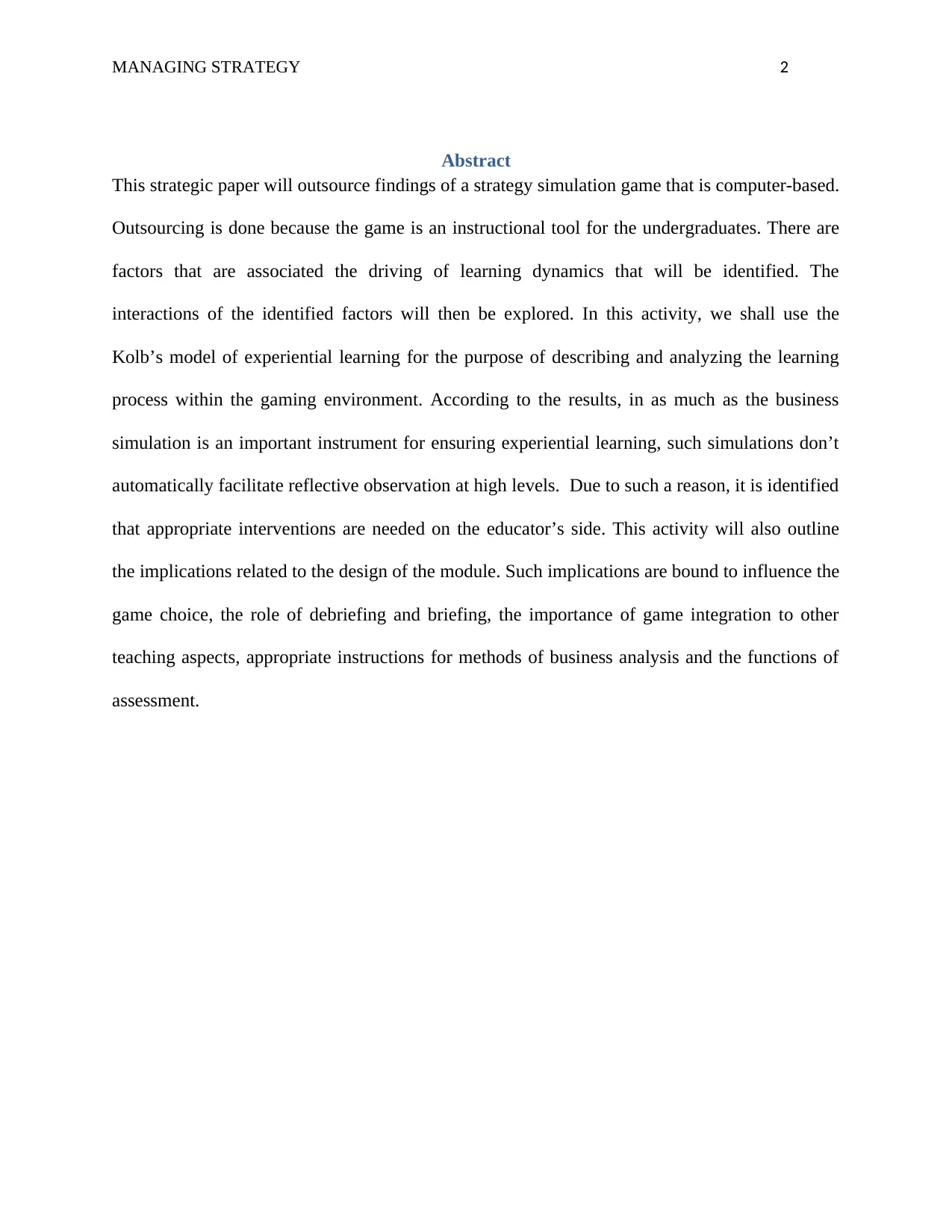
Abstract
This strategic paper will outsource findings of a strategy simulation game that is computer-based.
Outsourcing is done because the game is an instructional tool for the undergraduates. There are
factors that are associated the driving of learning dynamics that will be identified. The
interactions of the identified factors will then be explored. In this activity, we shall use the
Kolb’s model of experiential learning for the purpose of describing and analyzing the learning
process within the gaming environment. According to the results, in as much as the business
simulation is an important instrument for ensuring experiential learning, such simulations don’t
automatically facilitate reflective observation at high levels. Due to such a reason, it is identified
that appropriate interventions are needed on the educator’s side. This activity will also outline
the implications related to the design of the module. Such implications are bound to influence the
game choice, the role of debriefing and briefing, the importance of game integration to other
teaching aspects, appropriate instructions for methods of business analysis and the functions of
assessment.
Abstract
This strategic paper will outsource findings of a strategy simulation game that is computer-based.
Outsourcing is done because the game is an instructional tool for the undergraduates. There are
factors that are associated the driving of learning dynamics that will be identified. The
interactions of the identified factors will then be explored. In this activity, we shall use the
Kolb’s model of experiential learning for the purpose of describing and analyzing the learning
process within the gaming environment. According to the results, in as much as the business
simulation is an important instrument for ensuring experiential learning, such simulations don’t
automatically facilitate reflective observation at high levels. Due to such a reason, it is identified
that appropriate interventions are needed on the educator’s side. This activity will also outline
the implications related to the design of the module. Such implications are bound to influence the
game choice, the role of debriefing and briefing, the importance of game integration to other
teaching aspects, appropriate instructions for methods of business analysis and the functions of
assessment.
MANAGING STRATEGY 3
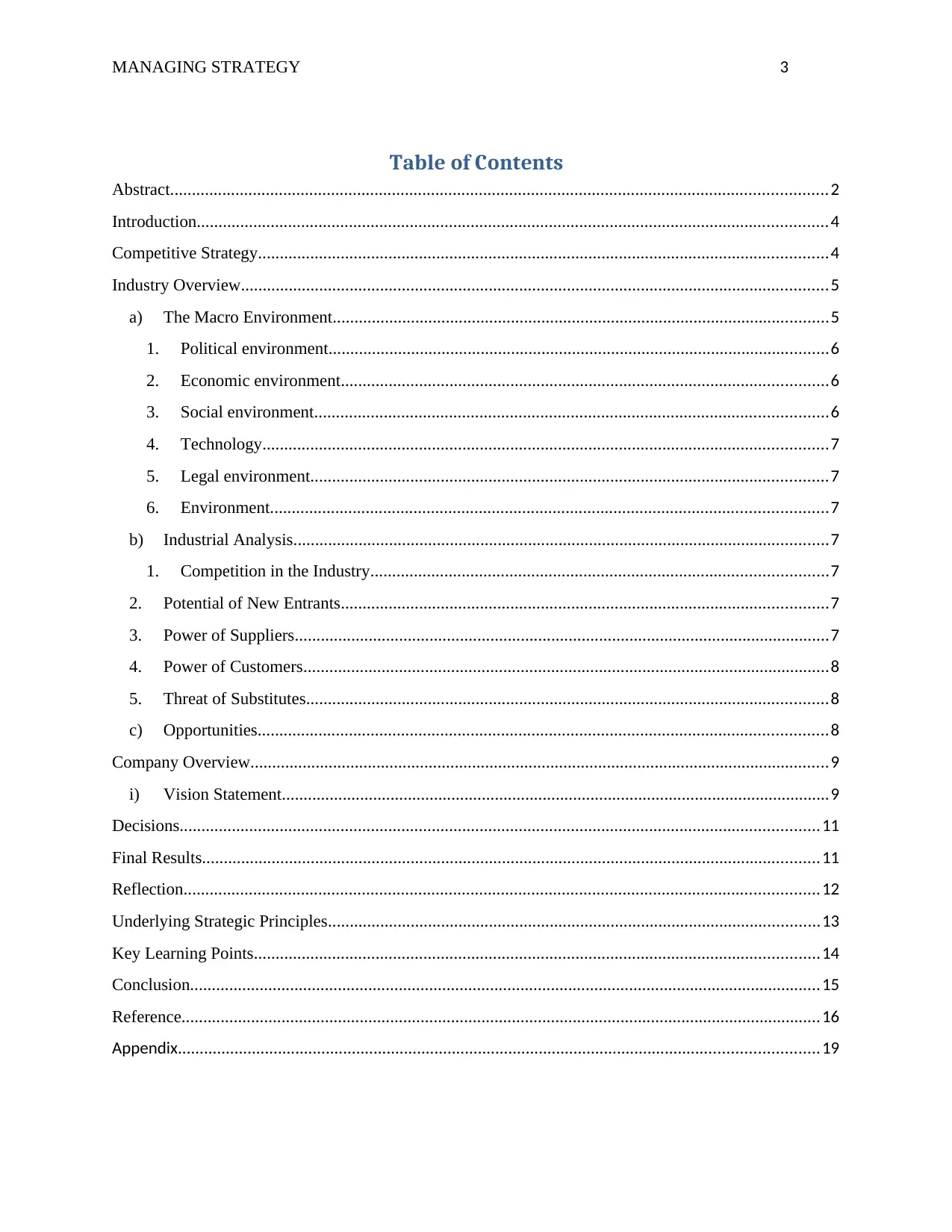
Table of Contents
Abstract.......................................................................................................................................................2
Introduction.................................................................................................................................................4
Competitive Strategy...................................................................................................................................4
Industry Overview.......................................................................................................................................5
a) The Macro Environment..................................................................................................................5
1. Political environment...................................................................................................................6
2. Economic environment................................................................................................................6
3. Social environment......................................................................................................................6
4. Technology..................................................................................................................................7
5. Legal environment.......................................................................................................................7
6. Environment................................................................................................................................7
b) Industrial Analysis...........................................................................................................................7
1. Competition in the Industry.........................................................................................................7
2. Potential of New Entrants................................................................................................................7
3. Power of Suppliers...........................................................................................................................7
4. Power of Customers.........................................................................................................................8
5. Threat of Substitutes........................................................................................................................8
c) Opportunities...................................................................................................................................8
Company Overview.....................................................................................................................................9
i) Vision Statement..............................................................................................................................9
Decisions...................................................................................................................................................11
Final Results..............................................................................................................................................11
Reflection..................................................................................................................................................12
Underlying Strategic Principles.................................................................................................................13
Key Learning Points..................................................................................................................................14
Conclusion.................................................................................................................................................15
Reference...................................................................................................................................................16
Appendix...................................................................................................................................................19
Table of Contents
Abstract.......................................................................................................................................................2
Introduction.................................................................................................................................................4
Competitive Strategy...................................................................................................................................4
Industry Overview.......................................................................................................................................5
a) The Macro Environment..................................................................................................................5
1. Political environment...................................................................................................................6
2. Economic environment................................................................................................................6
3. Social environment......................................................................................................................6
4. Technology..................................................................................................................................7
5. Legal environment.......................................................................................................................7
6. Environment................................................................................................................................7
b) Industrial Analysis...........................................................................................................................7
1. Competition in the Industry.........................................................................................................7
2. Potential of New Entrants................................................................................................................7
3. Power of Suppliers...........................................................................................................................7
4. Power of Customers.........................................................................................................................8
5. Threat of Substitutes........................................................................................................................8
c) Opportunities...................................................................................................................................8
Company Overview.....................................................................................................................................9
i) Vision Statement..............................................................................................................................9
Decisions...................................................................................................................................................11
Final Results..............................................................................................................................................11
Reflection..................................................................................................................................................12
Underlying Strategic Principles.................................................................................................................13
Key Learning Points..................................................................................................................................14
Conclusion.................................................................................................................................................15
Reference...................................................................................................................................................16
Appendix...................................................................................................................................................19
⊘ This is a preview!⊘
Do you want full access?
Subscribe today to unlock all pages.

Trusted by 1+ million students worldwide

MANAGING STRATEGY 4
Paraphrase This Document
Need a fresh take? Get an instant paraphrase of this document with our AI Paraphraser
MANAGING STRATEGY 5
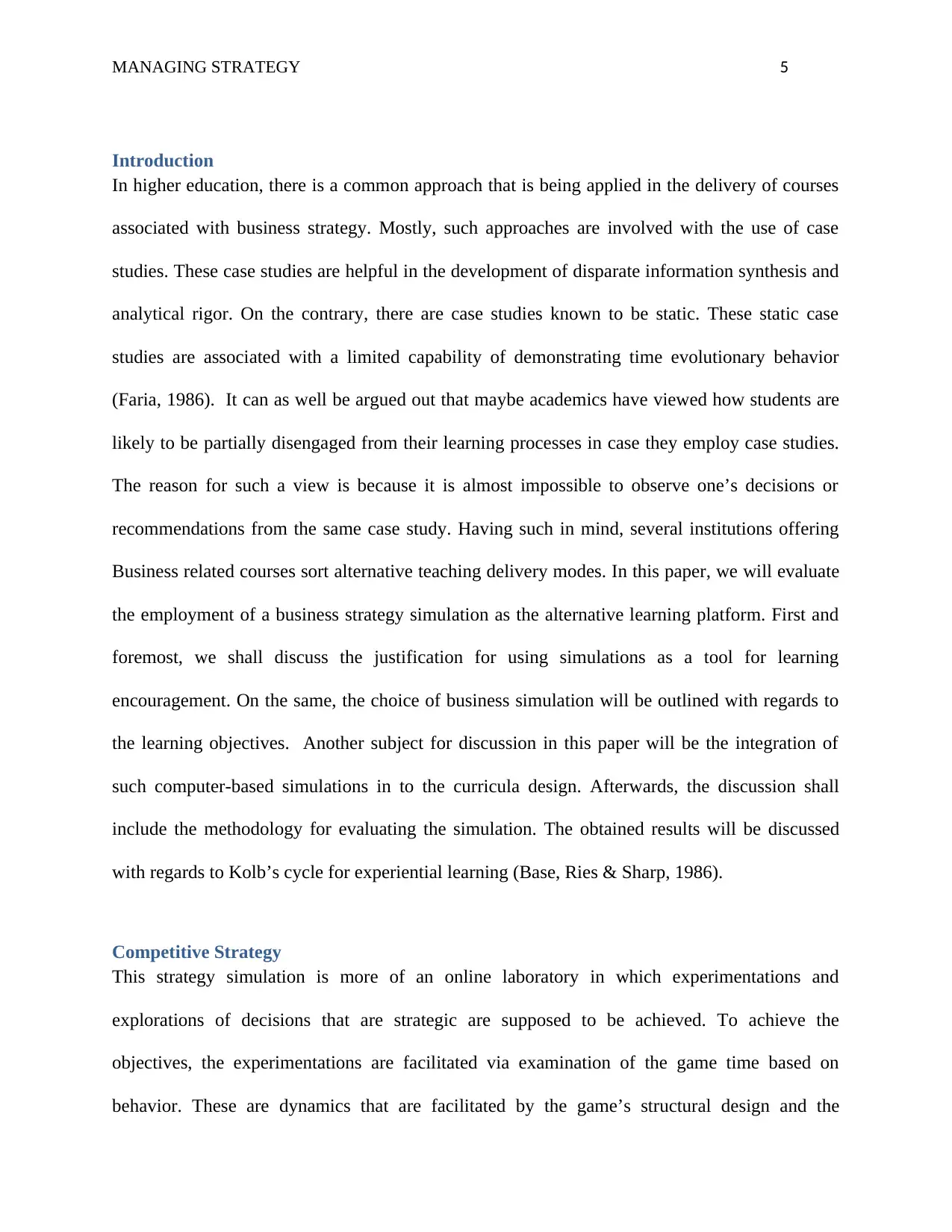
Introduction
In higher education, there is a common approach that is being applied in the delivery of courses
associated with business strategy. Mostly, such approaches are involved with the use of case
studies. These case studies are helpful in the development of disparate information synthesis and
analytical rigor. On the contrary, there are case studies known to be static. These static case
studies are associated with a limited capability of demonstrating time evolutionary behavior
(Faria, 1986). It can as well be argued out that maybe academics have viewed how students are
likely to be partially disengaged from their learning processes in case they employ case studies.
The reason for such a view is because it is almost impossible to observe one’s decisions or
recommendations from the same case study. Having such in mind, several institutions offering
Business related courses sort alternative teaching delivery modes. In this paper, we will evaluate
the employment of a business strategy simulation as the alternative learning platform. First and
foremost, we shall discuss the justification for using simulations as a tool for learning
encouragement. On the same, the choice of business simulation will be outlined with regards to
the learning objectives. Another subject for discussion in this paper will be the integration of
such computer-based simulations in to the curricula design. Afterwards, the discussion shall
include the methodology for evaluating the simulation. The obtained results will be discussed
with regards to Kolb’s cycle for experiential learning (Base, Ries & Sharp, 1986).
Competitive Strategy
This strategy simulation is more of an online laboratory in which experimentations and
explorations of decisions that are strategic are supposed to be achieved. To achieve the
objectives, the experimentations are facilitated via examination of the game time based on
behavior. These are dynamics that are facilitated by the game’s structural design and the
Introduction
In higher education, there is a common approach that is being applied in the delivery of courses
associated with business strategy. Mostly, such approaches are involved with the use of case
studies. These case studies are helpful in the development of disparate information synthesis and
analytical rigor. On the contrary, there are case studies known to be static. These static case
studies are associated with a limited capability of demonstrating time evolutionary behavior
(Faria, 1986). It can as well be argued out that maybe academics have viewed how students are
likely to be partially disengaged from their learning processes in case they employ case studies.
The reason for such a view is because it is almost impossible to observe one’s decisions or
recommendations from the same case study. Having such in mind, several institutions offering
Business related courses sort alternative teaching delivery modes. In this paper, we will evaluate
the employment of a business strategy simulation as the alternative learning platform. First and
foremost, we shall discuss the justification for using simulations as a tool for learning
encouragement. On the same, the choice of business simulation will be outlined with regards to
the learning objectives. Another subject for discussion in this paper will be the integration of
such computer-based simulations in to the curricula design. Afterwards, the discussion shall
include the methodology for evaluating the simulation. The obtained results will be discussed
with regards to Kolb’s cycle for experiential learning (Base, Ries & Sharp, 1986).
Competitive Strategy
This strategy simulation is more of an online laboratory in which experimentations and
explorations of decisions that are strategic are supposed to be achieved. To achieve the
objectives, the experimentations are facilitated via examination of the game time based on
behavior. These are dynamics that are facilitated by the game’s structural design and the
MANAGING STRATEGY 6
subsequent modification of its numerical parameters. In case of a simulation that is sufficiently
complex, a verisimilitude of the highest level can be achieved. In this case, we consider the
games as a way of learning from experience within the context of managerial education. Since
the system has established a high level of realism, this learning process has been satisfactory.
The process is clear and the participants are able to see the effects of decisions that they make.
This is because the simulation traces out the decisions. Afterwards, the participants have the
chance to reflect on the experiences that they gain. They can as well re-conceptualize and come
up with fresh decisions (Herz & Merz, 1998). The simulation is, therefore, a platform through
which learning is achieved via several iterations of decisions that are all played out. From the
consequences of the game, feedback is provided. However, it is worth noting that case studies
discussion and analysis always fail to show the identified strategic decision making aspects. The
truth is, participants that take part in case study learning processes are unlikely to pass the four
phases of the learning cycle. It is as a result of the possibility of failure that significantly higher
efficacy simulations results are obtained. Several studies on the same have also agreed with the
idea that strategy simulations have the ability to help students achieve higher learning levels
compared to teaching that is case led (Hornaday & Curran, 1996).
Industry Overview
a) The Macro Environment
We will, hereby, discuss the simulation’s political, economical, technological, environment,
social, and legal analyses with regards to the market. Through the same, this paper will be at a
position of outlining the potentiality of the business strategy simulation currently (Lane, 1995).
subsequent modification of its numerical parameters. In case of a simulation that is sufficiently
complex, a verisimilitude of the highest level can be achieved. In this case, we consider the
games as a way of learning from experience within the context of managerial education. Since
the system has established a high level of realism, this learning process has been satisfactory.
The process is clear and the participants are able to see the effects of decisions that they make.
This is because the simulation traces out the decisions. Afterwards, the participants have the
chance to reflect on the experiences that they gain. They can as well re-conceptualize and come
up with fresh decisions (Herz & Merz, 1998). The simulation is, therefore, a platform through
which learning is achieved via several iterations of decisions that are all played out. From the
consequences of the game, feedback is provided. However, it is worth noting that case studies
discussion and analysis always fail to show the identified strategic decision making aspects. The
truth is, participants that take part in case study learning processes are unlikely to pass the four
phases of the learning cycle. It is as a result of the possibility of failure that significantly higher
efficacy simulations results are obtained. Several studies on the same have also agreed with the
idea that strategy simulations have the ability to help students achieve higher learning levels
compared to teaching that is case led (Hornaday & Curran, 1996).
Industry Overview
a) The Macro Environment
We will, hereby, discuss the simulation’s political, economical, technological, environment,
social, and legal analyses with regards to the market. Through the same, this paper will be at a
position of outlining the potentiality of the business strategy simulation currently (Lane, 1995).
⊘ This is a preview!⊘
Do you want full access?
Subscribe today to unlock all pages.
Trusted by 1+ million students worldwide
MANAGING STRATEGY 7
1. Political environment
The performance as well as the results obtained from the simulation is influenced by political
factors like the stability of the institution offering the simulation, corruption, and even number of
government parties and policies. However, the good news is that most of the outlined factors are
positive. In summary, they include:
i) Stability of the institution offering the simulation
ii) Low corruption rates
iii) Increased policies governing the simulation
2. Economic environment
The institution’s economic growth has a huge chance of influencing the application of the
business strategy simulation game. The same factor has the ability to influence learners to take
their time on tracking their performances or operations using the game. The rate of expenditure
on the game would average at about 7% more than that of case study application. What will be
seen is an indication of a market factor which is positive. Having a strong economic position is
likelihood that the institution will spend more money to engage students in processes that will
enable them gain new experiences (Kolb & Fry, 1975).
3. Social environment
This factor is associated with high literacy levels, reduced corruption levels, and open culture.
The mentioned attributes encourage the application of business strategy simulation gaming
within the institution. The gaming process is also a new technological experiences that students
would wish to learn (Langley & Larsen, 1995).
1. Political environment
The performance as well as the results obtained from the simulation is influenced by political
factors like the stability of the institution offering the simulation, corruption, and even number of
government parties and policies. However, the good news is that most of the outlined factors are
positive. In summary, they include:
i) Stability of the institution offering the simulation
ii) Low corruption rates
iii) Increased policies governing the simulation
2. Economic environment
The institution’s economic growth has a huge chance of influencing the application of the
business strategy simulation game. The same factor has the ability to influence learners to take
their time on tracking their performances or operations using the game. The rate of expenditure
on the game would average at about 7% more than that of case study application. What will be
seen is an indication of a market factor which is positive. Having a strong economic position is
likelihood that the institution will spend more money to engage students in processes that will
enable them gain new experiences (Kolb & Fry, 1975).
3. Social environment
This factor is associated with high literacy levels, reduced corruption levels, and open culture.
The mentioned attributes encourage the application of business strategy simulation gaming
within the institution. The gaming process is also a new technological experiences that students
would wish to learn (Langley & Larsen, 1995).
Paraphrase This Document
Need a fresh take? Get an instant paraphrase of this document with our AI Paraphraser
MANAGING STRATEGY 8
4. Technology
The simulation process is computer-based as well as eco-friendly. Since the institution is based
on a technological background, the introduction of the computer game would gladly be gone for.
5. Legal environment
Our institution is well structured and guided using policies and legal systems from the
government. The application is also based on the same principles.
6. Environment
The students as well as the institution have a positive attitude towards the business strategy
simulation game.
b) Industrial Analysis
1. Competition in the Industry
Most institutions still use the case study methods of self reflection. The organization, therefore,
have an edge over most institutions in the country. Since the competitive rivalry happens to be
low, the institution possesses a greater competitive power (Miles & Huberman, 1994).
2. Potential of New Entrants
Other institutions offering business courses already understand the effects of using business
strategy simulation games and thus the force of new entrants is already affecting the institution.
3. Power of Suppliers
4. Technology
The simulation process is computer-based as well as eco-friendly. Since the institution is based
on a technological background, the introduction of the computer game would gladly be gone for.
5. Legal environment
Our institution is well structured and guided using policies and legal systems from the
government. The application is also based on the same principles.
6. Environment
The students as well as the institution have a positive attitude towards the business strategy
simulation game.
b) Industrial Analysis
1. Competition in the Industry
Most institutions still use the case study methods of self reflection. The organization, therefore,
have an edge over most institutions in the country. Since the competitive rivalry happens to be
low, the institution possesses a greater competitive power (Miles & Huberman, 1994).
2. Potential of New Entrants
Other institutions offering business courses already understand the effects of using business
strategy simulation games and thus the force of new entrants is already affecting the institution.
3. Power of Suppliers
MANAGING STRATEGY 9
Since the game is computer-based, making the same available for online students at rather
increased cost is possible. The software required to run is available in retail and wholesale IT
shops within the country (Miles & Huberman, 1994).
4. Power of Customers
In order to accommodate more students, the institution will ensure that the prices are reduced.
5. Threat of Substitutes
In as much as the model has proved to be efficient, the program is at times likely to fail. During
such instances, the institution sets aside case study models for learning processes.
c) Opportunities
This business strategy game is based on a global activity within the segment of manufacture and
sale footwear for athletics. Teams made up of students are required to compete each other for a
market demand of a given predetermined pattern. There is an administrator that oversees the
smooth running of the game. The administrator also sets up the externalities that will help in the
shaping of decisions at the institutional level. However, the simulation needs yearly business
decision inputs (Porter, 1980). They are decisions that are collectively processed by the
administrator on a spreadsheet and then the same rolls to another year’s play. The administrator
then provides a score on the basis of performance metrics such as market share, profit, sales
volume, capitalisation, among others. The result portrays a team move up or down a league table.
This simulation is run over fifteen weekly periods of decision making. These are known as
simulated years. The simulation is accompanied by playing guidelines that are comprehensive.
Since the game is computer-based, making the same available for online students at rather
increased cost is possible. The software required to run is available in retail and wholesale IT
shops within the country (Miles & Huberman, 1994).
4. Power of Customers
In order to accommodate more students, the institution will ensure that the prices are reduced.
5. Threat of Substitutes
In as much as the model has proved to be efficient, the program is at times likely to fail. During
such instances, the institution sets aside case study models for learning processes.
c) Opportunities
This business strategy game is based on a global activity within the segment of manufacture and
sale footwear for athletics. Teams made up of students are required to compete each other for a
market demand of a given predetermined pattern. There is an administrator that oversees the
smooth running of the game. The administrator also sets up the externalities that will help in the
shaping of decisions at the institutional level. However, the simulation needs yearly business
decision inputs (Porter, 1980). They are decisions that are collectively processed by the
administrator on a spreadsheet and then the same rolls to another year’s play. The administrator
then provides a score on the basis of performance metrics such as market share, profit, sales
volume, capitalisation, among others. The result portrays a team move up or down a league table.
This simulation is run over fifteen weekly periods of decision making. These are known as
simulated years. The simulation is accompanied by playing guidelines that are comprehensive.
⊘ This is a preview!⊘
Do you want full access?
Subscribe today to unlock all pages.
Trusted by 1+ million students worldwide
MANAGING STRATEGY 10
However, it also has a scope for flexibility in a high degree (Ramnarayan & Strohschneider,
1997).
Company Overview
Corporate Lobby – EYSC is a considerable online institution responsible for the implementation
of this simulation game. In this case, the development of a vision statement for the institution lies
on the level of technology, curriculum, and pedagogy. In order to operate in the online platform,
the organization uses the GLO-BUS Software. The platform is utilized by the University of
Greenwich to teach its undergraduate students business strategy (Saunders, Lewis & Thornhill,
2000). This is done as a capstone subject. In this system, the teaching delivery mode
accompanies an orientation that is student-led case study. In this system, the objective is to
emphasize in the teaching outcomes that would possibly arise. The organization proposed the
simulation to supplement in teaching of strategy. With time, after commercially available games
were reviewed, the simulation went for BSG (BUSINESS STRATEGY GAME). BSG was
chosen due to the fact that it meets several requirements. Some of the reasons as to why BSG
was chosen include being PC based, having complexity and verisimilitude, being textbook
integrated, being group based and lastly, stimulating ‘experiential learning.’
i) Vision Statement
BSG is a roadmap towards the future of Greenwich University’s teaching success. It will be used
in the creation of organizational changes. On the same not the simulation will also be used to
formulate values and beliefs. Within the same context, BSG will be influential in achieving:
a. Hopes
b. Organizational dreams
However, it also has a scope for flexibility in a high degree (Ramnarayan & Strohschneider,
1997).
Company Overview
Corporate Lobby – EYSC is a considerable online institution responsible for the implementation
of this simulation game. In this case, the development of a vision statement for the institution lies
on the level of technology, curriculum, and pedagogy. In order to operate in the online platform,
the organization uses the GLO-BUS Software. The platform is utilized by the University of
Greenwich to teach its undergraduate students business strategy (Saunders, Lewis & Thornhill,
2000). This is done as a capstone subject. In this system, the teaching delivery mode
accompanies an orientation that is student-led case study. In this system, the objective is to
emphasize in the teaching outcomes that would possibly arise. The organization proposed the
simulation to supplement in teaching of strategy. With time, after commercially available games
were reviewed, the simulation went for BSG (BUSINESS STRATEGY GAME). BSG was
chosen due to the fact that it meets several requirements. Some of the reasons as to why BSG
was chosen include being PC based, having complexity and verisimilitude, being textbook
integrated, being group based and lastly, stimulating ‘experiential learning.’
i) Vision Statement
BSG is a roadmap towards the future of Greenwich University’s teaching success. It will be used
in the creation of organizational changes. On the same not the simulation will also be used to
formulate values and beliefs. Within the same context, BSG will be influential in achieving:
a. Hopes
b. Organizational dreams
Paraphrase This Document
Need a fresh take? Get an instant paraphrase of this document with our AI Paraphraser
MANAGING STRATEGY 11
c. Interests and Organizational expectations
In our vision statement, we have: institutional goals, the institution’s philosophy, the school
mission, cultural features and core values, criteria of performance, rules of decision making,
overall strategies and employee ethical standards. We will apply a common approach being used
in the delivery of courses associated with business strategy. In our case, the case study approach
is crucial in the development of disparate information synthesis and analytical rigor. In our
educational vision statement, the ideologies and objectives are based on pedagogy, the
curriculum, and level of technology (Simister, 2011). Greenwich University understands that the
institution needs to fully integrate ICT in its and every educational processes. Educators will also
be needed to teach their students on the basis of BSG. Using the same concept, distance learners
will also be able to use BSG to gauge their interaction levels. In the meantime, the organization
has no interest whatsoever, to use the static case studies. Such is due to the fact that these static
case studies are associated with a limited capability of demonstrating time evolutionary behavior.
It can as well be argued out that maybe academics have viewed how students are likely to be
partially disengaged from their learning processes in case they employ case studies. In the static
case studies, it is almost impossible to observe the recommendations or decisions of a student. In
this case, we also check on the justification associated with the use of simulations for the purpose
of learning encouragement. It is worth noting that it is after the inclusion of BSG into the
academic welfare of the institution that the same will have to be included in the curriculum.
Using the same, students will be in a position of being able to learn a variety of concepts that
would allow them to easily get along. The statement; just as it was mentioned before, need to
have the institution’s strategies, expectations, goals, and interests (Thompson & Stappenbeck,
1998).
c. Interests and Organizational expectations
In our vision statement, we have: institutional goals, the institution’s philosophy, the school
mission, cultural features and core values, criteria of performance, rules of decision making,
overall strategies and employee ethical standards. We will apply a common approach being used
in the delivery of courses associated with business strategy. In our case, the case study approach
is crucial in the development of disparate information synthesis and analytical rigor. In our
educational vision statement, the ideologies and objectives are based on pedagogy, the
curriculum, and level of technology (Simister, 2011). Greenwich University understands that the
institution needs to fully integrate ICT in its and every educational processes. Educators will also
be needed to teach their students on the basis of BSG. Using the same concept, distance learners
will also be able to use BSG to gauge their interaction levels. In the meantime, the organization
has no interest whatsoever, to use the static case studies. Such is due to the fact that these static
case studies are associated with a limited capability of demonstrating time evolutionary behavior.
It can as well be argued out that maybe academics have viewed how students are likely to be
partially disengaged from their learning processes in case they employ case studies. In the static
case studies, it is almost impossible to observe the recommendations or decisions of a student. In
this case, we also check on the justification associated with the use of simulations for the purpose
of learning encouragement. It is worth noting that it is after the inclusion of BSG into the
academic welfare of the institution that the same will have to be included in the curriculum.
Using the same, students will be in a position of being able to learn a variety of concepts that
would allow them to easily get along. The statement; just as it was mentioned before, need to
have the institution’s strategies, expectations, goals, and interests (Thompson & Stappenbeck,
1998).
MANAGING STRATEGY 12
Decisions
First and foremost, the organization is quite clear on the issue of learning contributing to the
increasing level of personal awareness brought by BSG. Through several variable models, it is
easy to explain the fact that the obtained results from the learning activities contribute so much in
student development. One outstanding finding is that learners would bribe administrators to
perfect their operations. In as much as extrapolation of our conclusions in this case might be
difficult, such results are an indication of political “resource curse”. Also, in as much as the rules
of engagement show that bribing has its consequences on the overall results of a student with
regards to the site of the simulation; this study establishes the negative effects of the learning
processes (Tompson & Dass, 2000). Having cross-checked the results from other years, it is clear
to note that gaming contributes to the moral attributes of an individual. This phenomenon, on the
other hand, is associated with the deterioration of outcomes including academic growth and
investments. On the contrary, it has been deduced that personal interests also stands a great
chance of directly leading to greater outcomes. However, there are some plausible suggestions
these results portray:
Final Results
One is that the discovery of BSG introduces “high-end activities” with regards to student
performances. Students are, therefore, equipped with concrete experience. Such experience is
represented by aspects of experiment associated with taking part in the simulation. Most of the
information collected from the engagement process is important in showing an individual’s level
of enjoyment, gaming experience, and evidence of conflict between him or her and other team
members as well as the perceptions he or she has for the game. The same is vital in the judgment
of a candidate’s level of integration with regards to other module inputs (Marshall & Rossman,
Decisions
First and foremost, the organization is quite clear on the issue of learning contributing to the
increasing level of personal awareness brought by BSG. Through several variable models, it is
easy to explain the fact that the obtained results from the learning activities contribute so much in
student development. One outstanding finding is that learners would bribe administrators to
perfect their operations. In as much as extrapolation of our conclusions in this case might be
difficult, such results are an indication of political “resource curse”. Also, in as much as the rules
of engagement show that bribing has its consequences on the overall results of a student with
regards to the site of the simulation; this study establishes the negative effects of the learning
processes (Tompson & Dass, 2000). Having cross-checked the results from other years, it is clear
to note that gaming contributes to the moral attributes of an individual. This phenomenon, on the
other hand, is associated with the deterioration of outcomes including academic growth and
investments. On the contrary, it has been deduced that personal interests also stands a great
chance of directly leading to greater outcomes. However, there are some plausible suggestions
these results portray:
Final Results
One is that the discovery of BSG introduces “high-end activities” with regards to student
performances. Students are, therefore, equipped with concrete experience. Such experience is
represented by aspects of experiment associated with taking part in the simulation. Most of the
information collected from the engagement process is important in showing an individual’s level
of enjoyment, gaming experience, and evidence of conflict between him or her and other team
members as well as the perceptions he or she has for the game. The same is vital in the judgment
of a candidate’s level of integration with regards to other module inputs (Marshall & Rossman,
⊘ This is a preview!⊘
Do you want full access?
Subscribe today to unlock all pages.
Trusted by 1+ million students worldwide

1 out of 20


Your All-in-One AI-Powered Toolkit for Academic Success.
+13062052269
info@desklib.com
Available 24*7 on WhatsApp / Email
![[object Object]](/_next/static/media/star-bottom.7253800d.svg)
Unlock your academic potential
Copyright © 2020–2026 A2Z Services. All Rights Reserved. Developed and managed by ZUCOL.