Reflective Journal and Critical Analysis of Aboriginal Australians
VerifiedAdded on 2020/07/23
|9
|2754
|93
Journal and Reflective Writing
AI Summary
This assignment is a reflective journal and critical analysis focusing on the mental health and societal challenges faced by Aboriginal Australians, particularly the Torres Islanders. The student explores the issues of cultural competence, white privilege, and discrimination within the context of psychological practice. The journal reflects on the student's learning journey, including the emotional impact of understanding the historical and ongoing marginalization of Aboriginal communities. The analysis delves into the factors contributing to mental health disparities, such as societal isolation, poor living conditions, and systemic discrimination. The student also examines the importance of cultural competence for psychologists, advocating for increased awareness of indigenous cultures, values, and beliefs. The assignment concludes by highlighting the student's commitment to promoting cultural diversity and competence in future psychological practice. The analysis also includes the concept of white privilege and its impact on the Aboriginal community.
REFLECTIVE
JOURNAL AND
CRITICAL
ANALYSIS
JOURNAL AND
CRITICAL
ANALYSIS

Paraphrase This Document
Need a fresh take? Get an instant paraphrase of this document with our AI Paraphraser

Table of Contents
INTRODUCTION.................................................................................................................................3
MAIN BODY........................................................................................................................................3
CONCLUSION.....................................................................................................................................7
REFRENCES........................................................................................................................................8
INTRODUCTION.................................................................................................................................3
MAIN BODY........................................................................................................................................3
CONCLUSION.....................................................................................................................................7
REFRENCES........................................................................................................................................8
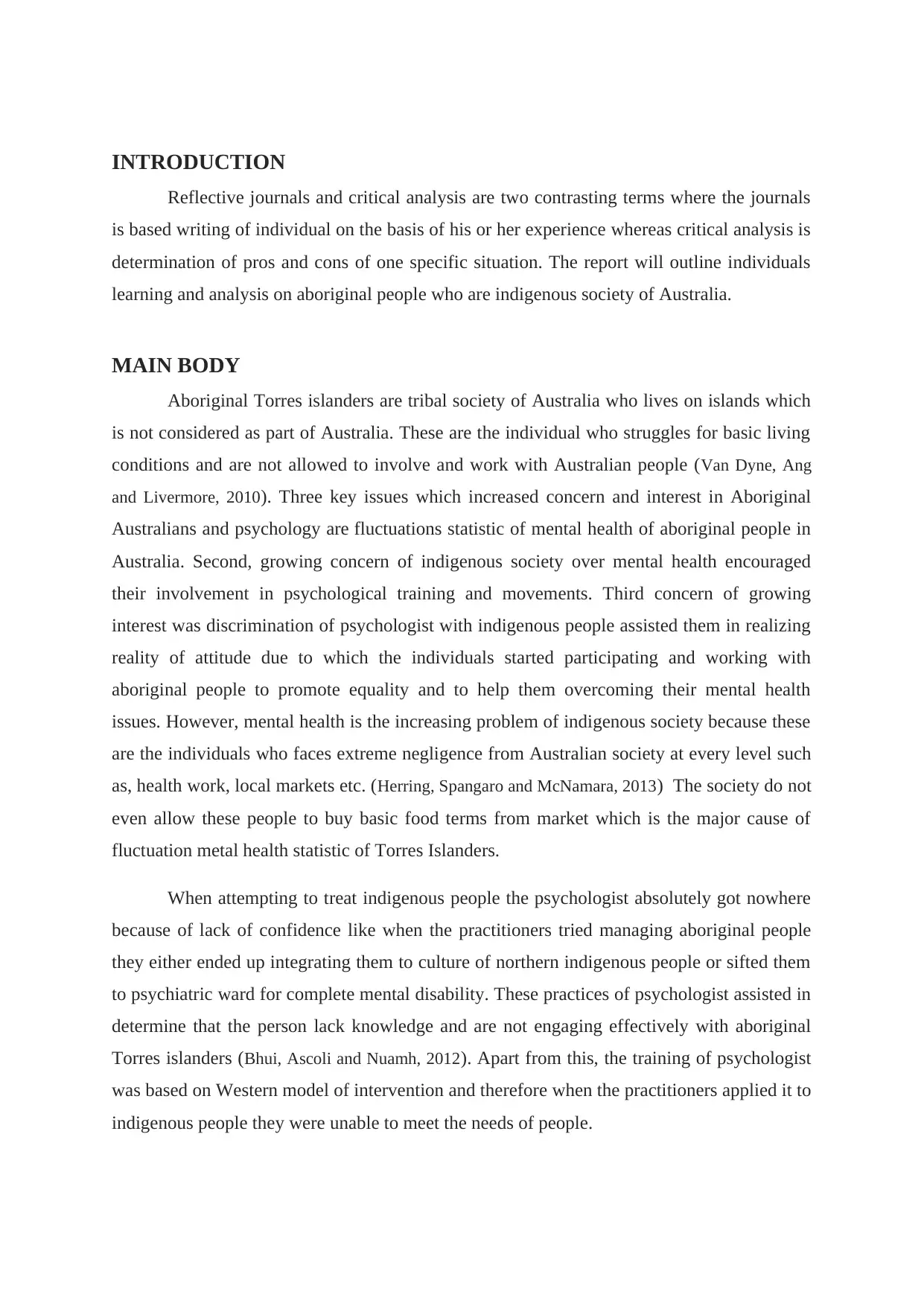
INTRODUCTION
Reflective journals and critical analysis are two contrasting terms where the journals
is based writing of individual on the basis of his or her experience whereas critical analysis is
determination of pros and cons of one specific situation. The report will outline individuals
learning and analysis on aboriginal people who are indigenous society of Australia.
MAIN BODY
Aboriginal Torres islanders are tribal society of Australia who lives on islands which
is not considered as part of Australia. These are the individual who struggles for basic living
conditions and are not allowed to involve and work with Australian people (Van Dyne, Ang
and Livermore, 2010). Three key issues which increased concern and interest in Aboriginal
Australians and psychology are fluctuations statistic of mental health of aboriginal people in
Australia. Second, growing concern of indigenous society over mental health encouraged
their involvement in psychological training and movements. Third concern of growing
interest was discrimination of psychologist with indigenous people assisted them in realizing
reality of attitude due to which the individuals started participating and working with
aboriginal people to promote equality and to help them overcoming their mental health
issues. However, mental health is the increasing problem of indigenous society because these
are the individuals who faces extreme negligence from Australian society at every level such
as, health work, local markets etc. (Herring, Spangaro and McNamara, 2013) The society do not
even allow these people to buy basic food terms from market which is the major cause of
fluctuation metal health statistic of Torres Islanders.
When attempting to treat indigenous people the psychologist absolutely got nowhere
because of lack of confidence like when the practitioners tried managing aboriginal people
they either ended up integrating them to culture of northern indigenous people or sifted them
to psychiatric ward for complete mental disability. These practices of psychologist assisted in
determine that the person lack knowledge and are not engaging effectively with aboriginal
Torres islanders (Bhui, Ascoli and Nuamh, 2012). Apart from this, the training of psychologist
was based on Western model of intervention and therefore when the practitioners applied it to
indigenous people they were unable to meet the needs of people.
Reflective journals and critical analysis are two contrasting terms where the journals
is based writing of individual on the basis of his or her experience whereas critical analysis is
determination of pros and cons of one specific situation. The report will outline individuals
learning and analysis on aboriginal people who are indigenous society of Australia.
MAIN BODY
Aboriginal Torres islanders are tribal society of Australia who lives on islands which
is not considered as part of Australia. These are the individual who struggles for basic living
conditions and are not allowed to involve and work with Australian people (Van Dyne, Ang
and Livermore, 2010). Three key issues which increased concern and interest in Aboriginal
Australians and psychology are fluctuations statistic of mental health of aboriginal people in
Australia. Second, growing concern of indigenous society over mental health encouraged
their involvement in psychological training and movements. Third concern of growing
interest was discrimination of psychologist with indigenous people assisted them in realizing
reality of attitude due to which the individuals started participating and working with
aboriginal people to promote equality and to help them overcoming their mental health
issues. However, mental health is the increasing problem of indigenous society because these
are the individuals who faces extreme negligence from Australian society at every level such
as, health work, local markets etc. (Herring, Spangaro and McNamara, 2013) The society do not
even allow these people to buy basic food terms from market which is the major cause of
fluctuation metal health statistic of Torres Islanders.
When attempting to treat indigenous people the psychologist absolutely got nowhere
because of lack of confidence like when the practitioners tried managing aboriginal people
they either ended up integrating them to culture of northern indigenous people or sifted them
to psychiatric ward for complete mental disability. These practices of psychologist assisted in
determine that the person lack knowledge and are not engaging effectively with aboriginal
Torres islanders (Bhui, Ascoli and Nuamh, 2012). Apart from this, the training of psychologist
was based on Western model of intervention and therefore when the practitioners applied it to
indigenous people they were unable to meet the needs of people.
⊘ This is a preview!⊘
Do you want full access?
Subscribe today to unlock all pages.

Trusted by 1+ million students worldwide
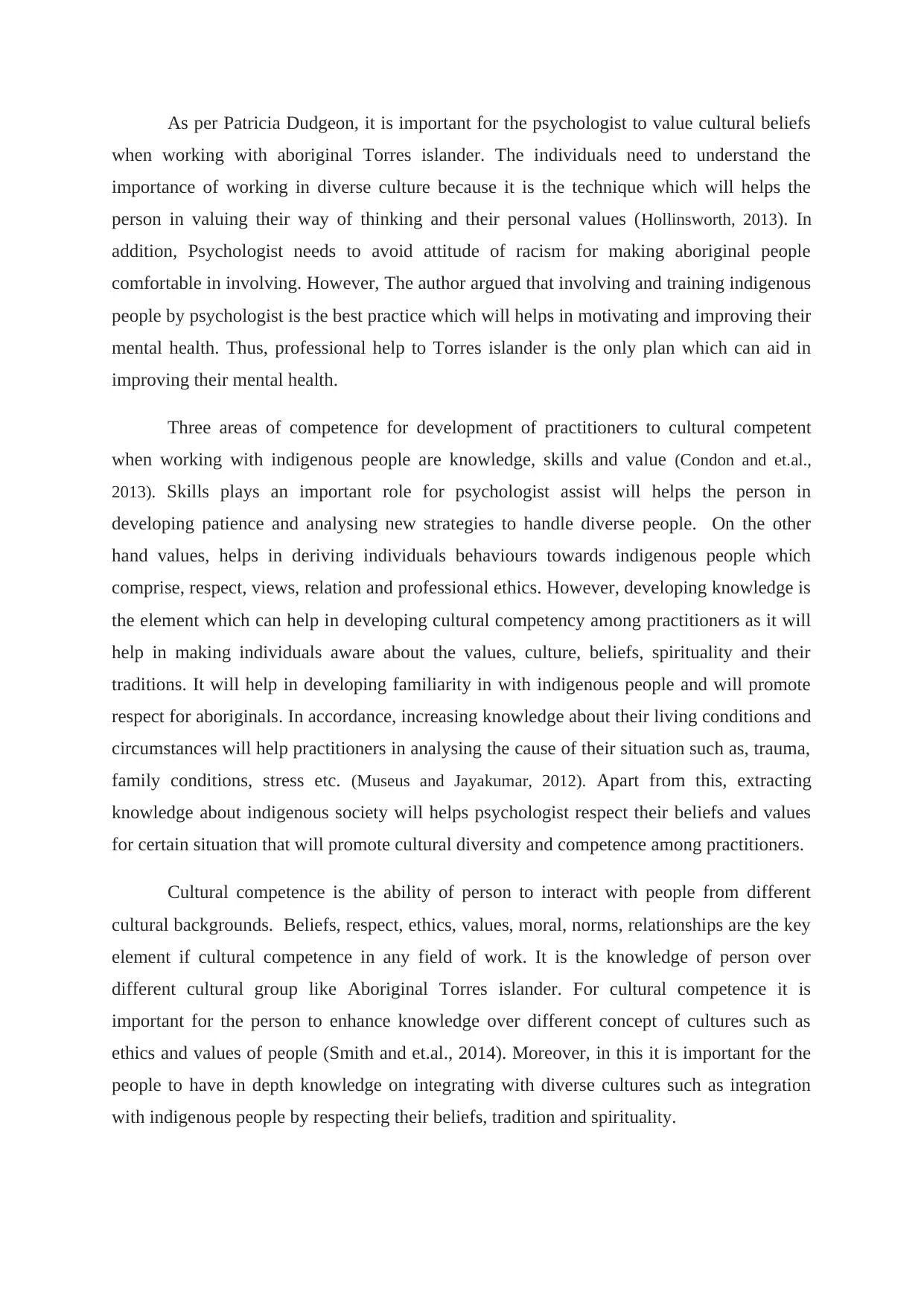
As per Patricia Dudgeon, it is important for the psychologist to value cultural beliefs
when working with aboriginal Torres islander. The individuals need to understand the
importance of working in diverse culture because it is the technique which will helps the
person in valuing their way of thinking and their personal values (Hollinsworth, 2013). In
addition, Psychologist needs to avoid attitude of racism for making aboriginal people
comfortable in involving. However, The author argued that involving and training indigenous
people by psychologist is the best practice which will helps in motivating and improving their
mental health. Thus, professional help to Torres islander is the only plan which can aid in
improving their mental health.
Three areas of competence for development of practitioners to cultural competent
when working with indigenous people are knowledge, skills and value (Condon and et.al.,
2013). Skills plays an important role for psychologist assist will helps the person in
developing patience and analysing new strategies to handle diverse people. On the other
hand values, helps in deriving individuals behaviours towards indigenous people which
comprise, respect, views, relation and professional ethics. However, developing knowledge is
the element which can help in developing cultural competency among practitioners as it will
help in making individuals aware about the values, culture, beliefs, spirituality and their
traditions. It will help in developing familiarity in with indigenous people and will promote
respect for aboriginals. In accordance, increasing knowledge about their living conditions and
circumstances will help practitioners in analysing the cause of their situation such as, trauma,
family conditions, stress etc. (Museus and Jayakumar, 2012). Apart from this, extracting
knowledge about indigenous society will helps psychologist respect their beliefs and values
for certain situation that will promote cultural diversity and competence among practitioners.
Cultural competence is the ability of person to interact with people from different
cultural backgrounds. Beliefs, respect, ethics, values, moral, norms, relationships are the key
element if cultural competence in any field of work. It is the knowledge of person over
different cultural group like Aboriginal Torres islander. For cultural competence it is
important for the person to enhance knowledge over different concept of cultures such as
ethics and values of people (Smith and et.al., 2014). Moreover, in this it is important for the
people to have in depth knowledge on integrating with diverse cultures such as integration
with indigenous people by respecting their beliefs, tradition and spirituality.
when working with aboriginal Torres islander. The individuals need to understand the
importance of working in diverse culture because it is the technique which will helps the
person in valuing their way of thinking and their personal values (Hollinsworth, 2013). In
addition, Psychologist needs to avoid attitude of racism for making aboriginal people
comfortable in involving. However, The author argued that involving and training indigenous
people by psychologist is the best practice which will helps in motivating and improving their
mental health. Thus, professional help to Torres islander is the only plan which can aid in
improving their mental health.
Three areas of competence for development of practitioners to cultural competent
when working with indigenous people are knowledge, skills and value (Condon and et.al.,
2013). Skills plays an important role for psychologist assist will helps the person in
developing patience and analysing new strategies to handle diverse people. On the other
hand values, helps in deriving individuals behaviours towards indigenous people which
comprise, respect, views, relation and professional ethics. However, developing knowledge is
the element which can help in developing cultural competency among practitioners as it will
help in making individuals aware about the values, culture, beliefs, spirituality and their
traditions. It will help in developing familiarity in with indigenous people and will promote
respect for aboriginals. In accordance, increasing knowledge about their living conditions and
circumstances will help practitioners in analysing the cause of their situation such as, trauma,
family conditions, stress etc. (Museus and Jayakumar, 2012). Apart from this, extracting
knowledge about indigenous society will helps psychologist respect their beliefs and values
for certain situation that will promote cultural diversity and competence among practitioners.
Cultural competence is the ability of person to interact with people from different
cultural backgrounds. Beliefs, respect, ethics, values, moral, norms, relationships are the key
element if cultural competence in any field of work. It is the knowledge of person over
different cultural group like Aboriginal Torres islander. For cultural competence it is
important for the person to enhance knowledge over different concept of cultures such as
ethics and values of people (Smith and et.al., 2014). Moreover, in this it is important for the
people to have in depth knowledge on integrating with diverse cultures such as integration
with indigenous people by respecting their beliefs, tradition and spirituality.
Paraphrase This Document
Need a fresh take? Get an instant paraphrase of this document with our AI Paraphraser
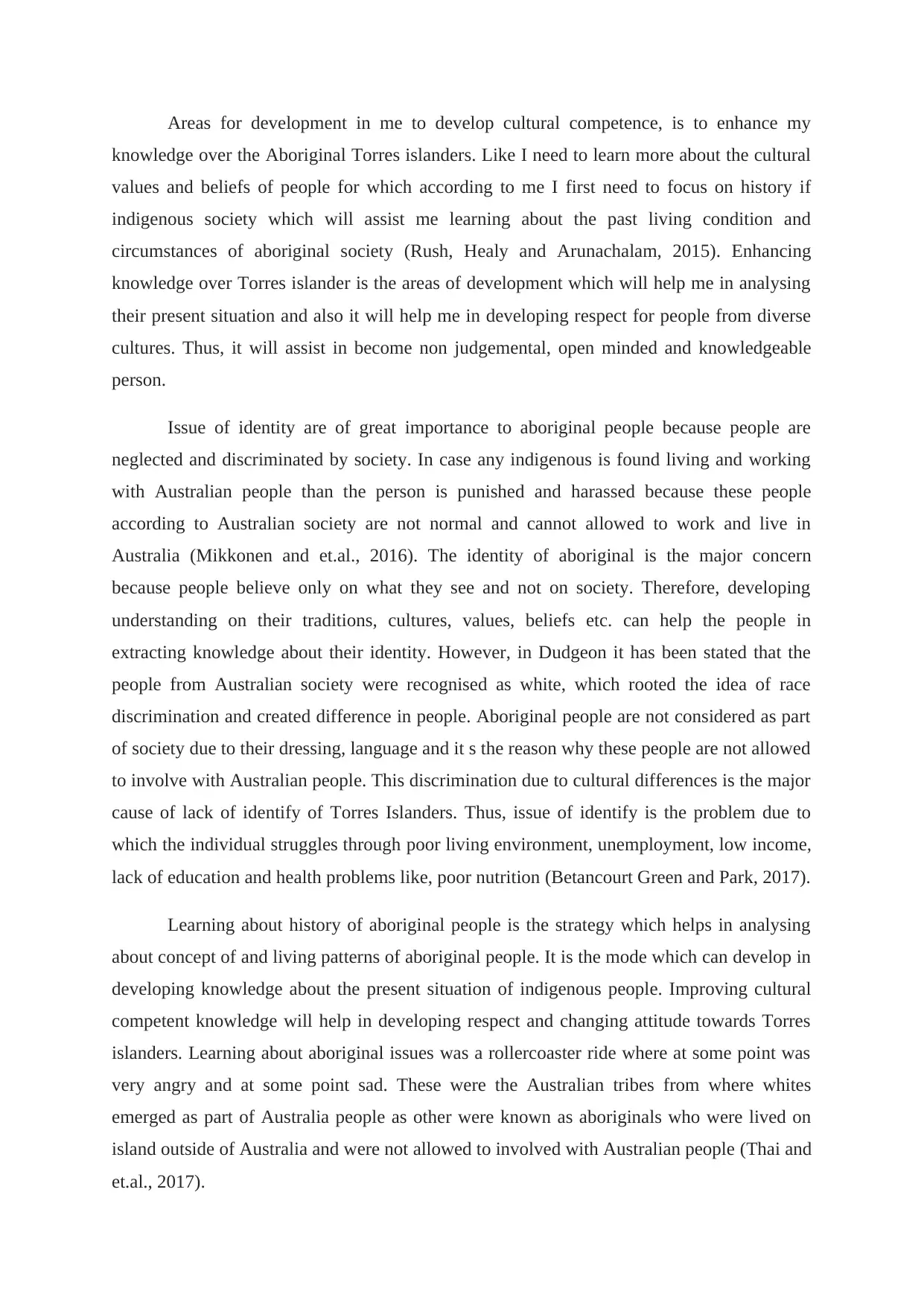
Areas for development in me to develop cultural competence, is to enhance my
knowledge over the Aboriginal Torres islanders. Like I need to learn more about the cultural
values and beliefs of people for which according to me I first need to focus on history if
indigenous society which will assist me learning about the past living condition and
circumstances of aboriginal society (Rush, Healy and Arunachalam, 2015). Enhancing
knowledge over Torres islander is the areas of development which will help me in analysing
their present situation and also it will help me in developing respect for people from diverse
cultures. Thus, it will assist in become non judgemental, open minded and knowledgeable
person.
Issue of identity are of great importance to aboriginal people because people are
neglected and discriminated by society. In case any indigenous is found living and working
with Australian people than the person is punished and harassed because these people
according to Australian society are not normal and cannot allowed to work and live in
Australia (Mikkonen and et.al., 2016). The identity of aboriginal is the major concern
because people believe only on what they see and not on society. Therefore, developing
understanding on their traditions, cultures, values, beliefs etc. can help the people in
extracting knowledge about their identity. However, in Dudgeon it has been stated that the
people from Australian society were recognised as white, which rooted the idea of race
discrimination and created difference in people. Aboriginal people are not considered as part
of society due to their dressing, language and it s the reason why these people are not allowed
to involve with Australian people. This discrimination due to cultural differences is the major
cause of lack of identify of Torres Islanders. Thus, issue of identify is the problem due to
which the individual struggles through poor living environment, unemployment, low income,
lack of education and health problems like, poor nutrition (Betancourt Green and Park, 2017).
Learning about history of aboriginal people is the strategy which helps in analysing
about concept of and living patterns of aboriginal people. It is the mode which can develop in
developing knowledge about the present situation of indigenous people. Improving cultural
competent knowledge will help in developing respect and changing attitude towards Torres
islanders. Learning about aboriginal issues was a rollercoaster ride where at some point was
very angry and at some point sad. These were the Australian tribes from where whites
emerged as part of Australia people as other were known as aboriginals who were lived on
island outside of Australia and were not allowed to involved with Australian people (Thai and
et.al., 2017).
knowledge over the Aboriginal Torres islanders. Like I need to learn more about the cultural
values and beliefs of people for which according to me I first need to focus on history if
indigenous society which will assist me learning about the past living condition and
circumstances of aboriginal society (Rush, Healy and Arunachalam, 2015). Enhancing
knowledge over Torres islander is the areas of development which will help me in analysing
their present situation and also it will help me in developing respect for people from diverse
cultures. Thus, it will assist in become non judgemental, open minded and knowledgeable
person.
Issue of identity are of great importance to aboriginal people because people are
neglected and discriminated by society. In case any indigenous is found living and working
with Australian people than the person is punished and harassed because these people
according to Australian society are not normal and cannot allowed to work and live in
Australia (Mikkonen and et.al., 2016). The identity of aboriginal is the major concern
because people believe only on what they see and not on society. Therefore, developing
understanding on their traditions, cultures, values, beliefs etc. can help the people in
extracting knowledge about their identity. However, in Dudgeon it has been stated that the
people from Australian society were recognised as white, which rooted the idea of race
discrimination and created difference in people. Aboriginal people are not considered as part
of society due to their dressing, language and it s the reason why these people are not allowed
to involve with Australian people. This discrimination due to cultural differences is the major
cause of lack of identify of Torres Islanders. Thus, issue of identify is the problem due to
which the individual struggles through poor living environment, unemployment, low income,
lack of education and health problems like, poor nutrition (Betancourt Green and Park, 2017).
Learning about history of aboriginal people is the strategy which helps in analysing
about concept of and living patterns of aboriginal people. It is the mode which can develop in
developing knowledge about the present situation of indigenous people. Improving cultural
competent knowledge will help in developing respect and changing attitude towards Torres
islanders. Learning about aboriginal issues was a rollercoaster ride where at some point was
very angry and at some point sad. These were the Australian tribes from where whites
emerged as part of Australia people as other were known as aboriginals who were lived on
island outside of Australia and were not allowed to involved with Australian people (Thai and
et.al., 2017).
From reading of attitude towards asylum seekers it has been determined the
conditions of asylum seekers was unpleasant and extreme and therefore people are forcing to
change government policy and society is turning hostile toward asylum seekers. Apart from
this, It has also been identified that racism is also reason behind unpleasant attitude of asylum
seekers, where indigenous people were termed as ugly. In addition, another key message of
author is given in difference in aboriginal people and asylum seekers where the aboriginal
people were not having any right unlike asylum seekers (Pedersen, et.al. 2005). Torres
islanders were oppressed and were not allowed to involve in society. Thus, it can be stated
that there were so many issues faced by indigenous people and also by asylum seekers due to
different in cultural beliefs, values, traditions etc.
White privilege is a term which reflects societal benefits to some specific people. Like
daily effects of white privileged according to me is, neutral behaviour of society, allowed to
move and work at any place, can participate in activity according to ones opinion. The
privileged people enjoy free living rights and also discriminate among them and indigenous
society. Moreover, as per my experience I have right to enjoy and share my opinion in society
unlike aboriginals. In accordance, I feel white people own the right to discriminate and isolate
indigenous people due to their differences. I am allowed to work and choose between
different opportunities of earning livelihood but still aboriginal society struggles for basic
living conditions and undergoes various employment issues and financial barriers which
restrict their growth in Australian Society. In comparison to white people society the status of
Torres islander is high mortality rates, high morbidity rates, low life expectancy, and multiple
morbidity (Haslam and et.al., 2014).
White people are privileged at work place in various situation like the individual can
leave pace in case of not feeling good, right, uncomfortable, lack of respect anything but on
the other hand if in case if some indigenous is working with us than the person has to stay
back and resist the situation no matter what all are the consequences. However, policies and
practices of workplace are also different for white and aboriginal people, that reflects
privileged of white people like the difference in working hours and working conditions is the
example which helps in analysing the basic difference of workplace which denotes difference
in two people of two different cultural backgrounds.
According to me engaging effectively with culturally diverse people is the best way to
promote own learning and knowledge. As per reading and learning, I derived that t is
conditions of asylum seekers was unpleasant and extreme and therefore people are forcing to
change government policy and society is turning hostile toward asylum seekers. Apart from
this, It has also been identified that racism is also reason behind unpleasant attitude of asylum
seekers, where indigenous people were termed as ugly. In addition, another key message of
author is given in difference in aboriginal people and asylum seekers where the aboriginal
people were not having any right unlike asylum seekers (Pedersen, et.al. 2005). Torres
islanders were oppressed and were not allowed to involve in society. Thus, it can be stated
that there were so many issues faced by indigenous people and also by asylum seekers due to
different in cultural beliefs, values, traditions etc.
White privilege is a term which reflects societal benefits to some specific people. Like
daily effects of white privileged according to me is, neutral behaviour of society, allowed to
move and work at any place, can participate in activity according to ones opinion. The
privileged people enjoy free living rights and also discriminate among them and indigenous
society. Moreover, as per my experience I have right to enjoy and share my opinion in society
unlike aboriginals. In accordance, I feel white people own the right to discriminate and isolate
indigenous people due to their differences. I am allowed to work and choose between
different opportunities of earning livelihood but still aboriginal society struggles for basic
living conditions and undergoes various employment issues and financial barriers which
restrict their growth in Australian Society. In comparison to white people society the status of
Torres islander is high mortality rates, high morbidity rates, low life expectancy, and multiple
morbidity (Haslam and et.al., 2014).
White people are privileged at work place in various situation like the individual can
leave pace in case of not feeling good, right, uncomfortable, lack of respect anything but on
the other hand if in case if some indigenous is working with us than the person has to stay
back and resist the situation no matter what all are the consequences. However, policies and
practices of workplace are also different for white and aboriginal people, that reflects
privileged of white people like the difference in working hours and working conditions is the
example which helps in analysing the basic difference of workplace which denotes difference
in two people of two different cultural backgrounds.
According to me engaging effectively with culturally diverse people is the best way to
promote own learning and knowledge. As per reading and learning, I derived that t is
⊘ This is a preview!⊘
Do you want full access?
Subscribe today to unlock all pages.
Trusted by 1+ million students worldwide
important for the psychologist to get involved with aboriginal people effectively to deliver
the services. Further, according to it is important for the person to value their beliefs,
traditions, cultures and ideology over different situation in order to make them comfortable in
environment. As per statistic of metal health, I derived that the major cause behind increasing
mental issues among Torres islander is societal isolation, basic living condition and
discrimination. The most challenging part of course for me was to determine key message
and element such as determining difference between asylum seeker and Torres islanders,
learning about history and valuing different cultural beliefs at least at the time of practising
(Almeida and et.al., 2014). I was enjoying white privilege regardless of the fact that these
people live in outskirts and struggles for basic livelihood and are discriminated at various
places like, Schools universities, workplaces etc. As per my learning and beliefs I feel
creating awareness among people about disrupting condition of these people by sharing some
history and promoting knowledge about diverse culture at work place can help me in making
people respect culture and beliefs of aboriginal people. This strategy of creating awareness at
one place will help in making people understand the situation and necessity to eliminate this
discrimination. However, I feel white privilege was easy to define because I feel it. I
explained some situation of white privileged people which I experience in my daily life.
These concepts and learning challenge my thinking because I am one of the White privileges
and now I need to learn and promote working in diverse culture. The most difficult part of
learning was to analyse key messages and elements because reading were lengthy and time
consuming. Thus, I would concluded by stating the promoting cultural competence and
cultural diversity is the thing which can assist me in my future plans of increasing effectives
in my psychologist services with aboriginal Torres Islander.
CONCLUSION
The report summarized individual learning through experience with the help of
critical analysis on aboriginal Torres islander. It outlined it is important for the psychologist
to value cultural beliefs and promote concept of diverse cultures when working with
indigenous society. Thus, it concluded with exploration of Power, Privilege of individual
which will help in encouragement for future psychologist.
the services. Further, according to it is important for the person to value their beliefs,
traditions, cultures and ideology over different situation in order to make them comfortable in
environment. As per statistic of metal health, I derived that the major cause behind increasing
mental issues among Torres islander is societal isolation, basic living condition and
discrimination. The most challenging part of course for me was to determine key message
and element such as determining difference between asylum seeker and Torres islanders,
learning about history and valuing different cultural beliefs at least at the time of practising
(Almeida and et.al., 2014). I was enjoying white privilege regardless of the fact that these
people live in outskirts and struggles for basic livelihood and are discriminated at various
places like, Schools universities, workplaces etc. As per my learning and beliefs I feel
creating awareness among people about disrupting condition of these people by sharing some
history and promoting knowledge about diverse culture at work place can help me in making
people respect culture and beliefs of aboriginal people. This strategy of creating awareness at
one place will help in making people understand the situation and necessity to eliminate this
discrimination. However, I feel white privilege was easy to define because I feel it. I
explained some situation of white privileged people which I experience in my daily life.
These concepts and learning challenge my thinking because I am one of the White privileges
and now I need to learn and promote working in diverse culture. The most difficult part of
learning was to analyse key messages and elements because reading were lengthy and time
consuming. Thus, I would concluded by stating the promoting cultural competence and
cultural diversity is the thing which can assist me in my future plans of increasing effectives
in my psychologist services with aboriginal Torres Islander.
CONCLUSION
The report summarized individual learning through experience with the help of
critical analysis on aboriginal Torres islander. It outlined it is important for the psychologist
to value cultural beliefs and promote concept of diverse cultures when working with
indigenous society. Thus, it concluded with exploration of Power, Privilege of individual
which will help in encouragement for future psychologist.
Paraphrase This Document
Need a fresh take? Get an instant paraphrase of this document with our AI Paraphraser
REFRENCES
Books and Journals
Van Dyne, L., Ang, S. and Livermore, D., 2010. Cultural intelligence: A pathway for leading
in a rapidly globalizing world. Leading across differences. pp.131-138.
Herring, S., Spangaro, J., and McNamara, L., 2013. The intersection of trauma, racism, and
cultural competence in effective work with aboriginal people: Waiting for trust.
Australian Social Work. 66(1). pp.104-117.
Bhui, K., Ascoli, M. and Nuamh, O., 2012. The place of race and racism in cultural
competence: What can we learn from the English experience about the narratives of
evidence and argument?. Transcultural psychiatry. 49(2). pp.185-205.
Hollinsworth, D., 2013. Decolonizing indigenous disability in Australia. Disability & Society.
28(5). pp.601-615.
Condon, J.R., and et.al., 2013. ABORIGINAL AND TORRES STRAIT ISLANDER. In
Cancer Forum is produced by Cancer Council Australia for health professionals
working in cancer control. It is the official journal of the Clinical Oncological
Society of Australia. (p. 26).
Museus, S.D. and Jayakumar, U.M. eds., 2012. Creating campus cultures: Fostering success
among racially diverse student populations. Routledge.
Smith, E. and et.al., 2014. From blues to rainbows: The mental health and well-being of
gender diverse and transgender young people in Australia. Australian Research Centre
in Sex, Health & Society.
Rush, A., Healy, E., and Arunachalam, D. 2015. Social Inequality and Social Capital in a
Culturally Diverse Society–Melbourne Australia. Global urban studies. 8. 61-75.
Mikkonen, K. and et.al., 2016. Culturally and linguistically diverse healthcare students’
experiences of learning in a clinical environment: a systematic review of qualitative
studies. International journal of nursing studies. 54. 173-187.
Betancourt, J. R., Green, A. R., and Park, E. R. 2017. Cultural competence and health care
disparities: key perspectives and trends. Health affairs.
Books and Journals
Van Dyne, L., Ang, S. and Livermore, D., 2010. Cultural intelligence: A pathway for leading
in a rapidly globalizing world. Leading across differences. pp.131-138.
Herring, S., Spangaro, J., and McNamara, L., 2013. The intersection of trauma, racism, and
cultural competence in effective work with aboriginal people: Waiting for trust.
Australian Social Work. 66(1). pp.104-117.
Bhui, K., Ascoli, M. and Nuamh, O., 2012. The place of race and racism in cultural
competence: What can we learn from the English experience about the narratives of
evidence and argument?. Transcultural psychiatry. 49(2). pp.185-205.
Hollinsworth, D., 2013. Decolonizing indigenous disability in Australia. Disability & Society.
28(5). pp.601-615.
Condon, J.R., and et.al., 2013. ABORIGINAL AND TORRES STRAIT ISLANDER. In
Cancer Forum is produced by Cancer Council Australia for health professionals
working in cancer control. It is the official journal of the Clinical Oncological
Society of Australia. (p. 26).
Museus, S.D. and Jayakumar, U.M. eds., 2012. Creating campus cultures: Fostering success
among racially diverse student populations. Routledge.
Smith, E. and et.al., 2014. From blues to rainbows: The mental health and well-being of
gender diverse and transgender young people in Australia. Australian Research Centre
in Sex, Health & Society.
Rush, A., Healy, E., and Arunachalam, D. 2015. Social Inequality and Social Capital in a
Culturally Diverse Society–Melbourne Australia. Global urban studies. 8. 61-75.
Mikkonen, K. and et.al., 2016. Culturally and linguistically diverse healthcare students’
experiences of learning in a clinical environment: a systematic review of qualitative
studies. International journal of nursing studies. 54. 173-187.
Betancourt, J. R., Green, A. R., and Park, E. R. 2017. Cultural competence and health care
disparities: key perspectives and trends. Health affairs.
Thai, A. A. and et.al., 2017. Exploring disparities in receipt of adjuvant chemotherapy in
culturally and linguistically diverse (CALD) groups: an Australian centre's
experience. Internal Medicine Journal.
Haslam, S. A. and et.al., 2014. Social identity at work: Developing theory for organizational
practice. Psychology Press.
Almeida, O. P. and et.al., 2014. The Kimberley assessment of depression of older indigenous
Australians: prevalence of depressive disorders, risk factors and validation of the
KICA-dep scale. PloS one. 9(4). e94983.
Pedersen, A. et.al. 2005. Attitudes Towards Indigenous Australians and Asylum Seekers: The
role of false beliefs and other social-psychological variables, Australian
Psychologist. 40 (3): pp. 170-178
culturally and linguistically diverse (CALD) groups: an Australian centre's
experience. Internal Medicine Journal.
Haslam, S. A. and et.al., 2014. Social identity at work: Developing theory for organizational
practice. Psychology Press.
Almeida, O. P. and et.al., 2014. The Kimberley assessment of depression of older indigenous
Australians: prevalence of depressive disorders, risk factors and validation of the
KICA-dep scale. PloS one. 9(4). e94983.
Pedersen, A. et.al. 2005. Attitudes Towards Indigenous Australians and Asylum Seekers: The
role of false beliefs and other social-psychological variables, Australian
Psychologist. 40 (3): pp. 170-178
⊘ This is a preview!⊘
Do you want full access?
Subscribe today to unlock all pages.
Trusted by 1+ million students worldwide

1 out of 9


Related Documents


Your All-in-One AI-Powered Toolkit for Academic Success.
+13062052269
info@desklib.com
Available 24*7 on WhatsApp / Email
![[object Object]](/_next/static/media/star-bottom.7253800d.svg)
Unlock your academic potential
Copyright © 2020–2026 A2Z Services. All Rights Reserved. Developed and managed by ZUCOL.