Week 1 Readings Summary: Professionalism and Education

Verified

Added on  2023/01/18

|5
|1723
|47
Homework Assignment
AI Summary
This assignment presents summaries of six academic readings. The first reading by Dixson and Worrell (2016) discusses formative and summative assessment in the classroom, emphasizing performance-based assessments and the importance of teachers understanding assessment goals. Frost's (2010) reading explores professionalism and social change, highlighting globalization, informationalism, networking, and managerialism's impact on reflective practice. Howard (2003) focuses on culturally relevant pedagogy and critical teacher reflection. Bassot (2016) delves into critically reflective practice as a way of being, emphasizing intelligent practitioners and various lenses for processing analytically. Churchill and Keddie (2011) examine professional, ethical, and legal issues for teachers, including codes of conduct and the Melbourne Declaration. Finally, Moon (1999) presents a map of learning and representation of learning, including stages like noticing, making sense, and transformative learning. Each summary includes key learnings, interesting points, and a question raised by the student.
Document Page
1
Readings Summary
Name__________________
Complete the following for each of this week’s readings.
Title of reading
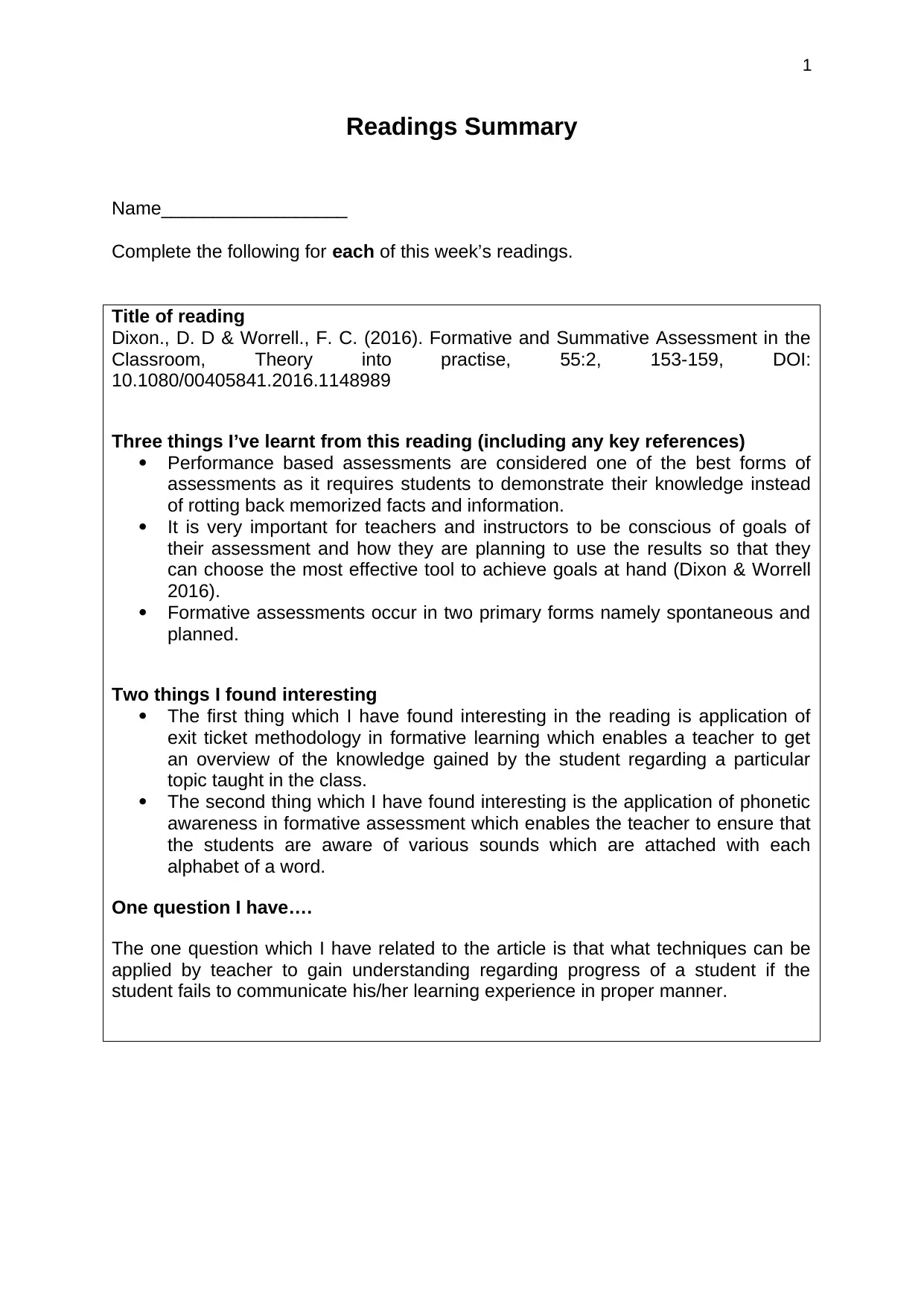
Dixon., D. D & Worrell., F. C. (2016). Formative and Summative Assessment in the
Classroom, Theory into practise, 55:2, 153-159, DOI:
10.1080/00405841.2016.1148989
Three things I’ve learnt from this reading (including any key references)
Performance based assessments are considered one of the best forms of
assessments as it requires students to demonstrate their knowledge instead
of rotting back memorized facts and information.
It is very important for teachers and instructors to be conscious of goals of
their assessment and how they are planning to use the results so that they
can choose the most effective tool to achieve goals at hand (Dixon & Worrell
2016).
Formative assessments occur in two primary forms namely spontaneous and
planned.
Two things I found interesting
The first thing which I have found interesting in the reading is application of
exit ticket methodology in formative learning which enables a teacher to get
an overview of the knowledge gained by the student regarding a particular
topic taught in the class.
The second thing which I have found interesting is the application of phonetic
awareness in formative assessment which enables the teacher to ensure that
the students are aware of various sounds which are attached with each
alphabet of a word.
One question I have….
The one question which I have related to the article is that what techniques can be
applied by teacher to gain understanding regarding progress of a student if the
student fails to communicate his/her learning experience in proper manner.
tabler-icon-diamond-filled.svg

Paraphrase This Document

Need a fresh take? Get an instant paraphrase of this document with our AI Paraphraser
Document Page
2
Title of reading
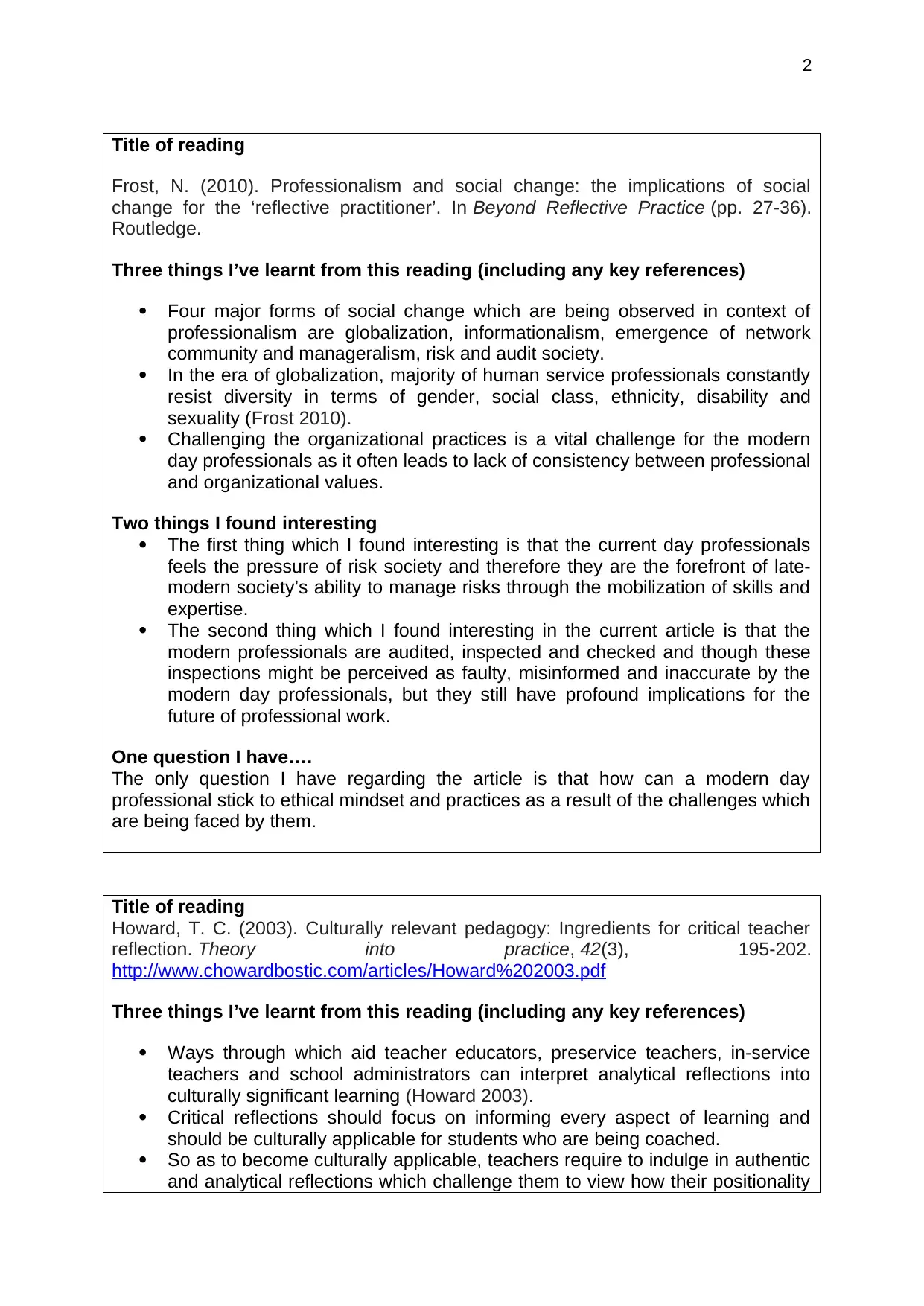
Frost, N. (2010). Professionalism and social change: the implications of social
change for the ‘reflective practitioner’. In Beyond Reflective Practice (pp. 27-36).
Routledge.
Three things I’ve learnt from this reading (including any key references)
Four major forms of social change which are being observed in context of
professionalism are globalization, informationalism, emergence of network
community and manageralism, risk and audit society.
In the era of globalization, majority of human service professionals constantly
resist diversity in terms of gender, social class, ethnicity, disability and
sexuality (Frost 2010).
Challenging the organizational practices is a vital challenge for the modern
day professionals as it often leads to lack of consistency between professional
and organizational values.
Two things I found interesting
The first thing which I found interesting is that the current day professionals
feels the pressure of risk society and therefore they are the forefront of late-
modern society’s ability to manage risks through the mobilization of skills and
expertise.
The second thing which I found interesting in the current article is that the
modern professionals are audited, inspected and checked and though these
inspections might be perceived as faulty, misinformed and inaccurate by the
modern day professionals, but they still have profound implications for the
future of professional work.
One question I have….
The only question I have regarding the article is that how can a modern day
professional stick to ethical mindset and practices as a result of the challenges which
are being faced by them.
Title of reading
Howard, T. C. (2003). Culturally relevant pedagogy: Ingredients for critical teacher
reflection. Theory into practice, 42(3), 195-202.
http://www.chowardbostic.com/articles/Howard%202003.pdf
Three things I’ve learnt from this reading (including any key references)
Ways through which aid teacher educators, preservice teachers, in-service
teachers and school administrators can interpret analytical reflections into
culturally significant learning (Howard 2003).
Critical reflections should focus on informing every aspect of learning and
should be culturally applicable for students who are being coached.
So as to become culturally applicable, teachers require to indulge in authentic
and analytical reflections which challenge them to view how their positionality
Document Page
3
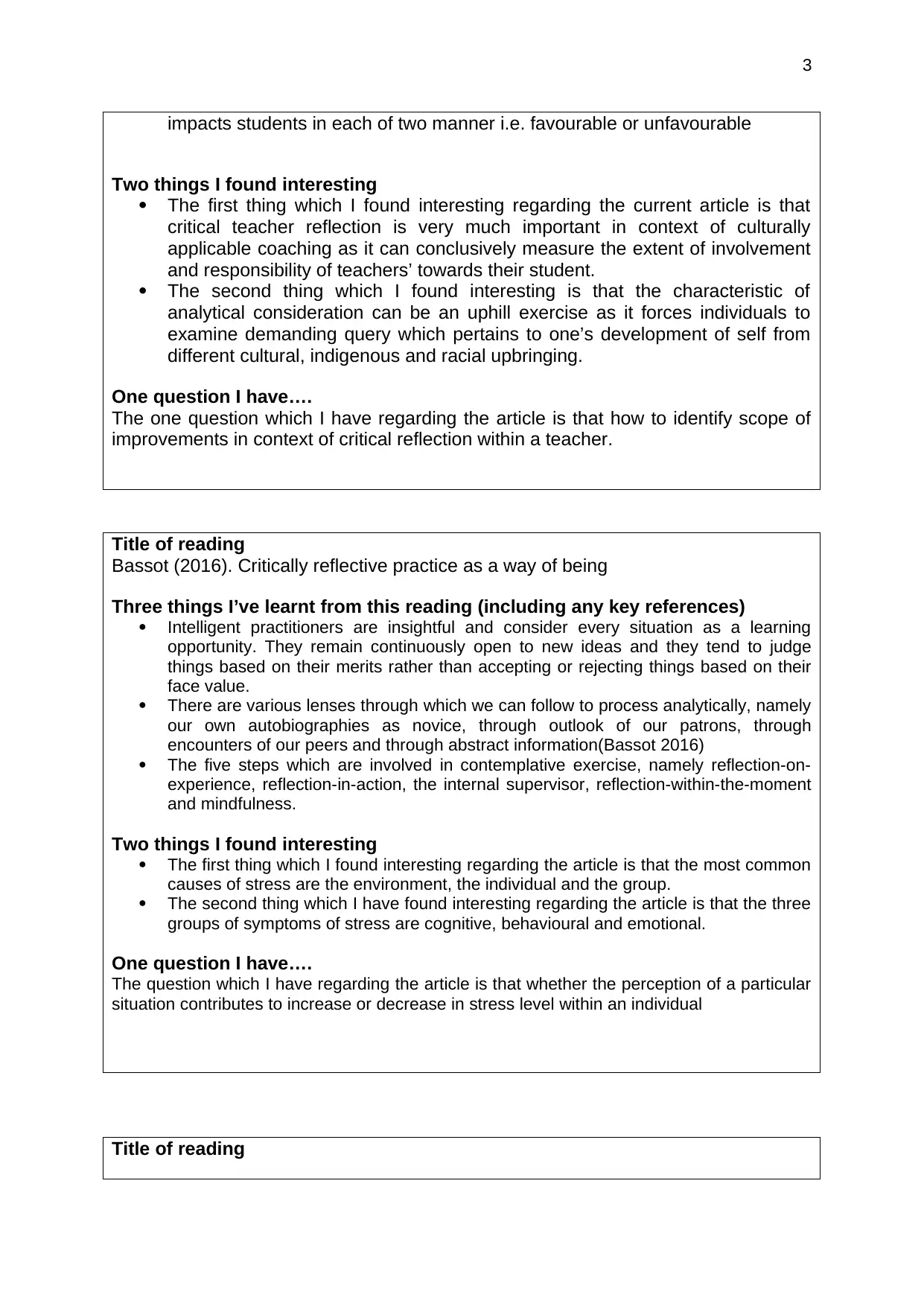
impacts students in each of two manner i.e. favourable or unfavourable
Two things I found interesting
The first thing which I found interesting regarding the current article is that
critical teacher reflection is very much important in context of culturally
applicable coaching as it can conclusively measure the extent of involvement
and responsibility of teachers’ towards their student.
The second thing which I found interesting is that the characteristic of
analytical consideration can be an uphill exercise as it forces individuals to
examine demanding query which pertains to one’s development of self from
different cultural, indigenous and racial upbringing.
One question I have….
The one question which I have regarding the article is that how to identify scope of
improvements in context of critical reflection within a teacher.
Title of reading
Bassot (2016). Critically reflective practice as a way of being
Three things I’ve learnt from this reading (including any key references)
Intelligent practitioners are insightful and consider every situation as a learning
opportunity. They remain continuously open to new ideas and they tend to judge
things based on their merits rather than accepting or rejecting things based on their
face value.
There are various lenses through which we can follow to process analytically, namely
our own autobiographies as novice, through outlook of our patrons, through
encounters of our peers and through abstract information(Bassot 2016)
The five steps which are involved in contemplative exercise, namely reflection-on-
experience, reflection-in-action, the internal supervisor, reflection-within-the-moment
and mindfulness.
Two things I found interesting
The first thing which I found interesting regarding the article is that the most common
causes of stress are the environment, the individual and the group.
The second thing which I have found interesting regarding the article is that the three
groups of symptoms of stress are cognitive, behavioural and emotional.
One question I have….
The question which I have regarding the article is that whether the perception of a particular
situation contributes to increase or decrease in stress level within an individual
Title of reading
Document Page
4
Churchill, R., & Keddie, A. (2011). Professional, ethical and legal issues for
teachers. Teaching: Making a difference, 554-591.
Three things I’ve learnt from this reading (including any key references)
It is very important to consider how one’s personal values and thinking
regarding teaching as a profession fits with the statement of ethics and codes
of conduct which are applicable in the profession.
The various laws and acts to which the teachers need to adhere to in addition
to the law of the lands.
The key sections of the Melbourne Declaration helps in identifying two
educational purposes for young Australians, namely Australian schooling
facilitating equity and intelligence and all young Australians becoming
outstanding leaders, fearless and visionary person and effective and learned
civilians. (Churchill & Keddie 2011).
Two things I found interesting
The first thing which I found interesting regarding the article is that there are
various factors which helps in attracting individuals towards the teaching
profession such as contact with young people and other learners, the
opportunity to revisit positive experiences of own schooling, perception that
teachers are providing a valuable service to the society and material rewards
which were less accessible to women and socially upward mobile male
teachers.
The second thing which I found interesting regarding the article is that
teachers are depicted as autonomous craftsman who administer, assimilate
and change accessible means and resources in response to continuously
altering scenarios for meeting goals associated with student learnings
according to bricolage conception of teachers’ classroom work.
One question I have….
The question I have regarding the article is that how to improve the conception and
perception regarding the teachers’ and teacher’s work in the society in order to
attract more individuals towards the profession.
Title of reading
Moon, J. A. (1999). Reflection in learning: Theory and practice.
Three things I’ve learnt from this reading (including any key references)
Idea of a map of learning and illustration of learning has been used to imply
the progress through events in the processing of learning which may have
one or another consequence for the outcome of learning.
Various steps of learning are noticing, making sense, making meaning,
working with the meaning and transformative learning (Moon 1999).
tabler-icon-diamond-filled.svg

Paraphrase This Document

Need a fresh take? Get an instant paraphrase of this document with our AI Paraphraser
Document Page
5
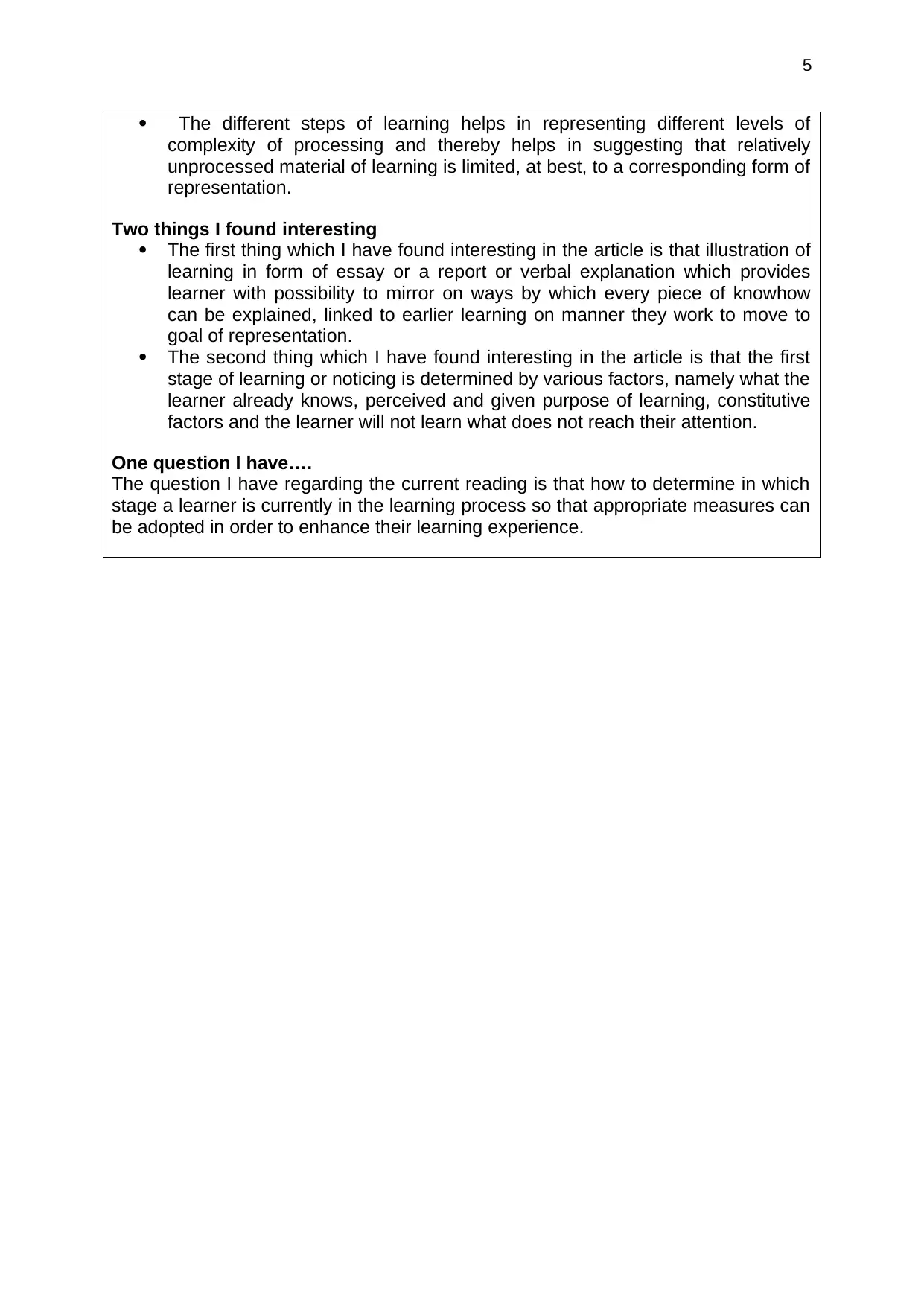
The different steps of learning helps in representing different levels of
complexity of processing and thereby helps in suggesting that relatively
unprocessed material of learning is limited, at best, to a corresponding form of
representation.
Two things I found interesting
The first thing which I have found interesting in the article is that illustration of
learning in form of essay or a report or verbal explanation which provides
learner with possibility to mirror on ways by which every piece of knowhow
can be explained, linked to earlier learning on manner they work to move to
goal of representation.
The second thing which I have found interesting in the article is that the first
stage of learning or noticing is determined by various factors, namely what the
learner already knows, perceived and given purpose of learning, constitutive
factors and the learner will not learn what does not reach their attention.
One question I have….
The question I have regarding the current reading is that how to determine in which
stage a learner is currently in the learning process so that appropriate measures can
be adopted in order to enhance their learning experience.
chevron_up_icon
1 out of 5
circle_padding
hide_on_mobile
zoom_out_icon
[object Object]