Effective Business Communication: Reflective Essay and Action Plan
VerifiedAdded on 2020/05/28
|16
|4909
|332
Report
AI Summary
This reflective essay analyzes a student's self-assessment of their effective business communication skills. The student uses various diagnostic tools, including Communication Skills Self-Assessment, Nonverbal Immediacy Scale, and Self-Perceived Communication Competence Scale, to identify strengths and weaknesses. The essay highlights two key shortfalls: public speaking apprehension and presentation skills. These weaknesses are illustrated through personal experiences, including an internship presentation and a job as a server. The essay then reviews literature on public speaking anxiety and its impact. The student concludes by creating an action plan, presented via a Gantt chart, to address these weaknesses and improve their communication skills for future professional interactions. The essay provides insights into the student's journey of self-discovery and improvement in business communication.


Paraphrase This Document
Need a fresh take? Get an instant paraphrase of this document with our AI Paraphraser
Effective Business Communication 2
In the functions of management, communication is the very basic function and helps the
individuals in making good decisions, in conceiving the plans, in creating sound business
structure and also allows the person to be well linked to their associates. Communication is
crucial in order for the person to attain managerial and even organizational effectiveness
(Mikkelson, York & Arritola, 2015). Through adoption of good communication, employees are
able to be more involved in the work they do and also enables in developing a better
understanding of the jobs which they have. Owing to clarity, timeliness and precision in
communication information, problems can be avoided from being raised in the organization. In
absence of proper communication, neither would the employees know on what is being done by
their co-worker, what their goals are and even the manner of assessing their performance, nor
will the managers be able to give out instructions to the ones below them in hierarchy level. This
would also lead to the management not getting the information which is crucial for drawing out
plans and taking the relevant decisions. This makes the communications, the nervous system for
any business/ organization (National Institute of Agricultural Extension Management, 2018).
Reflective essays are helpful in gaining an insight about an individual, in terms of who
they are, how they change, their strengths, their shortfalls, and the various other aspects of their
personality. It is basically the reflection of a person. When it comes to analysing the
communications of any person, the reflective essay prove to be quite helpful. Through this
reflective essay, my shortfalls would be identified and evaluated and would be worked upon so
that it could help me in my future business life. In order to identify the flaws which I have, I
would be making use of five distinctive diagnostic tools, taught to us in this coursework under
the modules. Once I identify the tools with the help of these tools, my weaknesses would be
In the functions of management, communication is the very basic function and helps the
individuals in making good decisions, in conceiving the plans, in creating sound business
structure and also allows the person to be well linked to their associates. Communication is
crucial in order for the person to attain managerial and even organizational effectiveness
(Mikkelson, York & Arritola, 2015). Through adoption of good communication, employees are
able to be more involved in the work they do and also enables in developing a better
understanding of the jobs which they have. Owing to clarity, timeliness and precision in
communication information, problems can be avoided from being raised in the organization. In
absence of proper communication, neither would the employees know on what is being done by
their co-worker, what their goals are and even the manner of assessing their performance, nor
will the managers be able to give out instructions to the ones below them in hierarchy level. This
would also lead to the management not getting the information which is crucial for drawing out
plans and taking the relevant decisions. This makes the communications, the nervous system for
any business/ organization (National Institute of Agricultural Extension Management, 2018).
Reflective essays are helpful in gaining an insight about an individual, in terms of who
they are, how they change, their strengths, their shortfalls, and the various other aspects of their
personality. It is basically the reflection of a person. When it comes to analysing the
communications of any person, the reflective essay prove to be quite helpful. Through this
reflective essay, my shortfalls would be identified and evaluated and would be worked upon so
that it could help me in my future business life. In order to identify the flaws which I have, I
would be making use of five distinctive diagnostic tools, taught to us in this coursework under
the modules. Once I identify the tools with the help of these tools, my weaknesses would be
Effective Business Communication 3
evaluated by me and a discussion of the same in context of the varied literature present for
identification of the two key shortfalls would be done. When this is done, the literature would be
taken as guidance for creation of an action plan for the next six months. The timeline of this
action plan would be presented through Gantt chart. Lastly, the discussion would end with
drawing out a conclusion of the entire leanings of this reflective essay.
In order to embark upon my reflective journey, I had to initially identify my flaws and for
this purpose, I began with the use of Communication Skills Self-Assessment diagnostic tool. As
covered in the introductory part of this reflective essay, communication skills are the backbone
and a crucial skill which is required in order for a person to succeed in their place of work. If an
individual wants to be an expert communicator, they need to be effective in all the points
covered under the communication process. This includes the effectiveness from sender to
receiver. The individual needs to be able to be comfortable in all the modes of communication,
be it face to face or telephonic (Mind Tools, 2018a). The next tool which I used was the
Nonverbal Immediacy Scale-Self Report, also referred shortly as NIS-S. This tool depicts the
non-verbal communication which an individual makes use of, which predominantly includes
their body language and the hand gestures while communicating. This tool helps in depicting that
an individual is closed to communication or that the person is over-indulged in the
communication they use for putting across their viewpoints (Richmond, McCroskey & Johnson,
2003).
The third diagnostic tool which I used for the purpose of this reflective essay was Self-
Perceived Communication Competence Scale or SPCC. This tool helps in depicting the
communication apprehensions held by an individual where they are required to speak in public
evaluated by me and a discussion of the same in context of the varied literature present for
identification of the two key shortfalls would be done. When this is done, the literature would be
taken as guidance for creation of an action plan for the next six months. The timeline of this
action plan would be presented through Gantt chart. Lastly, the discussion would end with
drawing out a conclusion of the entire leanings of this reflective essay.
In order to embark upon my reflective journey, I had to initially identify my flaws and for
this purpose, I began with the use of Communication Skills Self-Assessment diagnostic tool. As
covered in the introductory part of this reflective essay, communication skills are the backbone
and a crucial skill which is required in order for a person to succeed in their place of work. If an
individual wants to be an expert communicator, they need to be effective in all the points
covered under the communication process. This includes the effectiveness from sender to
receiver. The individual needs to be able to be comfortable in all the modes of communication,
be it face to face or telephonic (Mind Tools, 2018a). The next tool which I used was the
Nonverbal Immediacy Scale-Self Report, also referred shortly as NIS-S. This tool depicts the
non-verbal communication which an individual makes use of, which predominantly includes
their body language and the hand gestures while communicating. This tool helps in depicting that
an individual is closed to communication or that the person is over-indulged in the
communication they use for putting across their viewpoints (Richmond, McCroskey & Johnson,
2003).
The third diagnostic tool which I used for the purpose of this reflective essay was Self-
Perceived Communication Competence Scale or SPCC. This tool helps in depicting the
communication apprehensions held by an individual where they are required to speak in public
⊘ This is a preview!⊘
Do you want full access?
Subscribe today to unlock all pages.

Trusted by 1+ million students worldwide
Effective Business Communication 4
places, where there are strangers, and these are high in number. Through this tool, one can gain
an insight on the level of comfort which a person holds in addressing the crowds (Neuliep &
McCroskey, 1997). The fourth diagnostic tool I used was to gain an understanding on how good
are your people skills. These are often referred to as the soft skills, which impact the chances of
success of the technical skills. These become crucial when a person gets the leadership or
management role (Mind Tools, 2018b). The last diagnostic tool which was used for this
discussion was “How good are your presentation skills?” which helps in understanding the
feelings which an individual gets when they have to make a presentation (Mind Tools, 2018c).
Upon finishing the markings on the five diagnostic tools, the scores were calculated and
these were analysed on the basis of the given guides with these tools. In the first diagnostic tool
which was Communication Skills Self-Assessment, I got a score of 116, which was over the
marking of 110. This shows that when it comes to the mediation skills, I have mastery in it. The
next tool I used was NIS-S, where I got a score of 91. This shows that I have average non verbal
skills. On the third diagnostic tool which I used, i.e., on SPCC, I got average scoring in public at
66.67, low in meeting at 33.33, high in group at 100, low in dyad at 66.67, low in stranger at 25,
average in acquaintance at 75, high in friend at 100, and a total score of 66.67 which puts me on
an overall average rating. The fourth diagnostic tool I used was to gain an understanding on how
good are your people skills and on this I got a score of 48. This put me in average range, which
shows that I understand that working with others is crucial but there is room for improvement,
owing to the stress and pressure which I could feel in such situations. The last tool which I made
used of, for this reflective essay, was “How good are your presentation skills?” This also puts me
in the average rating which shows that my presentations are okay and also shows that I am an
places, where there are strangers, and these are high in number. Through this tool, one can gain
an insight on the level of comfort which a person holds in addressing the crowds (Neuliep &
McCroskey, 1997). The fourth diagnostic tool I used was to gain an understanding on how good
are your people skills. These are often referred to as the soft skills, which impact the chances of
success of the technical skills. These become crucial when a person gets the leadership or
management role (Mind Tools, 2018b). The last diagnostic tool which was used for this
discussion was “How good are your presentation skills?” which helps in understanding the
feelings which an individual gets when they have to make a presentation (Mind Tools, 2018c).
Upon finishing the markings on the five diagnostic tools, the scores were calculated and
these were analysed on the basis of the given guides with these tools. In the first diagnostic tool
which was Communication Skills Self-Assessment, I got a score of 116, which was over the
marking of 110. This shows that when it comes to the mediation skills, I have mastery in it. The
next tool I used was NIS-S, where I got a score of 91. This shows that I have average non verbal
skills. On the third diagnostic tool which I used, i.e., on SPCC, I got average scoring in public at
66.67, low in meeting at 33.33, high in group at 100, low in dyad at 66.67, low in stranger at 25,
average in acquaintance at 75, high in friend at 100, and a total score of 66.67 which puts me on
an overall average rating. The fourth diagnostic tool I used was to gain an understanding on how
good are your people skills and on this I got a score of 48. This put me in average range, which
shows that I understand that working with others is crucial but there is room for improvement,
owing to the stress and pressure which I could feel in such situations. The last tool which I made
used of, for this reflective essay, was “How good are your presentation skills?” This also puts me
in the average rating which shows that my presentations are okay and also shows that I am an
Paraphrase This Document
Need a fresh take? Get an instant paraphrase of this document with our AI Paraphraser
Effective Business Communication 5
average presenter. This means that the impressions which I leave are neither good nor bad, and
are essentially nonexistent.
These diagnostic tools show that I have two key shortfalls or weaknesses, i.e., public
speaking apprehensions and presentation skills. I deduced these predominantly due to the ratings
which I got in SPCC. These ratings showed me that I was very comfortable in my
communications with the individuals I knew, and with whom I was comfortable, but when it
came to the ones who were new to me, I got very nervous with them and lacked even the average
ratings on it. Presentation skills are a very important part of business communications and in the
diagnostic tool which tested this skill of mine, I got an average rating, which have to be
improved by me, if I have to excel in my professional interactions. These two shortfalls can be
further elucidated by two recent professional interactions.
In order to gain experience for my future, I got internship in a local firm, which was
preparing for a city based marathon. For this, I was asked to prepare a budget presentation,
which I had to present before the manager and the budget committee. I prepared a good
presentation in my view but was unable to deliver it with confidence and even stammered a bit. I
felt a bit numb and my heart raced, and even began sweating. I was eve asked to take a short
break by my supervisor but I refused to do so, as I found it very embarrassing. This even affected
by feedback and I was told that my presentation could have been way better, had I presented
what I actually planned to do, originally. I was even given a chance to present this at a meeting
which followed but I could not answer to the questions which were put before me due to the
apprehensions I felt at that moment.
average presenter. This means that the impressions which I leave are neither good nor bad, and
are essentially nonexistent.
These diagnostic tools show that I have two key shortfalls or weaknesses, i.e., public
speaking apprehensions and presentation skills. I deduced these predominantly due to the ratings
which I got in SPCC. These ratings showed me that I was very comfortable in my
communications with the individuals I knew, and with whom I was comfortable, but when it
came to the ones who were new to me, I got very nervous with them and lacked even the average
ratings on it. Presentation skills are a very important part of business communications and in the
diagnostic tool which tested this skill of mine, I got an average rating, which have to be
improved by me, if I have to excel in my professional interactions. These two shortfalls can be
further elucidated by two recent professional interactions.
In order to gain experience for my future, I got internship in a local firm, which was
preparing for a city based marathon. For this, I was asked to prepare a budget presentation,
which I had to present before the manager and the budget committee. I prepared a good
presentation in my view but was unable to deliver it with confidence and even stammered a bit. I
felt a bit numb and my heart raced, and even began sweating. I was eve asked to take a short
break by my supervisor but I refused to do so, as I found it very embarrassing. This even affected
by feedback and I was told that my presentation could have been way better, had I presented
what I actually planned to do, originally. I was even given a chance to present this at a meeting
which followed but I could not answer to the questions which were put before me due to the
apprehensions I felt at that moment.
Effective Business Communication 6
There was another professional interaction where my weaknesses were highlighted before
me. I was working as a server at a fast food joint in our locality and while working there, I was
asked to communicate with new customers on daily basis. However, this job proved out to be
very tough for me. On the very first day of my job, I was asked to cater to the walk in customers
but I could not engage in conversation with them. Irrespective of the questions put by them, be it
a question I knew the answer to or otherwise, I could not respond to the customers properly. A
middle-aged woman tried to make me feel at ease and told me to not get nervous about it, and yet
I could not control the manner in which I reacted. Ultimately, I was asked by the manager to
either improve my communication skills or to leave the job. Unfortunately I gave up and left the
job on the third day only.
One of the most common issues which is faced by people from different walks of life is
public speaking, and this problem is common in not only the pupils but also in the individuals
from general public. In the view of North and Rives (2001), where the people have a common
feeling of anxiety when they have to indulge in public speaking and when that happens, they face
a number of symptoms when such people have to speak in public. The symptoms include the
feeling of discomfort, sweating, palpitations, feeling confused, and muscles getting tensed and
even in some cases would be coupled with gastrointestinal discomfort. In the views presented by
Burnley, Cross and Spanos (1993), it was shown that nearly 85% of the public had faced some
level of anxiety when they were faced with public speaking. Rossi and Seiler (1986) have also
presented their views on public speaking and stage fright where they presented that the public
speaking is an issue which has been largely studied and investigated upon and the history of it
could be traced back to the mid part of the 1930s. Anxiety is often liked to public speaking and
There was another professional interaction where my weaknesses were highlighted before
me. I was working as a server at a fast food joint in our locality and while working there, I was
asked to communicate with new customers on daily basis. However, this job proved out to be
very tough for me. On the very first day of my job, I was asked to cater to the walk in customers
but I could not engage in conversation with them. Irrespective of the questions put by them, be it
a question I knew the answer to or otherwise, I could not respond to the customers properly. A
middle-aged woman tried to make me feel at ease and told me to not get nervous about it, and yet
I could not control the manner in which I reacted. Ultimately, I was asked by the manager to
either improve my communication skills or to leave the job. Unfortunately I gave up and left the
job on the third day only.
One of the most common issues which is faced by people from different walks of life is
public speaking, and this problem is common in not only the pupils but also in the individuals
from general public. In the view of North and Rives (2001), where the people have a common
feeling of anxiety when they have to indulge in public speaking and when that happens, they face
a number of symptoms when such people have to speak in public. The symptoms include the
feeling of discomfort, sweating, palpitations, feeling confused, and muscles getting tensed and
even in some cases would be coupled with gastrointestinal discomfort. In the views presented by
Burnley, Cross and Spanos (1993), it was shown that nearly 85% of the public had faced some
level of anxiety when they were faced with public speaking. Rossi and Seiler (1986) have also
presented their views on public speaking and stage fright where they presented that the public
speaking is an issue which has been largely studied and investigated upon and the history of it
could be traced back to the mid part of the 1930s. Anxiety is often liked to public speaking and
⊘ This is a preview!⊘
Do you want full access?
Subscribe today to unlock all pages.
Trusted by 1+ million students worldwide
Effective Business Communication 7
almost runs parallel to it. This shows that the individuals feel quite apprehensive and uneasy
about public speaking and have a fear of speaking in public due to their anticipations on things
which are taken to be threatening, even when these are not threatening in reality. Scovel (1991)
also presented his views on public speaking and its related anxiety. He stated that when the
anxiety felt during the public speaking is facilitated, the results are positive over the performance
of the learning party, and in such cases where the anxiety takes a negative toll it results in the
individual performing poorly.
Speaking is not an easy task, when it comes to the one taking place in public, due to the
anxiety which comes with it. In view of Horwitz, Horwitz and Cope (1991), this is exactly true
for the students, when they are faced with speaking in class, particularly when the student is an
anxious one. For the anxious students, it becomes difficult to make clear difference between the
sounds and the structures, and at times, even in apprehending the simple word meanings. Other
authors like Beatty and Friedland (1990), Beatty, Balfantz ad Kuwabara (1989) have also
contributed to the emotional predisposition faced by individuals when it comes to public
speaking and the sole reason for such predispositions have been attributed to the anxiety felt by
them. Communication skills, in view of Dunbar, Brooks and Miller (2006) are an essential tool
for students as it is not only important in their studies in college or high school life, but is very
crucial when they make transition from education to workplace. Two types of anxiety reactions
have been identified by Woodrow (2006), where psychological reasons are the first one, and the
cognitive reasons are the second one. When the person is faced with the first type, i.e., the
psychological reactions, their body shows their anxiety. This is in terms of stammering,
fidgeting, and raced heart rate. The second type is cognitive reaction, where the brain reacts and
almost runs parallel to it. This shows that the individuals feel quite apprehensive and uneasy
about public speaking and have a fear of speaking in public due to their anticipations on things
which are taken to be threatening, even when these are not threatening in reality. Scovel (1991)
also presented his views on public speaking and its related anxiety. He stated that when the
anxiety felt during the public speaking is facilitated, the results are positive over the performance
of the learning party, and in such cases where the anxiety takes a negative toll it results in the
individual performing poorly.
Speaking is not an easy task, when it comes to the one taking place in public, due to the
anxiety which comes with it. In view of Horwitz, Horwitz and Cope (1991), this is exactly true
for the students, when they are faced with speaking in class, particularly when the student is an
anxious one. For the anxious students, it becomes difficult to make clear difference between the
sounds and the structures, and at times, even in apprehending the simple word meanings. Other
authors like Beatty and Friedland (1990), Beatty, Balfantz ad Kuwabara (1989) have also
contributed to the emotional predisposition faced by individuals when it comes to public
speaking and the sole reason for such predispositions have been attributed to the anxiety felt by
them. Communication skills, in view of Dunbar, Brooks and Miller (2006) are an essential tool
for students as it is not only important in their studies in college or high school life, but is very
crucial when they make transition from education to workplace. Two types of anxiety reactions
have been identified by Woodrow (2006), where psychological reasons are the first one, and the
cognitive reasons are the second one. When the person is faced with the first type, i.e., the
psychological reactions, their body shows their anxiety. This is in terms of stammering,
fidgeting, and raced heart rate. The second type is cognitive reaction, where the brain reacts and
Paraphrase This Document
Need a fresh take? Get an instant paraphrase of this document with our AI Paraphraser
Effective Business Communication 8
the person starts getting irrelevant thoughts, and/ or self-depreciating thoughts. An anxious
person holds negative thoughts, which ultimately contributes to the anxiety levels of the person.
By facilitation of this anxiety, in view of Jones (2004), there is a need to provide
assistance to the anxious individual by learning the way through which the hurdle being faced by
the individual could be surmounted. In his view, upon the job which made the individual anxious
in the first place, ends, the anxiety also ends. When an individual is able to push himself for
doing the task which makes them anxious, the individual can surmount the very cause of their
anxiety. It has been identified by Ohata (2005) that by indulging in such facilitating effects, the
learners could be motivated and this is dependent on the attitude and perception of the individual
learner. He further stated that apprehensions in communication are just a form of anxiety and this
result from the negative self perceptions of individual resulting in such anxiety-filled behaviour.
The study conducted by Woodrow (2006) was based on inferring the anxiety particularly
in the verbal communications. It was identified by her that before speaking in public, the
individuals would get butterflies in their stomach. The same would also happen when a person
was asked to give a formal presentation as this was also coupled with anxiety. She suggested that
there was a need of learning the way in which the person could address the public without having
to fear on such a subject with could possibly never take place. And even in such cases, where the
feared upon thing takes place, it does not result in a devastating or detrimental effect as the
individual feared upon from the very start.
In the research undertaken by Marinho, Medeiros, Gama and Teixeira (2017), it was
depicted that competence in public speaking was a crucial element of business life and in order
for an individual to be successful in their professional life, there was a need for the individual to
the person starts getting irrelevant thoughts, and/ or self-depreciating thoughts. An anxious
person holds negative thoughts, which ultimately contributes to the anxiety levels of the person.
By facilitation of this anxiety, in view of Jones (2004), there is a need to provide
assistance to the anxious individual by learning the way through which the hurdle being faced by
the individual could be surmounted. In his view, upon the job which made the individual anxious
in the first place, ends, the anxiety also ends. When an individual is able to push himself for
doing the task which makes them anxious, the individual can surmount the very cause of their
anxiety. It has been identified by Ohata (2005) that by indulging in such facilitating effects, the
learners could be motivated and this is dependent on the attitude and perception of the individual
learner. He further stated that apprehensions in communication are just a form of anxiety and this
result from the negative self perceptions of individual resulting in such anxiety-filled behaviour.
The study conducted by Woodrow (2006) was based on inferring the anxiety particularly
in the verbal communications. It was identified by her that before speaking in public, the
individuals would get butterflies in their stomach. The same would also happen when a person
was asked to give a formal presentation as this was also coupled with anxiety. She suggested that
there was a need of learning the way in which the person could address the public without having
to fear on such a subject with could possibly never take place. And even in such cases, where the
feared upon thing takes place, it does not result in a devastating or detrimental effect as the
individual feared upon from the very start.
In the research undertaken by Marinho, Medeiros, Gama and Teixeira (2017), it was
depicted that competence in public speaking was a crucial element of business life and in order
for an individual to be successful in their professional life, there was a need for the individual to
Effective Business Communication 9
be fluent in their communication skills, as these helped the individuals in establishing their
credibility. Russ (2012) had also presented similar results through his research in which he
provided that with the help of good communication skills, the staff could easily enhance the
interpersonal workplace relationships and included in the staff were the key managerial
personnel. Majorly, the literature which is associated with the public speaking highlights the
requirement of harnessing the skill of communicating with efficiency and indulging in public
speaking without being apprehensive or anxious, in order for the individual to get the success
they aim for. This is true for not only the education life of the individual but holds particular
significance in the business or professional life of the person.
Even though the educators have chosen the path of exploring the technological advanced
forms of communication through the use of internet in terms of blogging or pod casting, in view
of Sheets and Tillson (2007), this is coupled with age-old problems. As per Sheets (2004) and
McCannon and Crews (1999), this is due to the improper mechanics, grammar and its usage.
Scott (2001) has attributed it to poor written forms of business correspondence which is
characterized by the inadequacy in organization and planning. And Hoff and Tian (2005) have
attributed it to the deficient oral presentation skills. As a result of these fundamental issues, the
mastery of students can be thwarted and this is true for both business communication and
academic disciplines. As per Sheets and Tillson (2007), the inability of an individual in
delivering oral presentations in an effective manner stems from the communication related
anxiety which is known as oral communication apprehension. The level of anxiety and fear
anticipated by the individual is deemed as the reason for the poor oral presentation performance
as per McCroskey (1977). This is due to the learned negative expectations and the learned
be fluent in their communication skills, as these helped the individuals in establishing their
credibility. Russ (2012) had also presented similar results through his research in which he
provided that with the help of good communication skills, the staff could easily enhance the
interpersonal workplace relationships and included in the staff were the key managerial
personnel. Majorly, the literature which is associated with the public speaking highlights the
requirement of harnessing the skill of communicating with efficiency and indulging in public
speaking without being apprehensive or anxious, in order for the individual to get the success
they aim for. This is true for not only the education life of the individual but holds particular
significance in the business or professional life of the person.
Even though the educators have chosen the path of exploring the technological advanced
forms of communication through the use of internet in terms of blogging or pod casting, in view
of Sheets and Tillson (2007), this is coupled with age-old problems. As per Sheets (2004) and
McCannon and Crews (1999), this is due to the improper mechanics, grammar and its usage.
Scott (2001) has attributed it to poor written forms of business correspondence which is
characterized by the inadequacy in organization and planning. And Hoff and Tian (2005) have
attributed it to the deficient oral presentation skills. As a result of these fundamental issues, the
mastery of students can be thwarted and this is true for both business communication and
academic disciplines. As per Sheets and Tillson (2007), the inability of an individual in
delivering oral presentations in an effective manner stems from the communication related
anxiety which is known as oral communication apprehension. The level of anxiety and fear
anticipated by the individual is deemed as the reason for the poor oral presentation performance
as per McCroskey (1977). This is due to the learned negative expectations and the learned
⊘ This is a preview!⊘
Do you want full access?
Subscribe today to unlock all pages.
Trusted by 1+ million students worldwide
Effective Business Communication 10
helplessness felt by an individual as per Seligman (1975). Both these contribute towards
increased anxiety and lost self confidence, resulting in the negative impact on the actions of an
individual in engaging in oral communications. This is true for very kind of communication, be it
face to face, or in presentation or speeches.
Even in the 21st century, the apprehensions of speaking before new groups continue to be
a problem. As per Krannich (2004), the fear of delivering a presentation/ speech continues to be
the number one fear in majority of individuals, which includes adults and students, and even in
adults from different backgrounds. In view of Gallo (2006), there are a number of options
available to the universities and colleges to improve upon the performance of the students in
delivering presentations in class. This requires the full support of the administrators and the
curriculum to be revised in order to include oral communication requirements. In this regard,
there is a need to take help of instructors who can teach the students about presenting in class and
this can be done by linking it to actual work life cases. Parvis (2001) had noted that for speaking
effectively before a group, there is a need to teach the students and this skill has to be honed
throughout their college life and also in the job-market. Thus, there is a need for the educators to
bring in their full support in order for the student to be successful in their efforts and this would
not benefit a handful of students; but would be beneficial for the majority of the students in
education field, which includes both the present and the future ones.
The literature review conducted in the previous segment highlighted that fear of public
speaking and communicating with new people is a key shortfall in the majority of individuals.
And stemmed from this shortfall is the problem of giving presentations, which due to the
apprehensions and fear of public speaking. In order to improve upon the shortfalls faced by me, I
helplessness felt by an individual as per Seligman (1975). Both these contribute towards
increased anxiety and lost self confidence, resulting in the negative impact on the actions of an
individual in engaging in oral communications. This is true for very kind of communication, be it
face to face, or in presentation or speeches.
Even in the 21st century, the apprehensions of speaking before new groups continue to be
a problem. As per Krannich (2004), the fear of delivering a presentation/ speech continues to be
the number one fear in majority of individuals, which includes adults and students, and even in
adults from different backgrounds. In view of Gallo (2006), there are a number of options
available to the universities and colleges to improve upon the performance of the students in
delivering presentations in class. This requires the full support of the administrators and the
curriculum to be revised in order to include oral communication requirements. In this regard,
there is a need to take help of instructors who can teach the students about presenting in class and
this can be done by linking it to actual work life cases. Parvis (2001) had noted that for speaking
effectively before a group, there is a need to teach the students and this skill has to be honed
throughout their college life and also in the job-market. Thus, there is a need for the educators to
bring in their full support in order for the student to be successful in their efforts and this would
not benefit a handful of students; but would be beneficial for the majority of the students in
education field, which includes both the present and the future ones.
The literature review conducted in the previous segment highlighted that fear of public
speaking and communicating with new people is a key shortfall in the majority of individuals.
And stemmed from this shortfall is the problem of giving presentations, which due to the
apprehensions and fear of public speaking. In order to improve upon the shortfalls faced by me, I
Paraphrase This Document
Need a fresh take? Get an instant paraphrase of this document with our AI Paraphraser
Effective Business Communication 11
would work on the suggestions presented in the different literature in order to work on bettering
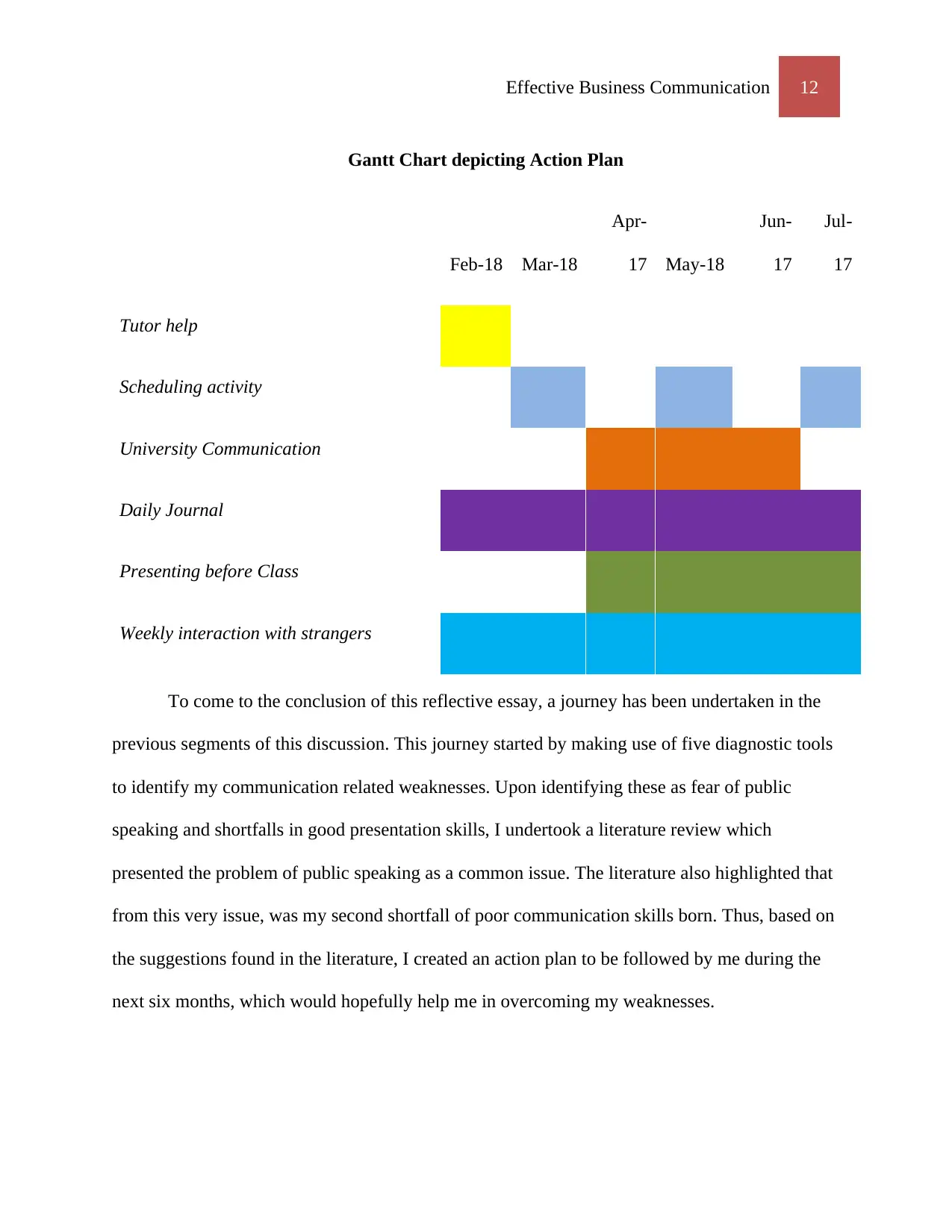
myself and to remove the apprehensions I have. In order to do so, I have chalked out an action
plan for the next six months. The very first step which I will be working upon is taking the help
of my tutor. This is because the literature suggested that the university personnel can help the
students best in improving upon their presentation skills. I would be requesting them to increase
presentation related activities to be scheduled in class to help all the students in improving their
presentation skills. I would also be scheduling an interactive activity between the different
classes of our university, where the individuals would get a chance of harnessing their
communication skills. This activity would be a kind of treasure hunt, which would
predominantly involve communication skills and presentation skills of the individuals. I would
also be taking up university communications to improve on my apprehensions on speaking to the
strangers and this would help me in getting a personal growth. I would be maintaining a daily
journal for keeping track of my progress and would also help me in deciding at the end of six
months, and in tracking, the progress which I have made. I would be taking up presentations
before our class, which the tutor would hopefully have included in our curriculum, which would
further help me out. Also, I would make attempts to carry out weekly interactions with strangers
I come across at work or at places where I go, to see if I have gained the confidence of speaking
easily.
The success of my action plan depends on delivering the presentation without feeling
nervous, getting sweaty or my heart pounding in my chest. This would be coupled with the same
feelings being controlled efficiently when faced with stranger interactions which I would be
carrying out. A detailed action plan is presented below:
would work on the suggestions presented in the different literature in order to work on bettering
myself and to remove the apprehensions I have. In order to do so, I have chalked out an action
plan for the next six months. The very first step which I will be working upon is taking the help
of my tutor. This is because the literature suggested that the university personnel can help the
students best in improving upon their presentation skills. I would be requesting them to increase
presentation related activities to be scheduled in class to help all the students in improving their
presentation skills. I would also be scheduling an interactive activity between the different
classes of our university, where the individuals would get a chance of harnessing their
communication skills. This activity would be a kind of treasure hunt, which would
predominantly involve communication skills and presentation skills of the individuals. I would
also be taking up university communications to improve on my apprehensions on speaking to the
strangers and this would help me in getting a personal growth. I would be maintaining a daily
journal for keeping track of my progress and would also help me in deciding at the end of six
months, and in tracking, the progress which I have made. I would be taking up presentations
before our class, which the tutor would hopefully have included in our curriculum, which would
further help me out. Also, I would make attempts to carry out weekly interactions with strangers
I come across at work or at places where I go, to see if I have gained the confidence of speaking
easily.
The success of my action plan depends on delivering the presentation without feeling
nervous, getting sweaty or my heart pounding in my chest. This would be coupled with the same
feelings being controlled efficiently when faced with stranger interactions which I would be
carrying out. A detailed action plan is presented below:
Effective Business Communication 12
Gantt Chart depicting Action Plan
Feb-18 Mar-18
Apr-
17 May-18
Jun-
17
Jul-
17
Tutor help
Scheduling activity
University Communication
Daily Journal
Presenting before Class
Weekly interaction with strangers
To come to the conclusion of this reflective essay, a journey has been undertaken in the
previous segments of this discussion. This journey started by making use of five diagnostic tools
to identify my communication related weaknesses. Upon identifying these as fear of public
speaking and shortfalls in good presentation skills, I undertook a literature review which
presented the problem of public speaking as a common issue. The literature also highlighted that
from this very issue, was my second shortfall of poor communication skills born. Thus, based on
the suggestions found in the literature, I created an action plan to be followed by me during the
next six months, which would hopefully help me in overcoming my weaknesses.
Gantt Chart depicting Action Plan
Feb-18 Mar-18
Apr-
17 May-18
Jun-
17
Jul-
17
Tutor help
Scheduling activity
University Communication
Daily Journal
Presenting before Class
Weekly interaction with strangers
To come to the conclusion of this reflective essay, a journey has been undertaken in the
previous segments of this discussion. This journey started by making use of five diagnostic tools
to identify my communication related weaknesses. Upon identifying these as fear of public
speaking and shortfalls in good presentation skills, I undertook a literature review which
presented the problem of public speaking as a common issue. The literature also highlighted that
from this very issue, was my second shortfall of poor communication skills born. Thus, based on
the suggestions found in the literature, I created an action plan to be followed by me during the
next six months, which would hopefully help me in overcoming my weaknesses.
⊘ This is a preview!⊘
Do you want full access?
Subscribe today to unlock all pages.
Trusted by 1+ million students worldwide

1 out of 16


Related Documents


Your All-in-One AI-Powered Toolkit for Academic Success.
+13062052269
info@desklib.com
Available 24*7 on WhatsApp / Email
![[object Object]](/_next/static/media/star-bottom.7253800d.svg)
Unlock your academic potential
Copyright © 2020–2026 A2Z Services. All Rights Reserved. Developed and managed by ZUCOL.