KOI BUS709 Reflective Journal: Negotiations, Social Media, Conflict
VerifiedAdded on 2022/12/19
|11
|2615
|64
Journal and Reflective Writing
AI Summary
This individual reflective journal analyzes the concepts of negotiations and conflict management, along with the role of social media, and evaluates their implications on the student's future role as an accountant. The journal begins with an introduction to the importance of an accountant in a business organization, followed by detailed discussions on negotiations and conflict management, including strategies for conflict resolution and the usefulness of these aspects in the workplace. The journal then explores the impact of social media on business operations, focusing on platforms like LinkedIn and Twitter, and discusses how these tools can be used to enhance an accountant's responsibilities, including client interactions and financial management. The student also reflects on how understanding these concepts has changed their perception of successful business operations and the importance of skills such as effective communication, conflict management, and adaptability in the dynamic business environment. The journal also covers the usefulness of these aspects and how the student's perception has changed regarding the management of conflicts and the role of power and performance in negotiations, alongside the utilization of social media for various business functions.
Running head: INDIVIDUAL REFLECTIVE JOURNAL
INDIVIDUAL REFLECTIVE JOURNAL
Name of the student
Name of the University
Author note
INDIVIDUAL REFLECTIVE JOURNAL
Name of the student
Name of the University
Author note

Paraphrase This Document
Need a fresh take? Get an instant paraphrase of this document with our AI Paraphraser
1INDIVIDUAL REFLECTIVE JOURNAL
Executive Summary
The significant objective of this Individual Reflective Journal is to analyze the
concepts of Negotiations and Conflict Management along with Social Media and evaluate the
various aspects related to it. Furthermore, these concepts have been evaluated in terms of
their implications on my future role as an Accountant.
Executive Summary
The significant objective of this Individual Reflective Journal is to analyze the
concepts of Negotiations and Conflict Management along with Social Media and evaluate the
various aspects related to it. Furthermore, these concepts have been evaluated in terms of
their implications on my future role as an Accountant.
2INDIVIDUAL REFLECTIVE JOURNAL
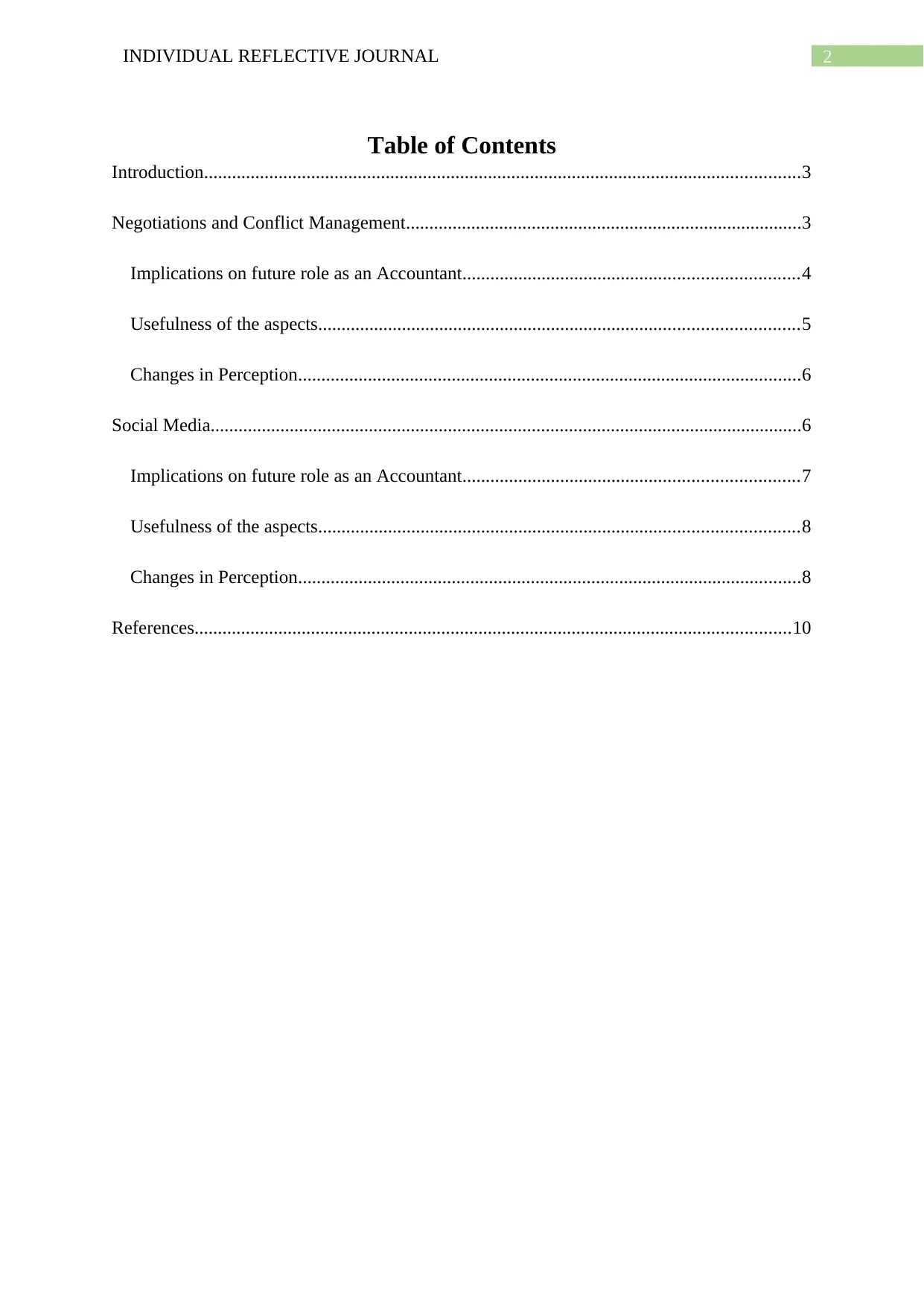
Table of Contents
Introduction................................................................................................................................3
Negotiations and Conflict Management.....................................................................................3
Implications on future role as an Accountant........................................................................4
Usefulness of the aspects.......................................................................................................5
Changes in Perception............................................................................................................6
Social Media...............................................................................................................................6
Implications on future role as an Accountant........................................................................7
Usefulness of the aspects.......................................................................................................8
Changes in Perception............................................................................................................8
References................................................................................................................................10
Table of Contents
Introduction................................................................................................................................3
Negotiations and Conflict Management.....................................................................................3
Implications on future role as an Accountant........................................................................4
Usefulness of the aspects.......................................................................................................5
Changes in Perception............................................................................................................6
Social Media...............................................................................................................................6
Implications on future role as an Accountant........................................................................7
Usefulness of the aspects.......................................................................................................8
Changes in Perception............................................................................................................8
References................................................................................................................................10
⊘ This is a preview!⊘
Do you want full access?
Subscribe today to unlock all pages.

Trusted by 1+ million students worldwide
3INDIVIDUAL REFLECTIVE JOURNAL
Introduction
Business organizations in the present age of rapid globalization entails the
incorporation of various functions and operations within its scope. In this respect, an
accountant plays an essential role in ensuring the smooth operation of business activities. My
future role as an accountant entails within its purview the performance of financial activities
pertaining to the collection, recording, analysis, accuracy and presentation of the financial
operations of the organization where I will work in. On a smaller scale, my role as an
accountant may consist of collection of financial data, entry and accordingly generation of
reports. In this reflective report I will further discuss on the aspects of negotiations and
conflict management in business organizations along with a study on the role of social media.
I will also discuss the implications of these aspects on my future role as an accountant, and
how an understanding of these topics will aid me in carrying out my responsibilities more
efficiently. Additionally, I will evaluate how an understanding on these aspects through the
report has changed my perception about the successful operation of business organizations.
Negotiations and Conflict Management
The purpose of negotiations in any business organization is to arrive at an agreement
and additionally allow the separate parties to mutually participate and collaborate in activities
that will ensure mutual benefits for them (Perreault, Kida and David Piercey 2017). The need
for negotiations arise when there is an observed or felt difference in opinions or interests
between individuals of an organization. Therefore, negotiating helps these individuals to
protect their interests and resolve the differences through the process of accommodation of
the conflicting opinions of each other. The process of negotiations ensures that the agreement
between the two conflicting parties enables them to protect their individual interests while
catering to the interests of the others. The need for negotiations in business organizations
Introduction
Business organizations in the present age of rapid globalization entails the
incorporation of various functions and operations within its scope. In this respect, an
accountant plays an essential role in ensuring the smooth operation of business activities. My
future role as an accountant entails within its purview the performance of financial activities
pertaining to the collection, recording, analysis, accuracy and presentation of the financial
operations of the organization where I will work in. On a smaller scale, my role as an
accountant may consist of collection of financial data, entry and accordingly generation of
reports. In this reflective report I will further discuss on the aspects of negotiations and
conflict management in business organizations along with a study on the role of social media.
I will also discuss the implications of these aspects on my future role as an accountant, and
how an understanding of these topics will aid me in carrying out my responsibilities more
efficiently. Additionally, I will evaluate how an understanding on these aspects through the
report has changed my perception about the successful operation of business organizations.
Negotiations and Conflict Management
The purpose of negotiations in any business organization is to arrive at an agreement
and additionally allow the separate parties to mutually participate and collaborate in activities
that will ensure mutual benefits for them (Perreault, Kida and David Piercey 2017). The need
for negotiations arise when there is an observed or felt difference in opinions or interests
between individuals of an organization. Therefore, negotiating helps these individuals to
protect their interests and resolve the differences through the process of accommodation of
the conflicting opinions of each other. The process of negotiations ensures that the agreement
between the two conflicting parties enables them to protect their individual interests while
catering to the interests of the others. The need for negotiations in business organizations
Paraphrase This Document
Need a fresh take? Get an instant paraphrase of this document with our AI Paraphraser
4INDIVIDUAL REFLECTIVE JOURNAL
occurs due to the arise for conflict, which further brings us to the aspect of managing such
conflicts.
The concept of conflict management relates to the implementation of distinct
strategies for the purpose of elimination of any undesirable or negative aspects of the conflict
between individuals of an organization, and maximize the output of the positive impacts in
order to enhance the effectivity and performance of those individuals (Folger, Poole and
Stutman 2017). In this aspect, the purpose of conflict management is to improve the
communication between the two conflicting parties and enhance the teamwork between them
so as to ensure the optimum productivity and profitability of the organization. Disagreements
of priorities between the conflicting parties often leads to challenges and discrepancies that
are addressed adequately through the process of conflict management. The several strategies
for such conflict management include avoiding, accommodating, collaborating and
comprising with the interests and opinions of the conflicting individuals of the organization.
The process of accommodation is generally widely accepted as a means of conflict resolution
as it ascertains that the interests of both the parties are protected.
Implications on future role as an Accountant
The role of an accountant is to ensure that the financial activities of the business
organization operate smoothly and without any hindrance. However, many a times, conflicts
may arise within the different departments of the organization regarding the allocation of
budget and auditing. My role as an accountant would entail that such conflicts are managed
efficiently. For this purpose, I may conduct research and surveys to provide a better
understanding to the departments regarding their financial requirements through the process
of report generation. Moreover, conflicts may also arise as a result of discrepancies from the
organization in case of provision of multiple services to a singular client, in the form of
audits, forensic accounting, taxes and bankruptcy services. In such cases, the conflicts that I
occurs due to the arise for conflict, which further brings us to the aspect of managing such
conflicts.
The concept of conflict management relates to the implementation of distinct
strategies for the purpose of elimination of any undesirable or negative aspects of the conflict
between individuals of an organization, and maximize the output of the positive impacts in
order to enhance the effectivity and performance of those individuals (Folger, Poole and
Stutman 2017). In this aspect, the purpose of conflict management is to improve the
communication between the two conflicting parties and enhance the teamwork between them
so as to ensure the optimum productivity and profitability of the organization. Disagreements
of priorities between the conflicting parties often leads to challenges and discrepancies that
are addressed adequately through the process of conflict management. The several strategies
for such conflict management include avoiding, accommodating, collaborating and
comprising with the interests and opinions of the conflicting individuals of the organization.
The process of accommodation is generally widely accepted as a means of conflict resolution
as it ascertains that the interests of both the parties are protected.
Implications on future role as an Accountant
The role of an accountant is to ensure that the financial activities of the business
organization operate smoothly and without any hindrance. However, many a times, conflicts
may arise within the different departments of the organization regarding the allocation of
budget and auditing. My role as an accountant would entail that such conflicts are managed
efficiently. For this purpose, I may conduct research and surveys to provide a better
understanding to the departments regarding their financial requirements through the process
of report generation. Moreover, conflicts may also arise as a result of discrepancies from the
organization in case of provision of multiple services to a singular client, in the form of
audits, forensic accounting, taxes and bankruptcy services. In such cases, the conflicts that I
5INDIVIDUAL REFLECTIVE JOURNAL
have to manage as an accountant is the determination of accepting or declining of such
assignments through personal judgment. These conflicts further require negotiations with the
clients regarding their requirements so that the interests of the clients as well as the
organization is protected.
Usefulness of the aspects
The role of an accountant in a business organization is varied and involves the
fulfillment of important responsibilities that in turn determines the efficiency of the
operations and business activities. Conflict management and negotiations require essential
skills that I need to inculcate so that I may be able to perform my duties responsibly. With the
help of sufficient negotiating skills, I can help in creating better relations among the clients
and the organization, deliver quality and lasting solutions to the two parties and also help in
avoiding conflicts and problems in the future. For this purpose, I must be able to develop
skills to create a constructive and courteous means of interaction with the clients so that I
may be able to foster their goodwill. In such a case, the company will benefit from my skills
of negotiation as it will ensure the satisfaction of the clients, and thereby the profitability of
the organization.
Conflicts can gave several positive outcomes such as the release of frustrations and
pressure and the gain of new information and perspectives. Such new perspective can provide
a better understanding about the significance of the interests and opinions of the conflicting
individuals, thereby paving the way for new opportunities and scopes for the organization as
well as its clients. By developing efficient conflict management skills, I can ensure the
increase of cohesiveness among the conflicting parties, prevention of complacency and an
appreciation and accommodation of differences. Thomas Kilmann’s model of conflict
resolution suggests several styles of managing conflicts (Riasi and Asadzadeh 2015). I can
adopt a compromising style of conflict management. This would enable me to evaluate a
have to manage as an accountant is the determination of accepting or declining of such
assignments through personal judgment. These conflicts further require negotiations with the
clients regarding their requirements so that the interests of the clients as well as the
organization is protected.
Usefulness of the aspects
The role of an accountant in a business organization is varied and involves the
fulfillment of important responsibilities that in turn determines the efficiency of the
operations and business activities. Conflict management and negotiations require essential
skills that I need to inculcate so that I may be able to perform my duties responsibly. With the
help of sufficient negotiating skills, I can help in creating better relations among the clients
and the organization, deliver quality and lasting solutions to the two parties and also help in
avoiding conflicts and problems in the future. For this purpose, I must be able to develop
skills to create a constructive and courteous means of interaction with the clients so that I
may be able to foster their goodwill. In such a case, the company will benefit from my skills
of negotiation as it will ensure the satisfaction of the clients, and thereby the profitability of
the organization.
Conflicts can gave several positive outcomes such as the release of frustrations and
pressure and the gain of new information and perspectives. Such new perspective can provide
a better understanding about the significance of the interests and opinions of the conflicting
individuals, thereby paving the way for new opportunities and scopes for the organization as
well as its clients. By developing efficient conflict management skills, I can ensure the
increase of cohesiveness among the conflicting parties, prevention of complacency and an
appreciation and accommodation of differences. Thomas Kilmann’s model of conflict
resolution suggests several styles of managing conflicts (Riasi and Asadzadeh 2015). I can
adopt a compromising style of conflict management. This would enable me to evaluate a
⊘ This is a preview!⊘
Do you want full access?
Subscribe today to unlock all pages.
Trusted by 1+ million students worldwide
6INDIVIDUAL REFLECTIVE JOURNAL
solution that is mutually acceptable to the conflicting parties. For this purpose, I must ensure
assertiveness and cooperation from the clients as well as the organization through the means
of effective communication and understanding their requirements, needs and interests. Such
process of decision-making will further ensure that the interests of none of the conflicting
parties is compromised.
Changes in Perception
The process of conflict management with the help of negotiations can in turn have
certain changes in my perceptions about the situations of the business and financial activities
between the organization and its clients. In the case of vertical conflicts arising within the
scope of the organization, the process of negotiation can help me gain a better understanding
about the resources, performance results and goals of the conflicting individuals. Such an
understanding can further aid me in taking efficient decisions with the help of proper
assessment of benefits for the organization as a whole. Another change in perception
regarding the management of conflicts involves the role of power and performance in
indicating the factors that must be considered during the negotiations. The hierarchical power
of the leaders and managers are expected to be valued in the process of decision-making or
conflict resolution. However, I must also ensure that this does not compromise the needs of
the employees or create a sense of bias and prejudice among them. Similarly, the scope of
negotiations not only entails the protection of interests of the conflicting parties but personal
judgments based on previous experiences. In this aspect, repeated management of conflicts
can further enable me to enhance my efficiency in tackling tricky and difficult situations.
Social Media
In the age of rapid globalization, social media has an important role to play in
business organizations regarding marketing and reaching out to the customers. The
solution that is mutually acceptable to the conflicting parties. For this purpose, I must ensure
assertiveness and cooperation from the clients as well as the organization through the means
of effective communication and understanding their requirements, needs and interests. Such
process of decision-making will further ensure that the interests of none of the conflicting
parties is compromised.
Changes in Perception
The process of conflict management with the help of negotiations can in turn have
certain changes in my perceptions about the situations of the business and financial activities
between the organization and its clients. In the case of vertical conflicts arising within the
scope of the organization, the process of negotiation can help me gain a better understanding
about the resources, performance results and goals of the conflicting individuals. Such an
understanding can further aid me in taking efficient decisions with the help of proper
assessment of benefits for the organization as a whole. Another change in perception
regarding the management of conflicts involves the role of power and performance in
indicating the factors that must be considered during the negotiations. The hierarchical power
of the leaders and managers are expected to be valued in the process of decision-making or
conflict resolution. However, I must also ensure that this does not compromise the needs of
the employees or create a sense of bias and prejudice among them. Similarly, the scope of
negotiations not only entails the protection of interests of the conflicting parties but personal
judgments based on previous experiences. In this aspect, repeated management of conflicts
can further enable me to enhance my efficiency in tackling tricky and difficult situations.
Social Media
In the age of rapid globalization, social media has an important role to play in
business organizations regarding marketing and reaching out to the customers. The
Paraphrase This Document
Need a fresh take? Get an instant paraphrase of this document with our AI Paraphraser
7INDIVIDUAL REFLECTIVE JOURNAL
responsiveness of the organization towards its customers is often facilitated through the use
of various social media platforms like Facebook, Twitter, LinkedIn and Pinterest (Aichner
and Jacob 2015). There are several benefits that can be observed in the use of social media
for business purposes. Such benefits include the gaining of traffic in the form of responses
and comments from the customers and clients regarding the quality of products and services,
interaction pertaining to the development of loyalty and trust of the customers on the
organization and its products and services. Other benefits of application of social media
platforms in business activities of the organizations include modes of market research,
management of reputation, ensuring a global reach and advertisement strategies to make the
customers aware about the features of the products and services.
Implications on future role as an Accountant
Social media can be utilized for various business functions within the scope of an
organization. In this aspect, my role as an accountant also involves certain uses of social
media platforms in order to ensure the smooth operations of the organization. The social
media platform of LinkedIn is essential for me as an accountant as this platform enables in
connecting with new clients. The interactive scope of this platform enables the customers to
appropriately judge the services provided by the organization and in turn research about their
skills. Furthermore the social media platform of Twitter can enable me as an accountant to
showcase my knowledge and personality so as to gain the trust of the clients, thereby
enabling them to distinguish among the other competitors in the market. Blogs and other
networks enables in building stronger relationships between the customers and the
organization and provide feedbacks on the issues that require urgent attention. Blogging
would therefore enable me as an accountant to improve credibility for the organization.
Moreover, YouTube is also a platform that can be utilized efficiently for the financial
responsiveness of the organization towards its customers is often facilitated through the use
of various social media platforms like Facebook, Twitter, LinkedIn and Pinterest (Aichner
and Jacob 2015). There are several benefits that can be observed in the use of social media
for business purposes. Such benefits include the gaining of traffic in the form of responses
and comments from the customers and clients regarding the quality of products and services,
interaction pertaining to the development of loyalty and trust of the customers on the
organization and its products and services. Other benefits of application of social media
platforms in business activities of the organizations include modes of market research,
management of reputation, ensuring a global reach and advertisement strategies to make the
customers aware about the features of the products and services.
Implications on future role as an Accountant
Social media can be utilized for various business functions within the scope of an
organization. In this aspect, my role as an accountant also involves certain uses of social
media platforms in order to ensure the smooth operations of the organization. The social
media platform of LinkedIn is essential for me as an accountant as this platform enables in
connecting with new clients. The interactive scope of this platform enables the customers to
appropriately judge the services provided by the organization and in turn research about their
skills. Furthermore the social media platform of Twitter can enable me as an accountant to
showcase my knowledge and personality so as to gain the trust of the clients, thereby
enabling them to distinguish among the other competitors in the market. Blogs and other
networks enables in building stronger relationships between the customers and the
organization and provide feedbacks on the issues that require urgent attention. Blogging
would therefore enable me as an accountant to improve credibility for the organization.
Moreover, YouTube is also a platform that can be utilized efficiently for the financial
8INDIVIDUAL REFLECTIVE JOURNAL
benefits of the organization. Advertisements and marketing with the help of YouTube can
also earn revenues for the organization if it appeals to its customer base.
Usefulness of the aspects
Social media is a powerful tool for business organizations and their activities in
today’s world. The scope of social media in business activities is increasing by the day due to
its benefits of effective means of marketing. Through the provision of superior quality of
products and services, the organizations can ensure an increase in their profitability through
the use of social media to advertise the various features that give them a competitive
advantage over the competitors (Eschenbrenner, Nah and Telaprolu 2014). This in turn
provides financial benefits for the organization as advertisements in certain social media
platforms like YouTube can help the organization to earn revenues. Apart from this aspect,
the social media platforms can also aid me as an accountant to look for potential clients and
also interact with them so as to ensure successful business operations for the organization.
My role as an accountant also entails that I must keep the budgets and finances of the
organization in consideration and limit additional and unnecessary expenditures. In this
aspect, social media platforms are one of the most cost effective means of communicating
and interacting with the customers and clients. Social media platforms will not only aid in
improving the brand image and visibility of the organizations but also provide an insight to
the customers regarding the nature of business activities performed by the organization such
as Corporate Social Responsibility activities and campaigns. Such advertisement will benefit
me as an accountant as I will be able to efficiently manage the financial demands of the
organization in a cost effective manner, providing them with plans to improve their
profitability in an advantageous and simple manner.
benefits of the organization. Advertisements and marketing with the help of YouTube can
also earn revenues for the organization if it appeals to its customer base.
Usefulness of the aspects
Social media is a powerful tool for business organizations and their activities in
today’s world. The scope of social media in business activities is increasing by the day due to
its benefits of effective means of marketing. Through the provision of superior quality of
products and services, the organizations can ensure an increase in their profitability through
the use of social media to advertise the various features that give them a competitive
advantage over the competitors (Eschenbrenner, Nah and Telaprolu 2014). This in turn
provides financial benefits for the organization as advertisements in certain social media
platforms like YouTube can help the organization to earn revenues. Apart from this aspect,
the social media platforms can also aid me as an accountant to look for potential clients and
also interact with them so as to ensure successful business operations for the organization.
My role as an accountant also entails that I must keep the budgets and finances of the
organization in consideration and limit additional and unnecessary expenditures. In this
aspect, social media platforms are one of the most cost effective means of communicating
and interacting with the customers and clients. Social media platforms will not only aid in
improving the brand image and visibility of the organizations but also provide an insight to
the customers regarding the nature of business activities performed by the organization such
as Corporate Social Responsibility activities and campaigns. Such advertisement will benefit
me as an accountant as I will be able to efficiently manage the financial demands of the
organization in a cost effective manner, providing them with plans to improve their
profitability in an advantageous and simple manner.
⊘ This is a preview!⊘
Do you want full access?
Subscribe today to unlock all pages.
Trusted by 1+ million students worldwide
9INDIVIDUAL REFLECTIVE JOURNAL
Changes in Perception
From the evaluation of the implication and uses of social media platforms in my
future role as an accountant, certain perceptions about the situation has been changed. Such
changes pertain to the scope of the benefits of social media platforms in the smooth operation
of business activities in an organization. My previous conception about the use of social
media was community building through personal interactions. However, the interactive and
appealing platform provided by the social media websites, ensures that business organizations
may also be able to benefit from it through an expansion of the customer base. I observed this
aspect from the scope of social media to not only provide a basis of personal interaction with
the customers and clients but also help in building business communities where the customers
and clients will be able to assess the skills and quality of products and services manufactured
by the organizations with its competitors.
Furthermore, the analysis has also changed by perception about the utilization of
database that can be provided by the social media platforms. In this aspect, I can utilize the
database to increase the reach of the organization with the clients, which will further enhance
the performance and customer services of the organization. Thus, it can be said that social
media has an immense scope of efficient utilization by me as an accountant that will further
aid me to improve the financial stability and growth of the organization I would work in.
Changes in Perception
From the evaluation of the implication and uses of social media platforms in my
future role as an accountant, certain perceptions about the situation has been changed. Such
changes pertain to the scope of the benefits of social media platforms in the smooth operation
of business activities in an organization. My previous conception about the use of social
media was community building through personal interactions. However, the interactive and
appealing platform provided by the social media websites, ensures that business organizations
may also be able to benefit from it through an expansion of the customer base. I observed this
aspect from the scope of social media to not only provide a basis of personal interaction with
the customers and clients but also help in building business communities where the customers
and clients will be able to assess the skills and quality of products and services manufactured
by the organizations with its competitors.
Furthermore, the analysis has also changed by perception about the utilization of
database that can be provided by the social media platforms. In this aspect, I can utilize the
database to increase the reach of the organization with the clients, which will further enhance
the performance and customer services of the organization. Thus, it can be said that social
media has an immense scope of efficient utilization by me as an accountant that will further
aid me to improve the financial stability and growth of the organization I would work in.
Paraphrase This Document
Need a fresh take? Get an instant paraphrase of this document with our AI Paraphraser
10INDIVIDUAL REFLECTIVE JOURNAL
References
Aichner, T. and Jacob, F., 2015. Measuring the degree of corporate social media use.
International Journal of Market Research, 57(2), pp.257-276.
Eschenbrenner, B., Nah, F.F.H. and Telaprolu, V.R., 2014. Efficacy of social media
utilization by public accounting firms: Findings and directions for future research. Journal of
Information Systems, 29(2), pp.5-21.
Folger, J., Poole, M.S. and Stutman, R.K., 2017. Working through conflict: Strategies for
relationships, groups, and organizations. Routledge.
Perreault, S., Kida, T. and David Piercey, M., 2017. The relative effectiveness of
simultaneous versus sequential negotiation strategies in auditor‐client negotiations.
Contemporary Accounting Research, 34(2), pp.1048-1070.
Riasi, A. and Asadzadeh, N., 2015. The relationship between principals’ reward power and
their conflict management styles based on Thomas–Kilmann conflict mode instrument.
Management Science Letters, 5(6), pp.611-618.
References
Aichner, T. and Jacob, F., 2015. Measuring the degree of corporate social media use.
International Journal of Market Research, 57(2), pp.257-276.
Eschenbrenner, B., Nah, F.F.H. and Telaprolu, V.R., 2014. Efficacy of social media
utilization by public accounting firms: Findings and directions for future research. Journal of
Information Systems, 29(2), pp.5-21.
Folger, J., Poole, M.S. and Stutman, R.K., 2017. Working through conflict: Strategies for
relationships, groups, and organizations. Routledge.
Perreault, S., Kida, T. and David Piercey, M., 2017. The relative effectiveness of
simultaneous versus sequential negotiation strategies in auditor‐client negotiations.
Contemporary Accounting Research, 34(2), pp.1048-1070.
Riasi, A. and Asadzadeh, N., 2015. The relationship between principals’ reward power and
their conflict management styles based on Thomas–Kilmann conflict mode instrument.
Management Science Letters, 5(6), pp.611-618.

1 out of 11


Related Documents


Your All-in-One AI-Powered Toolkit for Academic Success.
+13062052269
info@desklib.com
Available 24*7 on WhatsApp / Email
![[object Object]](/_next/static/media/star-bottom.7253800d.svg)
Unlock your academic potential
Copyright © 2020–2026 A2Z Services. All Rights Reserved. Developed and managed by ZUCOL.