Gibbs Reflective Cycle: Analysis of a Nursing Practice Event
VerifiedAdded on 2022/09/18
|5
|1190
|29
Practical Assignment
AI Summary
This assignment presents a reflection on a clinical nursing event using the Gibbs Reflective Cycle. The student describes a home visit to a postpartum patient, detailing the situation, feelings, and thoughts experienced. The student explores the patient's struggles with childcare, meals, and medication adherence, as well as the lack of family support. The assignment delves into the values and beliefs underpinning these experiences, analyzing the situation's meaning and drawing conclusions about the importance of patient education, family support, and certified care providers. The student proposes an action plan aligned with NMBA standards, focusing on establishing a therapeutic relationship, providing a certified caregiver, and evaluating outcomes to ensure safe and quality patient care. The student references relevant literature to support their analysis and proposed actions.
Running head:GIBBS REFLECTIVE CYCLE
GIBBS REFLECTIVE CYCLE
Name of the student
Name of the university
Author note
GIBBS REFLECTIVE CYCLE
Name of the student
Name of the university
Author note
Paraphrase This Document
Need a fresh take? Get an instant paraphrase of this document with our AI Paraphraser

1
GIBBS REFLECTIVE CYCLE
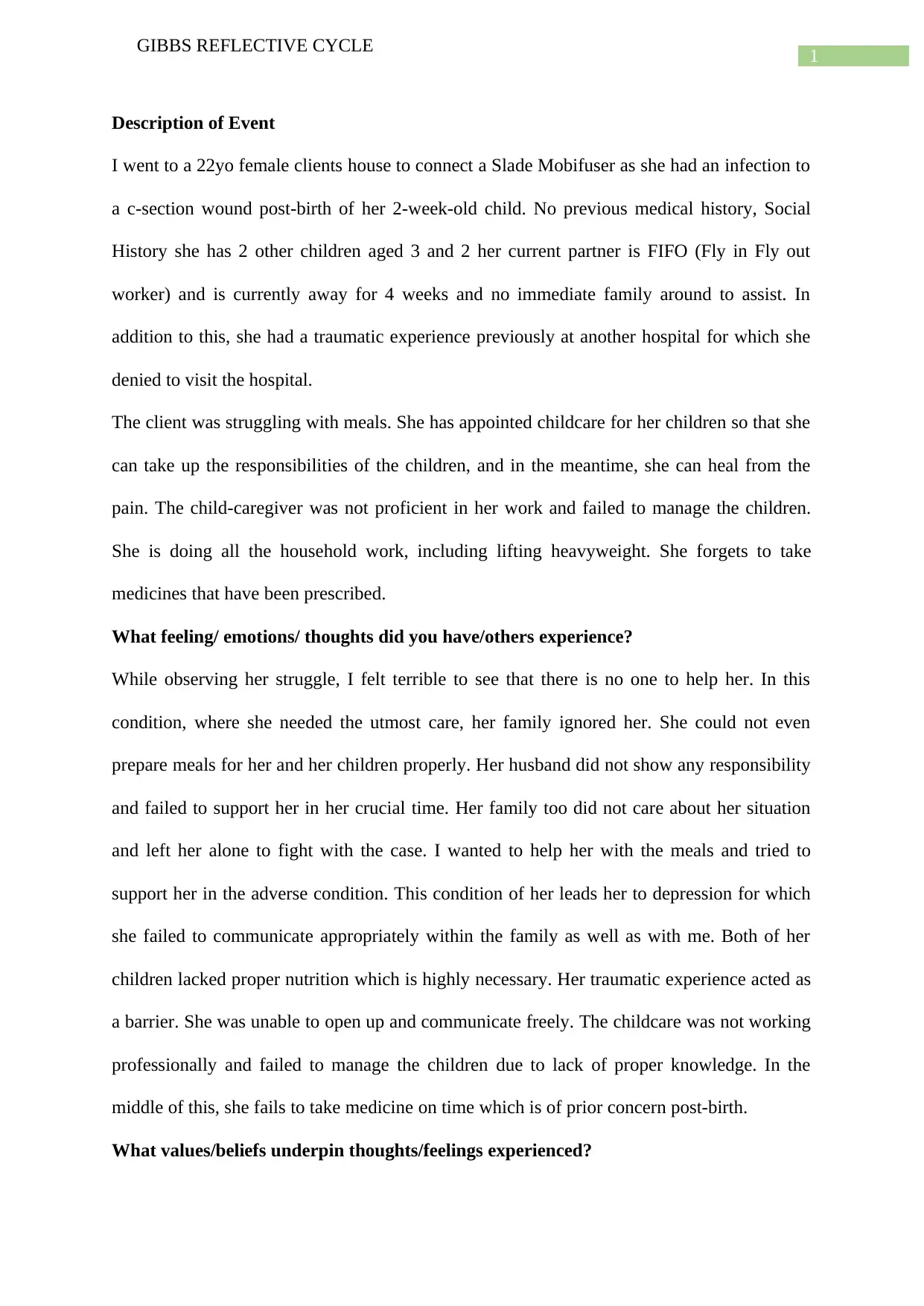
Description of Event
I went to a 22yo female clients house to connect a Slade Mobifuser as she had an infection to
a c-section wound post-birth of her 2-week-old child. No previous medical history, Social
History she has 2 other children aged 3 and 2 her current partner is FIFO (Fly in Fly out
worker) and is currently away for 4 weeks and no immediate family around to assist. In
addition to this, she had a traumatic experience previously at another hospital for which she
denied to visit the hospital.
The client was struggling with meals. She has appointed childcare for her children so that she
can take up the responsibilities of the children, and in the meantime, she can heal from the
pain. The child-caregiver was not proficient in her work and failed to manage the children.
She is doing all the household work, including lifting heavyweight. She forgets to take
medicines that have been prescribed.
What feeling/ emotions/ thoughts did you have/others experience?
While observing her struggle, I felt terrible to see that there is no one to help her. In this
condition, where she needed the utmost care, her family ignored her. She could not even
prepare meals for her and her children properly. Her husband did not show any responsibility
and failed to support her in her crucial time. Her family too did not care about her situation
and left her alone to fight with the case. I wanted to help her with the meals and tried to
support her in the adverse condition. This condition of her leads her to depression for which
she failed to communicate appropriately within the family as well as with me. Both of her
children lacked proper nutrition which is highly necessary. Her traumatic experience acted as
a barrier. She was unable to open up and communicate freely. The childcare was not working
professionally and failed to manage the children due to lack of proper knowledge. In the
middle of this, she fails to take medicine on time which is of prior concern post-birth.
What values/beliefs underpin thoughts/feelings experienced?
GIBBS REFLECTIVE CYCLE
Description of Event
I went to a 22yo female clients house to connect a Slade Mobifuser as she had an infection to
a c-section wound post-birth of her 2-week-old child. No previous medical history, Social
History she has 2 other children aged 3 and 2 her current partner is FIFO (Fly in Fly out
worker) and is currently away for 4 weeks and no immediate family around to assist. In
addition to this, she had a traumatic experience previously at another hospital for which she
denied to visit the hospital.
The client was struggling with meals. She has appointed childcare for her children so that she
can take up the responsibilities of the children, and in the meantime, she can heal from the
pain. The child-caregiver was not proficient in her work and failed to manage the children.
She is doing all the household work, including lifting heavyweight. She forgets to take
medicines that have been prescribed.
What feeling/ emotions/ thoughts did you have/others experience?
While observing her struggle, I felt terrible to see that there is no one to help her. In this
condition, where she needed the utmost care, her family ignored her. She could not even
prepare meals for her and her children properly. Her husband did not show any responsibility
and failed to support her in her crucial time. Her family too did not care about her situation
and left her alone to fight with the case. I wanted to help her with the meals and tried to
support her in the adverse condition. This condition of her leads her to depression for which
she failed to communicate appropriately within the family as well as with me. Both of her
children lacked proper nutrition which is highly necessary. Her traumatic experience acted as
a barrier. She was unable to open up and communicate freely. The childcare was not working
professionally and failed to manage the children due to lack of proper knowledge. In the
middle of this, she fails to take medicine on time which is of prior concern post-birth.
What values/beliefs underpin thoughts/feelings experienced?

2
GIBBS REFLECTIVE CYCLE
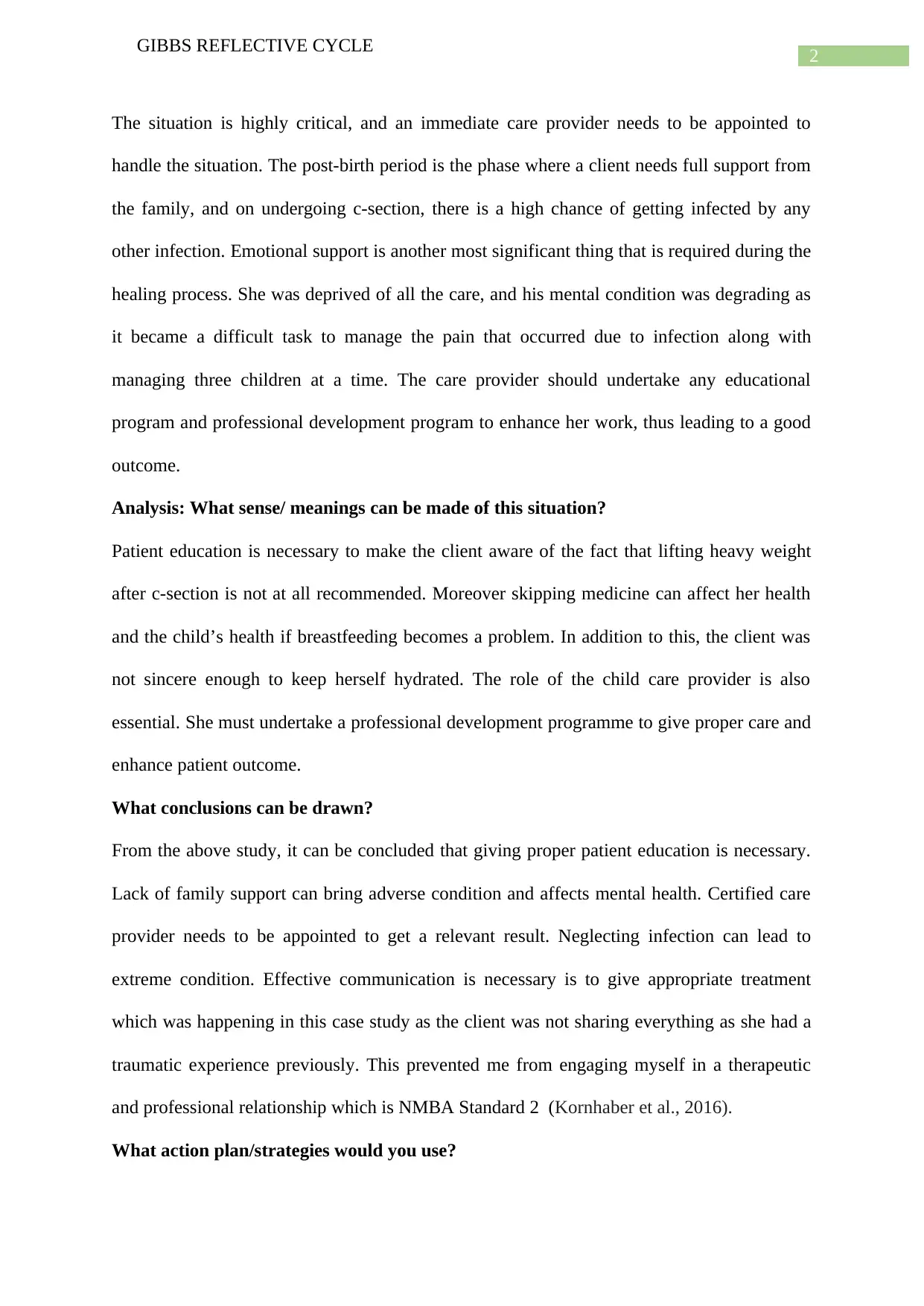
The situation is highly critical, and an immediate care provider needs to be appointed to
handle the situation. The post-birth period is the phase where a client needs full support from
the family, and on undergoing c-section, there is a high chance of getting infected by any
other infection. Emotional support is another most significant thing that is required during the
healing process. She was deprived of all the care, and his mental condition was degrading as
it became a difficult task to manage the pain that occurred due to infection along with
managing three children at a time. The care provider should undertake any educational
program and professional development program to enhance her work, thus leading to a good
outcome.
Analysis: What sense/ meanings can be made of this situation?
Patient education is necessary to make the client aware of the fact that lifting heavy weight
after c-section is not at all recommended. Moreover skipping medicine can affect her health
and the child’s health if breastfeeding becomes a problem. In addition to this, the client was
not sincere enough to keep herself hydrated. The role of the child care provider is also
essential. She must undertake a professional development programme to give proper care and
enhance patient outcome.
What conclusions can be drawn?
From the above study, it can be concluded that giving proper patient education is necessary.
Lack of family support can bring adverse condition and affects mental health. Certified care
provider needs to be appointed to get a relevant result. Neglecting infection can lead to
extreme condition. Effective communication is necessary is to give appropriate treatment
which was happening in this case study as the client was not sharing everything as she had a
traumatic experience previously. This prevented me from engaging myself in a therapeutic
and professional relationship which is NMBA Standard 2 (Kornhaber et al., 2016).
What action plan/strategies would you use?
GIBBS REFLECTIVE CYCLE
The situation is highly critical, and an immediate care provider needs to be appointed to
handle the situation. The post-birth period is the phase where a client needs full support from
the family, and on undergoing c-section, there is a high chance of getting infected by any
other infection. Emotional support is another most significant thing that is required during the
healing process. She was deprived of all the care, and his mental condition was degrading as
it became a difficult task to manage the pain that occurred due to infection along with
managing three children at a time. The care provider should undertake any educational
program and professional development program to enhance her work, thus leading to a good
outcome.
Analysis: What sense/ meanings can be made of this situation?
Patient education is necessary to make the client aware of the fact that lifting heavy weight
after c-section is not at all recommended. Moreover skipping medicine can affect her health
and the child’s health if breastfeeding becomes a problem. In addition to this, the client was
not sincere enough to keep herself hydrated. The role of the child care provider is also
essential. She must undertake a professional development programme to give proper care and
enhance patient outcome.
What conclusions can be drawn?
From the above study, it can be concluded that giving proper patient education is necessary.
Lack of family support can bring adverse condition and affects mental health. Certified care
provider needs to be appointed to get a relevant result. Neglecting infection can lead to
extreme condition. Effective communication is necessary is to give appropriate treatment
which was happening in this case study as the client was not sharing everything as she had a
traumatic experience previously. This prevented me from engaging myself in a therapeutic
and professional relationship which is NMBA Standard 2 (Kornhaber et al., 2016).
What action plan/strategies would you use?
⊘ This is a preview!⊘
Do you want full access?
Subscribe today to unlock all pages.

Trusted by 1+ million students worldwide

3
GIBBS REFLECTIVE CYCLE
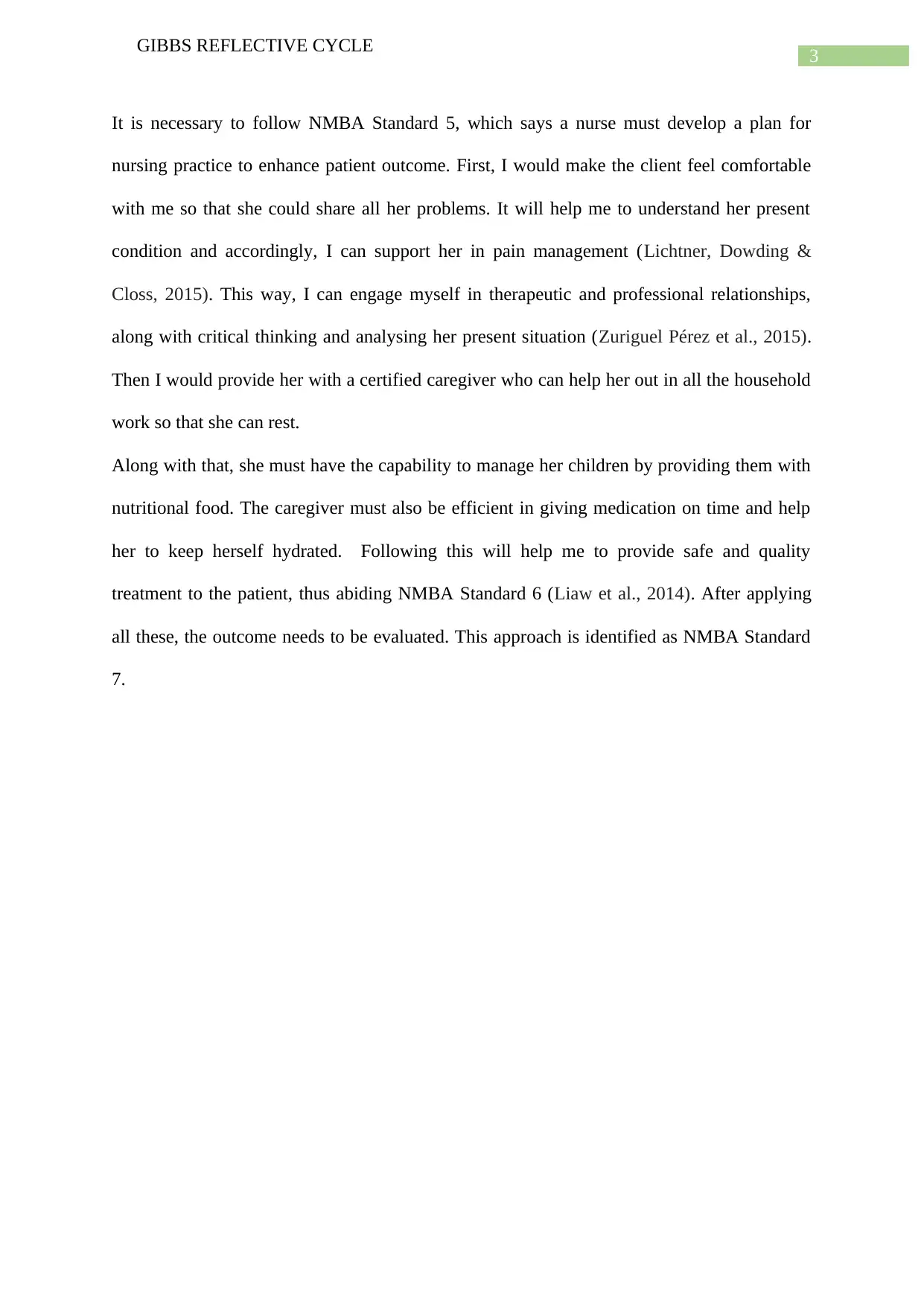
It is necessary to follow NMBA Standard 5, which says a nurse must develop a plan for
nursing practice to enhance patient outcome. First, I would make the client feel comfortable
with me so that she could share all her problems. It will help me to understand her present
condition and accordingly, I can support her in pain management (Lichtner, Dowding &
Closs, 2015). This way, I can engage myself in therapeutic and professional relationships,
along with critical thinking and analysing her present situation (Zuriguel Pérez et al., 2015).
Then I would provide her with a certified caregiver who can help her out in all the household
work so that she can rest.
Along with that, she must have the capability to manage her children by providing them with
nutritional food. The caregiver must also be efficient in giving medication on time and help
her to keep herself hydrated. Following this will help me to provide safe and quality
treatment to the patient, thus abiding NMBA Standard 6 (Liaw et al., 2014). After applying
all these, the outcome needs to be evaluated. This approach is identified as NMBA Standard
7.
GIBBS REFLECTIVE CYCLE
It is necessary to follow NMBA Standard 5, which says a nurse must develop a plan for
nursing practice to enhance patient outcome. First, I would make the client feel comfortable
with me so that she could share all her problems. It will help me to understand her present
condition and accordingly, I can support her in pain management (Lichtner, Dowding &
Closs, 2015). This way, I can engage myself in therapeutic and professional relationships,
along with critical thinking and analysing her present situation (Zuriguel Pérez et al., 2015).
Then I would provide her with a certified caregiver who can help her out in all the household
work so that she can rest.
Along with that, she must have the capability to manage her children by providing them with
nutritional food. The caregiver must also be efficient in giving medication on time and help
her to keep herself hydrated. Following this will help me to provide safe and quality
treatment to the patient, thus abiding NMBA Standard 6 (Liaw et al., 2014). After applying
all these, the outcome needs to be evaluated. This approach is identified as NMBA Standard
7.
Paraphrase This Document
Need a fresh take? Get an instant paraphrase of this document with our AI Paraphraser

4
GIBBS REFLECTIVE CYCLE
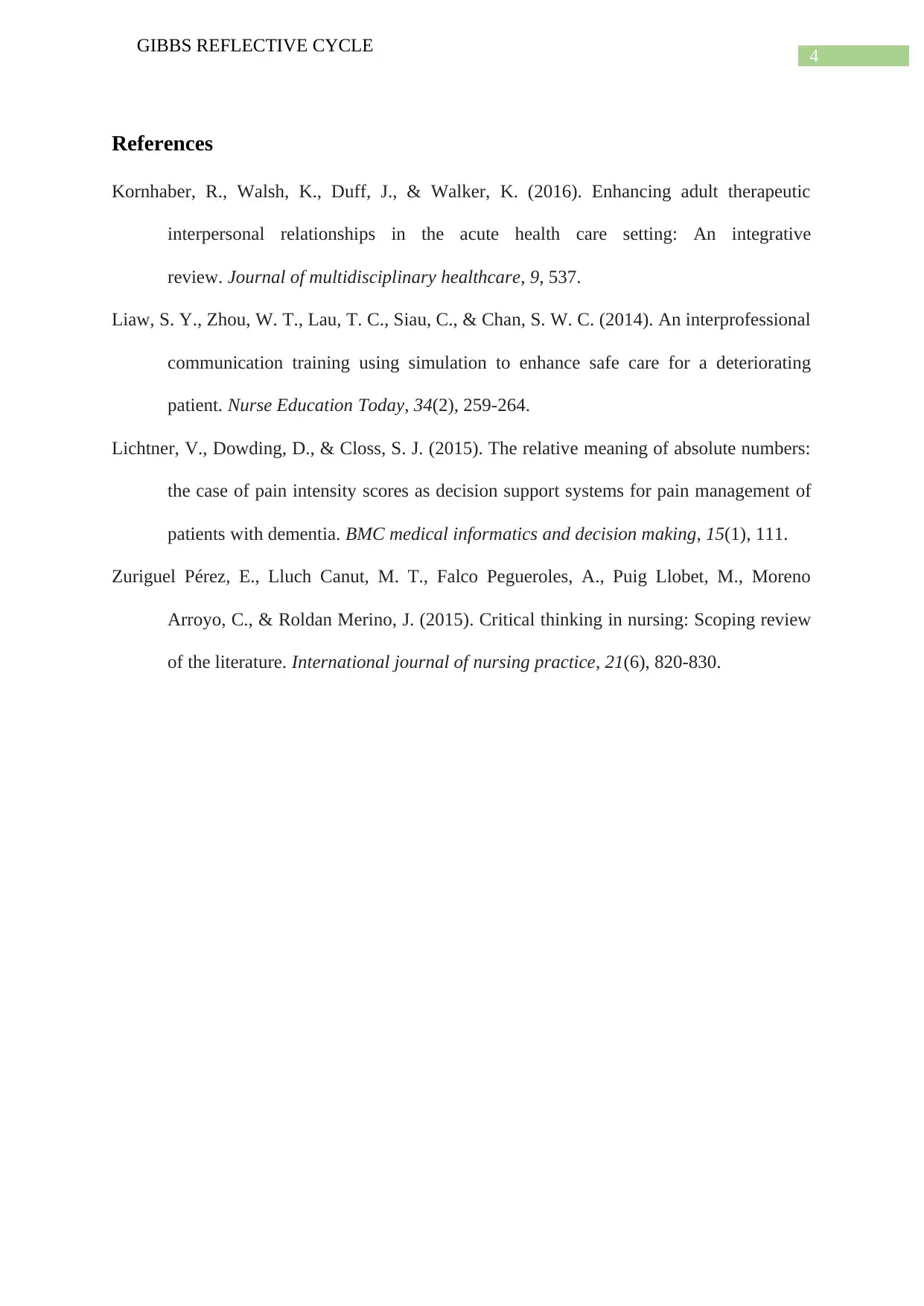
References
Kornhaber, R., Walsh, K., Duff, J., & Walker, K. (2016). Enhancing adult therapeutic
interpersonal relationships in the acute health care setting: An integrative
review. Journal of multidisciplinary healthcare, 9, 537.
Liaw, S. Y., Zhou, W. T., Lau, T. C., Siau, C., & Chan, S. W. C. (2014). An interprofessional
communication training using simulation to enhance safe care for a deteriorating
patient. Nurse Education Today, 34(2), 259-264.
Lichtner, V., Dowding, D., & Closs, S. J. (2015). The relative meaning of absolute numbers:
the case of pain intensity scores as decision support systems for pain management of
patients with dementia. BMC medical informatics and decision making, 15(1), 111.
Zuriguel Pérez, E., Lluch Canut, M. T., Falco Pegueroles, A., Puig Llobet, M., Moreno
Arroyo, C., & Roldan Merino, J. (2015). Critical thinking in nursing: Scoping review
of the literature. International journal of nursing practice, 21(6), 820-830.
GIBBS REFLECTIVE CYCLE
References
Kornhaber, R., Walsh, K., Duff, J., & Walker, K. (2016). Enhancing adult therapeutic
interpersonal relationships in the acute health care setting: An integrative
review. Journal of multidisciplinary healthcare, 9, 537.
Liaw, S. Y., Zhou, W. T., Lau, T. C., Siau, C., & Chan, S. W. C. (2014). An interprofessional
communication training using simulation to enhance safe care for a deteriorating
patient. Nurse Education Today, 34(2), 259-264.
Lichtner, V., Dowding, D., & Closs, S. J. (2015). The relative meaning of absolute numbers:
the case of pain intensity scores as decision support systems for pain management of
patients with dementia. BMC medical informatics and decision making, 15(1), 111.
Zuriguel Pérez, E., Lluch Canut, M. T., Falco Pegueroles, A., Puig Llobet, M., Moreno
Arroyo, C., & Roldan Merino, J. (2015). Critical thinking in nursing: Scoping review
of the literature. International journal of nursing practice, 21(6), 820-830.
1 out of 5
Your All-in-One AI-Powered Toolkit for Academic Success.
+13062052269
info@desklib.com
Available 24*7 on WhatsApp / Email
Unlock your academic potential
Copyright © 2020–2025 A2Z Services. All Rights Reserved. Developed and managed by ZUCOL.