Is Reflective Practice Essential for Health Professional Competence?

Verified

Added on  2023/01/12

|6
|1015
|76
Report
AI Summary
This report delves into the critical role of reflective practice in the health industry, emphasizing its importance for professional competence. It highlights how reflective practices, such as those incorporating concrete experiences, reflection, and observation, enhance learning and skill development. The report discusses the application of reflective models, including Gibb's reflective cycle, to analyze experiences, evaluate performance, and improve decision-making. It emphasizes the significance of learning from past experiences to foster proactive, competitive, and qualified health professionals. The analysis is supported by references to relevant research articles, showcasing how reflective practices contribute to continuous professional growth and competence in healthcare settings. The report underscores that reflective practice is vital for health professionals' learning, development, and success, surpassing traditional education by enabling individuals to learn from their experiences and improve their future performance.

Document Page
REFLECTIVE
REPORT
tabler-icon-diamond-filled.svg

Paraphrase This Document

Need a fresh take? Get an instant paraphrase of this document with our AI Paraphraser
Document Page
TABLE OF CONTENT
INTRODUCTION...........................................................................................................................1
Reflective practices essential in health professional competences..............................................1
REFERENCES................................................................................................................................2
Document Page
INTRODUCTION
Reflective practices essential in health professional competences
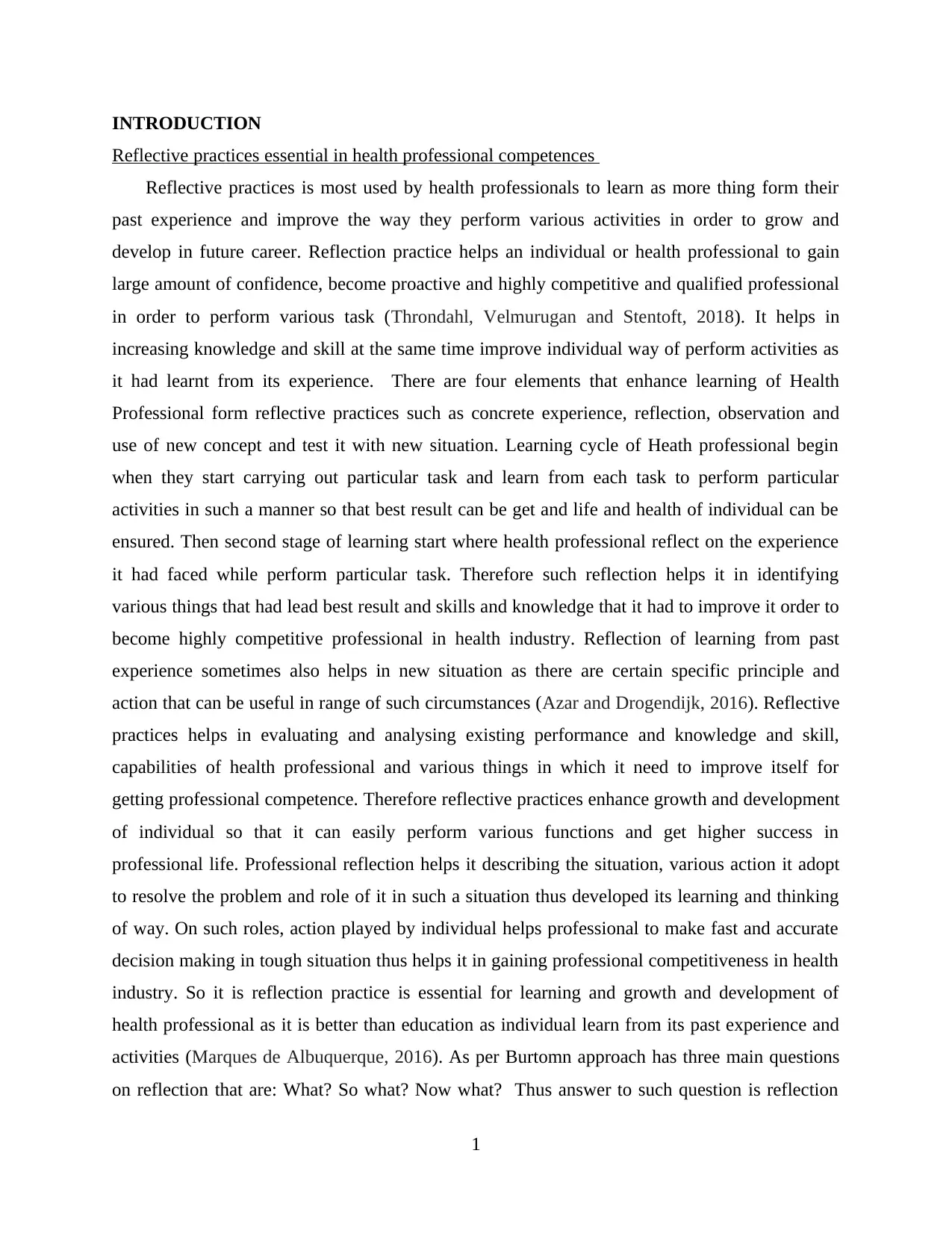
Reflective practices is most used by health professionals to learn as more thing form their
past experience and improve the way they perform various activities in order to grow and
develop in future career. Reflection practice helps an individual or health professional to gain
large amount of confidence, become proactive and highly competitive and qualified professional
in order to perform various task (Throndahl, Velmurugan and Stentoft, 2018). It helps in
increasing knowledge and skill at the same time improve individual way of perform activities as
it had learnt from its experience. There are four elements that enhance learning of Health
Professional form reflective practices such as concrete experience, reflection, observation and
use of new concept and test it with new situation. Learning cycle of Heath professional begin
when they start carrying out particular task and learn from each task to perform particular
activities in such a manner so that best result can be get and life and health of individual can be
ensured. Then second stage of learning start where health professional reflect on the experience
it had faced while perform particular task. Therefore such reflection helps it in identifying
various things that had lead best result and skills and knowledge that it had to improve it order to
become highly competitive professional in health industry. Reflection of learning from past
experience sometimes also helps in new situation as there are certain specific principle and
action that can be useful in range of such circumstances (Azar and Drogendijk, 2016). Reflective
practices helps in evaluating and analysing existing performance and knowledge and skill,
capabilities of health professional and various things in which it need to improve itself for
getting professional competence. Therefore reflective practices enhance growth and development
of individual so that it can easily perform various functions and get higher success in
professional life. Professional reflection helps it describing the situation, various action it adopt
to resolve the problem and role of it in such a situation thus developed its learning and thinking
of way. On such roles, action played by individual helps professional to make fast and accurate
decision making in tough situation thus helps it in gaining professional competitiveness in health
industry. So it is reflection practice is essential for learning and growth and development of
health professional as it is better than education as individual learn from its past experience and
activities (Marques de Albuquerque, 2016). As per Burtomn approach has three main questions
on reflection that are: What? So what? Now what? Thus answer to such question is reflection
1
Document Page
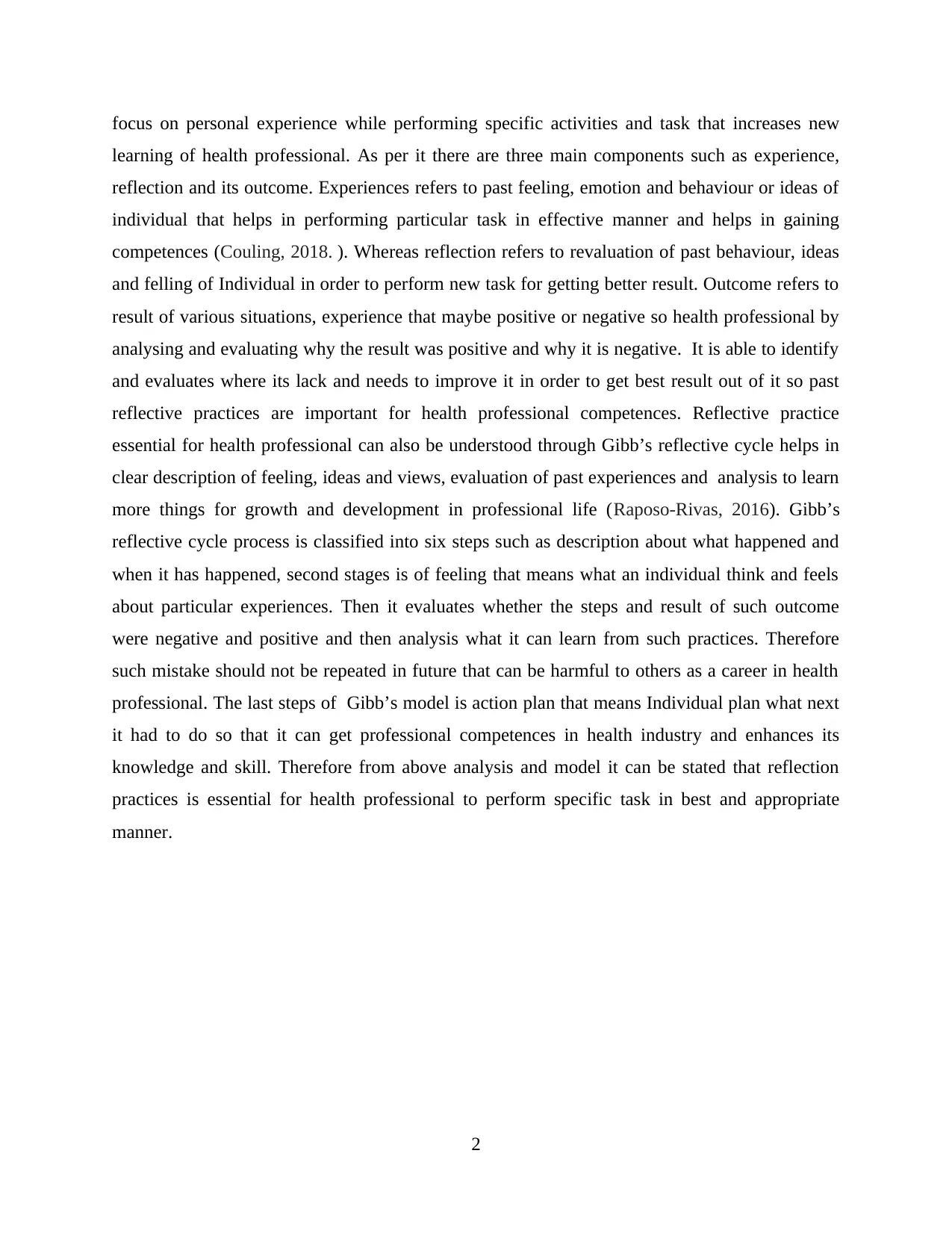
focus on personal experience while performing specific activities and task that increases new
learning of health professional. As per it there are three main components such as experience,
reflection and its outcome. Experiences refers to past feeling, emotion and behaviour or ideas of
individual that helps in performing particular task in effective manner and helps in gaining
competences (Couling, 2018. ). Whereas reflection refers to revaluation of past behaviour, ideas
and felling of Individual in order to perform new task for getting better result. Outcome refers to
result of various situations, experience that maybe positive or negative so health professional by
analysing and evaluating why the result was positive and why it is negative. It is able to identify
and evaluates where its lack and needs to improve it in order to get best result out of it so past
reflective practices are important for health professional competences. Reflective practice
essential for health professional can also be understood through Gibb’s reflective cycle helps in
clear description of feeling, ideas and views, evaluation of past experiences and analysis to learn
more things for growth and development in professional life (Raposo-Rivas, 2016). Gibb’s
reflective cycle process is classified into six steps such as description about what happened and
when it has happened, second stages is of feeling that means what an individual think and feels
about particular experiences. Then it evaluates whether the steps and result of such outcome
were negative and positive and then analysis what it can learn from such practices. Therefore
such mistake should not be repeated in future that can be harmful to others as a career in health
professional. The last steps of Gibb’s model is action plan that means Individual plan what next
it had to do so that it can get professional competences in health industry and enhances its
knowledge and skill. Therefore from above analysis and model it can be stated that reflection
practices is essential for health professional to perform specific task in best and appropriate
manner.
2
tabler-icon-diamond-filled.svg

Paraphrase This Document

Need a fresh take? Get an instant paraphrase of this document with our AI Paraphraser
Document Page
REFERENCES
Books and Journals
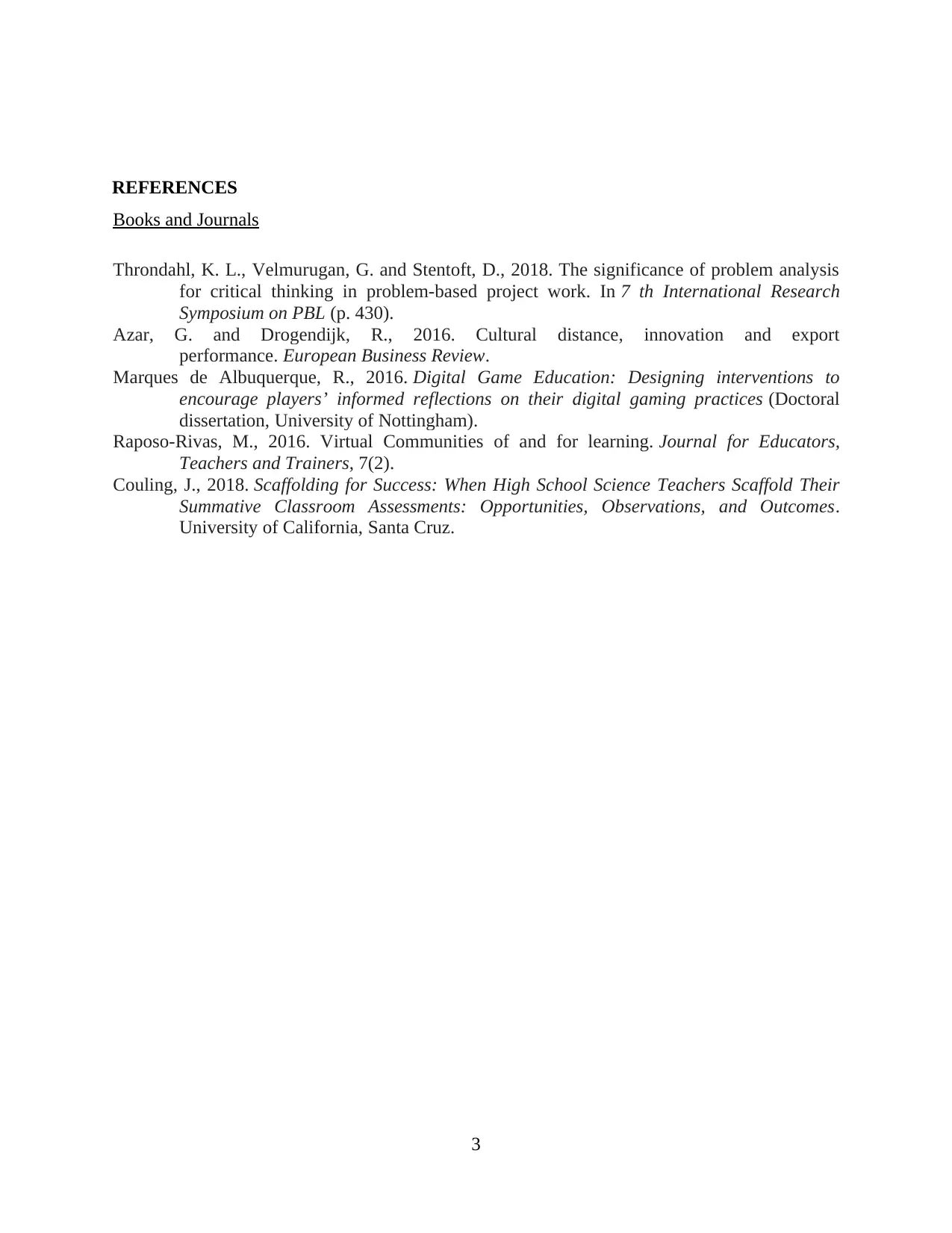
Throndahl, K. L., Velmurugan, G. and Stentoft, D., 2018. The significance of problem analysis
for critical thinking in problem-based project work. In 7 th International Research
Symposium on PBL (p. 430).
Azar, G. and Drogendijk, R., 2016. Cultural distance, innovation and export
performance. European Business Review.
Marques de Albuquerque, R., 2016. Digital Game Education: Designing interventions to
encourage players’ informed reflections on their digital gaming practices (Doctoral
dissertation, University of Nottingham).
Raposo-Rivas, M., 2016. Virtual Communities of and for learning. Journal for Educators,
Teachers and Trainers, 7(2).
Couling, J., 2018. Scaffolding for Success: When High School Science Teachers Scaffold Their
Summative Classroom Assessments: Opportunities, Observations, and Outcomes.
University of California, Santa Cruz.
3
Document Page
4
chevron_up_icon
1 out of 6
circle_padding
hide_on_mobile
zoom_out_icon
[object Object]