Transition to Professional Nursing: Importance of Reflective Practice
VerifiedAdded on 2020/05/11
|7
|2330
|247
Essay
AI Summary
This essay examines the concept of reflective practice in nursing, highlighting its significance in enhancing patient care, promoting critical thinking, and fostering professional development. The discussion emphasizes the application of personal experiences, theoretical knowledge, and practical values to improve the quality of healthcare. It explores the benefits of reflective practice, such as providing holistic care, improving communication, and reducing medical errors. The essay also addresses the complexities and limitations associated with its implementation, including subjective factors, time constraints, and the need for a supportive environment. It references various studies and guidelines, including those from the NMBA, to underscore the importance of reflective practice in evidence-based nursing and lifelong learning. The essay concludes by reinforcing the critical role of reflective practice in effective nursing, both individually and in group settings, for the benefit of patients and healthcare professionals.
Transition to Professional Nursing

Paraphrase This Document
Need a fresh take? Get an instant paraphrase of this document with our AI Paraphraser
Introduction:
Reflective practice incorporates application of own experiences in connecting knowledge and
practice for providing quality healthcare to the patients. Critical attention should be given to
the theories and practical values. It is authoritative for the nurses to practice reflective process
because it is the identity of the professional nursing. It is helpful for the nurses to eliminate
uncertainty of nurses at workplace and encourage them to work in competent and ethical
manner. Reflective practice is helpful in providing holistic care to the patients. Through
reflective practice, not only therapeutic but also personal, emotional, psychological and social
aspects off the patients can be addressed. This practice can give quality care to the patients.
However, this practice is associated with certain complexities and limitations (Bulman et al.,
2012).
Discussion:
In the effective implementation of the reflective practice all the stakeholders in healthcare
profession and family members of the patients should be incorporated. Reflective practice is
beneficial in providing person centred care to the patients (Glynn, 2012). Reflective practice
includes all the components of the nursing practice like getting information about the
condition of the patient, collecting past evidence and current clinical data, analysis of the
data, making exact conclusion based on the collected data and implementing effective
nursing plan for the patient. In this step wise approach, there is very little scope for the errors.
According to WHO estimates, approximately 10 million people suffer through medical
errors. In such scenario, reflective practice proved to be most useful. It is evident that most of
the medical errors occur due to inability of nurse to reflect on their own practice (Pezzolesi et
al., 2013).
Participation in ongoing professional development of self and others is the component of
critical thinking and analysis. In this nurse should pursue and acknowledge feedback from
other healthcare professionals and critically reflect on own nursing practice. It would be
helpful in incorporating amendments in the nursing practice for providing holistic care to the
patients. Nurse should participate in professional development to enhance nursing practice by
reflecting on self-nursing practice to recognize professional requirements for growth. Nurses
should use suitable approaches to make fit to the healthcare work environment. For this,
nurse should implement reflective practice to recognise personal requirements and pursue
Reflective practice incorporates application of own experiences in connecting knowledge and
practice for providing quality healthcare to the patients. Critical attention should be given to
the theories and practical values. It is authoritative for the nurses to practice reflective process
because it is the identity of the professional nursing. It is helpful for the nurses to eliminate
uncertainty of nurses at workplace and encourage them to work in competent and ethical
manner. Reflective practice is helpful in providing holistic care to the patients. Through
reflective practice, not only therapeutic but also personal, emotional, psychological and social
aspects off the patients can be addressed. This practice can give quality care to the patients.
However, this practice is associated with certain complexities and limitations (Bulman et al.,
2012).
Discussion:
In the effective implementation of the reflective practice all the stakeholders in healthcare
profession and family members of the patients should be incorporated. Reflective practice is
beneficial in providing person centred care to the patients (Glynn, 2012). Reflective practice
includes all the components of the nursing practice like getting information about the
condition of the patient, collecting past evidence and current clinical data, analysis of the
data, making exact conclusion based on the collected data and implementing effective
nursing plan for the patient. In this step wise approach, there is very little scope for the errors.
According to WHO estimates, approximately 10 million people suffer through medical
errors. In such scenario, reflective practice proved to be most useful. It is evident that most of
the medical errors occur due to inability of nurse to reflect on their own practice (Pezzolesi et
al., 2013).
Participation in ongoing professional development of self and others is the component of
critical thinking and analysis. In this nurse should pursue and acknowledge feedback from
other healthcare professionals and critically reflect on own nursing practice. It would be
helpful in incorporating amendments in the nursing practice for providing holistic care to the
patients. Nurse should participate in professional development to enhance nursing practice by
reflecting on self-nursing practice to recognize professional requirements for growth. Nurses
should use suitable approaches to make fit to the healthcare work environment. For this,
nurse should implement reflective practice to recognise personal requirements and pursue
necessary support from other healthcare professionals (Chong, 2009). Inter professional and
patient centred communication are the important aspect of reflective practice in patient care.
This communication should be trustworthy and consistent. It would be helpful in improving
trusting relationships with the patients and family members. Clinical reasoning is important
component for the effective implementation of the reflective practice (Bartlett et al., 2015).
With the advancement of the technology and sophisticated information sources, there is
augmentation in the keenness in the patients. Hence, healthcare professionals need to be think
critically and independently to answer patient’s queries. Critical reflection on own practice is
an important component of improving professional nursing practice and maintaining
expertise. In reflective practice, nurse need to think purposefully on the patient problem and
work towards the conclusion of the patient problem. Hence, reflection can be helpful for
nurses in facing challenge and solving problem in the patient care. Reflective practice make
nurse to understand problem of the patient. In clinical setting reflection can be implemented
by following certain steps. In the initial step, event should be described in detail comprising
of exact condition of the patient, reason behind the condition of the patient and stakeholders
taking part in curing the patient. In the next step, nurse should elaborate own feelings and
perceptions about the patient condition. Opinions and feelings of other stakeholders should
also be considered (Smith et al., 2015). All the positive and negative aspects of the patient
condition should be evaluated. Consequently, patient condition need to be analysed by taking
cues from the past and recent clinical data. Existing knowledge and experience should be
implemented to conclude exact condition of the patient. In making conclusion about the
diagnosis of the patient condition, opinions of the other healthcare professionals should be
taken. After making conclusion on the diagnosis of the patient, effective therapeutic plan
should be implemented. This therapeutic plan should be useful for the future patients also.
Nurse should critically think about the plan in diverse directions and different approaches for
implementing therapeutic plan. It would be useful in the self-assessment of the nurse. In
summary, in clinical practice reflection can be implemented by using five processes. These
five processes include implementation of knowledge, demonstrating comprehension,
application of theories and implementing analysis and synthesising the effective care plan
(Goudreau et al., 2015).
Reflective practice is useful in engaging healthcare professional with the patients. There is
improvement in the personal contacts with the patient and provision of the individualised care
to the patients. Patients can receive person centred and holistic care due to reflective process.
patient centred communication are the important aspect of reflective practice in patient care.
This communication should be trustworthy and consistent. It would be helpful in improving
trusting relationships with the patients and family members. Clinical reasoning is important
component for the effective implementation of the reflective practice (Bartlett et al., 2015).
With the advancement of the technology and sophisticated information sources, there is
augmentation in the keenness in the patients. Hence, healthcare professionals need to be think
critically and independently to answer patient’s queries. Critical reflection on own practice is
an important component of improving professional nursing practice and maintaining
expertise. In reflective practice, nurse need to think purposefully on the patient problem and
work towards the conclusion of the patient problem. Hence, reflection can be helpful for
nurses in facing challenge and solving problem in the patient care. Reflective practice make
nurse to understand problem of the patient. In clinical setting reflection can be implemented
by following certain steps. In the initial step, event should be described in detail comprising
of exact condition of the patient, reason behind the condition of the patient and stakeholders
taking part in curing the patient. In the next step, nurse should elaborate own feelings and
perceptions about the patient condition. Opinions and feelings of other stakeholders should
also be considered (Smith et al., 2015). All the positive and negative aspects of the patient
condition should be evaluated. Consequently, patient condition need to be analysed by taking
cues from the past and recent clinical data. Existing knowledge and experience should be
implemented to conclude exact condition of the patient. In making conclusion about the
diagnosis of the patient condition, opinions of the other healthcare professionals should be
taken. After making conclusion on the diagnosis of the patient, effective therapeutic plan
should be implemented. This therapeutic plan should be useful for the future patients also.
Nurse should critically think about the plan in diverse directions and different approaches for
implementing therapeutic plan. It would be useful in the self-assessment of the nurse. In
summary, in clinical practice reflection can be implemented by using five processes. These
five processes include implementation of knowledge, demonstrating comprehension,
application of theories and implementing analysis and synthesising the effective care plan
(Goudreau et al., 2015).
Reflective practice is useful in engaging healthcare professional with the patients. There is
improvement in the personal contacts with the patient and provision of the individualised care
to the patients. Patients can receive person centred and holistic care due to reflective process.
⊘ This is a preview!⊘
Do you want full access?
Subscribe today to unlock all pages.

Trusted by 1+ million students worldwide
Complete examination of the patient’s condition by incorporating past history and present
data can be carried out. Future predictions of the patient’s condition can be made. Hence,
patient can take preventive measures to manage the diseased condition. In reflective practice,
patient has the opportunity to share their feelings and opinion. It can be helpful for the
patients to communicate with the nurses more comfortably. As there is involvement of the
patients and family members in the patient care, there would be augmentation of the medical
knowledge of the patients and family members. It would improve adherence of the patients to
the treatment (Dunn and Musolino, 2011).
Critical thinking and analysis domain for nursing practice of the NMBA states that reflection
on practice, feelings, beliefs and it significance for the patients, family members and other
healthcare professionals is vital benchmark. Competent performance by the nurse in patient
care can be improved by reflective practice. Reflective practice is one of the important
components of the nursing practice which include legal, professional, ethical and reflective
framework. During implementation of the reflective practice, nurse should respect diverse
values of patients, beliefs and social and cultural aspects of the patients. Reflective practice
can be helpful for the nurses for life-long learning. Critical self-awareness, self-learning and
self-evaluation are the important components of the reflective practice. Reflective practice is
not useful for individual patients but also for practices and procedures in the ward. Reflective
practice can provide care to the patients by closing the gap between the theory and practice.
Success in the reflective practice for patients can be used as the evidence for nurses to
improve nursing intervention (Driscoll et al., 2012; Gray et al., 2016).
Reflective practice incorporates reflection on the feedback and incorporates modifications in
the practice based on the feedback. It includes nurse’s perceptions, attitudes and beliefs in the
nursing practice. It is also helpful in identifying knowledge discrepancy and pursue
explanation on this. It also ensures safety of the patients and quality nursing service to the
patients. In most of the instances, it has been observed that reflection is mainly associated
with the negative issues. Hence, positive aspects might remain unnoticed during this process.
Nurse might feel frustrated, if they wouldn’t be able to solve the issues observed during
reflective practice. Hence, it can demotivate nurse instead of promoting them for
implementation of nursing practice (Oelofsen et al., 2012).
Certain complexities are associated with the implementation of reflective practice. Subjective
factors can influence its implementation; hence this process can be manipulated to get the
data can be carried out. Future predictions of the patient’s condition can be made. Hence,
patient can take preventive measures to manage the diseased condition. In reflective practice,
patient has the opportunity to share their feelings and opinion. It can be helpful for the
patients to communicate with the nurses more comfortably. As there is involvement of the
patients and family members in the patient care, there would be augmentation of the medical
knowledge of the patients and family members. It would improve adherence of the patients to
the treatment (Dunn and Musolino, 2011).
Critical thinking and analysis domain for nursing practice of the NMBA states that reflection
on practice, feelings, beliefs and it significance for the patients, family members and other
healthcare professionals is vital benchmark. Competent performance by the nurse in patient
care can be improved by reflective practice. Reflective practice is one of the important
components of the nursing practice which include legal, professional, ethical and reflective
framework. During implementation of the reflective practice, nurse should respect diverse
values of patients, beliefs and social and cultural aspects of the patients. Reflective practice
can be helpful for the nurses for life-long learning. Critical self-awareness, self-learning and
self-evaluation are the important components of the reflective practice. Reflective practice is
not useful for individual patients but also for practices and procedures in the ward. Reflective
practice can provide care to the patients by closing the gap between the theory and practice.
Success in the reflective practice for patients can be used as the evidence for nurses to
improve nursing intervention (Driscoll et al., 2012; Gray et al., 2016).
Reflective practice incorporates reflection on the feedback and incorporates modifications in
the practice based on the feedback. It includes nurse’s perceptions, attitudes and beliefs in the
nursing practice. It is also helpful in identifying knowledge discrepancy and pursue
explanation on this. It also ensures safety of the patients and quality nursing service to the
patients. In most of the instances, it has been observed that reflection is mainly associated
with the negative issues. Hence, positive aspects might remain unnoticed during this process.
Nurse might feel frustrated, if they wouldn’t be able to solve the issues observed during
reflective practice. Hence, it can demotivate nurse instead of promoting them for
implementation of nursing practice (Oelofsen et al., 2012).
Certain complexities are associated with the implementation of reflective practice. Subjective
factors can influence its implementation; hence this process can be manipulated to get the
Paraphrase This Document
Need a fresh take? Get an instant paraphrase of this document with our AI Paraphraser
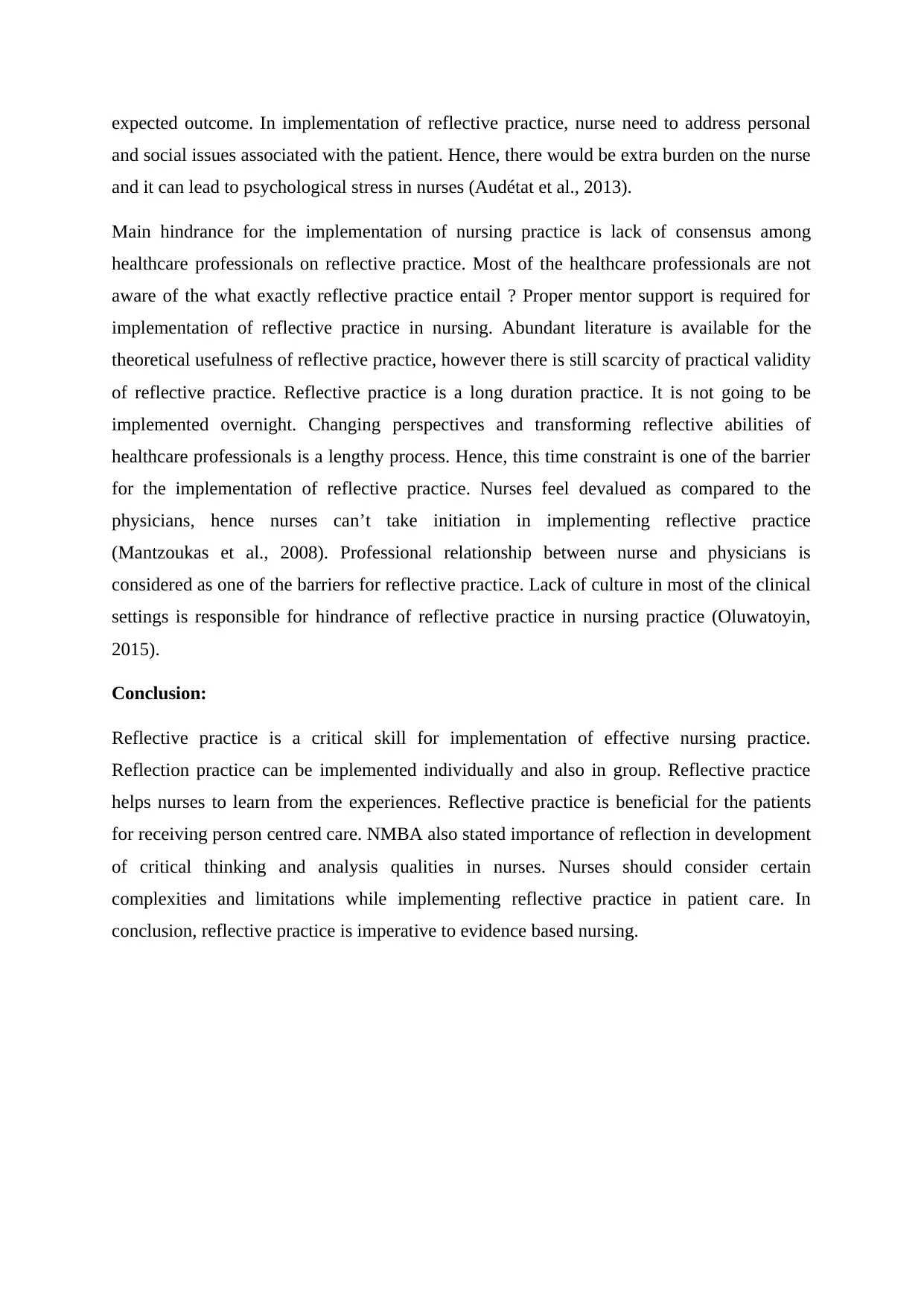
expected outcome. In implementation of reflective practice, nurse need to address personal
and social issues associated with the patient. Hence, there would be extra burden on the nurse
and it can lead to psychological stress in nurses (Audétat et al., 2013).
Main hindrance for the implementation of nursing practice is lack of consensus among
healthcare professionals on reflective practice. Most of the healthcare professionals are not
aware of the what exactly reflective practice entail ? Proper mentor support is required for
implementation of reflective practice in nursing. Abundant literature is available for the
theoretical usefulness of reflective practice, however there is still scarcity of practical validity
of reflective practice. Reflective practice is a long duration practice. It is not going to be
implemented overnight. Changing perspectives and transforming reflective abilities of
healthcare professionals is a lengthy process. Hence, this time constraint is one of the barrier
for the implementation of reflective practice. Nurses feel devalued as compared to the
physicians, hence nurses can’t take initiation in implementing reflective practice
(Mantzoukas et al., 2008). Professional relationship between nurse and physicians is
considered as one of the barriers for reflective practice. Lack of culture in most of the clinical
settings is responsible for hindrance of reflective practice in nursing practice (Oluwatoyin,
2015).
Conclusion:
Reflective practice is a critical skill for implementation of effective nursing practice.
Reflection practice can be implemented individually and also in group. Reflective practice
helps nurses to learn from the experiences. Reflective practice is beneficial for the patients
for receiving person centred care. NMBA also stated importance of reflection in development
of critical thinking and analysis qualities in nurses. Nurses should consider certain
complexities and limitations while implementing reflective practice in patient care. In
conclusion, reflective practice is imperative to evidence based nursing.
and social issues associated with the patient. Hence, there would be extra burden on the nurse
and it can lead to psychological stress in nurses (Audétat et al., 2013).
Main hindrance for the implementation of nursing practice is lack of consensus among
healthcare professionals on reflective practice. Most of the healthcare professionals are not
aware of the what exactly reflective practice entail ? Proper mentor support is required for
implementation of reflective practice in nursing. Abundant literature is available for the
theoretical usefulness of reflective practice, however there is still scarcity of practical validity
of reflective practice. Reflective practice is a long duration practice. It is not going to be
implemented overnight. Changing perspectives and transforming reflective abilities of
healthcare professionals is a lengthy process. Hence, this time constraint is one of the barrier
for the implementation of reflective practice. Nurses feel devalued as compared to the
physicians, hence nurses can’t take initiation in implementing reflective practice
(Mantzoukas et al., 2008). Professional relationship between nurse and physicians is
considered as one of the barriers for reflective practice. Lack of culture in most of the clinical
settings is responsible for hindrance of reflective practice in nursing practice (Oluwatoyin,
2015).
Conclusion:
Reflective practice is a critical skill for implementation of effective nursing practice.
Reflection practice can be implemented individually and also in group. Reflective practice
helps nurses to learn from the experiences. Reflective practice is beneficial for the patients
for receiving person centred care. NMBA also stated importance of reflection in development
of critical thinking and analysis qualities in nurses. Nurses should consider certain
complexities and limitations while implementing reflective practice in patient care. In
conclusion, reflective practice is imperative to evidence based nursing.
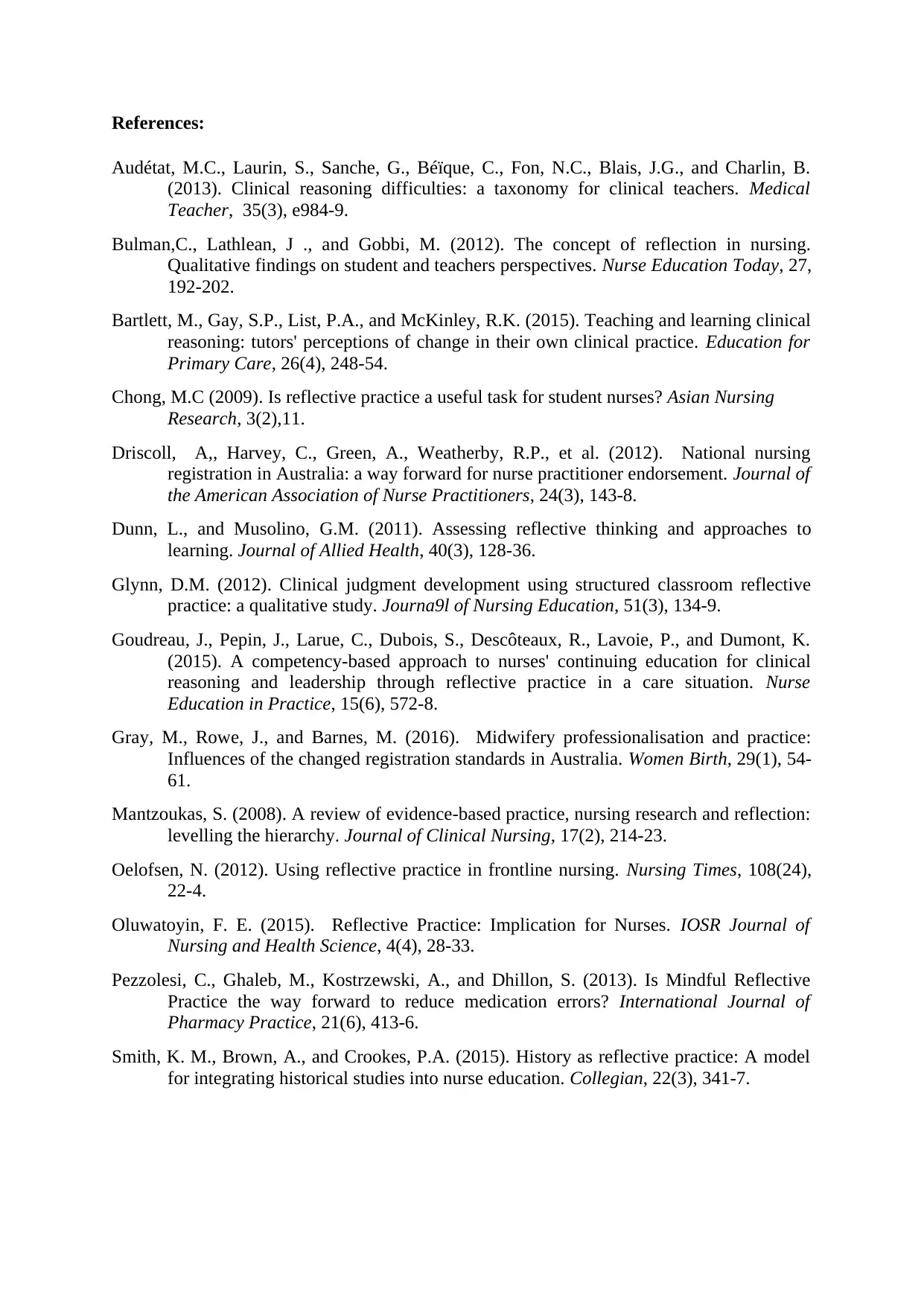
References:
Audétat, M.C., Laurin, S., Sanche, G., Béïque, C., Fon, N.C., Blais, J.G., and Charlin, B.
(2013). Clinical reasoning difficulties: a taxonomy for clinical teachers. Medical
Teacher, 35(3), e984-9.
Bulman,C., Lathlean, J ., and Gobbi, M. (2012). The concept of reflection in nursing.
Qualitative findings on student and teachers perspectives. Nurse Education Today, 27,
192-202.
Bartlett, M., Gay, S.P., List, P.A., and McKinley, R.K. (2015). Teaching and learning clinical
reasoning: tutors' perceptions of change in their own clinical practice. Education for
Primary Care, 26(4), 248-54.
Chong, M.C (2009). Is reflective practice a useful task for student nurses? Asian Nursing
Research, 3(2),11.
Driscoll, A,, Harvey, C., Green, A., Weatherby, R.P., et al. (2012). National nursing
registration in Australia: a way forward for nurse practitioner endorsement. Journal of
the American Association of Nurse Practitioners, 24(3), 143-8.
Dunn, L., and Musolino, G.M. (2011). Assessing reflective thinking and approaches to
learning. Journal of Allied Health, 40(3), 128-36.
Glynn, D.M. (2012). Clinical judgment development using structured classroom reflective
practice: a qualitative study. Journa9l of Nursing Education, 51(3), 134-9.
Goudreau, J., Pepin, J., Larue, C., Dubois, S., Descôteaux, R., Lavoie, P., and Dumont, K.
(2015). A competency-based approach to nurses' continuing education for clinical
reasoning and leadership through reflective practice in a care situation. Nurse
Education in Practice, 15(6), 572-8.
Gray, M., Rowe, J., and Barnes, M. (2016). Midwifery professionalisation and practice:
Influences of the changed registration standards in Australia. Women Birth, 29(1), 54-
61.
Mantzoukas, S. (2008). A review of evidence-based practice, nursing research and reflection:
levelling the hierarchy. Journal of Clinical Nursing, 17(2), 214-23.
Oelofsen, N. (2012). Using reflective practice in frontline nursing. Nursing Times, 108(24),
22-4.
Oluwatoyin, F. E. (2015). Reflective Practice: Implication for Nurses. IOSR Journal of
Nursing and Health Science, 4(4), 28-33.
Pezzolesi, C., Ghaleb, M., Kostrzewski, A., and Dhillon, S. (2013). Is Mindful Reflective
Practice the way forward to reduce medication errors? International Journal of
Pharmacy Practice, 21(6), 413-6.
Smith, K. M., Brown, A., and Crookes, P.A. (2015). History as reflective practice: A model
for integrating historical studies into nurse education. Collegian, 22(3), 341-7.
Audétat, M.C., Laurin, S., Sanche, G., Béïque, C., Fon, N.C., Blais, J.G., and Charlin, B.
(2013). Clinical reasoning difficulties: a taxonomy for clinical teachers. Medical
Teacher, 35(3), e984-9.
Bulman,C., Lathlean, J ., and Gobbi, M. (2012). The concept of reflection in nursing.
Qualitative findings on student and teachers perspectives. Nurse Education Today, 27,
192-202.
Bartlett, M., Gay, S.P., List, P.A., and McKinley, R.K. (2015). Teaching and learning clinical
reasoning: tutors' perceptions of change in their own clinical practice. Education for
Primary Care, 26(4), 248-54.
Chong, M.C (2009). Is reflective practice a useful task for student nurses? Asian Nursing
Research, 3(2),11.
Driscoll, A,, Harvey, C., Green, A., Weatherby, R.P., et al. (2012). National nursing
registration in Australia: a way forward for nurse practitioner endorsement. Journal of
the American Association of Nurse Practitioners, 24(3), 143-8.
Dunn, L., and Musolino, G.M. (2011). Assessing reflective thinking and approaches to
learning. Journal of Allied Health, 40(3), 128-36.
Glynn, D.M. (2012). Clinical judgment development using structured classroom reflective
practice: a qualitative study. Journa9l of Nursing Education, 51(3), 134-9.
Goudreau, J., Pepin, J., Larue, C., Dubois, S., Descôteaux, R., Lavoie, P., and Dumont, K.
(2015). A competency-based approach to nurses' continuing education for clinical
reasoning and leadership through reflective practice in a care situation. Nurse
Education in Practice, 15(6), 572-8.
Gray, M., Rowe, J., and Barnes, M. (2016). Midwifery professionalisation and practice:
Influences of the changed registration standards in Australia. Women Birth, 29(1), 54-
61.
Mantzoukas, S. (2008). A review of evidence-based practice, nursing research and reflection:
levelling the hierarchy. Journal of Clinical Nursing, 17(2), 214-23.
Oelofsen, N. (2012). Using reflective practice in frontline nursing. Nursing Times, 108(24),
22-4.
Oluwatoyin, F. E. (2015). Reflective Practice: Implication for Nurses. IOSR Journal of
Nursing and Health Science, 4(4), 28-33.
Pezzolesi, C., Ghaleb, M., Kostrzewski, A., and Dhillon, S. (2013). Is Mindful Reflective
Practice the way forward to reduce medication errors? International Journal of
Pharmacy Practice, 21(6), 413-6.
Smith, K. M., Brown, A., and Crookes, P.A. (2015). History as reflective practice: A model
for integrating historical studies into nurse education. Collegian, 22(3), 341-7.
⊘ This is a preview!⊘
Do you want full access?
Subscribe today to unlock all pages.
Trusted by 1+ million students worldwide

Veno, M., Silk, H., Savageau. J.A., and Sullivan, K.M. (2016). Evaluating One Strategy for
Including Reflection in Medical Education and Practice. Family Medicine, 48(4), 300-
4.
Including Reflection in Medical Education and Practice. Family Medicine, 48(4), 300-
4.

1 out of 7


Related Documents


Your All-in-One AI-Powered Toolkit for Academic Success.
+13062052269
info@desklib.com
Available 24*7 on WhatsApp / Email
![[object Object]](/_next/static/media/star-bottom.7253800d.svg)
Unlock your academic potential
Copyright © 2020–2026 A2Z Services. All Rights Reserved. Developed and managed by ZUCOL.