DPPV Module: Reflective Practice, Models, and Themes in Healthcare

Verified

Added on  2021/02/19

|8
|1933
|25
Report
AI Summary
This report delves into the significance of reflective practice within the health and social care sector. It begins by defining professional principles and values, emphasizing the importance of ethical standards in clinical practice. The report then explores the purpose and necessity of reflective practice, highlighting its role in identifying and addressing performance threats, improving care quality, and enhancing patient satisfaction. It also examines the impact of reflective models, such as Gibbs and Schon models, on personal and professional development, illustrating how these frameworks facilitate learning from experiences and promote growth. The report further discusses the role of practice themes, such as substance abuse and counseling theories, in providing a structured approach to reflection and improving care outcomes. Ultimately, the report underscores the value of reflective practice in enhancing the effectiveness of healthcare professionals and the quality of care delivery.

Document Page
DPPV
The Reflective Practitioner
tabler-icon-diamond-filled.svg

Paraphrase This Document

Need a fresh take? Get an instant paraphrase of this document with our AI Paraphraser
Document Page
Table of Contents
Introduction......................................................................................................................................1
Task..................................................................................................................................................1
Purpose of reflective practice and need of reflective practitioners........................................1
Impact of reflective models on personal and professional development...............................2
Role of the practice themes in providing framework of reflection........................................4
Conclusion.......................................................................................................................................4
References........................................................................................................................................5
Document Page
Document Page
Introduction
Professional principles & values refers to set of ethics, standards and other norms which
should be followed by practitioners while conducting clinical practitioners in health & social
care. It includes specific rules and codes of practices that must be considered by care providers
while providing medical facilities to people for their well being (Ghaye and Lillyman, 2014).
The present report will focus purpose of reflective including need of them in health & social
care. It will also includes impact of model of reflection on personal and professional
development. The role of practice themes in terms of providing a framework for reflection.
Task
Purpose of reflective practice and need of reflective practitioners
The reflective practice can be described as a way of analysing own experiences of work
in order to improve them. It is helpful to understand self threats of performing and learn to boost
up effectiveness of own performance at work place. However, it is necessary involvement of
reflective practice is favourable for improving quality of care along with reducing gap between
theory and practice accordingly. In addition to this, the purpose of reflective practice is to
determine issue of own practice in terms of improving them for delivering better quality of
medical facilities for wellness of an individual. Meanwhile, it is necessary for healthcare
professionals to focus on this aspect for increasing effectiveness of clinical procedures which
facilitate to reduce chance of occurring drug errors along with improving patient outcomes
respectively (Cameron and et. al., 2014). Moreover, reflective practices provide support to
increase quality and effectiveness of medical services which facilitate to avoid complicated
circumstances in healthcare institutions.
On the other hand, reflective practitioners can be defined as a professional who evaluate
their own work after regular intervals and make improvements in their performance. It is
necessary for every individual to focus on their work and conduct self evaluation to identify
threats which facilitate to boost up their own skills as well capabilities that helps in future to earn
growth. Basically, it has been analysed that reflective practices are suitable for facilitate self
development in order to gain future personal growth. Meanwhile, reflective practitioners are
required in health & social care due to several means that are given below:
1
tabler-icon-diamond-filled.svg

Paraphrase This Document

Need a fresh take? Get an instant paraphrase of this document with our AI Paraphraser
Document Page
Identify threats: Reflective practitioners are required in healthcare because they are
much capable to determine the threats of their own performance which is favourable to make
correct strategies to overcome with them. It includes the criterion of establish effective practices
and policies in order to eliminate such threats in care for increasing patient outcomes.
Improve performance: Identification of own threats of performance facilitate to
overcome with them which helps to increase effectiveness of performance (Barsky, 2019). Every
healthcare practitioners should focus on their performance issues and put efforts to eliminate
them for delivering better care facilities for welfare of an individual.
Increase quality of care: The reflective practitioners is required because they improve
every clinical activity which provide support to boost up quality of medical facilities. It is
suitable for reducing chance of occurring drugs errors as well as complications for patients which
helps to increase quality of care services. Moreover, it is observed that increased quality of care
is significant for patients and good will of an organisation.
Satisfy clients: Reflective practitioner are required because they are responsible for
identifying issues related to clinical procedures along with eliminating them for delivering better
services to needy individuals. It consist to render appropriate medical facilities in respect of
delivering appropriate medications to make them well being as well as satisfied.
Impact of reflective models on personal and professional development
Reflective model refers to an effective fame work which can be used to analyse own
performance in order to to determine issues to overcome with them. It consist the criterion of
eliminating threats of performing which facilitate to improve skills as well as abilities that helps
to achieve growth respectively (Han, 2015). However, it has been analysed that removing of
performance problems ate helpful to gain personal and professionals development in health &
social care. Hence, some of reflective models are explained here.
Gibbs Reflection model consist number of steps that should be followed in correct
sequences in order to conduct effective reflection of own work. It includes description, feelings,
evaluation, analysis, conclusion and action plan. Initially, description refers to information about
patient and relevant issues fir which they are required care facilities. It involves to define entire
situation, event or activity along with involved individuals that helps to develop desired goal of
care. Secondly, feelings dose not consist to understand feelings of an individuals but it focus to
analyse about awareness regarding specific health problems which is significant to make
2
Document Page
decision about treatment. Thirdly, evaluation is third step in which it is determined that what has
been done well at the time of whole clinical process and if the problems occurs then what is the
reason behind the same. It also includes to identify own contribution in the particular medical
procedure for wellness of a patient. However, analysis can be described as to determine aspects
that has been learned from that specific situation in healthcare. It consist the criterion of
analysing both positive as well as negative things happen during the event (Redmond, 2017). In
addition to this, conclusion refers to look back and analyse about own contribution to the specific
situations in context of patient. Moreover, action plan consist to establish an effective planning
including desired strategies which are favourable to deal with similar future conditions, activities
or events in terms of avoiding mistakes along with achieving better patient outcomes.
Schon model of reflection refers to a framework which differentiate among two types of
reflection that can be applied to specific situation for conducting reflective practices. It can be
categorised into two aspects such as reflection on action and reflection in action. However,
reflection on action can be described as a procedure to focus back on an event in order to analyse
the same for making explicit the information that facilitate to direct an action. In contrary to this,
reflection in action can be defined as a process to think and altering action at the time time of
specific activity. It can be considered as a procedure is generally employed while faced with an
unexpected event.
Impact of reflection model on personal and professional development
Reflection models are favourable to increase learning from an experiences of situation
which facilitate professional growth in health & social care.
It is beneficial to promote deep learning the reduce mistakes by care practitioners and
care homes (Malekoff, 2015).
The areas related to personal and professional development can be identified by reflection
models.
It is significant to determine training requirements of medical staff which improve their
skills and facilitate future growth.
Reflective models helps to gain further understanding of own beliefs, attitudes and values
that can be improved while dealing with patients to satisfy their actual care needs.
It will provide support to care professionals to conduct possible improvements in regards
to personal as well as clinical procedures.
3
Document Page
Reflective models provide support to care practitioners in terms of encouragement of self
motivation and self directed learning that facilitate personal & professionals development
respectively.
Role of the practice themes in providing framework of reflection
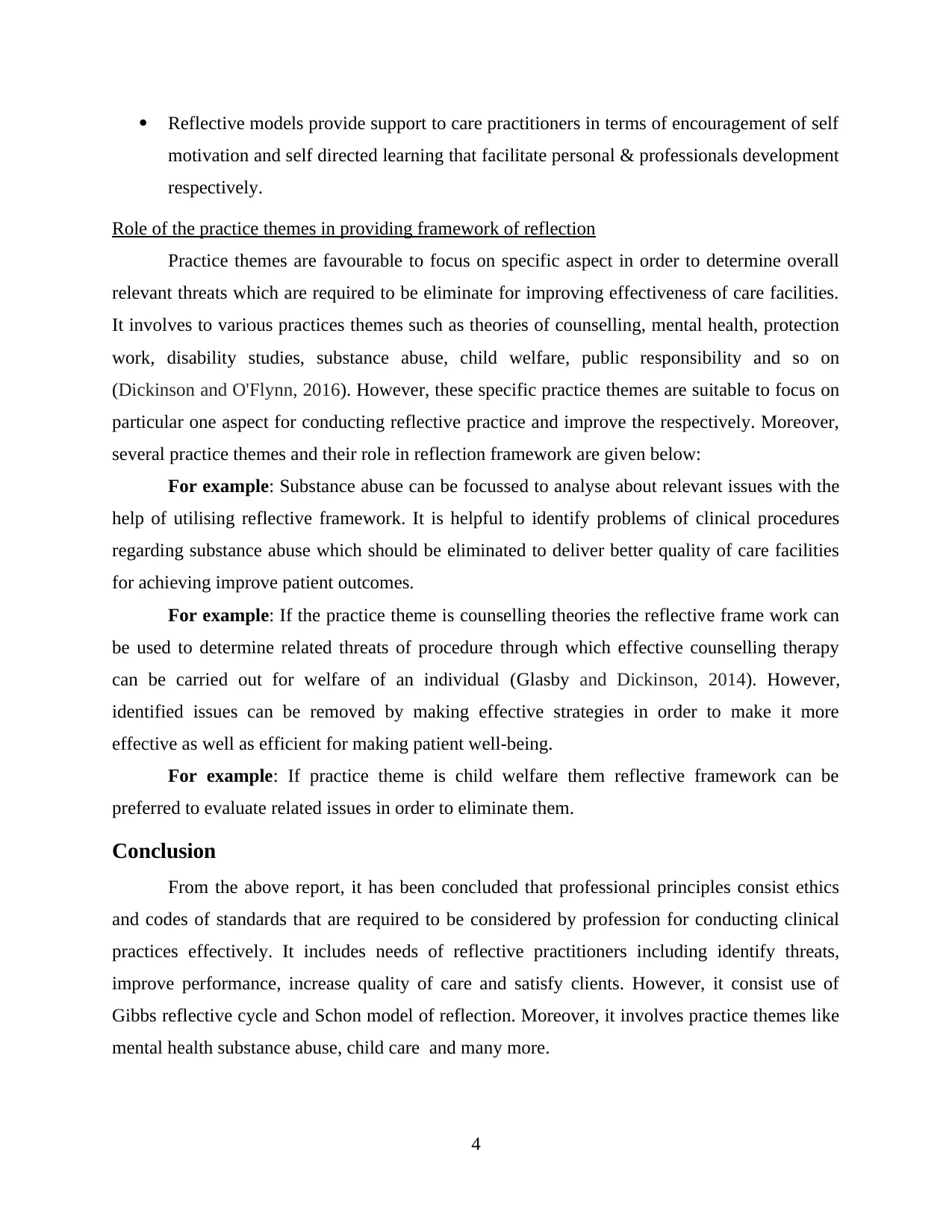
Practice themes are favourable to focus on specific aspect in order to determine overall
relevant threats which are required to be eliminate for improving effectiveness of care facilities.
It involves to various practices themes such as theories of counselling, mental health, protection
work, disability studies, substance abuse, child welfare, public responsibility and so on
(Dickinson and O'Flynn, 2016). However, these specific practice themes are suitable to focus on
particular one aspect for conducting reflective practice and improve the respectively. Moreover,
several practice themes and their role in reflection framework are given below:
For example: Substance abuse can be focussed to analyse about relevant issues with the
help of utilising reflective framework. It is helpful to identify problems of clinical procedures
regarding substance abuse which should be eliminated to deliver better quality of care facilities
for achieving improve patient outcomes.
For example: If the practice theme is counselling theories the reflective frame work can
be used to determine related threats of procedure through which effective counselling therapy
can be carried out for welfare of an individual (Glasby and Dickinson, 2014). However,
identified issues can be removed by making effective strategies in order to make it more
effective as well as efficient for making patient well-being.
For example: If practice theme is child welfare them reflective framework can be
preferred to evaluate related issues in order to eliminate them.
Conclusion
From the above report, it has been concluded that professional principles consist ethics
and codes of standards that are required to be considered by profession for conducting clinical
practices effectively. It includes needs of reflective practitioners including identify threats,
improve performance, increase quality of care and satisfy clients. However, it consist use of
Gibbs reflective cycle and Schon model of reflection. Moreover, it involves practice themes like
mental health substance abuse, child care and many more.
4
tabler-icon-diamond-filled.svg

Paraphrase This Document

Need a fresh take? Get an instant paraphrase of this document with our AI Paraphraser
Document Page
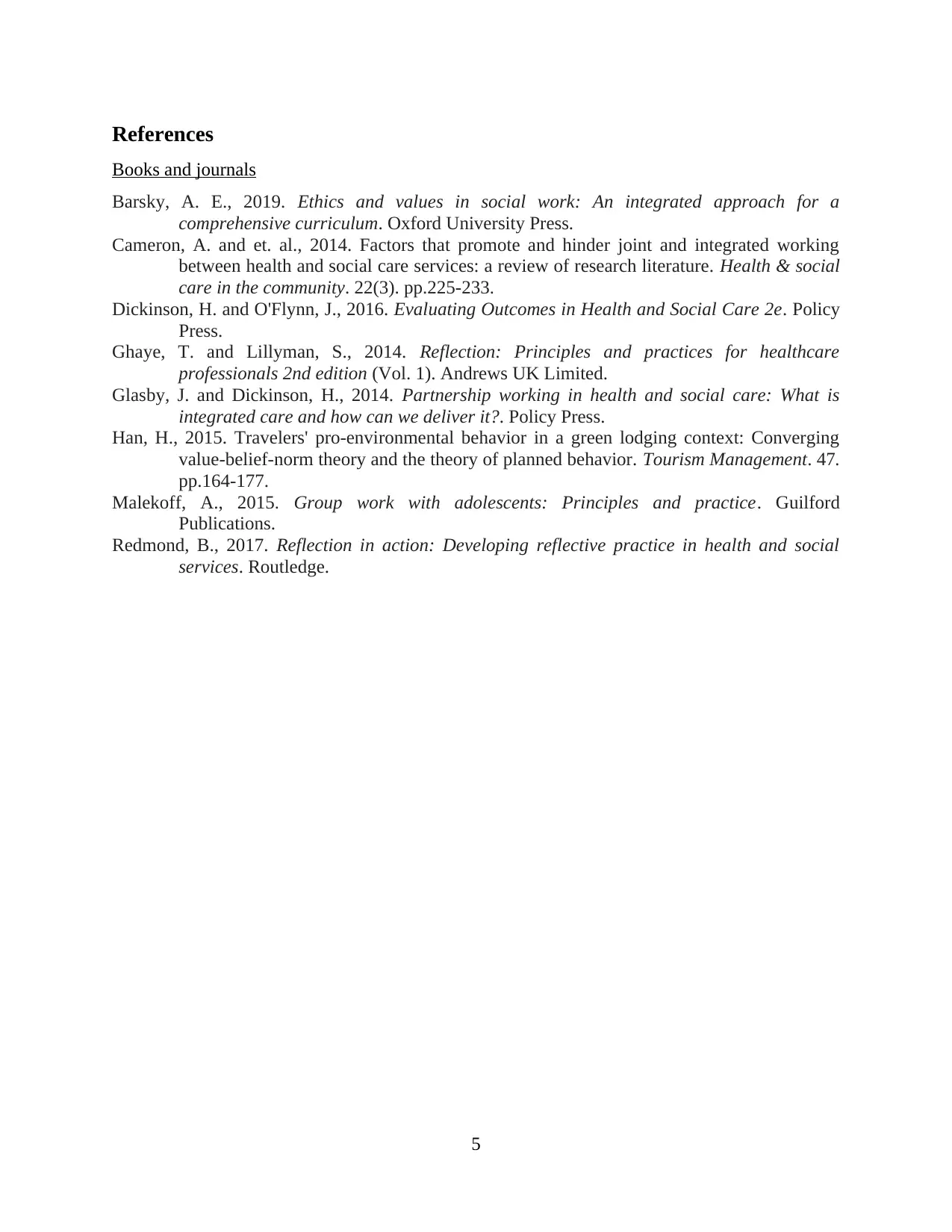
References
Books and journals
Barsky, A. E., 2019. Ethics and values in social work: An integrated approach for a
comprehensive curriculum. Oxford University Press.
Cameron, A. and et. al., 2014. Factors that promote and hinder joint and integrated working
between health and social care services: a review of research literature. Health & social
care in the community. 22(3). pp.225-233.
Dickinson, H. and O'Flynn, J., 2016. Evaluating Outcomes in Health and Social Care 2e. Policy
Press.
Ghaye, T. and Lillyman, S., 2014. Reflection: Principles and practices for healthcare
professionals 2nd edition (Vol. 1). Andrews UK Limited.
Glasby, J. and Dickinson, H., 2014. Partnership working in health and social care: What is
integrated care and how can we deliver it?. Policy Press.
Han, H., 2015. Travelers' pro-environmental behavior in a green lodging context: Converging
value-belief-norm theory and the theory of planned behavior. Tourism Management. 47.
pp.164-177.
Malekoff, A., 2015. Group work with adolescents: Principles and practice. Guilford
Publications.
Redmond, B., 2017. Reflection in action: Developing reflective practice in health and social
services. Routledge.
5
chevron_up_icon
1 out of 8
circle_padding
hide_on_mobile
zoom_out_icon
[object Object]