Case Study: Healthcare Access and Challenges for Refugee Communities
VerifiedAdded on 2022/09/30
|10
|2639
|498
Case Study
AI Summary
This case study examines the healthcare challenges faced by refugees in Canada, focusing on a Colombian refugee named Maria. The study highlights language barriers, particularly the lack of English proficiency among refugees, which hinders their ability to communicate with healthcare providers and understand medical information. It also reveals a lack of awareness regarding available healthcare schemes and procedures. The case study analyzes these issues, emphasizing the need for interpretation services, healthcare education programs, and the involvement of community health volunteers. The author suggests culturally competent interventions to address the healthcare disparities faced by refugees, including training community health workers and providing English language lessons. The study concludes that addressing language barriers and providing adequate healthcare information are crucial for improving refugees' access to healthcare services.
Running head: VULNERABLE POPULATION 1
Case Study: Vulnerable Populations
Name
Institutional Affiliation
Case Study: Vulnerable Populations
Name
Institutional Affiliation

Paraphrase This Document
Need a fresh take? Get an instant paraphrase of this document with our AI Paraphraser
VULNERABLE POPULATION 2
Introduction
Many people across the world are forcefully displaced out of their native land due to
conflicts and other violations of their human rights, making them refugees (Huot et al., 2019).
Canada is among the countries that s currently receiving the highest number of refugees.
Refugees have a high burden of disease and are also compromised access to healthcare due to
lack or little knowledge of the local language (Huot et al., 2009). This paper aims to prevent a
case study explaining the challenges that vulnerable populations, specifically refugees, face
while seeking healthcare services within their host countries.
Part 1: The Case Study
Maria, a Colombian refugee, walks into our clinic in one morning. I find her sitting at the
hospital entrance. On greeting her, she explains to me that she was among the group of refugees
resettles in Canada from Colombia in 2018. I realize that she has challenges communicating in
English. She explains to me that she is conversant with Spanish and knows very little English. I
know that I have about thirty minutes left before my shift. I am interested in learning about the
health situation of refugees living in Canada. Therefore, I engage her in a more intensive
discussion to understand the condition of her community.
Maria starts by explaining that she came to the hospital due to a severe migraine she has
been experiencing for the last three weeks. She also narrates to me that immigration into Canada
was a challenging task, and most of her friends have been feeling unwell since they arrived in
Canada. I promise to visit their camp after my shift, and so I give her my contacts. I also direct
her to the outpatient section for help.
After my shift, I visit the camp where the refugees live. I note that there are residents
from various parts of the world, with most of them from Colombia, China, and Sri Lanka. Others
Introduction
Many people across the world are forcefully displaced out of their native land due to
conflicts and other violations of their human rights, making them refugees (Huot et al., 2019).
Canada is among the countries that s currently receiving the highest number of refugees.
Refugees have a high burden of disease and are also compromised access to healthcare due to
lack or little knowledge of the local language (Huot et al., 2009). This paper aims to prevent a
case study explaining the challenges that vulnerable populations, specifically refugees, face
while seeking healthcare services within their host countries.
Part 1: The Case Study
Maria, a Colombian refugee, walks into our clinic in one morning. I find her sitting at the
hospital entrance. On greeting her, she explains to me that she was among the group of refugees
resettles in Canada from Colombia in 2018. I realize that she has challenges communicating in
English. She explains to me that she is conversant with Spanish and knows very little English. I
know that I have about thirty minutes left before my shift. I am interested in learning about the
health situation of refugees living in Canada. Therefore, I engage her in a more intensive
discussion to understand the condition of her community.
Maria starts by explaining that she came to the hospital due to a severe migraine she has
been experiencing for the last three weeks. She also narrates to me that immigration into Canada
was a challenging task, and most of her friends have been feeling unwell since they arrived in
Canada. I promise to visit their camp after my shift, and so I give her my contacts. I also direct
her to the outpatient section for help.
After my shift, I visit the camp where the refugees live. I note that there are residents
from various parts of the world, with most of them from Colombia, China, and Sri Lanka. Others
VULNERABLE POPULATION 3
are from as far as Somalia, Africa. Maria introduces me to her neighbours, and in a few minutes,
a considerable number gathers around me. I realize that only a few of the refugees can
communicate in English. Therefore, I use them as translators who help me to introduce myself to
the community. I also request them to gather opinions regarding the healthcare challenges they
experience as I tour around the camp to assess their environment.
I note that congestion is a significant challenge in the camp, which results in poor
sanitation and food insecurity. I then held a meeting with the translators to understand the
problems in the community. Yeng is a Chinese Immigrant and the states that
“Most Chinese friends here do not understand English, and they fear that visiting the
hospital as they know that most people at the hospital do not understand English. Also,
they do not have money to pay for healthcare”.
I respond, “But there is a government scheme that caters to healthcare for the refugees.”
Yeng exclaims, “But we have never heard about such a scheme.”
Raphael is a Colombian who worked as a community health volunteer in his country. He
narrates,
“Most of the most refugees demonstrate various symptoms, including high temperatures,
migraines, withdrawal, coughing, and anxiety. However, they often result in using
traditional treatment methods due to a lack of access to healthcare. They fear to visit the
hospitals as most of them had immigrated illegally into the country and would be
identified. Some people are extremely sick within the camp, but had no access to
healthcare.”
Maria adds that most family members are not even aware of what condition their members
were suffering from, as most of the symptoms started to manifest when they reach Canada. She
are from as far as Somalia, Africa. Maria introduces me to her neighbours, and in a few minutes,
a considerable number gathers around me. I realize that only a few of the refugees can
communicate in English. Therefore, I use them as translators who help me to introduce myself to
the community. I also request them to gather opinions regarding the healthcare challenges they
experience as I tour around the camp to assess their environment.
I note that congestion is a significant challenge in the camp, which results in poor
sanitation and food insecurity. I then held a meeting with the translators to understand the
problems in the community. Yeng is a Chinese Immigrant and the states that
“Most Chinese friends here do not understand English, and they fear that visiting the
hospital as they know that most people at the hospital do not understand English. Also,
they do not have money to pay for healthcare”.
I respond, “But there is a government scheme that caters to healthcare for the refugees.”
Yeng exclaims, “But we have never heard about such a scheme.”
Raphael is a Colombian who worked as a community health volunteer in his country. He
narrates,
“Most of the most refugees demonstrate various symptoms, including high temperatures,
migraines, withdrawal, coughing, and anxiety. However, they often result in using
traditional treatment methods due to a lack of access to healthcare. They fear to visit the
hospitals as most of them had immigrated illegally into the country and would be
identified. Some people are extremely sick within the camp, but had no access to
healthcare.”
Maria adds that most family members are not even aware of what condition their members
were suffering from, as most of the symptoms started to manifest when they reach Canada. She
⊘ This is a preview!⊘
Do you want full access?
Subscribe today to unlock all pages.

Trusted by 1+ million students worldwide
VULNERABLE POPULATION 4
adds that they desperately need assistance. She is also worried that nearly everyone at the camp
fears to go to the hospital.
I explain to the group members that I would organize with the hospital in which I work to
support them in addressing some of the challenges they mentioned. I advise them to encourage
their neighbours and family members to seek medical help in the nearest healthcare facility
without fear of preventing the spread of communicable diseases and to obtain the advice of how
to deal with various health-related situations. I leave the camp with a lot of enthusiasm to help
the refugee community access healthcare information and services despite the identified
challenges. At the hospital, I prepare a report on my visit, outlining the difficulties identified and
possible solutions, and presented it to the nursing leaders at the hospital.
Part 2: The Case Study Analysis
Language and interpretation and lack of healthcare information are major challenges that
hinder the refugee community from seeking healthcare services.
Problem 1: Language and interpretation barrier
Most refugees at the camp are from non-English speaking countries. Consequently, they
may experience difficulties accessing healthcare as information given to the patients may be
challenging to understand (Saberpor, 2016). Due to language barriers, the refugees may fear
seeking healthcare due to their inability to express themselves. For instance, most of the residents
at the camp I visited could not speak English. While interacting with the refugees, I realized that
most of them failed to seek medical attention since they could not communicate in English. Yeng
confirmed that most Chinese immigrants have difficulties speaking English. Also, only a few
members of the community were proficient in the English language. Consequently, they chose
not to seek healthcare services at all.
adds that they desperately need assistance. She is also worried that nearly everyone at the camp
fears to go to the hospital.
I explain to the group members that I would organize with the hospital in which I work to
support them in addressing some of the challenges they mentioned. I advise them to encourage
their neighbours and family members to seek medical help in the nearest healthcare facility
without fear of preventing the spread of communicable diseases and to obtain the advice of how
to deal with various health-related situations. I leave the camp with a lot of enthusiasm to help
the refugee community access healthcare information and services despite the identified
challenges. At the hospital, I prepare a report on my visit, outlining the difficulties identified and
possible solutions, and presented it to the nursing leaders at the hospital.
Part 2: The Case Study Analysis
Language and interpretation and lack of healthcare information are major challenges that
hinder the refugee community from seeking healthcare services.
Problem 1: Language and interpretation barrier
Most refugees at the camp are from non-English speaking countries. Consequently, they
may experience difficulties accessing healthcare as information given to the patients may be
challenging to understand (Saberpor, 2016). Due to language barriers, the refugees may fear
seeking healthcare due to their inability to express themselves. For instance, most of the residents
at the camp I visited could not speak English. While interacting with the refugees, I realized that
most of them failed to seek medical attention since they could not communicate in English. Yeng
confirmed that most Chinese immigrants have difficulties speaking English. Also, only a few
members of the community were proficient in the English language. Consequently, they chose
not to seek healthcare services at all.
Paraphrase This Document
Need a fresh take? Get an instant paraphrase of this document with our AI Paraphraser
VULNERABLE POPULATION 5
Therefore, I had to identify a few people who had some knowledge of English to help me
understand the issues within the community. According to Saberpor (2016), interpretation may
be required to bridge this gap of language differences and are also problematic an affect
healthcare accessibility. Most healthcare agencies lack translation services; hence, it may be
costly for the refugees to pay for interpreters. Saberpor (2016) also argued that even in the
presence of an interpreter, quality healthcare assurance might be limited due to issues of
confidentiality. Apart from the lack of professional interpreters as a healthcare challenge, less
attention is given to interpretation in general, raising further problems to refugees (Saberpor,
2016). Mangrio and Forss (2017) emphasized that the language barrier may result in
misunderstanding of healthcare instructions. Therefore, language is an essential factor that I
should consider while trying to address the healthcare challenges the refugees experience.
Problem 2: Lack of Healthcare Information
Lack of healthcare information was also evident in the refugee community. From the visit
to the refugee camp, it was clear that most of the refugees were unaware of any scheme by the
government to cater to refugee medical services, as explained by Yeng. Therefore, they could
neither claim the benefits nor access the healthcare services they needed. Saberpor (2016)
demonstrated that a large number of refugees in Canada lack information on facilities they are
entitled. They are also unfamiliar with the procedures required to get the necessary health
services. Lack of data is a problem that affects not only refugee patients but also healthcare
providers. Healthcare providers may lack sufficient information on refugee medical coverage
making then incur the probably high costs or refrain from getting the required services
(Saberpor, 2016).
Therefore, I had to identify a few people who had some knowledge of English to help me
understand the issues within the community. According to Saberpor (2016), interpretation may
be required to bridge this gap of language differences and are also problematic an affect
healthcare accessibility. Most healthcare agencies lack translation services; hence, it may be
costly for the refugees to pay for interpreters. Saberpor (2016) also argued that even in the
presence of an interpreter, quality healthcare assurance might be limited due to issues of
confidentiality. Apart from the lack of professional interpreters as a healthcare challenge, less
attention is given to interpretation in general, raising further problems to refugees (Saberpor,
2016). Mangrio and Forss (2017) emphasized that the language barrier may result in
misunderstanding of healthcare instructions. Therefore, language is an essential factor that I
should consider while trying to address the healthcare challenges the refugees experience.
Problem 2: Lack of Healthcare Information
Lack of healthcare information was also evident in the refugee community. From the visit
to the refugee camp, it was clear that most of the refugees were unaware of any scheme by the
government to cater to refugee medical services, as explained by Yeng. Therefore, they could
neither claim the benefits nor access the healthcare services they needed. Saberpor (2016)
demonstrated that a large number of refugees in Canada lack information on facilities they are
entitled. They are also unfamiliar with the procedures required to get the necessary health
services. Lack of data is a problem that affects not only refugee patients but also healthcare
providers. Healthcare providers may lack sufficient information on refugee medical coverage
making then incur the probably high costs or refrain from getting the required services
(Saberpor, 2016).
VULNERABLE POPULATION 6
Due to a lack of information on how to access healthcare services, the refugees often fear
seeking healthcare services on account of perceived cultural challenges, discrimination, and legal
challenges. Lack of information also makes it difficult for the refugees to navigate through the
healthcare systems hence difficult for them to get these essential services (Saberpor, 2016).
Raphael explained that some refugees at the camp are illegally in Canada and fear visiting
healthcare facilities. Additionally, refugees are rarely equipped with the necessary information
on health services available, making it difficult for them to access healthcare systems in Canada
(Chuah, Tan, Yeo, and Legido-Quigley, 2018). As a result of poor healthcare awareness of their
rights, refugees become more vulnerable to further risks (Chuah et al., 2018). At the camp, there
are many people in need of healthcare services, but they do not seek them. Mara explained that
the conditions remain undiagnosed and untreated.
Chuah et al. (2018) explained that even when these refugees get the required services,
they may not understand the treatment offered to them or the treatment options available.
Therefore, lack of information can be detrimental to the patient’s health and can lead to ethical
concerns. For example, the refugees may give their signatures and consents on procedures on
documents they do not fully understand (Chuah et al., 2018). Refugees mainly depend on
information from community leaders or members and also as translators when seeking services
from public facilities. Also, non-governmental organizations play the essential roles of providing
information to refugees, but still few refugees have information on their access, so only a few
benefit from their services. This always makes a large number of vulnerable (Chuah et al., 2018).
Raphael explained that most people at the camp seek healthcare services from traditional doctors
within the camp.
Possible Solutions
Due to a lack of information on how to access healthcare services, the refugees often fear
seeking healthcare services on account of perceived cultural challenges, discrimination, and legal
challenges. Lack of information also makes it difficult for the refugees to navigate through the
healthcare systems hence difficult for them to get these essential services (Saberpor, 2016).
Raphael explained that some refugees at the camp are illegally in Canada and fear visiting
healthcare facilities. Additionally, refugees are rarely equipped with the necessary information
on health services available, making it difficult for them to access healthcare systems in Canada
(Chuah, Tan, Yeo, and Legido-Quigley, 2018). As a result of poor healthcare awareness of their
rights, refugees become more vulnerable to further risks (Chuah et al., 2018). At the camp, there
are many people in need of healthcare services, but they do not seek them. Mara explained that
the conditions remain undiagnosed and untreated.
Chuah et al. (2018) explained that even when these refugees get the required services,
they may not understand the treatment offered to them or the treatment options available.
Therefore, lack of information can be detrimental to the patient’s health and can lead to ethical
concerns. For example, the refugees may give their signatures and consents on procedures on
documents they do not fully understand (Chuah et al., 2018). Refugees mainly depend on
information from community leaders or members and also as translators when seeking services
from public facilities. Also, non-governmental organizations play the essential roles of providing
information to refugees, but still few refugees have information on their access, so only a few
benefit from their services. This always makes a large number of vulnerable (Chuah et al., 2018).
Raphael explained that most people at the camp seek healthcare services from traditional doctors
within the camp.
Possible Solutions
⊘ This is a preview!⊘
Do you want full access?
Subscribe today to unlock all pages.
Trusted by 1+ million students worldwide
VULNERABLE POPULATION 7
Among my recommendations are healthcare education interventions and identification of
community health volunteers to help as a link between the hospital and the community.
Healthcare education programs targeted at the refugee community can help to address the
problem of lack of information. The healthcare education programs should be used as strategies
for equipping the refugees with diverse information regarding how to maneuver through
healthcare systems, the identification of healthcare problems. Gondek et al. (2015) asserted that
healthcare interventions delivered within community-based contexts and involving interpreters
are effective in enhancing the healthcare outcomes of refugee and immigrant women. With
adequate information, the refugees will understand where and how to seek medical assistance.
Education may also help to dispel fear and anxiety associated with obtaining healthcare services.
The involvement of community health workers is essential for addressing the problem of the
language barrier. The health workers can help motivate the refugees to learn and uphold healthy
behaviors. Frost, Markham, and Springer (2018) suggested that motivation is essential for
refuges to participate in educational interventions. Motivated refugees perceive interventions to
promote cultural values, hands-on learning, and self-efficiency. The involvement of community
health workers to train health educators for the refugee communities can make the interventions
more effective. Also, paring the health education material with English lessons can enable the
community members to develop English language skills (Frost et al., 2018). Enhancing the
English proficiency of the refugees helps to break the language barriers and promote access to
healthcare.
Cultural competence is critical throughout the selection of community health educators
and the implementation of education interventions. Working with refugees involves interacting
with individuals from different cultural backgrounds. Individuals perceive illnesses and
Among my recommendations are healthcare education interventions and identification of
community health volunteers to help as a link between the hospital and the community.
Healthcare education programs targeted at the refugee community can help to address the
problem of lack of information. The healthcare education programs should be used as strategies
for equipping the refugees with diverse information regarding how to maneuver through
healthcare systems, the identification of healthcare problems. Gondek et al. (2015) asserted that
healthcare interventions delivered within community-based contexts and involving interpreters
are effective in enhancing the healthcare outcomes of refugee and immigrant women. With
adequate information, the refugees will understand where and how to seek medical assistance.
Education may also help to dispel fear and anxiety associated with obtaining healthcare services.
The involvement of community health workers is essential for addressing the problem of the
language barrier. The health workers can help motivate the refugees to learn and uphold healthy
behaviors. Frost, Markham, and Springer (2018) suggested that motivation is essential for
refuges to participate in educational interventions. Motivated refugees perceive interventions to
promote cultural values, hands-on learning, and self-efficiency. The involvement of community
health workers to train health educators for the refugee communities can make the interventions
more effective. Also, paring the health education material with English lessons can enable the
community members to develop English language skills (Frost et al., 2018). Enhancing the
English proficiency of the refugees helps to break the language barriers and promote access to
healthcare.
Cultural competence is critical throughout the selection of community health educators
and the implementation of education interventions. Working with refugees involves interacting
with individuals from different cultural backgrounds. Individuals perceive illnesses and
Paraphrase This Document
Need a fresh take? Get an instant paraphrase of this document with our AI Paraphraser
VULNERABLE POPULATION 8
treatments based on various cultural values and beliefs. To address the healthcare needs of
refugees, the healthcare services need to e culturally congruent. Culturally competent healthcare
providers can support the elimination of healthcare disparities, and support communities to
access quality and preventive healthcare education (Clarke, 2017). Therefore, the hospital needs
to ensure that all healthcare providers involved in the interventions demonstrate respect and
understand the needs of different cultures in the community.
Conclusion
The case study presents two main challenges that prevent refugees from accessing
healthcare services in their host countries. The first challenge is the language barrier, as most
refugees cannot speak the languages spoken in their host countries. The problem can be
addressed by training community health volunteers who can act as interpreters. They can also
link community members with healthcare providers. The second problem is lack of information
on healthcare financing and the availability of healthcare. Healthcare education is essential in
refugee communities to inform them on the opportunities for healthcare funding provided by the
government, the identification of healthcare conditions, and how to express themselves in the
new healthcare settings. Cultural competence is essential for the realization of effective
healthcare interventions in refugee contexts. The case study suggests the need for healthcare
leaders to strategies on how to accommodate refugees as critical consumers of healthcare
services.
treatments based on various cultural values and beliefs. To address the healthcare needs of
refugees, the healthcare services need to e culturally congruent. Culturally competent healthcare
providers can support the elimination of healthcare disparities, and support communities to
access quality and preventive healthcare education (Clarke, 2017). Therefore, the hospital needs
to ensure that all healthcare providers involved in the interventions demonstrate respect and
understand the needs of different cultures in the community.
Conclusion
The case study presents two main challenges that prevent refugees from accessing
healthcare services in their host countries. The first challenge is the language barrier, as most
refugees cannot speak the languages spoken in their host countries. The problem can be
addressed by training community health volunteers who can act as interpreters. They can also
link community members with healthcare providers. The second problem is lack of information
on healthcare financing and the availability of healthcare. Healthcare education is essential in
refugee communities to inform them on the opportunities for healthcare funding provided by the
government, the identification of healthcare conditions, and how to express themselves in the
new healthcare settings. Cultural competence is essential for the realization of effective
healthcare interventions in refugee contexts. The case study suggests the need for healthcare
leaders to strategies on how to accommodate refugees as critical consumers of healthcare
services.
VULNERABLE POPULATION 9
References
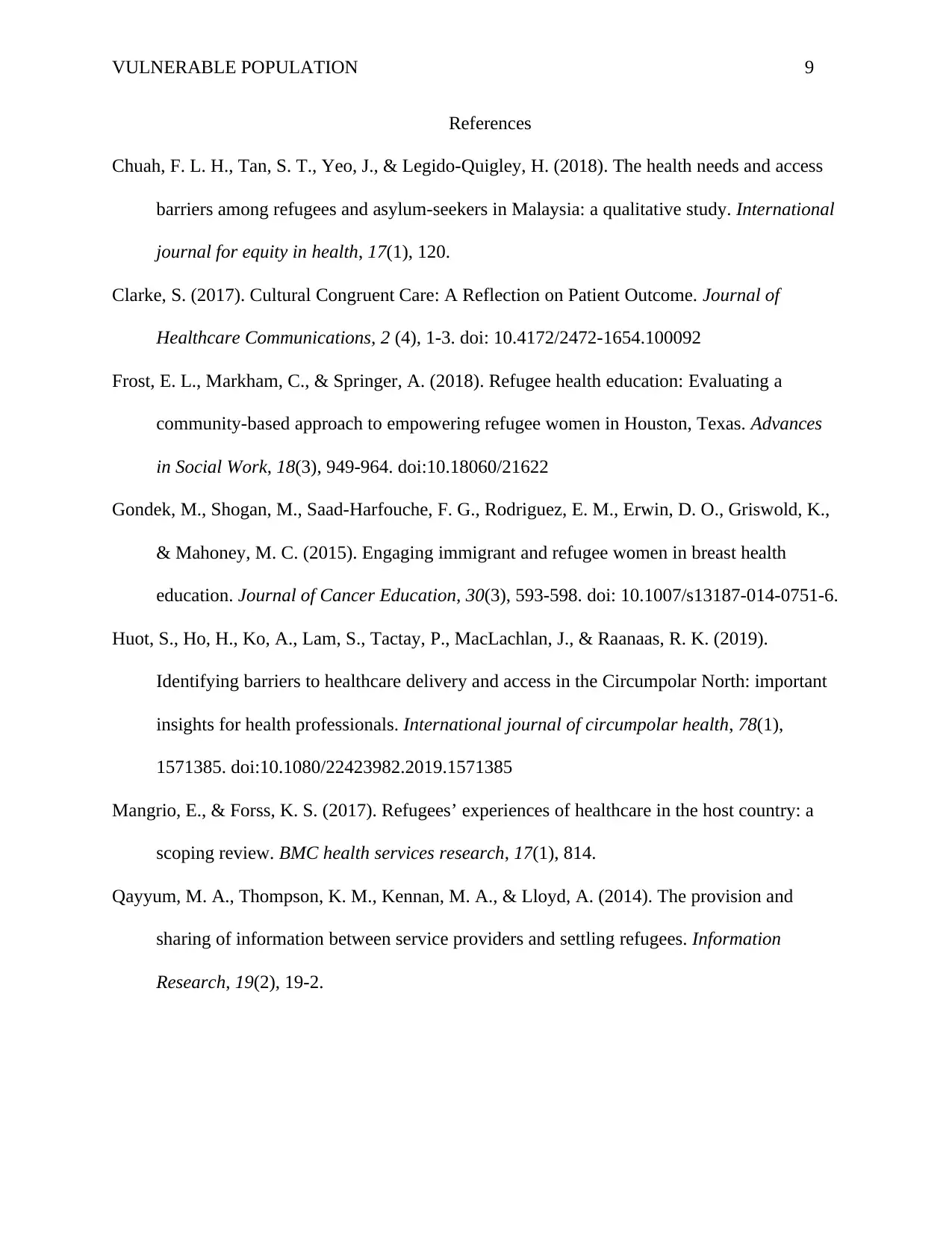
Chuah, F. L. H., Tan, S. T., Yeo, J., & Legido-Quigley, H. (2018). The health needs and access
barriers among refugees and asylum-seekers in Malaysia: a qualitative study. International
journal for equity in health, 17(1), 120.
Clarke, S. (2017). Cultural Congruent Care: A Reflection on Patient Outcome. Journal of
Healthcare Communications, 2 (4), 1-3. doi: 10.4172/2472-1654.100092
Frost, E. L., Markham, C., & Springer, A. (2018). Refugee health education: Evaluating a
community-based approach to empowering refugee women in Houston, Texas. Advances
in Social Work, 18(3), 949-964. doi:10.18060/21622
Gondek, M., Shogan, M., Saad-Harfouche, F. G., Rodriguez, E. M., Erwin, D. O., Griswold, K.,
& Mahoney, M. C. (2015). Engaging immigrant and refugee women in breast health
education. Journal of Cancer Education, 30(3), 593-598. doi: 10.1007/s13187-014-0751-6.
Huot, S., Ho, H., Ko, A., Lam, S., Tactay, P., MacLachlan, J., & Raanaas, R. K. (2019).
Identifying barriers to healthcare delivery and access in the Circumpolar North: important
insights for health professionals. International journal of circumpolar health, 78(1),
1571385. doi:10.1080/22423982.2019.1571385
Mangrio, E., & Forss, K. S. (2017). Refugees’ experiences of healthcare in the host country: a
scoping review. BMC health services research, 17(1), 814.
Qayyum, M. A., Thompson, K. M., Kennan, M. A., & Lloyd, A. (2014). The provision and
sharing of information between service providers and settling refugees. Information
Research, 19(2), 19-2.
References
Chuah, F. L. H., Tan, S. T., Yeo, J., & Legido-Quigley, H. (2018). The health needs and access
barriers among refugees and asylum-seekers in Malaysia: a qualitative study. International
journal for equity in health, 17(1), 120.
Clarke, S. (2017). Cultural Congruent Care: A Reflection on Patient Outcome. Journal of
Healthcare Communications, 2 (4), 1-3. doi: 10.4172/2472-1654.100092
Frost, E. L., Markham, C., & Springer, A. (2018). Refugee health education: Evaluating a
community-based approach to empowering refugee women in Houston, Texas. Advances
in Social Work, 18(3), 949-964. doi:10.18060/21622
Gondek, M., Shogan, M., Saad-Harfouche, F. G., Rodriguez, E. M., Erwin, D. O., Griswold, K.,
& Mahoney, M. C. (2015). Engaging immigrant and refugee women in breast health
education. Journal of Cancer Education, 30(3), 593-598. doi: 10.1007/s13187-014-0751-6.
Huot, S., Ho, H., Ko, A., Lam, S., Tactay, P., MacLachlan, J., & Raanaas, R. K. (2019).
Identifying barriers to healthcare delivery and access in the Circumpolar North: important
insights for health professionals. International journal of circumpolar health, 78(1),
1571385. doi:10.1080/22423982.2019.1571385
Mangrio, E., & Forss, K. S. (2017). Refugees’ experiences of healthcare in the host country: a
scoping review. BMC health services research, 17(1), 814.
Qayyum, M. A., Thompson, K. M., Kennan, M. A., & Lloyd, A. (2014). The provision and
sharing of information between service providers and settling refugees. Information
Research, 19(2), 19-2.
⊘ This is a preview!⊘
Do you want full access?
Subscribe today to unlock all pages.
Trusted by 1+ million students worldwide
VULNERABLE POPULATION 10
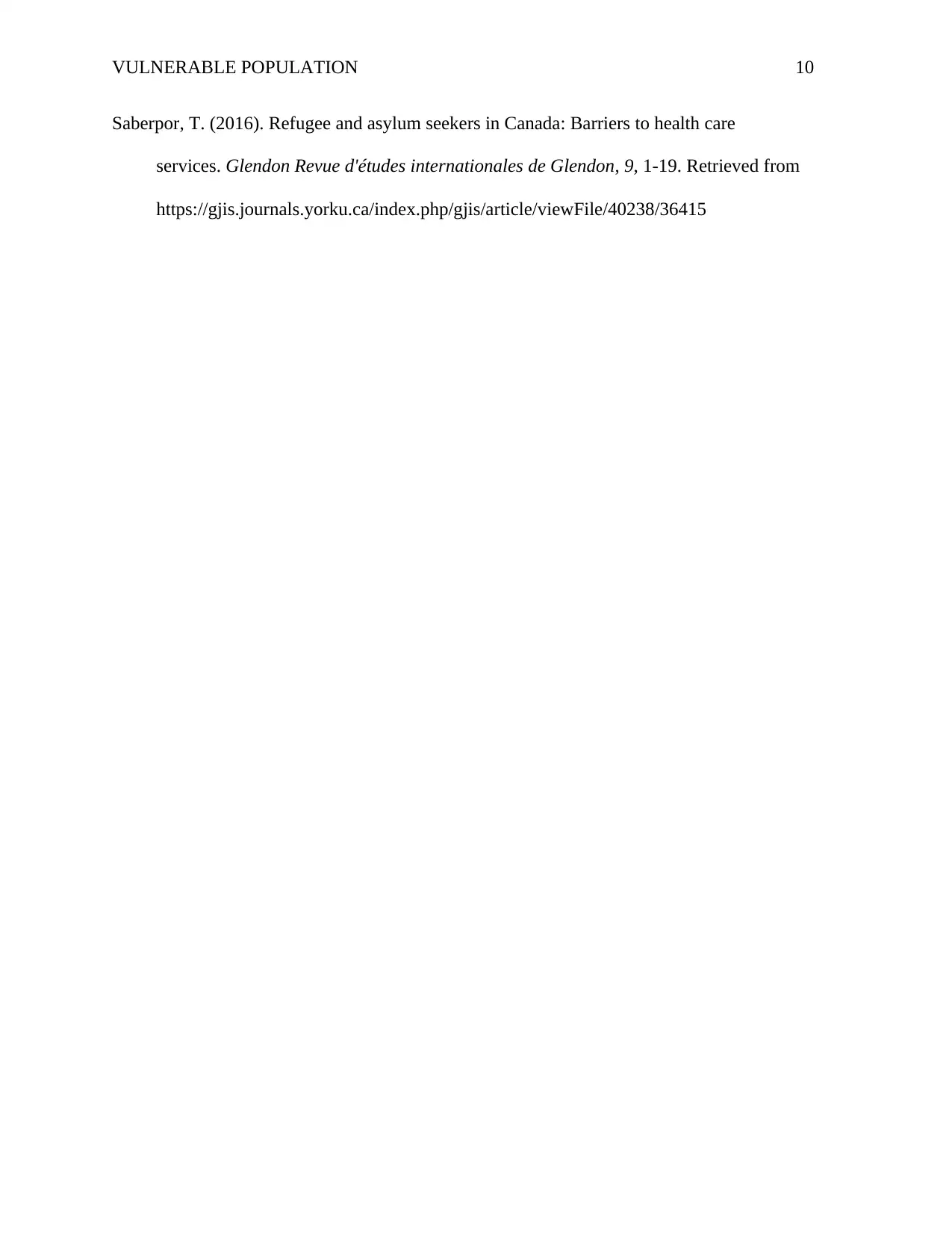
Saberpor, T. (2016). Refugee and asylum seekers in Canada: Barriers to health care
services. Glendon Revue d'études internationales de Glendon, 9, 1-19. Retrieved from
https://gjis.journals.yorku.ca/index.php/gjis/article/viewFile/40238/36415
Saberpor, T. (2016). Refugee and asylum seekers in Canada: Barriers to health care
services. Glendon Revue d'études internationales de Glendon, 9, 1-19. Retrieved from
https://gjis.journals.yorku.ca/index.php/gjis/article/viewFile/40238/36415

1 out of 10


Your All-in-One AI-Powered Toolkit for Academic Success.
+13062052269
info@desklib.com
Available 24*7 on WhatsApp / Email
![[object Object]](/_next/static/media/star-bottom.7253800d.svg)
Unlock your academic potential
Copyright © 2020–2026 A2Z Services. All Rights Reserved. Developed and managed by ZUCOL.