Regional Analysis: Canada's Economic Landscape and Regional Growth
VerifiedAdded on 2022/10/31
|10
|2627
|253
Essay
AI Summary
This essay provides a regional analysis of Canada's economic landscape, examining the impacts of resource exploration and development across different provinces. The analysis begins with a discussion of the Arctic region, focusing on the potential economic and environmental consequences of oil and gas exploration in Nunavut, considering impacts on local culture and subsistence farming. The essay then explores economic growth opportunities in Atlantic Canada, highlighting the potential of mega-projects and the importance of infrastructure development and business innovation. Finally, the analysis shifts to Western Canada, examining the economic contributions of various provinces, particularly British Columbia, and discussing the factors that contribute to a region being classified as a core region. The essay emphasizes the interplay of natural resources, technological advancements, and economic diversification in shaping Canada's regional economies.
Running Head: REGIONAL ANALYSIS 1
Title
Author’s name
Institutional affiliation
Title
Author’s name
Institutional affiliation

Paraphrase This Document
Need a fresh take? Get an instant paraphrase of this document with our AI Paraphraser
REGIONAL ANALYSIS 2
Regional Analysis
Question 1
Many refer to the Arctic as the final frontiers of gas and oil exploration (Niels Vestergaard,
2018). According to the United States Geological Survey, the region is estimated to have the
capability of holding approximately 160 billion crude oil barrels. The region is a habitat to the
northernmost permanent settlers around the world. It is expected that any exploration should
bring major changes within an environment especially by economically impacting the
environment. The case is different with Nunavut. The extraction of resources would not
primarily benefit the area. Benefits are realized after the resources have been refined and sold to
the market at a profitable price. Individuals inhabiting the South are assumed to be the direct
benefactors of the exploration that is to take place. Those at the North might also benefit
indirectly.
The Nunavut is commonly known for carrying out subsistence farming. The inhabitants have
been practicing the activity for several centuries ago. Oil and gas exploration are viewed as a
threat to the practice. There will be great interferences on the migration routes that are being
taken by the different species of the marine mammal Inuit, a species that defines the subsistence
farming being done on the area. Despite the exploration being a source of employment and wage
creation for the inhabitants, it is expected to interfere with the previously established balance in
the community. The global movement has been on the forefront to cut down the degree of global
warming being experienced. However, oil and gas exploration are working against the
movement's aim and is expected that after the exploration the degrees of global warming might
double. Fossil fuels are also viewed as a hazard to the environment (Kirsten Heimann, 2016).
The awareness levels are high to cut down the dependence on the fuel. However, the oil and gas
Regional Analysis
Question 1
Many refer to the Arctic as the final frontiers of gas and oil exploration (Niels Vestergaard,
2018). According to the United States Geological Survey, the region is estimated to have the
capability of holding approximately 160 billion crude oil barrels. The region is a habitat to the
northernmost permanent settlers around the world. It is expected that any exploration should
bring major changes within an environment especially by economically impacting the
environment. The case is different with Nunavut. The extraction of resources would not
primarily benefit the area. Benefits are realized after the resources have been refined and sold to
the market at a profitable price. Individuals inhabiting the South are assumed to be the direct
benefactors of the exploration that is to take place. Those at the North might also benefit
indirectly.
The Nunavut is commonly known for carrying out subsistence farming. The inhabitants have
been practicing the activity for several centuries ago. Oil and gas exploration are viewed as a
threat to the practice. There will be great interferences on the migration routes that are being
taken by the different species of the marine mammal Inuit, a species that defines the subsistence
farming being done on the area. Despite the exploration being a source of employment and wage
creation for the inhabitants, it is expected to interfere with the previously established balance in
the community. The global movement has been on the forefront to cut down the degree of global
warming being experienced. However, oil and gas exploration are working against the
movement's aim and is expected that after the exploration the degrees of global warming might
double. Fossil fuels are also viewed as a hazard to the environment (Kirsten Heimann, 2016).
The awareness levels are high to cut down the dependence on the fuel. However, the oil and gas
REGIONAL ANALYSIS 3
exploration would work to the opposite end by increasing the dependence of individuals on fossil
fuels. Hence, having negative environmental consequences.
Culture is primarily seeing with the lifestyle. The inhabitants of the Nunavut community are
primarily hunters (Heike Greschke, 2014). They hunt for animals that serve as their source of
food. The oil and gas exploration is expected to kick off with a series of seismic waves being
done before bringing down the different technologies to facilitate the drilling process. It is
expected that the harsh sounds made in the testing stage by the seismic activities will interfere
with the mammals. As a result, there will be significant interference with the hunting activity.
Many perceive the situation as the onset of the lack of food within the area. The ocean is also a
significant hunting ground for the inhabitants. The individuals spend time on the ocean both for
recreation and hunting activities. They expect the place to be clean and comforting for one to be
free from any harmful ailments. However, the oil and gas exploration are expected to result in oil
spills at the water beds. There is no equipment to facilitate the cleanup process. Chances are that
the area will be ignored and the culture interfered.
Question 2
Economic growth calls for one to be opportunistic of every chance that comes their way. Atlantic
Canada is to experience mega projects planned for the area (Merrow, 2011). The projects are
expected to come along with vast supply chain opportunities. The opportunities are a source of
business that will later impact the economical state of the area. The individuals in Canada have
to be aware of such opportunities that are to arise and have to be ready to keep up with the
rigorous demands coming with the projects. Readiness should be the guiding principle for the
level of preparedness that is needed. The projects are to be done by multinational companies.
The companies uphold excellence and have high expectations for the people living in Atlantic
exploration would work to the opposite end by increasing the dependence of individuals on fossil
fuels. Hence, having negative environmental consequences.
Culture is primarily seeing with the lifestyle. The inhabitants of the Nunavut community are
primarily hunters (Heike Greschke, 2014). They hunt for animals that serve as their source of
food. The oil and gas exploration is expected to kick off with a series of seismic waves being
done before bringing down the different technologies to facilitate the drilling process. It is
expected that the harsh sounds made in the testing stage by the seismic activities will interfere
with the mammals. As a result, there will be significant interference with the hunting activity.
Many perceive the situation as the onset of the lack of food within the area. The ocean is also a
significant hunting ground for the inhabitants. The individuals spend time on the ocean both for
recreation and hunting activities. They expect the place to be clean and comforting for one to be
free from any harmful ailments. However, the oil and gas exploration are expected to result in oil
spills at the water beds. There is no equipment to facilitate the cleanup process. Chances are that
the area will be ignored and the culture interfered.
Question 2
Economic growth calls for one to be opportunistic of every chance that comes their way. Atlantic
Canada is to experience mega projects planned for the area (Merrow, 2011). The projects are
expected to come along with vast supply chain opportunities. The opportunities are a source of
business that will later impact the economical state of the area. The individuals in Canada have
to be aware of such opportunities that are to arise and have to be ready to keep up with the
rigorous demands coming with the projects. Readiness should be the guiding principle for the
level of preparedness that is needed. The projects are to be done by multinational companies.
The companies uphold excellence and have high expectations for the people living in Atlantic
⊘ This is a preview!⊘
Do you want full access?
Subscribe today to unlock all pages.

Trusted by 1+ million students worldwide
REGIONAL ANALYSIS 4
Canada. Significant economic growth will be realized if the inhabitants will be ready for the
work and uphold the working principles that lead to being excellent. Newfoundland and
Labrador have been dominating the project's activity in the region and their dominance is
expected to progress for a significant period. The companies are taking up the supply chain
service provider roles, opportunities that have seen them bring major development to the
province. The latest being the development deal they reached with the Hebron partners. The
partnership will give the province a 4.9% equity stake approximately equal to $20 billion in
royalties in addition to payment of revenues through the time that the project will be alive.
Greenland and Baffin are expected to have potential resource-related mega projects. The
maturation period of the project is to be considered however, Atlantic Canada has to prepare
adequately before the project gets to mature. The preparation will boost the economic advantage
the province will gain from the project. The Arctic project works are highly seasonal. Support of
hub ports is highly needed. Atlantic Canada has to be in a position to take up the opportunity and
be ready to offer the support excellently. There is a need to get better infrastructure being done in
the area. The megaprojects will need housing and the infrastructure, a significant source of
finances for the province boosting its economical state. (Joan Nymand Larsen, 2015).
Apart from making use of the opportunities that come with the mega projects, the government
has to also embrace different plans that will ensure the economy of the province gets to be
vibrant. There is a need to foster greater business innovation. There are several small firms that
when scaled up, they will impact the economy substantially. The government has to support the
scaling-up process in addition to supporting the transfer of technology to the area. Supporting the
generation of breakthrough ideas in various areas of specialization has also to be done. Some of
the common areas that need such support include bioscience and ocean technology. The degree
Canada. Significant economic growth will be realized if the inhabitants will be ready for the
work and uphold the working principles that lead to being excellent. Newfoundland and
Labrador have been dominating the project's activity in the region and their dominance is
expected to progress for a significant period. The companies are taking up the supply chain
service provider roles, opportunities that have seen them bring major development to the
province. The latest being the development deal they reached with the Hebron partners. The
partnership will give the province a 4.9% equity stake approximately equal to $20 billion in
royalties in addition to payment of revenues through the time that the project will be alive.
Greenland and Baffin are expected to have potential resource-related mega projects. The
maturation period of the project is to be considered however, Atlantic Canada has to prepare
adequately before the project gets to mature. The preparation will boost the economic advantage
the province will gain from the project. The Arctic project works are highly seasonal. Support of
hub ports is highly needed. Atlantic Canada has to be in a position to take up the opportunity and
be ready to offer the support excellently. There is a need to get better infrastructure being done in
the area. The megaprojects will need housing and the infrastructure, a significant source of
finances for the province boosting its economical state. (Joan Nymand Larsen, 2015).
Apart from making use of the opportunities that come with the mega projects, the government
has to also embrace different plans that will ensure the economy of the province gets to be
vibrant. There is a need to foster greater business innovation. There are several small firms that
when scaled up, they will impact the economy substantially. The government has to support the
scaling-up process in addition to supporting the transfer of technology to the area. Supporting the
generation of breakthrough ideas in various areas of specialization has also to be done. Some of
the common areas that need such support include bioscience and ocean technology. The degree
Paraphrase This Document
Need a fresh take? Get an instant paraphrase of this document with our AI Paraphraser
REGIONAL ANALYSIS 5
of creating clean jobs has to increase (Yülek, 2014). Supporting innovations that allow for the
transition to a low carbon economy will also boost the economic performance of the region.
Question 3
Western Canada is jointly made up of four western provinces namely Manitoba, Alberta. British
Columbia and Saskatchewan (Liesbet Hooghe, 2016). The province shares jointly a contribution
to the country’s economy by approximately 35%. The Canadian Regions have grown vastly
following the influence of the west. Natural resources are the primary driver of the development
being experienced. There has been heavy investment being done on the oil sands of Alberta
which was a substantial boost to the economy. Most employees come from McMurray. The
country’s government coffers have received billions of dollars from the region. Saskatchewan
has also boosted the performance of western Canada considerably. In addition to investing in
natural resources, the province also invested in the farmland. The natural resource developments
that were successfully implemented include the potash, uranium and shale oil. The area has a
significant dependence on the pricing of oil. The result was Western Canada’s economy became
vulnerable to the prices for oil and several other commodities. British Columbia is one of the
provinces in Western Canada. However, the province has grown so fast to the point of exceeding
the general performance of Western Canada. Previously, British Columbia was dominated by
natural resources a case that significantly changed (Rees, 2017). The area is infested with a
diverse industrial and service economy. Forestry and mining industries are some of the major
industries that can be noticed all over the area. The same is also seen with the construction
industries. Technology is rapidly growing, telecommunication being the centerpiece. Tourism
has not been left behind. It has been a considerable source of revenue for British Columbia
following the vast natural beauty. The Rocky Mountains, the lengthy coastlines and sweeping
of creating clean jobs has to increase (Yülek, 2014). Supporting innovations that allow for the
transition to a low carbon economy will also boost the economic performance of the region.
Question 3
Western Canada is jointly made up of four western provinces namely Manitoba, Alberta. British
Columbia and Saskatchewan (Liesbet Hooghe, 2016). The province shares jointly a contribution
to the country’s economy by approximately 35%. The Canadian Regions have grown vastly
following the influence of the west. Natural resources are the primary driver of the development
being experienced. There has been heavy investment being done on the oil sands of Alberta
which was a substantial boost to the economy. Most employees come from McMurray. The
country’s government coffers have received billions of dollars from the region. Saskatchewan
has also boosted the performance of western Canada considerably. In addition to investing in
natural resources, the province also invested in the farmland. The natural resource developments
that were successfully implemented include the potash, uranium and shale oil. The area has a
significant dependence on the pricing of oil. The result was Western Canada’s economy became
vulnerable to the prices for oil and several other commodities. British Columbia is one of the
provinces in Western Canada. However, the province has grown so fast to the point of exceeding
the general performance of Western Canada. Previously, British Columbia was dominated by
natural resources a case that significantly changed (Rees, 2017). The area is infested with a
diverse industrial and service economy. Forestry and mining industries are some of the major
industries that can be noticed all over the area. The same is also seen with the construction
industries. Technology is rapidly growing, telecommunication being the centerpiece. Tourism
has not been left behind. It has been a considerable source of revenue for British Columbia
following the vast natural beauty. The Rocky Mountains, the lengthy coastlines and sweeping
REGIONAL ANALYSIS 6
area of protected greenspace are great contributors to the beauty being experienced in the area.
The fishing industry has proliferated in the province, characterizing the place as one with the
largest fishing industry in Canada. The cattle and dairy farm operations are also sizeable,
activities contributing to the economy of the area. The lighting in the region is excellent. It is the
third-largest generator of hydroelectric power and the second-largest producer of gas.
Vancouver, an area with a significant number of residents, has become a service center that is
gradually flourishing (Barry, 2012). If one has to find a job in Canada, locating British Columbia
and seeking a working place from there would be beneficial for many. The excellent economic
performance led to unemployment rate drop by approximately 6.1%. The new jobs are created
primarily in the service and technological sectors. Agriculture in western Canada has undergone
massive transformation, especially with the rise in technologies in the industry and the increasing
available market. As a result, most dividends in Western Canada can be paid with the profits
arising from agricultural practice. The Forest Industry has advanced significantly in the use of
technology. Chances of the nation engaging in errors are dropping citing the high levels of
accuracy. The province has risen to be a primary merchant of timber within the region, resulting
in the industry being a major source of income for the province.
Question 4
British Columbia will be classified as a core region in Canada. Before a place is classified as a
core region, several factors are always assessed. British Columbia borders the Pacific Ocean and
forms one of the best aesthetic sites along the ocean where one can find time and relax (Gregory
R. Pohl, 2015). It should be noted that despite the region inhabiting a considerable number of
individuals approximating to 4.6 million, the beauty of the place has been sustained for an
extended period. The region also harbors the third-largest city in Canada, Vancouver. The city
area of protected greenspace are great contributors to the beauty being experienced in the area.
The fishing industry has proliferated in the province, characterizing the place as one with the
largest fishing industry in Canada. The cattle and dairy farm operations are also sizeable,
activities contributing to the economy of the area. The lighting in the region is excellent. It is the
third-largest generator of hydroelectric power and the second-largest producer of gas.
Vancouver, an area with a significant number of residents, has become a service center that is
gradually flourishing (Barry, 2012). If one has to find a job in Canada, locating British Columbia
and seeking a working place from there would be beneficial for many. The excellent economic
performance led to unemployment rate drop by approximately 6.1%. The new jobs are created
primarily in the service and technological sectors. Agriculture in western Canada has undergone
massive transformation, especially with the rise in technologies in the industry and the increasing
available market. As a result, most dividends in Western Canada can be paid with the profits
arising from agricultural practice. The Forest Industry has advanced significantly in the use of
technology. Chances of the nation engaging in errors are dropping citing the high levels of
accuracy. The province has risen to be a primary merchant of timber within the region, resulting
in the industry being a major source of income for the province.
Question 4
British Columbia will be classified as a core region in Canada. Before a place is classified as a
core region, several factors are always assessed. British Columbia borders the Pacific Ocean and
forms one of the best aesthetic sites along the ocean where one can find time and relax (Gregory
R. Pohl, 2015). It should be noted that despite the region inhabiting a considerable number of
individuals approximating to 4.6 million, the beauty of the place has been sustained for an
extended period. The region also harbors the third-largest city in Canada, Vancouver. The city
⊘ This is a preview!⊘
Do you want full access?
Subscribe today to unlock all pages.
Trusted by 1+ million students worldwide
REGIONAL ANALYSIS 7
has people from different parts of the world, the Chinese community being the vibrant
population in the city. The result is that a vibrant multicultural atmosphere is created around
British Columbia contributing to it being a core region in Canada. The quality of life in British
has consistently been excellent, the result is that newcomers are always destined to the place
every other year.
The economy is a significant influence in making a region being ranked as core or periphery (M.
Davide Parrilli, 2017). Previously, British Columbia has been identified with natural resources,
an analogy that has gradually changed over time. The region has experienced intensive
diversification as it is now infested with the service and industrial economy. The construction
was ranked as an important industry in the region, the industries have also doubled and currently,
there are both mining and forestry industries in the region. Tourism has also been proliferating, a
factor that will influence its classification as being core in the next 25 years. The fish industry is
growing every other day. It is expected in 25 years time, the industry will be ranked as one of the
best-performing fish industries in Canada.
The standard of living in Vancouver can be rated as high especially with Vancouver being
consistently ranked as the top city that one can live and work. Continued observation of such
exemplary performance will lead to the city attaining a ranking as core in few years to come. The
economic opportunity offered to the migrants in the region is great. The immigrants have a
significant support network as they find their way out to attain stability. The result will be
immigrants will strive to utilize any economic opportunity being offered. The region will benefit
at the end of the day. The earnings are excellent and it is expected that there will be minimal
suffering atmosphere being experienced. Great benefits are also realized following the kind of
housing system being embraced. The housing demand is slightly more expensive compared to
has people from different parts of the world, the Chinese community being the vibrant
population in the city. The result is that a vibrant multicultural atmosphere is created around
British Columbia contributing to it being a core region in Canada. The quality of life in British
has consistently been excellent, the result is that newcomers are always destined to the place
every other year.
The economy is a significant influence in making a region being ranked as core or periphery (M.
Davide Parrilli, 2017). Previously, British Columbia has been identified with natural resources,
an analogy that has gradually changed over time. The region has experienced intensive
diversification as it is now infested with the service and industrial economy. The construction
was ranked as an important industry in the region, the industries have also doubled and currently,
there are both mining and forestry industries in the region. Tourism has also been proliferating, a
factor that will influence its classification as being core in the next 25 years. The fish industry is
growing every other day. It is expected in 25 years time, the industry will be ranked as one of the
best-performing fish industries in Canada.
The standard of living in Vancouver can be rated as high especially with Vancouver being
consistently ranked as the top city that one can live and work. Continued observation of such
exemplary performance will lead to the city attaining a ranking as core in few years to come. The
economic opportunity offered to the migrants in the region is great. The immigrants have a
significant support network as they find their way out to attain stability. The result will be
immigrants will strive to utilize any economic opportunity being offered. The region will benefit
at the end of the day. The earnings are excellent and it is expected that there will be minimal
suffering atmosphere being experienced. Great benefits are also realized following the kind of
housing system being embraced. The housing demand is slightly more expensive compared to
Paraphrase This Document
Need a fresh take? Get an instant paraphrase of this document with our AI Paraphraser
REGIONAL ANALYSIS 8
other regions in Canada influencing a higher income. The houses are also fully occupied, openly
telling that the area is a potential source of business (Sanghmitra S. Acharya, 2016).
The education system will also influence if a place will be categorized as being the core or
periphery. In 25 years time, British Columbia will be characterized as being core citing the
continued establishment if globally renown research Universities. The public-school system
offers free education to all primary children and permanent residents below the age of 20. Such
an established education system will enable many to be excellent with their working.
other regions in Canada influencing a higher income. The houses are also fully occupied, openly
telling that the area is a potential source of business (Sanghmitra S. Acharya, 2016).
The education system will also influence if a place will be categorized as being the core or
periphery. In 25 years time, British Columbia will be characterized as being core citing the
continued establishment if globally renown research Universities. The public-school system
offers free education to all primary children and permanent residents below the age of 20. Such
an established education system will enable many to be excellent with their working.
REGIONAL ANALYSIS 9
References
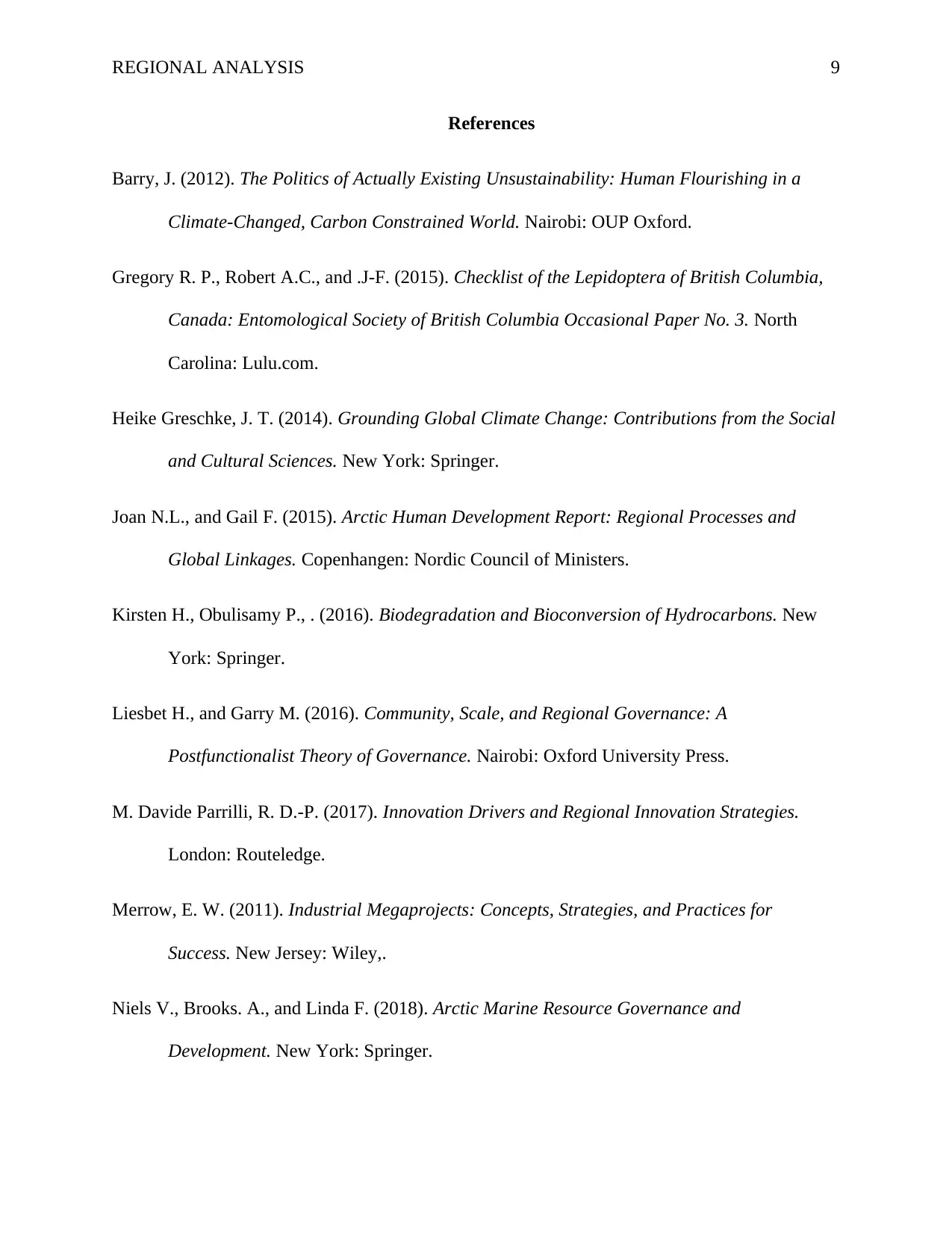
Barry, J. (2012). The Politics of Actually Existing Unsustainability: Human Flourishing in a
Climate-Changed, Carbon Constrained World. Nairobi: OUP Oxford.
Gregory R. P., Robert A.C., and .J-F. (2015). Checklist of the Lepidoptera of British Columbia,
Canada: Entomological Society of British Columbia Occasional Paper No. 3. North
Carolina: Lulu.com.
Heike Greschke, J. T. (2014). Grounding Global Climate Change: Contributions from the Social
and Cultural Sciences. New York: Springer.
Joan N.L., and Gail F. (2015). Arctic Human Development Report: Regional Processes and
Global Linkages. Copenhangen: Nordic Council of Ministers.
Kirsten H., Obulisamy P., . (2016). Biodegradation and Bioconversion of Hydrocarbons. New
York: Springer.
Liesbet H., and Garry M. (2016). Community, Scale, and Regional Governance: A
Postfunctionalist Theory of Governance. Nairobi: Oxford University Press.
M. Davide Parrilli, R. D.-P. (2017). Innovation Drivers and Regional Innovation Strategies.
London: Routeledge.
Merrow, E. W. (2011). Industrial Megaprojects: Concepts, Strategies, and Practices for
Success. New Jersey: Wiley,.
Niels V., Brooks. A., and Linda F. (2018). Arctic Marine Resource Governance and
Development. New York: Springer.
References
Barry, J. (2012). The Politics of Actually Existing Unsustainability: Human Flourishing in a
Climate-Changed, Carbon Constrained World. Nairobi: OUP Oxford.
Gregory R. P., Robert A.C., and .J-F. (2015). Checklist of the Lepidoptera of British Columbia,
Canada: Entomological Society of British Columbia Occasional Paper No. 3. North
Carolina: Lulu.com.
Heike Greschke, J. T. (2014). Grounding Global Climate Change: Contributions from the Social
and Cultural Sciences. New York: Springer.
Joan N.L., and Gail F. (2015). Arctic Human Development Report: Regional Processes and
Global Linkages. Copenhangen: Nordic Council of Ministers.
Kirsten H., Obulisamy P., . (2016). Biodegradation and Bioconversion of Hydrocarbons. New
York: Springer.
Liesbet H., and Garry M. (2016). Community, Scale, and Regional Governance: A
Postfunctionalist Theory of Governance. Nairobi: Oxford University Press.
M. Davide Parrilli, R. D.-P. (2017). Innovation Drivers and Regional Innovation Strategies.
London: Routeledge.
Merrow, E. W. (2011). Industrial Megaprojects: Concepts, Strategies, and Practices for
Success. New Jersey: Wiley,.
Niels V., Brooks. A., and Linda F. (2018). Arctic Marine Resource Governance and
Development. New York: Springer.
⊘ This is a preview!⊘
Do you want full access?
Subscribe today to unlock all pages.
Trusted by 1+ million students worldwide
REGIONAL ANALYSIS 10
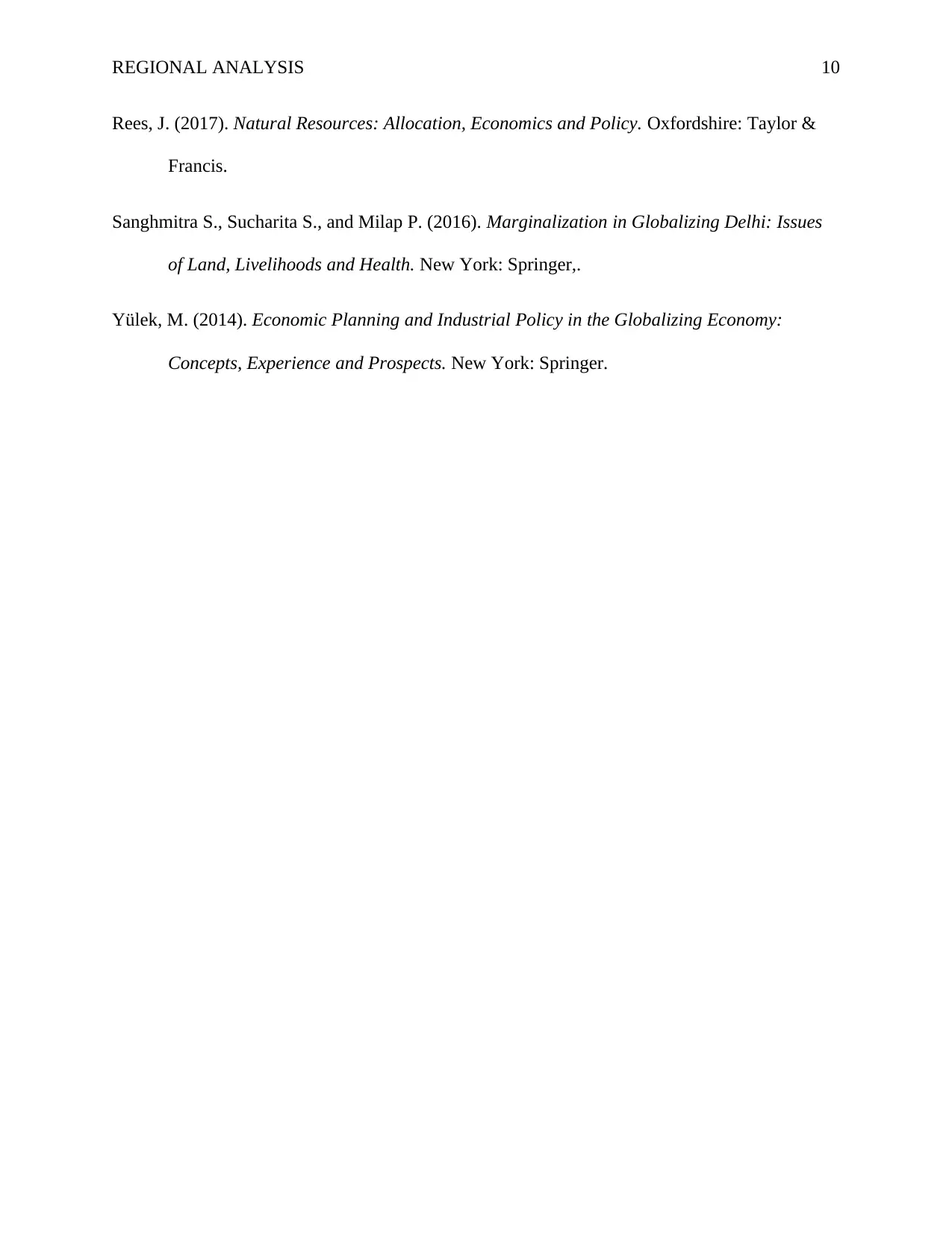
Rees, J. (2017). Natural Resources: Allocation, Economics and Policy. Oxfordshire: Taylor &
Francis.
Sanghmitra S., Sucharita S., and Milap P. (2016). Marginalization in Globalizing Delhi: Issues
of Land, Livelihoods and Health. New York: Springer,.
Yülek, M. (2014). Economic Planning and Industrial Policy in the Globalizing Economy:
Concepts, Experience and Prospects. New York: Springer.
Rees, J. (2017). Natural Resources: Allocation, Economics and Policy. Oxfordshire: Taylor &
Francis.
Sanghmitra S., Sucharita S., and Milap P. (2016). Marginalization in Globalizing Delhi: Issues
of Land, Livelihoods and Health. New York: Springer,.
Yülek, M. (2014). Economic Planning and Industrial Policy in the Globalizing Economy:
Concepts, Experience and Prospects. New York: Springer.

1 out of 10


Your All-in-One AI-Powered Toolkit for Academic Success.
+13062052269
info@desklib.com
Available 24*7 on WhatsApp / Email
![[object Object]](/_next/static/media/star-bottom.7253800d.svg)
Unlock your academic potential
Copyright © 2020–2026 A2Z Services. All Rights Reserved. Developed and managed by ZUCOL.