An Analysis of the Registered Nurse Safe Staffing Act of 2015
VerifiedAdded on 2021/05/30
|10
|3174
|62
Report
AI Summary
This report analyzes the Registered Nurse Safe Staffing Act of 2015, addressing the critical issue of hospital understaffing and its impact on patient care. It examines the problem context, highlighting the negative outcomes associated with inadequate nurse-to-patient ratios, such as increased mortality and complications. The report delves into the policy's framing, process, and the stakeholders involved, including nurses, patients, providers, and employers. It explores the policy solutions implemented to ensure optimal nursing care, such as mandated staffing plans and nurse staffing committees. The analysis also considers the competing interests among stakeholders and the policy's potential effectiveness in improving healthcare quality and patient outcomes. The report emphasizes the importance of the policy in addressing nursing shortages and promoting a safer working environment for nurses while ensuring quality health services. The report also explores the policy's impact on various stakeholders, including patients, nurses, employers, and the broader healthcare system, and its potential to enhance healthcare quality and patient satisfaction.
Health Advocacy And Policy1
Health Advocacy and Policy
By Name
Course
Instructor
Institution
Location
Date
Health Advocacy and Policy
By Name
Course
Instructor
Institution
Location
Date

Paraphrase This Document
Need a fresh take? Get an instant paraphrase of this document with our AI Paraphraser
Health Advocacy And Policy2
Health Advocacy and Policy
Introduction
The experience and education of nursing practitioners have to be made a priority in order
to guarantee quality and safe health care of patients in our country. The rate of negative patient
outcomes tends to increase in the hospital with inadequate staffing. The decrease in nursing has
the potential of several negative outcomes such as shock, urinary tract infections, cardiac arrest
and pneumonia. These negative outcomes made the state legislature to come up with staffing
policy that will ensure hospital have adequate staffing. The problem of understaffing is not only
affecting the patients but also the nurses delivering services to the patients. This essay is going to
discuss and analyze The Registered Nurse Safe Act of 2015 concerning the problem concept, the
policy framing and process, policy solutions as well as its effectiveness. Health policies are very
important and they should be implemented effectively to ensure the health of all citizens is
guaranteed.
A. Problem Context
Staffing of hospitals has been a major problem experienced by both state and federal
government. Nurses play a very critical role in ensuring quality health care is delivered to the
patient and most of the hospitals in the country were understaffed by the year 2015. This posed a
very big problem that the policy intended to solve and ensure quality and effective health welfare
of the citizens. The policy has concentrated on the problem of increasing the number of nursing
in hospitals but it has overlooked the shortage of doctors and other health officers in these
hospitals. The doctors, nurses and other health practitioners have to work together and for the
hospitals to achieve quality healthcare targets. The policy, therefore, concentrated on the nurse
Health Advocacy and Policy
Introduction
The experience and education of nursing practitioners have to be made a priority in order
to guarantee quality and safe health care of patients in our country. The rate of negative patient
outcomes tends to increase in the hospital with inadequate staffing. The decrease in nursing has
the potential of several negative outcomes such as shock, urinary tract infections, cardiac arrest
and pneumonia. These negative outcomes made the state legislature to come up with staffing
policy that will ensure hospital have adequate staffing. The problem of understaffing is not only
affecting the patients but also the nurses delivering services to the patients. This essay is going to
discuss and analyze The Registered Nurse Safe Act of 2015 concerning the problem concept, the
policy framing and process, policy solutions as well as its effectiveness. Health policies are very
important and they should be implemented effectively to ensure the health of all citizens is
guaranteed.
A. Problem Context
Staffing of hospitals has been a major problem experienced by both state and federal
government. Nurses play a very critical role in ensuring quality health care is delivered to the
patient and most of the hospitals in the country were understaffed by the year 2015. This posed a
very big problem that the policy intended to solve and ensure quality and effective health welfare
of the citizens. The policy has concentrated on the problem of increasing the number of nursing
in hospitals but it has overlooked the shortage of doctors and other health officers in these
hospitals. The doctors, nurses and other health practitioners have to work together and for the
hospitals to achieve quality healthcare targets. The policy, therefore, concentrated on the nurse
Health Advocacy And Policy3
shortage and ignored other health problems including adequate medical equipment and drugs as
well as good information management in these hospitals. The highlighted problem of
understaffing of nurses has taken the center stage of this policy due to the potential problems it
could bring in the health sector. The implementation of this policy was aiming at eliminating the
problems that are caused by the understaffing of nurses in hospitals so as to improve the quality
of health services offered in hospitals all over the nation.
B. Framing
The Registered Nurse Safe Staffing Act of 2015 was announced in 29th of April the year
2015. The policy is an amendment of the XVIII of the Social Security Act and it ensures all the
hospitals participating in Medicare are implementing a staffing plan (Tortorice, 2013). The
policy imposes that hospitals should an appropriate number of registered nurses in each shift and
each unit to provide direct patient care. The staffing levels in the hospitals should addresses
certain factors such as the hospital units, the unique characteristics of patients and the delivery of
quality, safe and consistent healthcare are required in the health standards. The policy requires a
nurse staffing committee to be established by all the participating hospitals. The committee will
be responsible for ensuring this policy is implemented and deal with the civil monetary
consequences that may arise due to the violation of this policy.
The phrases and word mostly used in this policy include the nurse, patients, quality and
safe patient care. These phrases and words show that the policy meanly resolves around patients
healthcare and the role of the nurses in ensuring health care services are efficient. The underlying
assumption behind the word nurse in this policy it has been used to represent all the other health
practitioners such as clinical officers and laboratory technicians excluding the medical doctors.
The staffing of all these medical officers is also very important in achieving the efficient patient
shortage and ignored other health problems including adequate medical equipment and drugs as
well as good information management in these hospitals. The highlighted problem of
understaffing of nurses has taken the center stage of this policy due to the potential problems it
could bring in the health sector. The implementation of this policy was aiming at eliminating the
problems that are caused by the understaffing of nurses in hospitals so as to improve the quality
of health services offered in hospitals all over the nation.
B. Framing
The Registered Nurse Safe Staffing Act of 2015 was announced in 29th of April the year
2015. The policy is an amendment of the XVIII of the Social Security Act and it ensures all the
hospitals participating in Medicare are implementing a staffing plan (Tortorice, 2013). The
policy imposes that hospitals should an appropriate number of registered nurses in each shift and
each unit to provide direct patient care. The staffing levels in the hospitals should addresses
certain factors such as the hospital units, the unique characteristics of patients and the delivery of
quality, safe and consistent healthcare are required in the health standards. The policy requires a
nurse staffing committee to be established by all the participating hospitals. The committee will
be responsible for ensuring this policy is implemented and deal with the civil monetary
consequences that may arise due to the violation of this policy.
The phrases and word mostly used in this policy include the nurse, patients, quality and
safe patient care. These phrases and words show that the policy meanly resolves around patients
healthcare and the role of the nurses in ensuring health care services are efficient. The underlying
assumption behind the word nurse in this policy it has been used to represent all the other health
practitioners such as clinical officers and laboratory technicians excluding the medical doctors.
The staffing of all these medical officers is also very important in achieving the efficient patient
⊘ This is a preview!⊘
Do you want full access?
Subscribe today to unlock all pages.

Trusted by 1+ million students worldwide
Health Advocacy And Policy4
care in the participating hospitals. The framing of this policy has identified various stakeholders
that are closely affected by the formation and implementation of the policy. Lois Capps is the
person who sponsored this legislation (Fowler and Comeaux,, 2017). Ten co-sponsors from
around seven states and only one was a Republican while the rest were Democrats. The Congress
subcommittee on health was involved in going through the legislation and gave their
recommendations. The policy applies to all the social groups in the country and this implies the
policy will ensure equality. The rich have the financial ability to go to private hospitals and
receive the best health services and the policy ensures that the average citizen going to a
federally managed hospital can also get quality health care.
There are moral judgments expressed in this policy. The Registered Nurse Safe Staffing
Act does not just concentrate on the number of nurses in the hospitals but also looks at the code
of ethical conduct and the professionalism of the nurses. The policy requires that the nurses meet
certain moral standards as they offer health care services to their patients.
C. Policy Process
The development of this policy involved various stakeholders before it was fully
formulated. Lois Capps sponsored the bill and it was introduced on the 29th of April 2015 to the
House Ways and Means and on 1st of May the same year it was presented to the Subcommittee
on Health. The American Nurses Associations (ANA) were also involved and they made several
recommendations to the legislation (American Nurses Association, 2015, p15). Some of the
recommendations they made include professional certification, RN education and clinical
experience. ANA also recommended on the whistleblower protection and public reporting of
stuffing information done by the hospitals.
care in the participating hospitals. The framing of this policy has identified various stakeholders
that are closely affected by the formation and implementation of the policy. Lois Capps is the
person who sponsored this legislation (Fowler and Comeaux,, 2017). Ten co-sponsors from
around seven states and only one was a Republican while the rest were Democrats. The Congress
subcommittee on health was involved in going through the legislation and gave their
recommendations. The policy applies to all the social groups in the country and this implies the
policy will ensure equality. The rich have the financial ability to go to private hospitals and
receive the best health services and the policy ensures that the average citizen going to a
federally managed hospital can also get quality health care.
There are moral judgments expressed in this policy. The Registered Nurse Safe Staffing
Act does not just concentrate on the number of nurses in the hospitals but also looks at the code
of ethical conduct and the professionalism of the nurses. The policy requires that the nurses meet
certain moral standards as they offer health care services to their patients.
C. Policy Process
The development of this policy involved various stakeholders before it was fully
formulated. Lois Capps sponsored the bill and it was introduced on the 29th of April 2015 to the
House Ways and Means and on 1st of May the same year it was presented to the Subcommittee
on Health. The American Nurses Associations (ANA) were also involved and they made several
recommendations to the legislation (American Nurses Association, 2015, p15). Some of the
recommendations they made include professional certification, RN education and clinical
experience. ANA also recommended on the whistleblower protection and public reporting of
stuffing information done by the hospitals.
Paraphrase This Document
Need a fresh take? Get an instant paraphrase of this document with our AI Paraphraser
Health Advocacy And Policy5
The main stakeholders involved were four. First, the providers, who have the perception of
nursing in terms of quality and accurate diagnosis and efficient healthcare that will ensure
positive outcomes are obtained. The second stakeholders are the taxpayers whose main concern
is to receive a cost-effective medical care. The third stakeholder considered in this policy is the
employers. The employers who are to ensure they do the staffing of nurses have to control costs
and the quality of healthcare at the same time. The fourth stakeholder in this policy is the patients
who require positive outcomes, compassion and quality care provided to them at an affordable
cost.
The policy mainly represented the interests of the patients and the nurses in America. The
patients are the main concern in this policy since the main aim of the policy is to ensure that
patients receive quality health care services from the nurses. The full implementation of this
policy ensures that the patients receive these quality health care services at an affordable cost.
Customers' satisfaction has been outlined and the patients are provided with complaint
framework to channel their dissatisfaction to the appropriate personnel in the event that they
have not received services as per the expected standards. The nurses' interests have also been
presented in this policy since the policy outlines the favorable working conditions they are
supposed to be provided to ensure that they are able to provide the quality care to their patients.
For instance, according to the policy, the nurses would not be forced to work in units they did not
train for without prior orientation and they are also offered the whistleblower protection. The
ratio of nurses to patients is expected to be high so that they will give close attention to their
patients.
There several competing ideas and interests among the stakeholders involved in the
development of the Registered Nurse Safe Staffing Act. The patients presume their employer to
The main stakeholders involved were four. First, the providers, who have the perception of
nursing in terms of quality and accurate diagnosis and efficient healthcare that will ensure
positive outcomes are obtained. The second stakeholders are the taxpayers whose main concern
is to receive a cost-effective medical care. The third stakeholder considered in this policy is the
employers. The employers who are to ensure they do the staffing of nurses have to control costs
and the quality of healthcare at the same time. The fourth stakeholder in this policy is the patients
who require positive outcomes, compassion and quality care provided to them at an affordable
cost.
The policy mainly represented the interests of the patients and the nurses in America. The
patients are the main concern in this policy since the main aim of the policy is to ensure that
patients receive quality health care services from the nurses. The full implementation of this
policy ensures that the patients receive these quality health care services at an affordable cost.
Customers' satisfaction has been outlined and the patients are provided with complaint
framework to channel their dissatisfaction to the appropriate personnel in the event that they
have not received services as per the expected standards. The nurses' interests have also been
presented in this policy since the policy outlines the favorable working conditions they are
supposed to be provided to ensure that they are able to provide the quality care to their patients.
For instance, according to the policy, the nurses would not be forced to work in units they did not
train for without prior orientation and they are also offered the whistleblower protection. The
ratio of nurses to patients is expected to be high so that they will give close attention to their
patients.
There several competing ideas and interests among the stakeholders involved in the
development of the Registered Nurse Safe Staffing Act. The patients presume their employer to
Health Advocacy And Policy6
give them a health cover having various options that are customizable as per the patients' specific
needs. The patients also expect their employer to finance a large part of their health insurance
covers. The conflict of interest comes in where the providers have to use the treatment tests and
technology to provide quality preventive care to the patients but the payers are expecting to
receive this at a low cost. Therefore, the providers have to compromise cost for quality
healthcare and they are left bearing the risk of huge losses. The patients also want the providers
to follow a clear diagnostic plan that reaches an accurate diagnosis and treatment with a
minimum number of tests and fewest visits at the hospital. There is also a complicit of interest
since the employers always want to lower their operating costs and increasing the number of
nurses in their hospitals is going to cause a rise in the funds they spend in paying the nurses. The
employers want the patients to pursue needed care and follow the instructions of the provider.
The employers would always think that they are being confined in a tough situation by this
policy.
‘The rule of the game' in the health industry is to always ensure the balance between
economic factors and the various social issues related to health care. As much as the providers
and the employers may have economic concerns that the policy is likely to raise, they will have
to accept their specified obligations. The quality of healthcare is a social issue that has to be
considered irrespective of the potential economic disadvantages it might bring to the other
stakeholders. The policy is also trying to tackle the issues of equal opportunities to quality
healthcare for the various social classes in the country. Like in any other business, customer
satisfaction is very crucial thus the same applies for patients' satisfaction in receiving good health
care services. The employers have to ensure they meet the nurse staffing requirements as
specified in the policy or they face the risk of being charge very huge monetary fines. The
give them a health cover having various options that are customizable as per the patients' specific
needs. The patients also expect their employer to finance a large part of their health insurance
covers. The conflict of interest comes in where the providers have to use the treatment tests and
technology to provide quality preventive care to the patients but the payers are expecting to
receive this at a low cost. Therefore, the providers have to compromise cost for quality
healthcare and they are left bearing the risk of huge losses. The patients also want the providers
to follow a clear diagnostic plan that reaches an accurate diagnosis and treatment with a
minimum number of tests and fewest visits at the hospital. There is also a complicit of interest
since the employers always want to lower their operating costs and increasing the number of
nurses in their hospitals is going to cause a rise in the funds they spend in paying the nurses. The
employers want the patients to pursue needed care and follow the instructions of the provider.
The employers would always think that they are being confined in a tough situation by this
policy.
‘The rule of the game' in the health industry is to always ensure the balance between
economic factors and the various social issues related to health care. As much as the providers
and the employers may have economic concerns that the policy is likely to raise, they will have
to accept their specified obligations. The quality of healthcare is a social issue that has to be
considered irrespective of the potential economic disadvantages it might bring to the other
stakeholders. The policy is also trying to tackle the issues of equal opportunities to quality
healthcare for the various social classes in the country. Like in any other business, customer
satisfaction is very crucial thus the same applies for patients' satisfaction in receiving good health
care services. The employers have to ensure they meet the nurse staffing requirements as
specified in the policy or they face the risk of being charge very huge monetary fines. The
⊘ This is a preview!⊘
Do you want full access?
Subscribe today to unlock all pages.
Trusted by 1+ million students worldwide
Health Advocacy And Policy7
providers and employers have no option but comply with the regulations or their certifications
for operating may be revoked.
Health care has always been given priority by both the state and federal government year
in year out and this gives the bill an opportunity window to be developed and be enacted as a
law. The Registered Nurse Safe Staffing Act policy has brought a very critical issue to the
attention of the Congress for so long. The nursing shortage has been highlighted and this requires
legislators, governments, hospitals and CEOs to work together and ensure that this problem
facing the healthcare services is solved amicably. The nurse per patient ratio, quality of patient
care, unsafe working environment and job burnout has been seen as issues that require collective
responsibility from various sectors (Cho et al, 2016, p 210). The policy is likely to be
implemented due to the high priority attached to the problem of nurse understaffing in the
country.
D. Policy Solutions.
The policy is putting up solutions to the address the problem of poor health care services
that is caused by the shortage of nurses in hospitals. The main aim of the policy is to provide the
various requirements that will ensure optimal nursing care for patients (Buchan et al, 2015, p
165). In October 2002 the Journal of the American Medical Association published a study that
cited high patient to nurse ratio to be the leading cause of nurse dissatisfaction with their jobs as
well as the increase in patient mortality rates in US hospitals. The study was done across 168
hospitals and it concentrated on the data of more than 230000 surgical patients. The study found
out that the increase in a single patient in the existing patient to nurse ratio has the potential of
increasing the mortality rate by 7 % and the job dissatisfaction of the nurse by a 15% increase.
The problem of the increased mortality rate caused by the insufficiency of nurses is further
providers and employers have no option but comply with the regulations or their certifications
for operating may be revoked.
Health care has always been given priority by both the state and federal government year
in year out and this gives the bill an opportunity window to be developed and be enacted as a
law. The Registered Nurse Safe Staffing Act policy has brought a very critical issue to the
attention of the Congress for so long. The nursing shortage has been highlighted and this requires
legislators, governments, hospitals and CEOs to work together and ensure that this problem
facing the healthcare services is solved amicably. The nurse per patient ratio, quality of patient
care, unsafe working environment and job burnout has been seen as issues that require collective
responsibility from various sectors (Cho et al, 2016, p 210). The policy is likely to be
implemented due to the high priority attached to the problem of nurse understaffing in the
country.
D. Policy Solutions.
The policy is putting up solutions to the address the problem of poor health care services
that is caused by the shortage of nurses in hospitals. The main aim of the policy is to provide the
various requirements that will ensure optimal nursing care for patients (Buchan et al, 2015, p
165). In October 2002 the Journal of the American Medical Association published a study that
cited high patient to nurse ratio to be the leading cause of nurse dissatisfaction with their jobs as
well as the increase in patient mortality rates in US hospitals. The study was done across 168
hospitals and it concentrated on the data of more than 230000 surgical patients. The study found
out that the increase in a single patient in the existing patient to nurse ratio has the potential of
increasing the mortality rate by 7 % and the job dissatisfaction of the nurse by a 15% increase.
The problem of the increased mortality rate caused by the insufficiency of nurses is further
Paraphrase This Document
Need a fresh take? Get an instant paraphrase of this document with our AI Paraphraser
Health Advocacy And Policy8
worsened by the potential of several negative outcomes such as shock, urinary tract infections,
cardiac arrest and pneumonia.
The policy has outlined the standards service providers and employers in the hospital
sector have to meet to ensure that patients receive quality healthcare services from the nurses.
The available nurses in the hospitals have been forced to work for long hours and serve very
many patients and this compromises the quality of service delivered to the patients (Dellefield et
al, 2015). The policy also gives guidelines concerning the education and experience of the nurses
to guarantee that the satisfied nurses have the required skills that will facilitate quality service
delivery to their patients. The policy requires hospitals to have an elaborate complaint handling
framework for handling the dissatisfaction of their patients as a way to ensure that the quality of
service delivered is according to the standards. The policy is solving the problem by ensuring
that the number of nurses is enough too and they are also given a good working environment that
promotes quality delivery of healthcare services. The hospitals are expected to give periodic
public reporting of staffing information including the patient to nurse ratio and this ensures the
regulations are met. The monetary implications imposed for violating this policy also ensure that
the participating hospitals put an effort to ensure they operate according to the given standards.
There are also alternative solutions that will ensure quality healthcare service delivery to
patients that the policy has overlooked. Improvement of the medical equipment and drugs in the
hospitals will also ensure that the hospitals deliver efficient healthcare services to patients.
Technology and new innovations in medicine should have been employed to dry and solve the
nursing shortages experienced in hospitals. Proper information management in the hospitals is
also an alternative solution to facilitate the delivery of quality services to patients
worsened by the potential of several negative outcomes such as shock, urinary tract infections,
cardiac arrest and pneumonia.
The policy has outlined the standards service providers and employers in the hospital
sector have to meet to ensure that patients receive quality healthcare services from the nurses.
The available nurses in the hospitals have been forced to work for long hours and serve very
many patients and this compromises the quality of service delivered to the patients (Dellefield et
al, 2015). The policy also gives guidelines concerning the education and experience of the nurses
to guarantee that the satisfied nurses have the required skills that will facilitate quality service
delivery to their patients. The policy requires hospitals to have an elaborate complaint handling
framework for handling the dissatisfaction of their patients as a way to ensure that the quality of
service delivered is according to the standards. The policy is solving the problem by ensuring
that the number of nurses is enough too and they are also given a good working environment that
promotes quality delivery of healthcare services. The hospitals are expected to give periodic
public reporting of staffing information including the patient to nurse ratio and this ensures the
regulations are met. The monetary implications imposed for violating this policy also ensure that
the participating hospitals put an effort to ensure they operate according to the given standards.
There are also alternative solutions that will ensure quality healthcare service delivery to
patients that the policy has overlooked. Improvement of the medical equipment and drugs in the
hospitals will also ensure that the hospitals deliver efficient healthcare services to patients.
Technology and new innovations in medicine should have been employed to dry and solve the
nursing shortages experienced in hospitals. Proper information management in the hospitals is
also an alternative solution to facilitate the delivery of quality services to patients
Health Advocacy And Policy9
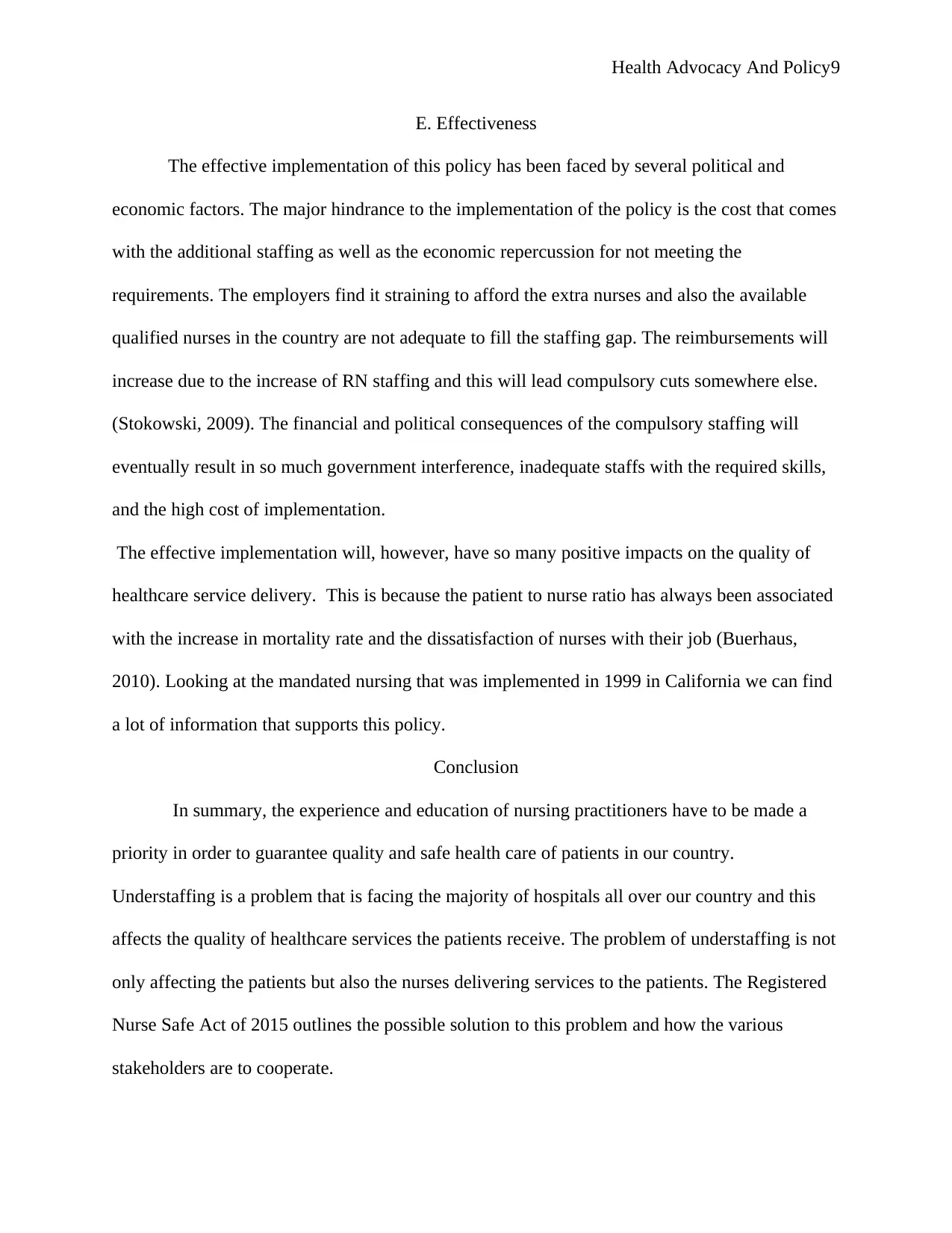
E. Effectiveness
The effective implementation of this policy has been faced by several political and
economic factors. The major hindrance to the implementation of the policy is the cost that comes
with the additional staffing as well as the economic repercussion for not meeting the
requirements. The employers find it straining to afford the extra nurses and also the available
qualified nurses in the country are not adequate to fill the staffing gap. The reimbursements will
increase due to the increase of RN staffing and this will lead compulsory cuts somewhere else.
(Stokowski, 2009). The financial and political consequences of the compulsory staffing will
eventually result in so much government interference, inadequate staffs with the required skills,
and the high cost of implementation.
The effective implementation will, however, have so many positive impacts on the quality of
healthcare service delivery. This is because the patient to nurse ratio has always been associated
with the increase in mortality rate and the dissatisfaction of nurses with their job (Buerhaus,
2010). Looking at the mandated nursing that was implemented in 1999 in California we can find
a lot of information that supports this policy.
Conclusion
In summary, the experience and education of nursing practitioners have to be made a
priority in order to guarantee quality and safe health care of patients in our country.
Understaffing is a problem that is facing the majority of hospitals all over our country and this
affects the quality of healthcare services the patients receive. The problem of understaffing is not
only affecting the patients but also the nurses delivering services to the patients. The Registered
Nurse Safe Act of 2015 outlines the possible solution to this problem and how the various
stakeholders are to cooperate.
E. Effectiveness
The effective implementation of this policy has been faced by several political and
economic factors. The major hindrance to the implementation of the policy is the cost that comes
with the additional staffing as well as the economic repercussion for not meeting the
requirements. The employers find it straining to afford the extra nurses and also the available
qualified nurses in the country are not adequate to fill the staffing gap. The reimbursements will
increase due to the increase of RN staffing and this will lead compulsory cuts somewhere else.
(Stokowski, 2009). The financial and political consequences of the compulsory staffing will
eventually result in so much government interference, inadequate staffs with the required skills,
and the high cost of implementation.
The effective implementation will, however, have so many positive impacts on the quality of
healthcare service delivery. This is because the patient to nurse ratio has always been associated
with the increase in mortality rate and the dissatisfaction of nurses with their job (Buerhaus,
2010). Looking at the mandated nursing that was implemented in 1999 in California we can find
a lot of information that supports this policy.
Conclusion
In summary, the experience and education of nursing practitioners have to be made a
priority in order to guarantee quality and safe health care of patients in our country.
Understaffing is a problem that is facing the majority of hospitals all over our country and this
affects the quality of healthcare services the patients receive. The problem of understaffing is not
only affecting the patients but also the nurses delivering services to the patients. The Registered
Nurse Safe Act of 2015 outlines the possible solution to this problem and how the various
stakeholders are to cooperate.
⊘ This is a preview!⊘
Do you want full access?
Subscribe today to unlock all pages.
Trusted by 1+ million students worldwide
Health Advocacy And Policy10
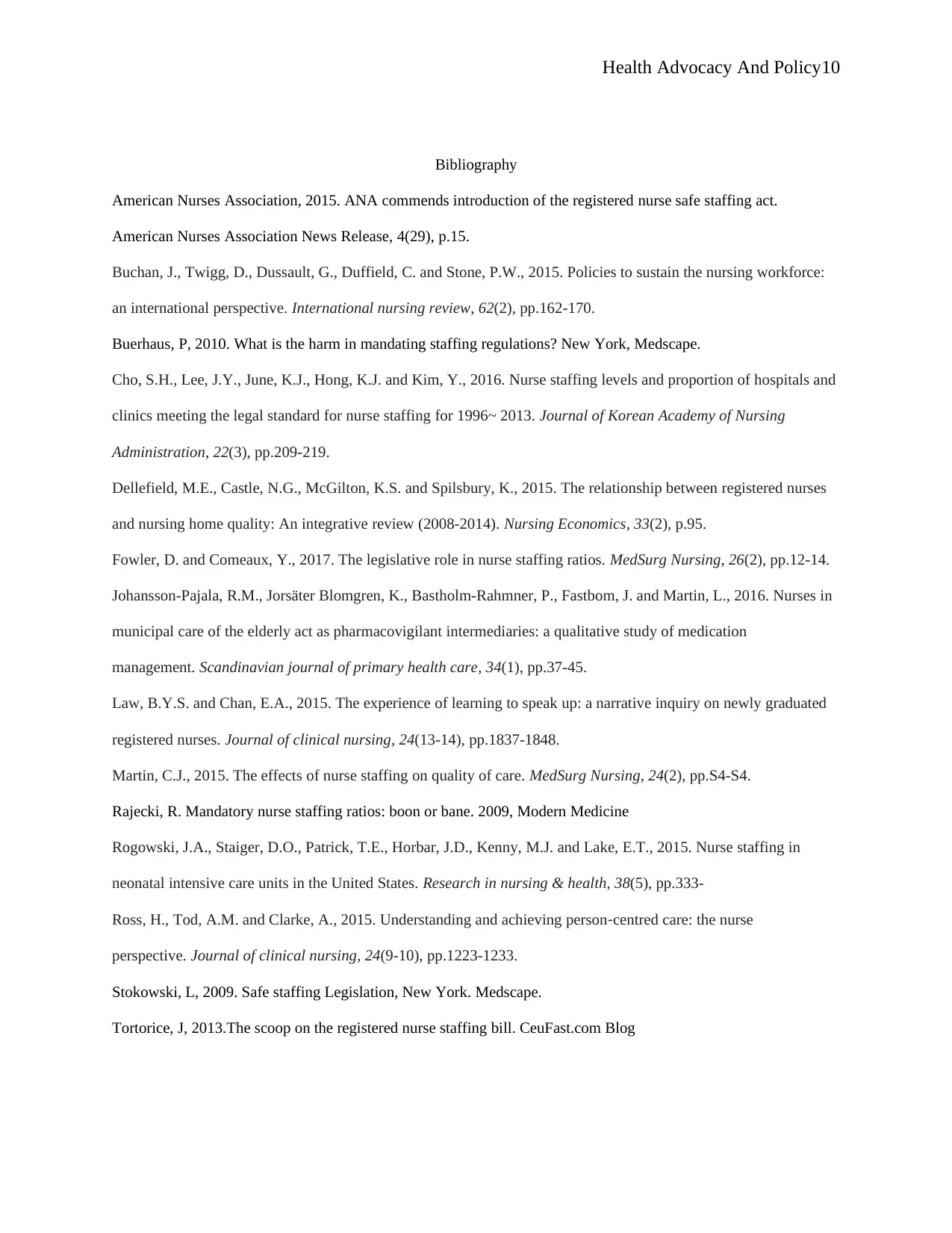
Bibliography
American Nurses Association, 2015. ANA commends introduction of the registered nurse safe staffing act.
American Nurses Association News Release, 4(29), p.15.
Buchan, J., Twigg, D., Dussault, G., Duffield, C. and Stone, P.W., 2015. Policies to sustain the nursing workforce:
an international perspective. International nursing review, 62(2), pp.162-170.
Buerhaus, P, 2010. What is the harm in mandating staffing regulations? New York, Medscape.
Cho, S.H., Lee, J.Y., June, K.J., Hong, K.J. and Kim, Y., 2016. Nurse staffing levels and proportion of hospitals and
clinics meeting the legal standard for nurse staffing for 1996~ 2013. Journal of Korean Academy of Nursing
Administration, 22(3), pp.209-219.
Dellefield, M.E., Castle, N.G., McGilton, K.S. and Spilsbury, K., 2015. The relationship between registered nurses
and nursing home quality: An integrative review (2008-2014). Nursing Economics, 33(2), p.95.
Fowler, D. and Comeaux, Y., 2017. The legislative role in nurse staffing ratios. MedSurg Nursing, 26(2), pp.12-14.
Johansson-Pajala, R.M., Jorsäter Blomgren, K., Bastholm-Rahmner, P., Fastbom, J. and Martin, L., 2016. Nurses in
municipal care of the elderly act as pharmacovigilant intermediaries: a qualitative study of medication
management. Scandinavian journal of primary health care, 34(1), pp.37-45.
Law, B.Y.S. and Chan, E.A., 2015. The experience of learning to speak up: a narrative inquiry on newly graduated
registered nurses. Journal of clinical nursing, 24(13-14), pp.1837-1848.
Martin, C.J., 2015. The effects of nurse staffing on quality of care. MedSurg Nursing, 24(2), pp.S4-S4.
Rajecki, R. Mandatory nurse staffing ratios: boon or bane. 2009, Modern Medicine
Rogowski, J.A., Staiger, D.O., Patrick, T.E., Horbar, J.D., Kenny, M.J. and Lake, E.T., 2015. Nurse staffing in
neonatal intensive care units in the United States. Research in nursing & health, 38(5), pp.333-
Ross, H., Tod, A.M. and Clarke, A., 2015. Understanding and achieving person‐centred care: the nurse
perspective. Journal of clinical nursing, 24(9-10), pp.1223-1233.
Stokowski, L, 2009. Safe staffing Legislation, New York. Medscape.
Tortorice, J, 2013.The scoop on the registered nurse staffing bill. CeuFast.com Blog
Bibliography
American Nurses Association, 2015. ANA commends introduction of the registered nurse safe staffing act.
American Nurses Association News Release, 4(29), p.15.
Buchan, J., Twigg, D., Dussault, G., Duffield, C. and Stone, P.W., 2015. Policies to sustain the nursing workforce:
an international perspective. International nursing review, 62(2), pp.162-170.
Buerhaus, P, 2010. What is the harm in mandating staffing regulations? New York, Medscape.
Cho, S.H., Lee, J.Y., June, K.J., Hong, K.J. and Kim, Y., 2016. Nurse staffing levels and proportion of hospitals and
clinics meeting the legal standard for nurse staffing for 1996~ 2013. Journal of Korean Academy of Nursing
Administration, 22(3), pp.209-219.
Dellefield, M.E., Castle, N.G., McGilton, K.S. and Spilsbury, K., 2015. The relationship between registered nurses
and nursing home quality: An integrative review (2008-2014). Nursing Economics, 33(2), p.95.
Fowler, D. and Comeaux, Y., 2017. The legislative role in nurse staffing ratios. MedSurg Nursing, 26(2), pp.12-14.
Johansson-Pajala, R.M., Jorsäter Blomgren, K., Bastholm-Rahmner, P., Fastbom, J. and Martin, L., 2016. Nurses in
municipal care of the elderly act as pharmacovigilant intermediaries: a qualitative study of medication
management. Scandinavian journal of primary health care, 34(1), pp.37-45.
Law, B.Y.S. and Chan, E.A., 2015. The experience of learning to speak up: a narrative inquiry on newly graduated
registered nurses. Journal of clinical nursing, 24(13-14), pp.1837-1848.
Martin, C.J., 2015. The effects of nurse staffing on quality of care. MedSurg Nursing, 24(2), pp.S4-S4.
Rajecki, R. Mandatory nurse staffing ratios: boon or bane. 2009, Modern Medicine
Rogowski, J.A., Staiger, D.O., Patrick, T.E., Horbar, J.D., Kenny, M.J. and Lake, E.T., 2015. Nurse staffing in
neonatal intensive care units in the United States. Research in nursing & health, 38(5), pp.333-
Ross, H., Tod, A.M. and Clarke, A., 2015. Understanding and achieving person‐centred care: the nurse
perspective. Journal of clinical nursing, 24(9-10), pp.1223-1233.
Stokowski, L, 2009. Safe staffing Legislation, New York. Medscape.
Tortorice, J, 2013.The scoop on the registered nurse staffing bill. CeuFast.com Blog

1 out of 10


Related Documents


Your All-in-One AI-Powered Toolkit for Academic Success.
+13062052269
info@desklib.com
Available 24*7 on WhatsApp / Email
![[object Object]](/_next/static/media/star-bottom.7253800d.svg)
Unlock your academic potential
Copyright © 2020–2026 A2Z Services. All Rights Reserved. Developed and managed by ZUCOL.