Case Study: Registered Nurse, Child Protection Policies, and MRG
VerifiedAdded on 2022/09/16
|9
|2832
|20
Case Study
AI Summary
This case study examines the role of a registered nurse in an emergency department, focusing on the care of a 3-year-old girl named Fiona who presents with a burn injury. The assignment highlights the nurse's responsibilities, including assessing the situation, making a Mandatory Reporter Guide (MRG), and determining if child protection services are required due to potential neglect. The case explores the implementation of child protection policies, the obligations of a registered nurse, and the ethical considerations involved in patient care. It discusses parental factors, such as incarceration, that may pose risks to a child's safety and the importance of strength-based approaches and family engagement. The case study also emphasizes the legal and professional responsibilities of the nurse, including maintaining patient confidentiality, advocating for the patient, and adhering to RN standards of practice and the ICN code of ethics. The nurse is obligated to ensure that child protection policies and legislation are implemented when child abuse or neglect is suspected. The importance of mandatory reporting in this context is also underlined.
Running head: CASE STUDY
CASE STUDY
Name of the Student
Name of the University
Author Note
CASE STUDY
Name of the Student
Name of the University
Author Note

Paraphrase This Document
Need a fresh take? Get an instant paraphrase of this document with our AI Paraphraser
1CASE STUDY
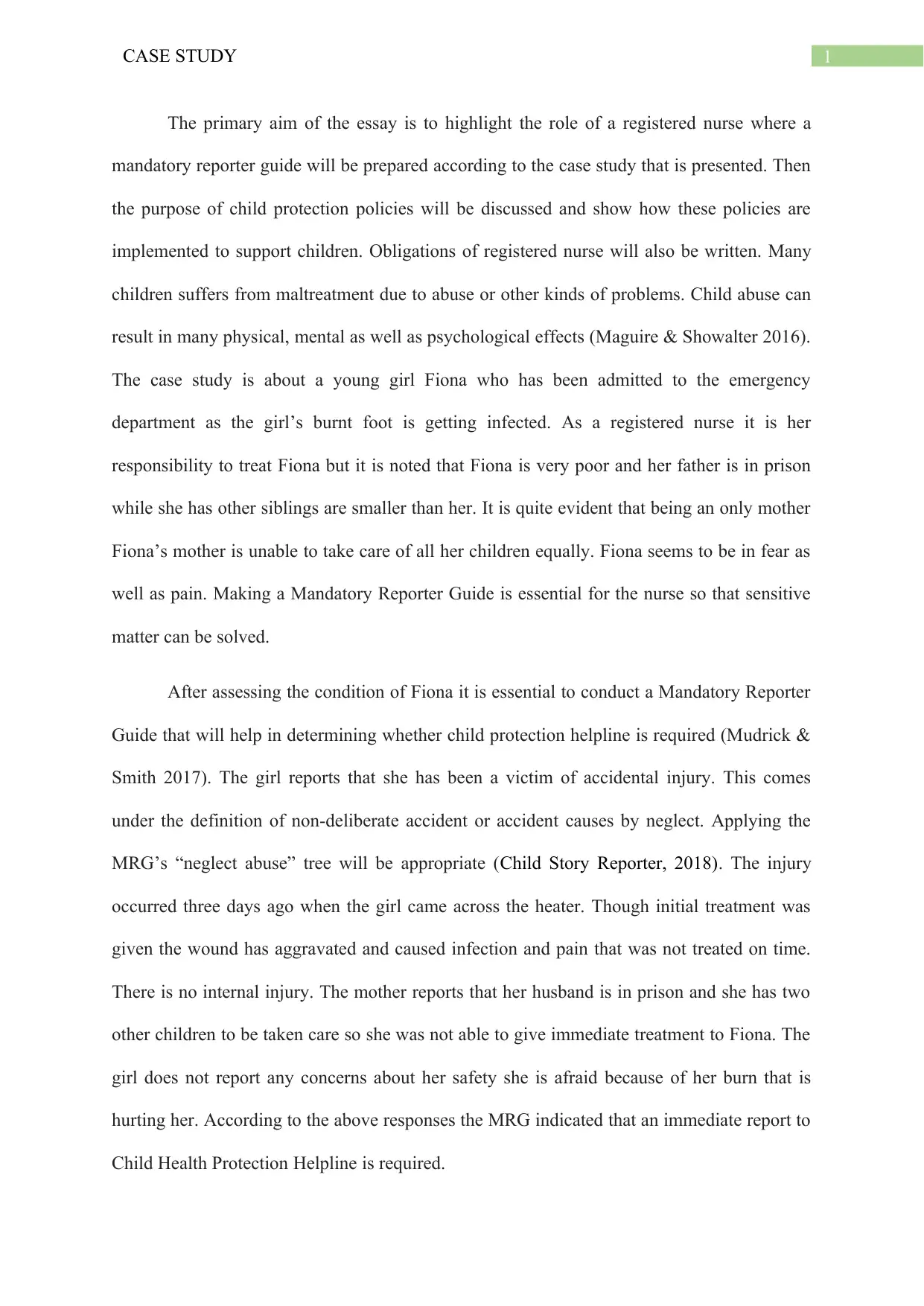
The primary aim of the essay is to highlight the role of a registered nurse where a
mandatory reporter guide will be prepared according to the case study that is presented. Then
the purpose of child protection policies will be discussed and show how these policies are
implemented to support children. Obligations of registered nurse will also be written. Many
children suffers from maltreatment due to abuse or other kinds of problems. Child abuse can
result in many physical, mental as well as psychological effects (Maguire & Showalter 2016).
The case study is about a young girl Fiona who has been admitted to the emergency
department as the girl’s burnt foot is getting infected. As a registered nurse it is her
responsibility to treat Fiona but it is noted that Fiona is very poor and her father is in prison
while she has other siblings are smaller than her. It is quite evident that being an only mother
Fiona’s mother is unable to take care of all her children equally. Fiona seems to be in fear as
well as pain. Making a Mandatory Reporter Guide is essential for the nurse so that sensitive
matter can be solved.
After assessing the condition of Fiona it is essential to conduct a Mandatory Reporter
Guide that will help in determining whether child protection helpline is required (Mudrick &
Smith 2017). The girl reports that she has been a victim of accidental injury. This comes
under the definition of non-deliberate accident or accident causes by neglect. Applying the
MRG’s “neglect abuse” tree will be appropriate (Child Story Reporter, 2018). The injury
occurred three days ago when the girl came across the heater. Though initial treatment was
given the wound has aggravated and caused infection and pain that was not treated on time.
There is no internal injury. The mother reports that her husband is in prison and she has two
other children to be taken care so she was not able to give immediate treatment to Fiona. The
girl does not report any concerns about her safety she is afraid because of her burn that is
hurting her. According to the above responses the MRG indicated that an immediate report to
Child Health Protection Helpline is required.
The primary aim of the essay is to highlight the role of a registered nurse where a
mandatory reporter guide will be prepared according to the case study that is presented. Then
the purpose of child protection policies will be discussed and show how these policies are
implemented to support children. Obligations of registered nurse will also be written. Many
children suffers from maltreatment due to abuse or other kinds of problems. Child abuse can
result in many physical, mental as well as psychological effects (Maguire & Showalter 2016).
The case study is about a young girl Fiona who has been admitted to the emergency
department as the girl’s burnt foot is getting infected. As a registered nurse it is her
responsibility to treat Fiona but it is noted that Fiona is very poor and her father is in prison
while she has other siblings are smaller than her. It is quite evident that being an only mother
Fiona’s mother is unable to take care of all her children equally. Fiona seems to be in fear as
well as pain. Making a Mandatory Reporter Guide is essential for the nurse so that sensitive
matter can be solved.
After assessing the condition of Fiona it is essential to conduct a Mandatory Reporter
Guide that will help in determining whether child protection helpline is required (Mudrick &
Smith 2017). The girl reports that she has been a victim of accidental injury. This comes
under the definition of non-deliberate accident or accident causes by neglect. Applying the
MRG’s “neglect abuse” tree will be appropriate (Child Story Reporter, 2018). The injury
occurred three days ago when the girl came across the heater. Though initial treatment was
given the wound has aggravated and caused infection and pain that was not treated on time.
There is no internal injury. The mother reports that her husband is in prison and she has two
other children to be taken care so she was not able to give immediate treatment to Fiona. The
girl does not report any concerns about her safety she is afraid because of her burn that is
hurting her. According to the above responses the MRG indicated that an immediate report to
Child Health Protection Helpline is required.
2CASE STUDY
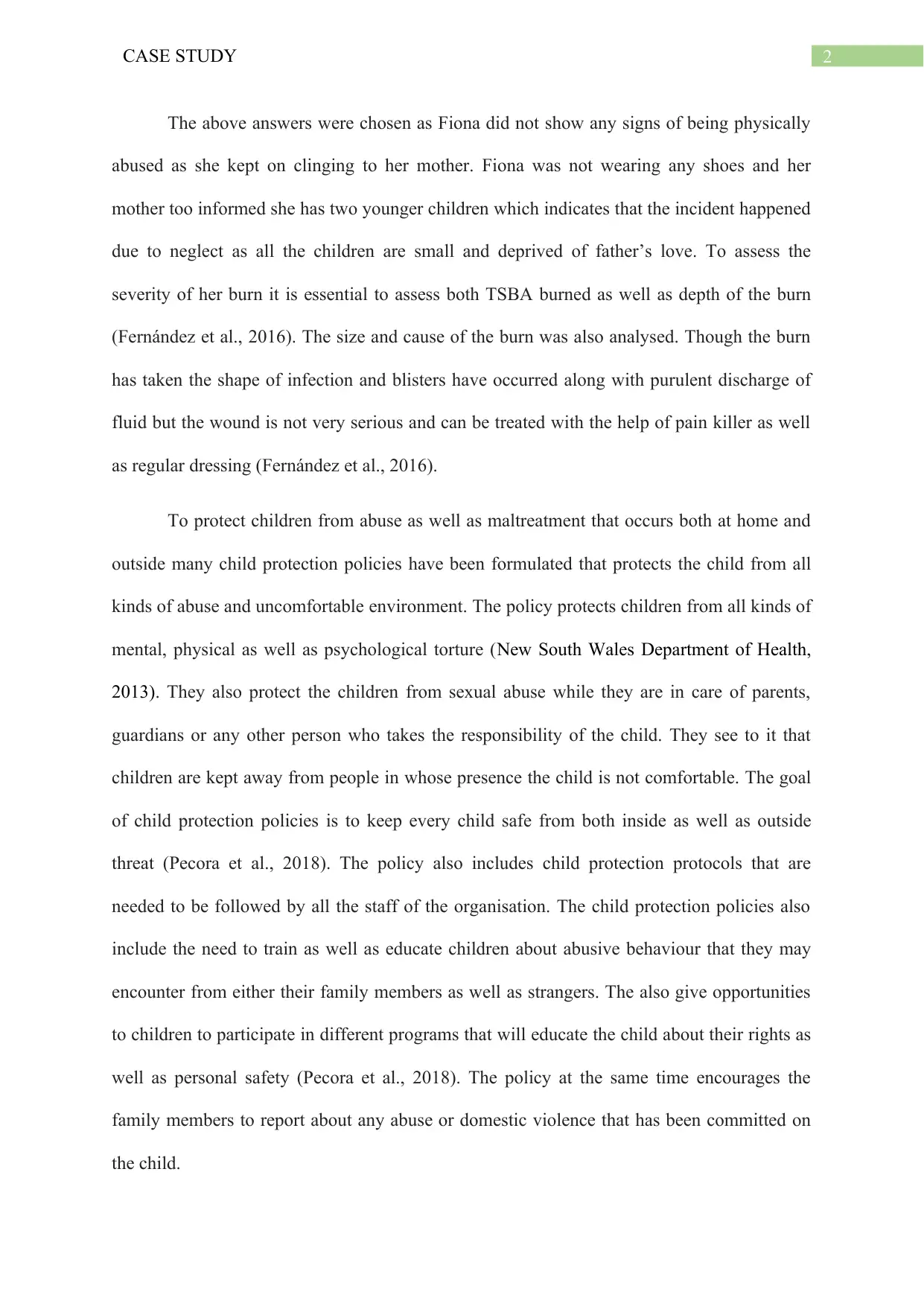
The above answers were chosen as Fiona did not show any signs of being physically
abused as she kept on clinging to her mother. Fiona was not wearing any shoes and her
mother too informed she has two younger children which indicates that the incident happened
due to neglect as all the children are small and deprived of father’s love. To assess the
severity of her burn it is essential to assess both TSBA burned as well as depth of the burn
(Fernández et al., 2016). The size and cause of the burn was also analysed. Though the burn
has taken the shape of infection and blisters have occurred along with purulent discharge of
fluid but the wound is not very serious and can be treated with the help of pain killer as well
as regular dressing (Fernández et al., 2016).
To protect children from abuse as well as maltreatment that occurs both at home and
outside many child protection policies have been formulated that protects the child from all
kinds of abuse and uncomfortable environment. The policy protects children from all kinds of
mental, physical as well as psychological torture (New South Wales Department of Health,
2013). They also protect the children from sexual abuse while they are in care of parents,
guardians or any other person who takes the responsibility of the child. They see to it that
children are kept away from people in whose presence the child is not comfortable. The goal
of child protection policies is to keep every child safe from both inside as well as outside
threat (Pecora et al., 2018). The policy also includes child protection protocols that are
needed to be followed by all the staff of the organisation. The child protection policies also
include the need to train as well as educate children about abusive behaviour that they may
encounter from either their family members as well as strangers. The also give opportunities
to children to participate in different programs that will educate the child about their rights as
well as personal safety (Pecora et al., 2018). The policy at the same time encourages the
family members to report about any abuse or domestic violence that has been committed on
the child.
The above answers were chosen as Fiona did not show any signs of being physically
abused as she kept on clinging to her mother. Fiona was not wearing any shoes and her
mother too informed she has two younger children which indicates that the incident happened
due to neglect as all the children are small and deprived of father’s love. To assess the
severity of her burn it is essential to assess both TSBA burned as well as depth of the burn
(Fernández et al., 2016). The size and cause of the burn was also analysed. Though the burn
has taken the shape of infection and blisters have occurred along with purulent discharge of
fluid but the wound is not very serious and can be treated with the help of pain killer as well
as regular dressing (Fernández et al., 2016).
To protect children from abuse as well as maltreatment that occurs both at home and
outside many child protection policies have been formulated that protects the child from all
kinds of abuse and uncomfortable environment. The policy protects children from all kinds of
mental, physical as well as psychological torture (New South Wales Department of Health,
2013). They also protect the children from sexual abuse while they are in care of parents,
guardians or any other person who takes the responsibility of the child. They see to it that
children are kept away from people in whose presence the child is not comfortable. The goal
of child protection policies is to keep every child safe from both inside as well as outside
threat (Pecora et al., 2018). The policy also includes child protection protocols that are
needed to be followed by all the staff of the organisation. The child protection policies also
include the need to train as well as educate children about abusive behaviour that they may
encounter from either their family members as well as strangers. The also give opportunities
to children to participate in different programs that will educate the child about their rights as
well as personal safety (Pecora et al., 2018). The policy at the same time encourages the
family members to report about any abuse or domestic violence that has been committed on
the child.
⊘ This is a preview!⊘
Do you want full access?
Subscribe today to unlock all pages.

Trusted by 1+ million students worldwide
3CASE STUDY
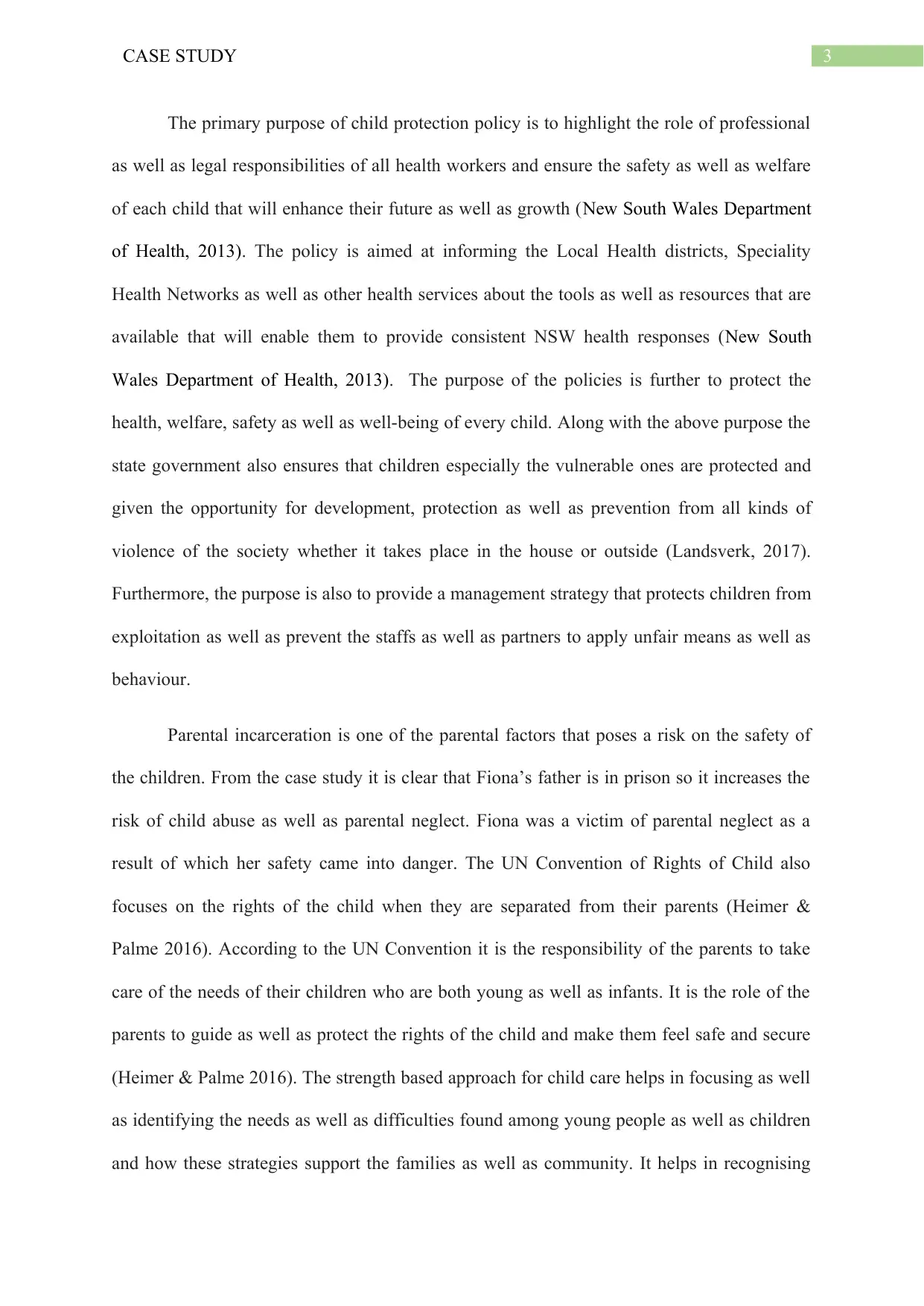
The primary purpose of child protection policy is to highlight the role of professional
as well as legal responsibilities of all health workers and ensure the safety as well as welfare
of each child that will enhance their future as well as growth (New South Wales Department
of Health, 2013). The policy is aimed at informing the Local Health districts, Speciality
Health Networks as well as other health services about the tools as well as resources that are
available that will enable them to provide consistent NSW health responses (New South
Wales Department of Health, 2013). The purpose of the policies is further to protect the
health, welfare, safety as well as well-being of every child. Along with the above purpose the
state government also ensures that children especially the vulnerable ones are protected and
given the opportunity for development, protection as well as prevention from all kinds of
violence of the society whether it takes place in the house or outside (Landsverk, 2017).
Furthermore, the purpose is also to provide a management strategy that protects children from
exploitation as well as prevent the staffs as well as partners to apply unfair means as well as
behaviour.
Parental incarceration is one of the parental factors that poses a risk on the safety of
the children. From the case study it is clear that Fiona’s father is in prison so it increases the
risk of child abuse as well as parental neglect. Fiona was a victim of parental neglect as a
result of which her safety came into danger. The UN Convention of Rights of Child also
focuses on the rights of the child when they are separated from their parents (Heimer &
Palme 2016). According to the UN Convention it is the responsibility of the parents to take
care of the needs of their children who are both young as well as infants. It is the role of the
parents to guide as well as protect the rights of the child and make them feel safe and secure
(Heimer & Palme 2016). The strength based approach for child care helps in focusing as well
as identifying the needs as well as difficulties found among young people as well as children
and how these strategies support the families as well as community. It helps in recognising
The primary purpose of child protection policy is to highlight the role of professional
as well as legal responsibilities of all health workers and ensure the safety as well as welfare
of each child that will enhance their future as well as growth (New South Wales Department
of Health, 2013). The policy is aimed at informing the Local Health districts, Speciality
Health Networks as well as other health services about the tools as well as resources that are
available that will enable them to provide consistent NSW health responses (New South
Wales Department of Health, 2013). The purpose of the policies is further to protect the
health, welfare, safety as well as well-being of every child. Along with the above purpose the
state government also ensures that children especially the vulnerable ones are protected and
given the opportunity for development, protection as well as prevention from all kinds of
violence of the society whether it takes place in the house or outside (Landsverk, 2017).
Furthermore, the purpose is also to provide a management strategy that protects children from
exploitation as well as prevent the staffs as well as partners to apply unfair means as well as
behaviour.
Parental incarceration is one of the parental factors that poses a risk on the safety of
the children. From the case study it is clear that Fiona’s father is in prison so it increases the
risk of child abuse as well as parental neglect. Fiona was a victim of parental neglect as a
result of which her safety came into danger. The UN Convention of Rights of Child also
focuses on the rights of the child when they are separated from their parents (Heimer &
Palme 2016). According to the UN Convention it is the responsibility of the parents to take
care of the needs of their children who are both young as well as infants. It is the role of the
parents to guide as well as protect the rights of the child and make them feel safe and secure
(Heimer & Palme 2016). The strength based approach for child care helps in focusing as well
as identifying the needs as well as difficulties found among young people as well as children
and how these strategies support the families as well as community. It helps in recognising
Paraphrase This Document
Need a fresh take? Get an instant paraphrase of this document with our AI Paraphraser
4CASE STUDY
the strength and uniqueness of each child as well as family (Swartz, 2017). Good family
engagement will create a positive environment for the child that will keep the child safe and
happy within the premises of his/her house (Reid & Chappell 2017).
The first and primary obligation of a nurse is to protect the rights of his/her patients.
The nurse should avoid the conflict that comes while taking care of the patient and take care
of his/her patients before their own interests (Milliken & Grace 2017). It is also their
obligation to support as well as educate the patients as well as their families about the
treatment that will be involved during the diagnosis process. It is her obligation to inform the
patient about the post care treatment, medications, exercise, nutrition as well as regular visit
to the doctors (Milliken & Grace 2017). Another primary obligation of the nurse is to keep
the safety of the patient as her primary objective. They must encourage the patients to take
care of themselves and also determines the courses of several treatments. Another obligation
of the nurse is to maintain privacy as well as confidentiality related to the patient’s health
conditions as well as their personal information (Milliken & Grace 2017). The nurse should
also avoid any conflict that arises in meeting the interest of the patients. Another obligation is
to treat every patient equally irrespective of race, sex, economical status as well as other
objectives. According to the MRG report and as nurse it is the responsibility of the latter to
offer the patient with primary care as well as support to the patient and at the same time the
patient is a young girl of three years old (Bastable, 2017). The MRG also highlighted that it
was essential to give immediate care to the patient that would help in healing the wounds as
well as made the obligation for the nurse to inform the Child Protection helpline as she was
being neglected by her mother and was not getting enough care and security because of the
poor home environment (Bastable, 2017). The family can be further supported if they are
informed about the importance of their rights as well as need for family engagement. Free
medical check-up can also be given to patient’s like Fiona who come from poor economic
the strength and uniqueness of each child as well as family (Swartz, 2017). Good family
engagement will create a positive environment for the child that will keep the child safe and
happy within the premises of his/her house (Reid & Chappell 2017).
The first and primary obligation of a nurse is to protect the rights of his/her patients.
The nurse should avoid the conflict that comes while taking care of the patient and take care
of his/her patients before their own interests (Milliken & Grace 2017). It is also their
obligation to support as well as educate the patients as well as their families about the
treatment that will be involved during the diagnosis process. It is her obligation to inform the
patient about the post care treatment, medications, exercise, nutrition as well as regular visit
to the doctors (Milliken & Grace 2017). Another primary obligation of the nurse is to keep
the safety of the patient as her primary objective. They must encourage the patients to take
care of themselves and also determines the courses of several treatments. Another obligation
of the nurse is to maintain privacy as well as confidentiality related to the patient’s health
conditions as well as their personal information (Milliken & Grace 2017). The nurse should
also avoid any conflict that arises in meeting the interest of the patients. Another obligation is
to treat every patient equally irrespective of race, sex, economical status as well as other
objectives. According to the MRG report and as nurse it is the responsibility of the latter to
offer the patient with primary care as well as support to the patient and at the same time the
patient is a young girl of three years old (Bastable, 2017). The MRG also highlighted that it
was essential to give immediate care to the patient that would help in healing the wounds as
well as made the obligation for the nurse to inform the Child Protection helpline as she was
being neglected by her mother and was not getting enough care and security because of the
poor home environment (Bastable, 2017). The family can be further supported if they are
informed about the importance of their rights as well as need for family engagement. Free
medical check-up can also be given to patient’s like Fiona who come from poor economic
5CASE STUDY
background and unsafe environment. The family will not be informed that an MRG report is
made as it might anger the mother or prevent her from coming to the health centre for
treatment of her children.
Some of the ethical responsibilities of the nurse would be to respect the dignity as
well as value every patient that comes to the health centre for treatment. They should treat
every patient equally irrespective of their economical background (Fitzpatrick, 2018). The
nurse should also show self-determination in patient care. They should also be accountable
for the decisions that they take. They should be fair while treating their patient. The legal
responsibility of the nurse is be an advocate for the patient in all instances of health care
including emergency situations (Fitzpatrick, 2018). They have a legal duty to monitor the
patient and at the same time watch for abnormalities as well as complications that occur
during patient care. The RN standards of practice states that nurses should think as well as
analyse critically where they make use of the research findings (Gomez et al., 2017).
Secondly, they should engage in therapeutic as well as professional relationships. Thirdly,
they should maintain the capability for practice that is they consider as well as respond in
timely manner. They further conduct assessment that are holistic and appropriate. They are
also responsible for planning as well as communication and lastly they provide safe,
responsive and quality service (Gomez et al., 2017). The ICN code of ethics states that the
professional responsibility of the nurse is to give care to the patients where the latter
advocates for justice and equity. Secondly, nurse carries accountability for their nursing
practice (Stievano & Tschudin 2019). Thirdly, they assume the role in implementing
standards that are acceptable for nursing practice, research, management and education.
Lastly, the code states that nurses should sustain collaborative relationship with their
colleagues (Stievano & Tschudin 2019). Furthermore, it is the obligation of the nurse to
ensure that child protection policies and legislation are implemented when a child is
background and unsafe environment. The family will not be informed that an MRG report is
made as it might anger the mother or prevent her from coming to the health centre for
treatment of her children.
Some of the ethical responsibilities of the nurse would be to respect the dignity as
well as value every patient that comes to the health centre for treatment. They should treat
every patient equally irrespective of their economical background (Fitzpatrick, 2018). The
nurse should also show self-determination in patient care. They should also be accountable
for the decisions that they take. They should be fair while treating their patient. The legal
responsibility of the nurse is be an advocate for the patient in all instances of health care
including emergency situations (Fitzpatrick, 2018). They have a legal duty to monitor the
patient and at the same time watch for abnormalities as well as complications that occur
during patient care. The RN standards of practice states that nurses should think as well as
analyse critically where they make use of the research findings (Gomez et al., 2017).
Secondly, they should engage in therapeutic as well as professional relationships. Thirdly,
they should maintain the capability for practice that is they consider as well as respond in
timely manner. They further conduct assessment that are holistic and appropriate. They are
also responsible for planning as well as communication and lastly they provide safe,
responsive and quality service (Gomez et al., 2017). The ICN code of ethics states that the
professional responsibility of the nurse is to give care to the patients where the latter
advocates for justice and equity. Secondly, nurse carries accountability for their nursing
practice (Stievano & Tschudin 2019). Thirdly, they assume the role in implementing
standards that are acceptable for nursing practice, research, management and education.
Lastly, the code states that nurses should sustain collaborative relationship with their
colleagues (Stievano & Tschudin 2019). Furthermore, it is the obligation of the nurse to
ensure that child protection policies and legislation are implemented when a child is
⊘ This is a preview!⊘
Do you want full access?
Subscribe today to unlock all pages.
Trusted by 1+ million students worldwide
6CASE STUDY
suspected to be a victim of abuse or neglect. In this situation mandatory reporting becomes an
obligation for the nurse by which suspected cases of child abuse and neglect is reported to the
concerned authorities (Tonmyr et al., 2018). The nurse in the case study too resorted to
mandatory reporting where she took the help from child helpline committee as Fiona was
being neglected by her mother.
To conclude it must be noted that it was necessary to ask for help from the child
helpline committee for Fiona in the MRG as it was necessary for her growth. It was clear by
the MRG report that Fiona was neglected by her mother and was at risk as her father was in
prison. Therefore, the MRG clearly aligns with the purpose of child protection policies and
why it has been implemented. The report also highlights the importance of family
engagement when the child is young and how the strength based approach would be helpful
for Fiona. The MRG also highlights the obligations of the nurse and lays down their duty as
well as presence of mind while dealing with such sensitive situations.
suspected to be a victim of abuse or neglect. In this situation mandatory reporting becomes an
obligation for the nurse by which suspected cases of child abuse and neglect is reported to the
concerned authorities (Tonmyr et al., 2018). The nurse in the case study too resorted to
mandatory reporting where she took the help from child helpline committee as Fiona was
being neglected by her mother.
To conclude it must be noted that it was necessary to ask for help from the child
helpline committee for Fiona in the MRG as it was necessary for her growth. It was clear by
the MRG report that Fiona was neglected by her mother and was at risk as her father was in
prison. Therefore, the MRG clearly aligns with the purpose of child protection policies and
why it has been implemented. The report also highlights the importance of family
engagement when the child is young and how the strength based approach would be helpful
for Fiona. The MRG also highlights the obligations of the nurse and lays down their duty as
well as presence of mind while dealing with such sensitive situations.
Paraphrase This Document
Need a fresh take? Get an instant paraphrase of this document with our AI Paraphraser
7CASE STUDY
References
Bastable, S. B. (2017). Nurse as educator: Principles of teaching and learning for nursing
practice. Jones & Bartlett Learning.
Child Story Reporter. (2018). A mandatory reporter's guide to selecting a decision tree.
https://reporter.childstory.nsw.gov.au/s/article/Guide-To-Selecting-A-Decision-Tree
Fernández-Manso, A., Fernández-Manso, O., & Quintano, C. (2016). SENTINEL-2A red-
edge spectral indices suitability for discriminating burn severity. International journal
of applied earth observation and geoinformation, 50, 170-175.
Fitzpatrick, J. J. (2018). Teaching moral courage: Obligation and challenge. Nursing
education perspectives, 39(4), 200.
Gomez, N. J., Castner, D., & Hain, D. (2017). Nephrology Nursing Scope and Standards of
Practice: Integration into Clinical Practice. Nephrology Nursing Journal, 44(1).
Heimer, M., & Palme, J. (2016). Rethinking child policy post-UN convention on the rights of
the child: Vulnerable children's welfare in Sweden. Journal of Social Policy, 45(3),
435-452.
Landsverk, J. (2017). Beyond common sense: Child welfare, child well-being, and the
evidence for policy reform. Routledge.
Maguire-Jack, K., & Showalter, K. (2016). The protective effect of neighborhood social
cohesion in child abuse and neglect. Child abuse & neglect, 52, 29-37.
Milliken, A., & Grace, P. (2017). Nurse ethical awareness: Understanding the nature of
everyday practice. Nursing ethics, 24(5), 517-524.
References
Bastable, S. B. (2017). Nurse as educator: Principles of teaching and learning for nursing
practice. Jones & Bartlett Learning.
Child Story Reporter. (2018). A mandatory reporter's guide to selecting a decision tree.
https://reporter.childstory.nsw.gov.au/s/article/Guide-To-Selecting-A-Decision-Tree
Fernández-Manso, A., Fernández-Manso, O., & Quintano, C. (2016). SENTINEL-2A red-
edge spectral indices suitability for discriminating burn severity. International journal
of applied earth observation and geoinformation, 50, 170-175.
Fitzpatrick, J. J. (2018). Teaching moral courage: Obligation and challenge. Nursing
education perspectives, 39(4), 200.
Gomez, N. J., Castner, D., & Hain, D. (2017). Nephrology Nursing Scope and Standards of
Practice: Integration into Clinical Practice. Nephrology Nursing Journal, 44(1).
Heimer, M., & Palme, J. (2016). Rethinking child policy post-UN convention on the rights of
the child: Vulnerable children's welfare in Sweden. Journal of Social Policy, 45(3),
435-452.
Landsverk, J. (2017). Beyond common sense: Child welfare, child well-being, and the
evidence for policy reform. Routledge.
Maguire-Jack, K., & Showalter, K. (2016). The protective effect of neighborhood social
cohesion in child abuse and neglect. Child abuse & neglect, 52, 29-37.
Milliken, A., & Grace, P. (2017). Nurse ethical awareness: Understanding the nature of
everyday practice. Nursing ethics, 24(5), 517-524.
8CASE STUDY
Mudrick, N. R., & Smith, C. J. (2017). Mandatory reporting for child protection in health
settings and the rights of parents with disabilities. Disability and health
journal, 10(2), 165-168.
New South Wales Department of Health. (2013). Child wellbeing and child protection
policies and procedures for NSW Health
Pecora, P. J., Whittaker, J. K., Barth, R. P., Borja, S., & Vesneski, W. (2018). The child
welfare challenge: Policy, practice, and research. Routledge.
Reid, R. C., & Chappell, N. L. (2017). Family involvement in nursing homes: Are family
caregivers getting what they want?. Journal of Applied Gerontology, 36(8), 993-1015.
Stievano, A., & Tschudin, V. (2019). The ICN code of ethics for nurses: a time for
revision. International nursing review, 66(2), 154-156.
Swartz, M. K. (2017). A strength-based approach to care. Journal of Pediatric Health
Care, 31(1), 1.
Tonmyr, L., Mathews, B., Shields, M. E., Hovdestad, W. E., & Afifi, T. O. (2018). Does
mandatory reporting legislation increase contact with child protection?–a legal
doctrinal review and an analytical examination. BMC public health, 18(1), 1021.
Mudrick, N. R., & Smith, C. J. (2017). Mandatory reporting for child protection in health
settings and the rights of parents with disabilities. Disability and health
journal, 10(2), 165-168.
New South Wales Department of Health. (2013). Child wellbeing and child protection
policies and procedures for NSW Health
Pecora, P. J., Whittaker, J. K., Barth, R. P., Borja, S., & Vesneski, W. (2018). The child
welfare challenge: Policy, practice, and research. Routledge.
Reid, R. C., & Chappell, N. L. (2017). Family involvement in nursing homes: Are family
caregivers getting what they want?. Journal of Applied Gerontology, 36(8), 993-1015.
Stievano, A., & Tschudin, V. (2019). The ICN code of ethics for nurses: a time for
revision. International nursing review, 66(2), 154-156.
Swartz, M. K. (2017). A strength-based approach to care. Journal of Pediatric Health
Care, 31(1), 1.
Tonmyr, L., Mathews, B., Shields, M. E., Hovdestad, W. E., & Afifi, T. O. (2018). Does
mandatory reporting legislation increase contact with child protection?–a legal
doctrinal review and an analytical examination. BMC public health, 18(1), 1021.
⊘ This is a preview!⊘
Do you want full access?
Subscribe today to unlock all pages.
Trusted by 1+ million students worldwide

1 out of 9


Related Documents


Your All-in-One AI-Powered Toolkit for Academic Success.
+13062052269
info@desklib.com
Available 24*7 on WhatsApp / Email
![[object Object]](/_next/static/media/star-bottom.7253800d.svg)
Unlock your academic potential
Copyright © 2020–2026 A2Z Services. All Rights Reserved. Developed and managed by ZUCOL.