Ethical Responsibilities of Registered Nurses in Healthcare: NURS 521
VerifiedAdded on 2022/10/12
|7
|1406
|136
Report
AI Summary
This report explores the crucial role of registered nurses in patient advocacy within the healthcare environment, emphasizing the importance of ethical considerations. It delves into the various ways nurses assist patients, acting as communicators, educators, and advocates to ensure informed decision-making and patient well-being. The report examines the significance of prelicensure education in preparing nurses for their ethical responsibilities. It also discusses the ANA Code of Ethics, its provisions, and its impact on nursing practice, including the shift from "client" to "patient" terminology. The report concludes with a review of the ANA Code of Ethics, highlighting the ethical standards and guidelines that nurses must adhere to in their practice to provide quality patient care and uphold human rights.
Running Head: ETHICS IN HEALTHCARE
ETHICS IN HEALTHCARE
Name of the Student
Name of the University
Authors Note
ETHICS IN HEALTHCARE
Name of the Student
Name of the University
Authors Note
Paraphrase This Document
Need a fresh take? Get an instant paraphrase of this document with our AI Paraphraser

1ETHICS IN HEALTHCARE
Executive Summary:
Nurses face different types of critical conditions in their profession. The ANA code of ethics is a
pathway following which they can provide best service to the patients. The report focuses on the
role of registered nurse in patient advocacy and assistance of patients through nursing advocacy.
Nurses should be eligible for a prelicensure education which would enhance the patient’s health.
The report also discusses about the ANA code of ethics for nurses and its implementation. The
report concludes with the review of ANA code of ethics and the guidelines of the nurses which
one should adhere to.
Executive Summary:
Nurses face different types of critical conditions in their profession. The ANA code of ethics is a
pathway following which they can provide best service to the patients. The report focuses on the
role of registered nurse in patient advocacy and assistance of patients through nursing advocacy.
Nurses should be eligible for a prelicensure education which would enhance the patient’s health.
The report also discusses about the ANA code of ethics for nurses and its implementation. The
report concludes with the review of ANA code of ethics and the guidelines of the nurses which
one should adhere to.

2ETHICS IN HEALTHCARE
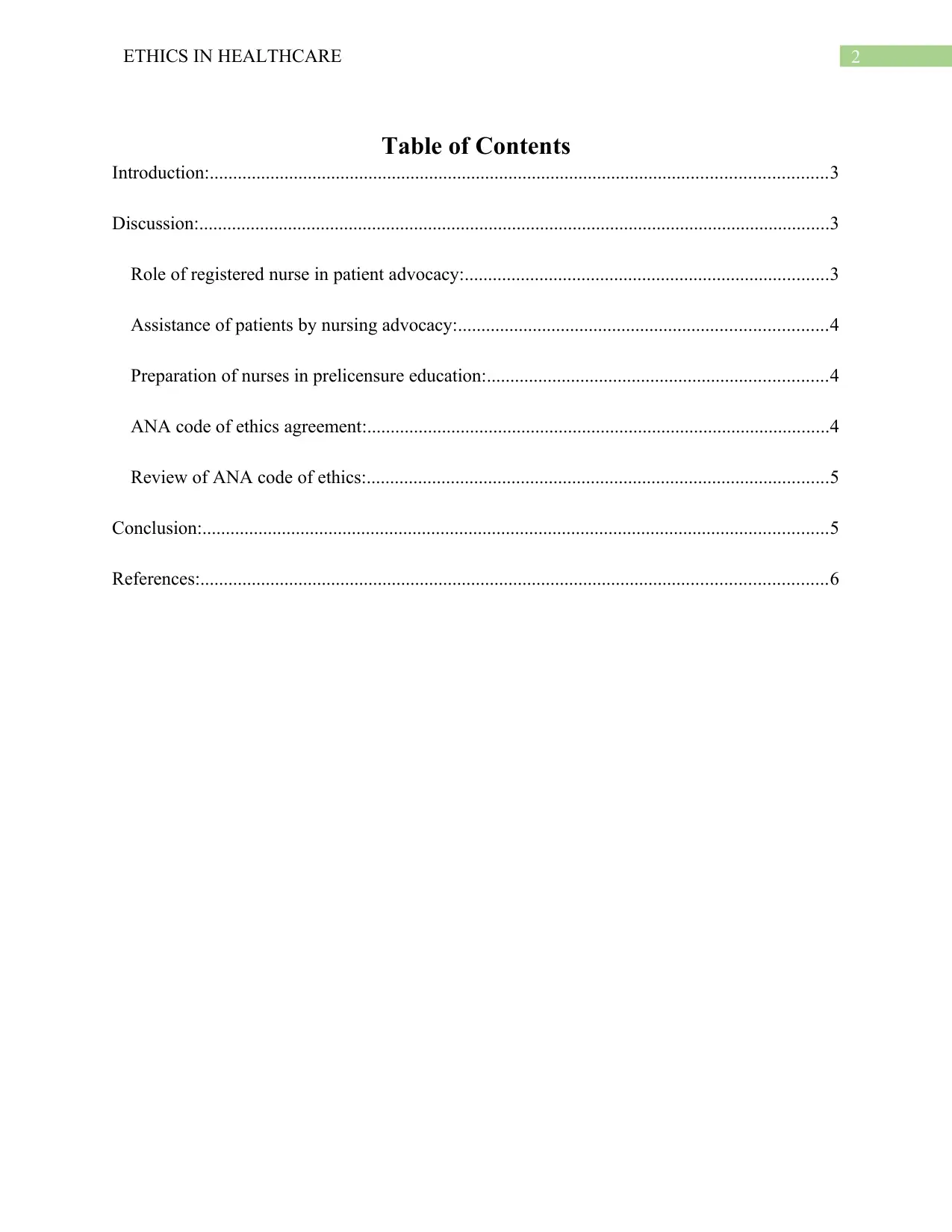
Table of Contents
Introduction:....................................................................................................................................3
Discussion:.......................................................................................................................................3
Role of registered nurse in patient advocacy:..............................................................................3
Assistance of patients by nursing advocacy:...............................................................................4
Preparation of nurses in prelicensure education:.........................................................................4
ANA code of ethics agreement:...................................................................................................4
Review of ANA code of ethics:...................................................................................................5
Conclusion:......................................................................................................................................5
References:......................................................................................................................................6
Table of Contents
Introduction:....................................................................................................................................3
Discussion:.......................................................................................................................................3
Role of registered nurse in patient advocacy:..............................................................................3
Assistance of patients by nursing advocacy:...............................................................................4
Preparation of nurses in prelicensure education:.........................................................................4
ANA code of ethics agreement:...................................................................................................4
Review of ANA code of ethics:...................................................................................................5
Conclusion:......................................................................................................................................5
References:......................................................................................................................................6
⊘ This is a preview!⊘
Do you want full access?
Subscribe today to unlock all pages.

Trusted by 1+ million students worldwide

3ETHICS IN HEALTHCARE
Introduction:
The most important part of a nursing job is delivering a quality care to the patient. They
can also assist the patient through advocacy. Nurses help the patients to make appropriate
decisions regarding their health. They also help the patients become acquainted with complex
medical systems, help them understand medical terms, the medications, its effects and actions as
well as help them to make ethical decisions. The advocacy of nurses towards patients help them
to recover from the disease faster and enhances the healing procedure.
Discussion:
Role of registered nurse in patient advocacy:
A nurse encourages, supports for, defends the rights, health and security of the patient. A
registered nurse has three basic roles for patient advocacy. They are preserving human dignity,
patient equality and freedom from suffering. An experienced nurse can solve the anxiousness and
confusion of the patient through communication and make them familiar with the medical
processes. Nurses should educate the patients about the tests and the procedures. They should
adhere to the privacy laws and must be aware of the culture and ethnicity of the patient
(Tomaschewski-Barlem et. al., 2017). A nurse should know to integrate care to the patient from
all aspects and address the concerns with a positive outcome.
A nurse should deliver care to the patients irrespective of the social or economic status of
the patient, personality or the type of disease the patient is suffering from. The nurse should be
compassionate and respectful towards the patient and treat him with dignity. The attitude of the
nurse towards a patient should not change irrespective of the changing health care system or
technological advancement.
Introduction:
The most important part of a nursing job is delivering a quality care to the patient. They
can also assist the patient through advocacy. Nurses help the patients to make appropriate
decisions regarding their health. They also help the patients become acquainted with complex
medical systems, help them understand medical terms, the medications, its effects and actions as
well as help them to make ethical decisions. The advocacy of nurses towards patients help them
to recover from the disease faster and enhances the healing procedure.
Discussion:
Role of registered nurse in patient advocacy:
A nurse encourages, supports for, defends the rights, health and security of the patient. A
registered nurse has three basic roles for patient advocacy. They are preserving human dignity,
patient equality and freedom from suffering. An experienced nurse can solve the anxiousness and
confusion of the patient through communication and make them familiar with the medical
processes. Nurses should educate the patients about the tests and the procedures. They should
adhere to the privacy laws and must be aware of the culture and ethnicity of the patient
(Tomaschewski-Barlem et. al., 2017). A nurse should know to integrate care to the patient from
all aspects and address the concerns with a positive outcome.
A nurse should deliver care to the patients irrespective of the social or economic status of
the patient, personality or the type of disease the patient is suffering from. The nurse should be
compassionate and respectful towards the patient and treat him with dignity. The attitude of the
nurse towards a patient should not change irrespective of the changing health care system or
technological advancement.
Paraphrase This Document
Need a fresh take? Get an instant paraphrase of this document with our AI Paraphraser

4ETHICS IN HEALTHCARE
Assistance of patients by nursing advocacy:
Nurses act as advocates for patients in many ways. They act as communicators, liaisons,
educators, interpreters and caregivers. Nurses ensures the patients for taking right decisions
about their own health. Nurses make their patients a priority. It is the duty of the nurse to
facilitate a patient’s needs. Personal feelings should not interfere with the decision making
process. A nurse should have patience and listen to the discussions on the family and the patient.
The families should feel comfortable to discuss their difficulties with the nurses (Johnstone et.
al., 2016). They can assist the patients for paying for the medications prescribed. They can
educate the patient about the medications and the process of surgery and the disease from which
the patient is suffering from.
Preparation of nurses in prelicensure education:
The nursing education would include the development of skills for direct patient care,
clinical decision making, caring for individual patient as well as group of patients (Herr et. al.,
2015). Prelicensure education is necessary for upbringing of the nursing character within a
student to be a good nurse with responsibility and ethics.
ANA code of ethics agreement:
The ANA code of ethics for nurses establishes standards for the nursing profession and
advocacy for the protection of human rights and social justice (Olson & Stokes, 2016). A
fundamental principle of the ANA code of ethics includes respect for the dignity, worth,
personality and the rights of humans for all population. Nurses should be able to bring attention
to the violation of human rights in all contexts and provide instant response against these
violation when come across. Nurses must always focus on the protection of human rights and its
Assistance of patients by nursing advocacy:
Nurses act as advocates for patients in many ways. They act as communicators, liaisons,
educators, interpreters and caregivers. Nurses ensures the patients for taking right decisions
about their own health. Nurses make their patients a priority. It is the duty of the nurse to
facilitate a patient’s needs. Personal feelings should not interfere with the decision making
process. A nurse should have patience and listen to the discussions on the family and the patient.
The families should feel comfortable to discuss their difficulties with the nurses (Johnstone et.
al., 2016). They can assist the patients for paying for the medications prescribed. They can
educate the patient about the medications and the process of surgery and the disease from which
the patient is suffering from.
Preparation of nurses in prelicensure education:
The nursing education would include the development of skills for direct patient care,
clinical decision making, caring for individual patient as well as group of patients (Herr et. al.,
2015). Prelicensure education is necessary for upbringing of the nursing character within a
student to be a good nurse with responsibility and ethics.
ANA code of ethics agreement:
The ANA code of ethics for nurses establishes standards for the nursing profession and
advocacy for the protection of human rights and social justice (Olson & Stokes, 2016). A
fundamental principle of the ANA code of ethics includes respect for the dignity, worth,
personality and the rights of humans for all population. Nurses should be able to bring attention
to the violation of human rights in all contexts and provide instant response against these
violation when come across. Nurses must always focus on the protection of human rights and its

5ETHICS IN HEALTHCARE
preservation especially for vulnerable group of people. Nurses must promote and protect social
justice, ethics and human rights.
The ANA code of ethics for nursing mainly uses the term patient for referring to those
people who will receive nursing care. Nurses mainly provide services to those who needs
medical guidance for responding to an illness.
Review of ANA code of ethics:
The ANA code of ethics of nursing consists of nine provisions. The first three provisions
describe the fundamental values and the duties of the nurse, the next three provisions discusses
the boundaries of the duties of a nurse and the last three provisions addresses the extra duties and
responsibilities which a nurse should have outside patient service (Epstein & Turner, 2015). The
Code of Ethics for Nurses with Interpretive Statements gives a framework to the nurses for using
ethical analysis and decision making skills. The code of ethics is not a subject of any type
amendment for any type of cases. The code is a guideline for the nurses to provide best service to
the patients (Lachman, Swanson & Winland-Brown, 2015).
Conclusion:
The report is concluded by stating the guidelines of ANA code of ethics for nurses. The
ANA code of ethics is developed as a guide for nurses to perform nursing responsibilities and
maintain ethics and standards of the profession. It addresses additional assistance for clinical
nurses to provide care for complex patients. The nurses should be able to implement the codes
and carry out their profession in a best way.
preservation especially for vulnerable group of people. Nurses must promote and protect social
justice, ethics and human rights.
The ANA code of ethics for nursing mainly uses the term patient for referring to those
people who will receive nursing care. Nurses mainly provide services to those who needs
medical guidance for responding to an illness.
Review of ANA code of ethics:
The ANA code of ethics of nursing consists of nine provisions. The first three provisions
describe the fundamental values and the duties of the nurse, the next three provisions discusses
the boundaries of the duties of a nurse and the last three provisions addresses the extra duties and
responsibilities which a nurse should have outside patient service (Epstein & Turner, 2015). The
Code of Ethics for Nurses with Interpretive Statements gives a framework to the nurses for using
ethical analysis and decision making skills. The code of ethics is not a subject of any type
amendment for any type of cases. The code is a guideline for the nurses to provide best service to
the patients (Lachman, Swanson & Winland-Brown, 2015).
Conclusion:
The report is concluded by stating the guidelines of ANA code of ethics for nurses. The
ANA code of ethics is developed as a guide for nurses to perform nursing responsibilities and
maintain ethics and standards of the profession. It addresses additional assistance for clinical
nurses to provide care for complex patients. The nurses should be able to implement the codes
and carry out their profession in a best way.
⊘ This is a preview!⊘
Do you want full access?
Subscribe today to unlock all pages.

Trusted by 1+ million students worldwide

6ETHICS IN HEALTHCARE
References:
Epstein, B., & Turner, M. (2015). The nursing code of ethics: Its value, its history. OJIN: The
Online Journal of Issues in Nursing, 20(2), 1-10.
Herr, K., St Marie, B., Gordon, D. B., Paice, J. A., Watt-Watson, J., Stevens, B. J., ... & Young,
H. M. (2015). An interprofessional consensus of core competencies for prelicensure
education in pain management: curriculum application for nursing. Journal of Nursing
Education, 54(6), 317-327.
Johnstone, M. J., Hutchinson, A. M., Redley, B., & Rawson, H. (2016). Nursing roles and
strategies in end-of-life decision making concerning elderly immigrants admitted to acute
care hospitals: An Australian study. Journal of Transcultural Nursing, 27(5), 471-479.
Lachman, V. D., Swanson, E. O. C., & Winland-Brown, J. (2015). The New'Code of Ethics for
Nurses with Interpretative Statements'(2015): Practical Clinical Application, Part
II. MedSurg Nursing, 24(5), 363.
Olson, L. L., & Stokes, F. (2016). The ANA code of ethics for nurses with interpretive
statements: Resource for nursing regulation. Journal of Nursing Regulation, 7(2), 9-20.
Tomaschewski-Barlem, J. G., Lunardi, V. L., Barlem, E. L. D., Silveira, R. S. D., Ramos, A. M.,
& Piexak, D. R. (2017). Patient advocacy in nursing: Barriers, facilitators and potential
implications. Texto & Contexto-Enfermagem, 26(3).
References:
Epstein, B., & Turner, M. (2015). The nursing code of ethics: Its value, its history. OJIN: The
Online Journal of Issues in Nursing, 20(2), 1-10.
Herr, K., St Marie, B., Gordon, D. B., Paice, J. A., Watt-Watson, J., Stevens, B. J., ... & Young,
H. M. (2015). An interprofessional consensus of core competencies for prelicensure
education in pain management: curriculum application for nursing. Journal of Nursing
Education, 54(6), 317-327.
Johnstone, M. J., Hutchinson, A. M., Redley, B., & Rawson, H. (2016). Nursing roles and
strategies in end-of-life decision making concerning elderly immigrants admitted to acute
care hospitals: An Australian study. Journal of Transcultural Nursing, 27(5), 471-479.
Lachman, V. D., Swanson, E. O. C., & Winland-Brown, J. (2015). The New'Code of Ethics for
Nurses with Interpretative Statements'(2015): Practical Clinical Application, Part
II. MedSurg Nursing, 24(5), 363.
Olson, L. L., & Stokes, F. (2016). The ANA code of ethics for nurses with interpretive
statements: Resource for nursing regulation. Journal of Nursing Regulation, 7(2), 9-20.
Tomaschewski-Barlem, J. G., Lunardi, V. L., Barlem, E. L. D., Silveira, R. S. D., Ramos, A. M.,
& Piexak, D. R. (2017). Patient advocacy in nursing: Barriers, facilitators and potential
implications. Texto & Contexto-Enfermagem, 26(3).
1 out of 7
Related Documents
Your All-in-One AI-Powered Toolkit for Academic Success.
+13062052269
info@desklib.com
Available 24*7 on WhatsApp / Email
Unlock your academic potential
Copyright © 2020–2025 A2Z Services. All Rights Reserved. Developed and managed by ZUCOL.