Registered Nurse Leadership and NSQHS Standards: An Essay Analysis
VerifiedAdded on 2022/09/05
|13
|3004
|24
Essay
AI Summary
This essay delves into the multifaceted responsibilities of a registered nurse, emphasizing the critical role of leadership in healthcare settings. It analyzes various leadership styles, including autocratic and democratic approaches, and their impact on patient care and team dynamics. The essay highlights the importance of RNs in maintaining and improving the quality of care through methods such as community development, health promotion, and policy development. Furthermore, it explores the significance of role modeling and teaching, covering essential aspects like professional skills, technical proficiency, and decision-making abilities. The essay also examines the RN standards of practice and NSQHS standards, providing a comprehensive overview of the governance, partnership with consumers, and communication for safety within healthcare systems, concluding with the crucial role of nurses in upholding the highest standards of patient care and safety.

NURSING 0
Nursing
April 3
2020
Nursing
April 3
2020

Paraphrase This Document
Need a fresh take? Get an instant paraphrase of this document with our AI Paraphraser
NURSING 1
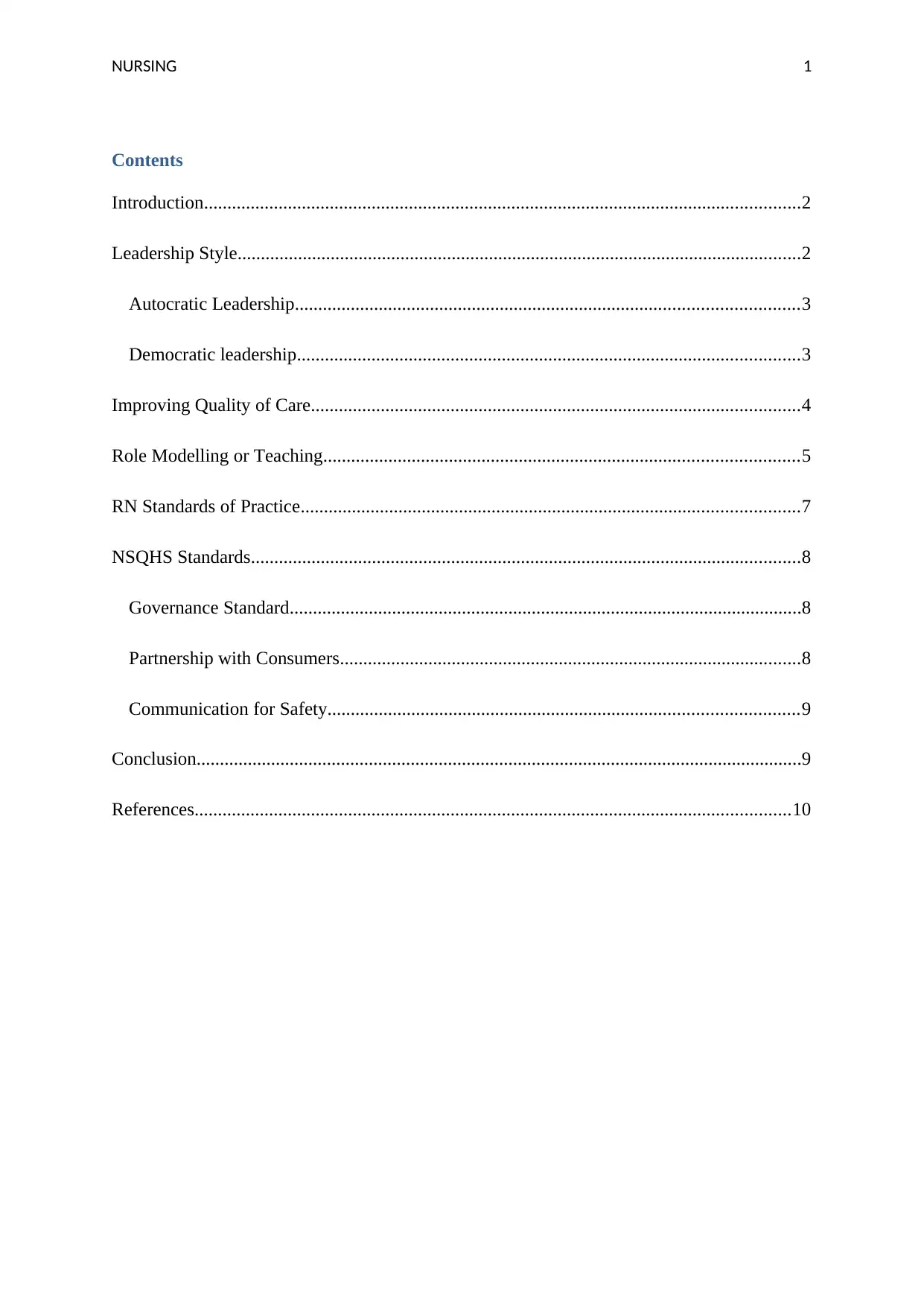
Contents
Introduction................................................................................................................................2
Leadership Style.........................................................................................................................2
Autocratic Leadership............................................................................................................3
Democratic leadership............................................................................................................3
Improving Quality of Care.........................................................................................................4
Role Modelling or Teaching......................................................................................................5
RN Standards of Practice...........................................................................................................7
NSQHS Standards......................................................................................................................8
Governance Standard..............................................................................................................8
Partnership with Consumers...................................................................................................8
Communication for Safety.....................................................................................................9
Conclusion..................................................................................................................................9
References................................................................................................................................10
Contents
Introduction................................................................................................................................2
Leadership Style.........................................................................................................................2
Autocratic Leadership............................................................................................................3
Democratic leadership............................................................................................................3
Improving Quality of Care.........................................................................................................4
Role Modelling or Teaching......................................................................................................5
RN Standards of Practice...........................................................................................................7
NSQHS Standards......................................................................................................................8
Governance Standard..............................................................................................................8
Partnership with Consumers...................................................................................................8
Communication for Safety.....................................................................................................9
Conclusion..................................................................................................................................9
References................................................................................................................................10
NURSING 2
Introduction
Nursing is considered to be a crucial part of healthcare. Many new concepts are been
included in nursing to enhance the health of the patient. Registered Nurse is also one such
concept. Registered Nurse is considered to be those nurses that are graduated from a nursing
program. Different requirements are set by every country. Nurses are required to fulfill those
requirements. RN is also considered to be professional nurses who will follow standards of
nursing and principles of code of conduct (Norful, Martsolf, Jacq, & Poghosyan, 2017).
Leadership qualities are also included in nursing. This will enhance personal as well as
professional skills of nurses. Nurses are responsible for undertaking different leadership
styles to solve or control situations. A registered nurse is also responsible for teaching
students and evaluating their results (ANA, 2020). In this essay leadership styles are been
identified. Outline of responsibilities of Registered Nurse and methods to provide quality care
will also be presented. There are different standards of practice of registered nursing that will
also be demonstrated.
Leadership Style
Leadership is the quality that can help a person in leading the team or group of
people. Effective leaders are an important part of the organization or any other department.
Effective leaders can also create a vision and inspire other employees or people, they also
motivate people, they are also responsible for managing the operations, and they also help in
building a team for achieving targets (Asamani, 2016). There are several types of leadership
styles that are followed in the healthcare department. These leadership styles are
transformational leadership, autocratic leadership, Laissez-faire leadership, and democratic
leadership and Servant leadership. Nurse leaders are responsible for setting an example for
Introduction
Nursing is considered to be a crucial part of healthcare. Many new concepts are been
included in nursing to enhance the health of the patient. Registered Nurse is also one such
concept. Registered Nurse is considered to be those nurses that are graduated from a nursing
program. Different requirements are set by every country. Nurses are required to fulfill those
requirements. RN is also considered to be professional nurses who will follow standards of
nursing and principles of code of conduct (Norful, Martsolf, Jacq, & Poghosyan, 2017).
Leadership qualities are also included in nursing. This will enhance personal as well as
professional skills of nurses. Nurses are responsible for undertaking different leadership
styles to solve or control situations. A registered nurse is also responsible for teaching
students and evaluating their results (ANA, 2020). In this essay leadership styles are been
identified. Outline of responsibilities of Registered Nurse and methods to provide quality care
will also be presented. There are different standards of practice of registered nursing that will
also be demonstrated.
Leadership Style
Leadership is the quality that can help a person in leading the team or group of
people. Effective leaders are an important part of the organization or any other department.
Effective leaders can also create a vision and inspire other employees or people, they also
motivate people, they are also responsible for managing the operations, and they also help in
building a team for achieving targets (Asamani, 2016). There are several types of leadership
styles that are followed in the healthcare department. These leadership styles are
transformational leadership, autocratic leadership, Laissez-faire leadership, and democratic
leadership and Servant leadership. Nurse leaders are responsible for setting an example for
⊘ This is a preview!⊘
Do you want full access?
Subscribe today to unlock all pages.

Trusted by 1+ million students worldwide
NURSING 3
other staff members. It can also have a negative or positive effect on the department (Della,
Ang, & Goh, 2016).
Autocratic Leadership
The autocratic leadership style is used by Registered Nurses in hospitals. In this
leadership, style leaders are not dependable on anybody. They make decisions according to
their understanding of the situation and the health of the patient. They did not consider any
advice or inputs from the staff of the hospital. Certain rules have to follow by nurses. In this
leadership style rules are often rules on nurses by negative reinforcement or punishments.
There are times when critical or important information regarding any treatment of the health
of the patient is withheld by the team and it has not to reach the particular nurse
(Dyczkowska & Dyczkowski, 2018). Mistakes are not tolerated in this leadership style and
blame is put on nurses without following any process. But there are also some positive
impacts of this leadership style as well. His leadership style can be effectively used in
emergencies because in those situations there is less time for decision making. By enforcing
rules and regulations public health and quality of care can be maintained. But this leadership
style does not help in the enhancement of trust and loyalty among staff members (AANAC
Extras, 2014).
Democratic leadership
The democratic style is also used by registered nurses in hospitals. In this leadership,
nurses fill the communication gap between nurses and patients or management. This
leadership style helps in the enhancement of open communication and staff participation. In
this leadership, decisions are also taken by taking advice from staff members.
Responsibilities are also divided among nurses and they are also held accountable for their
actions. Feedback is also included in this leadership style because improvements in the
department are implemented on this basis. Relationships are given importance in this
other staff members. It can also have a negative or positive effect on the department (Della,
Ang, & Goh, 2016).
Autocratic Leadership
The autocratic leadership style is used by Registered Nurses in hospitals. In this
leadership, style leaders are not dependable on anybody. They make decisions according to
their understanding of the situation and the health of the patient. They did not consider any
advice or inputs from the staff of the hospital. Certain rules have to follow by nurses. In this
leadership style rules are often rules on nurses by negative reinforcement or punishments.
There are times when critical or important information regarding any treatment of the health
of the patient is withheld by the team and it has not to reach the particular nurse
(Dyczkowska & Dyczkowski, 2018). Mistakes are not tolerated in this leadership style and
blame is put on nurses without following any process. But there are also some positive
impacts of this leadership style as well. His leadership style can be effectively used in
emergencies because in those situations there is less time for decision making. By enforcing
rules and regulations public health and quality of care can be maintained. But this leadership
style does not help in the enhancement of trust and loyalty among staff members (AANAC
Extras, 2014).
Democratic leadership
The democratic style is also used by registered nurses in hospitals. In this leadership,
nurses fill the communication gap between nurses and patients or management. This
leadership style helps in the enhancement of open communication and staff participation. In
this leadership, decisions are also taken by taking advice from staff members.
Responsibilities are also divided among nurses and they are also held accountable for their
actions. Feedback is also included in this leadership style because improvements in the
department are implemented on this basis. Relationships are given importance in this
Paraphrase This Document
Need a fresh take? Get an instant paraphrase of this document with our AI Paraphraser
NURSING 4
leadership style. Developing effective leadership helps in improving the quality of care and it
also helps in improvement in systems. The performance of nurses is also improved by
implementing this leadership style. Reduction in mistakes is also been observed after the
implementation of this leadership style (Pullen, 2016).
Improving Quality of Care
It is the duty and responsibility of Registered nurses to adopt some methods that can
help in improving the quality of care that is been provided to patients. Pubic are getting aware
of their health and as a result of that; there is an increase in demand for better quality of care.
Therefore the government has also implemented certain standards and code of conduct that
helps in maintaining quality care of patients. Quality of care can be determined through the
infrastructure of the hospital, training that is provided to nurses and the efficiency of nurses
(Jun, Kovner, & Stimpfel, 2016).
There are some responsibilities of the registered nurse by that they can contribute
towards improving the quality of care. These responsibilities are as follows:
Community Development
Health Promotion.
Illness Promotion.
Policy development.
Training and development.
Proper treatment (Sfantou , Laliotis, Patelarou, Pistolla, Matalliotakis, & Patelarou,
2017).
All these basic responsibilities are to be fulfilled by registered nurses. Registered nurses
are required to prepare a plan for the effective treatment of the patient. Proper training and
leadership style. Developing effective leadership helps in improving the quality of care and it
also helps in improvement in systems. The performance of nurses is also improved by
implementing this leadership style. Reduction in mistakes is also been observed after the
implementation of this leadership style (Pullen, 2016).
Improving Quality of Care
It is the duty and responsibility of Registered nurses to adopt some methods that can
help in improving the quality of care that is been provided to patients. Pubic are getting aware
of their health and as a result of that; there is an increase in demand for better quality of care.
Therefore the government has also implemented certain standards and code of conduct that
helps in maintaining quality care of patients. Quality of care can be determined through the
infrastructure of the hospital, training that is provided to nurses and the efficiency of nurses
(Jun, Kovner, & Stimpfel, 2016).
There are some responsibilities of the registered nurse by that they can contribute
towards improving the quality of care. These responsibilities are as follows:
Community Development
Health Promotion.
Illness Promotion.
Policy development.
Training and development.
Proper treatment (Sfantou , Laliotis, Patelarou, Pistolla, Matalliotakis, & Patelarou,
2017).
All these basic responsibilities are to be fulfilled by registered nurses. Registered nurses
are required to prepare a plan for the effective treatment of the patient. Proper training and
NURSING 5
development of nurses also ensure the quality of care as those nurses will also follow
standards and principles that are set by the healthcare department. Treatment is also decided
based on a proper evaluation of the health of the patient. There are several methods through
which also quality of care can be ensured (Stadnyk, Lauckner, & Clarke, 2011). These
methods are as follows:
By effective care and support, the health of the patient can be improved. Services of
nurses are based on scientific knowledge and evidence-based treatment must be
provided to patients.
Safe care must also be provided to the patient. This will help in enhancing the quality
of care. Risk can also be minimized and there will be fewer occurrences of errors in
medical treatment.
Timely care should be provided to the patient. Delay in evaluation or providing
treatment can lead a patient towards harmful situations.
Equal opportunity should be provided to all the patients. Quality of treatment should
not differ or it should not be based on any discrimination.
Effective health care can also be provided by minimizing the wastage of resources
that are available in the hospital (Ricciardi, 2018).
Nurses are required to consider the culture and beliefs of patients. By this, a
relationship can be created between patients and nurses. This can also result in an
improvement in the health of the patient. Quality of care will also be enhanced
because the patient will also cooperate with the nurse and in the treatments that will
be provided to them (Connolly & Wright, 2017)
development of nurses also ensure the quality of care as those nurses will also follow
standards and principles that are set by the healthcare department. Treatment is also decided
based on a proper evaluation of the health of the patient. There are several methods through
which also quality of care can be ensured (Stadnyk, Lauckner, & Clarke, 2011). These
methods are as follows:
By effective care and support, the health of the patient can be improved. Services of
nurses are based on scientific knowledge and evidence-based treatment must be
provided to patients.
Safe care must also be provided to the patient. This will help in enhancing the quality
of care. Risk can also be minimized and there will be fewer occurrences of errors in
medical treatment.
Timely care should be provided to the patient. Delay in evaluation or providing
treatment can lead a patient towards harmful situations.
Equal opportunity should be provided to all the patients. Quality of treatment should
not differ or it should not be based on any discrimination.
Effective health care can also be provided by minimizing the wastage of resources
that are available in the hospital (Ricciardi, 2018).
Nurses are required to consider the culture and beliefs of patients. By this, a
relationship can be created between patients and nurses. This can also result in an
improvement in the health of the patient. Quality of care will also be enhanced
because the patient will also cooperate with the nurse and in the treatments that will
be provided to them (Connolly & Wright, 2017)
⊘ This is a preview!⊘
Do you want full access?
Subscribe today to unlock all pages.
Trusted by 1+ million students worldwide
NURSING 6
Role Modelling or Teaching
According to Sandberg, An effective team leader is responsible for setting examples for
its team members so that it can have a positive impact on them. Effective team leaders are
considered to be inspirations for other employees or a group of people in the organization or
department. Some several roles and responsibilities are to be fulfilled by team members such
as managing the team, development of policy, developing professional relationships among
team members and many more. Team leaders are also responsible for teaching their
employees or team members during working hours. These teachings are as follows:
1. Being a good professional
Effective team leader consists of being effectively professional. Leaders should teach
communication skills, presentation skills, leadership skills to their employees or team
members. A leader should also share their vision regarding organization this will help in
motivating employees to achieve organizational goals (Ashley , 2013).
2. Technical Skills
Technology is considered to be an essential part of every department. Technology has
many advantages. It can help employees or nurses in finding new treatments. Technology
also helps in research. Nurses are also expected to be technology-friendly because many
types of machinery are been involved in hospitals and reports that are generated of patients
are also from that machinery. So nurses should know the functions of the machine and they
should be friendly with that technology. It will also help in becoming independent and time
can also be saved (Ceylan, 2018).
3. Decision-making ability
Role Modelling or Teaching
According to Sandberg, An effective team leader is responsible for setting examples for
its team members so that it can have a positive impact on them. Effective team leaders are
considered to be inspirations for other employees or a group of people in the organization or
department. Some several roles and responsibilities are to be fulfilled by team members such
as managing the team, development of policy, developing professional relationships among
team members and many more. Team leaders are also responsible for teaching their
employees or team members during working hours. These teachings are as follows:
1. Being a good professional
Effective team leader consists of being effectively professional. Leaders should teach
communication skills, presentation skills, leadership skills to their employees or team
members. A leader should also share their vision regarding organization this will help in
motivating employees to achieve organizational goals (Ashley , 2013).
2. Technical Skills
Technology is considered to be an essential part of every department. Technology has
many advantages. It can help employees or nurses in finding new treatments. Technology
also helps in research. Nurses are also expected to be technology-friendly because many
types of machinery are been involved in hospitals and reports that are generated of patients
are also from that machinery. So nurses should know the functions of the machine and they
should be friendly with that technology. It will also help in becoming independent and time
can also be saved (Ceylan, 2018).
3. Decision-making ability
Paraphrase This Document
Need a fresh take? Get an instant paraphrase of this document with our AI Paraphraser
NURSING 7
Making decisions on time is the basic requirement of every department and organization.
There are times when immediate actions have to be taken by employees or nurses. They may
not have time to take advice from their staff members. So these skills should be taught by
every team leader so that employees or nurses can be confident about their decisions and they
can also handle emergencies. Decisions should be taken on a logical basis because they are
accountable for the actions and decisions they have taken. Team leaders should also
communicate and make employees or nurses aware of the principles and standards that must
be followed while taking decisions (Alaseeri, Rajab, & Banakhar, 2019).
RN Standards of Practice
Seven standards are set by the government to maintain the quality of care and health of
the patient. Al these standards are used according to the situation. Standard that can be
demonstrated through teaching and ensuring quality of care are:
1. Thinks critically and analyses nursing practice
In this standard critical analysis of treatment is done before implementing it in practice.
Evaluation of treatment will also be done so that impacts of that treatment can be observed.
This standard can be taught to nurses and quality of care can also be ensured (Nursing and
Midwifery Board of Australia, 2016).
2. Engages in a therapeutic and professional relationship
In this standard nurses are required to involve with patients and relationships should also
be maintained with them. This can create a bond of trust and loyalty. Support will also be
provided to the patient. As a result of positive changes will also be observed in the health of
the patient. This standard can also be taught through teaching and enhancement in quality of
care can also be done (American Academy of Ambulatory Care Nursing, 2017).
Making decisions on time is the basic requirement of every department and organization.
There are times when immediate actions have to be taken by employees or nurses. They may
not have time to take advice from their staff members. So these skills should be taught by
every team leader so that employees or nurses can be confident about their decisions and they
can also handle emergencies. Decisions should be taken on a logical basis because they are
accountable for the actions and decisions they have taken. Team leaders should also
communicate and make employees or nurses aware of the principles and standards that must
be followed while taking decisions (Alaseeri, Rajab, & Banakhar, 2019).
RN Standards of Practice
Seven standards are set by the government to maintain the quality of care and health of
the patient. Al these standards are used according to the situation. Standard that can be
demonstrated through teaching and ensuring quality of care are:
1. Thinks critically and analyses nursing practice
In this standard critical analysis of treatment is done before implementing it in practice.
Evaluation of treatment will also be done so that impacts of that treatment can be observed.
This standard can be taught to nurses and quality of care can also be ensured (Nursing and
Midwifery Board of Australia, 2016).
2. Engages in a therapeutic and professional relationship
In this standard nurses are required to involve with patients and relationships should also
be maintained with them. This can create a bond of trust and loyalty. Support will also be
provided to the patient. As a result of positive changes will also be observed in the health of
the patient. This standard can also be taught through teaching and enhancement in quality of
care can also be done (American Academy of Ambulatory Care Nursing, 2017).
NURSING 8
3. Develop a plan for nursing practice
Before implementing any treatment plan has to be developed. This plan will help in
providing effective treatment and fast recovery of the patient can be observed. Nurses will
also take actions according to the plan that is been developed. Therefore the risk of medical
error will also be minimized (Cashin, Heartfield, Policy, & Buckley, 2016).
NSQHS Standards
Eight standards have been set by the healthcare department. These standards are as
follows:
1. Governance standard.
2. Partnership with consumers.
3. Prevention and control of healthcare standards.
4. Medical Safety.
5. Effective Care Standard.
6. Communication for safety.
7. Blood Management.
8. Recognition Standard.
Governance Standard
In this standard leader of the healthcare department consist of responsibility of a
community that helps in the improvement of the safety and quality of nursing practice. This
standard also ensures a safe, effective and patient-centered approach. The main aim of this
standard is to maintain and improve the system of the healthcare department (NSQHS
Standard, 2019).
3. Develop a plan for nursing practice
Before implementing any treatment plan has to be developed. This plan will help in
providing effective treatment and fast recovery of the patient can be observed. Nurses will
also take actions according to the plan that is been developed. Therefore the risk of medical
error will also be minimized (Cashin, Heartfield, Policy, & Buckley, 2016).
NSQHS Standards
Eight standards have been set by the healthcare department. These standards are as
follows:
1. Governance standard.
2. Partnership with consumers.
3. Prevention and control of healthcare standards.
4. Medical Safety.
5. Effective Care Standard.
6. Communication for safety.
7. Blood Management.
8. Recognition Standard.
Governance Standard
In this standard leader of the healthcare department consist of responsibility of a
community that helps in the improvement of the safety and quality of nursing practice. This
standard also ensures a safe, effective and patient-centered approach. The main aim of this
standard is to maintain and improve the system of the healthcare department (NSQHS
Standard, 2019).
⊘ This is a preview!⊘
Do you want full access?
Subscribe today to unlock all pages.
Trusted by 1+ million students worldwide
NURSING 9
Partnership with Consumers
In these standard leaders of healthcare, the department is responsible to develop,
implement and maintain a relationship with consumers. Partnerships are related to designing,
planning, delivering and evaluating the care of the patient. The main aim of this standard is to
create service in the organization so that mutual results can be achieved (Jensen, 2020).
Communication for Safety
In this standard leader of the healthcare department set up and maintain a system that
can support and handle effective communication. Communication is to be maintaining with
nurses, patient, and their families. The Healthcare department uses these systems for effective
communication. The main aim of this standard is to ensure effective and timely
communication (Steel, 2016).
Conclusion
Health is considered to be the most important aspect. Therefore nursing department
has updated its services and approaches. Any new concepts have been added to nursing. A
registered nurse is a new such concept. Registered nurses are expected to be professionals in
providing care to patients. They are also more effective and efficient. In the concept of
registered nurse leadership quality is also been involved. Leadership quality can be of many
types. The nurse uses a leadership style according to the situation nurses are facing. Nurses
are also expected to improve the quality of care that is provided to the patient. There are some
responsibilities and methods that can be taken for improvement. NSQHS also have set many
standards that help in ensuring the quality of nursing practice.
Partnership with Consumers
In these standard leaders of healthcare, the department is responsible to develop,
implement and maintain a relationship with consumers. Partnerships are related to designing,
planning, delivering and evaluating the care of the patient. The main aim of this standard is to
create service in the organization so that mutual results can be achieved (Jensen, 2020).
Communication for Safety
In this standard leader of the healthcare department set up and maintain a system that
can support and handle effective communication. Communication is to be maintaining with
nurses, patient, and their families. The Healthcare department uses these systems for effective
communication. The main aim of this standard is to ensure effective and timely
communication (Steel, 2016).
Conclusion
Health is considered to be the most important aspect. Therefore nursing department
has updated its services and approaches. Any new concepts have been added to nursing. A
registered nurse is a new such concept. Registered nurses are expected to be professionals in
providing care to patients. They are also more effective and efficient. In the concept of
registered nurse leadership quality is also been involved. Leadership quality can be of many
types. The nurse uses a leadership style according to the situation nurses are facing. Nurses
are also expected to improve the quality of care that is provided to the patient. There are some
responsibilities and methods that can be taken for improvement. NSQHS also have set many
standards that help in ensuring the quality of nursing practice.
Paraphrase This Document
Need a fresh take? Get an instant paraphrase of this document with our AI Paraphraser
NURSING 10
References
AANAC Extras. (2014). NURSING NURSING. Retrieved 04 03, 2020, from AANAC Extras:
https://www.aanac.org/docs/white-papers/2013-nursing-leadership---management-
leadership-styles.pdf?sfvrsn=2
Alaseeri, R., Rajab, A., & Banakhar, M. (2019). Factors Influencing Nurses’ Decision-
Making Process: An Integrative Literature Review. IOSR Journal of Nursing and
Health Science, 8(4), 36-48.
American Academy of Ambulatory Care Nursing. (2017). Scope and Standards of Practice
for Professional Ambulatory Care Nursing. Jannetti Publications.
ANA. (2020). What is Nursing? Retrieved 04 03, 2020, from ANA:
https://www.nursingworld.org/practice-policy/workforce/what-is-nursing/
Asamani, A. (2016). Leadership styles in nursing management: implications for staff
outcomes. Journal of Health Science, 6(1).
Ashley , C. (2013, 06). Christine Ashley. Australia : Australian medical local alliance .
Cashin, A., Heartfield, M., Policy, G. D., & Buckley, T. (2016). Standards for practice for
registered nurses in Australia. Elsevier.
Ceylan, H. (2018). Leadership in nursing. Journal of Nursing Research and Practice, 2(2),
20-21.
Connolly, D., & Wright, F. (2017). The nursing quality indicator framework tool.
International Journal of Health Care Quality Assurance, 30(7), 603-616.
References
AANAC Extras. (2014). NURSING NURSING. Retrieved 04 03, 2020, from AANAC Extras:
https://www.aanac.org/docs/white-papers/2013-nursing-leadership---management-
leadership-styles.pdf?sfvrsn=2
Alaseeri, R., Rajab, A., & Banakhar, M. (2019). Factors Influencing Nurses’ Decision-
Making Process: An Integrative Literature Review. IOSR Journal of Nursing and
Health Science, 8(4), 36-48.
American Academy of Ambulatory Care Nursing. (2017). Scope and Standards of Practice
for Professional Ambulatory Care Nursing. Jannetti Publications.
ANA. (2020). What is Nursing? Retrieved 04 03, 2020, from ANA:
https://www.nursingworld.org/practice-policy/workforce/what-is-nursing/
Asamani, A. (2016). Leadership styles in nursing management: implications for staff
outcomes. Journal of Health Science, 6(1).
Ashley , C. (2013, 06). Christine Ashley. Australia : Australian medical local alliance .
Cashin, A., Heartfield, M., Policy, G. D., & Buckley, T. (2016). Standards for practice for
registered nurses in Australia. Elsevier.
Ceylan, H. (2018). Leadership in nursing. Journal of Nursing Research and Practice, 2(2),
20-21.
Connolly, D., & Wright, F. (2017). The nursing quality indicator framework tool.
International Journal of Health Care Quality Assurance, 30(7), 603-616.
NURSING 11
Della, P. R., Ang, S. Y., & Goh, A. M. (2016). Leadership style of nurse managers as
perceived by registered nurses: A cross-sectional survey. Sage Journals, 27(3), 205-
210.
Dyczkowska, J., & Dyczkowski, T. (2018). Democratic or Autocratic Leadership Style?
Democratic or Autocratic Leadership Style?, 4(2), 193-218.
Jensen, F. (2020). Partnering with consumers through NSQHS standards. Journal of Health
Information and Libraries Australasia, 1(1), 18-19.
Jun, J., Kovner, C. T., & Stimpfel, A. W. (2016). Barriers and facilitators of nurses’ use of
clinical practice guidelines: An integrative review. Internal Journal of Nursing
Studies, 60, 54-68.
Norful, A., Martsolf, G., Jacq, K., & Poghosyan, L. (2017). Utilization of registered nurses in
primary care teams: A systematic review. Internation Journal of Nursing Studies, 74,
15-23.
NSQHS Standard. (2019). Clinical Governance Standard. Retrieved 04 03, 2020, from
NSQHS Standard: https://www.safetyandquality.gov.au/our-work/clinical-
governance/clinical-governance-standard
Nursing and Midwifery Board of Australia. (2016, 07 01). Registered nurses STANDARDS
FOR PRACTICE. Australia : Nursing and Midwifery Board of Australia .
Pullen, R. L. (2016). Leadership in nursing practice. Nursing made Incredibly Easy, 14(3),
26-31.
Ricciardi, R. (2018). The Next Frontier for Nurses. Journal of Nursing Care Quality, 33(1),
1-4.
Della, P. R., Ang, S. Y., & Goh, A. M. (2016). Leadership style of nurse managers as
perceived by registered nurses: A cross-sectional survey. Sage Journals, 27(3), 205-
210.
Dyczkowska, J., & Dyczkowski, T. (2018). Democratic or Autocratic Leadership Style?
Democratic or Autocratic Leadership Style?, 4(2), 193-218.
Jensen, F. (2020). Partnering with consumers through NSQHS standards. Journal of Health
Information and Libraries Australasia, 1(1), 18-19.
Jun, J., Kovner, C. T., & Stimpfel, A. W. (2016). Barriers and facilitators of nurses’ use of
clinical practice guidelines: An integrative review. Internal Journal of Nursing
Studies, 60, 54-68.
Norful, A., Martsolf, G., Jacq, K., & Poghosyan, L. (2017). Utilization of registered nurses in
primary care teams: A systematic review. Internation Journal of Nursing Studies, 74,
15-23.
NSQHS Standard. (2019). Clinical Governance Standard. Retrieved 04 03, 2020, from
NSQHS Standard: https://www.safetyandquality.gov.au/our-work/clinical-
governance/clinical-governance-standard
Nursing and Midwifery Board of Australia. (2016, 07 01). Registered nurses STANDARDS
FOR PRACTICE. Australia : Nursing and Midwifery Board of Australia .
Pullen, R. L. (2016). Leadership in nursing practice. Nursing made Incredibly Easy, 14(3),
26-31.
Ricciardi, R. (2018). The Next Frontier for Nurses. Journal of Nursing Care Quality, 33(1),
1-4.
⊘ This is a preview!⊘
Do you want full access?
Subscribe today to unlock all pages.
Trusted by 1+ million students worldwide

1 out of 13


Related Documents


Your All-in-One AI-Powered Toolkit for Academic Success.
+13062052269
info@desklib.com
Available 24*7 on WhatsApp / Email
![[object Object]](/_next/static/media/star-bottom.7253800d.svg)
Unlock your academic potential
Copyright © 2020–2026 A2Z Services. All Rights Reserved. Developed and managed by ZUCOL.