Registered Nurse Leadership and NSQHS Standards in Healthcare
VerifiedAdded on 2022/08/21
|13
|2600
|19
Essay
AI Summary
This essay critically evaluates the responsibilities of a registered nurse in leading a team to ensure that National Safety and Quality Health Service (NSQHS) standards are met through clinical teaching. The essay explores various leadership styles applicable in nursing, including autocratic, laissez-faire, democratic, transformational, and servant leadership. It delves into the importance of these styles in fostering quality patient care and achieving organizational goals. Furthermore, the essay analyzes the NSQHS standards, emphasizing governance, consumer partnerships, and clinical handover procedures. The role of the RN in upholding these standards through clinical practice, teaching, and evaluation is thoroughly discussed, alongside the qualities of an effective team leader in the healthcare setting. The discussion emphasizes the role of registered nurses in ensuring patient safety and quality care, highlighting the importance of leadership, teamwork, and adherence to established standards in the healthcare environment.

TEACHING, LEARNING & LEADERSHIP 0
Nursing
March 21
2020
Nursing
March 21
2020

Paraphrase This Document
Need a fresh take? Get an instant paraphrase of this document with our AI Paraphraser
TEACHING, LEARNING & LEADERSHIP 1
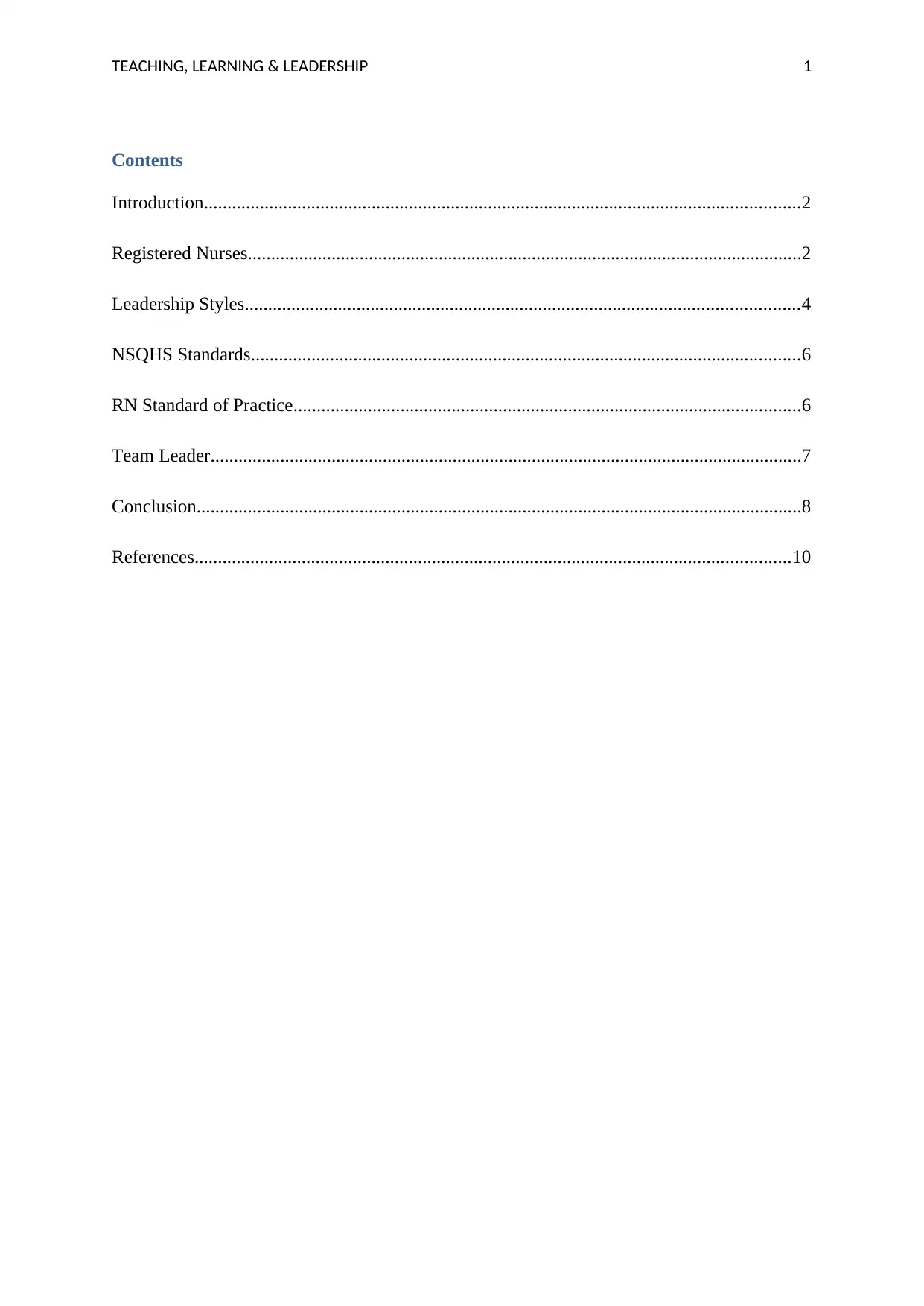
Contents
Introduction................................................................................................................................2
Registered Nurses.......................................................................................................................2
Leadership Styles.......................................................................................................................4
NSQHS Standards......................................................................................................................6
RN Standard of Practice.............................................................................................................6
Team Leader...............................................................................................................................7
Conclusion..................................................................................................................................8
References................................................................................................................................10
Contents
Introduction................................................................................................................................2
Registered Nurses.......................................................................................................................2
Leadership Styles.......................................................................................................................4
NSQHS Standards......................................................................................................................6
RN Standard of Practice.............................................................................................................6
Team Leader...............................................................................................................................7
Conclusion..................................................................................................................................8
References................................................................................................................................10
TEACHING, LEARNING & LEADERSHIP 2
Introduction
Nurses are considered to be an important aspect of the healthcare department. The
main responsibility of a nurse is to take care of the patients. Quality care of nurses can show
positive results in the health of the patients. Nursing has also changed its style. Nursing has
updated itself and now the most important element that is been involved in nursing is the
leadership style. Leadership in nursing is important because it will help nurses in providing
better care to the patient (WHO, 2020). Nurses will also be able to handle and manage issues.
Registered nurses are expected to provide quality care and they are also expected to show
their leadership skills and manage all the activities of the hospital. Registered nurses are
expected to follow a model that is set by the department of healthcare and they can also
provide training to other nurses. In this discussion, a critical evaluation of the responsibilities
of a registered nurse will be presented. Identification of leadership skills and methods of
providing care will also be presented.
Registered Nurses
Registered Nurses are considered to be those nurses who are graduated from a nursing
program. Registered nurses are also known as the team players and they are also expected to
contribute to the mission of the team (All Star Directories, Inc, 2020). Certain responsibilities
are expected to be fulfilled by registered nurses and they are as follows:
Evaluating and reporting the symptoms of patients.
Help during operations and surgeries.
Providing knowledge regarding self-care and health.
They are considered supervisors.
Treating patients.
Introduction
Nurses are considered to be an important aspect of the healthcare department. The
main responsibility of a nurse is to take care of the patients. Quality care of nurses can show
positive results in the health of the patients. Nursing has also changed its style. Nursing has
updated itself and now the most important element that is been involved in nursing is the
leadership style. Leadership in nursing is important because it will help nurses in providing
better care to the patient (WHO, 2020). Nurses will also be able to handle and manage issues.
Registered nurses are expected to provide quality care and they are also expected to show
their leadership skills and manage all the activities of the hospital. Registered nurses are
expected to follow a model that is set by the department of healthcare and they can also
provide training to other nurses. In this discussion, a critical evaluation of the responsibilities
of a registered nurse will be presented. Identification of leadership skills and methods of
providing care will also be presented.
Registered Nurses
Registered Nurses are considered to be those nurses who are graduated from a nursing
program. Registered nurses are also known as the team players and they are also expected to
contribute to the mission of the team (All Star Directories, Inc, 2020). Certain responsibilities
are expected to be fulfilled by registered nurses and they are as follows:
Evaluating and reporting the symptoms of patients.
Help during operations and surgeries.
Providing knowledge regarding self-care and health.
They are considered supervisors.
Treating patients.
⊘ This is a preview!⊘
Do you want full access?
Subscribe today to unlock all pages.

Trusted by 1+ million students worldwide
TEACHING, LEARNING & LEADERSHIP 3
Some standards are set by The National Safety and Quality Health Services Standards.
These standards will provide a stable and uniform set of rules that are related to safety and
quality. These standards address may areas such as consumers, safety and quality healthcare,
medication, safety of patients, blood and its products, clinics and many more. The aim of
designing these standards is to design and assist the healthcare services in the organization
(NSHQS Standards, 2011).
Ten standards are set by the government so that the quality of service can be enhanced.
These standards are as follows:
1. Standard for Governance of safety and maintaining quality in healthcare departments.
2. Standard for building relationship with consumers.
3. Standards for adopting prevention and control.
4. Standard for providing medical safety.
5. Standard for identifying Patients and treat accordingly.
6. Standard for Clinics.
7. Standard for Blood and its products.
8. Prevention for managing injuries.
9. Recognition of clinical deterioration for maintaining health care department.
10. Prevention of harm falls (Nursing and Midwifey Council, 2020).
Many distractions are reset in the environment of hospitals. In this environment also
nurses are expected to deliver their best performance. For that, there is a requirement of
proper and finite plans that can be helpful for nurses. This approach is to analyse and
coordinate the efforts of nurses. There are many complex procedures and situations through
which nurses have to pass through every day. For that proper training and expertise
Some standards are set by The National Safety and Quality Health Services Standards.
These standards will provide a stable and uniform set of rules that are related to safety and
quality. These standards address may areas such as consumers, safety and quality healthcare,
medication, safety of patients, blood and its products, clinics and many more. The aim of
designing these standards is to design and assist the healthcare services in the organization
(NSHQS Standards, 2011).
Ten standards are set by the government so that the quality of service can be enhanced.
These standards are as follows:
1. Standard for Governance of safety and maintaining quality in healthcare departments.
2. Standard for building relationship with consumers.
3. Standards for adopting prevention and control.
4. Standard for providing medical safety.
5. Standard for identifying Patients and treat accordingly.
6. Standard for Clinics.
7. Standard for Blood and its products.
8. Prevention for managing injuries.
9. Recognition of clinical deterioration for maintaining health care department.
10. Prevention of harm falls (Nursing and Midwifey Council, 2020).
Many distractions are reset in the environment of hospitals. In this environment also
nurses are expected to deliver their best performance. For that, there is a requirement of
proper and finite plans that can be helpful for nurses. This approach is to analyse and
coordinate the efforts of nurses. There are many complex procedures and situations through
which nurses have to pass through every day. For that proper training and expertise
Paraphrase This Document
Need a fresh take? Get an instant paraphrase of this document with our AI Paraphraser
TEACHING, LEARNING & LEADERSHIP 4
Clinical reasoning and decision making are two components that help nurses in analysing-
the situation of patients. It also helps them in analysing which treatment can have a positive
effect. Certain methods are required by registered nurses to fulfil their responsibilities and
duties. These methods are namely, HFE quantitative technique, Qualitative technique, and
merging qualitative (Potter, et al., 2005).
Leadership Styles
Leadership styles consist of different types and they are also different for every
department. Leadership style helps the organization in marinating stability. This also helps
the organization in achieving its desired goals. These styles are as follows:
1. Autocratic style
Autocratic leadership is the style in which registered nurse will make all decisions that is
regarding the care of the patients or minor hospitals issues. Registered nurses are also
responsible for giving specific orders and decisions to their teammates or subordinates
(Nurse.com, 2017). This leadership will provide nurses to give instructions to its team
members so that they can ensure quality of service. By adopting this leadership nurses can be
act as a boss.
2. Laissez-Faire Leadership
The Concept of Laissez-Faire Leadership style is the converse concept of the autocratic
leadership style. The Registered nurses in this style provide no specific direction to their tea
members. This leadership can be adopted by registered who are experienced and self-
directed. With the application of this leadership registered nurses should also be able to
handle their team members or subordinates (Durmuş & Kırca, 2019).
3. Democratic Leadership
Clinical reasoning and decision making are two components that help nurses in analysing-
the situation of patients. It also helps them in analysing which treatment can have a positive
effect. Certain methods are required by registered nurses to fulfil their responsibilities and
duties. These methods are namely, HFE quantitative technique, Qualitative technique, and
merging qualitative (Potter, et al., 2005).
Leadership Styles
Leadership styles consist of different types and they are also different for every
department. Leadership style helps the organization in marinating stability. This also helps
the organization in achieving its desired goals. These styles are as follows:
1. Autocratic style
Autocratic leadership is the style in which registered nurse will make all decisions that is
regarding the care of the patients or minor hospitals issues. Registered nurses are also
responsible for giving specific orders and decisions to their teammates or subordinates
(Nurse.com, 2017). This leadership will provide nurses to give instructions to its team
members so that they can ensure quality of service. By adopting this leadership nurses can be
act as a boss.
2. Laissez-Faire Leadership
The Concept of Laissez-Faire Leadership style is the converse concept of the autocratic
leadership style. The Registered nurses in this style provide no specific direction to their tea
members. This leadership can be adopted by registered who are experienced and self-
directed. With the application of this leadership registered nurses should also be able to
handle their team members or subordinates (Durmuş & Kırca, 2019).
3. Democratic Leadership
TEACHING, LEARNING & LEADERSHIP 5
Democratic leadership is the style in which registered nurses are expected to take
feedback from their subordinates. Application of this strategy in healthcare department will
enhance communication among staff members (MAS Medical Staff, 2018). Nursing is also
influenced by stakeholders, environment and behaviour of patients. Nurses are expected to
deal situations and for that communication is the basic element (Sfantou, Laliotis, &
Patelarou, 2017).
4. Transformational Leadership
Transformational leadership is the style in which a registered nurse is focused on the
improvement of patients care (Norwich University Online, 2017). The concepts of
transformational leadership were identified by James Mac Gregor Burns. This leadership help
nurses to build relationship with other nurses and patient. With the help of the leadership
style nurses can also change and update the environment of hospitals. Nurses will also be able
to give fair suggestions to their team members so that quality of care can be provided by the
nurses.
5. Servant Leadership
In this leadership, registered nurses are mainly focused on the achievements of success or
goals. This leadership style has become effective in recent years as competition as increased
in the market. In this style nurses needs to ensure that their leadership, relationship, and tools
elements are efficient in achieving the goals of their leadership.
The type of leadership style that will be chosen by registered nurse depends upon the
environment and prevailing situation. Leadership style will help nurses in providing more
effective and efficient care to patients. This can also result in rapid positive growth in the
health of the patient (Posnick, 2018).
Democratic leadership is the style in which registered nurses are expected to take
feedback from their subordinates. Application of this strategy in healthcare department will
enhance communication among staff members (MAS Medical Staff, 2018). Nursing is also
influenced by stakeholders, environment and behaviour of patients. Nurses are expected to
deal situations and for that communication is the basic element (Sfantou, Laliotis, &
Patelarou, 2017).
4. Transformational Leadership
Transformational leadership is the style in which a registered nurse is focused on the
improvement of patients care (Norwich University Online, 2017). The concepts of
transformational leadership were identified by James Mac Gregor Burns. This leadership help
nurses to build relationship with other nurses and patient. With the help of the leadership
style nurses can also change and update the environment of hospitals. Nurses will also be able
to give fair suggestions to their team members so that quality of care can be provided by the
nurses.
5. Servant Leadership
In this leadership, registered nurses are mainly focused on the achievements of success or
goals. This leadership style has become effective in recent years as competition as increased
in the market. In this style nurses needs to ensure that their leadership, relationship, and tools
elements are efficient in achieving the goals of their leadership.
The type of leadership style that will be chosen by registered nurse depends upon the
environment and prevailing situation. Leadership style will help nurses in providing more
effective and efficient care to patients. This can also result in rapid positive growth in the
health of the patient (Posnick, 2018).
⊘ This is a preview!⊘
Do you want full access?
Subscribe today to unlock all pages.
Trusted by 1+ million students worldwide
TEACHING, LEARNING & LEADERSHIP 6
NSQHS Standards
1. Governance for safety and quality in health service organizations.
Leaders have implemented this standard in health services organizations to monitor,
control and improve the performance of employees of the organization. In this standard
importance is given to the experience of patients in the hospital. The quality of services that
are provided by a nurse is also maintained in this standard. Members that are related to the
healthcare department follow the rules and regulations that are set by the government
(NSHQS Standards, 2011).
2. Partnering with Consumers
Leaders of the healthcare department implement this standard in their hospitals because it
can support relationships with patients, carers and other people. It will also improve the
safety and quality of care that is been provided to patients. The main aim of this standard is to
create a health service. This standard is also responsive towards patients and input of their
needs and requirement (NSHQS Standards, 2011).
3. Clinical Handover
In this standard clinical registered nurses and senior managers of the health care
department. Hospitals will implement documented systems so that effective management can
be possible. Nurses and doctors use these clinical handover systems. The main aim of this
standard is to ensure that there should be timely, relevant and structured clinical handover. It
also supports safe patients care (NSHQS Standards, 2011).
RN Standard of Practice
Some standards are set by the department of healthcare. It requires continuous thinking,
analysis, and maintenance of relationships. Registered Nurses determine, coordinate and
NSQHS Standards
1. Governance for safety and quality in health service organizations.
Leaders have implemented this standard in health services organizations to monitor,
control and improve the performance of employees of the organization. In this standard
importance is given to the experience of patients in the hospital. The quality of services that
are provided by a nurse is also maintained in this standard. Members that are related to the
healthcare department follow the rules and regulations that are set by the government
(NSHQS Standards, 2011).
2. Partnering with Consumers
Leaders of the healthcare department implement this standard in their hospitals because it
can support relationships with patients, carers and other people. It will also improve the
safety and quality of care that is been provided to patients. The main aim of this standard is to
create a health service. This standard is also responsive towards patients and input of their
needs and requirement (NSHQS Standards, 2011).
3. Clinical Handover
In this standard clinical registered nurses and senior managers of the health care
department. Hospitals will implement documented systems so that effective management can
be possible. Nurses and doctors use these clinical handover systems. The main aim of this
standard is to ensure that there should be timely, relevant and structured clinical handover. It
also supports safe patients care (NSHQS Standards, 2011).
RN Standard of Practice
Some standards are set by the department of healthcare. It requires continuous thinking,
analysis, and maintenance of relationships. Registered Nurses determine, coordinate and
Paraphrase This Document
Need a fresh take? Get an instant paraphrase of this document with our AI Paraphraser
TEACHING, LEARNING & LEADERSHIP 7
provide safe and quality nursing. This practice does not involve in hospitals but these
principles are also useful in organizations. Seven principles are been set by the government.
Some of these principles can be demonstrated through teaching so that quality of service can
be ensured. These principles are as follows:
1. Development of plans in nursing can be taught to nurses so that they can also build a
relationship with their team members and they can also provide quality of healthcare
services. Evaluation of data is also an essential element because this relevant
information can be provided to nurses. Coordination can also be taught to nurses so
that all the efforts can be effectively implemented in a direction (Nursing and
Midwifey Board , 2020).
2. Provides safe, appropriate and responsive quality nursing practice. Registered nurses
are also expected to teach their team members that they can also use the appropriate
treatment for their patients. Nurses can also calculate the actual risk that can be
caused to patient and because of that proper and effective treatment can be given to
the patient (Davis, 2018).
3. Evaluation of outcomes to inform nursing practice is also an important standard.
Registered nurses are also required to teach this standard to their subordinates or team
members. This standard will help RN in setting their priority, goals, plans, and
policies. Proper evaluation monitors the outcomes of expected goals (Nursing
Standards, 2010).
Team Leader
Team leaders are considered as those people in an organization who will lead the eth
group of people or teams in the organization. The team leader is also considered to be a role
model who will showcase their leadership style and they will also influence the employees of
provide safe and quality nursing. This practice does not involve in hospitals but these
principles are also useful in organizations. Seven principles are been set by the government.
Some of these principles can be demonstrated through teaching so that quality of service can
be ensured. These principles are as follows:
1. Development of plans in nursing can be taught to nurses so that they can also build a
relationship with their team members and they can also provide quality of healthcare
services. Evaluation of data is also an essential element because this relevant
information can be provided to nurses. Coordination can also be taught to nurses so
that all the efforts can be effectively implemented in a direction (Nursing and
Midwifey Board , 2020).
2. Provides safe, appropriate and responsive quality nursing practice. Registered nurses
are also expected to teach their team members that they can also use the appropriate
treatment for their patients. Nurses can also calculate the actual risk that can be
caused to patient and because of that proper and effective treatment can be given to
the patient (Davis, 2018).
3. Evaluation of outcomes to inform nursing practice is also an important standard.
Registered nurses are also required to teach this standard to their subordinates or team
members. This standard will help RN in setting their priority, goals, plans, and
policies. Proper evaluation monitors the outcomes of expected goals (Nursing
Standards, 2010).
Team Leader
Team leaders are considered as those people in an organization who will lead the eth
group of people or teams in the organization. The team leader is also considered to be a role
model who will showcase their leadership style and they will also influence the employees of
TEACHING, LEARNING & LEADERSHIP 8
the organization (Career Guide, 2020). This will ensure that the timely achievement of goals
can be possible. Certain qualities should be possessed by the team leader and these qualities
are as follows:
Team leaders should have a positive attitude.
Team leaders should be able to build trust.
The team leader should exhibit integrity.
The team leader should inspire people.
The team leader should make time for employees.
The team leader should know its employees.
The team leader should support and encourage people ( Mimeo, 2016).
Teams should possess all these qualities so that their plans and policies can be
implemented in the organization. Team members can also work efficiently and their roles and
deities are also justified by their actions.
Conclusion
Nurses are considered to be an important part of the healthcare department. They are
also expected to follow rules and regulations that are set by the government. These standard
acts as a framework which can provide quality of services in the healthcare department. In
recent years, there have been great changes that are been noticed in the field of the healthcare
department. Now nursing has involved many new and advanced factors such as decision
making, up-gradation of technology, knowledge to solve issues and many more. Training
sessions are also been provided to nurses so that quality of services can be provided to
patients. The team leader also ensures that all the efforts of the teamwork in a single direction
the organization (Career Guide, 2020). This will ensure that the timely achievement of goals
can be possible. Certain qualities should be possessed by the team leader and these qualities
are as follows:
Team leaders should have a positive attitude.
Team leaders should be able to build trust.
The team leader should exhibit integrity.
The team leader should inspire people.
The team leader should make time for employees.
The team leader should know its employees.
The team leader should support and encourage people ( Mimeo, 2016).
Teams should possess all these qualities so that their plans and policies can be
implemented in the organization. Team members can also work efficiently and their roles and
deities are also justified by their actions.
Conclusion
Nurses are considered to be an important part of the healthcare department. They are
also expected to follow rules and regulations that are set by the government. These standard
acts as a framework which can provide quality of services in the healthcare department. In
recent years, there have been great changes that are been noticed in the field of the healthcare
department. Now nursing has involved many new and advanced factors such as decision
making, up-gradation of technology, knowledge to solve issues and many more. Training
sessions are also been provided to nurses so that quality of services can be provided to
patients. The team leader also ensures that all the efforts of the teamwork in a single direction
⊘ This is a preview!⊘
Do you want full access?
Subscribe today to unlock all pages.
Trusted by 1+ million students worldwide

TEACHING, LEARNING & LEADERSHIP 9
so that goals can be achieved. In this discussion, different standards of nursing are presented.
All these standards are followed and that is ensured by Registered Nurse.
Team Leader is considered to be one of the most important members. Not only in
hospitals had team members played a vital role in the organization as well. In this discussion
teaching practices of Registered nurses are also discussed. RN Standards can be followed in
origination as well. This ensures that timely achievement of goals can be possible.
so that goals can be achieved. In this discussion, different standards of nursing are presented.
All these standards are followed and that is ensured by Registered Nurse.
Team Leader is considered to be one of the most important members. Not only in
hospitals had team members played a vital role in the organization as well. In this discussion
teaching practices of Registered nurses are also discussed. RN Standards can be followed in
origination as well. This ensures that timely achievement of goals can be possible.
Paraphrase This Document
Need a fresh take? Get an instant paraphrase of this document with our AI Paraphraser
TEACHING, LEARNING & LEADERSHIP 10
References
Mimeo. (2016, 10 14). Leadership: 7 Ways to Become a Role Model Manager. 03 22, 2020,
Mimeo: https://www.mimeo.com/blog/leadership-role-models/
Nursing Standards. (2010, 12 22). 03 22, 2020, Nursing Management:
http://currentnursing.com/nursing_management/nursing_standards.html
All Star Directories, Inc. (2020). What You’ll Do as an RN. 03 21, 2020, All Star
Directories, Inc: https://www.allnursingschools.com/registered-nursing/job-
description/
Career Guide. (2020, 03 19). 5 Roles and Responsibilities of a Team Leader. 03 22, 2020,
Career Guide:
https://www.indeed.com/career-advice/career-development/responsibilities-of-a-team-
leader
Davis, C. (2018, 10). The importance of professional standards. 03 21, 2020, Wolters Kluwer
Health, Inc.:
https://journals.lww.com/nursingmadeincrediblyeasy/fulltext/2014/09000/
the_importance_of_professional_standards.1.aspx
Durmuş, S. Ç., & Kırca, K. (2019, 09 11). Leadership Styles in Nursing. 03 22, 2020, Intech
Open : https://www.intechopen.com/online-first/leadership-styles-in-nursing
MAS Medical Staff. (2018, 02 08). 7 Types of Leadership Styles in Nursing. 03 22, 2020,
MAS Medical Staff: https://www.masmedicalstaffing.com/2018/02/08/types-of-
leadership-styles-in-nursing/
References
Mimeo. (2016, 10 14). Leadership: 7 Ways to Become a Role Model Manager. 03 22, 2020,
Mimeo: https://www.mimeo.com/blog/leadership-role-models/
Nursing Standards. (2010, 12 22). 03 22, 2020, Nursing Management:
http://currentnursing.com/nursing_management/nursing_standards.html
All Star Directories, Inc. (2020). What You’ll Do as an RN. 03 21, 2020, All Star
Directories, Inc: https://www.allnursingschools.com/registered-nursing/job-
description/
Career Guide. (2020, 03 19). 5 Roles and Responsibilities of a Team Leader. 03 22, 2020,
Career Guide:
https://www.indeed.com/career-advice/career-development/responsibilities-of-a-team-
leader
Davis, C. (2018, 10). The importance of professional standards. 03 21, 2020, Wolters Kluwer
Health, Inc.:
https://journals.lww.com/nursingmadeincrediblyeasy/fulltext/2014/09000/
the_importance_of_professional_standards.1.aspx
Durmuş, S. Ç., & Kırca, K. (2019, 09 11). Leadership Styles in Nursing. 03 22, 2020, Intech
Open : https://www.intechopen.com/online-first/leadership-styles-in-nursing
MAS Medical Staff. (2018, 02 08). 7 Types of Leadership Styles in Nursing. 03 22, 2020,
MAS Medical Staff: https://www.masmedicalstaffing.com/2018/02/08/types-of-
leadership-styles-in-nursing/
TEACHING, LEARNING & LEADERSHIP 11
Norwich University Online. (2017, 12 04). 5 Leadership Styles for Clinical Nurse Leaders.
03 22, 2020, Norwich University Online: https://online.norwich.edu/academic-
programs/resources/5-leadership-styles-for-clinical-nurse-leaders
NSHQS Standards. (2011). The National Safety and Quality Health Service Standards. 03 21,
2020, NSHQS Standards:
https://www.safetyandquality.gov.au/sites/default/files/migrated/NSQHS-Standards-
Sept2011.pdf
Nurse.com. (2017, 07 07). What’s your leadership style? 03 22, 2020, Nurse.com:
https://www.nurse.com/blog/2017/07/07/whats-your-leadership-style/
Nursing and Midwifey Board . (2020). Registered nurse standards for practice. 03 22, 2020,
Nursing and Midwifey Board: https://www.nursingmidwiferyboard.gov.au/codes-
guidelines-statements/professional-standards/registered-nurse-standards-for-
practice.aspx
Nursing and Midwifey Council. (2020). Standards of proficiency for registered nurses. 03 22,
2020, Nursing and Midwifey Council: https://www.nmc.org.uk/standards/standards-
for-nurses/standards-of-proficiency-for-registered-nurses/
Posnick, S. (2018). 5 Nursing Leadership Styles You’ll Come to Learn as a Nurse. 03 21,
2020, The Job Network: https://www.thejobnetwork.com/5-nursing-leadership-styles-
utilize-122016/
Potter, P., Wolf, L., Boxerman, S., Grayson, D., Sledge, J., Dunagan, C., et al. (2005). An
Analysis of Nurses' Cognitive Work: A New Perspective for Understanding Medical
Errors. 03 21, 2020, NCBI: https://www.ncbi.nlm.nih.gov/books/NBK20475/
Norwich University Online. (2017, 12 04). 5 Leadership Styles for Clinical Nurse Leaders.
03 22, 2020, Norwich University Online: https://online.norwich.edu/academic-
programs/resources/5-leadership-styles-for-clinical-nurse-leaders
NSHQS Standards. (2011). The National Safety and Quality Health Service Standards. 03 21,
2020, NSHQS Standards:
https://www.safetyandquality.gov.au/sites/default/files/migrated/NSQHS-Standards-
Sept2011.pdf
Nurse.com. (2017, 07 07). What’s your leadership style? 03 22, 2020, Nurse.com:
https://www.nurse.com/blog/2017/07/07/whats-your-leadership-style/
Nursing and Midwifey Board . (2020). Registered nurse standards for practice. 03 22, 2020,
Nursing and Midwifey Board: https://www.nursingmidwiferyboard.gov.au/codes-
guidelines-statements/professional-standards/registered-nurse-standards-for-
practice.aspx
Nursing and Midwifey Council. (2020). Standards of proficiency for registered nurses. 03 22,
2020, Nursing and Midwifey Council: https://www.nmc.org.uk/standards/standards-
for-nurses/standards-of-proficiency-for-registered-nurses/
Posnick, S. (2018). 5 Nursing Leadership Styles You’ll Come to Learn as a Nurse. 03 21,
2020, The Job Network: https://www.thejobnetwork.com/5-nursing-leadership-styles-
utilize-122016/
Potter, P., Wolf, L., Boxerman, S., Grayson, D., Sledge, J., Dunagan, C., et al. (2005). An
Analysis of Nurses' Cognitive Work: A New Perspective for Understanding Medical
Errors. 03 21, 2020, NCBI: https://www.ncbi.nlm.nih.gov/books/NBK20475/
⊘ This is a preview!⊘
Do you want full access?
Subscribe today to unlock all pages.
Trusted by 1+ million students worldwide

1 out of 13


Related Documents


Your All-in-One AI-Powered Toolkit for Academic Success.
+13062052269
info@desklib.com
Available 24*7 on WhatsApp / Email
![[object Object]](/_next/static/media/star-bottom.7253800d.svg)
Unlock your academic potential
Copyright © 2020–2026 A2Z Services. All Rights Reserved. Developed and managed by ZUCOL.