Exploring Medication Errors and Registered Nurse Responsibilities
VerifiedAdded on 2022/09/17
|7
|1870
|21
Essay
AI Summary
This essay critically analyzes the safety issue of medication errors within the mental health sector, specifically focusing on the Australian healthcare system. The essay highlights the vulnerability of middle-aged individuals with mental illnesses to medication errors, attributing this to communication challenges and inadequate mental health unit formulation. The analysis draws upon various research studies to quantify the prevalence and impact of these errors, including increased hospital stays, re-admissions, and adverse drug reactions. Furthermore, the essay explores the role and responsibilities of registered nurses in preventing medication errors, emphasizing the need for training, skill enhancement, and adherence to professional standards. The discussion underscores the importance of patient safety and suggests evidence-based recommendations to mitigate medication errors and promote better health outcomes for patients in mental health settings. The essay concludes by reiterating the significance of registered nurses in ensuring safe and effective care within mental health units.
Running head: SAFETY ISSUE IN HEALTH CARE SECTOR
SAFETY ISSUE IN HEALTH CARE SECTOR
Name of Student:
Name of University:
Author’s Note:
SAFETY ISSUE IN HEALTH CARE SECTOR
Name of Student:
Name of University:
Author’s Note:
Paraphrase This Document
Need a fresh take? Get an instant paraphrase of this document with our AI Paraphraser

1SAFETY ISSUE IN HEALTH CARE SECTOR
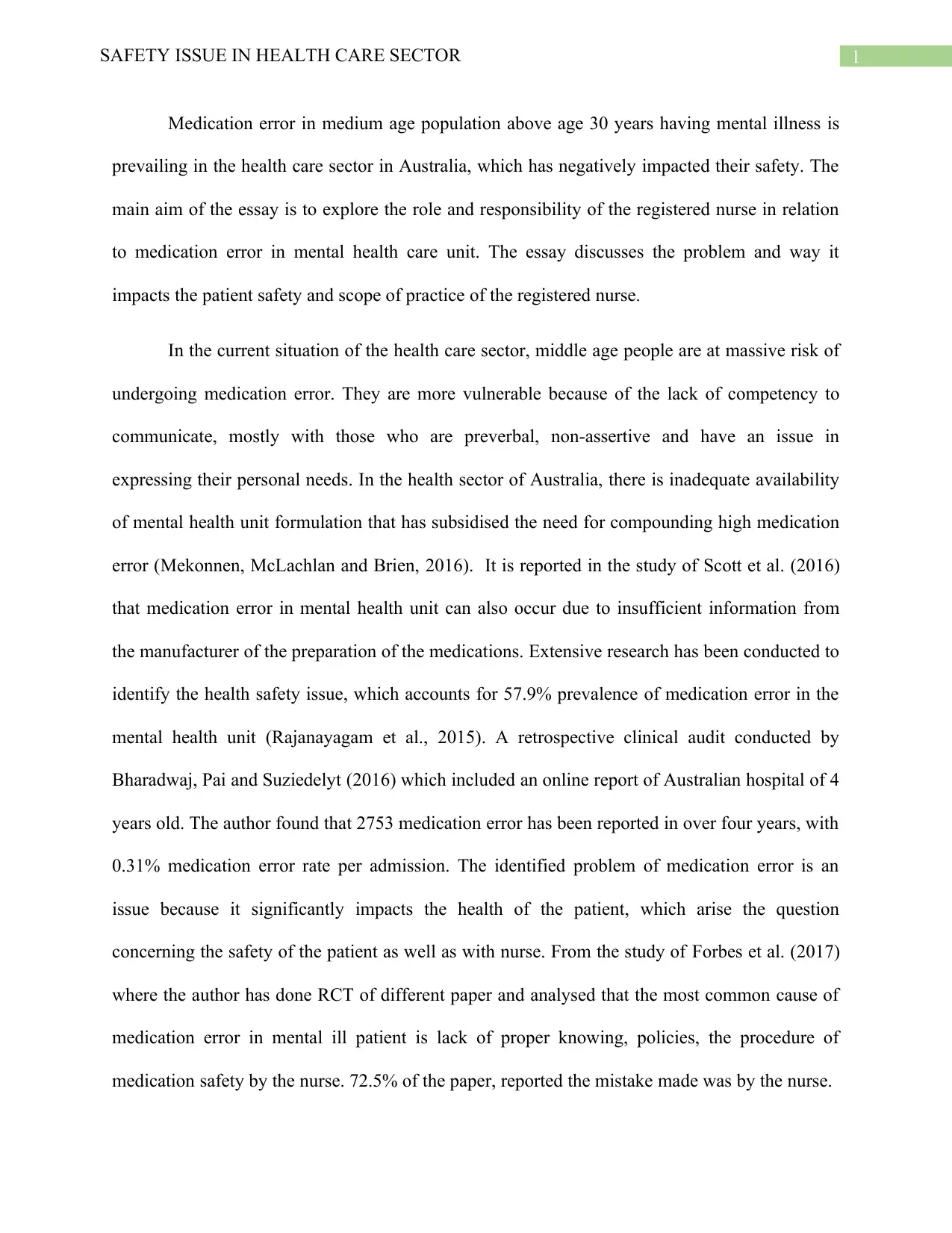
Medication error in medium age population above age 30 years having mental illness is
prevailing in the health care sector in Australia, which has negatively impacted their safety. The
main aim of the essay is to explore the role and responsibility of the registered nurse in relation
to medication error in mental health care unit. The essay discusses the problem and way it
impacts the patient safety and scope of practice of the registered nurse.
In the current situation of the health care sector, middle age people are at massive risk of
undergoing medication error. They are more vulnerable because of the lack of competency to
communicate, mostly with those who are preverbal, non-assertive and have an issue in
expressing their personal needs. In the health sector of Australia, there is inadequate availability
of mental health unit formulation that has subsidised the need for compounding high medication
error (Mekonnen, McLachlan and Brien, 2016). It is reported in the study of Scott et al. (2016)
that medication error in mental health unit can also occur due to insufficient information from
the manufacturer of the preparation of the medications. Extensive research has been conducted to
identify the health safety issue, which accounts for 57.9% prevalence of medication error in the
mental health unit (Rajanayagam et al., 2015). A retrospective clinical audit conducted by
Bharadwaj, Pai and Suziedelyt (2016) which included an online report of Australian hospital of 4
years old. The author found that 2753 medication error has been reported in over four years, with
0.31% medication error rate per admission. The identified problem of medication error is an
issue because it significantly impacts the health of the patient, which arise the question
concerning the safety of the patient as well as with nurse. From the study of Forbes et al. (2017)
where the author has done RCT of different paper and analysed that the most common cause of
medication error in mental ill patient is lack of proper knowing, policies, the procedure of
medication safety by the nurse. 72.5% of the paper, reported the mistake made was by the nurse.
Medication error in medium age population above age 30 years having mental illness is
prevailing in the health care sector in Australia, which has negatively impacted their safety. The
main aim of the essay is to explore the role and responsibility of the registered nurse in relation
to medication error in mental health care unit. The essay discusses the problem and way it
impacts the patient safety and scope of practice of the registered nurse.
In the current situation of the health care sector, middle age people are at massive risk of
undergoing medication error. They are more vulnerable because of the lack of competency to
communicate, mostly with those who are preverbal, non-assertive and have an issue in
expressing their personal needs. In the health sector of Australia, there is inadequate availability
of mental health unit formulation that has subsidised the need for compounding high medication
error (Mekonnen, McLachlan and Brien, 2016). It is reported in the study of Scott et al. (2016)
that medication error in mental health unit can also occur due to insufficient information from
the manufacturer of the preparation of the medications. Extensive research has been conducted to
identify the health safety issue, which accounts for 57.9% prevalence of medication error in the
mental health unit (Rajanayagam et al., 2015). A retrospective clinical audit conducted by
Bharadwaj, Pai and Suziedelyt (2016) which included an online report of Australian hospital of 4
years old. The author found that 2753 medication error has been reported in over four years, with
0.31% medication error rate per admission. The identified problem of medication error is an
issue because it significantly impacts the health of the patient, which arise the question
concerning the safety of the patient as well as with nurse. From the study of Forbes et al. (2017)
where the author has done RCT of different paper and analysed that the most common cause of
medication error in mental ill patient is lack of proper knowing, policies, the procedure of
medication safety by the nurse. 72.5% of the paper, reported the mistake made was by the nurse.

2SAFETY ISSUE IN HEALTH CARE SECTOR
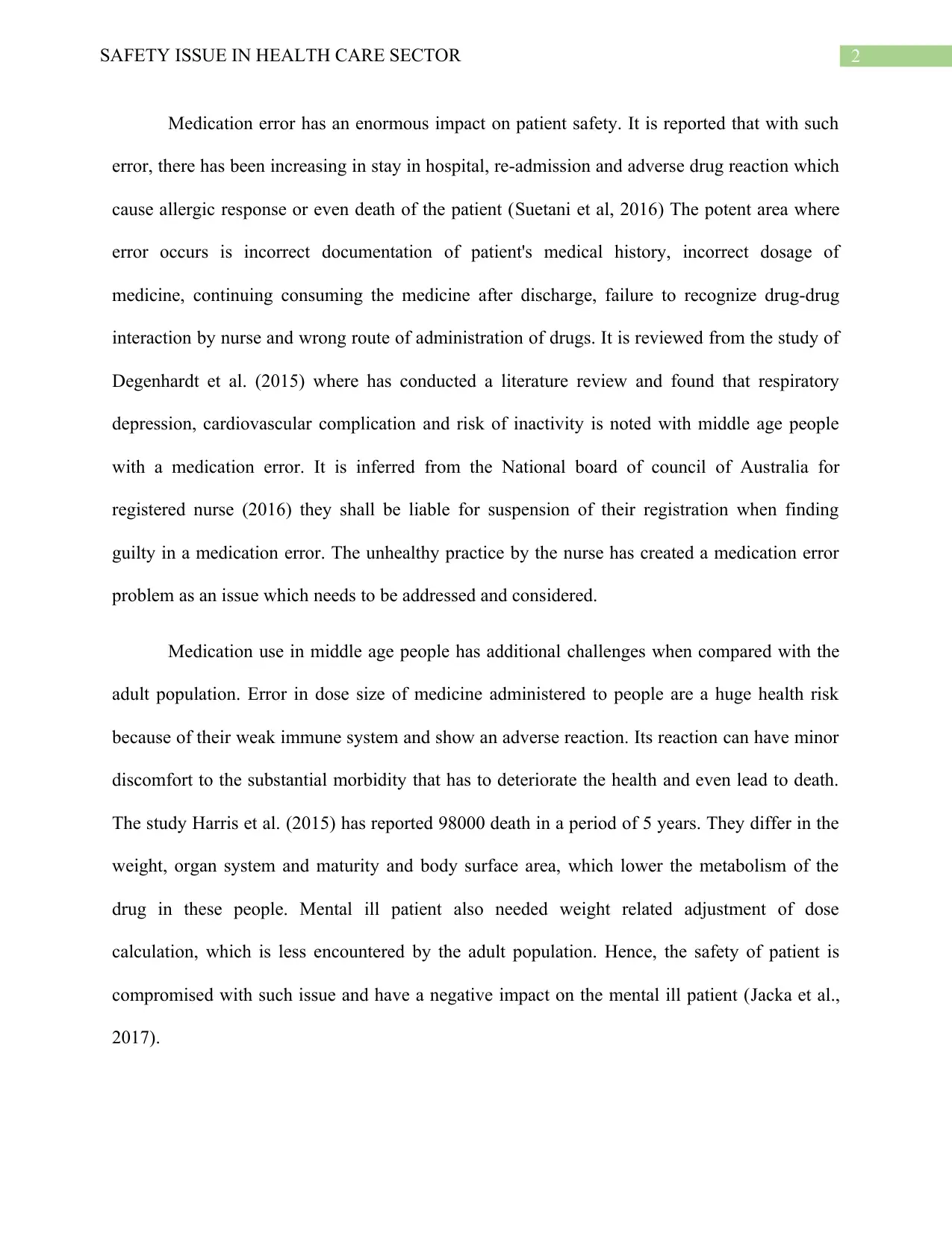
Medication error has an enormous impact on patient safety. It is reported that with such
error, there has been increasing in stay in hospital, re-admission and adverse drug reaction which
cause allergic response or even death of the patient (Suetani et al, 2016) The potent area where
error occurs is incorrect documentation of patient's medical history, incorrect dosage of
medicine, continuing consuming the medicine after discharge, failure to recognize drug-drug
interaction by nurse and wrong route of administration of drugs. It is reviewed from the study of
Degenhardt et al. (2015) where has conducted a literature review and found that respiratory
depression, cardiovascular complication and risk of inactivity is noted with middle age people
with a medication error. It is inferred from the National board of council of Australia for
registered nurse (2016) they shall be liable for suspension of their registration when finding
guilty in a medication error. The unhealthy practice by the nurse has created a medication error
problem as an issue which needs to be addressed and considered.
Medication use in middle age people has additional challenges when compared with the
adult population. Error in dose size of medicine administered to people are a huge health risk
because of their weak immune system and show an adverse reaction. Its reaction can have minor
discomfort to the substantial morbidity that has to deteriorate the health and even lead to death.
The study Harris et al. (2015) has reported 98000 death in a period of 5 years. They differ in the
weight, organ system and maturity and body surface area, which lower the metabolism of the
drug in these people. Mental ill patient also needed weight related adjustment of dose
calculation, which is less encountered by the adult population. Hence, the safety of patient is
compromised with such issue and have a negative impact on the mental ill patient (Jacka et al.,
2017).
Medication error has an enormous impact on patient safety. It is reported that with such
error, there has been increasing in stay in hospital, re-admission and adverse drug reaction which
cause allergic response or even death of the patient (Suetani et al, 2016) The potent area where
error occurs is incorrect documentation of patient's medical history, incorrect dosage of
medicine, continuing consuming the medicine after discharge, failure to recognize drug-drug
interaction by nurse and wrong route of administration of drugs. It is reviewed from the study of
Degenhardt et al. (2015) where has conducted a literature review and found that respiratory
depression, cardiovascular complication and risk of inactivity is noted with middle age people
with a medication error. It is inferred from the National board of council of Australia for
registered nurse (2016) they shall be liable for suspension of their registration when finding
guilty in a medication error. The unhealthy practice by the nurse has created a medication error
problem as an issue which needs to be addressed and considered.
Medication use in middle age people has additional challenges when compared with the
adult population. Error in dose size of medicine administered to people are a huge health risk
because of their weak immune system and show an adverse reaction. Its reaction can have minor
discomfort to the substantial morbidity that has to deteriorate the health and even lead to death.
The study Harris et al. (2015) has reported 98000 death in a period of 5 years. They differ in the
weight, organ system and maturity and body surface area, which lower the metabolism of the
drug in these people. Mental ill patient also needed weight related adjustment of dose
calculation, which is less encountered by the adult population. Hence, the safety of patient is
compromised with such issue and have a negative impact on the mental ill patient (Jacka et al.,
2017).
⊘ This is a preview!⊘
Do you want full access?
Subscribe today to unlock all pages.

Trusted by 1+ million students worldwide

3SAFETY ISSUE IN HEALTH CARE SECTOR
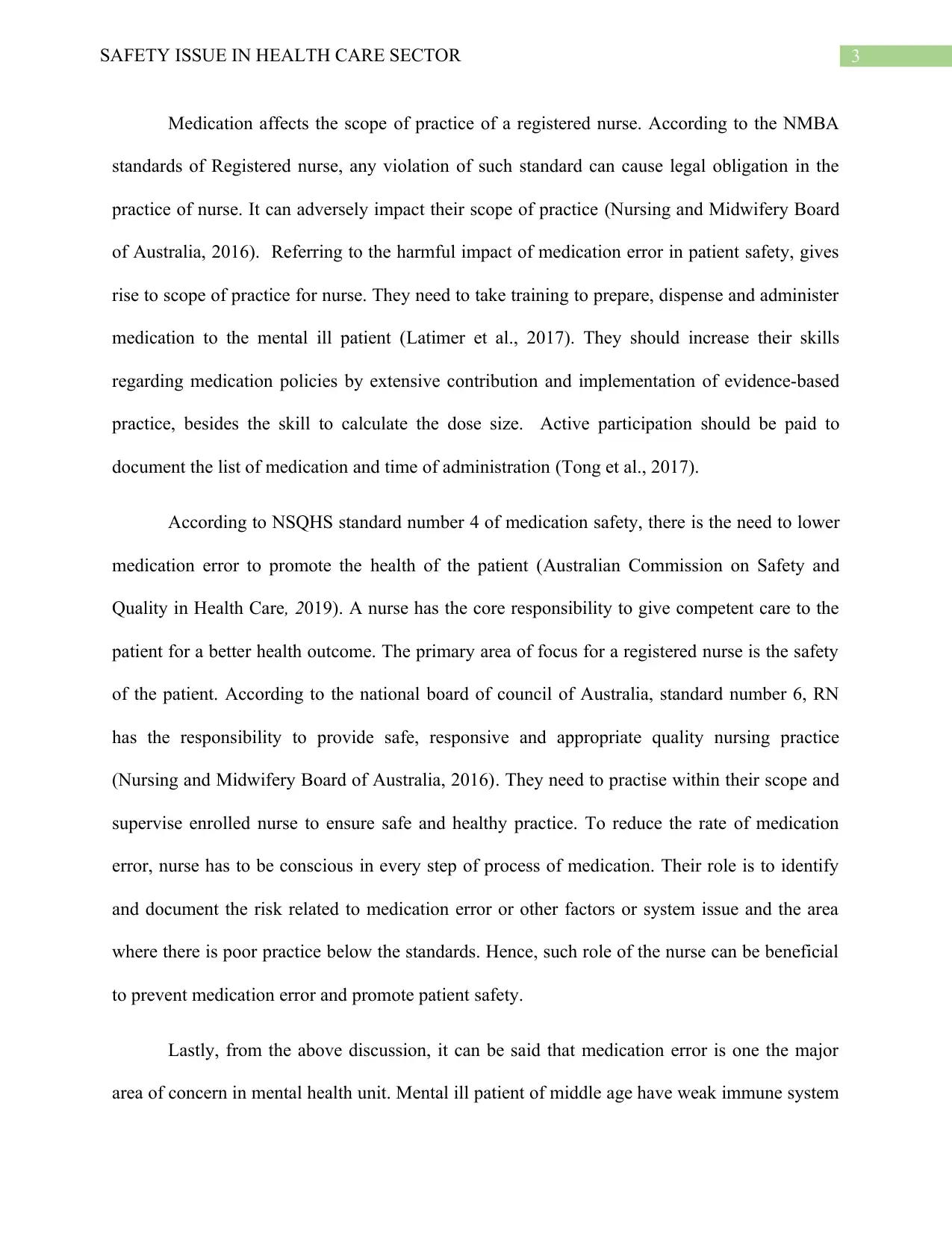
Medication affects the scope of practice of a registered nurse. According to the NMBA
standards of Registered nurse, any violation of such standard can cause legal obligation in the
practice of nurse. It can adversely impact their scope of practice (Nursing and Midwifery Board
of Australia, 2016). Referring to the harmful impact of medication error in patient safety, gives
rise to scope of practice for nurse. They need to take training to prepare, dispense and administer
medication to the mental ill patient (Latimer et al., 2017). They should increase their skills
regarding medication policies by extensive contribution and implementation of evidence-based
practice, besides the skill to calculate the dose size. Active participation should be paid to
document the list of medication and time of administration (Tong et al., 2017).
According to NSQHS standard number 4 of medication safety, there is the need to lower
medication error to promote the health of the patient (Australian Commission on Safety and
Quality in Health Care, 2019). A nurse has the core responsibility to give competent care to the
patient for a better health outcome. The primary area of focus for a registered nurse is the safety
of the patient. According to the national board of council of Australia, standard number 6, RN
has the responsibility to provide safe, responsive and appropriate quality nursing practice
(Nursing and Midwifery Board of Australia, 2016). They need to practise within their scope and
supervise enrolled nurse to ensure safe and healthy practice. To reduce the rate of medication
error, nurse has to be conscious in every step of process of medication. Their role is to identify
and document the risk related to medication error or other factors or system issue and the area
where there is poor practice below the standards. Hence, such role of the nurse can be beneficial
to prevent medication error and promote patient safety.
Lastly, from the above discussion, it can be said that medication error is one the major
area of concern in mental health unit. Mental ill patient of middle age have weak immune system
Medication affects the scope of practice of a registered nurse. According to the NMBA
standards of Registered nurse, any violation of such standard can cause legal obligation in the
practice of nurse. It can adversely impact their scope of practice (Nursing and Midwifery Board
of Australia, 2016). Referring to the harmful impact of medication error in patient safety, gives
rise to scope of practice for nurse. They need to take training to prepare, dispense and administer
medication to the mental ill patient (Latimer et al., 2017). They should increase their skills
regarding medication policies by extensive contribution and implementation of evidence-based
practice, besides the skill to calculate the dose size. Active participation should be paid to
document the list of medication and time of administration (Tong et al., 2017).
According to NSQHS standard number 4 of medication safety, there is the need to lower
medication error to promote the health of the patient (Australian Commission on Safety and
Quality in Health Care, 2019). A nurse has the core responsibility to give competent care to the
patient for a better health outcome. The primary area of focus for a registered nurse is the safety
of the patient. According to the national board of council of Australia, standard number 6, RN
has the responsibility to provide safe, responsive and appropriate quality nursing practice
(Nursing and Midwifery Board of Australia, 2016). They need to practise within their scope and
supervise enrolled nurse to ensure safe and healthy practice. To reduce the rate of medication
error, nurse has to be conscious in every step of process of medication. Their role is to identify
and document the risk related to medication error or other factors or system issue and the area
where there is poor practice below the standards. Hence, such role of the nurse can be beneficial
to prevent medication error and promote patient safety.
Lastly, from the above discussion, it can be said that medication error is one the major
area of concern in mental health unit. Mental ill patient of middle age have weak immune system
Paraphrase This Document
Need a fresh take? Get an instant paraphrase of this document with our AI Paraphraser

4SAFETY ISSUE IN HEALTH CARE SECTOR
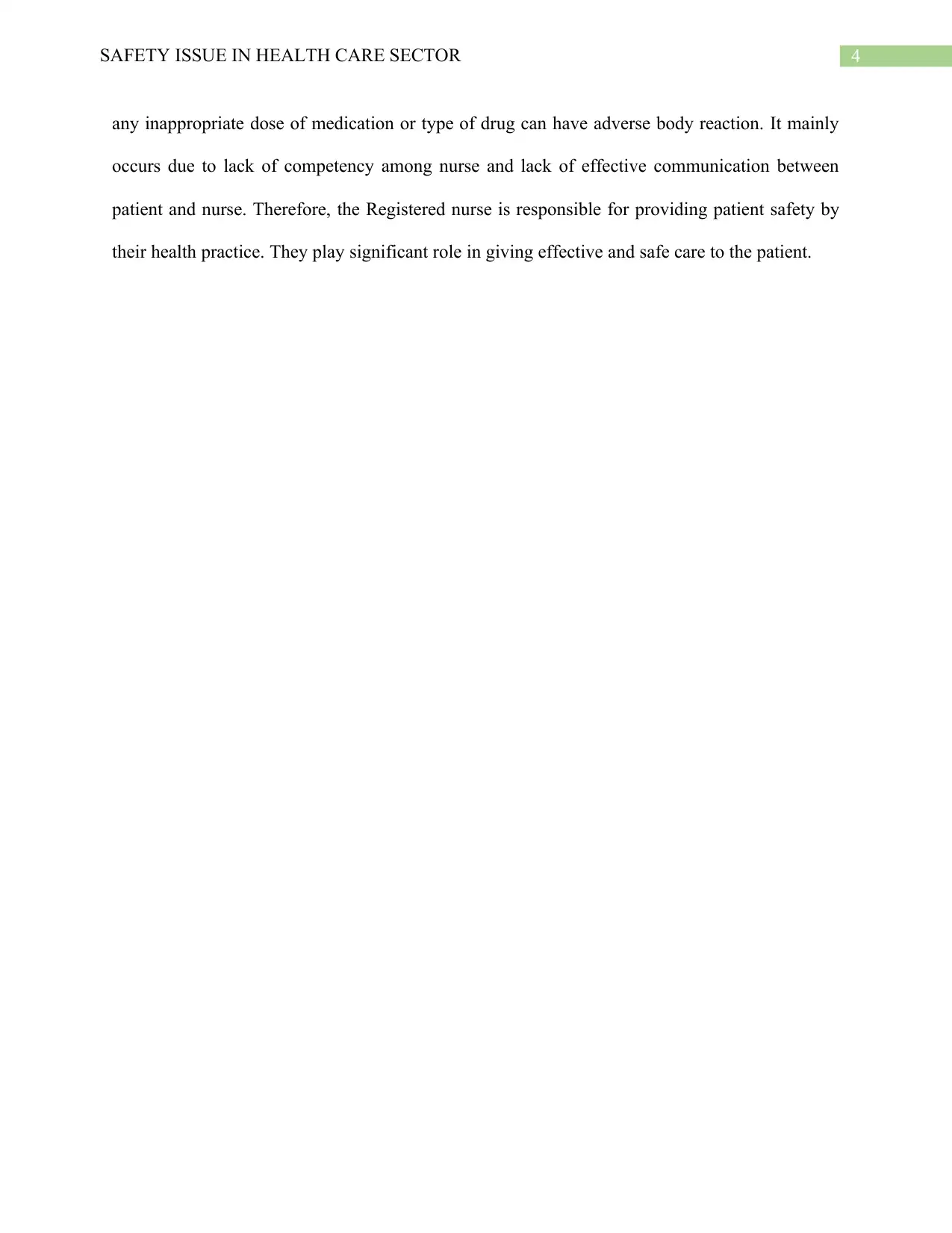
any inappropriate dose of medication or type of drug can have adverse body reaction. It mainly
occurs due to lack of competency among nurse and lack of effective communication between
patient and nurse. Therefore, the Registered nurse is responsible for providing patient safety by
their health practice. They play significant role in giving effective and safe care to the patient.
any inappropriate dose of medication or type of drug can have adverse body reaction. It mainly
occurs due to lack of competency among nurse and lack of effective communication between
patient and nurse. Therefore, the Registered nurse is responsible for providing patient safety by
their health practice. They play significant role in giving effective and safe care to the patient.

5SAFETY ISSUE IN HEALTH CARE SECTOR
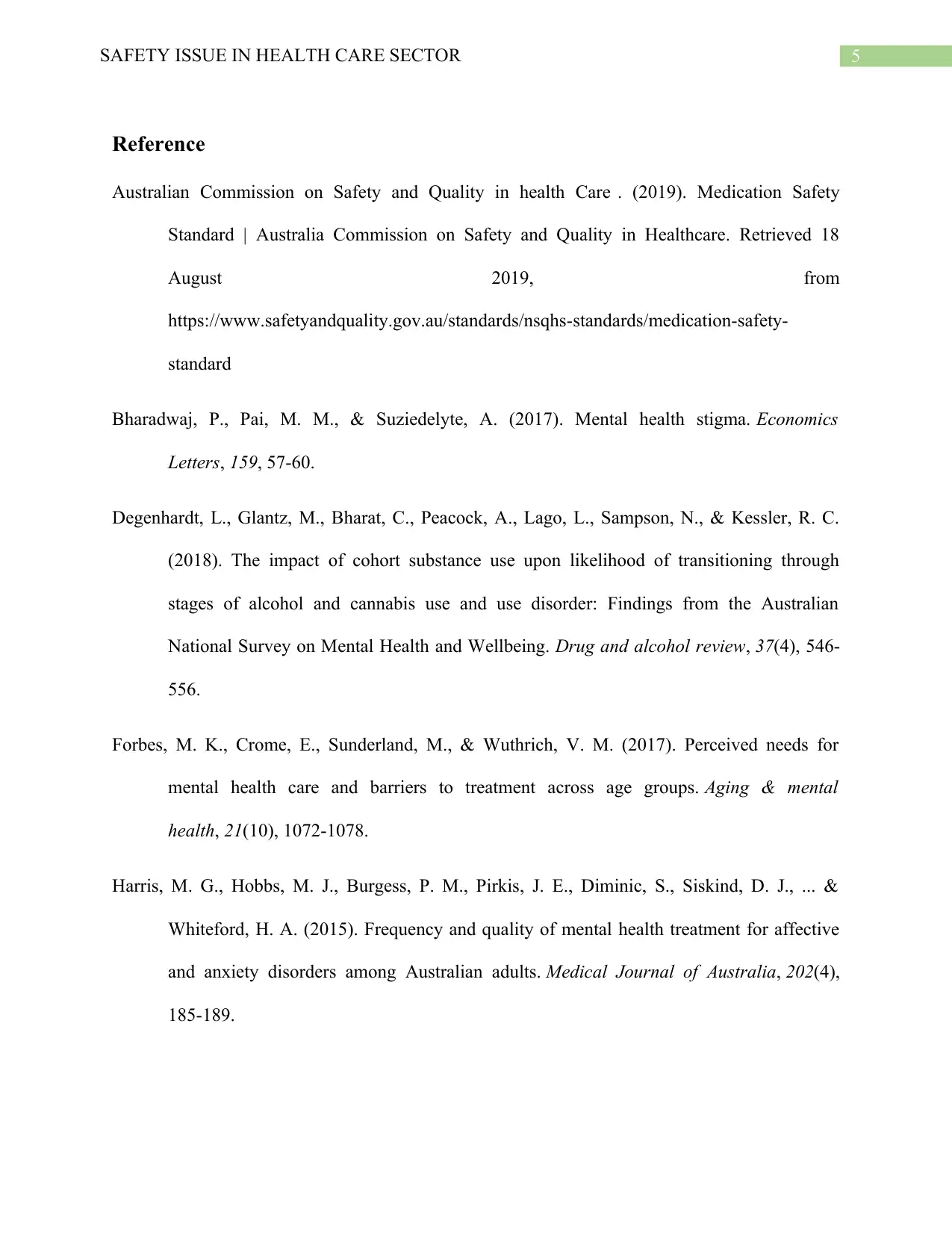
Reference
Australian Commission on Safety and Quality in health Care . (2019). Medication Safety
Standard | Australia Commission on Safety and Quality in Healthcare. Retrieved 18
August 2019, from
https://www.safetyandquality.gov.au/standards/nsqhs-standards/medication-safety-
standard
Bharadwaj, P., Pai, M. M., & Suziedelyte, A. (2017). Mental health stigma. Economics
Letters, 159, 57-60.
Degenhardt, L., Glantz, M., Bharat, C., Peacock, A., Lago, L., Sampson, N., & Kessler, R. C.
(2018). The impact of cohort substance use upon likelihood of transitioning through
stages of alcohol and cannabis use and use disorder: Findings from the Australian
National Survey on Mental Health and Wellbeing. Drug and alcohol review, 37(4), 546-
556.
Forbes, M. K., Crome, E., Sunderland, M., & Wuthrich, V. M. (2017). Perceived needs for
mental health care and barriers to treatment across age groups. Aging & mental
health, 21(10), 1072-1078.
Harris, M. G., Hobbs, M. J., Burgess, P. M., Pirkis, J. E., Diminic, S., Siskind, D. J., ... &
Whiteford, H. A. (2015). Frequency and quality of mental health treatment for affective
and anxiety disorders among Australian adults. Medical Journal of Australia, 202(4),
185-189.
Reference
Australian Commission on Safety and Quality in health Care . (2019). Medication Safety
Standard | Australia Commission on Safety and Quality in Healthcare. Retrieved 18
August 2019, from
https://www.safetyandquality.gov.au/standards/nsqhs-standards/medication-safety-
standard
Bharadwaj, P., Pai, M. M., & Suziedelyte, A. (2017). Mental health stigma. Economics
Letters, 159, 57-60.
Degenhardt, L., Glantz, M., Bharat, C., Peacock, A., Lago, L., Sampson, N., & Kessler, R. C.
(2018). The impact of cohort substance use upon likelihood of transitioning through
stages of alcohol and cannabis use and use disorder: Findings from the Australian
National Survey on Mental Health and Wellbeing. Drug and alcohol review, 37(4), 546-
556.
Forbes, M. K., Crome, E., Sunderland, M., & Wuthrich, V. M. (2017). Perceived needs for
mental health care and barriers to treatment across age groups. Aging & mental
health, 21(10), 1072-1078.
Harris, M. G., Hobbs, M. J., Burgess, P. M., Pirkis, J. E., Diminic, S., Siskind, D. J., ... &
Whiteford, H. A. (2015). Frequency and quality of mental health treatment for affective
and anxiety disorders among Australian adults. Medical Journal of Australia, 202(4),
185-189.
⊘ This is a preview!⊘
Do you want full access?
Subscribe today to unlock all pages.

Trusted by 1+ million students worldwide

6SAFETY ISSUE IN HEALTH CARE SECTOR
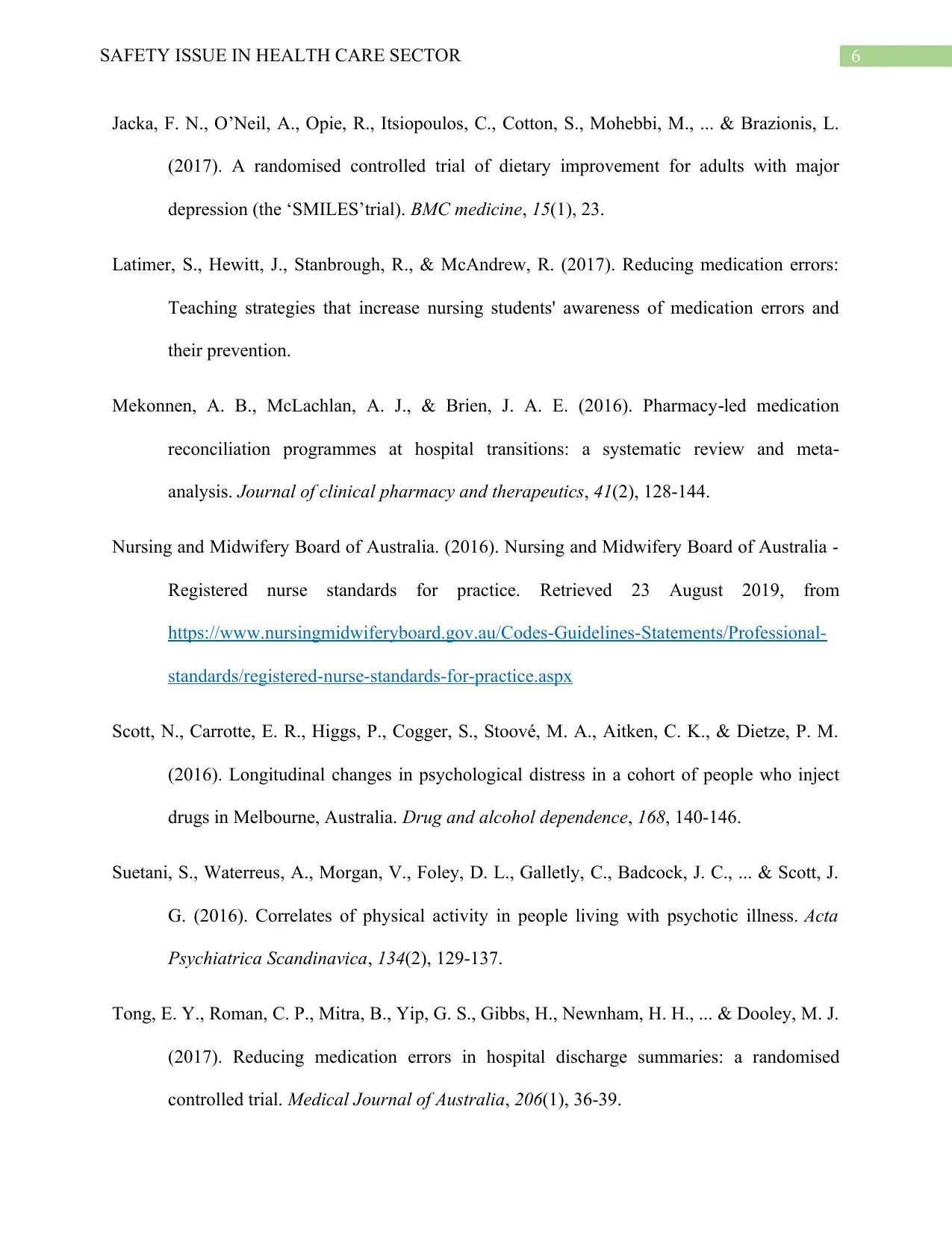
Jacka, F. N., O’Neil, A., Opie, R., Itsiopoulos, C., Cotton, S., Mohebbi, M., ... & Brazionis, L.
(2017). A randomised controlled trial of dietary improvement for adults with major
depression (the ‘SMILES’trial). BMC medicine, 15(1), 23.
Latimer, S., Hewitt, J., Stanbrough, R., & McAndrew, R. (2017). Reducing medication errors:
Teaching strategies that increase nursing students' awareness of medication errors and
their prevention.
Mekonnen, A. B., McLachlan, A. J., & Brien, J. A. E. (2016). Pharmacy led medication‐
reconciliation programmes at hospital transitions: a systematic review and meta‐
analysis. Journal of clinical pharmacy and therapeutics, 41(2), 128-144.
Nursing and Midwifery Board of Australia. (2016). Nursing and Midwifery Board of Australia -
Registered nurse standards for practice. Retrieved 23 August 2019, from
https://www.nursingmidwiferyboard.gov.au/Codes-Guidelines-Statements/Professional-
standards/registered-nurse-standards-for-practice.aspx
Scott, N., Carrotte, E. R., Higgs, P., Cogger, S., Stoové, M. A., Aitken, C. K., & Dietze, P. M.
(2016). Longitudinal changes in psychological distress in a cohort of people who inject
drugs in Melbourne, Australia. Drug and alcohol dependence, 168, 140-146.
Suetani, S., Waterreus, A., Morgan, V., Foley, D. L., Galletly, C., Badcock, J. C., ... & Scott, J.
G. (2016). Correlates of physical activity in people living with psychotic illness. Acta
Psychiatrica Scandinavica, 134(2), 129-137.
Tong, E. Y., Roman, C. P., Mitra, B., Yip, G. S., Gibbs, H., Newnham, H. H., ... & Dooley, M. J.
(2017). Reducing medication errors in hospital discharge summaries: a randomised
controlled trial. Medical Journal of Australia, 206(1), 36-39.
Jacka, F. N., O’Neil, A., Opie, R., Itsiopoulos, C., Cotton, S., Mohebbi, M., ... & Brazionis, L.
(2017). A randomised controlled trial of dietary improvement for adults with major
depression (the ‘SMILES’trial). BMC medicine, 15(1), 23.
Latimer, S., Hewitt, J., Stanbrough, R., & McAndrew, R. (2017). Reducing medication errors:
Teaching strategies that increase nursing students' awareness of medication errors and
their prevention.
Mekonnen, A. B., McLachlan, A. J., & Brien, J. A. E. (2016). Pharmacy led medication‐
reconciliation programmes at hospital transitions: a systematic review and meta‐
analysis. Journal of clinical pharmacy and therapeutics, 41(2), 128-144.
Nursing and Midwifery Board of Australia. (2016). Nursing and Midwifery Board of Australia -
Registered nurse standards for practice. Retrieved 23 August 2019, from
https://www.nursingmidwiferyboard.gov.au/Codes-Guidelines-Statements/Professional-
standards/registered-nurse-standards-for-practice.aspx
Scott, N., Carrotte, E. R., Higgs, P., Cogger, S., Stoové, M. A., Aitken, C. K., & Dietze, P. M.
(2016). Longitudinal changes in psychological distress in a cohort of people who inject
drugs in Melbourne, Australia. Drug and alcohol dependence, 168, 140-146.
Suetani, S., Waterreus, A., Morgan, V., Foley, D. L., Galletly, C., Badcock, J. C., ... & Scott, J.
G. (2016). Correlates of physical activity in people living with psychotic illness. Acta
Psychiatrica Scandinavica, 134(2), 129-137.
Tong, E. Y., Roman, C. P., Mitra, B., Yip, G. S., Gibbs, H., Newnham, H. H., ... & Dooley, M. J.
(2017). Reducing medication errors in hospital discharge summaries: a randomised
controlled trial. Medical Journal of Australia, 206(1), 36-39.
1 out of 7
Related Documents
Your All-in-One AI-Powered Toolkit for Academic Success.
+13062052269
info@desklib.com
Available 24*7 on WhatsApp / Email
Unlock your academic potential
Copyright © 2020–2026 A2Z Services. All Rights Reserved. Developed and managed by ZUCOL.