Selection Criteria for Registered Nurse: Experience and Skills
VerifiedAdded on 2022/08/21
|11
|3222
|11
Homework Assignment
AI Summary
This assignment presents a comprehensive overview of the selection criteria for a Registered Nurse (RN) position, emphasizing the importance of clinical experience, commitment to evidence-based practice, and leadership skills. The document highlights the applicant's experience with COPD patients, demonstrating the application of evidence-based protocols, critical thinking, and problem-solving abilities. It further explores the RN's leadership capabilities, including delegation, supervision, and negotiation skills, and the importance of effective communication, including the use of technology and interpersonal skills. The assignment also addresses the RN's adherence to organizational core values, clinical knowledge, and understanding of professional, ethical, and legal requirements. It includes reflections on personal experiences, such as tracking tasks, addressing missed medication administration, managing work deadlines, and adapting to workplace changes. The document underscores the RN's ability to adapt, communicate effectively, and uphold ethical standards in patient care. It provides insights into the challenges faced in the nursing profession and the strategies used to overcome them, making it a valuable resource for aspiring and practicing nurses.
Running Head:Selection criteria 1
Selection criteria
Student’s Name
Institution
Date
Selection criteria
Student’s Name
Institution
Date

Paraphrase This Document
Need a fresh take? Get an instant paraphrase of this document with our AI Paraphraser
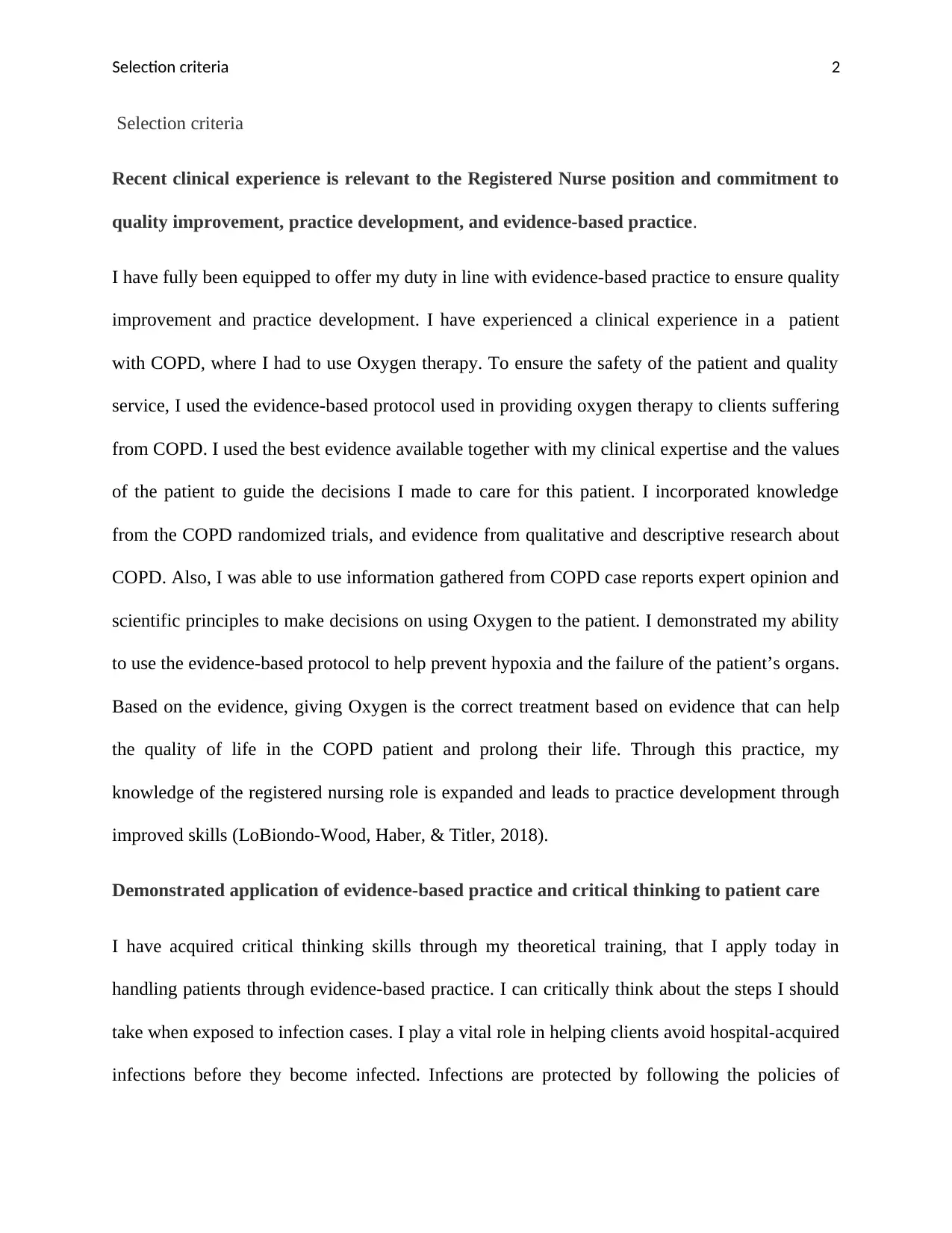
Selection criteria 2
Selection criteria
Recent clinical experience is relevant to the Registered Nurse position and commitment to
quality improvement, practice development, and evidence-based practice.
I have fully been equipped to offer my duty in line with evidence-based practice to ensure quality
improvement and practice development. I have experienced a clinical experience in a patient
with COPD, where I had to use Oxygen therapy. To ensure the safety of the patient and quality
service, I used the evidence-based protocol used in providing oxygen therapy to clients suffering
from COPD. I used the best evidence available together with my clinical expertise and the values
of the patient to guide the decisions I made to care for this patient. I incorporated knowledge
from the COPD randomized trials, and evidence from qualitative and descriptive research about
COPD. Also, I was able to use information gathered from COPD case reports expert opinion and
scientific principles to make decisions on using Oxygen to the patient. I demonstrated my ability
to use the evidence-based protocol to help prevent hypoxia and the failure of the patient’s organs.
Based on the evidence, giving Oxygen is the correct treatment based on evidence that can help
the quality of life in the COPD patient and prolong their life. Through this practice, my
knowledge of the registered nursing role is expanded and leads to practice development through
improved skills (LoBiondo-Wood, Haber, & Titler, 2018).
Demonstrated application of evidence-based practice and critical thinking to patient care
I have acquired critical thinking skills through my theoretical training, that I apply today in
handling patients through evidence-based practice. I can critically think about the steps I should
take when exposed to infection cases. I play a vital role in helping clients avoid hospital-acquired
infections before they become infected. Infections are protected by following the policies of
Selection criteria
Recent clinical experience is relevant to the Registered Nurse position and commitment to
quality improvement, practice development, and evidence-based practice.
I have fully been equipped to offer my duty in line with evidence-based practice to ensure quality
improvement and practice development. I have experienced a clinical experience in a patient
with COPD, where I had to use Oxygen therapy. To ensure the safety of the patient and quality
service, I used the evidence-based protocol used in providing oxygen therapy to clients suffering
from COPD. I used the best evidence available together with my clinical expertise and the values
of the patient to guide the decisions I made to care for this patient. I incorporated knowledge
from the COPD randomized trials, and evidence from qualitative and descriptive research about
COPD. Also, I was able to use information gathered from COPD case reports expert opinion and
scientific principles to make decisions on using Oxygen to the patient. I demonstrated my ability
to use the evidence-based protocol to help prevent hypoxia and the failure of the patient’s organs.
Based on the evidence, giving Oxygen is the correct treatment based on evidence that can help
the quality of life in the COPD patient and prolong their life. Through this practice, my
knowledge of the registered nursing role is expanded and leads to practice development through
improved skills (LoBiondo-Wood, Haber, & Titler, 2018).
Demonstrated application of evidence-based practice and critical thinking to patient care
I have acquired critical thinking skills through my theoretical training, that I apply today in
handling patients through evidence-based practice. I can critically think about the steps I should
take when exposed to infection cases. I play a vital role in helping clients avoid hospital-acquired
infections before they become infected. Infections are protected by following the policies of
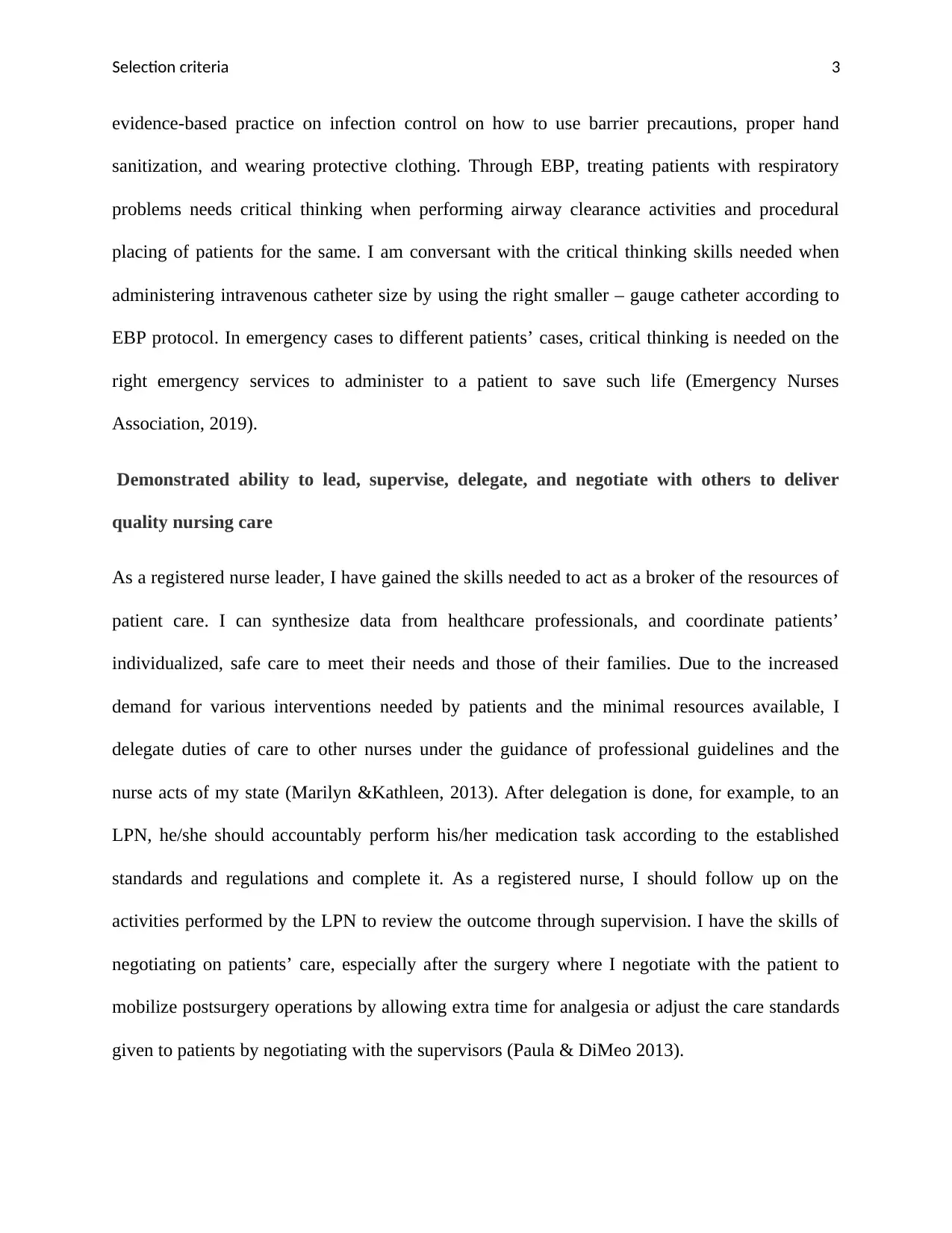
Selection criteria 3
evidence-based practice on infection control on how to use barrier precautions, proper hand
sanitization, and wearing protective clothing. Through EBP, treating patients with respiratory
problems needs critical thinking when performing airway clearance activities and procedural
placing of patients for the same. I am conversant with the critical thinking skills needed when
administering intravenous catheter size by using the right smaller – gauge catheter according to
EBP protocol. In emergency cases to different patients’ cases, critical thinking is needed on the
right emergency services to administer to a patient to save such life (Emergency Nurses
Association, 2019).
Demonstrated ability to lead, supervise, delegate, and negotiate with others to deliver
quality nursing care
As a registered nurse leader, I have gained the skills needed to act as a broker of the resources of
patient care. I can synthesize data from healthcare professionals, and coordinate patients’
individualized, safe care to meet their needs and those of their families. Due to the increased
demand for various interventions needed by patients and the minimal resources available, I
delegate duties of care to other nurses under the guidance of professional guidelines and the
nurse acts of my state (Marilyn &Kathleen, 2013). After delegation is done, for example, to an
LPN, he/she should accountably perform his/her medication task according to the established
standards and regulations and complete it. As a registered nurse, I should follow up on the
activities performed by the LPN to review the outcome through supervision. I have the skills of
negotiating on patients’ care, especially after the surgery where I negotiate with the patient to
mobilize postsurgery operations by allowing extra time for analgesia or adjust the care standards
given to patients by negotiating with the supervisors (Paula & DiMeo 2013).
evidence-based practice on infection control on how to use barrier precautions, proper hand
sanitization, and wearing protective clothing. Through EBP, treating patients with respiratory
problems needs critical thinking when performing airway clearance activities and procedural
placing of patients for the same. I am conversant with the critical thinking skills needed when
administering intravenous catheter size by using the right smaller – gauge catheter according to
EBP protocol. In emergency cases to different patients’ cases, critical thinking is needed on the
right emergency services to administer to a patient to save such life (Emergency Nurses
Association, 2019).
Demonstrated ability to lead, supervise, delegate, and negotiate with others to deliver
quality nursing care
As a registered nurse leader, I have gained the skills needed to act as a broker of the resources of
patient care. I can synthesize data from healthcare professionals, and coordinate patients’
individualized, safe care to meet their needs and those of their families. Due to the increased
demand for various interventions needed by patients and the minimal resources available, I
delegate duties of care to other nurses under the guidance of professional guidelines and the
nurse acts of my state (Marilyn &Kathleen, 2013). After delegation is done, for example, to an
LPN, he/she should accountably perform his/her medication task according to the established
standards and regulations and complete it. As a registered nurse, I should follow up on the
activities performed by the LPN to review the outcome through supervision. I have the skills of
negotiating on patients’ care, especially after the surgery where I negotiate with the patient to
mobilize postsurgery operations by allowing extra time for analgesia or adjust the care standards
given to patients by negotiating with the supervisors (Paula & DiMeo 2013).
⊘ This is a preview!⊘
Do you want full access?
Subscribe today to unlock all pages.

Trusted by 1+ million students worldwide
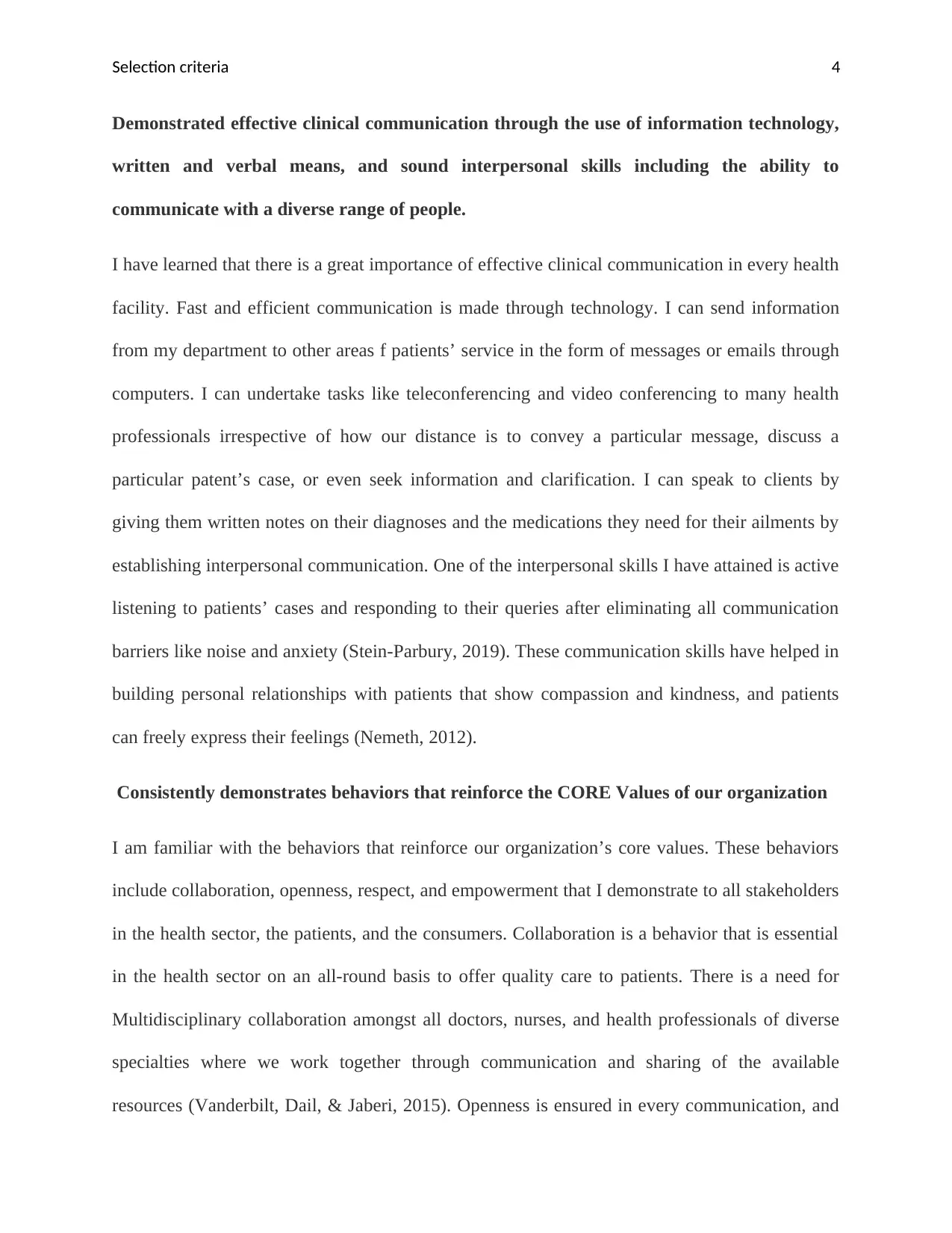
Selection criteria 4
Demonstrated effective clinical communication through the use of information technology,
written and verbal means, and sound interpersonal skills including the ability to
communicate with a diverse range of people.
I have learned that there is a great importance of effective clinical communication in every health
facility. Fast and efficient communication is made through technology. I can send information
from my department to other areas f patients’ service in the form of messages or emails through
computers. I can undertake tasks like teleconferencing and video conferencing to many health
professionals irrespective of how our distance is to convey a particular message, discuss a
particular patent’s case, or even seek information and clarification. I can speak to clients by
giving them written notes on their diagnoses and the medications they need for their ailments by
establishing interpersonal communication. One of the interpersonal skills I have attained is active
listening to patients’ cases and responding to their queries after eliminating all communication
barriers like noise and anxiety (Stein-Parbury, 2019). These communication skills have helped in
building personal relationships with patients that show compassion and kindness, and patients
can freely express their feelings (Nemeth, 2012).
Consistently demonstrates behaviors that reinforce the CORE Values of our organization
I am familiar with the behaviors that reinforce our organization’s core values. These behaviors
include collaboration, openness, respect, and empowerment that I demonstrate to all stakeholders
in the health sector, the patients, and the consumers. Collaboration is a behavior that is essential
in the health sector on an all-round basis to offer quality care to patients. There is a need for
Multidisciplinary collaboration amongst all doctors, nurses, and health professionals of diverse
specialties where we work together through communication and sharing of the available
resources (Vanderbilt, Dail, & Jaberi, 2015). Openness is ensured in every communication, and
Demonstrated effective clinical communication through the use of information technology,
written and verbal means, and sound interpersonal skills including the ability to
communicate with a diverse range of people.
I have learned that there is a great importance of effective clinical communication in every health
facility. Fast and efficient communication is made through technology. I can send information
from my department to other areas f patients’ service in the form of messages or emails through
computers. I can undertake tasks like teleconferencing and video conferencing to many health
professionals irrespective of how our distance is to convey a particular message, discuss a
particular patent’s case, or even seek information and clarification. I can speak to clients by
giving them written notes on their diagnoses and the medications they need for their ailments by
establishing interpersonal communication. One of the interpersonal skills I have attained is active
listening to patients’ cases and responding to their queries after eliminating all communication
barriers like noise and anxiety (Stein-Parbury, 2019). These communication skills have helped in
building personal relationships with patients that show compassion and kindness, and patients
can freely express their feelings (Nemeth, 2012).
Consistently demonstrates behaviors that reinforce the CORE Values of our organization
I am familiar with the behaviors that reinforce our organization’s core values. These behaviors
include collaboration, openness, respect, and empowerment that I demonstrate to all stakeholders
in the health sector, the patients, and the consumers. Collaboration is a behavior that is essential
in the health sector on an all-round basis to offer quality care to patients. There is a need for
Multidisciplinary collaboration amongst all doctors, nurses, and health professionals of diverse
specialties where we work together through communication and sharing of the available
resources (Vanderbilt, Dail, & Jaberi, 2015). Openness is ensured in every communication, and
Paraphrase This Document
Need a fresh take? Get an instant paraphrase of this document with our AI Paraphraser
Selection criteria 5
the ideas of every person are welcomed and respected within our health team. I have learned how
to empower myself for the benefit of the patients through researching my field and learning from
other professionals to enable evidence-based practice. With all these practices, the patients’
expectations and needs fulfilled through ensured safety and quality service.
Current clinical knowledge and clinical problem-solving ability in my field
I have fully understood the set clinical rules and principles that guide decision making in my
field. The decisions are made to solve problems in the entire healthcare set up. The nursing
knowledge that I have acquired throughout my training includes the personal practice
knowledge, reflexive knowledge, cultural and procedural knowledge that are all integrated in the
nursing practice to offer diagnosis, make interventions and treat patients (Chinn & Kramer,
2014). I can solve any problem that arises in the healthcare set up by incorporating the essential
knowledge needed in the case presented, not only between the patient and me but also with other
medicare teams.
An understanding of the professional, ethical, and legal requirements of the Registered
Nurse
I have acquired knowledge of the professional, ethical guidelines, and legal requirements of a
registered nurse. I know that it is in my line of duty to act as a patient’s advocate where I should
make sure that their needs are met. Through patient advocacy, I can present the needs of the
patients to the necessary medical specialist, such as the radiologists to perform radiology, which
can help in getting the basis of diagnosis in a patient. It requires me to use the appropriate
languae when handling patients and use evidence-based practice as stipulated in my professional
guidelines. The state requires a registered nurse to ensure that the right of patients is protected,
the ideas of every person are welcomed and respected within our health team. I have learned how
to empower myself for the benefit of the patients through researching my field and learning from
other professionals to enable evidence-based practice. With all these practices, the patients’
expectations and needs fulfilled through ensured safety and quality service.
Current clinical knowledge and clinical problem-solving ability in my field
I have fully understood the set clinical rules and principles that guide decision making in my
field. The decisions are made to solve problems in the entire healthcare set up. The nursing
knowledge that I have acquired throughout my training includes the personal practice
knowledge, reflexive knowledge, cultural and procedural knowledge that are all integrated in the
nursing practice to offer diagnosis, make interventions and treat patients (Chinn & Kramer,
2014). I can solve any problem that arises in the healthcare set up by incorporating the essential
knowledge needed in the case presented, not only between the patient and me but also with other
medicare teams.
An understanding of the professional, ethical, and legal requirements of the Registered
Nurse
I have acquired knowledge of the professional, ethical guidelines, and legal requirements of a
registered nurse. I know that it is in my line of duty to act as a patient’s advocate where I should
make sure that their needs are met. Through patient advocacy, I can present the needs of the
patients to the necessary medical specialist, such as the radiologists to perform radiology, which
can help in getting the basis of diagnosis in a patient. It requires me to use the appropriate
languae when handling patients and use evidence-based practice as stipulated in my professional
guidelines. The state requires a registered nurse to ensure that the right of patients is protected,
Selection criteria 6
such as privacy, when handling a patient where I should create an environment free of noise and
interruptions that can hinder the patient from opening up. Ensuring privacy is an ethical standard
that should be enhanced in the health sector (Keatings & Adams, 2019). Every practice carried
out by a registered nurse should be aimed at the provision of quality service and care, as
stipulated in the professional guidelines and the state requirements.
Description of a procedure I have used to keep track of items requiring my attention
To track the items that needed my attention, I used the hospital system. I was required to pay
attention to the preoperative activities for a patient’s case that was to be carried out that evening.
At that time, I was operating in the surgical department, and that was my main duty when taking
patients to the theatre. I obtained the patient’s data from the hospital system, read and understood
their case, and performed preoperative procedures according to the patient’s condition needs.
The outcome was the positive psychological preparedness of the patient and successful surgery.
The time that I forgot to do something important for an internal/external customer.
As a registered nurse, I have failed in some situations to offer complete medication. I was located
in the outpatient department during the moments of ending the shift when I was presented with a
case of an asthmatic patient. In this situation, I was overwhelmed with the task of handing over
preparations and still had to make the diagnosis of this patient because some minutes were
remaining before the shift ended. The signs and symptoms of this patient were mild, but in my
interventions, I forgot to urge them to purchase an inhaler for opening the airway when a nurse is
not around. The reasons for this were work pressure and fatigue experienced throughout the shift
due to long shift hours. Long shift hours result in negative implications in every healthcare
facility, to both the clinician and the patient (Rhéaume & Mullen, 2017). The outcome of this
such as privacy, when handling a patient where I should create an environment free of noise and
interruptions that can hinder the patient from opening up. Ensuring privacy is an ethical standard
that should be enhanced in the health sector (Keatings & Adams, 2019). Every practice carried
out by a registered nurse should be aimed at the provision of quality service and care, as
stipulated in the professional guidelines and the state requirements.
Description of a procedure I have used to keep track of items requiring my attention
To track the items that needed my attention, I used the hospital system. I was required to pay
attention to the preoperative activities for a patient’s case that was to be carried out that evening.
At that time, I was operating in the surgical department, and that was my main duty when taking
patients to the theatre. I obtained the patient’s data from the hospital system, read and understood
their case, and performed preoperative procedures according to the patient’s condition needs.
The outcome was the positive psychological preparedness of the patient and successful surgery.
The time that I forgot to do something important for an internal/external customer.
As a registered nurse, I have failed in some situations to offer complete medication. I was located
in the outpatient department during the moments of ending the shift when I was presented with a
case of an asthmatic patient. In this situation, I was overwhelmed with the task of handing over
preparations and still had to make the diagnosis of this patient because some minutes were
remaining before the shift ended. The signs and symptoms of this patient were mild, but in my
interventions, I forgot to urge them to purchase an inhaler for opening the airway when a nurse is
not around. The reasons for this were work pressure and fatigue experienced throughout the shift
due to long shift hours. Long shift hours result in negative implications in every healthcare
facility, to both the clinician and the patient (Rhéaume & Mullen, 2017). The outcome of this
⊘ This is a preview!⊘
Do you want full access?
Subscribe today to unlock all pages.
Trusted by 1+ million students worldwide
Selection criteria 7
practice was endangered patient life due to failure to urge them to buy and train them on how to
use an inhaler.
We’ve all been in situations in which we couldn’t complete everything we needed to on
time. Tell me about a time when this happened to you (Looking for: the situation, what you
did, why you did it and what the outcome was
There is a great need for working across deadlines in every organization setup (Barnsteiner &
Disch, 2012). As a Registered Nurse, I failed in performing the supervision of the tasks I had
delegated on time. I had allocated the duties of medication administration to the LPN. I failed to
supervise the task on time due to an emergency case I was subjected to during my routine duties.
I had to stop the supervision task to go to the emergency department to save a life. My untimely
supervision led to the wrong administration of the medicine I had prescribed to the patient in
terms of the quantity required.
Tell me about the most challenging change you have faced at work (Looking for: the
situation, what you did, why you did it and what the outcome was)
As a Registered nurse, the most challenging change I faced was about prolonged shift hours due
to changed hospital administration. This change affected me physically, socially, and mentally
through stress, the poor balance between work and time, lack of free time, and associated health
risks such as insomnia (Avidan, 2012). Performance levels at work reduced as a result of fatigue
and tiredness. To counter this change, we channeled our complaints to the management, who
called for an impromptu meeting with the new administrator. The impact of the held meeting was
changed shift hours to short durations.
practice was endangered patient life due to failure to urge them to buy and train them on how to
use an inhaler.
We’ve all been in situations in which we couldn’t complete everything we needed to on
time. Tell me about a time when this happened to you (Looking for: the situation, what you
did, why you did it and what the outcome was
There is a great need for working across deadlines in every organization setup (Barnsteiner &
Disch, 2012). As a Registered Nurse, I failed in performing the supervision of the tasks I had
delegated on time. I had allocated the duties of medication administration to the LPN. I failed to
supervise the task on time due to an emergency case I was subjected to during my routine duties.
I had to stop the supervision task to go to the emergency department to save a life. My untimely
supervision led to the wrong administration of the medicine I had prescribed to the patient in
terms of the quantity required.
Tell me about the most challenging change you have faced at work (Looking for: the
situation, what you did, why you did it and what the outcome was)
As a Registered nurse, the most challenging change I faced was about prolonged shift hours due
to changed hospital administration. This change affected me physically, socially, and mentally
through stress, the poor balance between work and time, lack of free time, and associated health
risks such as insomnia (Avidan, 2012). Performance levels at work reduced as a result of fatigue
and tiredness. To counter this change, we channeled our complaints to the management, who
called for an impromptu meeting with the new administrator. The impact of the held meeting was
changed shift hours to short durations.
Paraphrase This Document
Need a fresh take? Get an instant paraphrase of this document with our AI Paraphraser
Selection criteria 8
Tell me about a time when you had to change or adjust your work schedule to get your
work done? (Looking for: the situation, what you did, why you did it and what the outcome
was)
I changed /adjusted my work schedule to get work done when on duty after I was informed of the
nurse leader's long meetings the following day.I prescribed morning hours medications to the
inpatients before leaving from the shift and gave instructions on the right time to take the
medicines. I did this to ensure that no medicine prescribed is missed the following day. The
outcome was fully accomplished tasks in my absence during the meeting, and no complaints
were received from the patients.
Not all organizational changes are clearly explained and/or communicated. What have you
done when you found out about an unexpected change or were confused by a change?
(Looking for: the situation, what you did, why you did it and what the outcome was
When I reported to my duty, I found out that there were administration changes in the hospital.
Our preparation/changing rooms had been relocated to a different room, though in the same
facility due to issues raised by the new leadership. When I found out this, I enquired with the
secretary who guided me on where I could find the new registered nurses changing rooms. I did
this to ensure that I embark on my duties on time and avoid confusion. The outcome was timely
attendance to patients.
Tell me what each of the following values means to you, and how do you demonstrate each
value at work? Teamwork, Respect, Accountability.5. What does resident-centered care
mean to you? Can you give us an example of when you have demonstrated resident-
centered care?
Tell me about a time when you had to change or adjust your work schedule to get your
work done? (Looking for: the situation, what you did, why you did it and what the outcome
was)
I changed /adjusted my work schedule to get work done when on duty after I was informed of the
nurse leader's long meetings the following day.I prescribed morning hours medications to the
inpatients before leaving from the shift and gave instructions on the right time to take the
medicines. I did this to ensure that no medicine prescribed is missed the following day. The
outcome was fully accomplished tasks in my absence during the meeting, and no complaints
were received from the patients.
Not all organizational changes are clearly explained and/or communicated. What have you
done when you found out about an unexpected change or were confused by a change?
(Looking for: the situation, what you did, why you did it and what the outcome was
When I reported to my duty, I found out that there were administration changes in the hospital.
Our preparation/changing rooms had been relocated to a different room, though in the same
facility due to issues raised by the new leadership. When I found out this, I enquired with the
secretary who guided me on where I could find the new registered nurses changing rooms. I did
this to ensure that I embark on my duties on time and avoid confusion. The outcome was timely
attendance to patients.
Tell me what each of the following values means to you, and how do you demonstrate each
value at work? Teamwork, Respect, Accountability.5. What does resident-centered care
mean to you? Can you give us an example of when you have demonstrated resident-
centered care?
Selection criteria 9
Teamwork means collaboration with fellow workmates to enable multidisciplinary cooperation
and successful accomplishment of tasks (Interprofessional Collaboration and Communication in
Nursing Homes: a Qualitative Exploration of Problems in Medical Care for Nursing Home
Residents – Study Protocol, 2014). Teamwork is demonstrated through the sharing of ideas,
tasks, and skills to accomplish medical duties to a patient. Respect means showing regard to the
feelings, views, and ideas of other people at work. It is demonstrated at work through listening to
the views and ideas of others and at the same time, considering their feelings towards a patient's
case when in dialogue about the actions needed for quality treatment. Accountability refers to
being responsible for every action carried out at work ("What Is Accountability? 1," 2015).In the
health sector, this is demonstrated through performing duties in line with evidence-based
practice.
What does resident-centered care mean to you? Can you give us an example of when you
have demonstrated resident-centered care?
Resident centered care is a model that invites, respects and accommodates the wishes and
lifestyle decisions in the resident in the healthcare as they get routine care from the resident’s
physician (Barnsteiner, Disch, & Walton, 2014). I demonstrated this by helping the patient
develop a comprehensive care plan and implemented it to meet her preferences and goals. I
addressed her medical needs in the plan of care, her physical needs, mental and psychosocial
needs. Medical needs included a request to change medications by the physician because the
patient was allergic. Physical needs included how often she needed therapeutic care, which was
provided through continuous relationships between the patient and other healthcare
professionals. In the care plan, religious and cultural beliefs of the patient were considered.
Teamwork means collaboration with fellow workmates to enable multidisciplinary cooperation
and successful accomplishment of tasks (Interprofessional Collaboration and Communication in
Nursing Homes: a Qualitative Exploration of Problems in Medical Care for Nursing Home
Residents – Study Protocol, 2014). Teamwork is demonstrated through the sharing of ideas,
tasks, and skills to accomplish medical duties to a patient. Respect means showing regard to the
feelings, views, and ideas of other people at work. It is demonstrated at work through listening to
the views and ideas of others and at the same time, considering their feelings towards a patient's
case when in dialogue about the actions needed for quality treatment. Accountability refers to
being responsible for every action carried out at work ("What Is Accountability? 1," 2015).In the
health sector, this is demonstrated through performing duties in line with evidence-based
practice.
What does resident-centered care mean to you? Can you give us an example of when you
have demonstrated resident-centered care?
Resident centered care is a model that invites, respects and accommodates the wishes and
lifestyle decisions in the resident in the healthcare as they get routine care from the resident’s
physician (Barnsteiner, Disch, & Walton, 2014). I demonstrated this by helping the patient
develop a comprehensive care plan and implemented it to meet her preferences and goals. I
addressed her medical needs in the plan of care, her physical needs, mental and psychosocial
needs. Medical needs included a request to change medications by the physician because the
patient was allergic. Physical needs included how often she needed therapeutic care, which was
provided through continuous relationships between the patient and other healthcare
professionals. In the care plan, religious and cultural beliefs of the patient were considered.
⊘ This is a preview!⊘
Do you want full access?
Subscribe today to unlock all pages.
Trusted by 1+ million students worldwide
Selection criteria 10
References
Avidan, A. Y. (2012). Hypersomnia, An Issue of Sleep Medicine Clinics - E-Book. St. Louis,
MO: Elsevier Health Sciences.
Barnsteiner, J., & Disch, J. (2012). Second Generation QSEN, An Issue of Nursing Clinics. St.
Louis, MO: Elsevier Health Sciences.
Barnsteiner, J., Disch, J., & Walton, M. (2014). Person and Family Centered Care.
Indianapolis, IN: Sigma Theta Tau.
Chinn, P. L., & Kramer, M. K. (2014). Knowledge Development in Nursing: Theory and
Process. St. Louis, MO: Elsevier Health Sciences.
Emergency Nurses Association. (2019). Sheehy's Emergency Nursing - E-Book: Principles and
Practice. St. Louis, MO: Elsevier Health Sciences.
Interprofessional Collaboration and Communication in Nursing Homes: a Qualitative
Exploration of Problems in Medical Care for Nursing Home Residents – Study Protocol.
(2014). IN.
Keatings, M., & Adams, P. (2019). Ethical and Legal Issues in Canadian Nursing E-Book. St.
Louis, MO: Elsevier Health Sciences.
References
Avidan, A. Y. (2012). Hypersomnia, An Issue of Sleep Medicine Clinics - E-Book. St. Louis,
MO: Elsevier Health Sciences.
Barnsteiner, J., & Disch, J. (2012). Second Generation QSEN, An Issue of Nursing Clinics. St.
Louis, MO: Elsevier Health Sciences.
Barnsteiner, J., Disch, J., & Walton, M. (2014). Person and Family Centered Care.
Indianapolis, IN: Sigma Theta Tau.
Chinn, P. L., & Kramer, M. K. (2014). Knowledge Development in Nursing: Theory and
Process. St. Louis, MO: Elsevier Health Sciences.
Emergency Nurses Association. (2019). Sheehy's Emergency Nursing - E-Book: Principles and
Practice. St. Louis, MO: Elsevier Health Sciences.
Interprofessional Collaboration and Communication in Nursing Homes: a Qualitative
Exploration of Problems in Medical Care for Nursing Home Residents – Study Protocol.
(2014). IN.
Keatings, M., & Adams, P. (2019). Ethical and Legal Issues in Canadian Nursing E-Book. St.
Louis, MO: Elsevier Health Sciences.
Paraphrase This Document
Need a fresh take? Get an instant paraphrase of this document with our AI Paraphraser
Selection criteria 11
LoBiondo-Wood, G., Haber, J., & Titler, M. G. (2018). Evidence-Based Practice for Nursing
and Healthcare Quality Improvement - E-Book. St. Louis, MO: Elsevier Health
Sciences.
Marilyn H. Oermann; RN; FAAN; ANEF, & Kathleen B Gaberson; RN; CNOR; CNE; ANEF.
(2013). Evaluation and Testing in Nursing Education: Fourth Edition. New York, NY:
Springer Publishing Company.
Nemeth, D. C. (2012). Improving Healthcare Team Communication: Building on Lessons from
Aviation and Aerospace. Surrey, NY: Ashgate Publishing.
Paula DiMeo Grant; RN; BSN; MA; JD, & Diana Ballard, J. (2013). Fast Facts About Nursing
and the Law: Law for Nurses in a Nutshell. New York, NY: Springer Publishing
Company.
Pusdekar, V. (2013). Preoperative Preparation of the Patient Prior to Surgical
Procedures. Systematic Approach to Describe Instruments and Operative Procedures in
Surgery, Orthopedics and Anesthesia, 205-205. doi:10.5005/jp/books/11935_32
Rhéaume, A., & Mullen, J. (2017). The impact of long work hours and shift work on cognitive
errors in nurses. Journal of Nursing Management, 26(1), 26-32. doi:10.1111/jonm.12513
Stein-Parbury, J. (2019). Interpersonal communication skills. Clinical Nursing Skills, 73-92.
doi:10.1017/cbo9781316718285.004
Vanderbilt, A., Dail, M., & Jaberi, P. (2015). Reducing health disparities in underserved
communities via interprofessional collaboration across health care professions. Journal
of Multidisciplinary Healthcare, 205. doi:10.2147/jmdh.s74129
What Is Accountability? 1. (2015). Board Accountability in Corporate Governance, 33-70.
doi:10.4324/9781315849713-2
LoBiondo-Wood, G., Haber, J., & Titler, M. G. (2018). Evidence-Based Practice for Nursing
and Healthcare Quality Improvement - E-Book. St. Louis, MO: Elsevier Health
Sciences.
Marilyn H. Oermann; RN; FAAN; ANEF, & Kathleen B Gaberson; RN; CNOR; CNE; ANEF.
(2013). Evaluation and Testing in Nursing Education: Fourth Edition. New York, NY:
Springer Publishing Company.
Nemeth, D. C. (2012). Improving Healthcare Team Communication: Building on Lessons from
Aviation and Aerospace. Surrey, NY: Ashgate Publishing.
Paula DiMeo Grant; RN; BSN; MA; JD, & Diana Ballard, J. (2013). Fast Facts About Nursing
and the Law: Law for Nurses in a Nutshell. New York, NY: Springer Publishing
Company.
Pusdekar, V. (2013). Preoperative Preparation of the Patient Prior to Surgical
Procedures. Systematic Approach to Describe Instruments and Operative Procedures in
Surgery, Orthopedics and Anesthesia, 205-205. doi:10.5005/jp/books/11935_32
Rhéaume, A., & Mullen, J. (2017). The impact of long work hours and shift work on cognitive
errors in nurses. Journal of Nursing Management, 26(1), 26-32. doi:10.1111/jonm.12513
Stein-Parbury, J. (2019). Interpersonal communication skills. Clinical Nursing Skills, 73-92.
doi:10.1017/cbo9781316718285.004
Vanderbilt, A., Dail, M., & Jaberi, P. (2015). Reducing health disparities in underserved
communities via interprofessional collaboration across health care professions. Journal
of Multidisciplinary Healthcare, 205. doi:10.2147/jmdh.s74129
What Is Accountability? 1. (2015). Board Accountability in Corporate Governance, 33-70.
doi:10.4324/9781315849713-2

1 out of 11


Related Documents


Your All-in-One AI-Powered Toolkit for Academic Success.
+13062052269
info@desklib.com
Available 24*7 on WhatsApp / Email
![[object Object]](/_next/static/media/star-bottom.7253800d.svg)
Unlock your academic potential
Copyright © 2020–2026 A2Z Services. All Rights Reserved. Developed and managed by ZUCOL.