Accountability and Responsibility of Registered Nurses in Practice
VerifiedAdded on 2020/03/16
|9
|2896
|48
Essay
AI Summary
This essay examines the crucial topic of accountability for registered nurses, arguing for its necessity in the healthcare setting. The discussion begins by establishing the legal and professional mandates that require nurses to be accountable for their actions, including adherence to regulatory bodies like the NMBA in Australia. The essay then delves into the benefits of accountability, highlighting how it improves the quality of nursing practice by encouraging thoroughness and value, and enhances patient safety through improved care during and after medical procedures. Furthermore, the essay explores accountability as a catalyst for lifelong learning and professional education, emphasizing how nurses learn from their experiences and mistakes to refine their skills and knowledge. The conclusion reinforces the importance of accountability for registered nurses, underscoring its positive impact on patient outcomes and the nursing profession as a whole.
NAME
STUDENT ID
SUBJECT
TOPIC: SHOULD REGISTERED NURSES BE HELD ACCOUNTABLE OF THEIR
OWN PRACTICE?
DATE
1
STUDENT ID
SUBJECT
TOPIC: SHOULD REGISTERED NURSES BE HELD ACCOUNTABLE OF THEIR
OWN PRACTICE?
DATE
1

Paraphrase This Document
Need a fresh take? Get an instant paraphrase of this document with our AI Paraphraser
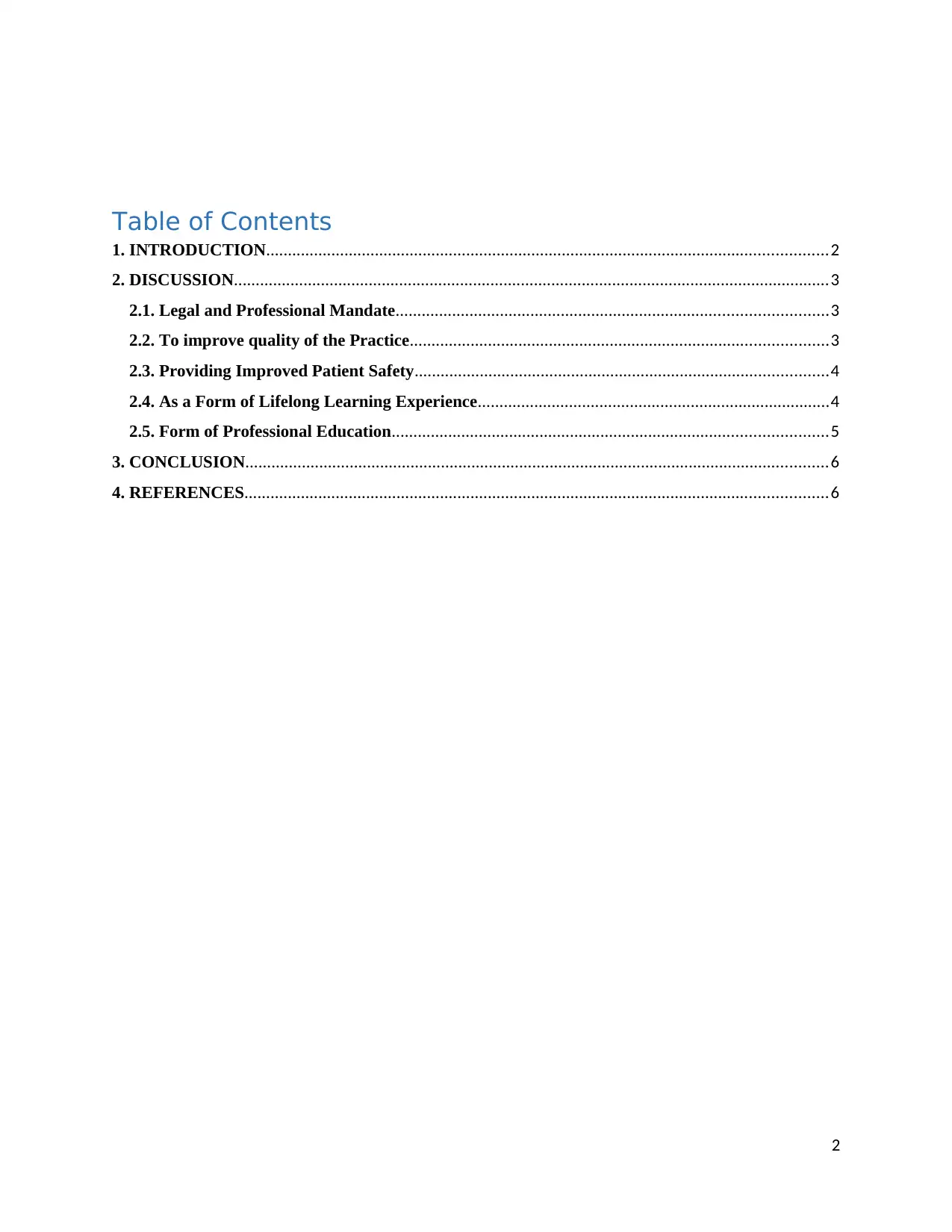
Table of Contents
1. INTRODUCTION.................................................................................................................................2
2. DISCUSSION.........................................................................................................................................3
2.1. Legal and Professional Mandate...................................................................................................3
2.2. To improve quality of the Practice................................................................................................3
2.3. Providing Improved Patient Safety...............................................................................................4
2.4. As a Form of Lifelong Learning Experience.................................................................................4
2.5. Form of Professional Education....................................................................................................5
3. CONCLUSION......................................................................................................................................6
4. REFERENCES......................................................................................................................................6
2
1. INTRODUCTION.................................................................................................................................2
2. DISCUSSION.........................................................................................................................................3
2.1. Legal and Professional Mandate...................................................................................................3
2.2. To improve quality of the Practice................................................................................................3
2.3. Providing Improved Patient Safety...............................................................................................4
2.4. As a Form of Lifelong Learning Experience.................................................................................4
2.5. Form of Professional Education....................................................................................................5
3. CONCLUSION......................................................................................................................................6
4. REFERENCES......................................................................................................................................6
2
1. INTRODUCTION
Registered Nurses are those nurses that have officially graduated from a nursing college,
university or any other educational institution and have excelled in the national licensing exam.
These nurses are meant to provide and set up care activities for the patients. Registered nurses
are responsible for recovering patients. Additionally, they are responsible for educating patients
and coordinating patient care schedules. Furthermore, the registered nurses have the
responsibility to educate the public (non-patients) about any health condition and on various
diseases and infections (Fisher, 2009). These nurses are mostly found in areas like the operations
rooms, doctors’ offices, Intensive Care Units (ICU’s), clinics, patient recovery rooms, patient
admission rooms and ambulatory care rooms. Accountability is the state of being responsible or
liable for a certain action or result.
Accountability encourages individuals towards being responsible and answerable whenever they
are involved in an action or when their actions causes certain results. On the other hand,
responsibility is referred to as the obligation to carry out some tasks or duties by use certain
professional knowledge and having the courage to be answerable for them. In that case,
registered nurses are supposed to be accountable or rather responsible for their practices. Every
employee who has a role and responsibility must have the courage to be accountable and
answerable for all the activities they conduct and all the results that arise from those activities
(McConnell et al, 2012). To be precise, registered nurses are usually trained to take care of
hospital patients which basically means that they have to be accountable of what happens to the
patients as a result of their professional practices (Goudreau et al, 2013). Therefore, it is
important to note all health care providers are deemed accountable for their own practices by
both the criminal and civil courts to ensure that all their practices are focused towards meeting
their legal requirements and objectives. Furthermore, just as how general employees are
accountable of their activities in the employer’s eyes, the registered nurses in Australia are also
accountable to their regulatory organization (Nursing and Midwife Board of Australia previously
called the Nursing and Midwife Council) who ensure that they abide to the rules and regulations
governing their professional practice and patient care responsibility (Zahedi et al, 2013).
3
Registered Nurses are those nurses that have officially graduated from a nursing college,
university or any other educational institution and have excelled in the national licensing exam.
These nurses are meant to provide and set up care activities for the patients. Registered nurses
are responsible for recovering patients. Additionally, they are responsible for educating patients
and coordinating patient care schedules. Furthermore, the registered nurses have the
responsibility to educate the public (non-patients) about any health condition and on various
diseases and infections (Fisher, 2009). These nurses are mostly found in areas like the operations
rooms, doctors’ offices, Intensive Care Units (ICU’s), clinics, patient recovery rooms, patient
admission rooms and ambulatory care rooms. Accountability is the state of being responsible or
liable for a certain action or result.
Accountability encourages individuals towards being responsible and answerable whenever they
are involved in an action or when their actions causes certain results. On the other hand,
responsibility is referred to as the obligation to carry out some tasks or duties by use certain
professional knowledge and having the courage to be answerable for them. In that case,
registered nurses are supposed to be accountable or rather responsible for their practices. Every
employee who has a role and responsibility must have the courage to be accountable and
answerable for all the activities they conduct and all the results that arise from those activities
(McConnell et al, 2012). To be precise, registered nurses are usually trained to take care of
hospital patients which basically means that they have to be accountable of what happens to the
patients as a result of their professional practices (Goudreau et al, 2013). Therefore, it is
important to note all health care providers are deemed accountable for their own practices by
both the criminal and civil courts to ensure that all their practices are focused towards meeting
their legal requirements and objectives. Furthermore, just as how general employees are
accountable of their activities in the employer’s eyes, the registered nurses in Australia are also
accountable to their regulatory organization (Nursing and Midwife Board of Australia previously
called the Nursing and Midwife Council) who ensure that they abide to the rules and regulations
governing their professional practice and patient care responsibility (Zahedi et al, 2013).
3
⊘ This is a preview!⊘
Do you want full access?
Subscribe today to unlock all pages.

Trusted by 1+ million students worldwide
2. DISCUSSION
This discussion will provide a clear understanding on the reasons why the registered nurses
should be held accountable of their own practices. The following are the reasons:
2.1. Legal and Professional Mandate
The registered nurses must be accountable because it is actually their legal and professional
responsibility to do so. When the nurses are trained, there main goal, objective and duty is solely
to provide patient care in a health institution (Zahedi et al, 2013). By training them, they are
equipped with immense knowledge, skills and expertise that is to be used when doing their jobs.
Technically, the county’s laws (Australia) imposes a duty to all the health practitioners which is
basically a duty to care on practitioners. These laws are imposed for all nurses whether HCA’s,
Aps, students still in the program, doctors, registered nurses among others (Cashin et al, 2017).
However, the registered nurses are also liable to adhering to the rules and regulations set aside by
the NMBA which is the authoritative body in charge of registering nurses and giving the
licenses. Therefore, it is the duty of each nurse to be accountable of any action that they take
under those laws. If the action is within the laws grounds, then the responsible nurse for the
action or result is supposed to take credit and if not according to the laws, the nurse responsible
is supposed to shoulder the damages or danger caused by the results (Cashin et al, 2015). By
setting up these laws, the nurses are aware of what they are supposed to do and what they are
responsible for. On the other hand, the laws also offer protection to the regulatory organizations
so that they are not entirely blamed for the nurses’ practices.
2.2. To improve quality of the Practice
As mentioned earlier, registered nurses’ roles and responsibility, is to take care of the patients
when doctors are not available. According to Sadeghi et al, 2016, this means that they actually
give medicine to the patients, change the patient’s beddings, give them food and other drinks,
take them to visit the toilets, educate them on how to care for themselves, involve the patients in
professional talks and other activities that the patients may need. In the grounds of taking care of
the patients, the nurses are supposed to check on the patients on a regular basis, make
observations when needed or when the doctor is not available, strategize on methods of making
their health condition better to name just but a few activities that are supposed to be done by a
registered nurse on duty. According to Hughes, 2008, all these activities are all related to a
4
This discussion will provide a clear understanding on the reasons why the registered nurses
should be held accountable of their own practices. The following are the reasons:
2.1. Legal and Professional Mandate
The registered nurses must be accountable because it is actually their legal and professional
responsibility to do so. When the nurses are trained, there main goal, objective and duty is solely
to provide patient care in a health institution (Zahedi et al, 2013). By training them, they are
equipped with immense knowledge, skills and expertise that is to be used when doing their jobs.
Technically, the county’s laws (Australia) imposes a duty to all the health practitioners which is
basically a duty to care on practitioners. These laws are imposed for all nurses whether HCA’s,
Aps, students still in the program, doctors, registered nurses among others (Cashin et al, 2017).
However, the registered nurses are also liable to adhering to the rules and regulations set aside by
the NMBA which is the authoritative body in charge of registering nurses and giving the
licenses. Therefore, it is the duty of each nurse to be accountable of any action that they take
under those laws. If the action is within the laws grounds, then the responsible nurse for the
action or result is supposed to take credit and if not according to the laws, the nurse responsible
is supposed to shoulder the damages or danger caused by the results (Cashin et al, 2015). By
setting up these laws, the nurses are aware of what they are supposed to do and what they are
responsible for. On the other hand, the laws also offer protection to the regulatory organizations
so that they are not entirely blamed for the nurses’ practices.
2.2. To improve quality of the Practice
As mentioned earlier, registered nurses’ roles and responsibility, is to take care of the patients
when doctors are not available. According to Sadeghi et al, 2016, this means that they actually
give medicine to the patients, change the patient’s beddings, give them food and other drinks,
take them to visit the toilets, educate them on how to care for themselves, involve the patients in
professional talks and other activities that the patients may need. In the grounds of taking care of
the patients, the nurses are supposed to check on the patients on a regular basis, make
observations when needed or when the doctor is not available, strategize on methods of making
their health condition better to name just but a few activities that are supposed to be done by a
registered nurse on duty. According to Hughes, 2008, all these activities are all related to a
4
Paraphrase This Document
Need a fresh take? Get an instant paraphrase of this document with our AI Paraphraser
person’s health condition and life. This means that nurses are the ones to determine whether the
patients will recover or not. Therefore, it is important for all nurses to be accountable of their
own action/practice so that whenever a person’s life or health is in danger, they can be solely
answerable for the results (Masso et al, 2014). Through this, the nursing practice will be given
more though and value because of the fact that every nurse will be on their own. Additionally,
the nurses will be ready to perform their best in their practices therefore providing the best care
quality to the patients.
2.3. Providing Improved Patient Safety
This is related to the improved quality care provision. The nurses that are placed in surgery
rooms help the surgeons in operating on the patient. These practices give the nurses the
opportunity to experience the operation activity and understand the care that the patient needs
(Battie et al, 2015). The nurses placed in such scenarios get to understand these patients better
because they have an idea of exactly what may have happened in the operation room, what
medications that were used, what possible dangers that may affect the patients among other
things (Mitchell, 2008). Therefore, these nurses are given the responsibility of taking care of
these patients simply because they have more experience and information on their condition than
any other. However, nurses should be accountable for their patients during their time of illness as
well as when their during their recovery time, e.g. in the case of a surgery patient. When these
nurses are deemed accountable for their actions, they give their best during the operational and
after the operations (Battie et al, 2014). The nurses are allocated the responsibility to provide
medication, observe the patients and make regular checkups on them. By doing all of these, the
nurses will be determining the health condition and status of the patient especially towards their
recovery process. Through this, the nurses will be ready to offer the best and improved safety
and care to the patients no matter what.
2.4. As a Form of Lifelong Learning Experience
Every registered nurse’s career is determined by how much experience, skills and knowledge
they have. However, after the nurses have finished their training programs and are officially
registered, they can only get experience by working in a hospital. Basically, it means that new
registered nurses may not have enough experience but can get it from performing their duties to
their patients in hospitals. However, as for the already experienced nurses, they can learn from
5
patients will recover or not. Therefore, it is important for all nurses to be accountable of their
own action/practice so that whenever a person’s life or health is in danger, they can be solely
answerable for the results (Masso et al, 2014). Through this, the nursing practice will be given
more though and value because of the fact that every nurse will be on their own. Additionally,
the nurses will be ready to perform their best in their practices therefore providing the best care
quality to the patients.
2.3. Providing Improved Patient Safety
This is related to the improved quality care provision. The nurses that are placed in surgery
rooms help the surgeons in operating on the patient. These practices give the nurses the
opportunity to experience the operation activity and understand the care that the patient needs
(Battie et al, 2015). The nurses placed in such scenarios get to understand these patients better
because they have an idea of exactly what may have happened in the operation room, what
medications that were used, what possible dangers that may affect the patients among other
things (Mitchell, 2008). Therefore, these nurses are given the responsibility of taking care of
these patients simply because they have more experience and information on their condition than
any other. However, nurses should be accountable for their patients during their time of illness as
well as when their during their recovery time, e.g. in the case of a surgery patient. When these
nurses are deemed accountable for their actions, they give their best during the operational and
after the operations (Battie et al, 2014). The nurses are allocated the responsibility to provide
medication, observe the patients and make regular checkups on them. By doing all of these, the
nurses will be determining the health condition and status of the patient especially towards their
recovery process. Through this, the nurses will be ready to offer the best and improved safety
and care to the patients no matter what.
2.4. As a Form of Lifelong Learning Experience
Every registered nurse’s career is determined by how much experience, skills and knowledge
they have. However, after the nurses have finished their training programs and are officially
registered, they can only get experience by working in a hospital. Basically, it means that new
registered nurses may not have enough experience but can get it from performing their duties to
their patients in hospitals. However, as for the already experienced nurses, they can learn from
5
their past nursing experiences. This is where the accountability aspect comes in. When nurses are
accountable of their own practices, they get to learn more or better than when they are given
examples of nurses who failed or who made certain mistakes (Ross et al, 2013). Generally, a
person is capable of taking their own mistake into consideration more than one of a person whom
they may not know or even heard of. Therefore, when nurses are accountable of their actions,
they get to correct their mistakes more positively or faster than when they are given examples of
the same mistakes made by a different person. Every experience is a lesson for a nurse, e.g.
taking care of different kinds of patients with different health conditions. When a nurse becomes
responsible for a patient’s death, they should be accountable of the death on their own and if a
patient’s health condition improves drastically, the nurse responsible should be responsible of the
improvement of their own. According to Krautscheid, 2014, the accountability will certainly be
helpful especially when the results of a practice are negative. Hence, accountability serves as a
person’s own form of lifelong learning experience to say the least.
2.5. Form of Professional Education
Registered nurses are educated individuals who have graduated from a nursing college or a
university or any other learning institution offering nursing education services. However, in these
educational institutions, the activities involved are just teaching, studying and being examines
theoretically or rather there are no actual patients in the educational forums (Hernandez, 2016).
When these nurses are registered and start working, the have to deal with real human being and
worry about their lives. This means that they get the opportunity to tackle real health conditions
being experienced by real humans. In that case, these nurses are given the chance to practice
their profession in real life. They get to observe patients, check their health conditions,
differentiating different medications to give a person suffering among other things. This means
that they ought to be effective and efficient planners, smart decision makers, have strong
communication skills, a good caregiver, among other things. They certainly need to increase
their levels and strategies of making the right calls or decisions (Kako et al, 2008). Through all
these activities and roles about caring another person’s life, improves the thinking capacity of a
nurse which is a basic way of letting them learn new things in their profession and career
(Gardner et al, 2016). For that reason, it is important to approve the aspect of accountability or
nurses for their practices because through this, they will be able to actually learn more and
improve their professional education by practicing it.
6
accountable of their own practices, they get to learn more or better than when they are given
examples of nurses who failed or who made certain mistakes (Ross et al, 2013). Generally, a
person is capable of taking their own mistake into consideration more than one of a person whom
they may not know or even heard of. Therefore, when nurses are accountable of their actions,
they get to correct their mistakes more positively or faster than when they are given examples of
the same mistakes made by a different person. Every experience is a lesson for a nurse, e.g.
taking care of different kinds of patients with different health conditions. When a nurse becomes
responsible for a patient’s death, they should be accountable of the death on their own and if a
patient’s health condition improves drastically, the nurse responsible should be responsible of the
improvement of their own. According to Krautscheid, 2014, the accountability will certainly be
helpful especially when the results of a practice are negative. Hence, accountability serves as a
person’s own form of lifelong learning experience to say the least.
2.5. Form of Professional Education
Registered nurses are educated individuals who have graduated from a nursing college or a
university or any other learning institution offering nursing education services. However, in these
educational institutions, the activities involved are just teaching, studying and being examines
theoretically or rather there are no actual patients in the educational forums (Hernandez, 2016).
When these nurses are registered and start working, the have to deal with real human being and
worry about their lives. This means that they get the opportunity to tackle real health conditions
being experienced by real humans. In that case, these nurses are given the chance to practice
their profession in real life. They get to observe patients, check their health conditions,
differentiating different medications to give a person suffering among other things. This means
that they ought to be effective and efficient planners, smart decision makers, have strong
communication skills, a good caregiver, among other things. They certainly need to increase
their levels and strategies of making the right calls or decisions (Kako et al, 2008). Through all
these activities and roles about caring another person’s life, improves the thinking capacity of a
nurse which is a basic way of letting them learn new things in their profession and career
(Gardner et al, 2016). For that reason, it is important to approve the aspect of accountability or
nurses for their practices because through this, they will be able to actually learn more and
improve their professional education by practicing it.
6
⊘ This is a preview!⊘
Do you want full access?
Subscribe today to unlock all pages.
Trusted by 1+ million students worldwide
3. CONCLUSION
Registered nurses are those that have already passed through the nursing education institutions
and passed the national examination for licensing. However, these nurses, especially those in
Australia, should be able to be recognized by their specific regulatory bodies, in the case of
Australia it’s the NMBA. It is also important for nurse to ensure that their roles and
responsibilities and duties are tied to a patient’s life which means that every any registered nurse
should make sure that they take care of the patient’s health condition because their life is
technically on their hands. Therefore, this being the obvious reason for the nurses to be held
accountable for their practices and actions, the other are: the fact that it is a way of enhancing
improvement in the quality of the nursing practice, a way of improving the safety standards of
the patients, it offers a chance for further learning and professional education for the nurses, it is
a way of adhering to the legal standards of a country and nursing regulatory body and that it
offers an opportunity to the nurse to have more experience in their practice. Therefore, yes, the
nurses should be accountable for their own practices because it will definitely do more good than
harm to the patients and the entire society.
7
Registered nurses are those that have already passed through the nursing education institutions
and passed the national examination for licensing. However, these nurses, especially those in
Australia, should be able to be recognized by their specific regulatory bodies, in the case of
Australia it’s the NMBA. It is also important for nurse to ensure that their roles and
responsibilities and duties are tied to a patient’s life which means that every any registered nurse
should make sure that they take care of the patient’s health condition because their life is
technically on their hands. Therefore, this being the obvious reason for the nurses to be held
accountable for their practices and actions, the other are: the fact that it is a way of enhancing
improvement in the quality of the nursing practice, a way of improving the safety standards of
the patients, it offers a chance for further learning and professional education for the nurses, it is
a way of adhering to the legal standards of a country and nursing regulatory body and that it
offers an opportunity to the nurse to have more experience in their practice. Therefore, yes, the
nurses should be accountable for their own practices because it will definitely do more good than
harm to the patients and the entire society.
7
Paraphrase This Document
Need a fresh take? Get an instant paraphrase of this document with our AI Paraphraser
4. REFERENCES
Battié, R., & Steelman, V. M. (2014). Accountability in nursing practice: Why it is important for
patient safety. Association of Operating Room Nurses. AORN Journal, 100(5), 537.
Battie, R., & Steelman, V. M. (2015). Accountability in nursing practice: Why it is important for
patient safety. ACORN: The Journal of Perioperative Nursing in Australia, 28(4), 14.
Cashin, A., Buckley, T., Donoghue, J., Heartfield, M., Bryce, J., Cox, D., ...& Dunn, S. V.
(2015). Development of the nurse practitioner standards for practice Australia. Policy,
Politics, & Nursing Practice, 16(1-2), 27-37.
Cashin, A., Heartfield, M., Bryce, J., Devey, L., Buckley, T., Cox, D., ...& Fisher, M. (2017).
Standards for practice for registered nurses in Australia. Collegian, 24(3), 255-266.
Fisher, P. (2009). Organizational effectiveness and capacity: the critical role of organizational
health. Victoria (BC): Fisher & Associates Solutions Inc.
Gardner, G., Duffield, C., Doubrovsky, A., & Adams, M. (2016). Identifying advanced practice:
A national survey of a nursing workforce. International journal of nursing studies, 55,
60-70.
Goudreau, K. A., & Smolenski, M. (Eds.). (2013). Health policy and advanced practice nursing:
Impact and implications. Springer Publishing Company.
Hernandez, J. S. (2016). Coaching other physicians through difficult conversations. Physician
Leadership Journal, 3(5), 40.
Hughes, R. G. (2008). Nurses at the “sharp end” of patient care.
Kako, M., & Rudge, T. (2008). Governing nursing: Curriculum as a rhetorical vehicle using
South Australian nursing schools from the 1950s onwards as an illustrative
case. Contemporary nurse, 30(2), 142-155.
Krautscheid, L. C. (2014). Defining professional nursing accountability: a literature
review. Journal of Professional Nursing, 30(1), 43-47.
Masso, M., & Thompson, C. (2014). Nurse practitioners in NSW'Gaining Momentum': rapid
review of the nurse practitioner literature.
8
Battié, R., & Steelman, V. M. (2014). Accountability in nursing practice: Why it is important for
patient safety. Association of Operating Room Nurses. AORN Journal, 100(5), 537.
Battie, R., & Steelman, V. M. (2015). Accountability in nursing practice: Why it is important for
patient safety. ACORN: The Journal of Perioperative Nursing in Australia, 28(4), 14.
Cashin, A., Buckley, T., Donoghue, J., Heartfield, M., Bryce, J., Cox, D., ...& Dunn, S. V.
(2015). Development of the nurse practitioner standards for practice Australia. Policy,
Politics, & Nursing Practice, 16(1-2), 27-37.
Cashin, A., Heartfield, M., Bryce, J., Devey, L., Buckley, T., Cox, D., ...& Fisher, M. (2017).
Standards for practice for registered nurses in Australia. Collegian, 24(3), 255-266.
Fisher, P. (2009). Organizational effectiveness and capacity: the critical role of organizational
health. Victoria (BC): Fisher & Associates Solutions Inc.
Gardner, G., Duffield, C., Doubrovsky, A., & Adams, M. (2016). Identifying advanced practice:
A national survey of a nursing workforce. International journal of nursing studies, 55,
60-70.
Goudreau, K. A., & Smolenski, M. (Eds.). (2013). Health policy and advanced practice nursing:
Impact and implications. Springer Publishing Company.
Hernandez, J. S. (2016). Coaching other physicians through difficult conversations. Physician
Leadership Journal, 3(5), 40.
Hughes, R. G. (2008). Nurses at the “sharp end” of patient care.
Kako, M., & Rudge, T. (2008). Governing nursing: Curriculum as a rhetorical vehicle using
South Australian nursing schools from the 1950s onwards as an illustrative
case. Contemporary nurse, 30(2), 142-155.
Krautscheid, L. C. (2014). Defining professional nursing accountability: a literature
review. Journal of Professional Nursing, 30(1), 43-47.
Masso, M., & Thompson, C. (2014). Nurse practitioners in NSW'Gaining Momentum': rapid
review of the nurse practitioner literature.
8
McConnell, K. J., Delate, T., & Newlon, C. L. (2012). Impact of continuing professional
development versus traditional continuing pharmacy education on learning
behaviors. Journal of the American Pharmacists Association, 52(6), 742-752.
Mitchell, P. H. (2008). Defining patient safety and quality care.
Ross, K., Barr, J., & Stevens, J. (2013). Mandatory continuing professional development
requirements: what does this mean for Australian nurses. BMC nursing, 12(1), 9.
Sadeghi, A., & Khamarnia, M. (2016). Professional Ethics in health management, Patients’
rights grounds. Medical Ethics Journal, 4(13), 13-26.
Zahedi, F., Sanjari, M., Aala, M., Peymani, M., Aramesh, K., Parsapour, A.,& Dastgerdi, M. V.
(2013). The code of ethics for nurses. Iranian journal of public health, 42(Supple1), 1.
9
development versus traditional continuing pharmacy education on learning
behaviors. Journal of the American Pharmacists Association, 52(6), 742-752.
Mitchell, P. H. (2008). Defining patient safety and quality care.
Ross, K., Barr, J., & Stevens, J. (2013). Mandatory continuing professional development
requirements: what does this mean for Australian nurses. BMC nursing, 12(1), 9.
Sadeghi, A., & Khamarnia, M. (2016). Professional Ethics in health management, Patients’
rights grounds. Medical Ethics Journal, 4(13), 13-26.
Zahedi, F., Sanjari, M., Aala, M., Peymani, M., Aramesh, K., Parsapour, A.,& Dastgerdi, M. V.
(2013). The code of ethics for nurses. Iranian journal of public health, 42(Supple1), 1.
9
⊘ This is a preview!⊘
Do you want full access?
Subscribe today to unlock all pages.
Trusted by 1+ million students worldwide

1 out of 9


Related Documents


Your All-in-One AI-Powered Toolkit for Academic Success.
+13062052269
info@desklib.com
Available 24*7 on WhatsApp / Email
![[object Object]](/_next/static/media/star-bottom.7253800d.svg)
Unlock your academic potential
Copyright © 2020–2026 A2Z Services. All Rights Reserved. Developed and managed by ZUCOL.