The Impact of Price Regulation on Drugs in the Healthcare Industry

Verified

Added on  2022/09/17

|4
|833
|27
Report
AI Summary
This report examines the critical topic of drug price regulation within the healthcare industry. It begins by outlining the context of rising healthcare expenditures and the role of government interventions, specifically price regulations, in addressing this issue. The report presents arguments for and against price regulation, highlighting the benefits of lower drug prices for patients and payers while also acknowledging potential negative impacts on pharmaceutical companies and research and development. It provides an overview of countries with and without price regulations, using the United States as a key example of a country without such regulations, and discusses the importance of regulations in ensuring drug availability and affordability. The report cites relevant studies and reports to support its arguments, including comparisons of drug prices across different countries and analysis of cancer drug price increases in the US. It also addresses counterarguments, such as the potential for regulations to stifle innovation, and offers rebuttals to these claims. The report concludes by advocating for price regulation as a necessary step to improve access to affordable medicines, particularly for vulnerable populations.
Document Page
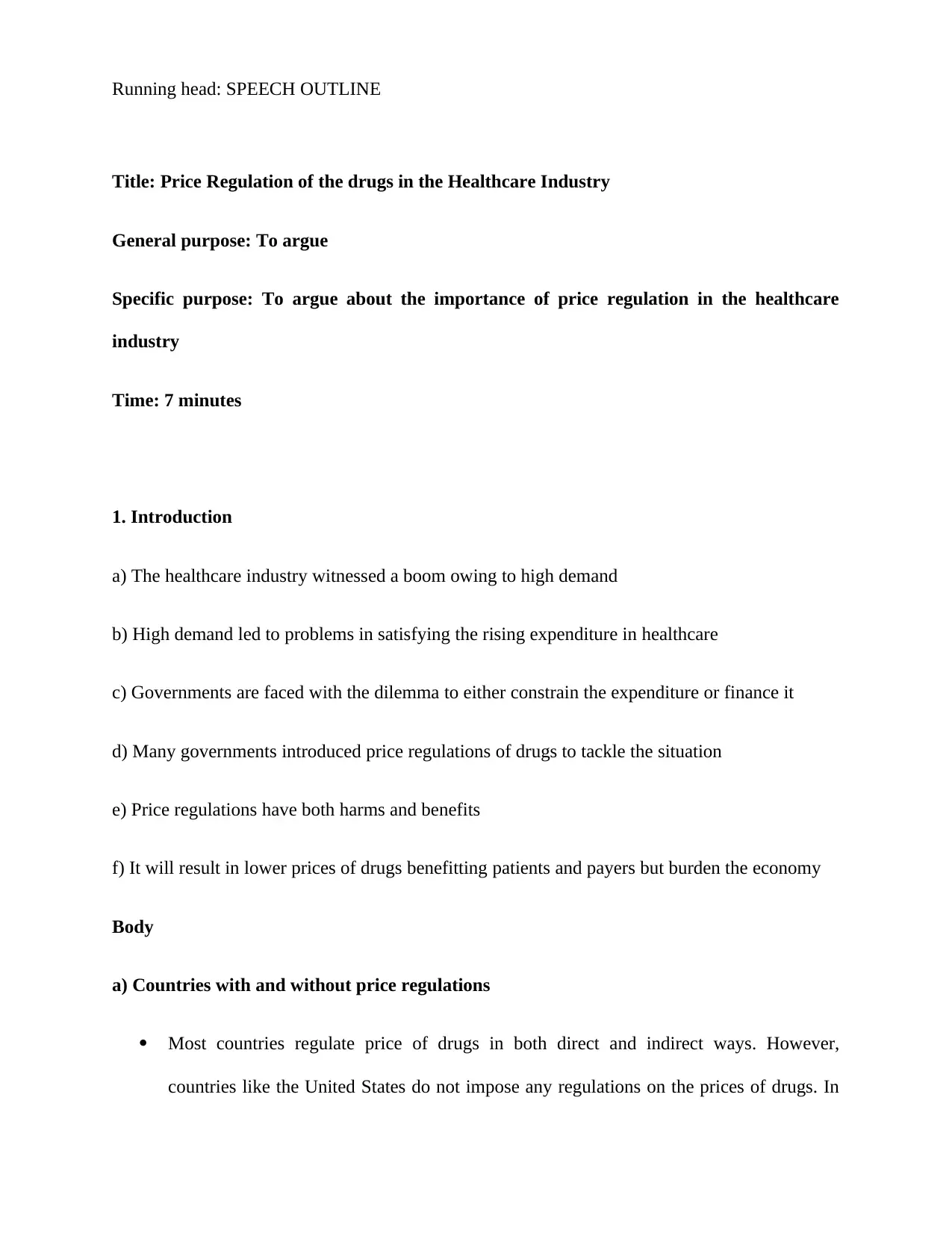
Running head: SPEECH OUTLINE
Title: Price Regulation of the drugs in the Healthcare Industry
General purpose: To argue
Specific purpose: To argue about the importance of price regulation in the healthcare
industry
Time: 7 minutes
1. Introduction
a) The healthcare industry witnessed a boom owing to high demand
b) High demand led to problems in satisfying the rising expenditure in healthcare
c) Governments are faced with the dilemma to either constrain the expenditure or finance it
d) Many governments introduced price regulations of drugs to tackle the situation
e) Price regulations have both harms and benefits
f) It will result in lower prices of drugs benefitting patients and payers but burden the economy
Body
a) Countries with and without price regulations
Most countries regulate price of drugs in both direct and indirect ways. However,
countries like the United States do not impose any regulations on the prices of drugs. In
tabler-icon-diamond-filled.svg

Paraphrase This Document

Need a fresh take? Get an instant paraphrase of this document with our AI Paraphraser
Document Page
contrast to this, countries such as China, Italy, Japan and France have strict price
regulations.
Therefore, I would argue in favor of price regulations in the healthcare industry because I
believe it is beneficial for the larger population.
b) Importance of price regulations
Price regulations on drug are imposed by government agencies to ensure the drugs are
available in abundance and at a reasonable price.
The regulation of drug prices also ensures that the pharmaceutical companies
manufacture medicines that are of high quality.
Without any regulation on price of the drugs, the consumers have to bear the complete
brunt of the expensive drugs that enter the US market.
In a report it has been found that the US is at the top when it comes to spending the most
on pharmaceuticals.
The country spends more than 1000 dollars on pharmaceuticals and the second country in
the list – Switzerland – spends around 780 dollars (Theconversation.com, 2019).
In a study by Rossiter et al. (2014), it has been found that the cancer drug prices are
increasing each year in the US and it is estimated to grow consistently.
Costa-Font, McGuire and Varol (2014) further found that the lack of regulation and
competition in the healthcare industry allows for the prices to increase remarkably in the
US than in other countries.
c) Opposition to price regulation
Document Page
According to Ben-Aharon, Shavit and Magnezi (2017), price-regulation and
reimbursement mechanisms have no association with healthcare costs.
The results revealed that no association could be established between the two although it
value-based pricing was found effective in reducing healthcare costs.
Eichler et al. (2016) further observes that regulation might contribute to high cost of
drugs. The authors argue that excessive regulation harms the research and development in
the field of developing new drugs.
d) Rebuttal
However, I would tend to disagree with the above statement because I have found that
without regulation, the prices are bound to go up.
When there is no regulation on the prices of the drugs, the manufactures and sellers have
the complete license to exploit this freedom and set high prices for the drugs.
d) Conclusion
In the end, I would reiterate that the price regulation of drugs in the healthcare industry is
a much needed step that the US government should take.
The arguments and supporting evidences reveal that regulating drug prices benefits the
larger section of the society because it helps the poor access medicines that could
otherwise be unaffordable and inaccessible.
Document Page
References:
Ben-Aharon, O., Shavit, O., & Magnezi, R. (2017). Does drug price-regulation affect healthcare
expenditures?. The European Journal of Health Economics, 18(7), 859-867.
Costa-Font, J., McGuire, A., & Varol, N. (2014). Price regulation and relative delays in generic
drug adoption. Journal of health economics, 38, 1-9.
Eichler, H. G., Hurts, H., Broich, K., & Rasi, G. (2016). Drug regulation and pricing—can
regulators influence affordability?. New England Journal of Medicine, 374(19), 1807-
1809.
Rossiter, L. F., Kirson, N. Y., Shei, A., White, A. G., Birnbaum, H. G., Ben-Joseph, R., &
Michna, E. (2014). Medical cost savings associated with an extended-release opioid with
abuse-deterrent technology in the US. Journal of medical economics, 17(4), 279-287.
Theconversation.com. (2019). Why the US has higher drug prices than other countries. Retrieved
24 August 2019, from https://theconversation.com/why-the-us-has-higher-drug-prices-
than-other-countries-111256
chevron_up_icon
1 out of 4
circle_padding
hide_on_mobile
zoom_out_icon
[object Object]