Financial Report: Relevant Cost Analysis, Budgeting, and Variances

Verified

Added on  2020/05/11

|5
|1556
|43
Report
AI Summary
This report provides a comprehensive analysis of relevant cost, budgeting, and variance analysis within a financial context. Part A is an excel sheet, while Part B delves into relevant cost analysis, emphasizing its significance in managerial decision-making, particularly concerning investment choices. It examines a company's investment decision in light of changing governmental regulations, evaluating the relevant costs and benefits associated with building a new manufacturing facility. Part C focuses on budgeting, comparing budgeted data with actual results and analyzing variances. It explains the concepts of favorable and unfavorable variances, presenting a detailed comparison between flexible and static budgets. Part D explores the impact of imposed versus participatory budgeting approaches, illustrating how different budgetary methods influence employee behavior and organizational outcomes, specifically considering how Paulo Farmer would respond to each approach. The report concludes with a bibliography of supporting resources.
Document Page
Part A
Check excel sheet
Part B
Introduction
Relevant cost is a term which is used by the managers in making managerial decisions. Relevant
cost is a cost is a cost which is significant to the business decision. This report is written for
making an analysis regarding the investment decisions of a company on the basis of relevant cost
and relevant benefits occurred from that decision.
Relevant cost
The occurrence of relevant cost in the business will be affected by the business decisions
(Horngren 2009). It is an avoidable cost. This cost helps in elimination of data regarding the
irrelevant cost i.e. the cost which will remain as present even after making any decision. This
cost helps in decisions of make or buys, decisions regarding acceptance of special order or
decisions regarding any investment.
Present Situation of the company
In the present case company in consideration is making a decision regarding investment. In the
present case, the company is having a possibility of change in the governmental environment of
the organization. This change will result in lack of support for current energy generation process
of the organization. The company is going to make an investment for building a manufacturing
facility on recently purchased land. This investment will result in a reduction of material and
labor cost and increase in manufacturing overheads.
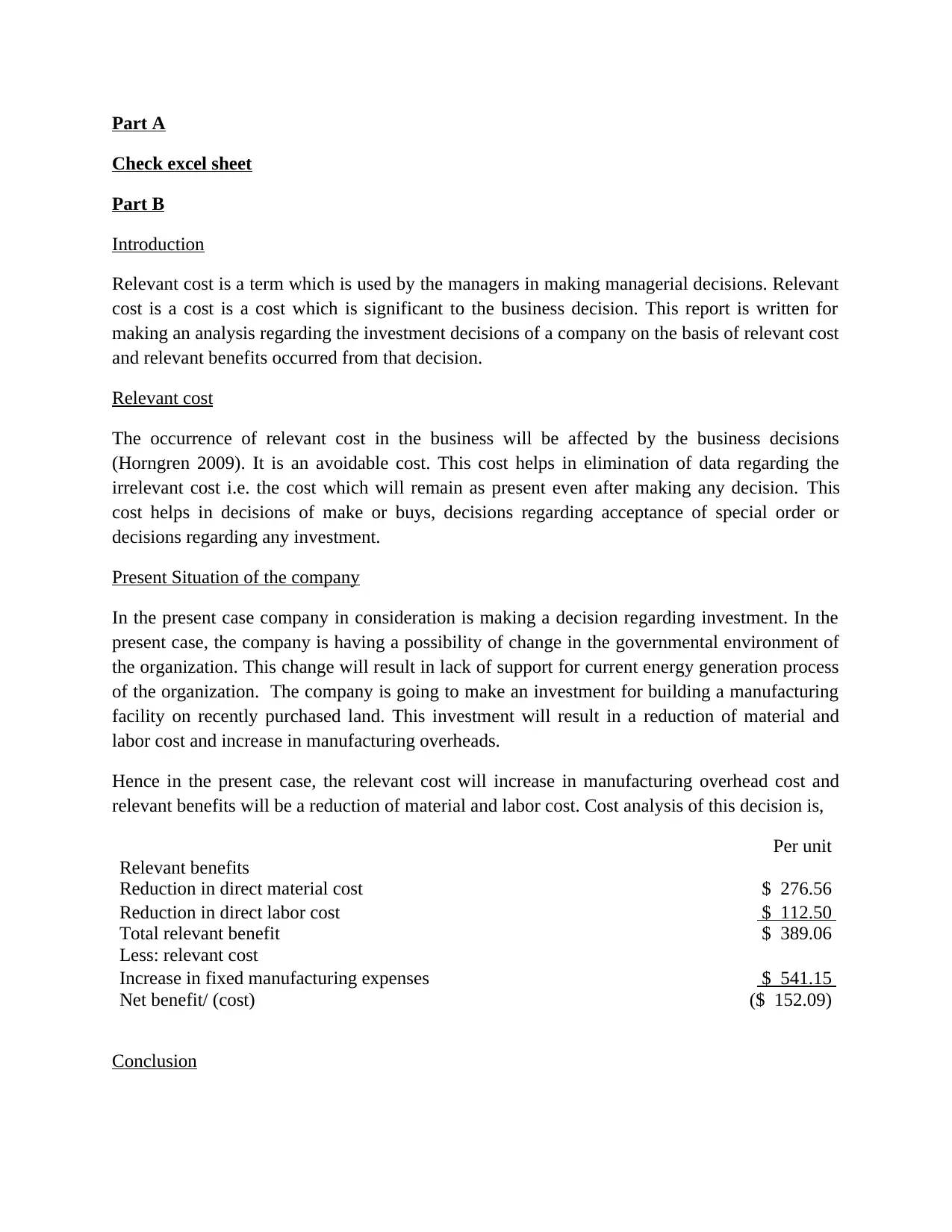
Hence in the present case, the relevant cost will increase in manufacturing overhead cost and
relevant benefits will be a reduction of material and labor cost. Cost analysis of this decision is,
Per unit
Relevant benefits
Reduction in direct material cost $ 276.56
Reduction in direct labor cost $ 112.50
Total relevant benefit $ 389.06
Less: relevant cost
Increase in fixed manufacturing expenses $ 541.15
Net benefit/ (cost) ($ 152.09)
Conclusion
tabler-icon-diamond-filled.svg

Paraphrase This Document

Need a fresh take? Get an instant paraphrase of this document with our AI Paraphraser
Document Page
Above analysis presents that, in the present case relevant cost i.e. cost increase due to increase in
fixed manufacturing expenses is higher than the relevant benefits i.e. benefits from the reduction
of material and direct labor cost. It concludes that the decision of the company to invest for the
for building a manufacturing facility on recently purchased land is in appropriate because it will
enhance the net cost of the company. Therefore company needs to reconsider this decision and
make a decision after proper cost structure analysis.
Part C
Introduction
Budgeted data is data created for making future expectations regarding organization’s costs and
revenue. However actual data is historical data and created on the basis of actual results for
calculating actual profits and incomes earned by the organization in the period. This report is
written for making analysis regarding the different between original budget nd actual results of
the organization.
Concept of Variance
Budgeted data is data which is created by the organization before starting of the budgeted period.
It is a forecasted data and helps the organization in making plans for the future budgeted period.
On the other hand, actual data is the real data which achieved by the organization in the period, it
shows past results in the period. This data is maintained by the organizations for computing
actual incomes and expenses.
Moreover, variances are the difference between the actual and budgeted data. It shows whether
organizations actual performance was as per the budgets i.e. planes or better then budgets or
poorer than budgets. Whenever actual revenues become higher than the budgeted then it results
in favorable variances however the reduction in actual revenues in comparison of budgeted
revenue will result in an unfavorable variance. In the same way, whenever actual costs become
higher than the budgeted then it results in unfavorable variances however the reduction in actual
costs in comparison of budgeted costs results in unfavorable variance (Horngren et al. 2002).
Present Situation of the company
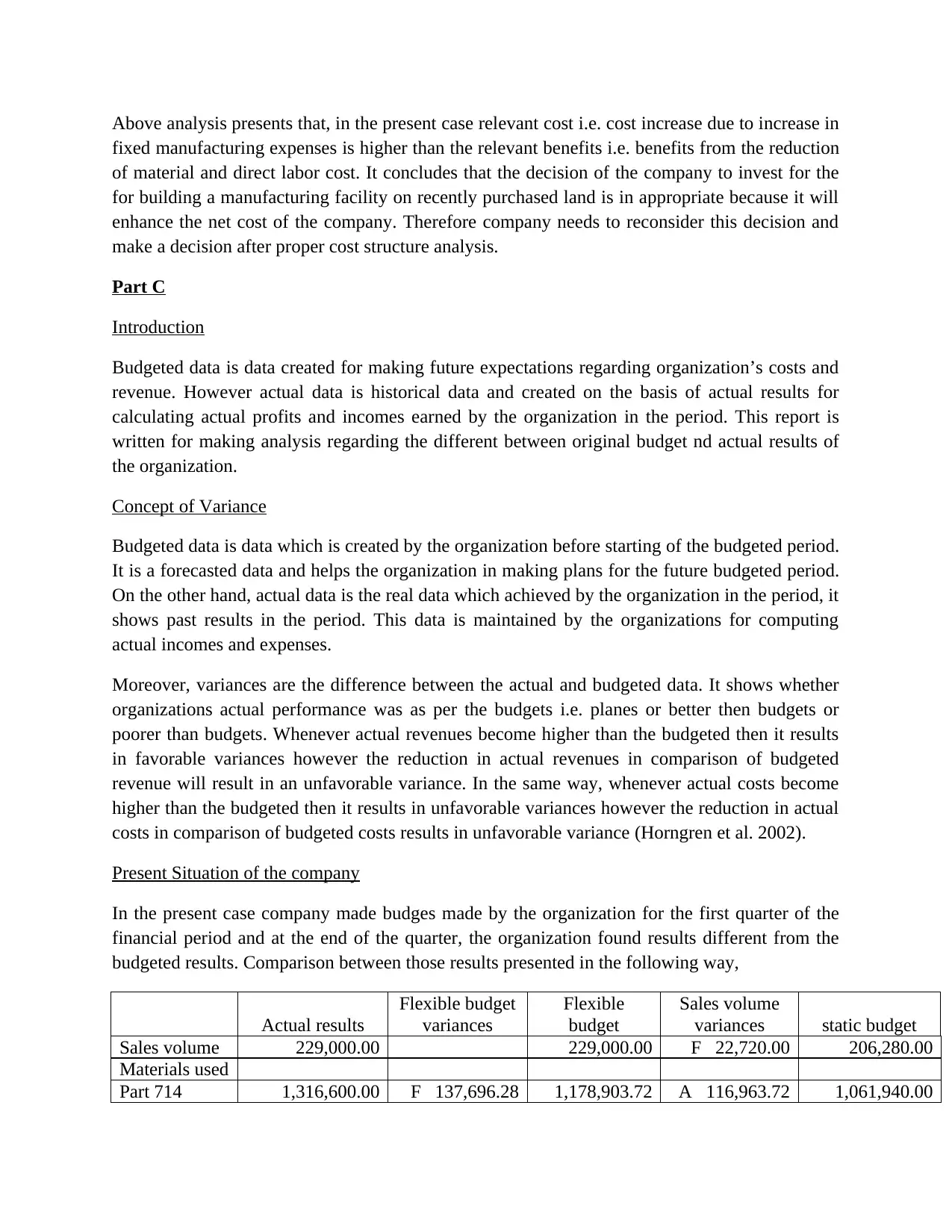
In the present case company made budges made by the organization for the first quarter of the
financial period and at the end of the quarter, the organization found results different from the
budgeted results. Comparison between those results presented in the following way,
Actual results
Flexible budget
variances
Flexible
budget
Sales volume
variances static budget
Sales volume 229,000.00 229,000.00 F 22,720.00 206,280.00
Materials used
Part 714 1,316,600.00 F 137,696.28 1,178,903.72 A 116,963.72 1,061,940.00
Document Page
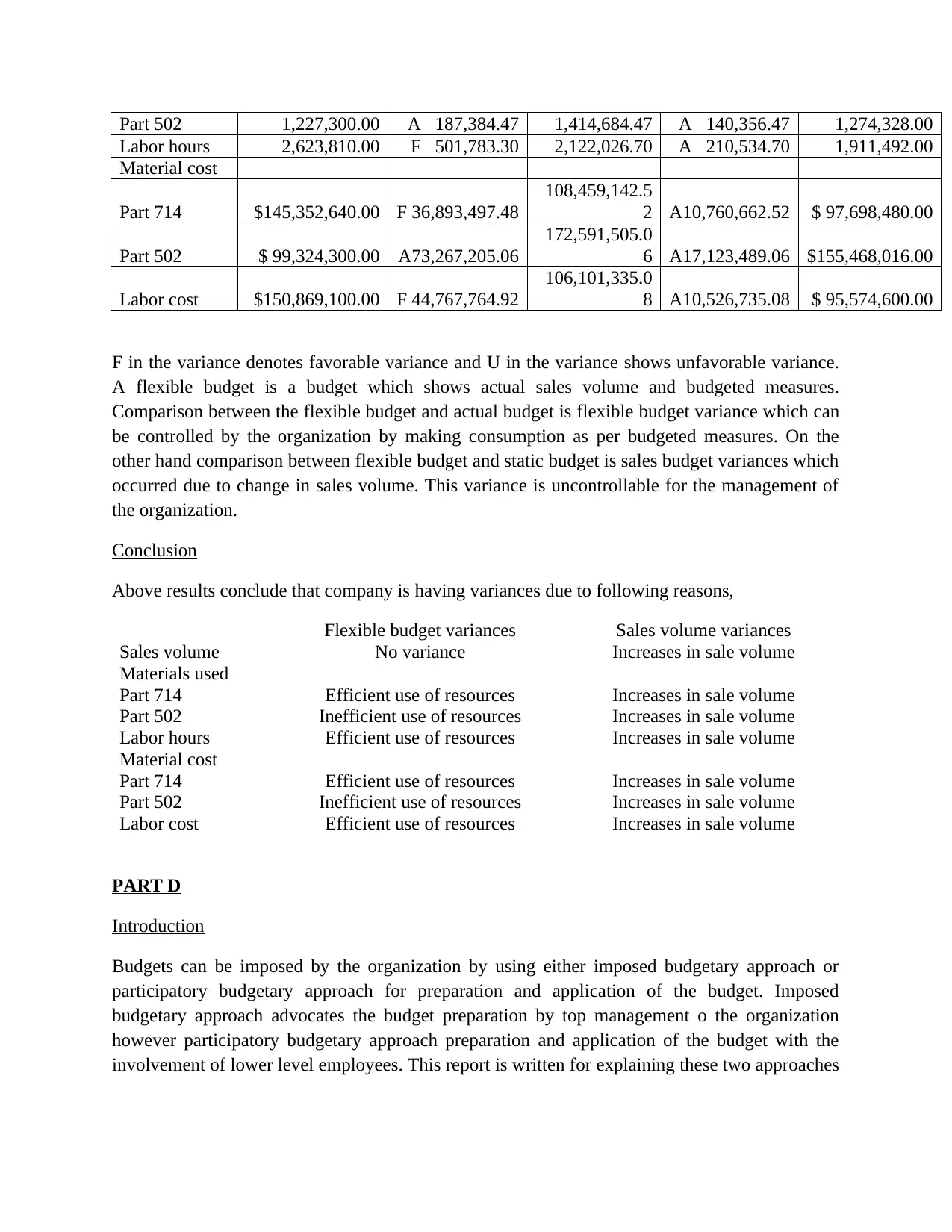
Part 502 1,227,300.00 A 187,384.47 1,414,684.47 A 140,356.47 1,274,328.00
Labor hours 2,623,810.00 F 501,783.30 2,122,026.70 A 210,534.70 1,911,492.00
Material cost
Part 714 $145,352,640.00 F 36,893,497.48
108,459,142.5
2 A10,760,662.52 $ 97,698,480.00
Part 502 $ 99,324,300.00 A73,267,205.06
172,591,505.0
6 A17,123,489.06 $155,468,016.00
Labor cost $150,869,100.00 F 44,767,764.92
106,101,335.0
8 A10,526,735.08 $ 95,574,600.00
F in the variance denotes favorable variance and U in the variance shows unfavorable variance.
A flexible budget is a budget which shows actual sales volume and budgeted measures.
Comparison between the flexible budget and actual budget is flexible budget variance which can
be controlled by the organization by making consumption as per budgeted measures. On the
other hand comparison between flexible budget and static budget is sales budget variances which
occurred due to change in sales volume. This variance is uncontrollable for the management of
the organization.
Conclusion
Above results conclude that company is having variances due to following reasons,
Flexible budget variances Sales volume variances
Sales volume No variance Increases in sale volume
Materials used
Part 714 Efficient use of resources Increases in sale volume
Part 502 Inefficient use of resources Increases in sale volume
Labor hours Efficient use of resources Increases in sale volume
Material cost
Part 714 Efficient use of resources Increases in sale volume
Part 502 Inefficient use of resources Increases in sale volume
Labor cost Efficient use of resources Increases in sale volume
PART D
Introduction
Budgets can be imposed by the organization by using either imposed budgetary approach or
participatory budgetary approach for preparation and application of the budget. Imposed
budgetary approach advocates the budget preparation by top management o the organization
however participatory budgetary approach preparation and application of the budget with the
involvement of lower level employees. This report is written for explaining these two approaches
Document Page
and forming results how of Paulo Farmer will respond if budgets prepared by imposed budgetary
approach or participatory budgetary approach.
Imposed budgetary approach
Imposed budgetary approach does not demand the inputs for the persons who will affect the
operating process of the organizations directly i.e. budgets prepared by the top management of
the organizations. Under this approach, only management of the organization took goals of the
organization as an important factor and does not focus on employee’s well being. This approach
gives a bad feeling to the employees of the organization and they will feel unimportant. Under
this approach, employees will feel only working for the standards set by the seniors and do not
get an emotional attachment to the organization (Hansen, Mowen & Guan 2007). This approach
is also known as top down approach. This approach is having an advantage that is, under this
approach budgets prepared by the top management hence it considers all long term and short
term objectives of the organization. Under this approach, the budget is worked at a device for
communication for the employees they need to hear the budgets and perform on the basis of the
budgeted goals.
If the current budget made by the using imposed budget then Paulo Farmer should be happy
because lower management made higher sales and higher profits then the budgets set by the
higher management.
Participatory budgetary approach
Participatory budgetary approach demands the inputs for the persons who will affect the
operating process of the organizations directly i.e. budgets prepared by including employees of
the organization in the budgetary process (Shah 2007). Under this approach, goals set by the
budgets become the personal goals of the employees and the management. This approach gives a
good feeling to the employees of the organization and they will feel important. Under this
approach, employees will feel working for the standards set by them and get an emotional
attachment to the organization. This approach is also known as bottom up approach. This
approach is having a disadvantage that is, under this approach budgetary process becomes time
consuming and costly due to excess cost incurred for development and administration of the
budgetary process.
If the current budget made by the using participatory budget then Paulo Farmer should be happy
because lower management made higher sales and higher profits then the budgets set by them.
tabler-icon-diamond-filled.svg

Paraphrase This Document

Need a fresh take? Get an instant paraphrase of this document with our AI Paraphraser
Document Page
Bibliography
Hansen, D, Mowen, M & Guan, L 2007, Cost Management: Accounting and Control, Cengage Learning.
Horngren, CT 2009, Cost Accounting: A Managerial Emphasis, Pearson Education India.
Horngren, CT, Bhimani, A, Datar, SM & Foster, G 2002, Management and cost accounting, Pearson
Educati, New York.
Shah, A 2007, Participatory Budgeting, World Bank Publications.
chevron_up_icon
1 out of 5
circle_padding
hide_on_mobile
zoom_out_icon
[object Object]