Microeconomics Analysis: Reliance Jio's Strategy & Tomato Prices

Verified

Added on  2023/06/11

|15
|3054
|130
Essay
AI Summary
This essay provides a microeconomic analysis of Reliance Jio's strategies and the factors influencing the rise in tomato prices. It examines the demand determinants employed by Reliance Jio, including price strategies, related product pricing, and consumer expectations, and how these have impacted the telecom industry. The concept of cross-price elasticity of demand is explored in relation to the telecom sector, focusing on how Jio's affordable data plans affected competitors like Airtel and Idea. Furthermore, the essay discusses the Amazon Fire TV Stick's market introduction and its features. It also analyzes the stages of production, arguing that Reliance Jio has pushed competitors into earlier stages by forcing them to invest in new technologies and labor. Finally, the essay investigates the reasons behind the surge in tomato prices, attributing it to factors such as low prices in previous seasons, demonetization, excessive rainfall, hoarding, drought, farmer strikes, production shortfalls, and the impact of the Goods and Services Tax (GST) on vegetable prices. Desklib offers a wide range of past papers and solved assignments to aid students in their studies.

Document Page
Microeconomics 1
MICROECONOMICS
By (Student’s Name)
Professor’s Name
College
Course
Date
tabler-icon-diamond-filled.svg

Paraphrase This Document

Need a fresh take? Get an instant paraphrase of this document with our AI Paraphraser
Document Page
Microeconomics 2
MICROECONOMICS
What are the demand determinants that Reliance Jio has focused on?
Reliance Jio is a telecommunication company based in India. Reliance Jio is the
most used Internet Service provider in the country and has more than 185000000. Jio is causing
turbulence in the telecom industry, and this is because of its efficiency and effectiveness. The
mobile network has the best offers regarding internet and also calls services (Nair 2017).
Ever since it was launched Jio has managed to gain recognition all over India,
and this is due to the demand determinants that the industry uses. Some of the demand
determinants that Jio uses are as follows.
First, the telecommunication company uses the price determinant. The company
realised that with a change in the prices of their goods and services the demand in the market
also changed. The company gives a four-month trial to all its users meaning the client base can
use the network first for free before deciding to use it fully (Kumar, Balaji, Krishna and Yadav
2018). This has increased their demand as more people are running the test trial. Also, Jio allows
users to make free voice calls to other Jio networks and even to other networks. Reliance Jio also
offers the lowest data plans in India which many users have found useful. Therefore in this
instance, we see that they have managed to increase their demand through price by being easily
affordable.
Second, the mobile network uses the determinant of prices of products that are
related to it. Ever since the launch of Jio, the demand for handsets that are VoLTE enabled has
increased in India. These handsets include those such as Lenovo, Xiaomi, Samsung and
Counterpoint. This is because these handsets allow for the transmission of voice calls as data
while using a 4G network which Jio offers. Also, Jio will impact the online market in India, and
Document Page
Microeconomics 3
this is because it provides cheap data and even fast data. Therefore there will be more audio-
visual content in the online market. In this instance, we see that a change in income or
preferences has resulted in a shift in demand (Kaur 2018).
Lastly, the mobile network uses the determinant of expectation. Ever since its
launch, more and more Indians are using the network, and the client base is expecting more from
the company. Jio has just launched its new data plan, and the users cannot wait to see what more
the company has to offer (Agarwal, 2017). The users are expecting more data plan offers and
merging with other mobile network companies to provide better quality services. Therefore the
expectation in the client base also has a change in the demand.
Explain the concept of cross-price elasticity of demand with respect to clash in telecom
sector companies.
Cross-price elasticity is whereby a change in the price of a good affects the
demand of another related good. For example, if the price of data plans by Jio is cheap then how
has this affected the demand for other mobile networks such as Airtel and Idea (Haq 2017).
Ever since the launch of Jio, the mobile network has managed to score close to
16million subscribers in the country. The network just recently announced its data plans and they
were cheap and affordable. This caused other network companies to have to cut down on their
tariffs by 80 percent. Airtel was the first to slash of their prepaid tariffs, and other networks
followed. In this instance, we see that once the price of the data plans of Jio went down, then the
demand for the mobile network went up. This affected other mobile networks in that their
demand went down because most of the users preferred the data plan that Jio offered. The other
networks hat to cut down on their prices as well so that they could not lose their demand
(Chinthala, Madhur and Kumar 2017).
Document Page
Microeconomics 4
Also, the price of the goods and services that Reliance Jio offers has had an
adverse effect on the balance sheets of other mobile network companies. Airtel for example, after
cutting down on the data tariffs has had a 4.9 percent decline in their profits in Q2. The company
was however lucky because, despite their declines in profit, they had a 24 percent increase in the
data revenue. Idea was however not fortunate because they witnessed a decrease of 24 percent in
the data revenue. Since Jio made its voice calls free, the other mobile networks are resisting
doing this, but they could make calls over the VoLTE networks free (Mahalaxmi and Kumar
2017).
Reliance Jio has also affected the sales of VoLTE enabled handsets in the
country. With its fast and cheap data plans, more Indians are buying VoLTE enabled handsets
that allow one to transmit voice calls as data over a 4G network. In this instance, we see that the
affordable prices for the 4G data that Jio offers have had a positive effect on the demand for
handsets that are VoLTE enabled. The demand for such handsets has increased in the country.
Amazon Fire TV Stick Introduction in the market.
The Amazon Fire TV Stick is a digital media player that is designed to stream
digital audio and video to television at high definition. The media player is simply an
entertainment device that was developed by Amazon. The media player also allows one to play
video games on a mobile app or via a video game controller. The Fire TV Stick is a smaller
version of the Fire TV. It does everything that the Fire TV does, but it has different hardware
(James 2016).
The Fire TV Stick has a 1GB RAM, 8GB storage, is 25.1g and it uses two
processers which are Broadcom BCM28155 dual-core 1.0 GHz Cortex-A9 processor and a
Broadcom VideoCore IV GPU. The Fire TV Stick has two remotes where one has a voice search
tabler-icon-diamond-filled.svg

Paraphrase This Document

Need a fresh take? Get an instant paraphrase of this document with our AI Paraphraser
Document Page
Microeconomics 5
while the other does not (Morrison, Read, Xynos and Sutherland 2017). The voice commands on
the Fire TV Stick offer great navigation and also it has a high processor speed due to the new
processor. It also has improved Wi-Fi, therefore, making it efficient to use. The Fire Stick TV is
consequently an upgrade from the Fire TV, and every new user should purchase it (Weber 2017).
Recall three stages of production. Can we say that Reliance Jio has pushed
the incumbents (Airtel, Idea etc.) in the first stages of production? Explain.
Production is the process of manufacturing an item from raw materials. The total
product is the output of mixing different resources for example capital and raw materials. The
marginal product is the change that occurs in the production when more workers are hired.
Lastly, the average product is the number of total products divided by the labour used. The
production process has three main stages, and these are as follows
In stage one; there is an increase in the average product. The total product also
increases at this stage and remains positive. The marginal product on the other hand at first
increases but then with time decreases till it equalises with the average product (Leontief 2016).
In stage two; the production is characterised by decreasing. The total product the
total product decreases but positively with each added input which is the raw materials in this
case. The marginal product also decreases with each added input as well as the average product
(Panda 2017).
In stage three; the diminishing marginal product characterises the production.
The marginal product decreases until it becomes negative. The average product at this stage
remains positive but decreases as well.
From the above, it is correct to say that Reliance Jio has pushed other mobile
networks into the first stage of production. Reliance Jio offers free voice calls and cheap data
Document Page
Microeconomics 6
plans which other mobile networks have to compete with. This has caused the network to invest
in new inputs such as technology and labour to increase and better their output. In labour, they
are hiring more skilled personnel while in technology they are using new high tech to improve
their services. The mobile networks are also investing more capital and purchasing better raw
materials such as new appliances. All these are in the efforts to counter the strategies of Jio and
have better services than them (Jose 2017).
Why have tomato prices risen so much? Explain through the concepts of
supply and demand.
The price of tomatoes has risen due to the following reasons
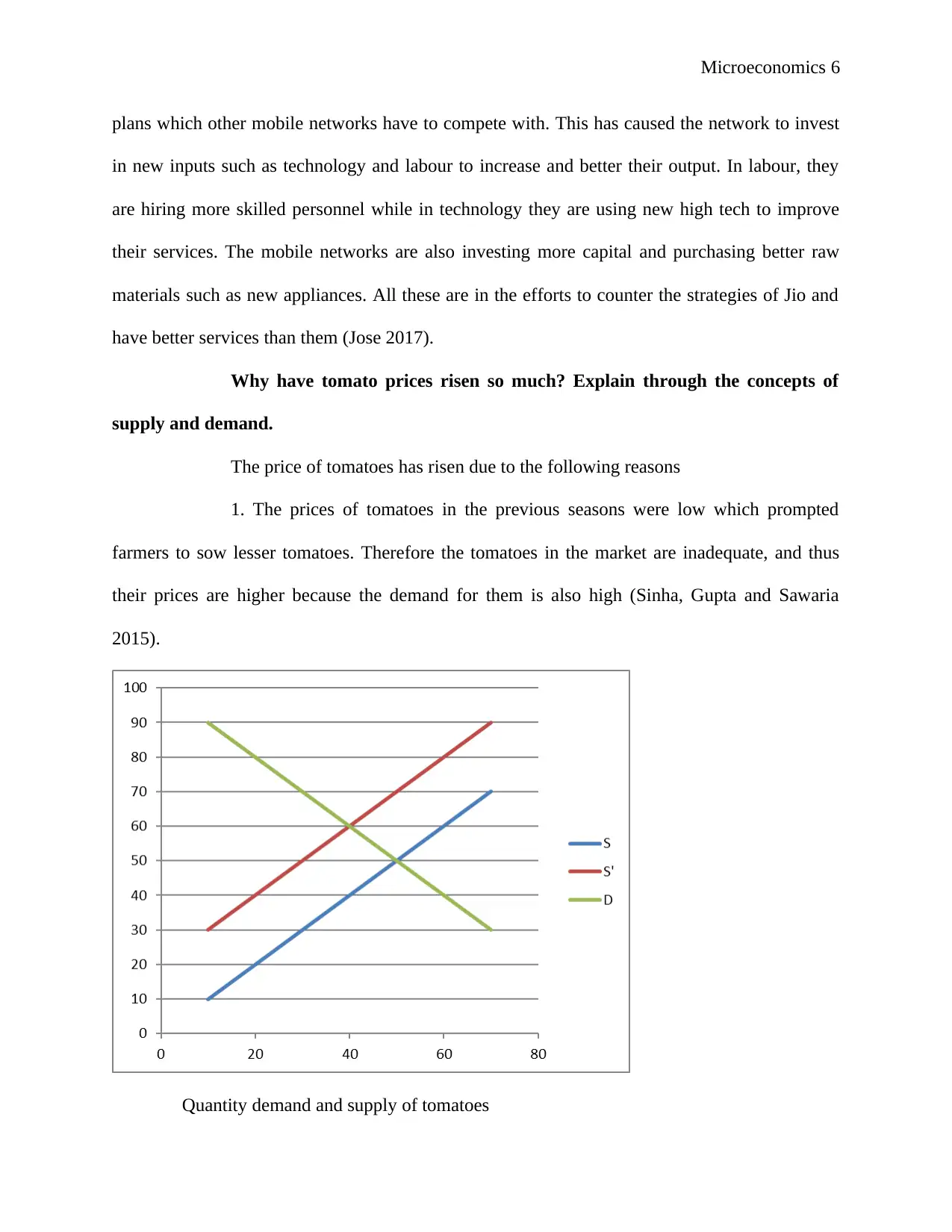
1. The prices of tomatoes in the previous seasons were low which prompted
farmers to sow lesser tomatoes. Therefore the tomatoes in the market are inadequate, and thus
their prices are higher because the demand for them is also high (Sinha, Gupta and Sawaria
2015).
Quantity demand and supply of tomatoes
Document Page
Microeconomics 7
Figure 1: inadequate supply leads to higher prices and low quantity
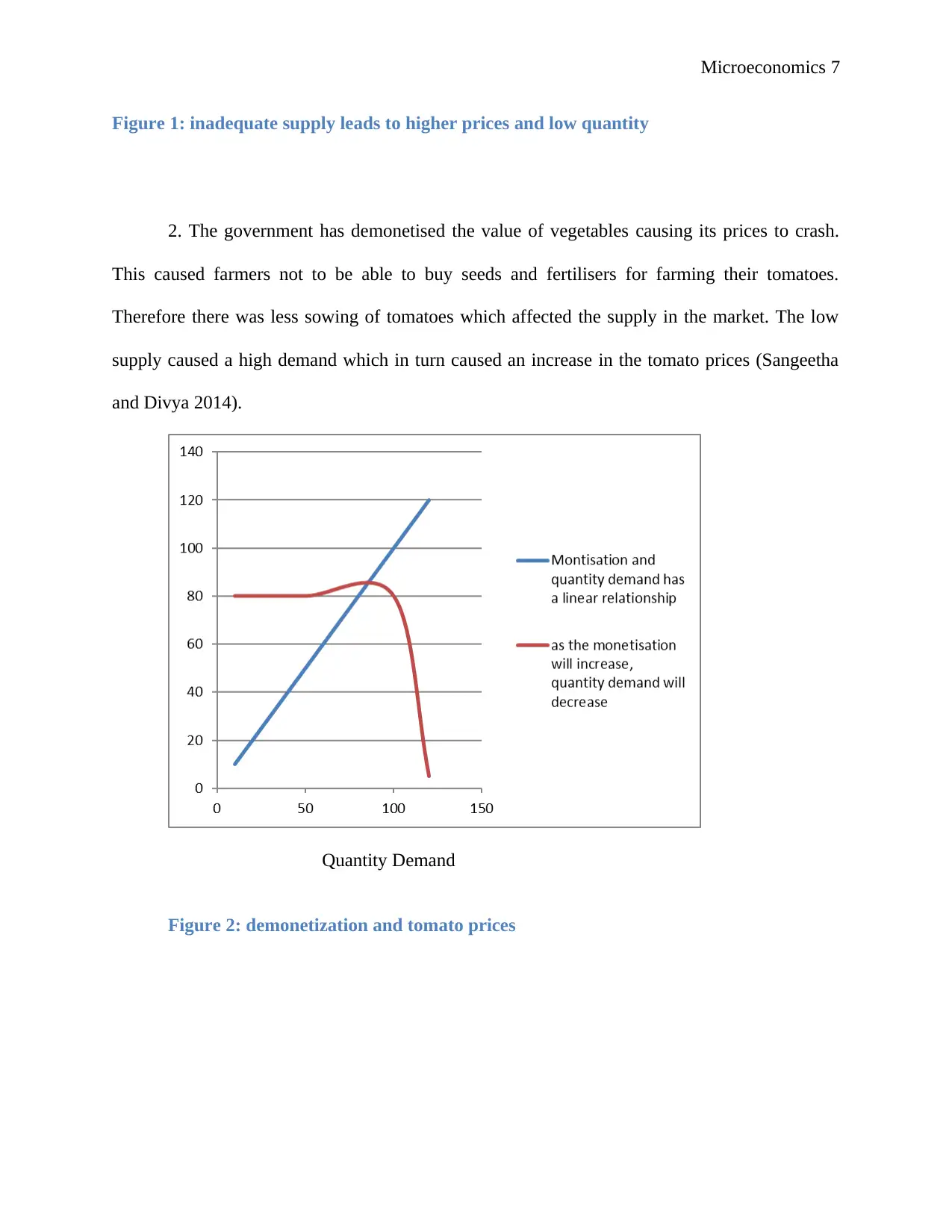
2. The government has demonetised the value of vegetables causing its prices to crash.
This caused farmers not to be able to buy seeds and fertilisers for farming their tomatoes.
Therefore there was less sowing of tomatoes which affected the supply in the market. The low
supply caused a high demand which in turn caused an increase in the tomato prices (Sangeetha
and Divya 2014).
Quantity Demand
Figure 2: demonetization and tomato prices
tabler-icon-diamond-filled.svg

Paraphrase This Document

Need a fresh take? Get an instant paraphrase of this document with our AI Paraphraser
Document Page
Microeconomics 8
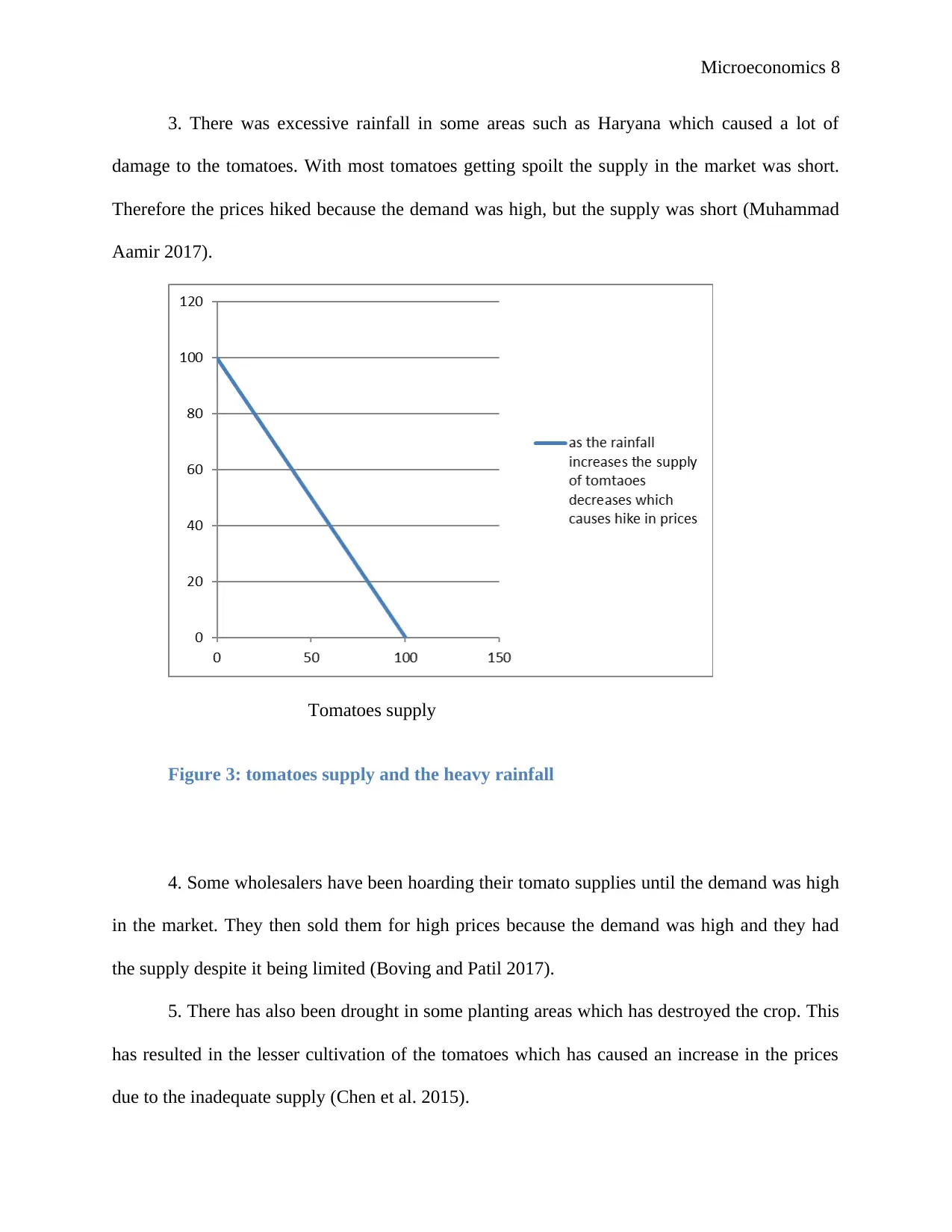
3. There was excessive rainfall in some areas such as Haryana which caused a lot of
damage to the tomatoes. With most tomatoes getting spoilt the supply in the market was short.
Therefore the prices hiked because the demand was high, but the supply was short (Muhammad
Aamir 2017).
Tomatoes supply
Figure 3: tomatoes supply and the heavy rainfall
4. Some wholesalers have been hoarding their tomato supplies until the demand was high
in the market. They then sold them for high prices because the demand was high and they had
the supply despite it being limited (Boving and Patil 2017).
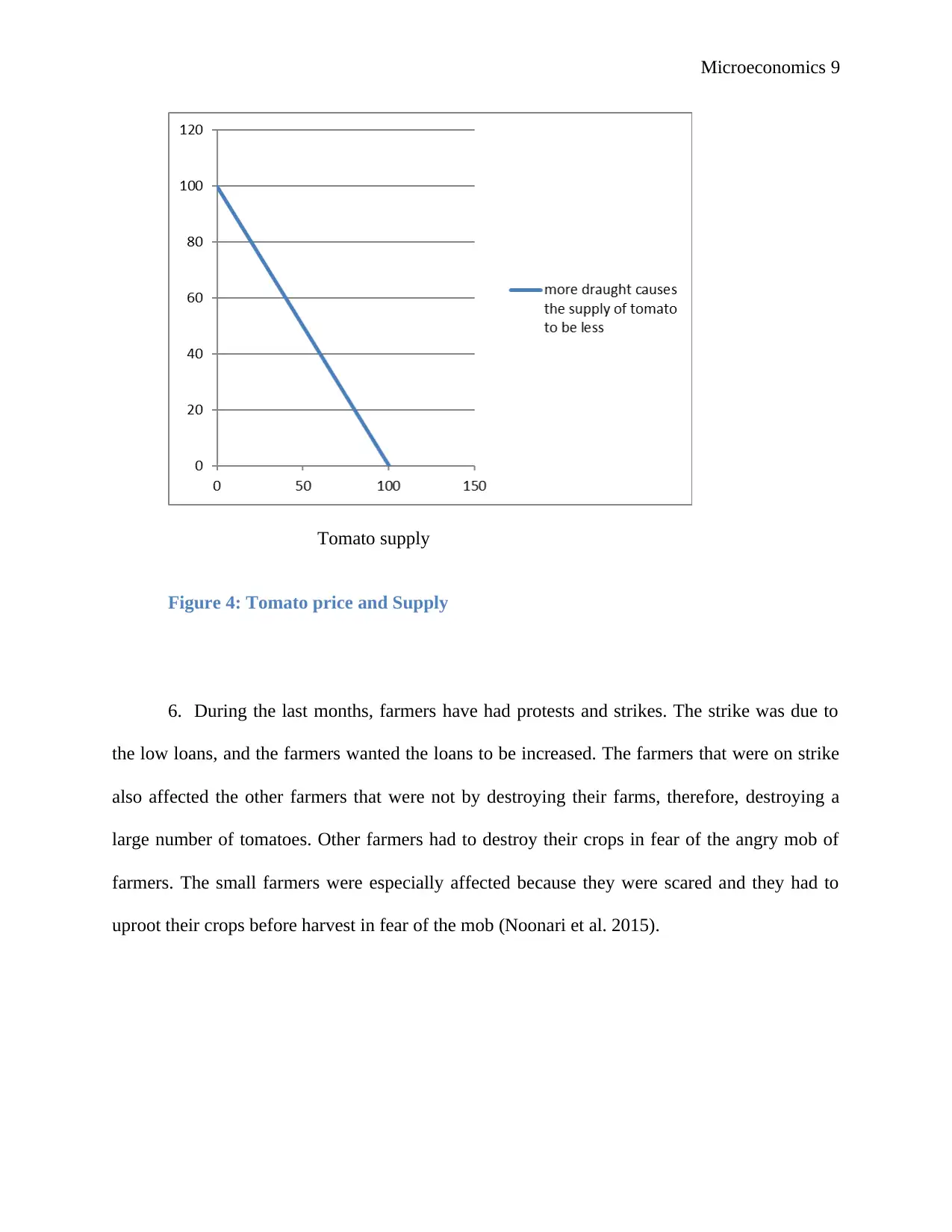
5. There has also been drought in some planting areas which has destroyed the crop. This
has resulted in the lesser cultivation of the tomatoes which has caused an increase in the prices
due to the inadequate supply (Chen et al. 2015).
Document Page
Microeconomics 9
Tomato supply
Figure 4: Tomato price and Supply
6. During the last months, farmers have had protests and strikes. The strike was due to
the low loans, and the farmers wanted the loans to be increased. The farmers that were on strike
also affected the other farmers that were not by destroying their farms, therefore, destroying a
large number of tomatoes. Other farmers had to destroy their crops in fear of the angry mob of
farmers. The small farmers were especially affected because they were scared and they had to
uproot their crops before harvest in fear of the mob (Noonari et al. 2015).
Document Page
Microeconomics 10
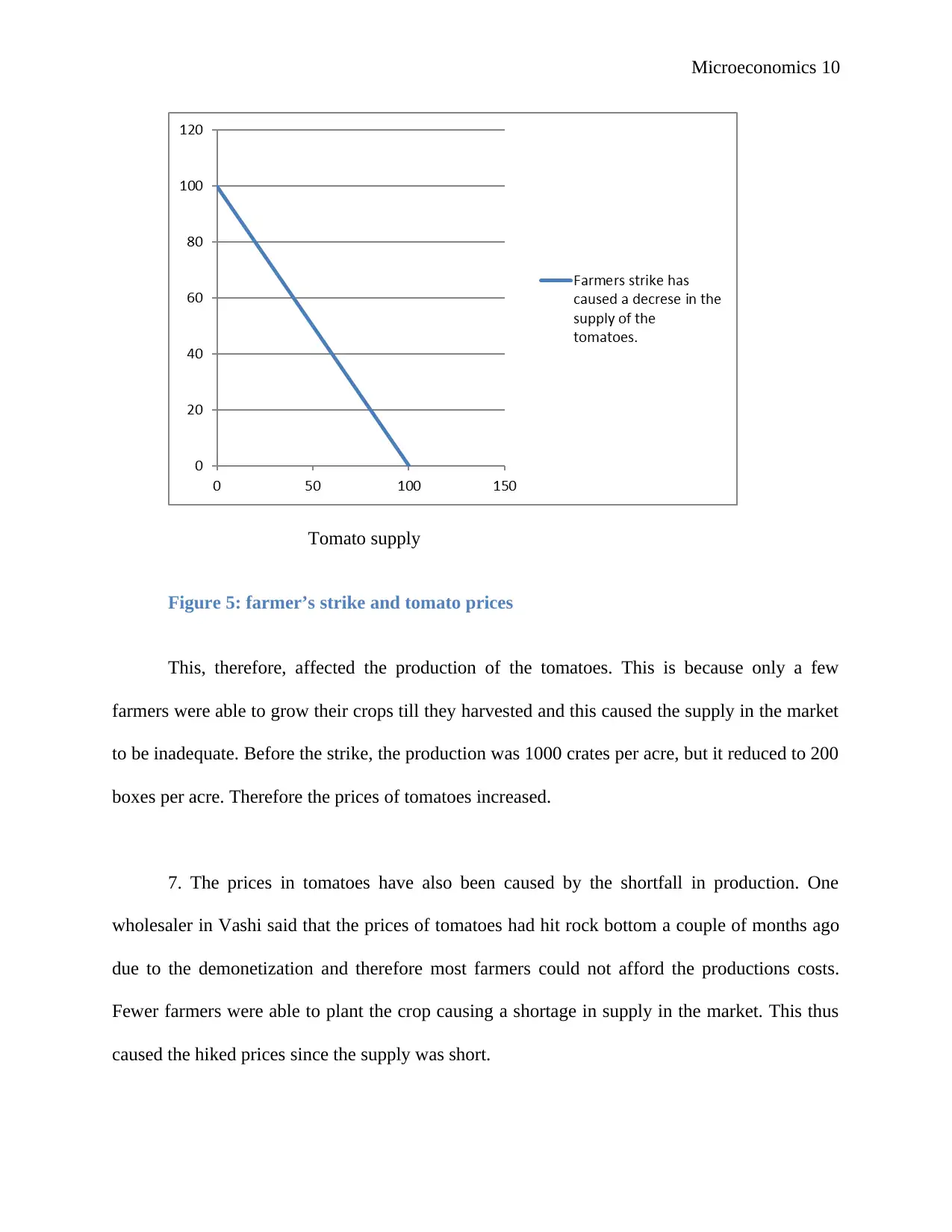
Tomato supply
Figure 5: farmer’s strike and tomato prices
This, therefore, affected the production of the tomatoes. This is because only a few
farmers were able to grow their crops till they harvested and this caused the supply in the market
to be inadequate. Before the strike, the production was 1000 crates per acre, but it reduced to 200
boxes per acre. Therefore the prices of tomatoes increased.
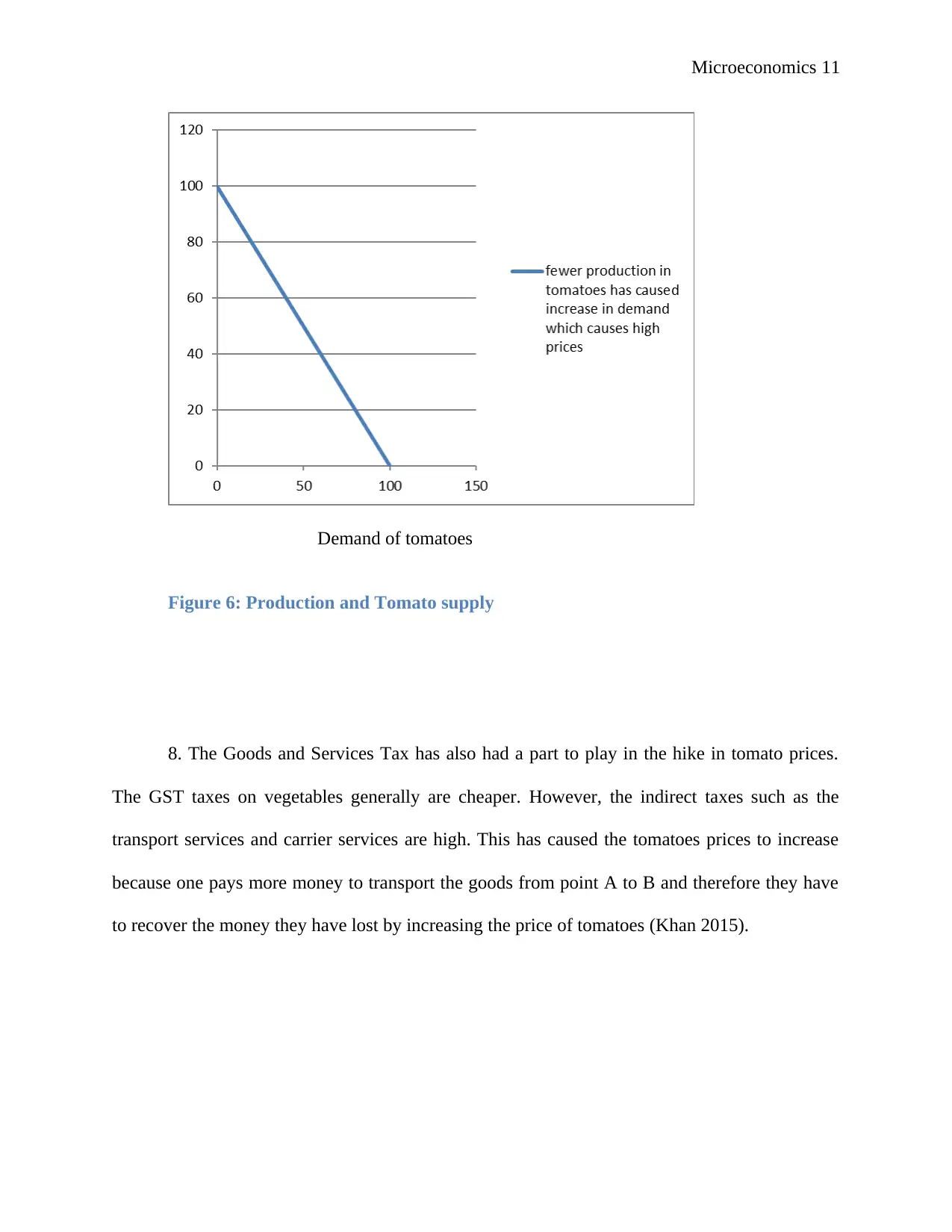
7. The prices in tomatoes have also been caused by the shortfall in production. One
wholesaler in Vashi said that the prices of tomatoes had hit rock bottom a couple of months ago
due to the demonetization and therefore most farmers could not afford the productions costs.
Fewer farmers were able to plant the crop causing a shortage in supply in the market. This thus
caused the hiked prices since the supply was short.
tabler-icon-diamond-filled.svg

Paraphrase This Document

Need a fresh take? Get an instant paraphrase of this document with our AI Paraphraser
Document Page
Microeconomics 11
Demand of tomatoes
Figure 6: Production and Tomato supply
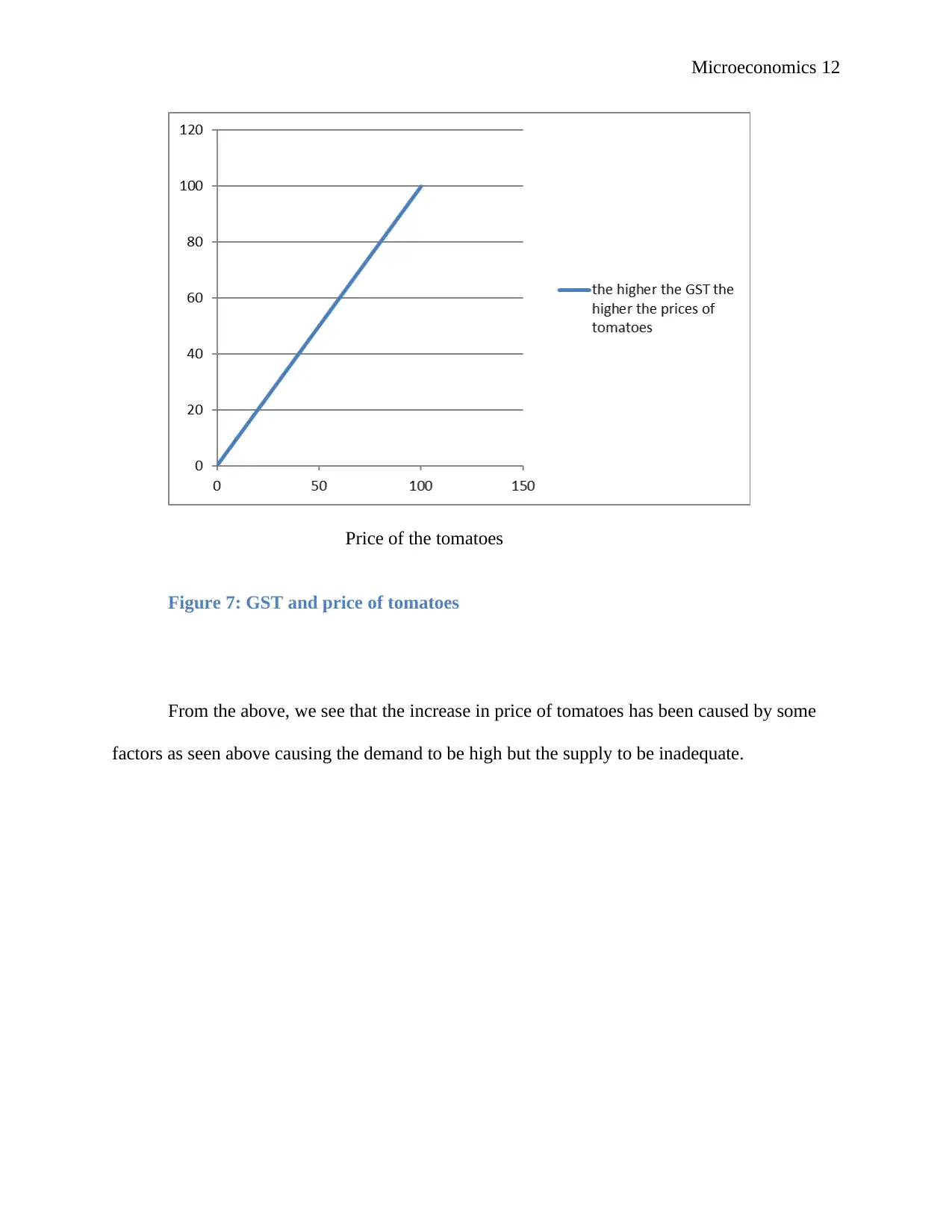
8. The Goods and Services Tax has also had a part to play in the hike in tomato prices.
The GST taxes on vegetables generally are cheaper. However, the indirect taxes such as the
transport services and carrier services are high. This has caused the tomatoes prices to increase
because one pays more money to transport the goods from point A to B and therefore they have
to recover the money they have lost by increasing the price of tomatoes (Khan 2015).
Document Page
Microeconomics 12
Price of the tomatoes
Figure 7: GST and price of tomatoes
From the above, we see that the increase in price of tomatoes has been caused by some
factors as seen above causing the demand to be high but the supply to be inadequate.
chevron_up_icon
1 out of 15
circle_padding
hide_on_mobile
zoom_out_icon
[object Object]