Religion and Its Aspects: Psychology Research Paper - Semester Project
VerifiedAdded on 2023/01/05
|12
|3217
|51
Report
AI Summary
This research paper delves into the multifaceted aspects of religion and its impact on individuals and society. The paper begins with an abstract and introduction that outlines the scope of the study, focusing on the psychological perspectives of religion. A comprehensive literature review examines the existing research on religious beliefs, spiritual practices, and their correlation with mental health issues, including the merits of religion in treating mental illnesses, religious development throughout the human lifespan, and the impact of religion on daily lives. The discussion and conclusions section synthesizes the findings, highlighting the complex relationship between religion, mental well-being, and social interactions. The paper emphasizes the role of religion in fostering a sense of belonging, trustworthiness, and mindfulness, while also acknowledging the potential for negative impacts, particularly in cases of pathological religious beliefs. The study also touches upon religious conversion and pluralism, underscoring the dynamic nature of religious practices across different communities. The research paper concludes by emphasizing the need for a nuanced understanding of the multifaceted role of religion in shaping individual and societal behaviors.
Running head: RELIGION AND ITS ASPECTS
RELIGION AND ITS ASPECTS
Name of the student
Name of the university
Author note
RELIGION AND ITS ASPECTS
Name of the student
Name of the university
Author note

Paraphrase This Document
Need a fresh take? Get an instant paraphrase of this document with our AI Paraphraser
1RELIGION AND ITS ASPECTS
Abstract
The aim of the paper is to understand the issue of religion and the diverse aspects of it. It has
been observed that religion is one of the cultural and social aspects of the individual living in
that place and grows over a long period of time. It has been highlighted that the growth of
ideas and learning process of practices associated with the cultural and religious connotation
has their genesis in the early years of child. This paper also discusses the issue of
development of religious conversion, their practices throughout different communities of
people. This paper has also highlighted the aspects of impact that religion has on the
treatment of the mental health issues is not particular to any community, there are number of
such evidences across religion and communities. Considering the aim of the paper, this
paper will be highlighting the issues of religious impact on the lives of the people. It has
been observed that religion has the overarching impact in developing the sense of
belongingness and trustworthiness among the people which acts as the boon for the
development of good mental health. Hence it is justified to argue the fact that there is a
correlation between the good mental health and the sense of belongingness to a particular
religious community. This paper has also developed understanding in the ways religion
shapes the way we perceive the world. The impact of religion is likely to shape the way one
particular community lives. Hence it is important to consider the fact that religion is on the
guiding factors of society that has the multidimensional aspects and underlying nuances.
Abstract
The aim of the paper is to understand the issue of religion and the diverse aspects of it. It has
been observed that religion is one of the cultural and social aspects of the individual living in
that place and grows over a long period of time. It has been highlighted that the growth of
ideas and learning process of practices associated with the cultural and religious connotation
has their genesis in the early years of child. This paper also discusses the issue of
development of religious conversion, their practices throughout different communities of
people. This paper has also highlighted the aspects of impact that religion has on the
treatment of the mental health issues is not particular to any community, there are number of
such evidences across religion and communities. Considering the aim of the paper, this
paper will be highlighting the issues of religious impact on the lives of the people. It has
been observed that religion has the overarching impact in developing the sense of
belongingness and trustworthiness among the people which acts as the boon for the
development of good mental health. Hence it is justified to argue the fact that there is a
correlation between the good mental health and the sense of belongingness to a particular
religious community. This paper has also developed understanding in the ways religion
shapes the way we perceive the world. The impact of religion is likely to shape the way one
particular community lives. Hence it is important to consider the fact that religion is on the
guiding factors of society that has the multidimensional aspects and underlying nuances.
2RELIGION AND ITS ASPECTS
Introduction
The aim of the paper is to evaluate and understand the topic of religion psychology and the
underlying aspects of the same. It has been observed in the previous discussion that the
development of religion and it correlation with the treatment of the mental illness among
minority communities. Treatment of mental illness is one of the issues that had positive
correlation with the social support and spiritual care of the people belonging to the
communities (Bhat et al., 2017). It has been further observed in the last discussion that
religion has an important role to play in interpersonal and intergroup relationship within the
context of Ireland. The impact of the mixed religion is one of the aspects that have impacted
the daily lives of the people in the multiple aspects. The last of the previous discussion has
pointed out the development of religion throughout the human lifespan. The aim of this paper
is to further develop the understanding of the same by looking into the nuances of the same.
The formal definition of religion is part of the religious studies that explains the set of beliefs
that is based on the worship of the personal god or the supernatural forces. The practice of
religion differs in terms of place and context (Philip et al., 2017). While in the context of
Europe adoption of one single faith is accepted as natural process, the reverse is not true in
the context of Asia. According to Emile Durkheim, the process of unified system of beliefs
and practices and relative to sacred things (Fox, 2018). The unification of such beliefs into
one single moral community called church is what has been the guiding understanding of
religion. According to the definition provided by the Stackhouse, it is the comprehensive
worldview of the metaphysical moral vision of things that’s accepted as the binding as the
single belief(Galek et al., 2015). However what is significant to note here is that the
definition of religion has changed over a long period of time and it is important to
understand the specific context of discussion in order to appreciate the same.
Introduction
The aim of the paper is to evaluate and understand the topic of religion psychology and the
underlying aspects of the same. It has been observed in the previous discussion that the
development of religion and it correlation with the treatment of the mental illness among
minority communities. Treatment of mental illness is one of the issues that had positive
correlation with the social support and spiritual care of the people belonging to the
communities (Bhat et al., 2017). It has been further observed in the last discussion that
religion has an important role to play in interpersonal and intergroup relationship within the
context of Ireland. The impact of the mixed religion is one of the aspects that have impacted
the daily lives of the people in the multiple aspects. The last of the previous discussion has
pointed out the development of religion throughout the human lifespan. The aim of this paper
is to further develop the understanding of the same by looking into the nuances of the same.
The formal definition of religion is part of the religious studies that explains the set of beliefs
that is based on the worship of the personal god or the supernatural forces. The practice of
religion differs in terms of place and context (Philip et al., 2017). While in the context of
Europe adoption of one single faith is accepted as natural process, the reverse is not true in
the context of Asia. According to Emile Durkheim, the process of unified system of beliefs
and practices and relative to sacred things (Fox, 2018). The unification of such beliefs into
one single moral community called church is what has been the guiding understanding of
religion. According to the definition provided by the Stackhouse, it is the comprehensive
worldview of the metaphysical moral vision of things that’s accepted as the binding as the
single belief(Galek et al., 2015). However what is significant to note here is that the
definition of religion has changed over a long period of time and it is important to
understand the specific context of discussion in order to appreciate the same.
⊘ This is a preview!⊘
Do you want full access?
Subscribe today to unlock all pages.

Trusted by 1+ million students worldwide
3RELIGION AND ITS ASPECTS
Literature review
Religion is defined as the process of organized and community based belief system which is
guided by fulfilment of certain rituals and based on certain common teachings. In this case,
the relation between mental health and religion has been positive since data estimate says
that religion reduces the chances of suicides ,alcoholism and the drug use. It has been also
pointed out that religion tends to initiate social interactions and connection with other
members of the society(Fischer, 2018). Religion has an important contribution in assuring the
trustworthiness by enhancing the social engagement among the people. The sense of
becomingness and development of mindfulness in one of the key aspects of the religion in
lives of people (Philip et al., 2017). According to the opinion of the scholars, there is a stark
difference in the public and private religiosity. The impact of religion is part of the internal
belief and it has been observed in the last discussions that the regular attendance of people to
the places of worship embeds in people social, emotional and moral supports which are the
important components of good mental health (Goody, 2018). Even in some part of the world,
religious readings are used for the purpose of treating the mental health issues of the patients.
This is harnessed as the process of resource for recovery of the individuals with mental health
disorder. According to the global estimation on the issue of mental health, only 52% of the
total population is diagnosed with severe mental health issues which requires the medical
intrusion, however for the minor cases of such issues, it could be easily treated with
enhanced interactions among the communities of people(Hood Jr et al., 2018). This brings us
to need of looking into the literatures existing on the issue of impact of religion on the lives
of individuals and that of the society. In the previous discussion it has been highlighted that
religion and sexual behaviour of the individual in terms of the premarital sexual activity and
the relationship of religion. It is interesting to note that the development of fundamentalism
and new religious movements has led to the process of re-examination of religion and sexual
Literature review
Religion is defined as the process of organized and community based belief system which is
guided by fulfilment of certain rituals and based on certain common teachings. In this case,
the relation between mental health and religion has been positive since data estimate says
that religion reduces the chances of suicides ,alcoholism and the drug use. It has been also
pointed out that religion tends to initiate social interactions and connection with other
members of the society(Fischer, 2018). Religion has an important contribution in assuring the
trustworthiness by enhancing the social engagement among the people. The sense of
becomingness and development of mindfulness in one of the key aspects of the religion in
lives of people (Philip et al., 2017). According to the opinion of the scholars, there is a stark
difference in the public and private religiosity. The impact of religion is part of the internal
belief and it has been observed in the last discussions that the regular attendance of people to
the places of worship embeds in people social, emotional and moral supports which are the
important components of good mental health (Goody, 2018). Even in some part of the world,
religious readings are used for the purpose of treating the mental health issues of the patients.
This is harnessed as the process of resource for recovery of the individuals with mental health
disorder. According to the global estimation on the issue of mental health, only 52% of the
total population is diagnosed with severe mental health issues which requires the medical
intrusion, however for the minor cases of such issues, it could be easily treated with
enhanced interactions among the communities of people(Hood Jr et al., 2018). This brings us
to need of looking into the literatures existing on the issue of impact of religion on the lives
of individuals and that of the society. In the previous discussion it has been highlighted that
religion and sexual behaviour of the individual in terms of the premarital sexual activity and
the relationship of religion. It is interesting to note that the development of fundamentalism
and new religious movements has led to the process of re-examination of religion and sexual
Paraphrase This Document
Need a fresh take? Get an instant paraphrase of this document with our AI Paraphraser
4RELIGION AND ITS ASPECTS
behaviour. Hence it is critical to note that the religion is the public psychology is more
complex than it appears since there are number of underlying factor and aspects that are
impacting in diverse ways(Imber, 2017).
Discussion and conclusions
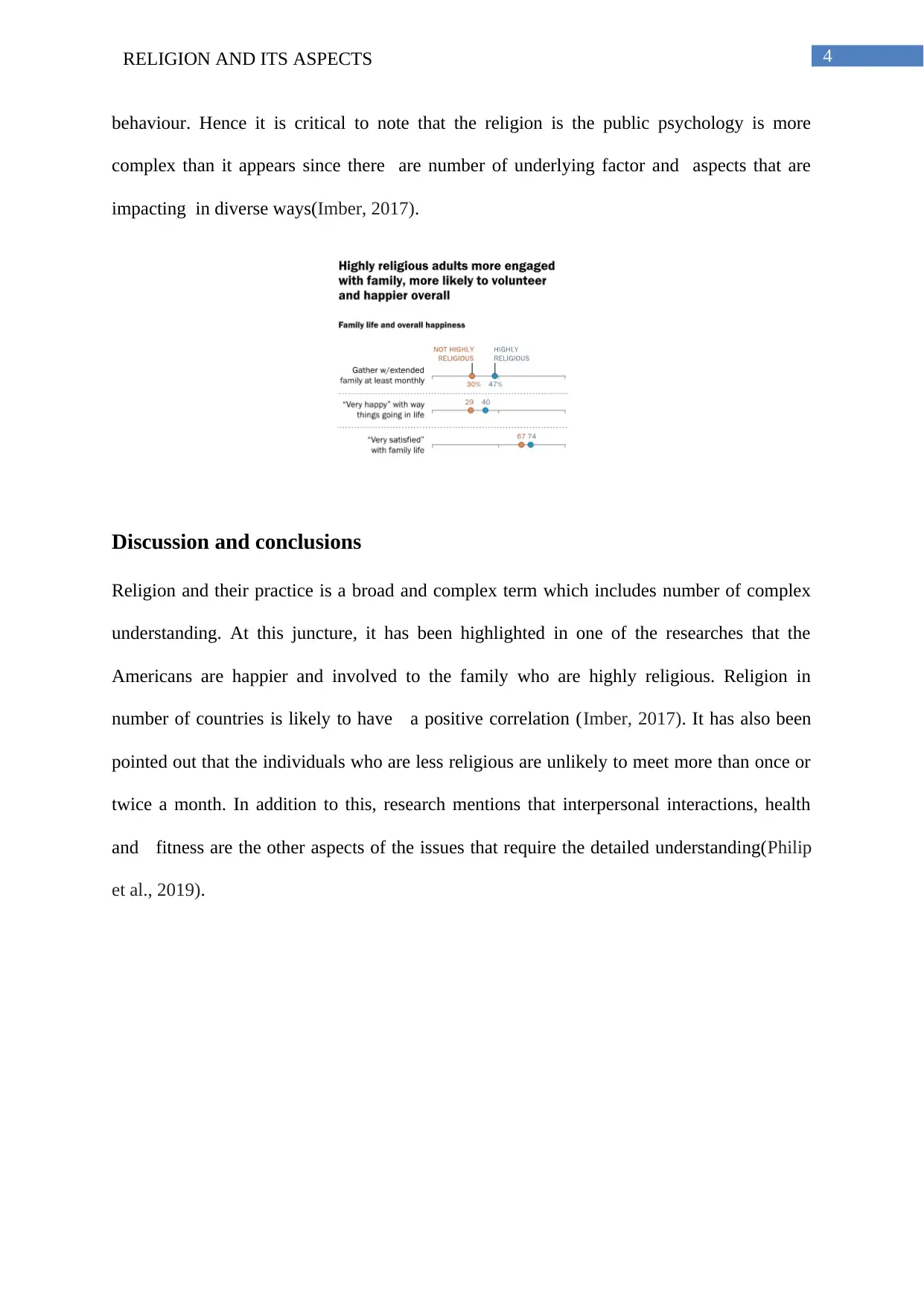
Religion and their practice is a broad and complex term which includes number of complex
understanding. At this juncture, it has been highlighted in one of the researches that the
Americans are happier and involved to the family who are highly religious. Religion in
number of countries is likely to have a positive correlation (Imber, 2017). It has also been
pointed out that the individuals who are less religious are unlikely to meet more than once or
twice a month. In addition to this, research mentions that interpersonal interactions, health
and fitness are the other aspects of the issues that require the detailed understanding(Philip
et al., 2019).
behaviour. Hence it is critical to note that the religion is the public psychology is more
complex than it appears since there are number of underlying factor and aspects that are
impacting in diverse ways(Imber, 2017).
Discussion and conclusions
Religion and their practice is a broad and complex term which includes number of complex
understanding. At this juncture, it has been highlighted in one of the researches that the
Americans are happier and involved to the family who are highly religious. Religion in
number of countries is likely to have a positive correlation (Imber, 2017). It has also been
pointed out that the individuals who are less religious are unlikely to meet more than once or
twice a month. In addition to this, research mentions that interpersonal interactions, health
and fitness are the other aspects of the issues that require the detailed understanding(Philip
et al., 2019).
5RELIGION AND ITS ASPECTS
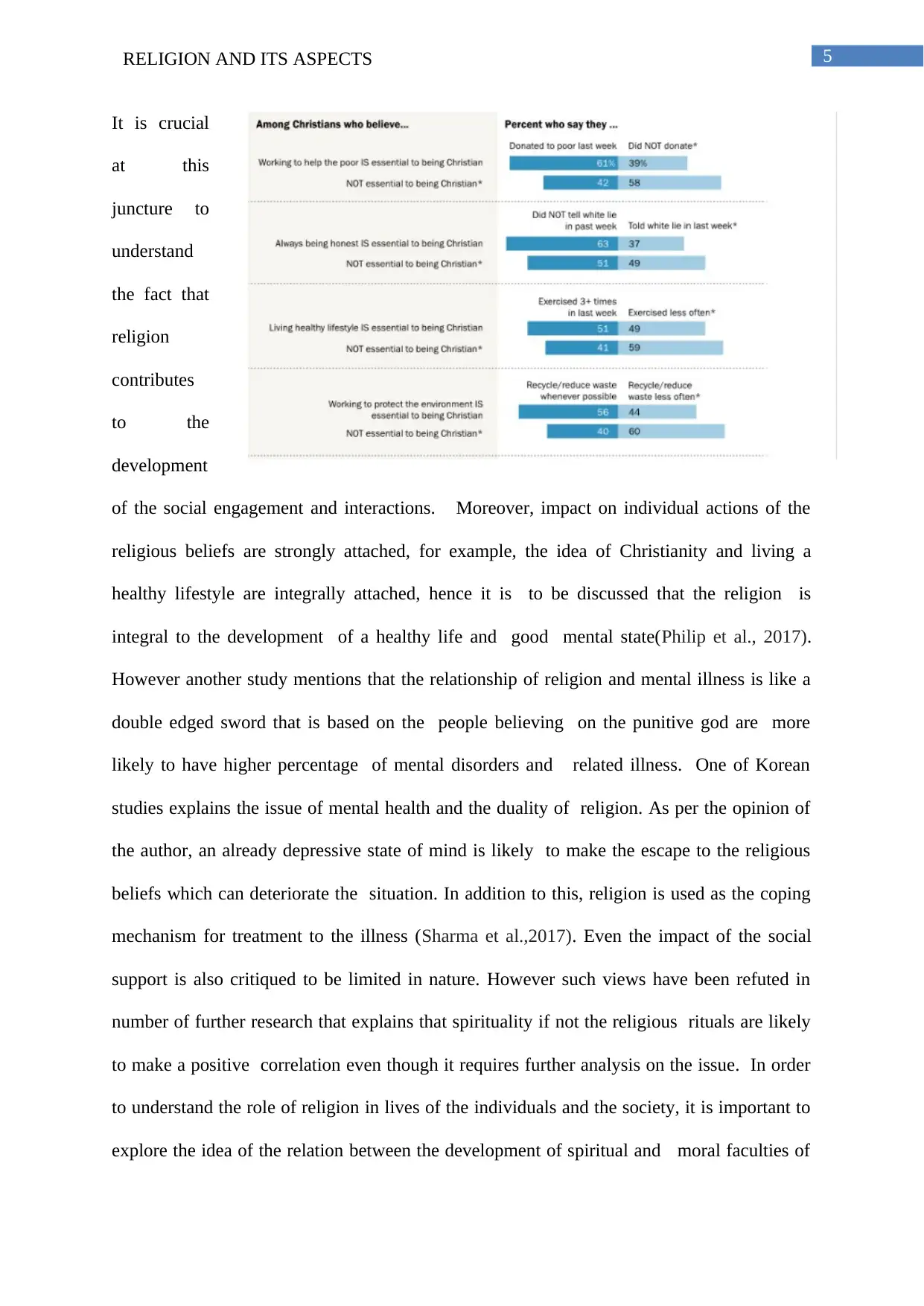
It is crucial
at this
juncture to
understand
the fact that
religion
contributes
to the
development
of the social engagement and interactions. Moreover, impact on individual actions of the
religious beliefs are strongly attached, for example, the idea of Christianity and living a
healthy lifestyle are integrally attached, hence it is to be discussed that the religion is
integral to the development of a healthy life and good mental state(Philip et al., 2017).
However another study mentions that the relationship of religion and mental illness is like a
double edged sword that is based on the people believing on the punitive god are more
likely to have higher percentage of mental disorders and related illness. One of Korean
studies explains the issue of mental health and the duality of religion. As per the opinion of
the author, an already depressive state of mind is likely to make the escape to the religious
beliefs which can deteriorate the situation. In addition to this, religion is used as the coping
mechanism for treatment to the illness (Sharma et al.,2017). Even the impact of the social
support is also critiqued to be limited in nature. However such views have been refuted in
number of further research that explains that spirituality if not the religious rituals are likely
to make a positive correlation even though it requires further analysis on the issue. In order
to understand the role of religion in lives of the individuals and the society, it is important to
explore the idea of the relation between the development of spiritual and moral faculties of
It is crucial
at this
juncture to
understand
the fact that
religion
contributes
to the
development
of the social engagement and interactions. Moreover, impact on individual actions of the
religious beliefs are strongly attached, for example, the idea of Christianity and living a
healthy lifestyle are integrally attached, hence it is to be discussed that the religion is
integral to the development of a healthy life and good mental state(Philip et al., 2017).
However another study mentions that the relationship of religion and mental illness is like a
double edged sword that is based on the people believing on the punitive god are more
likely to have higher percentage of mental disorders and related illness. One of Korean
studies explains the issue of mental health and the duality of religion. As per the opinion of
the author, an already depressive state of mind is likely to make the escape to the religious
beliefs which can deteriorate the situation. In addition to this, religion is used as the coping
mechanism for treatment to the illness (Sharma et al.,2017). Even the impact of the social
support is also critiqued to be limited in nature. However such views have been refuted in
number of further research that explains that spirituality if not the religious rituals are likely
to make a positive correlation even though it requires further analysis on the issue. In order
to understand the role of religion in lives of the individuals and the society, it is important to
explore the idea of the relation between the development of spiritual and moral faculties of
⊘ This is a preview!⊘
Do you want full access?
Subscribe today to unlock all pages.
Trusted by 1+ million students worldwide
6RELIGION AND ITS ASPECTS
the individuals. This has been observed in this regard that the development of the religious
and spiritual faculties are directly related to the psychological development of the human
being. In other, the well belong of the individuals are positively linked to their growth of the
spiritual faculties in their growing years. There have been number of studies in this regard
that mentions that growth of the moral faculties in individuals are one of the parts of their
preceding religious development since how individuals behave is related to their spiritual
conduct(Philip et al., 2017).
On the other hand, it has been also observed that development of the cultural and religious
faculties starts at the early years of the child. Early childhood relationship are shaped by the
their events in the early years of their life. The term used for this purpose is “culture
ontogeny”, in order to discuss the biological process when the abstract ideas of culture and
religion are grown into the neurophysiology of the brain(Philip et al., 2017). It has been
also realised that the changing role of the emotional state of the individuals are important
indicator to understand the changing role that religion plays in the lives of people. Such
developments are easily derivable from the exploration of how much religion impact
individual lives.
The process of religious development of three layers process, according to the Piaget that
describes the process as undergoing the pre-operational, operational and formal operational
process(Imber, 2017). In terms of the development at the early age, in the developing
countries, he role of religious beliefs are higher that the developed nations of the world. This
process is more of developing the identity of the individual that can contribute to the
development of the deeper religious beliefs. While in the adulthood phase, over 70% of the
individuals expresses that they are highly religious since a major part of their life is based on
the adoption of the spiritual ideas(Mayo, 2016). The process of religious belief among the
human being takes place under two heads, the path of normal belief while for the other
the individuals. This has been observed in this regard that the development of the religious
and spiritual faculties are directly related to the psychological development of the human
being. In other, the well belong of the individuals are positively linked to their growth of the
spiritual faculties in their growing years. There have been number of studies in this regard
that mentions that growth of the moral faculties in individuals are one of the parts of their
preceding religious development since how individuals behave is related to their spiritual
conduct(Philip et al., 2017).
On the other hand, it has been also observed that development of the cultural and religious
faculties starts at the early years of the child. Early childhood relationship are shaped by the
their events in the early years of their life. The term used for this purpose is “culture
ontogeny”, in order to discuss the biological process when the abstract ideas of culture and
religion are grown into the neurophysiology of the brain(Philip et al., 2017). It has been
also realised that the changing role of the emotional state of the individuals are important
indicator to understand the changing role that religion plays in the lives of people. Such
developments are easily derivable from the exploration of how much religion impact
individual lives.
The process of religious development of three layers process, according to the Piaget that
describes the process as undergoing the pre-operational, operational and formal operational
process(Imber, 2017). In terms of the development at the early age, in the developing
countries, he role of religious beliefs are higher that the developed nations of the world. This
process is more of developing the identity of the individual that can contribute to the
development of the deeper religious beliefs. While in the adulthood phase, over 70% of the
individuals expresses that they are highly religious since a major part of their life is based on
the adoption of the spiritual ideas(Mayo, 2016). The process of religious belief among the
human being takes place under two heads, the path of normal belief while for the other
Paraphrase This Document
Need a fresh take? Get an instant paraphrase of this document with our AI Paraphraser
7RELIGION AND ITS ASPECTS
belief is based on the pathological manifestation of the belief in case of the religious belief,
it is important to understand the fact that this belongs to the second category of pathological
construction of ideas(Imber, 2017). It has been argued by the scholars that the roles of the
stimulus are important for the manifestation of such religious beliefs. The process of religious
syncretism has been one of the outcomes of the process of religious conversion and the
development of the single system. The process of religious development and conversion is
not a new movement, it has been developing and in process from decades and centuries.
Religious pluralism is the result of this process which is the simply defined as the process of
coexistence of number of religion at the same context. The process of religious conversion
has taken place at the global platform at all times and space. However there has been lack of
understanding on the process of religious conversion around the world which has been one of
the most prevalent events in the history of nation building. The growth of religion around the
world has been possible due to the process of conversion (Imber, 2017). The total statistics is
derived from the total number of adherents to one or the other religions. One of the fastest
growing religions around the world in Islam which has adhered to the process of conversion
around the world. According to the estimation, by 2050, the total number of population
belonging to the Islam would be highest (Galek et al., 2015). There are other minor religions
like the Baha’ism and Buddhism growing on a faster rate. The growth of Baha’ism has taken
up 0.1% of the total population (Galek et al., 2015). According to the theory of social theory,
the need to upward mobility is one of the factors that have led to the process of conversion to
other religions in order to come out of the ladder of discrimination. With the advent of
globalisation the process of religious conversion and practice has taken a different turn
whereas the relationship between globalisation and religion has opened up new possibilities.
On one hand, religion takes the advantage of making use of technology and communication
while at the same time is also acting as the greatest resistance to the forces of globalisation. It
belief is based on the pathological manifestation of the belief in case of the religious belief,
it is important to understand the fact that this belongs to the second category of pathological
construction of ideas(Imber, 2017). It has been argued by the scholars that the roles of the
stimulus are important for the manifestation of such religious beliefs. The process of religious
syncretism has been one of the outcomes of the process of religious conversion and the
development of the single system. The process of religious development and conversion is
not a new movement, it has been developing and in process from decades and centuries.
Religious pluralism is the result of this process which is the simply defined as the process of
coexistence of number of religion at the same context. The process of religious conversion
has taken place at the global platform at all times and space. However there has been lack of
understanding on the process of religious conversion around the world which has been one of
the most prevalent events in the history of nation building. The growth of religion around the
world has been possible due to the process of conversion (Imber, 2017). The total statistics is
derived from the total number of adherents to one or the other religions. One of the fastest
growing religions around the world in Islam which has adhered to the process of conversion
around the world. According to the estimation, by 2050, the total number of population
belonging to the Islam would be highest (Galek et al., 2015). There are other minor religions
like the Baha’ism and Buddhism growing on a faster rate. The growth of Baha’ism has taken
up 0.1% of the total population (Galek et al., 2015). According to the theory of social theory,
the need to upward mobility is one of the factors that have led to the process of conversion to
other religions in order to come out of the ladder of discrimination. With the advent of
globalisation the process of religious conversion and practice has taken a different turn
whereas the relationship between globalisation and religion has opened up new possibilities.
On one hand, religion takes the advantage of making use of technology and communication
while at the same time is also acting as the greatest resistance to the forces of globalisation. It
8RELIGION AND ITS ASPECTS
comes into conflict with that of the factors of globalisation (Galek et al., 2015). Hence it is
important to mention that the nature of religious development and its process of conversion
have significantly changed in the last few years. Lastly, it is important to mention at this
juncture that globalisation has also generated the need of developing a new form of religious
tolerance in the age of globalisation. Religion is likely to change the ways people behave and
live. Religion has been the binding force of the communities which is also reflected in the
adoption of the religious policies in the fundamental laws of the land. For example, the
United States, Christianity being the dominant religion also practices number of other
religion which ensures religious pluralism. Religion is not likely to have that much of a
greater impact in the context of US (Galek et al., 2015), however on the other hand, the
impact of religion in the context of the Asian countries goes to a different level. For example
the role of religion is so deep rooted in the context of Asia that custom of eating food is also
shaped by the way religion is practiced. Throughout tea areas of India and Vietnam, practice
of washing bands before eating is not only the social custom, it is equally associated with
some of the religious customer and beliefs (Mayo, 2016). The nature of the staple diet is also
shaped by the way it is practiced within one particular religious community.
Hence it is to be concluded from the above mentioned discussion that the role of religion is
pervasive in all aspects of life and it is likely to make an impact in lives of the individuals.
The role of religion is changed in the way it was perceived and the new form of religion is
more syncretic in nature.
Conclusion
This paper has highlighted the correlation of relation and its impact on people. It has been
observed that the impact of religion is both positive and negative since it is impacting very
context in different way. The role of religion in treating the mental health issues of the
comes into conflict with that of the factors of globalisation (Galek et al., 2015). Hence it is
important to mention that the nature of religious development and its process of conversion
have significantly changed in the last few years. Lastly, it is important to mention at this
juncture that globalisation has also generated the need of developing a new form of religious
tolerance in the age of globalisation. Religion is likely to change the ways people behave and
live. Religion has been the binding force of the communities which is also reflected in the
adoption of the religious policies in the fundamental laws of the land. For example, the
United States, Christianity being the dominant religion also practices number of other
religion which ensures religious pluralism. Religion is not likely to have that much of a
greater impact in the context of US (Galek et al., 2015), however on the other hand, the
impact of religion in the context of the Asian countries goes to a different level. For example
the role of religion is so deep rooted in the context of Asia that custom of eating food is also
shaped by the way religion is practiced. Throughout tea areas of India and Vietnam, practice
of washing bands before eating is not only the social custom, it is equally associated with
some of the religious customer and beliefs (Mayo, 2016). The nature of the staple diet is also
shaped by the way it is practiced within one particular religious community.
Hence it is to be concluded from the above mentioned discussion that the role of religion is
pervasive in all aspects of life and it is likely to make an impact in lives of the individuals.
The role of religion is changed in the way it was perceived and the new form of religion is
more syncretic in nature.
Conclusion
This paper has highlighted the correlation of relation and its impact on people. It has been
observed that the impact of religion is both positive and negative since it is impacting very
context in different way. The role of religion in treating the mental health issues of the
⊘ This is a preview!⊘
Do you want full access?
Subscribe today to unlock all pages.
Trusted by 1+ million students worldwide
9RELIGION AND ITS ASPECTS
particular community has been one of the crucial points of discussion. This essay has also
highlighted the development of religious conversion, their practice and impact on the
individual. In summation, it can be said that the religion is the set of belief that guides the
individual ideas of religion. Even though the idea of religion is has number of reservations
and debates regarding the meaning and essence of it, it largely remained untouched in terms
of many of the underlying aspects which requires further exploration.
particular community has been one of the crucial points of discussion. This essay has also
highlighted the development of religious conversion, their practice and impact on the
individual. In summation, it can be said that the religion is the set of belief that guides the
individual ideas of religion. Even though the idea of religion is has number of reservations
and debates regarding the meaning and essence of it, it largely remained untouched in terms
of many of the underlying aspects which requires further exploration.
Paraphrase This Document
Need a fresh take? Get an instant paraphrase of this document with our AI Paraphraser
10RELIGION AND ITS ASPECTS
Reference
Bhat, S. A., & Shah, S. A. (2017). Religion and mental health: A co-relational study of family
members of disappeared persons of Kashmir. Indian Journal of Positive
Psychology, 8(3), 450-453.
Fischer, M. G. (2018). Anti-Conversion Laws and the International Response. Penn St. JL &
Int'l Aff., 6, 1.
Fox, J. (2018). An introduction to religion and politics: Theory and practice. Routledge.
Galek, K., Flannelly, K. J., Ellison, C. G., Silton, N. R., & Jankowski, K. R. (2015). Religion,
meaning and purpose, and mental health. Psychology of Religion and
Spirituality, 7(1), 1.
Goody, J. (2018). Religion, social change and the sociology of conversion. In Changing
social structure in Ghana (pp. 91-106). Routledge.
Hood Jr, R. W., Hill, P. C., & Spilka, B. (2018). The psychology of religion: An empirical
approach. Guilford Publications.
Imber, J. B. (Ed.). (2017). Markets, morals, and religion. Routledge.
Mayo, K. R. (2016). Creativity, spirituality, and mental health: exploring connections.
Routledge.
Philip, S., Neuer Colburn, A. A., Underwood, L., & Bayne, H. (2019). The Impact of
Religion/Spirituality on Acculturative Stress Among International Students. Journal
of College Counseling, 22(1), 27-40.
Reference
Bhat, S. A., & Shah, S. A. (2017). Religion and mental health: A co-relational study of family
members of disappeared persons of Kashmir. Indian Journal of Positive
Psychology, 8(3), 450-453.
Fischer, M. G. (2018). Anti-Conversion Laws and the International Response. Penn St. JL &
Int'l Aff., 6, 1.
Fox, J. (2018). An introduction to religion and politics: Theory and practice. Routledge.
Galek, K., Flannelly, K. J., Ellison, C. G., Silton, N. R., & Jankowski, K. R. (2015). Religion,
meaning and purpose, and mental health. Psychology of Religion and
Spirituality, 7(1), 1.
Goody, J. (2018). Religion, social change and the sociology of conversion. In Changing
social structure in Ghana (pp. 91-106). Routledge.
Hood Jr, R. W., Hill, P. C., & Spilka, B. (2018). The psychology of religion: An empirical
approach. Guilford Publications.
Imber, J. B. (Ed.). (2017). Markets, morals, and religion. Routledge.
Mayo, K. R. (2016). Creativity, spirituality, and mental health: exploring connections.
Routledge.
Philip, S., Neuer Colburn, A. A., Underwood, L., & Bayne, H. (2019). The Impact of
Religion/Spirituality on Acculturative Stress Among International Students. Journal
of College Counseling, 22(1), 27-40.
11RELIGION AND ITS ASPECTS
Sharma, V., Marin, D. B., Koenig, H. K., Feder, A., Iacoviello, B. M., Southwick, S. M., &
Pietrzak, R. H. (2017). Religion, spirituality, and mental health of US military
veterans: Results from the National Health and Resilience in Veterans Study. Journal
of affective disorders, 217, 197-204.
Sharma, V., Marin, D. B., Koenig, H. K., Feder, A., Iacoviello, B. M., Southwick, S. M., &
Pietrzak, R. H. (2017). Religion, spirituality, and mental health of US military
veterans: Results from the National Health and Resilience in Veterans Study. Journal
of affective disorders, 217, 197-204.
⊘ This is a preview!⊘
Do you want full access?
Subscribe today to unlock all pages.
Trusted by 1+ million students worldwide

1 out of 12


Related Documents


Your All-in-One AI-Powered Toolkit for Academic Success.
+13062052269
info@desklib.com
Available 24*7 on WhatsApp / Email
![[object Object]](/_next/static/media/star-bottom.7253800d.svg)
Unlock your academic potential
Copyright © 2020–2026 A2Z Services. All Rights Reserved. Developed and managed by ZUCOL.