Lab Project: Religiosity, Political Ideology, and Society

Verified

Added on  2022/11/22

|3
|808
|455
Project
AI Summary
This lab project investigates the relationship between religiosity and political ideology, focusing on the extent to which religious beliefs influence political stances. The project defines both dependent and independent variables, hypothesizing a positive correlation between the two. The dependent variable explores how religion affects the organization of society, using a modified spirituality scale. The independent variable examines how religious beliefs influence a person’s overall approach to life. The project's objective is to analyze the influence of religion on political ideologies, referencing relevant literature to establish a framework for understanding the complex interplay between religious and political spheres. The research design is based on the provided instructions and aims to explore the complexities of this relationship, including how religiosity impacts individual political viewpoints and societal structures.
Document Page
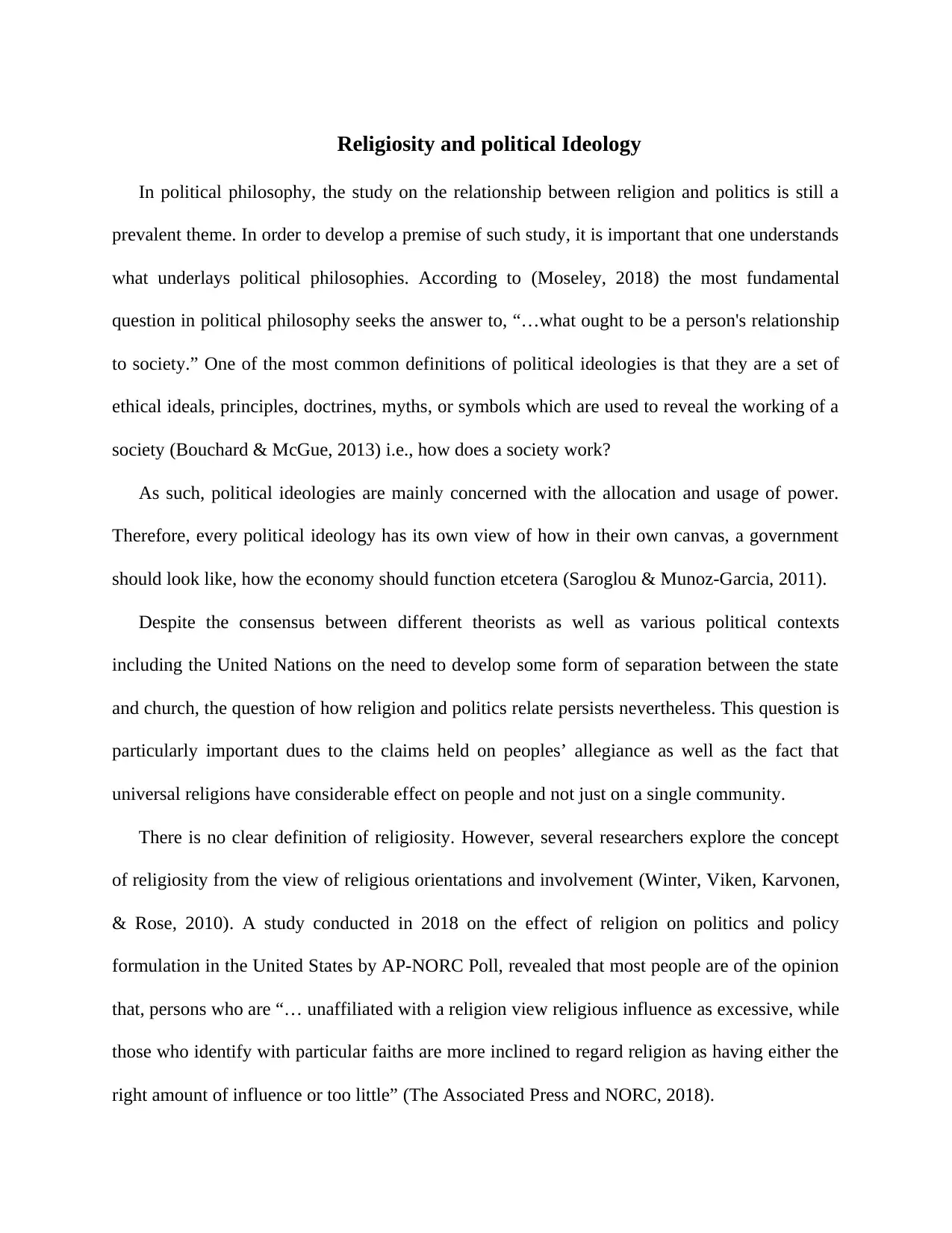
Religiosity and political Ideology
In political philosophy, the study on the relationship between religion and politics is still a
prevalent theme. In order to develop a premise of such study, it is important that one understands
what underlays political philosophies. According to (Moseley, 2018) the most fundamental
question in political philosophy seeks the answer to, “…what ought to be a person's relationship
to society.” One of the most common definitions of political ideologies is that they are a set of
ethical ideals, principles, doctrines, myths, or symbols which are used to reveal the working of a
society (Bouchard & McGue, 2013) i.e., how does a society work?
As such, political ideologies are mainly concerned with the allocation and usage of power.
Therefore, every political ideology has its own view of how in their own canvas, a government
should look like, how the economy should function etcetera (Saroglou & Munoz-Garcia, 2011).
Despite the consensus between different theorists as well as various political contexts
including the United Nations on the need to develop some form of separation between the state
and church, the question of how religion and politics relate persists nevertheless. This question is
particularly important dues to the claims held on peoples’ allegiance as well as the fact that
universal religions have considerable effect on people and not just on a single community.
There is no clear definition of religiosity. However, several researchers explore the concept
of religiosity from the view of religious orientations and involvement (Winter, Viken, Karvonen,
& Rose, 2010). A study conducted in 2018 on the effect of religion on politics and policy
formulation in the United States by AP-NORC Poll, revealed that most people are of the opinion
that, persons who are “… unaffiliated with a religion view religious influence as excessive, while
those who identify with particular faiths are more inclined to regard religion as having either the
right amount of influence or too little” (The Associated Press and NORC, 2018).
tabler-icon-diamond-filled.svg

Paraphrase This Document

Need a fresh take? Get an instant paraphrase of this document with our AI Paraphraser
Document Page
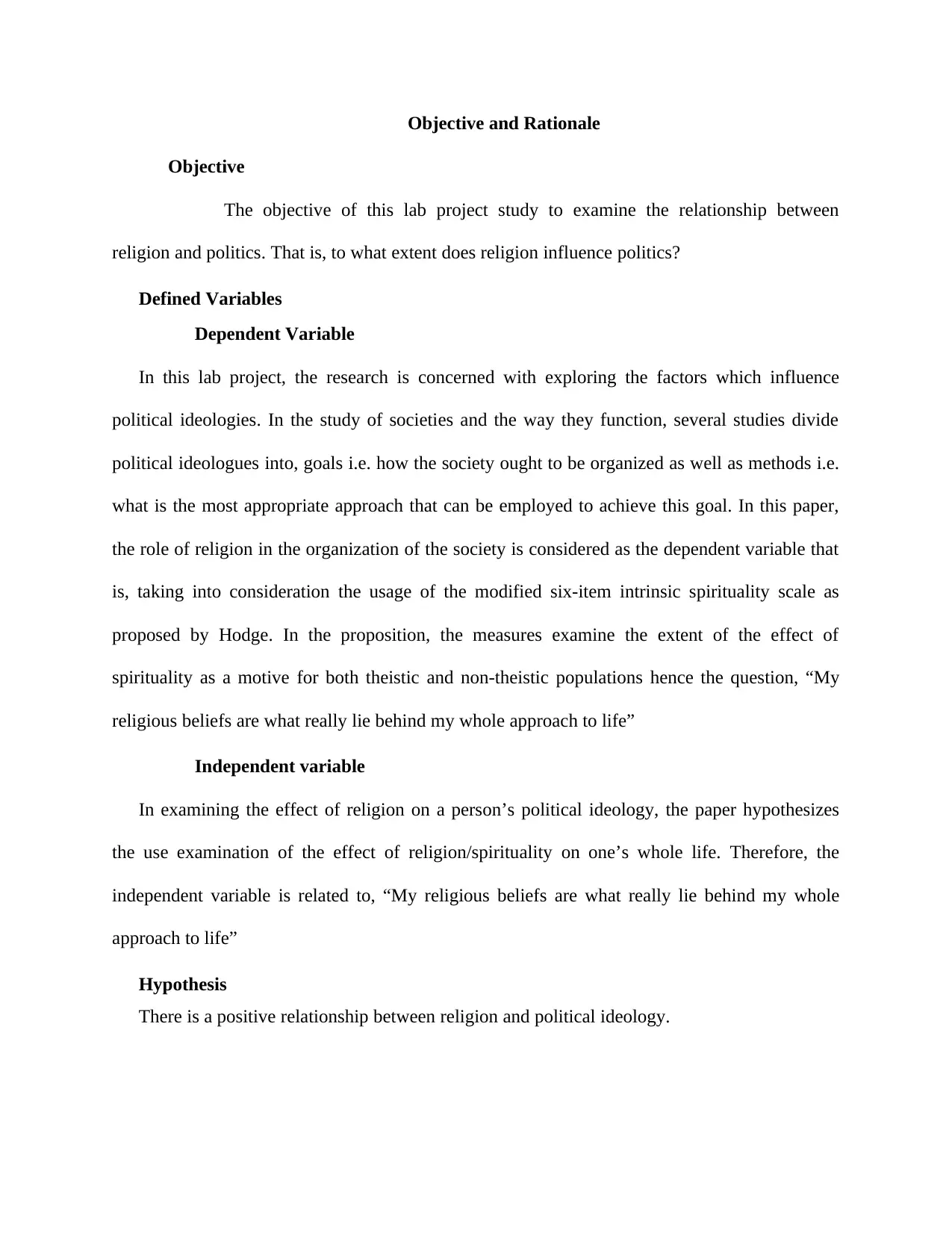
Objective and Rationale
Objective
The objective of this lab project study to examine the relationship between
religion and politics. That is, to what extent does religion influence politics?
Defined Variables
Dependent Variable
In this lab project, the research is concerned with exploring the factors which influence
political ideologies. In the study of societies and the way they function, several studies divide
political ideologues into, goals i.e. how the society ought to be organized as well as methods i.e.
what is the most appropriate approach that can be employed to achieve this goal. In this paper,
the role of religion in the organization of the society is considered as the dependent variable that
is, taking into consideration the usage of the modified six-item intrinsic spirituality scale as
proposed by Hodge. In the proposition, the measures examine the extent of the effect of
spirituality as a motive for both theistic and non-theistic populations hence the question, “My
religious beliefs are what really lie behind my whole approach to life”
Independent variable
In examining the effect of religion on a person’s political ideology, the paper hypothesizes
the use examination of the effect of religion/spirituality on one’s whole life. Therefore, the
independent variable is related to, “My religious beliefs are what really lie behind my whole
approach to life”
Hypothesis
There is a positive relationship between religion and political ideology.
Document Page
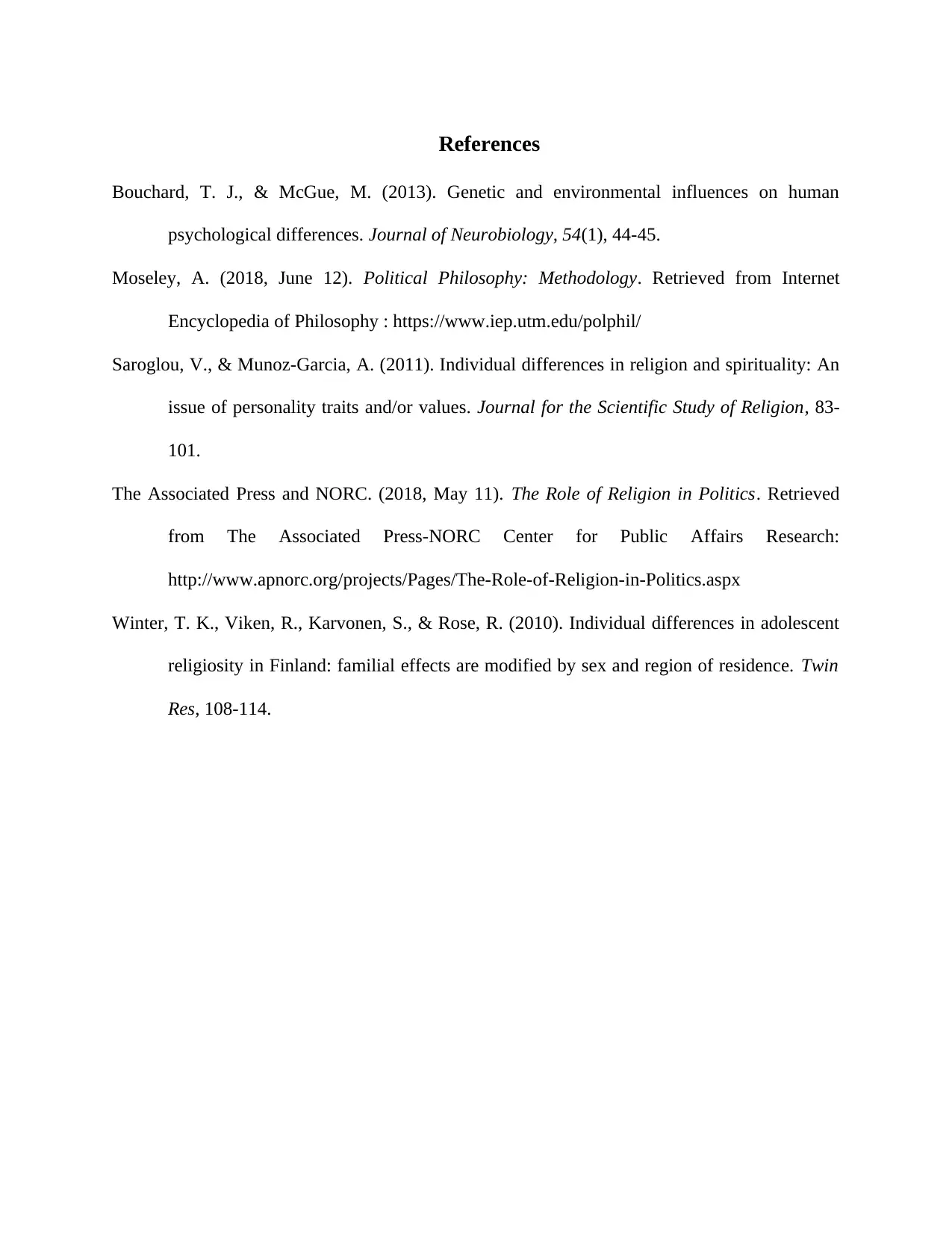
References
Bouchard, T. J., & McGue, M. (2013). Genetic and environmental influences on human
psychological differences. Journal of Neurobiology, 54(1), 44-45.
Moseley, A. (2018, June 12). Political Philosophy: Methodology. Retrieved from Internet
Encyclopedia of Philosophy : https://www.iep.utm.edu/polphil/
Saroglou, V., & Munoz-Garcia, A. (2011). Individual differences in religion and spirituality: An
issue of personality traits and/or values. Journal for the Scientific Study of Religion, 83-
101.
The Associated Press and NORC. (2018, May 11). The Role of Religion in Politics. Retrieved
from The Associated Press-NORC Center for Public Affairs Research:
http://www.apnorc.org/projects/Pages/The-Role-of-Religion-in-Politics.aspx
Winter, T. K., Viken, R., Karvonen, S., & Rose, R. (2010). Individual differences in adolescent
religiosity in Finland: familial effects are modified by sex and region of residence. Twin
Res, 108-114.
chevron_up_icon
1 out of 3
circle_padding
hide_on_mobile
zoom_out_icon
[object Object]