Assessing Religion and Spirituality in Older Adult Social Care in UK
VerifiedAdded on 2023/06/08
|21
|8591
|168
Case Study
AI Summary
This qualitative research project investigates the role and value of religion and spirituality in older adult social care within the Sandwell Metropolitan Borough Council in the UK. The study employs document analysis, interviews, and auto-ethnographical methods to explore whether social workers and social care officers consider religion and spirituality in their assessments and support plans for care home placements. The research aims to understand how these professionals perceive and value spirituality and religion in their practice, drawing on grounded theory to construct insights from the collected data. The research design was inspired by a social dreaming conference, using the concept of a tree's sustainability to ensure the methods effectively address the research questions. The study analyzes assessments, support plans from Sandwell Council, care plans from care homes, and interviews with social workers and care workers. It also reflects on the author's role as a social work manager and the influence of this position on the research, particularly in understanding the importance of holistic care for the elderly.
Chapter 3 Research Methodology
Section on Sandwell council needs to go later, so I’ve moved it
Introduction
This research explored the role of the role and value of religion/spirituality in older adult
social care users in the Sandwell Metropolitan Borough Council in the UK. The research
questions to be answered were 1. ‘Are social workers and social care officers catering
religion and spirituality in their assessments and support plans for citizens they are
supporting to place in care homes? 2. Are social workers and social care workers taking into
account the religious views and spirituality? 3. Are social care workers at care homes
considering to promote religion and spirituality while assessing citizen before going to care
home? Initially, I also wanted to find out if care residents felt their religion and spirituality
was being catered for at care homes. I wanted to find out if there are any barriers to
considering religion/spirituality from the care home residents. I also wanted to do some
field work observations so I could see more clearly what actually happened in practice,
rather than just relying on worker’s accounts and documents. However, unfortunately, due
to covid 19 restrictions, I could not carry out this part of the project. It would be interesting
to complete more research on this section in future.
This was primarily a qualitative research project which undertook document analysis,
interviews and a self- interview which drew on auto-ethnographical methods of research.
Epistemologically, the research was interpretive and ontologically it was constructivist as I
aimed to understand how social care workers understand and value spirituality and religion
in their practice. A qualitative and interpretive methodology enabled me to gain in-depth
information about how participants view their world and how they use religion in practice
(Shipman, 1997; Cresswell, 1998, 2003; Silverman, 2004, 2010; Bryman, 2008). interpretive
research solicits a variety of meanings and this makes it informative. This is particularly
because of the reason that interpretivism works on developing theoretical knowledge
relating to the research topic. Hence, this present study aims to analyse that whether the
social workers are taking into consideration the religion and spirituality among the elder
people while taking care of them. This interpretive research is informative as it aims at
Section on Sandwell council needs to go later, so I’ve moved it
Introduction
This research explored the role of the role and value of religion/spirituality in older adult
social care users in the Sandwell Metropolitan Borough Council in the UK. The research
questions to be answered were 1. ‘Are social workers and social care officers catering
religion and spirituality in their assessments and support plans for citizens they are
supporting to place in care homes? 2. Are social workers and social care workers taking into
account the religious views and spirituality? 3. Are social care workers at care homes
considering to promote religion and spirituality while assessing citizen before going to care
home? Initially, I also wanted to find out if care residents felt their religion and spirituality
was being catered for at care homes. I wanted to find out if there are any barriers to
considering religion/spirituality from the care home residents. I also wanted to do some
field work observations so I could see more clearly what actually happened in practice,
rather than just relying on worker’s accounts and documents. However, unfortunately, due
to covid 19 restrictions, I could not carry out this part of the project. It would be interesting
to complete more research on this section in future.
This was primarily a qualitative research project which undertook document analysis,
interviews and a self- interview which drew on auto-ethnographical methods of research.
Epistemologically, the research was interpretive and ontologically it was constructivist as I
aimed to understand how social care workers understand and value spirituality and religion
in their practice. A qualitative and interpretive methodology enabled me to gain in-depth
information about how participants view their world and how they use religion in practice
(Shipman, 1997; Cresswell, 1998, 2003; Silverman, 2004, 2010; Bryman, 2008). interpretive
research solicits a variety of meanings and this makes it informative. This is particularly
because of the reason that interpretivism works on developing theoretical knowledge
relating to the research topic. Hence, this present study aims to analyse that whether the
social workers are taking into consideration the religion and spirituality among the elder
people while taking care of them. This interpretive research is informative as it aims at

Paraphrase This Document
Need a fresh take? Get an instant paraphrase of this document with our AI Paraphraser
developing theoretical knowledge and this provides a wide range of information to the
readers.
Participants were allowed to narrate their story, being guided by open ended questions
which enabled them to provide more in-depth information (Rubin & Rubin, 2012;
Oppenheimer, 1992). Data from examining care plans, support plans, assessments from
Sandwell Council, care plans from care homes, interviews from Sandwell social workers and
social care officers and from care workers’ interviews will be triangulated.
Qualitative research allowed me to gain in-depth information of how social workers, social
care officers conduct their assessments and how (or if) they incorporate religion/spirituality.
It also allowed me to gain information on how religion /spirituality is catered for in care
homes. Knowledge came from the participants who were giving their experience of
assessing and working with religion/spirituality. My own view is that religion/spirituality is
important to those who believe and non -believers and hence social workers and social care
workers in care homes should consider this for older adults who reside in their care homes. I
also hold that religion/spirituality is part of a human being’s identity and therefore by not
acknowledging and assessing this we may be missing and neglecting an important part of a
citizen’s life. Within this the own role involved the SW manager that is social worker
manager which basically works in direction to protect the working of the elder people and
ensure that there is not any issue for the company.
Theory was developed as the investigation progressed (Znaniecki, 1934; Silverman, 2004). I
engaged some aspects of grounded theory as used data that I collected to construct
outcomes/theory to that will help answer my research questions. Grounded theory was
developed by Glaser and Strauss (1967) to help researchers gather and analyse qualitative
data to identify important categories in the material with the aim of generating theory and
ideas from the data. This development of the idea and the theory was helpful alter as it
provided a base to work in better manner and to attain the objectives of the study in better
manner. Along with this the theory and data will be assistive in supporting the research
findings in better and effective manner and will help them in increasing knowledge relating
to the research topic.
readers.
Participants were allowed to narrate their story, being guided by open ended questions
which enabled them to provide more in-depth information (Rubin & Rubin, 2012;
Oppenheimer, 1992). Data from examining care plans, support plans, assessments from
Sandwell Council, care plans from care homes, interviews from Sandwell social workers and
social care officers and from care workers’ interviews will be triangulated.
Qualitative research allowed me to gain in-depth information of how social workers, social
care officers conduct their assessments and how (or if) they incorporate religion/spirituality.
It also allowed me to gain information on how religion /spirituality is catered for in care
homes. Knowledge came from the participants who were giving their experience of
assessing and working with religion/spirituality. My own view is that religion/spirituality is
important to those who believe and non -believers and hence social workers and social care
workers in care homes should consider this for older adults who reside in their care homes. I
also hold that religion/spirituality is part of a human being’s identity and therefore by not
acknowledging and assessing this we may be missing and neglecting an important part of a
citizen’s life. Within this the own role involved the SW manager that is social worker
manager which basically works in direction to protect the working of the elder people and
ensure that there is not any issue for the company.
Theory was developed as the investigation progressed (Znaniecki, 1934; Silverman, 2004). I
engaged some aspects of grounded theory as used data that I collected to construct
outcomes/theory to that will help answer my research questions. Grounded theory was
developed by Glaser and Strauss (1967) to help researchers gather and analyse qualitative
data to identify important categories in the material with the aim of generating theory and
ideas from the data. This development of the idea and the theory was helpful alter as it
provided a base to work in better manner and to attain the objectives of the study in better
manner. Along with this the theory and data will be assistive in supporting the research
findings in better and effective manner and will help them in increasing knowledge relating
to the research topic.
Inspiration for my Research Design ??
My research came to proper understanding after I attended a conference on social
dreaming on 15 June 2019 at the University of Central Lancashire. I attended this
conference because I was fascinated by the dreaming matrix and how this could be used as
a research method. It was at this conference that we did an exercise on dreams and we
were asked to imagine/dream a tree and how it survives. The attending of the conference
assisted me in developing a base for the research design and will be helpful in improving the
study. The ideas were that if the main stem does not feed a branch, the branch dies but the
main stem remains. The exercise involved examining sustainability. I tried to apply this idea
to my own research. I viewed my main topic as the main stem and I looked at the methods
as the branches that needed to be fed and kept alive by relating to the main stem. I
interpreted this to mean that I had to find methods that will answer my main question (the
stem). I also had to find a topic that will keep alive for the duration of the research. I also
had to find methods that would sustain the project and keep me interested. This exercise
also directed me to reflexivity as I needed to keep going back to the stem and reflect on my
methods and assess if the methods were answering the research questions. Further my own
position of SW manager helps me in identifying the importance of the care of elder people.
Also this position helped me in developing my knowledge relating to research. this created a
better impact over the study as this will be providing a better opportunity to do the study in
better terms. Also, because of the own work position I was already having proper
knowledge relating to the research topic and this created a better base for the study. I drew
on the dream matrix being learnt from the conference being attended to help me come up
with a tangible research design.
The research involved convenience purposive sampling to help answer my research
questions. I selected a research project with older adults in Sandwell because I work for
Sandwell Council as SW manager. The following section describes the council in more
detail….
My research came to proper understanding after I attended a conference on social
dreaming on 15 June 2019 at the University of Central Lancashire. I attended this
conference because I was fascinated by the dreaming matrix and how this could be used as
a research method. It was at this conference that we did an exercise on dreams and we
were asked to imagine/dream a tree and how it survives. The attending of the conference
assisted me in developing a base for the research design and will be helpful in improving the
study. The ideas were that if the main stem does not feed a branch, the branch dies but the
main stem remains. The exercise involved examining sustainability. I tried to apply this idea
to my own research. I viewed my main topic as the main stem and I looked at the methods
as the branches that needed to be fed and kept alive by relating to the main stem. I
interpreted this to mean that I had to find methods that will answer my main question (the
stem). I also had to find a topic that will keep alive for the duration of the research. I also
had to find methods that would sustain the project and keep me interested. This exercise
also directed me to reflexivity as I needed to keep going back to the stem and reflect on my
methods and assess if the methods were answering the research questions. Further my own
position of SW manager helps me in identifying the importance of the care of elder people.
Also this position helped me in developing my knowledge relating to research. this created a
better impact over the study as this will be providing a better opportunity to do the study in
better terms. Also, because of the own work position I was already having proper
knowledge relating to the research topic and this created a better base for the study. I drew
on the dream matrix being learnt from the conference being attended to help me come up
with a tangible research design.
The research involved convenience purposive sampling to help answer my research
questions. I selected a research project with older adults in Sandwell because I work for
Sandwell Council as SW manager. The following section describes the council in more
detail….
⊘ This is a preview!⊘
Do you want full access?
Subscribe today to unlock all pages.

Trusted by 1+ million students worldwide
Sandwell Council
Sandwell Council Adult Social Care: Im still to get accurate data on statistics. We have just
moved to use Power BI and I will need support to extract the latest data when I return to
work.
Sandwell Borough is in West Midlands. There is a population of 328000…. female and male
There are 6 towns Oldbury, Rowley, Tipton, West Bromwich, Smethwick and Wednesbury.
When I started my research there were 11 older adult community teams. As of June 2021
teams are back in the 6 towns format so there are now six teams and I am one of the
managers for the Rowley team. These teams assess and support to place older adult citizens
in care placements. There are ……in residential and care placements. There are …social
workers and …. social care officers in these teams.
There are …residential care homes and …. nursing homes in the Sandwell Borough. We are a
catchment area for our neighbouring boroughs Birmingham, Dudley, Walsall, Worcester,
Coventry, Wolverhampton Staffordshire and Warwick.
The role within the council is the SW manager that is social welfare manager. This role
includes the analysis of the situation of the elder people and this assisted in developing
knowledge relating to the research topic. This also assisted me in developing a good base
and knowledge for the fact that whether the religion and spirituality is being used in the
care home for treatment of elder people. This is very necessary for the reason that it will be
helping the people to take proper care of the elder people and to ensure that the religion
and spirituality is being implemented within the care home so that proper care can be
provide to the patient. This role influenced me to conduct the present study as it will help
me in analysing the views of the people relating to the use of religion and spiritual
techniques for taking care of the patient especially the elder ones. This was the base for the
research to be completed and to analyse whether the social workers implement and plays a
crucial role in the taking care of elder people by keeping in mind the religion and spirituality.
Sandwell Council Adult Social Care: Im still to get accurate data on statistics. We have just
moved to use Power BI and I will need support to extract the latest data when I return to
work.
Sandwell Borough is in West Midlands. There is a population of 328000…. female and male
There are 6 towns Oldbury, Rowley, Tipton, West Bromwich, Smethwick and Wednesbury.
When I started my research there were 11 older adult community teams. As of June 2021
teams are back in the 6 towns format so there are now six teams and I am one of the
managers for the Rowley team. These teams assess and support to place older adult citizens
in care placements. There are ……in residential and care placements. There are …social
workers and …. social care officers in these teams.
There are …residential care homes and …. nursing homes in the Sandwell Borough. We are a
catchment area for our neighbouring boroughs Birmingham, Dudley, Walsall, Worcester,
Coventry, Wolverhampton Staffordshire and Warwick.
The role within the council is the SW manager that is social welfare manager. This role
includes the analysis of the situation of the elder people and this assisted in developing
knowledge relating to the research topic. This also assisted me in developing a good base
and knowledge for the fact that whether the religion and spirituality is being used in the
care home for treatment of elder people. This is very necessary for the reason that it will be
helping the people to take proper care of the elder people and to ensure that the religion
and spirituality is being implemented within the care home so that proper care can be
provide to the patient. This role influenced me to conduct the present study as it will help
me in analysing the views of the people relating to the use of religion and spiritual
techniques for taking care of the patient especially the elder ones. This was the base for the
research to be completed and to analyse whether the social workers implement and plays a
crucial role in the taking care of elder people by keeping in mind the religion and spirituality.
Paraphrase This Document
Need a fresh take? Get an instant paraphrase of this document with our AI Paraphraser
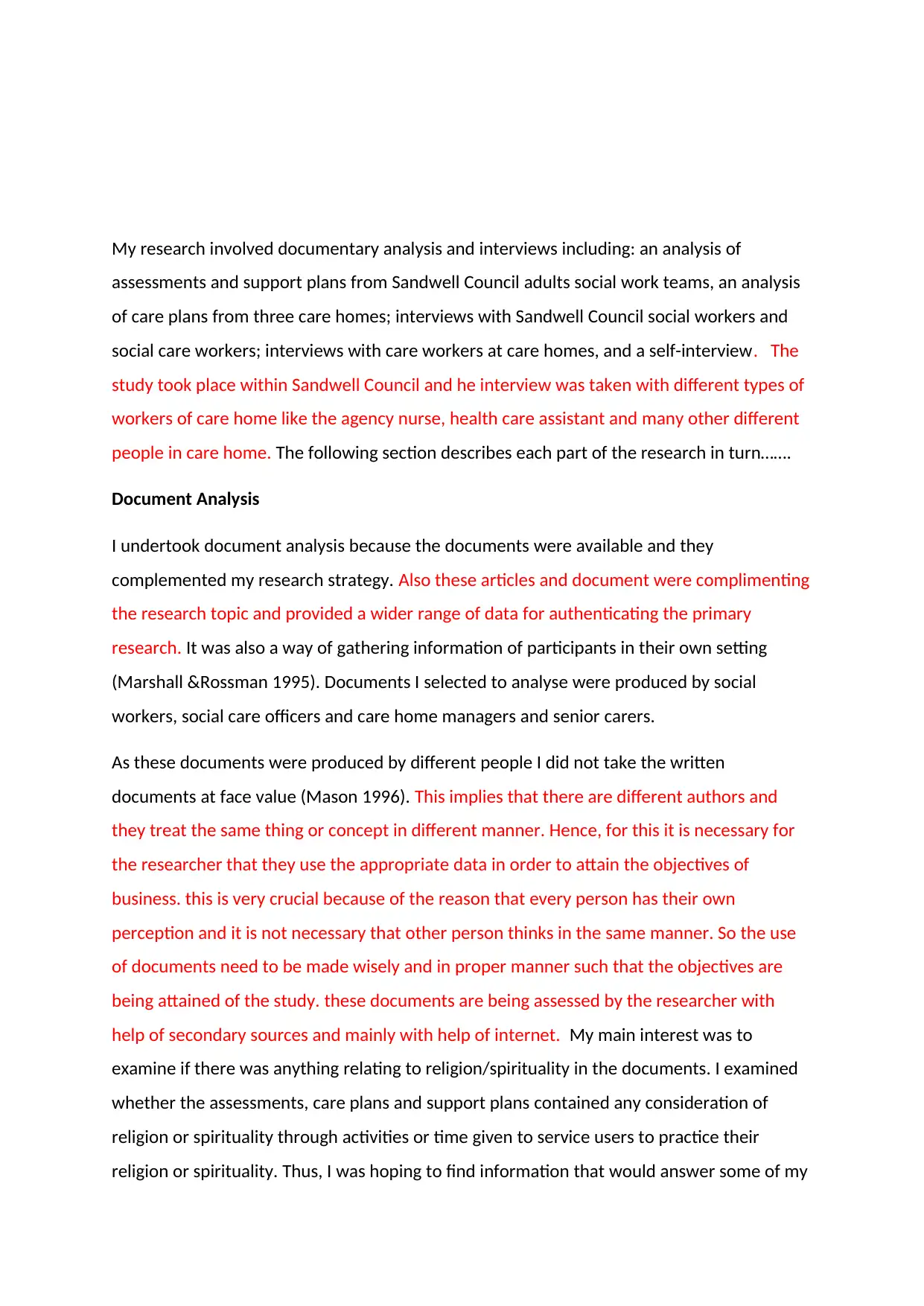
My research involved documentary analysis and interviews including: an analysis of
assessments and support plans from Sandwell Council adults social work teams, an analysis
of care plans from three care homes; interviews with Sandwell Council social workers and
social care workers; interviews with care workers at care homes, and a self-interview. The
study took place within Sandwell Council and he interview was taken with different types of
workers of care home like the agency nurse, health care assistant and many other different
people in care home. The following section describes each part of the research in turn…….
Document Analysis
I undertook document analysis because the documents were available and they
complemented my research strategy. Also these articles and document were complimenting
the research topic and provided a wider range of data for authenticating the primary
research. It was also a way of gathering information of participants in their own setting
(Marshall &Rossman 1995). Documents I selected to analyse were produced by social
workers, social care officers and care home managers and senior carers.
As these documents were produced by different people I did not take the written
documents at face value (Mason 1996). This implies that there are different authors and
they treat the same thing or concept in different manner. Hence, for this it is necessary for
the researcher that they use the appropriate data in order to attain the objectives of
business. this is very crucial because of the reason that every person has their own
perception and it is not necessary that other person thinks in the same manner. So the use
of documents need to be made wisely and in proper manner such that the objectives are
being attained of the study. these documents are being assessed by the researcher with
help of secondary sources and mainly with help of internet. My main interest was to
examine if there was anything relating to religion/spirituality in the documents. I examined
whether the assessments, care plans and support plans contained any consideration of
religion or spirituality through activities or time given to service users to practice their
religion or spirituality. Thus, I was hoping to find information that would answer some of my
assessments and support plans from Sandwell Council adults social work teams, an analysis
of care plans from three care homes; interviews with Sandwell Council social workers and
social care workers; interviews with care workers at care homes, and a self-interview. The
study took place within Sandwell Council and he interview was taken with different types of
workers of care home like the agency nurse, health care assistant and many other different
people in care home. The following section describes each part of the research in turn…….
Document Analysis
I undertook document analysis because the documents were available and they
complemented my research strategy. Also these articles and document were complimenting
the research topic and provided a wider range of data for authenticating the primary
research. It was also a way of gathering information of participants in their own setting
(Marshall &Rossman 1995). Documents I selected to analyse were produced by social
workers, social care officers and care home managers and senior carers.
As these documents were produced by different people I did not take the written
documents at face value (Mason 1996). This implies that there are different authors and
they treat the same thing or concept in different manner. Hence, for this it is necessary for
the researcher that they use the appropriate data in order to attain the objectives of
business. this is very crucial because of the reason that every person has their own
perception and it is not necessary that other person thinks in the same manner. So the use
of documents need to be made wisely and in proper manner such that the objectives are
being attained of the study. these documents are being assessed by the researcher with
help of secondary sources and mainly with help of internet. My main interest was to
examine if there was anything relating to religion/spirituality in the documents. I examined
whether the assessments, care plans and support plans contained any consideration of
religion or spirituality through activities or time given to service users to practice their
religion or spirituality. Thus, I was hoping to find information that would answer some of my
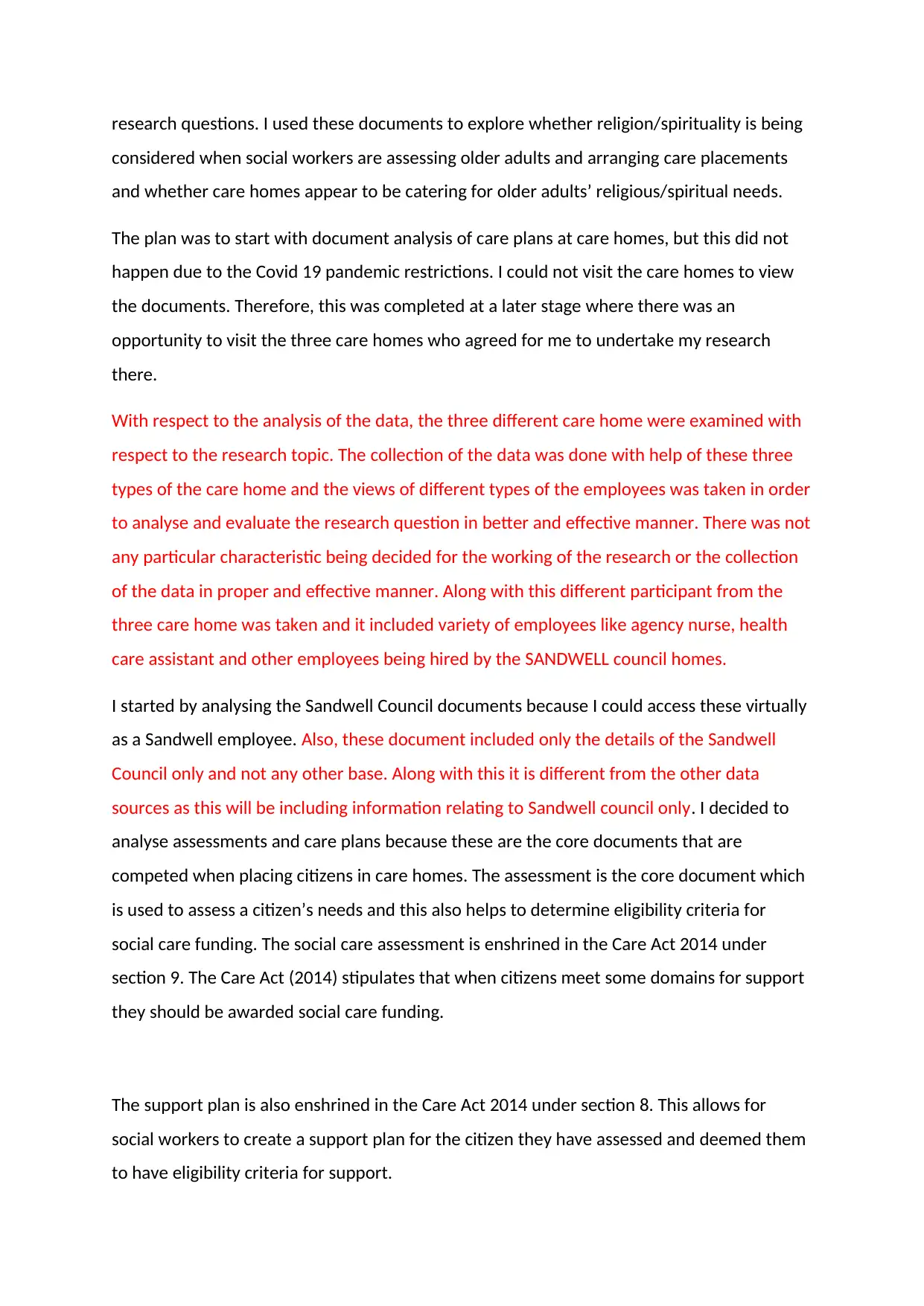
research questions. I used these documents to explore whether religion/spirituality is being
considered when social workers are assessing older adults and arranging care placements
and whether care homes appear to be catering for older adults’ religious/spiritual needs.
The plan was to start with document analysis of care plans at care homes, but this did not
happen due to the Covid 19 pandemic restrictions. I could not visit the care homes to view
the documents. Therefore, this was completed at a later stage where there was an
opportunity to visit the three care homes who agreed for me to undertake my research
there.
With respect to the analysis of the data, the three different care home were examined with
respect to the research topic. The collection of the data was done with help of these three
types of the care home and the views of different types of the employees was taken in order
to analyse and evaluate the research question in better and effective manner. There was not
any particular characteristic being decided for the working of the research or the collection
of the data in proper and effective manner. Along with this different participant from the
three care home was taken and it included variety of employees like agency nurse, health
care assistant and other employees being hired by the SANDWELL council homes.
I started by analysing the Sandwell Council documents because I could access these virtually
as a Sandwell employee. Also, these document included only the details of the Sandwell
Council only and not any other base. Along with this it is different from the other data
sources as this will be including information relating to Sandwell council only. I decided to
analyse assessments and care plans because these are the core documents that are
competed when placing citizens in care homes. The assessment is the core document which
is used to assess a citizen’s needs and this also helps to determine eligibility criteria for
social care funding. The social care assessment is enshrined in the Care Act 2014 under
section 9. The Care Act (2014) stipulates that when citizens meet some domains for support
they should be awarded social care funding.
The support plan is also enshrined in the Care Act 2014 under section 8. This allows for
social workers to create a support plan for the citizen they have assessed and deemed them
to have eligibility criteria for support.
considered when social workers are assessing older adults and arranging care placements
and whether care homes appear to be catering for older adults’ religious/spiritual needs.
The plan was to start with document analysis of care plans at care homes, but this did not
happen due to the Covid 19 pandemic restrictions. I could not visit the care homes to view
the documents. Therefore, this was completed at a later stage where there was an
opportunity to visit the three care homes who agreed for me to undertake my research
there.
With respect to the analysis of the data, the three different care home were examined with
respect to the research topic. The collection of the data was done with help of these three
types of the care home and the views of different types of the employees was taken in order
to analyse and evaluate the research question in better and effective manner. There was not
any particular characteristic being decided for the working of the research or the collection
of the data in proper and effective manner. Along with this different participant from the
three care home was taken and it included variety of employees like agency nurse, health
care assistant and other employees being hired by the SANDWELL council homes.
I started by analysing the Sandwell Council documents because I could access these virtually
as a Sandwell employee. Also, these document included only the details of the Sandwell
Council only and not any other base. Along with this it is different from the other data
sources as this will be including information relating to Sandwell council only. I decided to
analyse assessments and care plans because these are the core documents that are
competed when placing citizens in care homes. The assessment is the core document which
is used to assess a citizen’s needs and this also helps to determine eligibility criteria for
social care funding. The social care assessment is enshrined in the Care Act 2014 under
section 9. The Care Act (2014) stipulates that when citizens meet some domains for support
they should be awarded social care funding.
The support plan is also enshrined in the Care Act 2014 under section 8. This allows for
social workers to create a support plan for the citizen they have assessed and deemed them
to have eligibility criteria for support.
⊘ This is a preview!⊘
Do you want full access?
Subscribe today to unlock all pages.
Trusted by 1+ million students worldwide
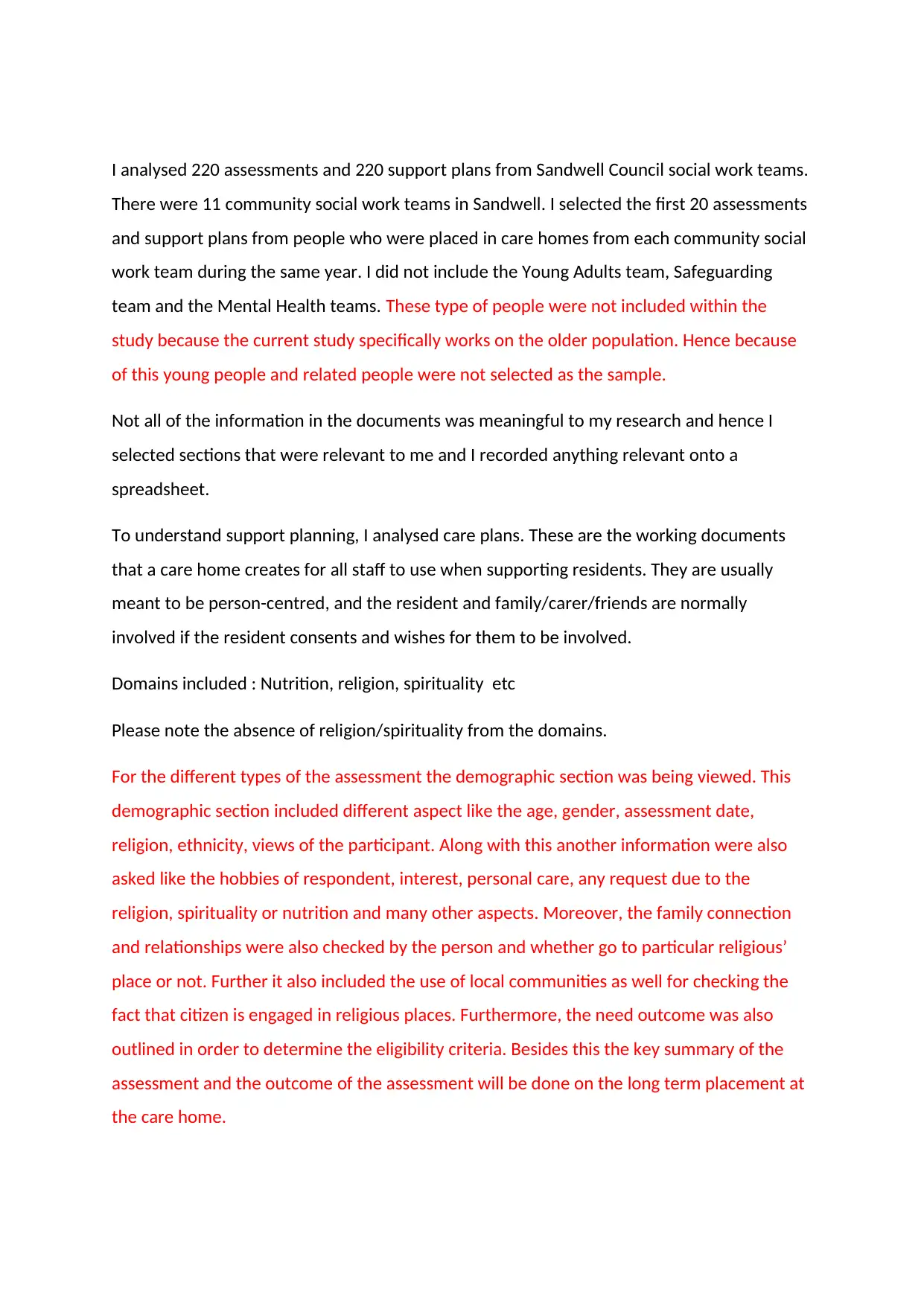
I analysed 220 assessments and 220 support plans from Sandwell Council social work teams.
There were 11 community social work teams in Sandwell. I selected the first 20 assessments
and support plans from people who were placed in care homes from each community social
work team during the same year. I did not include the Young Adults team, Safeguarding
team and the Mental Health teams. These type of people were not included within the
study because the current study specifically works on the older population. Hence because
of this young people and related people were not selected as the sample.
Not all of the information in the documents was meaningful to my research and hence I
selected sections that were relevant to me and I recorded anything relevant onto a
spreadsheet.
To understand support planning, I analysed care plans. These are the working documents
that a care home creates for all staff to use when supporting residents. They are usually
meant to be person-centred, and the resident and family/carer/friends are normally
involved if the resident consents and wishes for them to be involved.
Domains included : Nutrition, religion, spirituality etc
Please note the absence of religion/spirituality from the domains.
For the different types of the assessment the demographic section was being viewed. This
demographic section included different aspect like the age, gender, assessment date,
religion, ethnicity, views of the participant. Along with this another information were also
asked like the hobbies of respondent, interest, personal care, any request due to the
religion, spirituality or nutrition and many other aspects. Moreover, the family connection
and relationships were also checked by the person and whether go to particular religious’
place or not. Further it also included the use of local communities as well for checking the
fact that citizen is engaged in religious places. Furthermore, the need outcome was also
outlined in order to determine the eligibility criteria. Besides this the key summary of the
assessment and the outcome of the assessment will be done on the long term placement at
the care home.
There were 11 community social work teams in Sandwell. I selected the first 20 assessments
and support plans from people who were placed in care homes from each community social
work team during the same year. I did not include the Young Adults team, Safeguarding
team and the Mental Health teams. These type of people were not included within the
study because the current study specifically works on the older population. Hence because
of this young people and related people were not selected as the sample.
Not all of the information in the documents was meaningful to my research and hence I
selected sections that were relevant to me and I recorded anything relevant onto a
spreadsheet.
To understand support planning, I analysed care plans. These are the working documents
that a care home creates for all staff to use when supporting residents. They are usually
meant to be person-centred, and the resident and family/carer/friends are normally
involved if the resident consents and wishes for them to be involved.
Domains included : Nutrition, religion, spirituality etc
Please note the absence of religion/spirituality from the domains.
For the different types of the assessment the demographic section was being viewed. This
demographic section included different aspect like the age, gender, assessment date,
religion, ethnicity, views of the participant. Along with this another information were also
asked like the hobbies of respondent, interest, personal care, any request due to the
religion, spirituality or nutrition and many other aspects. Moreover, the family connection
and relationships were also checked by the person and whether go to particular religious’
place or not. Further it also included the use of local communities as well for checking the
fact that citizen is engaged in religious places. Furthermore, the need outcome was also
outlined in order to determine the eligibility criteria. Besides this the key summary of the
assessment and the outcome of the assessment will be done on the long term placement at
the care home.
Paraphrase This Document
Need a fresh take? Get an instant paraphrase of this document with our AI Paraphraser
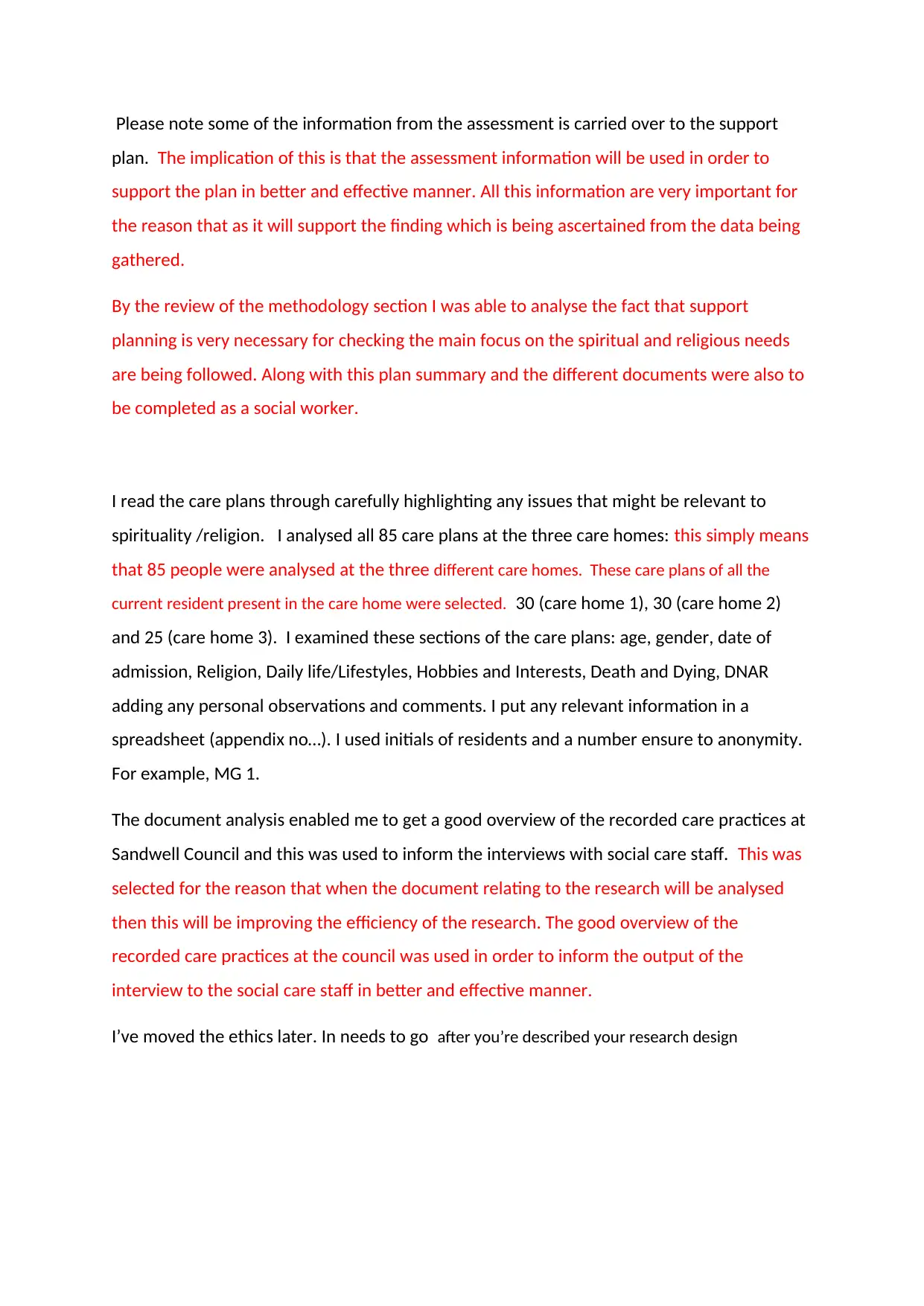
Please note some of the information from the assessment is carried over to the support
plan. The implication of this is that the assessment information will be used in order to
support the plan in better and effective manner. All this information are very important for
the reason that as it will support the finding which is being ascertained from the data being
gathered.
By the review of the methodology section I was able to analyse the fact that support
planning is very necessary for checking the main focus on the spiritual and religious needs
are being followed. Along with this plan summary and the different documents were also to
be completed as a social worker.
I read the care plans through carefully highlighting any issues that might be relevant to
spirituality /religion. I analysed all 85 care plans at the three care homes: this simply means
that 85 people were analysed at the three different care homes. These care plans of all the
current resident present in the care home were selected. 30 (care home 1), 30 (care home 2)
and 25 (care home 3). I examined these sections of the care plans: age, gender, date of
admission, Religion, Daily life/Lifestyles, Hobbies and Interests, Death and Dying, DNAR
adding any personal observations and comments. I put any relevant information in a
spreadsheet (appendix no…). I used initials of residents and a number ensure to anonymity.
For example, MG 1.
The document analysis enabled me to get a good overview of the recorded care practices at
Sandwell Council and this was used to inform the interviews with social care staff. This was
selected for the reason that when the document relating to the research will be analysed
then this will be improving the efficiency of the research. The good overview of the
recorded care practices at the council was used in order to inform the output of the
interview to the social care staff in better and effective manner.
I’ve moved the ethics later. In needs to go after you’re described your research design
plan. The implication of this is that the assessment information will be used in order to
support the plan in better and effective manner. All this information are very important for
the reason that as it will support the finding which is being ascertained from the data being
gathered.
By the review of the methodology section I was able to analyse the fact that support
planning is very necessary for checking the main focus on the spiritual and religious needs
are being followed. Along with this plan summary and the different documents were also to
be completed as a social worker.
I read the care plans through carefully highlighting any issues that might be relevant to
spirituality /religion. I analysed all 85 care plans at the three care homes: this simply means
that 85 people were analysed at the three different care homes. These care plans of all the
current resident present in the care home were selected. 30 (care home 1), 30 (care home 2)
and 25 (care home 3). I examined these sections of the care plans: age, gender, date of
admission, Religion, Daily life/Lifestyles, Hobbies and Interests, Death and Dying, DNAR
adding any personal observations and comments. I put any relevant information in a
spreadsheet (appendix no…). I used initials of residents and a number ensure to anonymity.
For example, MG 1.
The document analysis enabled me to get a good overview of the recorded care practices at
Sandwell Council and this was used to inform the interviews with social care staff. This was
selected for the reason that when the document relating to the research will be analysed
then this will be improving the efficiency of the research. The good overview of the
recorded care practices at the council was used in order to inform the output of the
interview to the social care staff in better and effective manner.
I’ve moved the ethics later. In needs to go after you’re described your research design
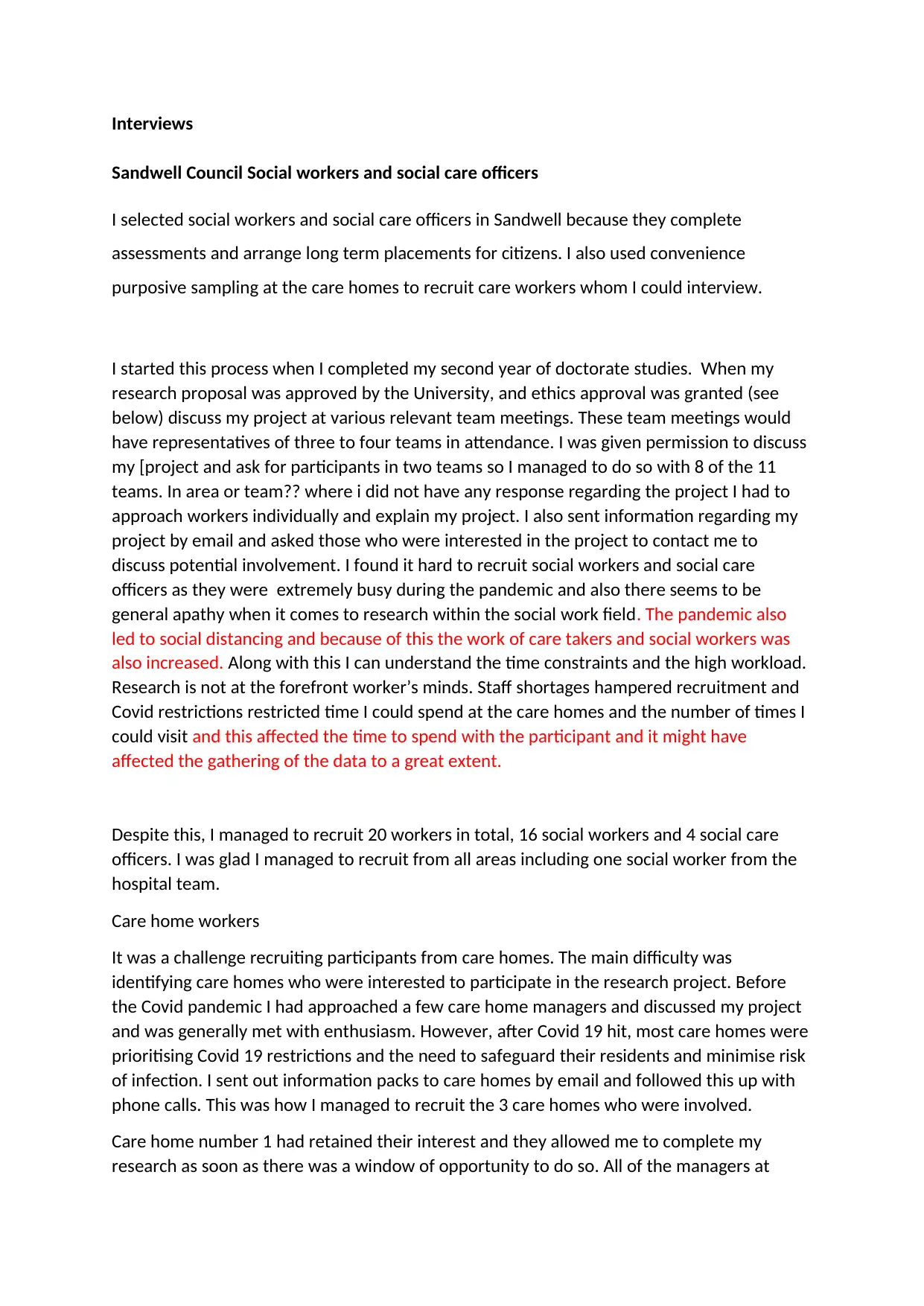
Interviews
Sandwell Council Social workers and social care officers
I selected social workers and social care officers in Sandwell because they complete
assessments and arrange long term placements for citizens. I also used convenience
purposive sampling at the care homes to recruit care workers whom I could interview.
I started this process when I completed my second year of doctorate studies. When my
research proposal was approved by the University, and ethics approval was granted (see
below) discuss my project at various relevant team meetings. These team meetings would
have representatives of three to four teams in attendance. I was given permission to discuss
my [project and ask for participants in two teams so I managed to do so with 8 of the 11
teams. In area or team?? where i did not have any response regarding the project I had to
approach workers individually and explain my project. I also sent information regarding my
project by email and asked those who were interested in the project to contact me to
discuss potential involvement. I found it hard to recruit social workers and social care
officers as they were extremely busy during the pandemic and also there seems to be
general apathy when it comes to research within the social work field. The pandemic also
led to social distancing and because of this the work of care takers and social workers was
also increased. Along with this I can understand the time constraints and the high workload.
Research is not at the forefront worker’s minds. Staff shortages hampered recruitment and
Covid restrictions restricted time I could spend at the care homes and the number of times I
could visit and this affected the time to spend with the participant and it might have
affected the gathering of the data to a great extent.
Despite this, I managed to recruit 20 workers in total, 16 social workers and 4 social care
officers. I was glad I managed to recruit from all areas including one social worker from the
hospital team.
Care home workers
It was a challenge recruiting participants from care homes. The main difficulty was
identifying care homes who were interested to participate in the research project. Before
the Covid pandemic I had approached a few care home managers and discussed my project
and was generally met with enthusiasm. However, after Covid 19 hit, most care homes were
prioritising Covid 19 restrictions and the need to safeguard their residents and minimise risk
of infection. I sent out information packs to care homes by email and followed this up with
phone calls. This was how I managed to recruit the 3 care homes who were involved.
Care home number 1 had retained their interest and they allowed me to complete my
research as soon as there was a window of opportunity to do so. All of the managers at
Sandwell Council Social workers and social care officers
I selected social workers and social care officers in Sandwell because they complete
assessments and arrange long term placements for citizens. I also used convenience
purposive sampling at the care homes to recruit care workers whom I could interview.
I started this process when I completed my second year of doctorate studies. When my
research proposal was approved by the University, and ethics approval was granted (see
below) discuss my project at various relevant team meetings. These team meetings would
have representatives of three to four teams in attendance. I was given permission to discuss
my [project and ask for participants in two teams so I managed to do so with 8 of the 11
teams. In area or team?? where i did not have any response regarding the project I had to
approach workers individually and explain my project. I also sent information regarding my
project by email and asked those who were interested in the project to contact me to
discuss potential involvement. I found it hard to recruit social workers and social care
officers as they were extremely busy during the pandemic and also there seems to be
general apathy when it comes to research within the social work field. The pandemic also
led to social distancing and because of this the work of care takers and social workers was
also increased. Along with this I can understand the time constraints and the high workload.
Research is not at the forefront worker’s minds. Staff shortages hampered recruitment and
Covid restrictions restricted time I could spend at the care homes and the number of times I
could visit and this affected the time to spend with the participant and it might have
affected the gathering of the data to a great extent.
Despite this, I managed to recruit 20 workers in total, 16 social workers and 4 social care
officers. I was glad I managed to recruit from all areas including one social worker from the
hospital team.
Care home workers
It was a challenge recruiting participants from care homes. The main difficulty was
identifying care homes who were interested to participate in the research project. Before
the Covid pandemic I had approached a few care home managers and discussed my project
and was generally met with enthusiasm. However, after Covid 19 hit, most care homes were
prioritising Covid 19 restrictions and the need to safeguard their residents and minimise risk
of infection. I sent out information packs to care homes by email and followed this up with
phone calls. This was how I managed to recruit the 3 care homes who were involved.
Care home number 1 had retained their interest and they allowed me to complete my
research as soon as there was a window of opportunity to do so. All of the managers at
⊘ This is a preview!⊘
Do you want full access?
Subscribe today to unlock all pages.
Trusted by 1+ million students worldwide
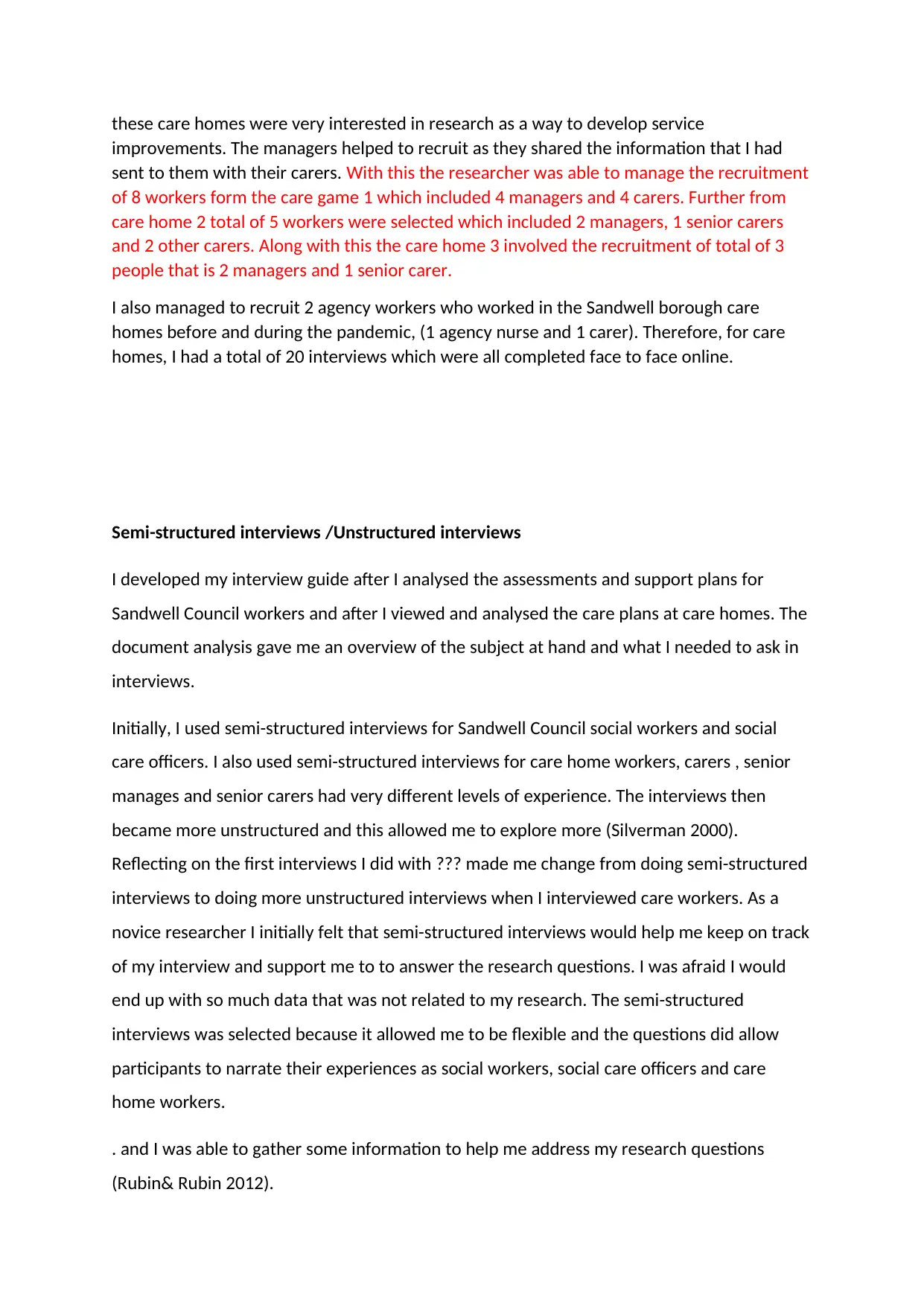
these care homes were very interested in research as a way to develop service
improvements. The managers helped to recruit as they shared the information that I had
sent to them with their carers. With this the researcher was able to manage the recruitment
of 8 workers form the care game 1 which included 4 managers and 4 carers. Further from
care home 2 total of 5 workers were selected which included 2 managers, 1 senior carers
and 2 other carers. Along with this the care home 3 involved the recruitment of total of 3
people that is 2 managers and 1 senior carer.
I also managed to recruit 2 agency workers who worked in the Sandwell borough care
homes before and during the pandemic, (1 agency nurse and 1 carer). Therefore, for care
homes, I had a total of 20 interviews which were all completed face to face online.
Semi-structured interviews /Unstructured interviews
I developed my interview guide after I analysed the assessments and support plans for
Sandwell Council workers and after I viewed and analysed the care plans at care homes. The
document analysis gave me an overview of the subject at hand and what I needed to ask in
interviews.
Initially, I used semi-structured interviews for Sandwell Council social workers and social
care officers. I also used semi-structured interviews for care home workers, carers , senior
manages and senior carers had very different levels of experience. The interviews then
became more unstructured and this allowed me to explore more (Silverman 2000).
Reflecting on the first interviews I did with ??? made me change from doing semi-structured
interviews to doing more unstructured interviews when I interviewed care workers. As a
novice researcher I initially felt that semi-structured interviews would help me keep on track
of my interview and support me to to answer the research questions. I was afraid I would
end up with so much data that was not related to my research. The semi-structured
interviews was selected because it allowed me to be flexible and the questions did allow
participants to narrate their experiences as social workers, social care officers and care
home workers.
. and I was able to gather some information to help me address my research questions
(Rubin& Rubin 2012).
improvements. The managers helped to recruit as they shared the information that I had
sent to them with their carers. With this the researcher was able to manage the recruitment
of 8 workers form the care game 1 which included 4 managers and 4 carers. Further from
care home 2 total of 5 workers were selected which included 2 managers, 1 senior carers
and 2 other carers. Along with this the care home 3 involved the recruitment of total of 3
people that is 2 managers and 1 senior carer.
I also managed to recruit 2 agency workers who worked in the Sandwell borough care
homes before and during the pandemic, (1 agency nurse and 1 carer). Therefore, for care
homes, I had a total of 20 interviews which were all completed face to face online.
Semi-structured interviews /Unstructured interviews
I developed my interview guide after I analysed the assessments and support plans for
Sandwell Council workers and after I viewed and analysed the care plans at care homes. The
document analysis gave me an overview of the subject at hand and what I needed to ask in
interviews.
Initially, I used semi-structured interviews for Sandwell Council social workers and social
care officers. I also used semi-structured interviews for care home workers, carers , senior
manages and senior carers had very different levels of experience. The interviews then
became more unstructured and this allowed me to explore more (Silverman 2000).
Reflecting on the first interviews I did with ??? made me change from doing semi-structured
interviews to doing more unstructured interviews when I interviewed care workers. As a
novice researcher I initially felt that semi-structured interviews would help me keep on track
of my interview and support me to to answer the research questions. I was afraid I would
end up with so much data that was not related to my research. The semi-structured
interviews was selected because it allowed me to be flexible and the questions did allow
participants to narrate their experiences as social workers, social care officers and care
home workers.
. and I was able to gather some information to help me address my research questions
(Rubin& Rubin 2012).
Paraphrase This Document
Need a fresh take? Get an instant paraphrase of this document with our AI Paraphraser
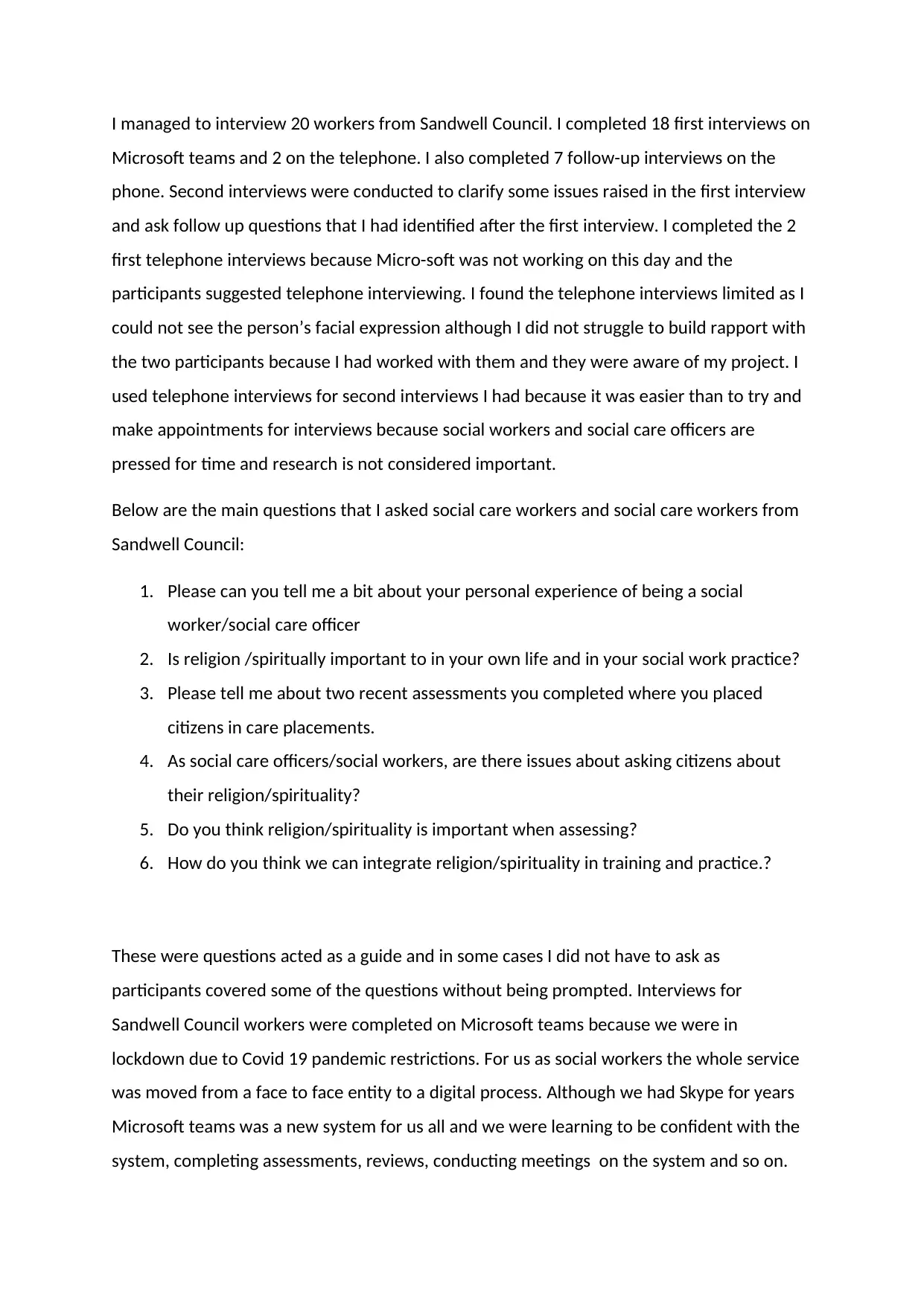
I managed to interview 20 workers from Sandwell Council. I completed 18 first interviews on
Microsoft teams and 2 on the telephone. I also completed 7 follow-up interviews on the
phone. Second interviews were conducted to clarify some issues raised in the first interview
and ask follow up questions that I had identified after the first interview. I completed the 2
first telephone interviews because Micro-soft was not working on this day and the
participants suggested telephone interviewing. I found the telephone interviews limited as I
could not see the person’s facial expression although I did not struggle to build rapport with
the two participants because I had worked with them and they were aware of my project. I
used telephone interviews for second interviews I had because it was easier than to try and
make appointments for interviews because social workers and social care officers are
pressed for time and research is not considered important.
Below are the main questions that I asked social care workers and social care workers from
Sandwell Council:
1. Please can you tell me a bit about your personal experience of being a social
worker/social care officer
2. Is religion /spiritually important to in your own life and in your social work practice?
3. Please tell me about two recent assessments you completed where you placed
citizens in care placements.
4. As social care officers/social workers, are there issues about asking citizens about
their religion/spirituality?
5. Do you think religion/spirituality is important when assessing?
6. How do you think we can integrate religion/spirituality in training and practice.?
These were questions acted as a guide and in some cases I did not have to ask as
participants covered some of the questions without being prompted. Interviews for
Sandwell Council workers were completed on Microsoft teams because we were in
lockdown due to Covid 19 pandemic restrictions. For us as social workers the whole service
was moved from a face to face entity to a digital process. Although we had Skype for years
Microsoft teams was a new system for us all and we were learning to be confident with the
system, completing assessments, reviews, conducting meetings on the system and so on.
Microsoft teams and 2 on the telephone. I also completed 7 follow-up interviews on the
phone. Second interviews were conducted to clarify some issues raised in the first interview
and ask follow up questions that I had identified after the first interview. I completed the 2
first telephone interviews because Micro-soft was not working on this day and the
participants suggested telephone interviewing. I found the telephone interviews limited as I
could not see the person’s facial expression although I did not struggle to build rapport with
the two participants because I had worked with them and they were aware of my project. I
used telephone interviews for second interviews I had because it was easier than to try and
make appointments for interviews because social workers and social care officers are
pressed for time and research is not considered important.
Below are the main questions that I asked social care workers and social care workers from
Sandwell Council:
1. Please can you tell me a bit about your personal experience of being a social
worker/social care officer
2. Is religion /spiritually important to in your own life and in your social work practice?
3. Please tell me about two recent assessments you completed where you placed
citizens in care placements.
4. As social care officers/social workers, are there issues about asking citizens about
their religion/spirituality?
5. Do you think religion/spirituality is important when assessing?
6. How do you think we can integrate religion/spirituality in training and practice.?
These were questions acted as a guide and in some cases I did not have to ask as
participants covered some of the questions without being prompted. Interviews for
Sandwell Council workers were completed on Microsoft teams because we were in
lockdown due to Covid 19 pandemic restrictions. For us as social workers the whole service
was moved from a face to face entity to a digital process. Although we had Skype for years
Microsoft teams was a new system for us all and we were learning to be confident with the
system, completing assessments, reviews, conducting meetings on the system and so on.
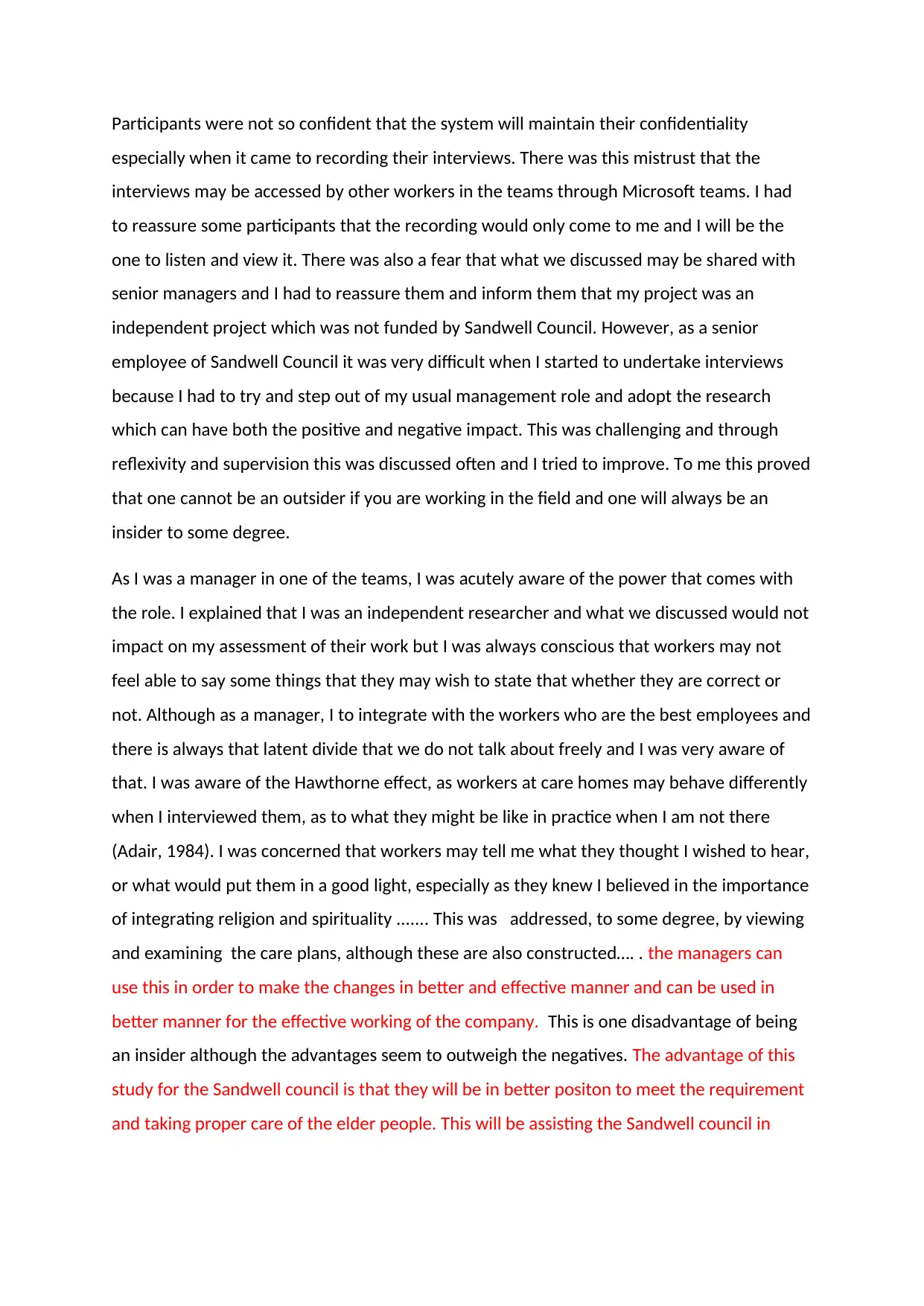
Participants were not so confident that the system will maintain their confidentiality
especially when it came to recording their interviews. There was this mistrust that the
interviews may be accessed by other workers in the teams through Microsoft teams. I had
to reassure some participants that the recording would only come to me and I will be the
one to listen and view it. There was also a fear that what we discussed may be shared with
senior managers and I had to reassure them and inform them that my project was an
independent project which was not funded by Sandwell Council. However, as a senior
employee of Sandwell Council it was very difficult when I started to undertake interviews
because I had to try and step out of my usual management role and adopt the research
which can have both the positive and negative impact. This was challenging and through
reflexivity and supervision this was discussed often and I tried to improve. To me this proved
that one cannot be an outsider if you are working in the field and one will always be an
insider to some degree.
As I was a manager in one of the teams, I was acutely aware of the power that comes with
the role. I explained that I was an independent researcher and what we discussed would not
impact on my assessment of their work but I was always conscious that workers may not
feel able to say some things that they may wish to state that whether they are correct or
not. Although as a manager, I to integrate with the workers who are the best employees and
there is always that latent divide that we do not talk about freely and I was very aware of
that. I was aware of the Hawthorne effect, as workers at care homes may behave differently
when I interviewed them, as to what they might be like in practice when I am not there
(Adair, 1984). I was concerned that workers may tell me what they thought I wished to hear,
or what would put them in a good light, especially as they knew I believed in the importance
of integrating religion and spirituality ....... This was addressed, to some degree, by viewing
and examining the care plans, although these are also constructed…. . the managers can
use this in order to make the changes in better and effective manner and can be used in
better manner for the effective working of the company. This is one disadvantage of being
an insider although the advantages seem to outweigh the negatives. The advantage of this
study for the Sandwell council is that they will be in better positon to meet the requirement
and taking proper care of the elder people. This will be assisting the Sandwell council in
especially when it came to recording their interviews. There was this mistrust that the
interviews may be accessed by other workers in the teams through Microsoft teams. I had
to reassure some participants that the recording would only come to me and I will be the
one to listen and view it. There was also a fear that what we discussed may be shared with
senior managers and I had to reassure them and inform them that my project was an
independent project which was not funded by Sandwell Council. However, as a senior
employee of Sandwell Council it was very difficult when I started to undertake interviews
because I had to try and step out of my usual management role and adopt the research
which can have both the positive and negative impact. This was challenging and through
reflexivity and supervision this was discussed often and I tried to improve. To me this proved
that one cannot be an outsider if you are working in the field and one will always be an
insider to some degree.
As I was a manager in one of the teams, I was acutely aware of the power that comes with
the role. I explained that I was an independent researcher and what we discussed would not
impact on my assessment of their work but I was always conscious that workers may not
feel able to say some things that they may wish to state that whether they are correct or
not. Although as a manager, I to integrate with the workers who are the best employees and
there is always that latent divide that we do not talk about freely and I was very aware of
that. I was aware of the Hawthorne effect, as workers at care homes may behave differently
when I interviewed them, as to what they might be like in practice when I am not there
(Adair, 1984). I was concerned that workers may tell me what they thought I wished to hear,
or what would put them in a good light, especially as they knew I believed in the importance
of integrating religion and spirituality ....... This was addressed, to some degree, by viewing
and examining the care plans, although these are also constructed…. . the managers can
use this in order to make the changes in better and effective manner and can be used in
better manner for the effective working of the company. This is one disadvantage of being
an insider although the advantages seem to outweigh the negatives. The advantage of this
study for the Sandwell council is that they will be in better positon to meet the requirement
and taking proper care of the elder people. This will be assisting the Sandwell council in
⊘ This is a preview!⊘
Do you want full access?
Subscribe today to unlock all pages.
Trusted by 1+ million students worldwide

1 out of 21


Related Documents


Your All-in-One AI-Powered Toolkit for Academic Success.
+13062052269
info@desklib.com
Available 24*7 on WhatsApp / Email
![[object Object]](/_next/static/media/star-bottom.7253800d.svg)
Unlock your academic potential
Copyright © 2020–2026 A2Z Services. All Rights Reserved. Developed and managed by ZUCOL.