University ARTS 105: In-depth Report on Rembrandt Van Rijn

Verified

Added on  2022/09/08

|4
|802
|21
Report
AI Summary
This report delves into the life and work of the renowned Dutch artist, Rembrandt Van Rijn. It begins with an overview of his biography, including his birth, family, education, and significant life events. The report then explores the art movement Rembrandt was associated with, specifically the Baroque movement, outlining its key characteristics and influences. It further examines the critical reception of Rembrandt's work, citing perspectives from art historians and critics. The paper includes an analysis of one of Rembrandt's famous works, 'The Anatomy Lesson of Dr. Nicholas Tulp,' providing details such as the year of creation, medium, dimensions, and current location. The report also incorporates the biblical integration, as required by the assignment brief, and concludes with the student's personal thoughts and reflections on Rembrandt's art, including spiritual aspects and overall impressions. The report is well-researched and utilizes scholarly references to support its analysis.
Document Page
1
Name of the Student
Name of the University
Author note
Rembrandt Van Rijn
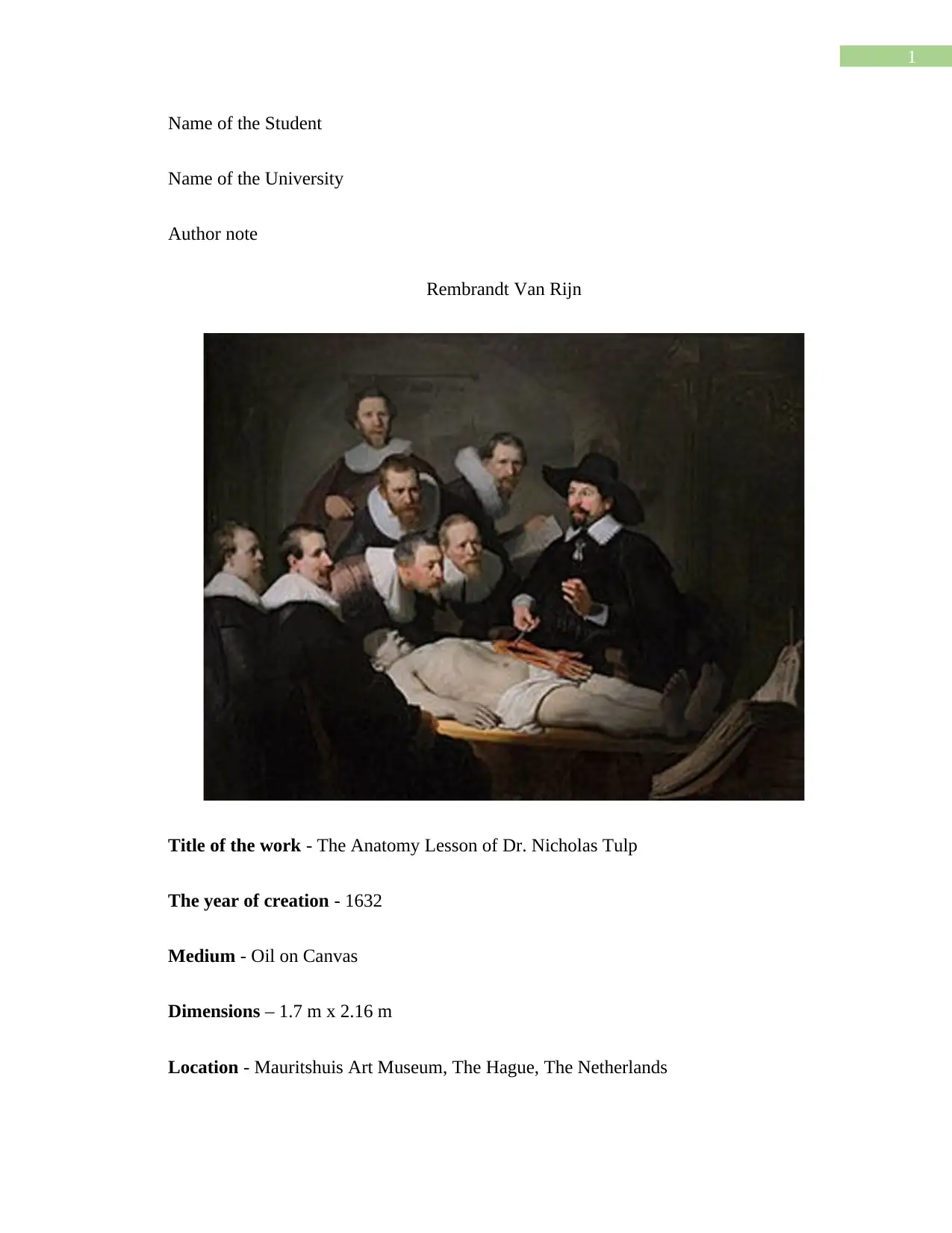
Title of the work - The Anatomy Lesson of Dr. Nicholas Tulp
The year of creation - 1632
Medium - Oil on Canvas
Dimensions – 1.7 m x 2.16 m
Location - Mauritshuis Art Museum, The Hague, The Netherlands
tabler-icon-diamond-filled.svg

Paraphrase This Document

Need a fresh take? Get an instant paraphrase of this document with our AI Paraphraser
Document Page
2
Rembrandt Harmenszoon Van Rijn was a Dutch artist who was born in 15th of July 1606
in Leiden, The Netherlands. He was a draughtsman, a painter and a printmaker as well. He is
considered as the one of the most important personalities in Dutch art history and one of the
greatest visual artists too. The artist was born in a well-to-do family and was the ninth child of
Harmen Gerritszoon Van Rijn and Neeltgen Wilemsdochter Van Zuytbrouck. He joined a Latin
school. Later, he was registered at the University of Leiden. His interest in painting made him
spend three years under the apprenticeship of a Leiden painter, Jacob Van Swanenburgh
(Dickey). After spending six months of his apprenticeship with Pieter Lastman, he opened his
own studio and later in 1627, he started accepting pupils too. His illustrious career came to an
end when he died on October 4th 1669, in Amsterdam.
Rembrandt was one of the most significant artists of the 17th century. The Baroque
movement influenced the art movement at that time, which was extravagant in its own way. The
distinguishing feature of this particular art movement was its dynamism and the detail, which
was aimed at creating drama as well as grandeur in paintings, architecture and sculpture (Noble).
The movement started in Rome at around the year 1600 and then it must have spread across
Europe. The Catholic Church heavily influenced the style as it was used to encourage religious
themes, images that depicted war and the aristocrats who enjoyed such exuberance. The style
was characterized by the depiction of natural images with intense emotions displayed in it
through the play of light and shadow (Getlein). The form was simplistic as well as melodramatic
that glorified the church and the monarchy.
According to several art critics, Rembrandt was not that a known artist of his era as the
century was more dominated by the works of Gerrit Dou as well as Nicolaes Berchem. His
popularity is more of a recent one. The works of Lastman, for instance, the “Stoning of Stephen”
Document Page
3
that was painted in 1624, have inspired his works. He became a prominent artist in Amsterdam
with his dramatic portraits like the “The Anatomy lesson of Dr. Tulp”. As Rembrandt was
assisted by the Mennonites, it can be said that they served as an inspiration for the subjective and
the moving treatment of the Biblical subjects. The theatrical style of his art was replaced by a
more contemplative style that was mature in work, for example the painting, “Aristotle with a
Bust of Homer”, painted in 1653 (Ivanova). He was influenced by a biblical verse from Mathew
27:46-54, when Christ cried, “My God, my God, why hast Thou forsaken Me?”, in his work,
“The Three Crosses” (Dürer).
According to me, the paintings of Rembrandt are a masterpiece on its own. His particular
work, “The Storm on the Sea of Galilee” is a beauty that portrays the effective play of light and
shadow in it. His works serve as an inspiration for the upcoming artists. His works have spiritual
aspect that evoke emotions in the viewers.
Document Page
4
Works Cited
Dickey, Stephanie S. "Rembrandt and his Circle." The Ashgate Research Companion to Dutch
Art of the Seventeenth Century. Routledge, 2017. 169-201.
Dürer, Albrecht. "Rembrandt’s iconography of the healing arts." Pharos (2019): 25.
Getlein, Mark. Living With Art. 12th ed., Mcgraw Hill Education, 2020, pp. 159-165.
Ivanova, Krassimira, Peter L. Stanchev, and Boyan Dimitrov. "Analysis of the distributions of
color characteristics in art painting images." Serdica Journal of Computing 2.2 (2008):
111-136.
Noble, Petria, et al. "The development of new imaging techniques for the study and
interpretation of late Rembrandt paintings." Preprints ICOM committee for conservation
17th triennial meeting, Melbourne. 2014.
chevron_up_icon
1 out of 4
circle_padding
hide_on_mobile
zoom_out_icon
[object Object]