Research Proposal: RHM vs. Face-to-Face in Australia

Verified

Added on  2020/04/07

|7
|1064
|46
Report
AI Summary
This research proposal explores the integration and impact of Remote Home Monitoring (RHM) in the Australian healthcare system. It begins with a literature review, highlighting the emergence of RHM in 2008 and its subsequent adoption to address increasing monitoring needs for various patient groups, including the elderly and those with chronic illnesses. The proposal outlines objectives to compare RHM with face-to-face medical follow-ups, discuss the shortcomings of traditional methods, and encourage wider adoption of RHM. The research questions focus on the similarities and differences between the two methods, the current usage percentage of RHM in Australia, and the problems of face-to-face checkups that RHM overcomes. The methodology includes data collection through interviews, questionnaires, and surveys with a sample size of 1000 patients. The proposal anticipates analyzing the collected data to determine the percentage of RHM users and discusses the advantages of RHM in overcoming challenges like long distances to health centers and patient immobility, ultimately recommending its broader implementation.
Document Page
A research proposal on Remote Home Monitoring (RHM) in Australia
Student’s Name
The Name of the Course
Instructor’s Name
Date
tabler-icon-diamond-filled.svg

Paraphrase This Document

Need a fresh take? Get an instant paraphrase of this document with our AI Paraphraser
Document Page
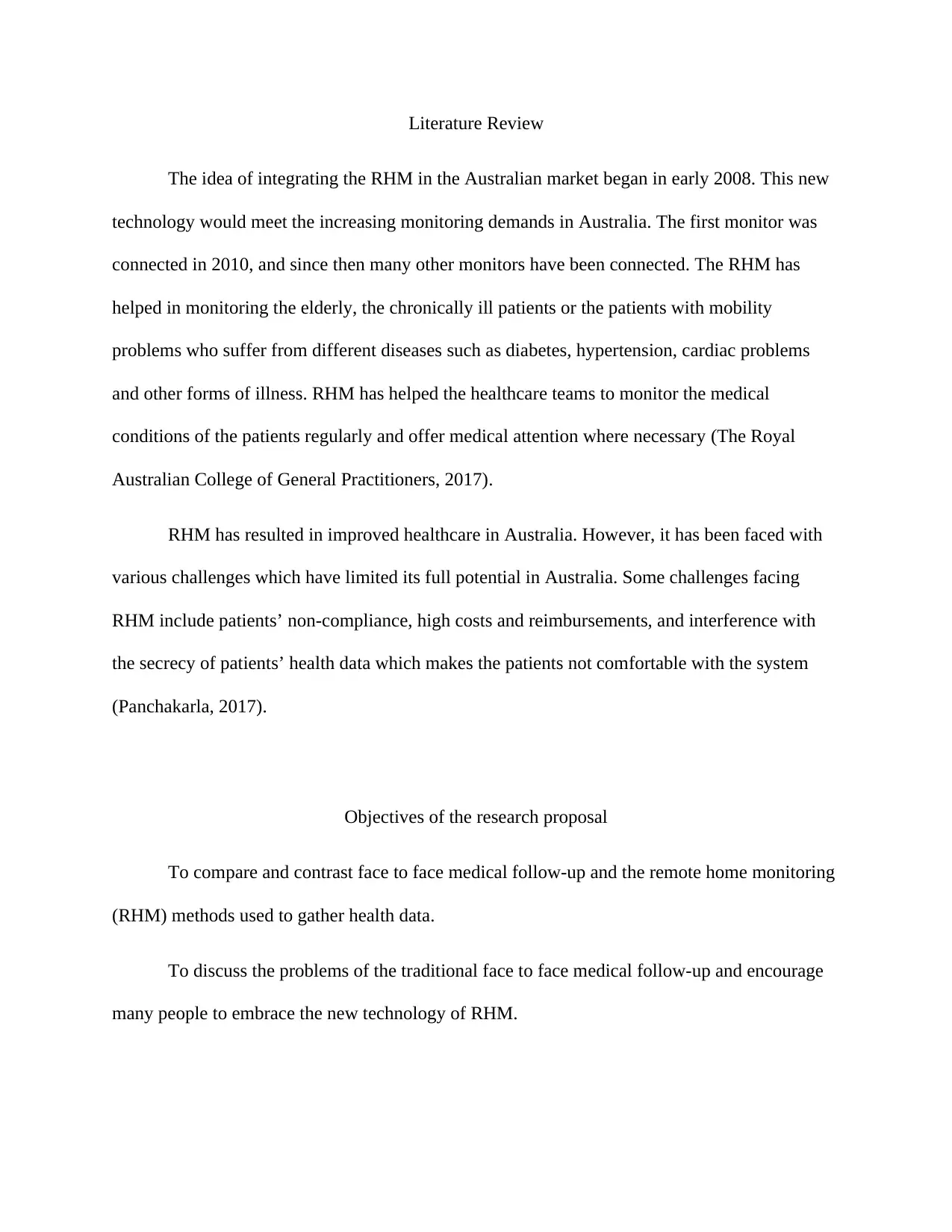
Literature Review
The idea of integrating the RHM in the Australian market began in early 2008. This new
technology would meet the increasing monitoring demands in Australia. The first monitor was
connected in 2010, and since then many other monitors have been connected. The RHM has
helped in monitoring the elderly, the chronically ill patients or the patients with mobility
problems who suffer from different diseases such as diabetes, hypertension, cardiac problems
and other forms of illness. RHM has helped the healthcare teams to monitor the medical
conditions of the patients regularly and offer medical attention where necessary (The Royal
Australian College of General Practitioners, 2017).
RHM has resulted in improved healthcare in Australia. However, it has been faced with
various challenges which have limited its full potential in Australia. Some challenges facing
RHM include patients’ non-compliance, high costs and reimbursements, and interference with
the secrecy of patients’ health data which makes the patients not comfortable with the system
(Panchakarla, 2017).
Objectives of the research proposal
To compare and contrast face to face medical follow-up and the remote home monitoring
(RHM) methods used to gather health data.
To discuss the problems of the traditional face to face medical follow-up and encourage
many people to embrace the new technology of RHM.
Document Page
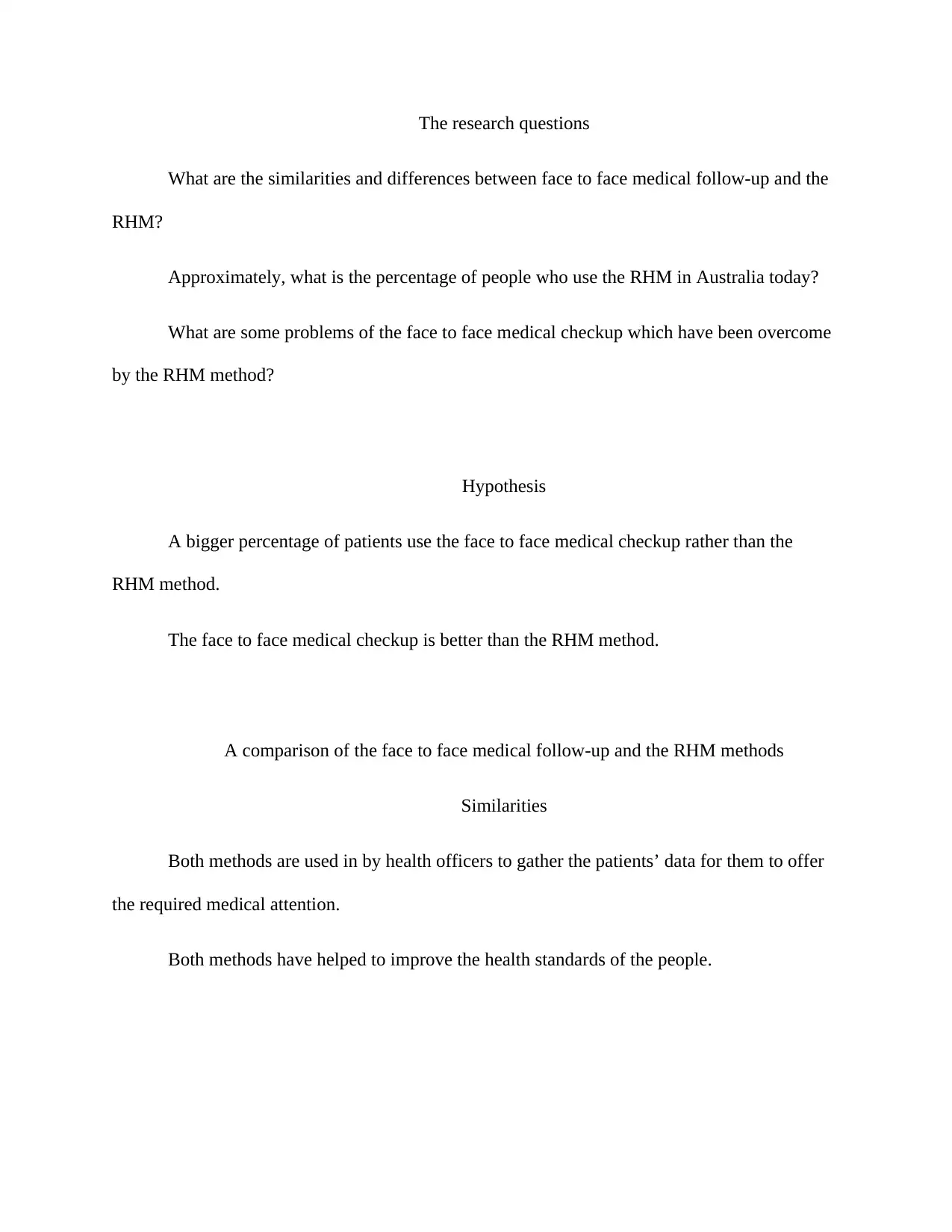
The research questions
What are the similarities and differences between face to face medical follow-up and the
RHM?
Approximately, what is the percentage of people who use the RHM in Australia today?
What are some problems of the face to face medical checkup which have been overcome
by the RHM method?
Hypothesis
A bigger percentage of patients use the face to face medical checkup rather than the
RHM method.
The face to face medical checkup is better than the RHM method.
A comparison of the face to face medical follow-up and the RHM methods
Similarities
Both methods are used in by health officers to gather the patients’ data for them to offer
the required medical attention.
Both methods have helped to improve the health standards of the people.
Document Page
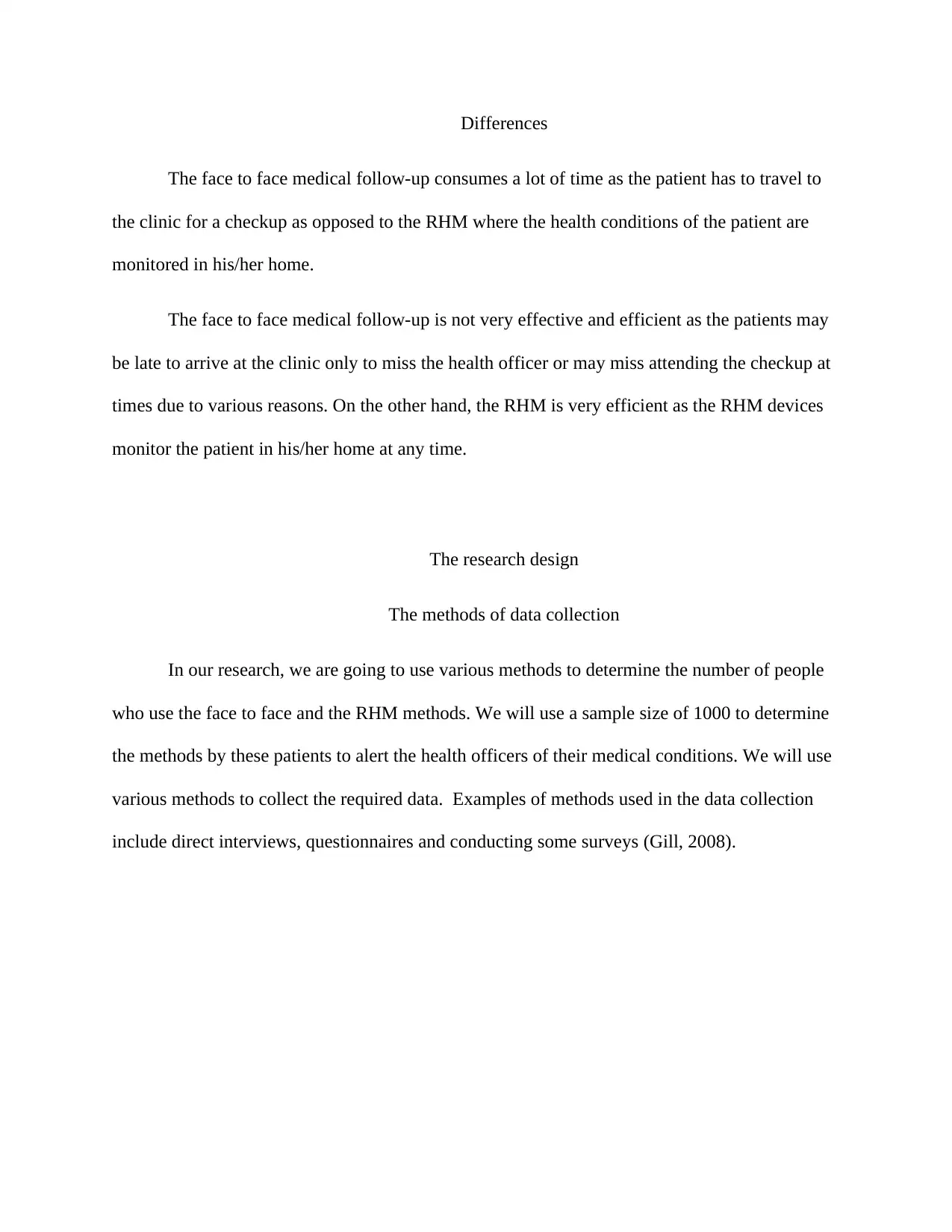
Differences
The face to face medical follow-up consumes a lot of time as the patient has to travel to
the clinic for a checkup as opposed to the RHM where the health conditions of the patient are
monitored in his/her home.
The face to face medical follow-up is not very effective and efficient as the patients may
be late to arrive at the clinic only to miss the health officer or may miss attending the checkup at
times due to various reasons. On the other hand, the RHM is very efficient as the RHM devices
monitor the patient in his/her home at any time.
The research design
The methods of data collection
In our research, we are going to use various methods to determine the number of people
who use the face to face and the RHM methods. We will use a sample size of 1000 to determine
the methods by these patients to alert the health officers of their medical conditions. We will use
various methods to collect the required data. Examples of methods used in the data collection
include direct interviews, questionnaires and conducting some surveys (Gill, 2008).
tabler-icon-diamond-filled.svg

Paraphrase This Document

Need a fresh take? Get an instant paraphrase of this document with our AI Paraphraser
Document Page
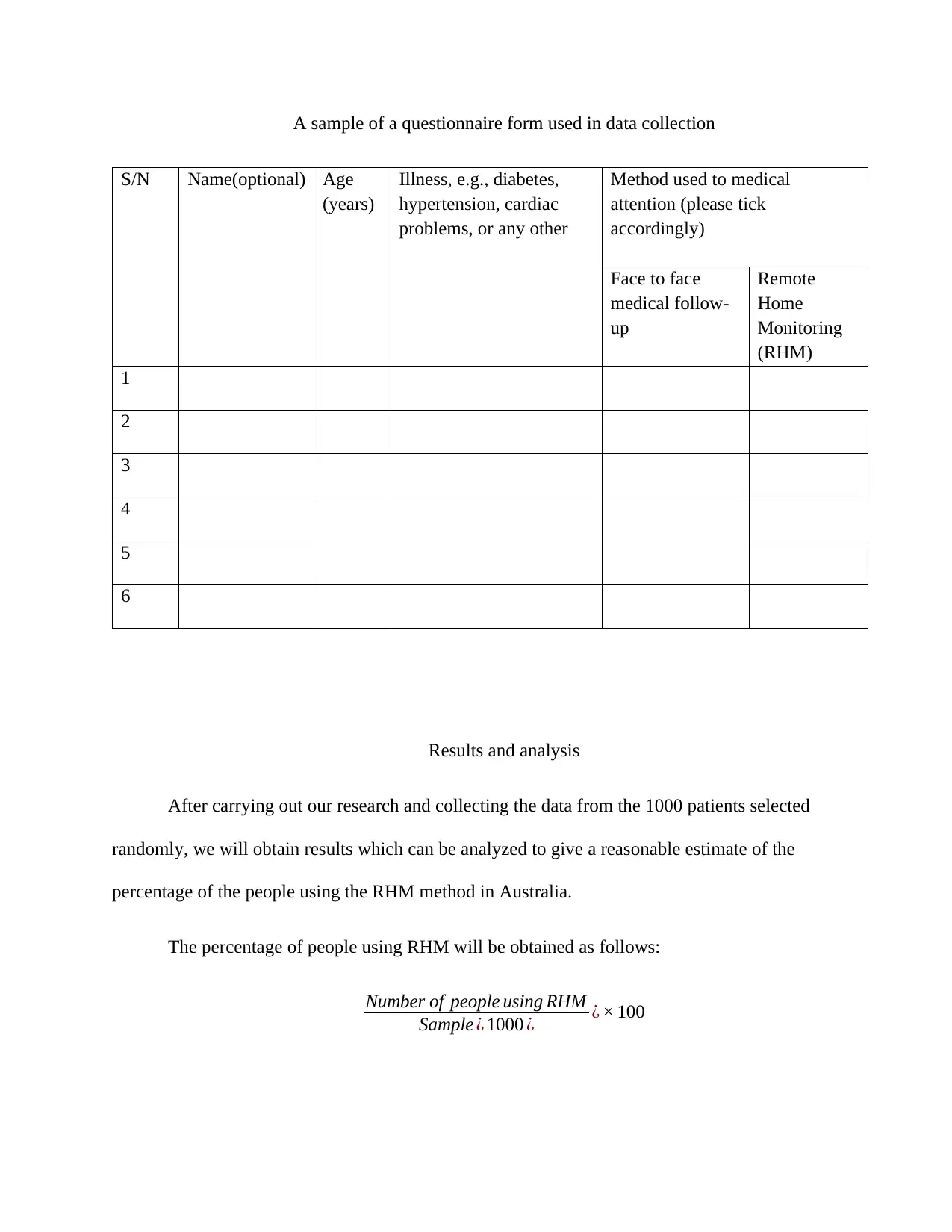
A sample of a questionnaire form used in data collection
S/N Name(optional) Age
(years)
Illness, e.g., diabetes,
hypertension, cardiac
problems, or any other
Method used to medical
attention (please tick
accordingly)
Face to face
medical follow-
up
Remote
Home
Monitoring
(RHM)
1
2
3
4
5
6
Results and analysis
After carrying out our research and collecting the data from the 1000 patients selected
randomly, we will obtain results which can be analyzed to give a reasonable estimate of the
percentage of the people using the RHM method in Australia.
The percentage of people using RHM will be obtained as follows:
Number of people using RHM
Sample ¿ 1000 ¿ ¿ × 100
Document Page
Discussion
In the field of health, some problems which affect the patients include the long
distance between the patients and the health centers, some patients are very weak to walk to the
health centers, and long queues in hospitals where some patients may even die before they get
medical attention. These problems are very common in the face to face medical checkup method.
These problems have been overcome by the RHM method where the health conditions of
the patients are monitored in their homes, and the health officers can attend to the patients
according to their urgency. The patients won’t have to walk all the way to the health centers to
seek some medical attention. This has been very beneficial especially to the elderly and the
people with some mobility problems.
Conclusion
As we have discussed above, the RHM is highly advantageous as compared to the face to
face medical checkup method. Therefore, I would recommend this method to many people of
Australia as it has helped to save the lives of many patients whose health conditions are
monitored at their own homes and the doctors respond accordingly.
Document Page
References
Coye, A. H. S. D., 2009. Remote patient management: technology-enabled innovation and
evolving business models for chronic disease care. Health Affair, 28(1), pp. 126-135.
Gill, K. S. a. B. C., 2008. Methods of data collection in qualitative research. British Dental
Journal, Volume 204, pp. 291-295.
Langreth, 2010. Why remote patient monitoring is overhyped. [Online]
Available at: https://www.forbes.com/sites/robertlangreth/2010/11/18/why-telemedicine-is-
overhyped/2/
Panchakarla, S., 2017. Challenges facing remote patient monitoring market detailed in new
research report. Medical Health & Life Science Research News, 24 August.Volume 6.
The Royal Australian College of General Practitioners, 2017. Remote Monitoring Devices: A
guide for General Practice, Melbourne: s.n.
chevron_up_icon
1 out of 7
circle_padding
hide_on_mobile
zoom_out_icon
[object Object]