Briefing Paper on Renewable Energy Technology: Solar Power

Verified

Added on  2022/11/18

|7
|1788
|52
Report
AI Summary
This briefing paper provides an insightful analysis of solar power technology, emphasizing its potential to address energy generation challenges from biophysical and psycho-social perspectives. It explores solar energy's advantages over conventional sources, focusing on emission reduction, sustainability, and cost-effectiveness. The paper presents a comparative analysis, highlighting solar power's positive impact on health and the environment while contrasting it with the negative effects of fossil fuels. Furthermore, it discusses the socio-economic benefits of solar energy, such as cost savings and scalability. The paper concludes by advocating for increased investment and research in clean energy sources like solar power to mitigate climate change and ensure a sustainable future. The paper also includes a table comparing the biophysical and socio-economic aspects of solar and conventional energy sources and concludes with the need for further research on the global implementation of clean energy sources.
Document Page
Running head: Renewable Energy Technology; Solar Power 1
Briefing paper on Renewable Energy Technology: Solar Power
Name of Student
Course
Institution Affiliation
tabler-icon-diamond-filled.svg

Paraphrase This Document

Need a fresh take? Get an instant paraphrase of this document with our AI Paraphraser
Document Page
Renewable Energy Technology; Solar Power 2
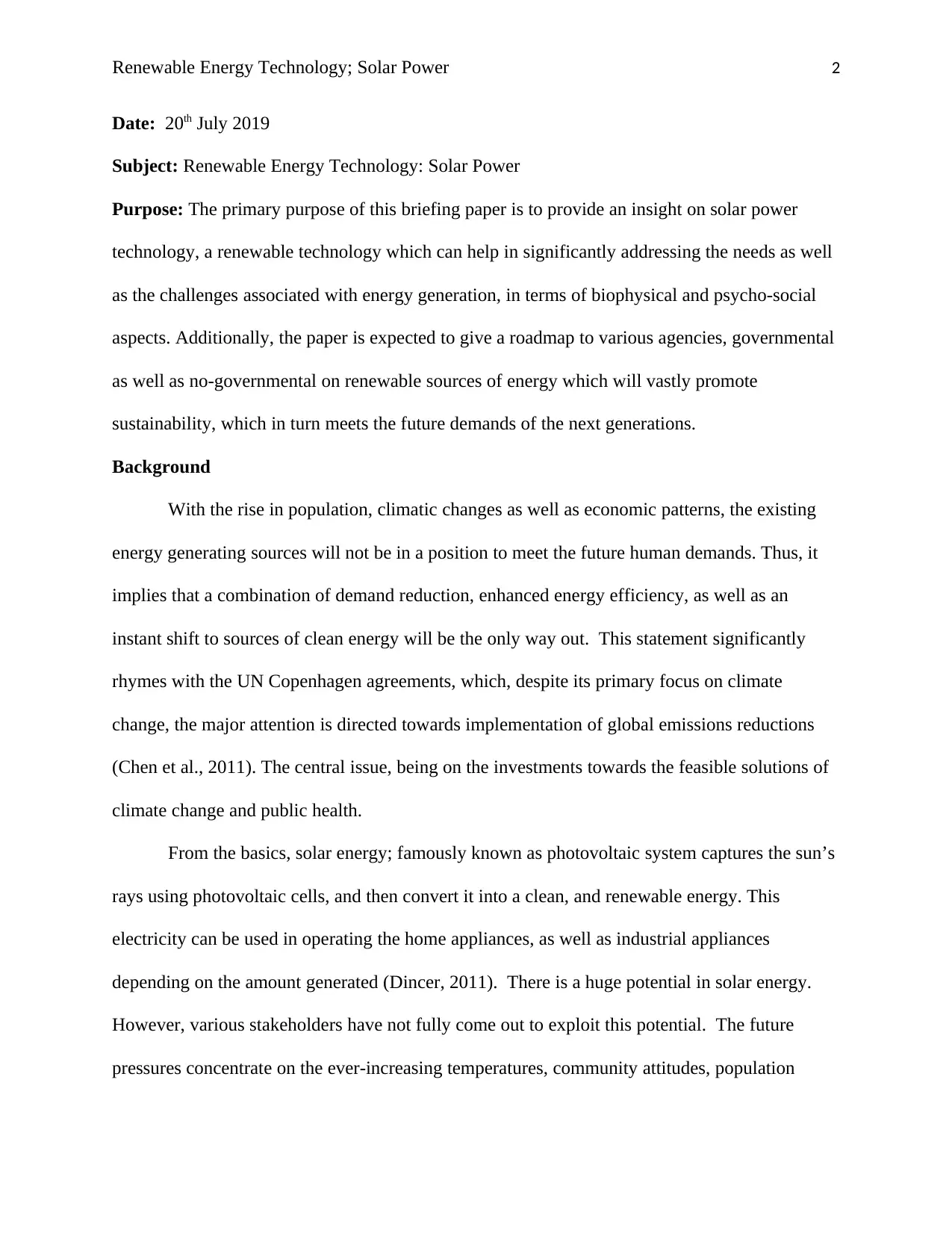
Date: 20th July 2019
Subject: Renewable Energy Technology: Solar Power
Purpose: The primary purpose of this briefing paper is to provide an insight on solar power
technology, a renewable technology which can help in significantly addressing the needs as well
as the challenges associated with energy generation, in terms of biophysical and psycho-social
aspects. Additionally, the paper is expected to give a roadmap to various agencies, governmental
as well as no-governmental on renewable sources of energy which will vastly promote
sustainability, which in turn meets the future demands of the next generations.
Background
With the rise in population, climatic changes as well as economic patterns, the existing
energy generating sources will not be in a position to meet the future human demands. Thus, it
implies that a combination of demand reduction, enhanced energy efficiency, as well as an
instant shift to sources of clean energy will be the only way out. This statement significantly
rhymes with the UN Copenhagen agreements, which, despite its primary focus on climate
change, the major attention is directed towards implementation of global emissions reductions
(Chen et al., 2011). The central issue, being on the investments towards the feasible solutions of
climate change and public health.
From the basics, solar energy; famously known as photovoltaic system captures the sun’s
rays using photovoltaic cells, and then convert it into a clean, and renewable energy. This
electricity can be used in operating the home appliances, as well as industrial appliances
depending on the amount generated (Dincer, 2011). There is a huge potential in solar energy.
However, various stakeholders have not fully come out to exploit this potential. The future
pressures concentrate on the ever-increasing temperatures, community attitudes, population
Document Page
Renewable Energy Technology; Solar Power 3
growth, and the necessity to reduce the rate of greenhouse emissions. These facts are only
addressed by adopting a clean and sustainable form of generating energy. Hence, it’s a call for
every person to join hands to significantly promote solar energy technology which is not only
sustainable but also renewable in the sense that future demands will be essentially met (Foley et
al., 2012).
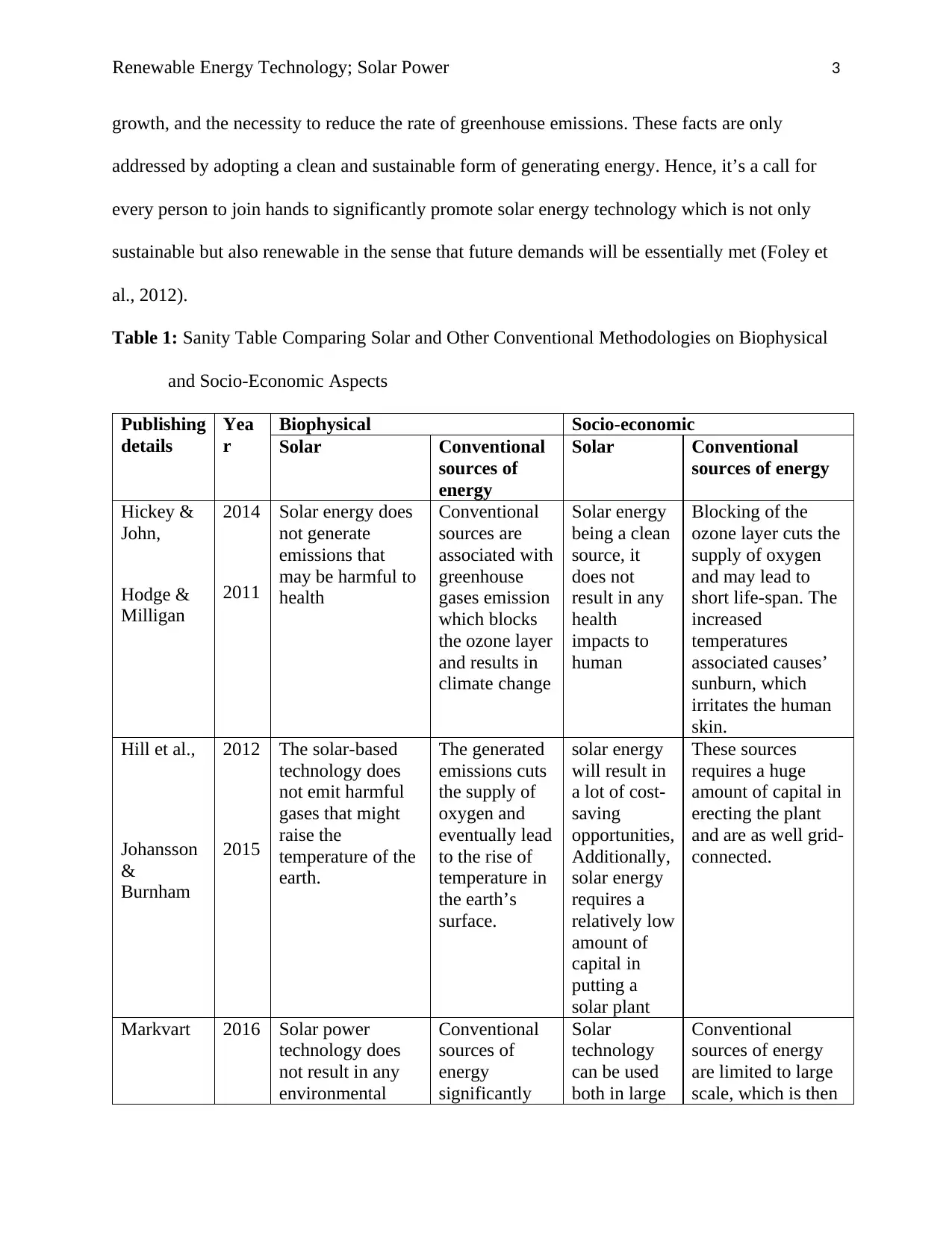
Table 1: Sanity Table Comparing Solar and Other Conventional Methodologies on Biophysical
and Socio-Economic Aspects
Publishing
details
Yea
r
Biophysical Socio-economic
Solar Conventional
sources of
energy
Solar Conventional
sources of energy
Hickey &
John,
Hodge &
Milligan
2014
2011
Solar energy does
not generate
emissions that
may be harmful to
health
Conventional
sources are
associated with
greenhouse
gases emission
which blocks
the ozone layer
and results in
climate change
Solar energy
being a clean
source, it
does not
result in any
health
impacts to
human
Blocking of the
ozone layer cuts the
supply of oxygen
and may lead to
short life-span. The
increased
temperatures
associated causes’
sunburn, which
irritates the human
skin.
Hill et al.,
Johansson
&
Burnham
2012
2015
The solar-based
technology does
not emit harmful
gases that might
raise the
temperature of the
earth.
The generated
emissions cuts
the supply of
oxygen and
eventually lead
to the rise of
temperature in
the earth’s
surface.
solar energy
will result in
a lot of cost-
saving
opportunities,
Additionally,
solar energy
requires a
relatively low
amount of
capital in
putting a
solar plant
These sources
requires a huge
amount of capital in
erecting the plant
and are as well grid-
connected.
Markvart 2016 Solar power
technology does
not result in any
environmental
Conventional
sources of
energy
significantly
Solar
technology
can be used
both in large
Conventional
sources of energy
are limited to large
scale, which is then
Document Page
Renewable Energy Technology; Solar Power 4
disturbance. pollute the
environment,
destroying
aquatic life and
endangering
the
productivity.
and small
scale.
connected to the
grid.
Biophysical aspects of analysis
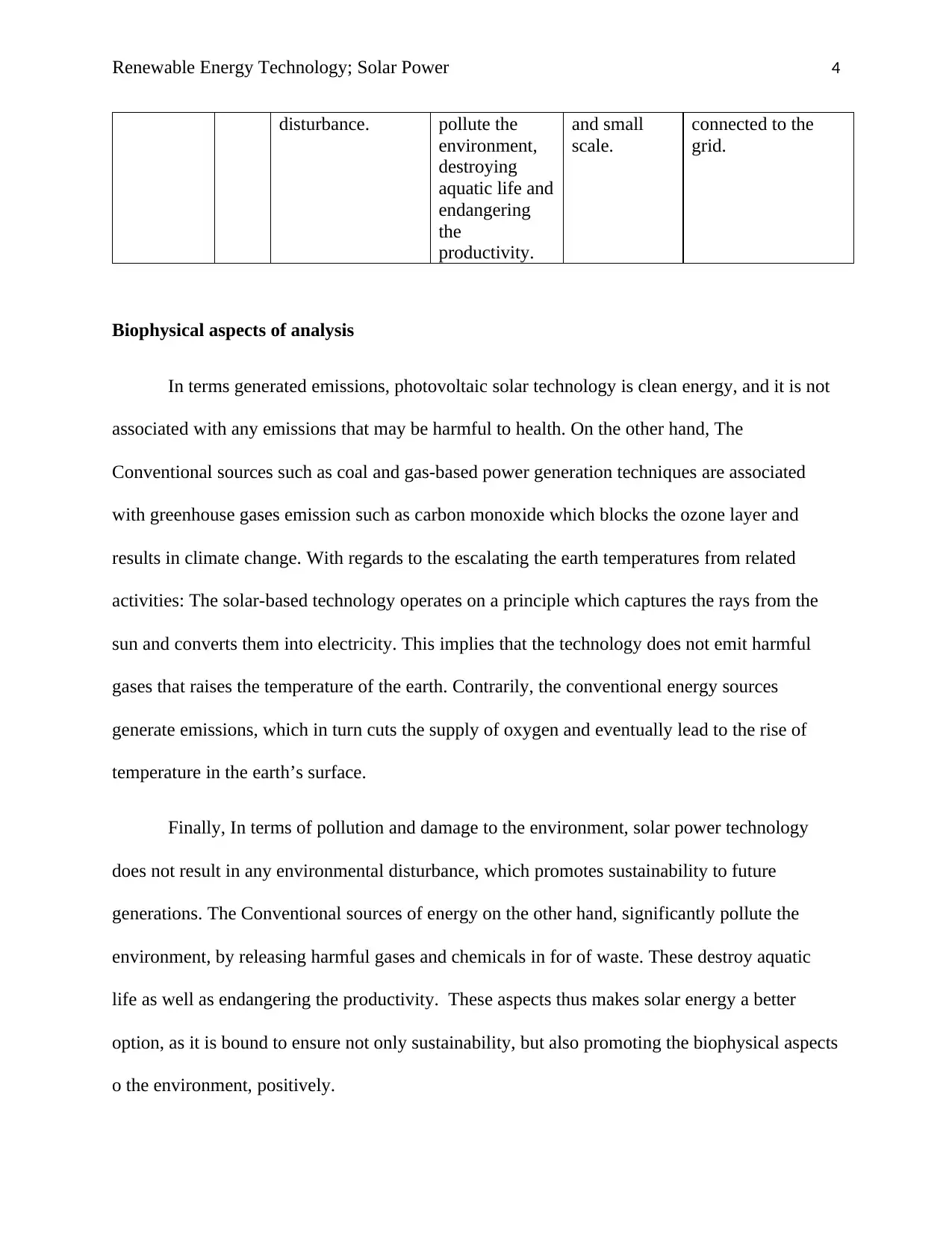
In terms generated emissions, photovoltaic solar technology is clean energy, and it is not
associated with any emissions that may be harmful to health. On the other hand, The
Conventional sources such as coal and gas-based power generation techniques are associated
with greenhouse gases emission such as carbon monoxide which blocks the ozone layer and
results in climate change. With regards to the escalating the earth temperatures from related
activities: The solar-based technology operates on a principle which captures the rays from the
sun and converts them into electricity. This implies that the technology does not emit harmful
gases that raises the temperature of the earth. Contrarily, the conventional energy sources
generate emissions, which in turn cuts the supply of oxygen and eventually lead to the rise of
temperature in the earth’s surface.
Finally, In terms of pollution and damage to the environment, solar power technology
does not result in any environmental disturbance, which promotes sustainability to future
generations. The Conventional sources of energy on the other hand, significantly pollute the
environment, by releasing harmful gases and chemicals in for of waste. These destroy aquatic
life as well as endangering the productivity. These aspects thus makes solar energy a better
option, as it is bound to ensure not only sustainability, but also promoting the biophysical aspects
o the environment, positively.
tabler-icon-diamond-filled.svg

Paraphrase This Document

Need a fresh take? Get an instant paraphrase of this document with our AI Paraphraser
Document Page
Renewable Energy Technology; Solar Power 5
Socio-economic aspects of analysis
Solar energy being a clean source, it does not result in any health impacts to human. The
conventional sources, for instance, coal, generates carbon monoxide which potentially blocks the
ozone layer, cutting the supply of oxygen and may lead to short life-span. The increased
temperatures associated with the conventional techniques causes’ sunburn, which irritates the
human skin. Further, some of the conventional mechanisms, such as coal, releases harmful gases
and wastes into soil and water bodies, thus affecting both the aquatic life and microorganism. In
terms of the socio-economic, solar energy will result in a lot of cost-saving opportunities, as bills
that would be incurred settling energy and water bills shall have been taken care of. Additionally,
solar energy requires a relatively low amount of capital in putting a solar plant is most of the
energy is harnessed from the sun. Solar is relatively cheap and cost-saving as compared to the
conventional sources of energy. These sources will not only require a huge amount of capital in
erecting the plant but also they have to be connected to the grid. This implies that the common
person will be expected to settle the associated bills and also the other bills, which is much
costly.
Additionally, solar technology can be used both in large and small scale. Small scale
implies that it can be used in homes, eliminating the need for energy bills. The excess energy can
then be sold to the grid, which generates some income. On contrary, Conventional sources of
energy are limited to large scale, which is then connected to the grid, thus restricting everyone to
rely on the grid by committing to some expenses.
Research strengths and gaps
From the evidence provided above, relating to findings by various authors, the analysis
provides a clear reason as to why adopting solar power energy as opposed to the conventional
Document Page
Renewable Energy Technology; Solar Power 6
sources of energy will be of significance. The aspect of climate change, sustainability and public
health is key and essential and has been critically analyzed by this paper. This provides
substantial research strength into further research on the global implementation of clean energy
sources: solar in particular. However, being that it is a briefing paper, it is a bit superficial as it
does not give a clear road map on the technology, hence would require further improvement,
based on a proposal.
Conclusion
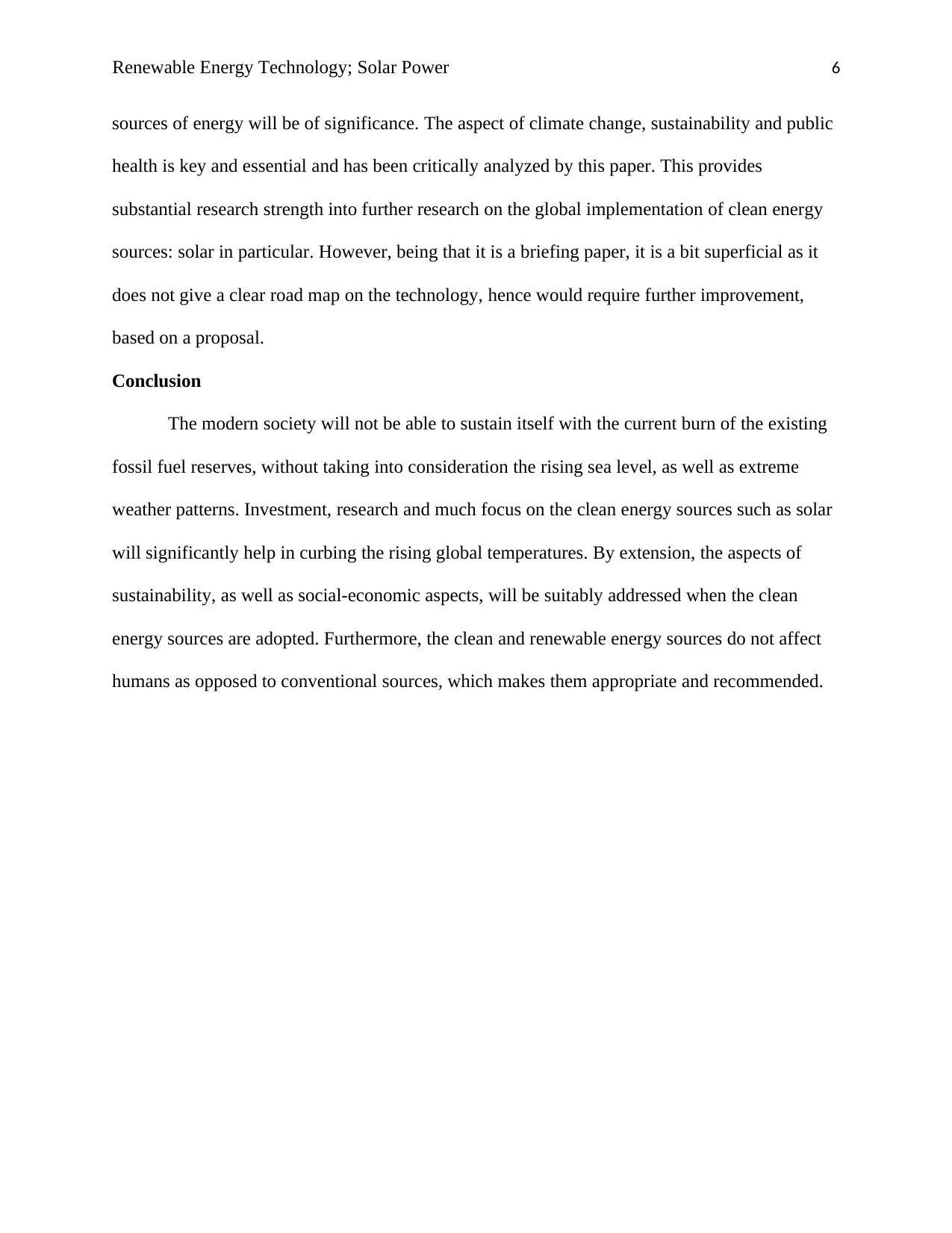
The modern society will not be able to sustain itself with the current burn of the existing
fossil fuel reserves, without taking into consideration the rising sea level, as well as extreme
weather patterns. Investment, research and much focus on the clean energy sources such as solar
will significantly help in curbing the rising global temperatures. By extension, the aspects of
sustainability, as well as social-economic aspects, will be suitably addressed when the clean
energy sources are adopted. Furthermore, the clean and renewable energy sources do not affect
humans as opposed to conventional sources, which makes them appropriate and recommended.
Document Page
Renewable Energy Technology; Solar Power 7
References
Chen, C., Duan, S., Cai, T., Liu, B. and Hu, G., 2011. Smart energy management system for optimal
microgrid economic operation. IET renewable power generation, 5(3), pp.258-267.
Dincer, F., 2011. The analysis on photovoltaic electricity generation status, potential and policies of the
leading countries in solar energy. Renewable and Sustainable Energy Reviews, 15(1), pp.713-
720.
Foley, A.M., Leahy, P.G., Marvuglia, A. and McKeogh, E.J., 2012. Current methods and advances in
forecasting of wind power generation. Renewable Energy, 37(1), pp.1-8.
Hickey, J.J., Hickey and John J., 2013. Solar and wind energy generating system for a high rise building.
U.S. Patent 5,394,016.
Hill, C.A., Such, M.C., Chen, D., Gonzalez, J. and Grady, W.M., 2012. Battery energy storage for
enabling integration of distributed solar power generation. IEEE Transactions on smart grid,
3(2), pp.850-857.
Hodge, B.M. and Milligan, M., 2011, July. Wind power forecasting error distributions over multiple
timescales. In Power and Energy Society General Meeting, 2011 IEEE (pp. 1-8). IEEE.
Johansson, T.B. and Burnham, L. eds., 2015. Renewable energy: sources for fuels and electricity. Island
press.
Markvart, T., 2016. Sizing of hybrid photovoltaic-wind energy systems. Solar Energy, 57(4), pp.277-
281.
chevron_up_icon
1 out of 7
circle_padding
hide_on_mobile
zoom_out_icon
[object Object]