An Analysis of Employability Skills and the 4 D's Strategy Report
VerifiedAdded on 2021/02/20
|9
|2559
|83
Report
AI Summary
This report delves into the realm of employability skills, highlighting their significance for both individuals and organizations. It begins by defining employability skills and categorizing them into essential and professional skill sets. The report then provides detailed explanations and examples of key skills such as communication, teamwork, problem-solving, and planning and organizing, emphasizing their practical application in the workplace. Furthermore, it explores the 4 D's strategy (Discovery, Dream, Design, and Destiny) and offers suggestions for its improvement within an organizational context. The report concludes by reiterating the importance of employability skills for career advancement and organizational success, making it a valuable resource for students and professionals alike.
Employability
Skills
Skills

Paraphrase This Document
Need a fresh take? Get an instant paraphrase of this document with our AI Paraphraser
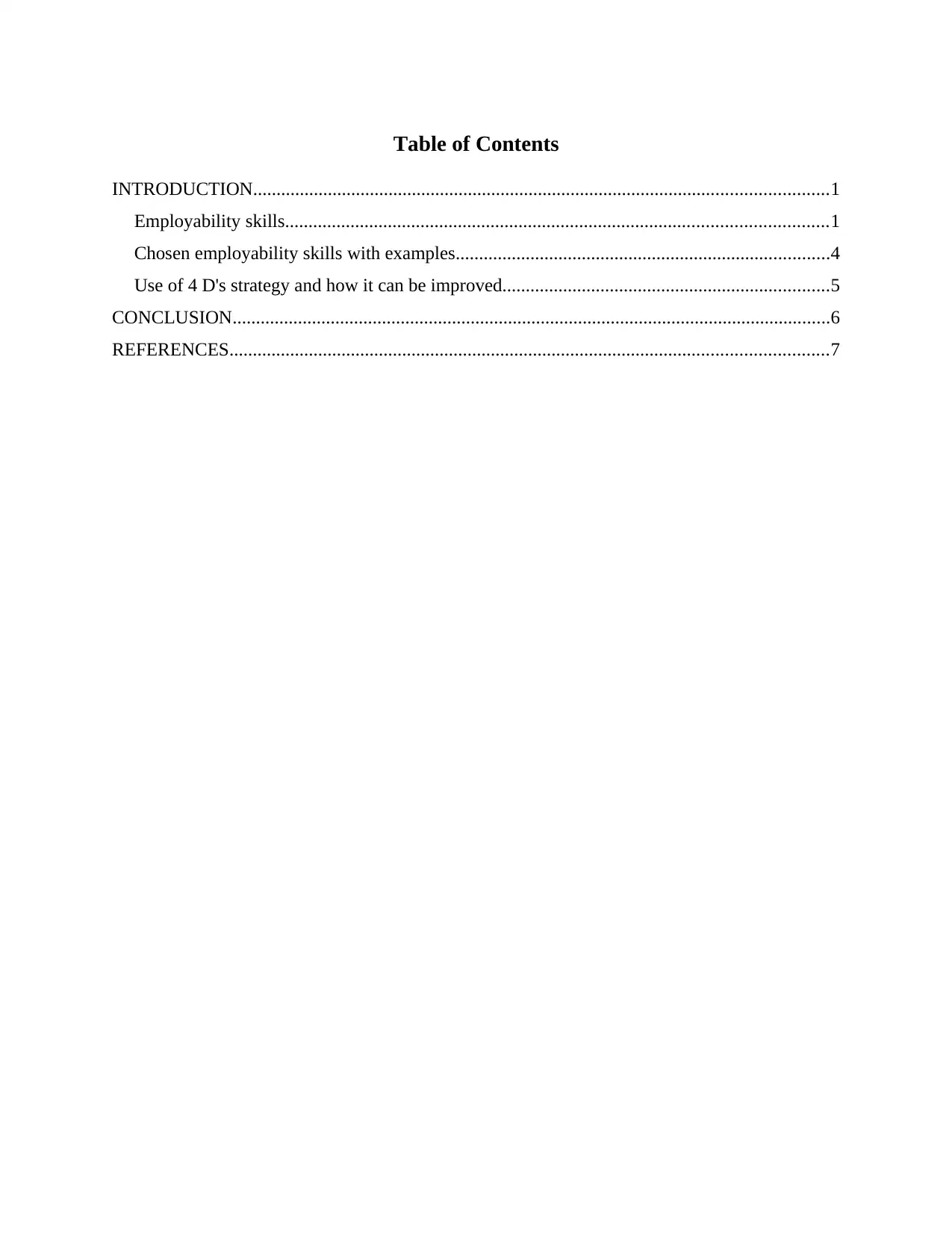
Table of Contents
INTRODUCTION...........................................................................................................................1
Employability skills....................................................................................................................1
Chosen employability skills with examples................................................................................4
Use of 4 D's strategy and how it can be improved......................................................................5
CONCLUSION................................................................................................................................6
REFERENCES................................................................................................................................7
INTRODUCTION...........................................................................................................................1
Employability skills....................................................................................................................1
Chosen employability skills with examples................................................................................4
Use of 4 D's strategy and how it can be improved......................................................................5
CONCLUSION................................................................................................................................6
REFERENCES................................................................................................................................7
INTRODUCTION
There are several employability skills which is an essential part of organisation and
employees (Benson, Morgan and Filippaios, 2014). These skill are very helpful in achieve
desired goals and objectives. Employees are most valuable asset of organisation as their skills
will leads to its effective and efficient functioning. Employability skills includes good
communication, motivation, leadership, teamwork and so on. This report is based on
employability and different employability skills that are beneficial for employees as well as
organisation. It also includes 4 D's strategies and ways to improve these strategies.
Employability skills
Employment skills can be define as all those skills or set of skills which help individual
to successful complete task of job. These are those skills and behaviours that are necessary for
working and accomplished task or job given. Employment skills are includes different skills such
as soft skills, foundational skills, work- readiness skills and job readiness skills. These skills are
required to conducts job task effectively and efficiently. Skills of employment are core skills and
traits that are specifically needed in almost all types of job roles. These employment skills will
help individual to carry out roles and responsibilities of job in such a manner that it leads to
achieve set goals and objectives (Collet, Hine and Du Plessis, 2015). These are general skills that
make someone more desirable to an organisation. Manger who is hiring new candidate for its
organisation always look for these employment skills in candidates. Hiring manager will only
select those candidates who have most of employment skills in order to increase productivity of
organisation.
There are different types of employment skills which is beneficial for employees. These
skills can be categorised into two parts which is essentials employability skills and professional
skills.
Essential Employability skills
These are those skills in an individual which helps in achieving success in workplace as
well as day to day living with regardless of a student program and course. Essential
employability skills includes, foundational skills, interpersonal skills, communication skills,
1
There are several employability skills which is an essential part of organisation and
employees (Benson, Morgan and Filippaios, 2014). These skill are very helpful in achieve
desired goals and objectives. Employees are most valuable asset of organisation as their skills
will leads to its effective and efficient functioning. Employability skills includes good
communication, motivation, leadership, teamwork and so on. This report is based on
employability and different employability skills that are beneficial for employees as well as
organisation. It also includes 4 D's strategies and ways to improve these strategies.
Employability skills
Employment skills can be define as all those skills or set of skills which help individual
to successful complete task of job. These are those skills and behaviours that are necessary for
working and accomplished task or job given. Employment skills are includes different skills such
as soft skills, foundational skills, work- readiness skills and job readiness skills. These skills are
required to conducts job task effectively and efficiently. Skills of employment are core skills and
traits that are specifically needed in almost all types of job roles. These employment skills will
help individual to carry out roles and responsibilities of job in such a manner that it leads to
achieve set goals and objectives (Collet, Hine and Du Plessis, 2015). These are general skills that
make someone more desirable to an organisation. Manger who is hiring new candidate for its
organisation always look for these employment skills in candidates. Hiring manager will only
select those candidates who have most of employment skills in order to increase productivity of
organisation.
There are different types of employment skills which is beneficial for employees. These
skills can be categorised into two parts which is essentials employability skills and professional
skills.
Essential Employability skills
These are those skills in an individual which helps in achieving success in workplace as
well as day to day living with regardless of a student program and course. Essential
employability skills includes, foundational skills, interpersonal skills, communication skills,
1
⊘ This is a preview!⊘
Do you want full access?
Subscribe today to unlock all pages.

Trusted by 1+ million students worldwide
problem solving skills, team work, ethical and legal responsibilities. All of these skills are
mention below in detail.
Foundational skills: Employees with this skills will have qualities that leads to effective job
performance (Cottrell, 2015). Foundational skills of employability are:
To be organize and manage thing in effective manner.
Employees with this skills will arrive to work on time.
Individual will have positive attitude towards their job role and work.
They always put high level of efforts and perseverance in their job.
Individual with this skills will always look for seeking out information and improving
their skills.
They are flexible and complete given task on time. Employee who have this skills maintain personal hygiene and follow dress code.
Interpersonal skills: Employees with these skills have certain behaviours which help them in get
along with co-workers and others. Traits or skills consist:
Friendly or polite nature towards others.
They respect supervisors and co-workers.
Employee with this skill have ability to respond appropriately to customers.
They always ask for feedback and take constructive criticism. These employees are able to resolve conflicts calmly and appropriately.
Communication skills: These skills help employee to effectively communicate or convey their
thought or ideas easily with other.
Employee with this skill are able to read and understand documents or other written
materials.
They are able to listen, understand and ask questions with other people.
These employees are able to express ideas clearly thought their speaking and writing
skills. Employees are able to learn and use new technology and techniques easily.
Problem solving and critical thinking: Employees with this skills have ability to manage and
handle difficult situations (de Guzman and Choi, 2013). Employees with this skills have mention
below qualities.
They are able to accept changes in workplace.
2
mention below in detail.
Foundational skills: Employees with this skills will have qualities that leads to effective job
performance (Cottrell, 2015). Foundational skills of employability are:
To be organize and manage thing in effective manner.
Employees with this skills will arrive to work on time.
Individual will have positive attitude towards their job role and work.
They always put high level of efforts and perseverance in their job.
Individual with this skills will always look for seeking out information and improving
their skills.
They are flexible and complete given task on time. Employee who have this skills maintain personal hygiene and follow dress code.
Interpersonal skills: Employees with these skills have certain behaviours which help them in get
along with co-workers and others. Traits or skills consist:
Friendly or polite nature towards others.
They respect supervisors and co-workers.
Employee with this skill have ability to respond appropriately to customers.
They always ask for feedback and take constructive criticism. These employees are able to resolve conflicts calmly and appropriately.
Communication skills: These skills help employee to effectively communicate or convey their
thought or ideas easily with other.
Employee with this skill are able to read and understand documents or other written
materials.
They are able to listen, understand and ask questions with other people.
These employees are able to express ideas clearly thought their speaking and writing
skills. Employees are able to learn and use new technology and techniques easily.
Problem solving and critical thinking: Employees with this skills have ability to manage and
handle difficult situations (de Guzman and Choi, 2013). Employees with this skills have mention
below qualities.
They are able to accept changes in workplace.
2
Paraphrase This Document
Need a fresh take? Get an instant paraphrase of this document with our AI Paraphraser
These employees are always willing to start, stop and switch to new duties and job role.
They have quality to work calmly in difficult situation or busy environment. Employees with this skills will work to solve problems with the motive of performing
better.
Teamwork: Employees with teamwork skills leads to effective and successful working of team
to achieve set targets.
These employees are able to take responsibilities for their work and share achieved
rewards.
Employee is comfortable while working with other people. They help each other and contribute most to achieve set targets and objective.
Ethical and legal responsibilities: Employees who have these skills are very ethical and have
moral values to perform task and job roles.
They take responsibilities for their task and own actions or decisions.
These employees always follow rules and regulation of company.
They are honest to other and trustworthy.
Professional skills
These are generally those skill which help employee to get selected for desired job roles
(Fallows and Steven, 2013). These skill will leads to gaining success in professional career of
employee. These skills are mention below:
Career development skills: These skills will help individual to gain success in it professional
career as well as reaching to desired job role.
Employees with career development skills are passionate towards learning new skills and
take new job opportunities.
They are committed to their work and workplace.
These employees does not require high level to supervision. They can work effectively
with little supervision.
They understand common business practices as well as environment of industry. They are working with the motive of achieving set goals or mission.
Leadership skills: These skills helps in influencing other to work effectively and achieving set
goals and objectives. Individuals with this skills have ability to guide others.
Employees with this skills are able to coach and mentor others.
3
They have quality to work calmly in difficult situation or busy environment. Employees with this skills will work to solve problems with the motive of performing
better.
Teamwork: Employees with teamwork skills leads to effective and successful working of team
to achieve set targets.
These employees are able to take responsibilities for their work and share achieved
rewards.
Employee is comfortable while working with other people. They help each other and contribute most to achieve set targets and objective.
Ethical and legal responsibilities: Employees who have these skills are very ethical and have
moral values to perform task and job roles.
They take responsibilities for their task and own actions or decisions.
These employees always follow rules and regulation of company.
They are honest to other and trustworthy.
Professional skills
These are generally those skill which help employee to get selected for desired job roles
(Fallows and Steven, 2013). These skill will leads to gaining success in professional career of
employee. These skills are mention below:
Career development skills: These skills will help individual to gain success in it professional
career as well as reaching to desired job role.
Employees with career development skills are passionate towards learning new skills and
take new job opportunities.
They are committed to their work and workplace.
These employees does not require high level to supervision. They can work effectively
with little supervision.
They understand common business practices as well as environment of industry. They are working with the motive of achieving set goals or mission.
Leadership skills: These skills helps in influencing other to work effectively and achieving set
goals and objectives. Individuals with this skills have ability to guide others.
Employees with this skills are able to coach and mentor others.
3
They are willing to take risk.
These employees are able to negotiate and have quality to motivates or direct other.
They demonstrate efficiency and seek to achieve needs business needs.
Employees with this skills build partnership and teams with co-workers.
All of these skills help an individual to work effectively in workplace as well as achieve
set goals and objectives of organisation (Ito and Kawazoe, 2015). Employment skills are
beneficial for both employees and organisation. Individual with these skills are able to perform
better and attain their desired goals and objectives. Company which have employees with this
skill set will be able to achieve set targets and earn more profits.
Chosen employability skills with examples
Communication skills
Communication skills includes ability of a person to provide and understand any kind of
information. This is a trait of an individual that will help them in communicating and conveying
their thoughts and idea in a effective way. Communication skills involves speaking, observing,
listening as well as empathising with others. Communication can be done through various ways
such as face to face, telephone conversations, digital communications and it also includes
gestures and postures.
Example of communications skills: When an employees is able to effectively convey
their ideas and thought with other employees as well as their supervisor. Employee giving an
effective presentation which leads to understanding of its motive clearly is an example of
communication skill.
Teamwork
This is a skills that will help an individual to get along with other team members. Team
work skills is a ability of employees that is interrelated to effective and effective functioning
team that leads to achieving targets (Jackson, 2014). This skill will help in coordinating and
collaborating employees with other members of team so that they can improve productivity and
profitability of company as a team.
Example of teamwork skills: When a complex task given to employees so they have to
use teamwork skills so that they can accomplish that specific task. For achieving set targets
employees needs to take decision and delegate role or responsibility as per ability of each and
every employee.
4
These employees are able to negotiate and have quality to motivates or direct other.
They demonstrate efficiency and seek to achieve needs business needs.
Employees with this skills build partnership and teams with co-workers.
All of these skills help an individual to work effectively in workplace as well as achieve
set goals and objectives of organisation (Ito and Kawazoe, 2015). Employment skills are
beneficial for both employees and organisation. Individual with these skills are able to perform
better and attain their desired goals and objectives. Company which have employees with this
skill set will be able to achieve set targets and earn more profits.
Chosen employability skills with examples
Communication skills
Communication skills includes ability of a person to provide and understand any kind of
information. This is a trait of an individual that will help them in communicating and conveying
their thoughts and idea in a effective way. Communication skills involves speaking, observing,
listening as well as empathising with others. Communication can be done through various ways
such as face to face, telephone conversations, digital communications and it also includes
gestures and postures.
Example of communications skills: When an employees is able to effectively convey
their ideas and thought with other employees as well as their supervisor. Employee giving an
effective presentation which leads to understanding of its motive clearly is an example of
communication skill.
Teamwork
This is a skills that will help an individual to get along with other team members. Team
work skills is a ability of employees that is interrelated to effective and effective functioning
team that leads to achieving targets (Jackson, 2014). This skill will help in coordinating and
collaborating employees with other members of team so that they can improve productivity and
profitability of company as a team.
Example of teamwork skills: When a complex task given to employees so they have to
use teamwork skills so that they can accomplish that specific task. For achieving set targets
employees needs to take decision and delegate role or responsibility as per ability of each and
every employee.
4
⊘ This is a preview!⊘
Do you want full access?
Subscribe today to unlock all pages.
Trusted by 1+ million students worldwide
Problem solving
Problem solving skills is very helpful in managing difficult task or situations. This is a
key skills or ability of an individual that leads to handling complex situation very easily. These
skills are lead though experience and training by solving complicated issues. This skills will help
in providing creativity and innovative solutions to problems.
Example of problem solving skills: When company is facing issue that leads to
reduction in its productivity and profitability (Mishra, 2014). Conflict between employees and
organisation can be refers as a serious problems which will affect company's functions.
Employees with problem solving skills will be able to deal with this issue by providing effective
solution. They will understand needs and wants of employees as well as provide creative solution
which will resolve conflicts.
Planning and organising skills
This is a skill of an individual that help in creating effective plans as well as successful
implementation of these plans. Planning and organising skills of a person will leads to
prioritizing its activities and analysing or managing time that is required to complete. This will
leads to controlling and coordinating all resource that is need to accomplish task.
Example of planning and organising skills: When manager is delegating task to its
subordinates. Manger needs to evaluate priority of task that are important or urgently needed as
well as delegation of these task as per skills and ability of employees. This requires proper
planning about time that is needs to accomplish those task as well as different resources that is
required.
Use of 4 D's strategy and how it can be improved
There are four different strategies which can be used by organisation in order to improve
productivity. This 4 D's strategy will leads to attaining desired goals and objective. It includes
discovery, dream, design and destiny. All of these four strategies is mention below:
Discovery: This phase within an organisation is basically characterised by considering a
positive core of a particular business (PârvuIpate and Mitran, 2014). It primarily includes
what are the values of an organisation, what are its areas where it performs its best.
However, several other aspects related to the functioning of an organisation are also
considered. This strategies can be improved by analysing and evaluating core values of
5
Problem solving skills is very helpful in managing difficult task or situations. This is a
key skills or ability of an individual that leads to handling complex situation very easily. These
skills are lead though experience and training by solving complicated issues. This skills will help
in providing creativity and innovative solutions to problems.
Example of problem solving skills: When company is facing issue that leads to
reduction in its productivity and profitability (Mishra, 2014). Conflict between employees and
organisation can be refers as a serious problems which will affect company's functions.
Employees with problem solving skills will be able to deal with this issue by providing effective
solution. They will understand needs and wants of employees as well as provide creative solution
which will resolve conflicts.
Planning and organising skills
This is a skill of an individual that help in creating effective plans as well as successful
implementation of these plans. Planning and organising skills of a person will leads to
prioritizing its activities and analysing or managing time that is required to complete. This will
leads to controlling and coordinating all resource that is need to accomplish task.
Example of planning and organising skills: When manager is delegating task to its
subordinates. Manger needs to evaluate priority of task that are important or urgently needed as
well as delegation of these task as per skills and ability of employees. This requires proper
planning about time that is needs to accomplish those task as well as different resources that is
required.
Use of 4 D's strategy and how it can be improved
There are four different strategies which can be used by organisation in order to improve
productivity. This 4 D's strategy will leads to attaining desired goals and objective. It includes
discovery, dream, design and destiny. All of these four strategies is mention below:
Discovery: This phase within an organisation is basically characterised by considering a
positive core of a particular business (PârvuIpate and Mitran, 2014). It primarily includes
what are the values of an organisation, what are its areas where it performs its best.
However, several other aspects related to the functioning of an organisation are also
considered. This strategies can be improved by analysing and evaluating core values of
5
Paraphrase This Document
Need a fresh take? Get an instant paraphrase of this document with our AI Paraphraser
organisation. Company should identify in which they are best as well as how they can
improve their services.
Dream: Under this organisation usually aims at exploring their possibilities. Objectives
are made under this stage to identify several factors which can have an organisation in
fulfilling future targets vastly. This strategies will help organisation to explore new
opportunities and possibilities with the motive of achieving biggest and most fulfilling
future. Company can improve this strategies by identifying and exploring their
possibilities in order to achieve their goals. Organisation needs to think beyond their
customary boundaries to improve this.
Design: This is a practical phase, that primarily deals at forming ideas as well as energy
to prioritized the effectiveness of an organisation. Therefore several steps might to take in
order to achieve the accomplished goals of an organisation (Sung and et.al., 2013).
Company should use best of discovery strategies so that they can develop or create an
effective design. It can be improved by identifying their highest value and analysing what
is the most valuable to them.
Destiny: This phase usually deals at making a series of inspired actions. It is an ongoing
process which basically emphasis on thinking beyond the established boundaries. This
strategies is more related to measuring impact of organisational functions in achieving
mission and objectives. This strategies can be improved by fulfilling its dream strategies
as well as effective designing and executions .
CONCLUSION
From the above report it can be concluded that employability skills are very essentials for
effective and efficient working of a company. Employability skills act as a indicator of
employees performance. Each and every employee wants to achieve most of these skills so that
they can grow and develop their future career. There are various employability skills and these
skills will help employee in dealing with complex and difficult situations. Employer who is
responsible to hiring candidates in organisation will only look for employee that have these
skills. Apart from this, with the effective use of 4 D's organisation can attain their desired
mission and vision.
6
improve their services.
Dream: Under this organisation usually aims at exploring their possibilities. Objectives
are made under this stage to identify several factors which can have an organisation in
fulfilling future targets vastly. This strategies will help organisation to explore new
opportunities and possibilities with the motive of achieving biggest and most fulfilling
future. Company can improve this strategies by identifying and exploring their
possibilities in order to achieve their goals. Organisation needs to think beyond their
customary boundaries to improve this.
Design: This is a practical phase, that primarily deals at forming ideas as well as energy
to prioritized the effectiveness of an organisation. Therefore several steps might to take in
order to achieve the accomplished goals of an organisation (Sung and et.al., 2013).
Company should use best of discovery strategies so that they can develop or create an
effective design. It can be improved by identifying their highest value and analysing what
is the most valuable to them.
Destiny: This phase usually deals at making a series of inspired actions. It is an ongoing
process which basically emphasis on thinking beyond the established boundaries. This
strategies is more related to measuring impact of organisational functions in achieving
mission and objectives. This strategies can be improved by fulfilling its dream strategies
as well as effective designing and executions .
CONCLUSION
From the above report it can be concluded that employability skills are very essentials for
effective and efficient working of a company. Employability skills act as a indicator of
employees performance. Each and every employee wants to achieve most of these skills so that
they can grow and develop their future career. There are various employability skills and these
skills will help employee in dealing with complex and difficult situations. Employer who is
responsible to hiring candidates in organisation will only look for employee that have these
skills. Apart from this, with the effective use of 4 D's organisation can attain their desired
mission and vision.
6
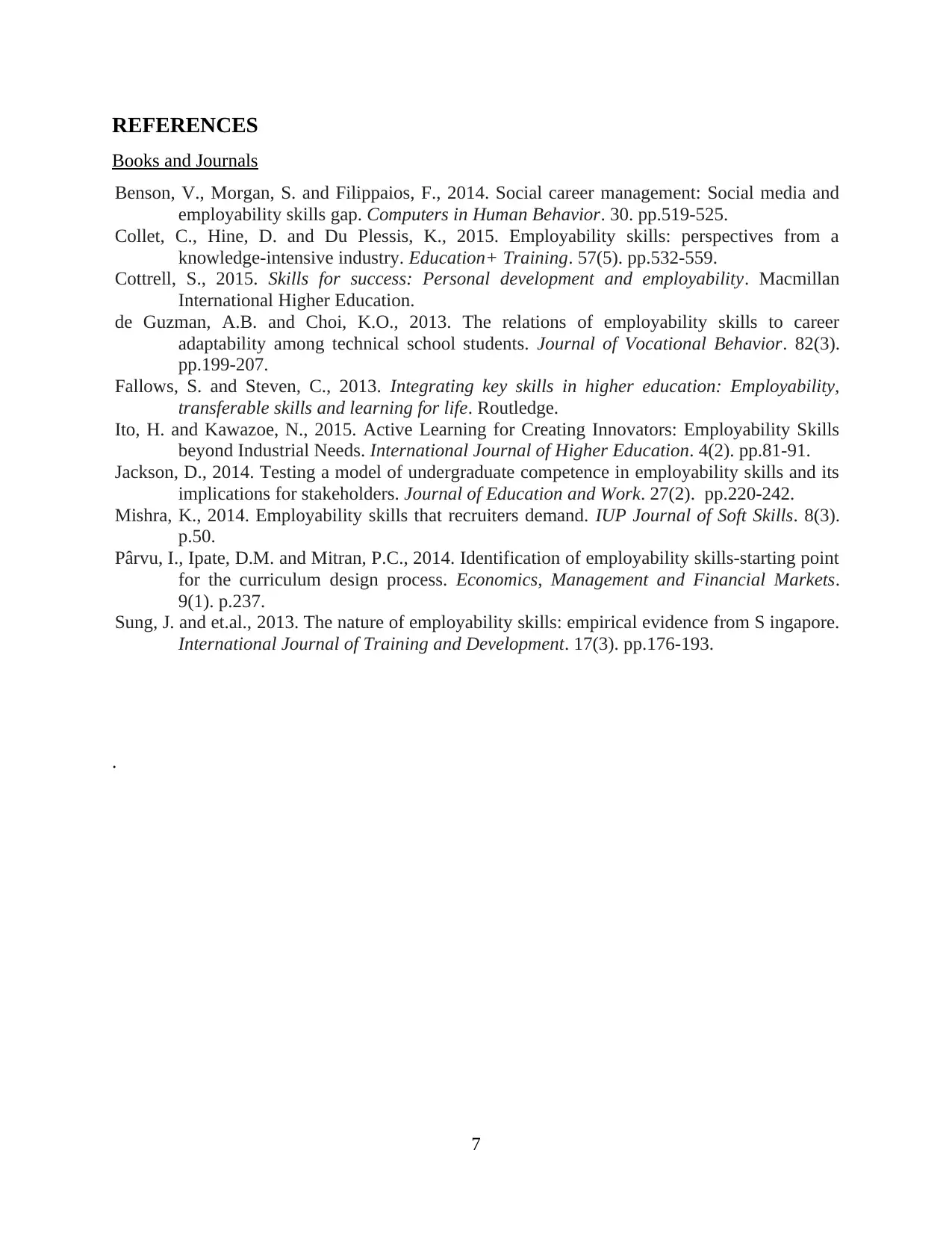
REFERENCES
Books and Journals
Benson, V., Morgan, S. and Filippaios, F., 2014. Social career management: Social media and
employability skills gap. Computers in Human Behavior. 30. pp.519-525.
Collet, C., Hine, D. and Du Plessis, K., 2015. Employability skills: perspectives from a
knowledge-intensive industry. Education+ Training. 57(5). pp.532-559.
Cottrell, S., 2015. Skills for success: Personal development and employability. Macmillan
International Higher Education.
de Guzman, A.B. and Choi, K.O., 2013. The relations of employability skills to career
adaptability among technical school students. Journal of Vocational Behavior. 82(3).
pp.199-207.
Fallows, S. and Steven, C., 2013. Integrating key skills in higher education: Employability,
transferable skills and learning for life. Routledge.
Ito, H. and Kawazoe, N., 2015. Active Learning for Creating Innovators: Employability Skills
beyond Industrial Needs. International Journal of Higher Education. 4(2). pp.81-91.
Jackson, D., 2014. Testing a model of undergraduate competence in employability skills and its
implications for stakeholders. Journal of Education and Work. 27(2). pp.220-242.
Mishra, K., 2014. Employability skills that recruiters demand. IUP Journal of Soft Skills. 8(3).
p.50.
Pârvu, I., Ipate, D.M. and Mitran, P.C., 2014. Identification of employability skills-starting point
for the curriculum design process. Economics, Management and Financial Markets.
9(1). p.237.
Sung, J. and et.al., 2013. The nature of employability skills: empirical evidence from S ingapore.
International Journal of Training and Development. 17(3). pp.176-193.
.
7
Books and Journals
Benson, V., Morgan, S. and Filippaios, F., 2014. Social career management: Social media and
employability skills gap. Computers in Human Behavior. 30. pp.519-525.
Collet, C., Hine, D. and Du Plessis, K., 2015. Employability skills: perspectives from a
knowledge-intensive industry. Education+ Training. 57(5). pp.532-559.
Cottrell, S., 2015. Skills for success: Personal development and employability. Macmillan
International Higher Education.
de Guzman, A.B. and Choi, K.O., 2013. The relations of employability skills to career
adaptability among technical school students. Journal of Vocational Behavior. 82(3).
pp.199-207.
Fallows, S. and Steven, C., 2013. Integrating key skills in higher education: Employability,
transferable skills and learning for life. Routledge.
Ito, H. and Kawazoe, N., 2015. Active Learning for Creating Innovators: Employability Skills
beyond Industrial Needs. International Journal of Higher Education. 4(2). pp.81-91.
Jackson, D., 2014. Testing a model of undergraduate competence in employability skills and its
implications for stakeholders. Journal of Education and Work. 27(2). pp.220-242.
Mishra, K., 2014. Employability skills that recruiters demand. IUP Journal of Soft Skills. 8(3).
p.50.
Pârvu, I., Ipate, D.M. and Mitran, P.C., 2014. Identification of employability skills-starting point
for the curriculum design process. Economics, Management and Financial Markets.
9(1). p.237.
Sung, J. and et.al., 2013. The nature of employability skills: empirical evidence from S ingapore.
International Journal of Training and Development. 17(3). pp.176-193.
.
7
⊘ This is a preview!⊘
Do you want full access?
Subscribe today to unlock all pages.
Trusted by 1+ million students worldwide

1 out of 9


Related Documents


Your All-in-One AI-Powered Toolkit for Academic Success.
+13062052269
info@desklib.com
Available 24*7 on WhatsApp / Email
![[object Object]](/_next/static/media/star-bottom.7253800d.svg)
Unlock your academic potential
Copyright © 2020–2026 A2Z Services. All Rights Reserved. Developed and managed by ZUCOL.