RES411 Building Law: Analyzing Resource & Building Acts in Real Estate
VerifiedAdded on 2023/06/15
|15
|3015
|466
Report
AI Summary
This report provides a comprehensive analysis of building laws in New Zealand, focusing primarily on the Resource Management Act 1991 and the Building Act 2004. It covers restrictions and controls imposed by the Resource Management Act, including principles related to national importance, matters of consideration, and elements of environmental control. The report also discusses building-related documents such as Land Information Memorandums, Building Consents, and Code Compliance Certificates, along with their purposes and implications. Furthermore, it addresses requirements and implications of the Building Act concerning alterations and changes of use for premises, and legal implications for licensees under the Fencing Act 1978 and the Fencing of Swimming Pools Act 1987. Case studies are used to illustrate the practical application of these laws and regulations. Desklib offers a variety of solved assignments and past papers for students.

Running head: BUILDING LAW
Building Laws
Name of the student
Name of the university
Author note
Building Laws
Name of the student
Name of the university
Author note

Paraphrase This Document
Need a fresh take? Get an instant paraphrase of this document with our AI Paraphraser
1
BUILDING LAW
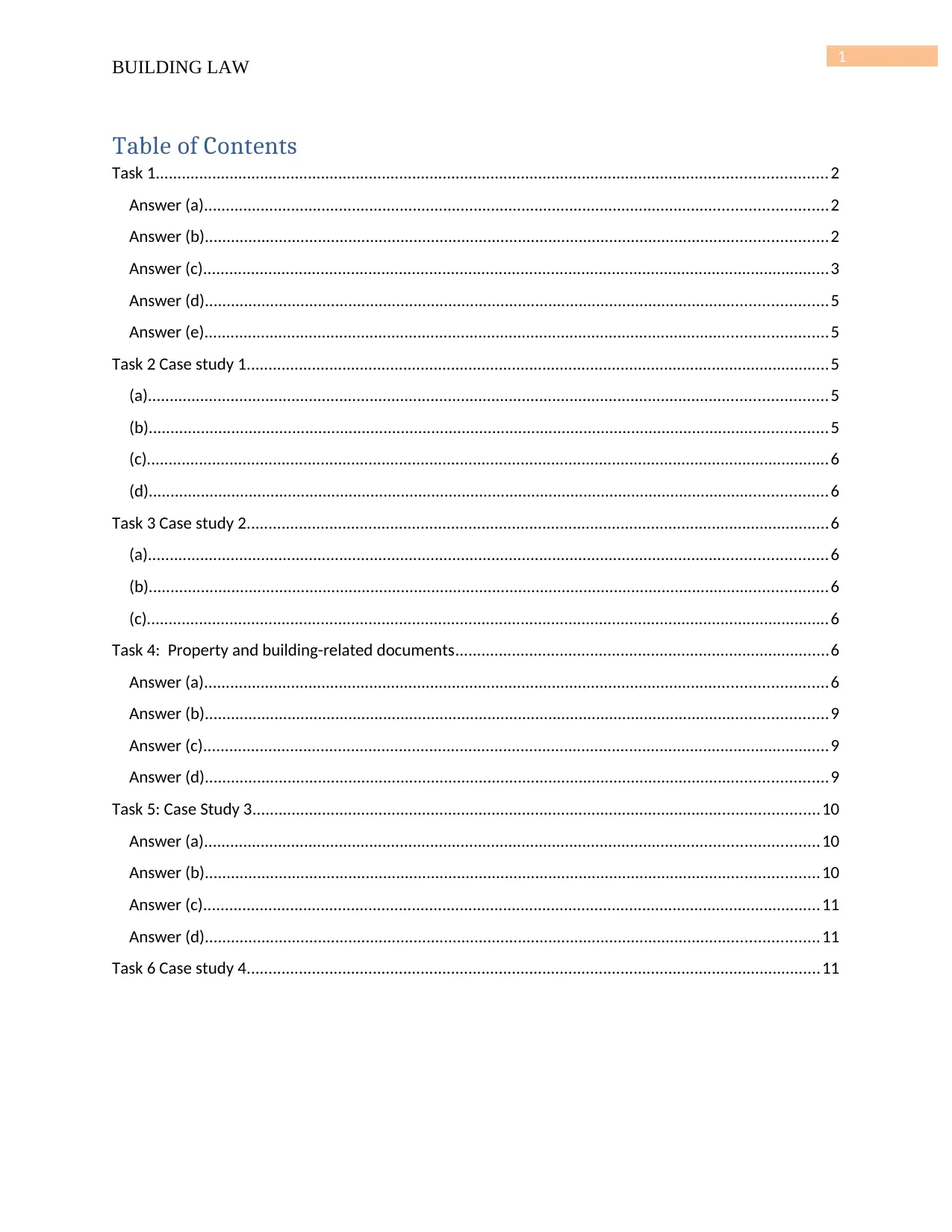
Table of Contents
Task 1..........................................................................................................................................................2
Answer (a)...............................................................................................................................................2
Answer (b)...............................................................................................................................................2
Answer (c)................................................................................................................................................3
Answer (d)...............................................................................................................................................5
Answer (e)...............................................................................................................................................5
Task 2 Case study 1......................................................................................................................................5
(a)............................................................................................................................................................5
(b)............................................................................................................................................................5
(c).............................................................................................................................................................6
(d)............................................................................................................................................................6
Task 3 Case study 2......................................................................................................................................6
(a)............................................................................................................................................................6
(b)............................................................................................................................................................6
(c).............................................................................................................................................................6
Task 4: Property and building-related documents......................................................................................6
Answer (a)...............................................................................................................................................6
Answer (b)...............................................................................................................................................9
Answer (c)................................................................................................................................................9
Answer (d)...............................................................................................................................................9
Task 5: Case Study 3..................................................................................................................................10
Answer (a).............................................................................................................................................10
Answer (b).............................................................................................................................................10
Answer (c)..............................................................................................................................................11
Answer (d).............................................................................................................................................11
Task 6 Case study 4....................................................................................................................................11
BUILDING LAW
Table of Contents
Task 1..........................................................................................................................................................2
Answer (a)...............................................................................................................................................2
Answer (b)...............................................................................................................................................2
Answer (c)................................................................................................................................................3
Answer (d)...............................................................................................................................................5
Answer (e)...............................................................................................................................................5
Task 2 Case study 1......................................................................................................................................5
(a)............................................................................................................................................................5
(b)............................................................................................................................................................5
(c).............................................................................................................................................................6
(d)............................................................................................................................................................6
Task 3 Case study 2......................................................................................................................................6
(a)............................................................................................................................................................6
(b)............................................................................................................................................................6
(c).............................................................................................................................................................6
Task 4: Property and building-related documents......................................................................................6
Answer (a)...............................................................................................................................................6
Answer (b)...............................................................................................................................................9
Answer (c)................................................................................................................................................9
Answer (d)...............................................................................................................................................9
Task 5: Case Study 3..................................................................................................................................10
Answer (a).............................................................................................................................................10
Answer (b).............................................................................................................................................10
Answer (c)..............................................................................................................................................11
Answer (d).............................................................................................................................................11
Task 6 Case study 4....................................................................................................................................11
2
BUILDING LAW
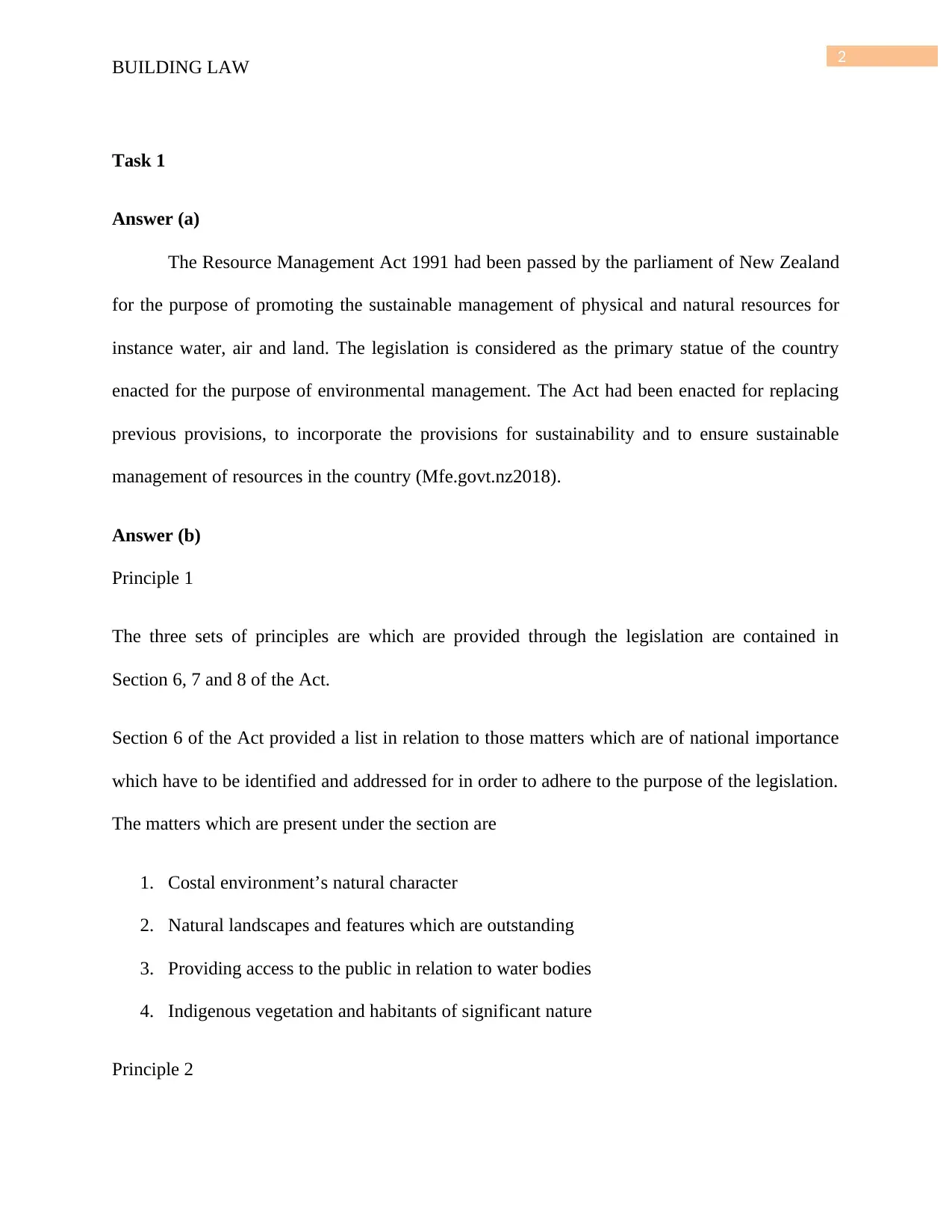
Task 1
Answer (a)
The Resource Management Act 1991 had been passed by the parliament of New Zealand
for the purpose of promoting the sustainable management of physical and natural resources for
instance water, air and land. The legislation is considered as the primary statue of the country
enacted for the purpose of environmental management. The Act had been enacted for replacing
previous provisions, to incorporate the provisions for sustainability and to ensure sustainable
management of resources in the country (Mfe.govt.nz2018).
Answer (b)
Principle 1
The three sets of principles are which are provided through the legislation are contained in
Section 6, 7 and 8 of the Act.
Section 6 of the Act provided a list in relation to those matters which are of national importance
which have to be identified and addressed for in order to adhere to the purpose of the legislation.
The matters which are present under the section are
1. Costal environment’s natural character
2. Natural landscapes and features which are outstanding
3. Providing access to the public in relation to water bodies
4. Indigenous vegetation and habitants of significant nature
Principle 2
BUILDING LAW
Task 1
Answer (a)
The Resource Management Act 1991 had been passed by the parliament of New Zealand
for the purpose of promoting the sustainable management of physical and natural resources for
instance water, air and land. The legislation is considered as the primary statue of the country
enacted for the purpose of environmental management. The Act had been enacted for replacing
previous provisions, to incorporate the provisions for sustainability and to ensure sustainable
management of resources in the country (Mfe.govt.nz2018).
Answer (b)
Principle 1
The three sets of principles are which are provided through the legislation are contained in
Section 6, 7 and 8 of the Act.
Section 6 of the Act provided a list in relation to those matters which are of national importance
which have to be identified and addressed for in order to adhere to the purpose of the legislation.
The matters which are present under the section are
1. Costal environment’s natural character
2. Natural landscapes and features which are outstanding
3. Providing access to the public in relation to water bodies
4. Indigenous vegetation and habitants of significant nature
Principle 2
⊘ This is a preview!⊘
Do you want full access?
Subscribe today to unlock all pages.

Trusted by 1+ million students worldwide
3
BUILDING LAW
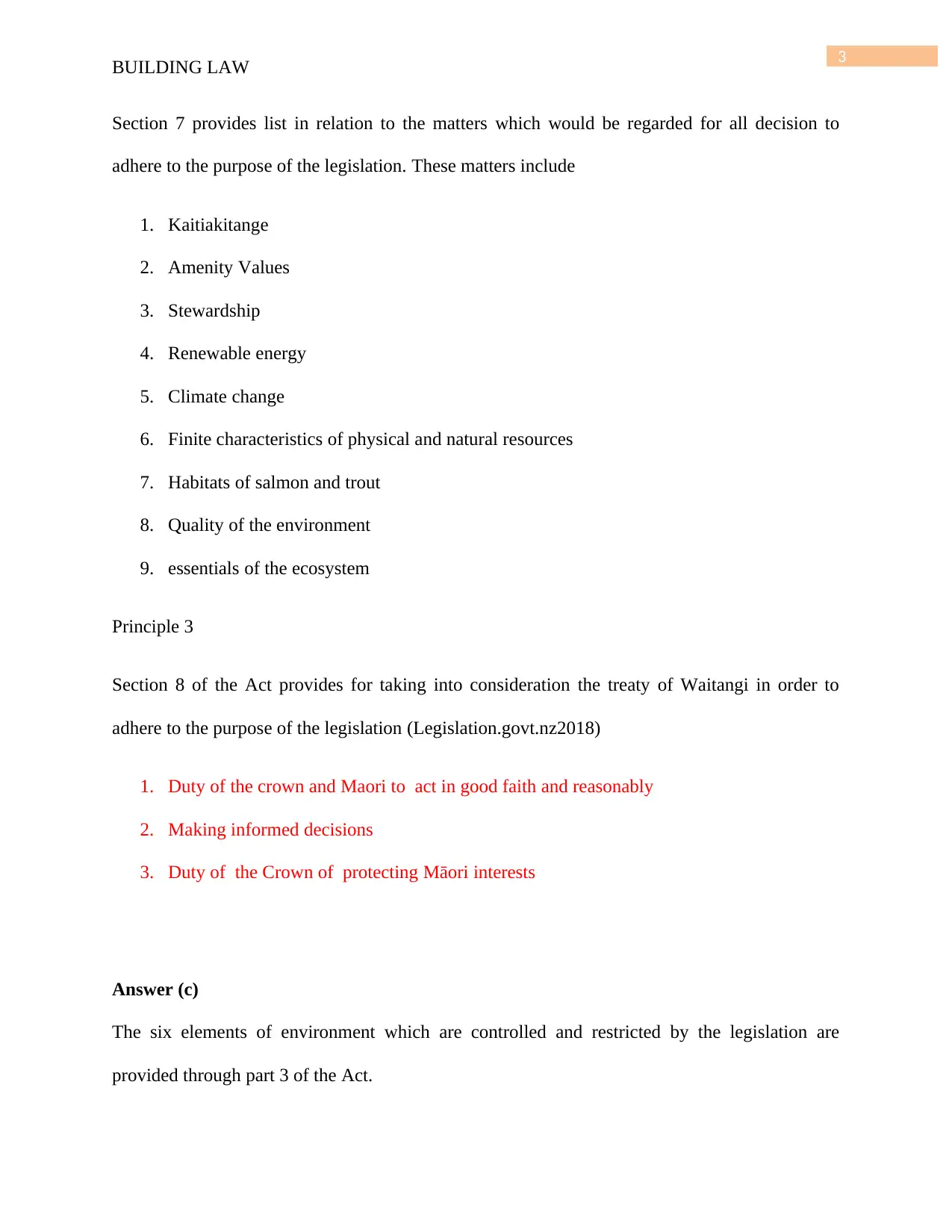
Section 7 provides list in relation to the matters which would be regarded for all decision to
adhere to the purpose of the legislation. These matters include
1. Kaitiakitange
2. Amenity Values
3. Stewardship
4. Renewable energy
5. Climate change
6. Finite characteristics of physical and natural resources
7. Habitats of salmon and trout
8. Quality of the environment
9. essentials of the ecosystem
Principle 3
Section 8 of the Act provides for taking into consideration the treaty of Waitangi in order to
adhere to the purpose of the legislation (Legislation.govt.nz2018)
1. Duty of the crown and Maori to act in good faith and reasonably
2. Making informed decisions
3. Duty of the Crown of protecting Māori interests
Answer (c)
The six elements of environment which are controlled and restricted by the legislation are
provided through part 3 of the Act.
BUILDING LAW
Section 7 provides list in relation to the matters which would be regarded for all decision to
adhere to the purpose of the legislation. These matters include
1. Kaitiakitange
2. Amenity Values
3. Stewardship
4. Renewable energy
5. Climate change
6. Finite characteristics of physical and natural resources
7. Habitats of salmon and trout
8. Quality of the environment
9. essentials of the ecosystem
Principle 3
Section 8 of the Act provides for taking into consideration the treaty of Waitangi in order to
adhere to the purpose of the legislation (Legislation.govt.nz2018)
1. Duty of the crown and Maori to act in good faith and reasonably
2. Making informed decisions
3. Duty of the Crown of protecting Māori interests
Answer (c)
The six elements of environment which are controlled and restricted by the legislation are
provided through part 3 of the Act.
Paraphrase This Document
Need a fresh take? Get an instant paraphrase of this document with our AI Paraphraser
4
BUILDING LAW
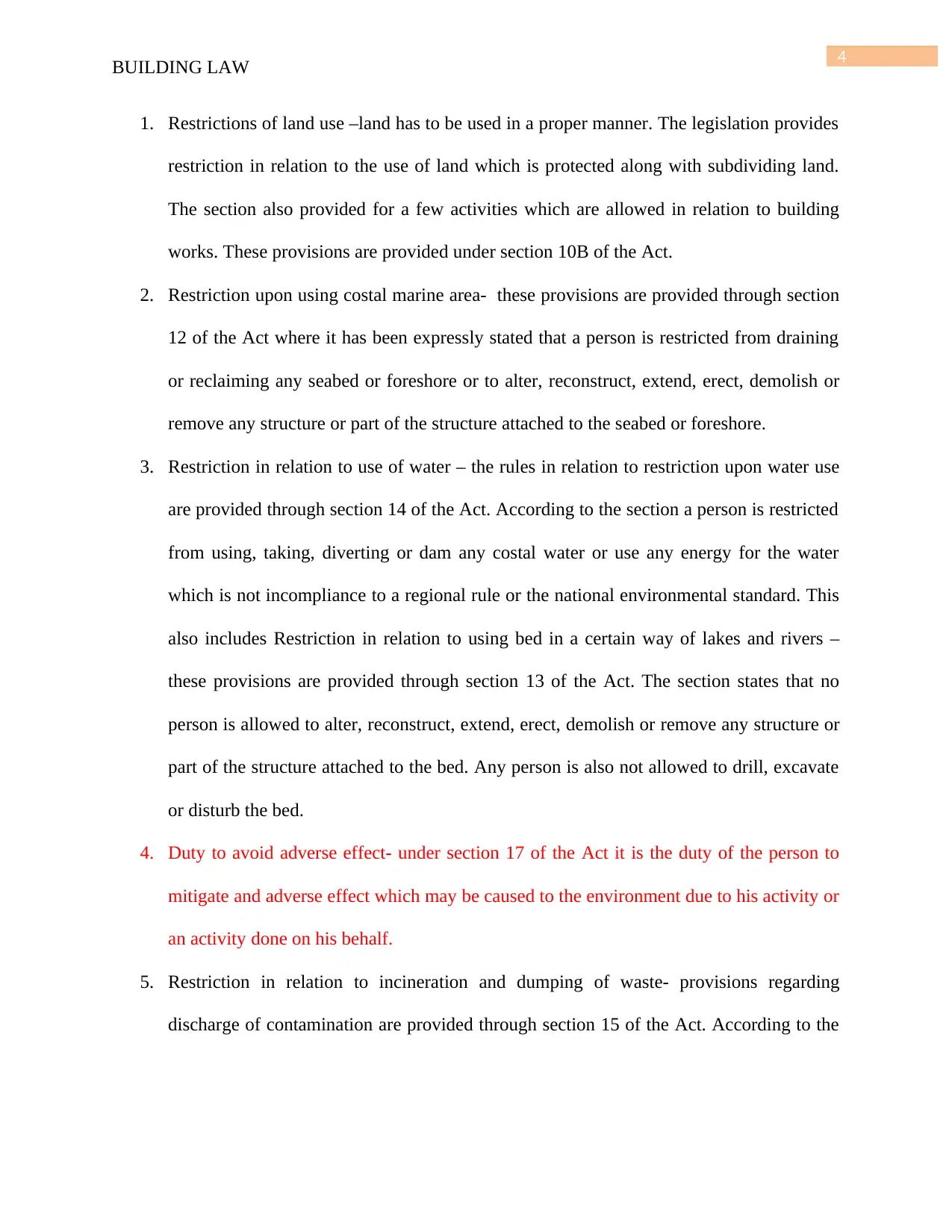
1. Restrictions of land use –land has to be used in a proper manner. The legislation provides
restriction in relation to the use of land which is protected along with subdividing land.
The section also provided for a few activities which are allowed in relation to building
works. These provisions are provided under section 10B of the Act.
2. Restriction upon using costal marine area- these provisions are provided through section
12 of the Act where it has been expressly stated that a person is restricted from draining
or reclaiming any seabed or foreshore or to alter, reconstruct, extend, erect, demolish or
remove any structure or part of the structure attached to the seabed or foreshore.
3. Restriction in relation to use of water – the rules in relation to restriction upon water use
are provided through section 14 of the Act. According to the section a person is restricted
from using, taking, diverting or dam any costal water or use any energy for the water
which is not incompliance to a regional rule or the national environmental standard. This
also includes Restriction in relation to using bed in a certain way of lakes and rivers –
these provisions are provided through section 13 of the Act. The section states that no
person is allowed to alter, reconstruct, extend, erect, demolish or remove any structure or
part of the structure attached to the bed. Any person is also not allowed to drill, excavate
or disturb the bed.
4. Duty to avoid adverse effect- under section 17 of the Act it is the duty of the person to
mitigate and adverse effect which may be caused to the environment due to his activity or
an activity done on his behalf.
5. Restriction in relation to incineration and dumping of waste- provisions regarding
discharge of contamination are provided through section 15 of the Act. According to the
BUILDING LAW
1. Restrictions of land use –land has to be used in a proper manner. The legislation provides
restriction in relation to the use of land which is protected along with subdividing land.
The section also provided for a few activities which are allowed in relation to building
works. These provisions are provided under section 10B of the Act.
2. Restriction upon using costal marine area- these provisions are provided through section
12 of the Act where it has been expressly stated that a person is restricted from draining
or reclaiming any seabed or foreshore or to alter, reconstruct, extend, erect, demolish or
remove any structure or part of the structure attached to the seabed or foreshore.
3. Restriction in relation to use of water – the rules in relation to restriction upon water use
are provided through section 14 of the Act. According to the section a person is restricted
from using, taking, diverting or dam any costal water or use any energy for the water
which is not incompliance to a regional rule or the national environmental standard. This
also includes Restriction in relation to using bed in a certain way of lakes and rivers –
these provisions are provided through section 13 of the Act. The section states that no
person is allowed to alter, reconstruct, extend, erect, demolish or remove any structure or
part of the structure attached to the bed. Any person is also not allowed to drill, excavate
or disturb the bed.
4. Duty to avoid adverse effect- under section 17 of the Act it is the duty of the person to
mitigate and adverse effect which may be caused to the environment due to his activity or
an activity done on his behalf.
5. Restriction in relation to incineration and dumping of waste- provisions regarding
discharge of contamination are provided through section 15 of the Act. According to the
5
BUILDING LAW
section any person is not allowed to contaminate water, land or air unless the discharge
has been allowed by a national environmental standard or a regional plan.
6. Restrictions of making unreasonable noise- provisions of avoiding unreasonable noise are
provided under section 16 of the legislation. According to the section the occupier of land
or a person indulging in an activity under, in or on a water body has to undertake the best
measures for the purpose of ensuring that the noise produced by the activity is limited.
-
Answer (d)
Esplanade strips or esplanade reserves are a form of mechanism which is in place for the
purpose of providing protection to riparian and costal margins. It is a legal instrument which is
established between a territorial authority and a land owner. The authority can provided certain
restrictions in relation to the use of the strip although it is owned by the owner of the land. On
the other hand access strips are established in order to provide access to the public for using
water bodies or land. They are established under section 237B of the Act via an agreement
between the authority and the owner. The measurement of the boundaries in case of an
esplanade reserve is done from the banks in case of river or stream and form the means high
water springs in case of a coastal area. The land boundary in all cases is a fixed survey line.
Esplanade strips can be varied or changed under s234 of the Act.
Answer (e)
A provision in a district plan in relation to public project or work is known as a
designation. The notice in relation to a designation can e provided by the requiring authority.
The authority has the power to do anything with the designation, thus they can take the area for
the purpose of road widening as in this case. Any person is not allowed to carry out any work on
BUILDING LAW
section any person is not allowed to contaminate water, land or air unless the discharge
has been allowed by a national environmental standard or a regional plan.
6. Restrictions of making unreasonable noise- provisions of avoiding unreasonable noise are
provided under section 16 of the legislation. According to the section the occupier of land
or a person indulging in an activity under, in or on a water body has to undertake the best
measures for the purpose of ensuring that the noise produced by the activity is limited.
-
Answer (d)
Esplanade strips or esplanade reserves are a form of mechanism which is in place for the
purpose of providing protection to riparian and costal margins. It is a legal instrument which is
established between a territorial authority and a land owner. The authority can provided certain
restrictions in relation to the use of the strip although it is owned by the owner of the land. On
the other hand access strips are established in order to provide access to the public for using
water bodies or land. They are established under section 237B of the Act via an agreement
between the authority and the owner. The measurement of the boundaries in case of an
esplanade reserve is done from the banks in case of river or stream and form the means high
water springs in case of a coastal area. The land boundary in all cases is a fixed survey line.
Esplanade strips can be varied or changed under s234 of the Act.
Answer (e)
A provision in a district plan in relation to public project or work is known as a
designation. The notice in relation to a designation can e provided by the requiring authority.
The authority has the power to do anything with the designation, thus they can take the area for
the purpose of road widening as in this case. Any person is not allowed to carry out any work on
⊘ This is a preview!⊘
Do you want full access?
Subscribe today to unlock all pages.
Trusted by 1+ million students worldwide
6
BUILDING LAW
the designation which is not allowed by the Authority without its consent. These implications
would be applicable on the land in the future (Ministry of Business 2018).
Task 2 Case study 1
(a)
(v) 5 m from each road frontage
(b)
(iii) 35% of the land area
(c)
(i) Build the home as designed by the architect
(iv) Erect a 2 metre high sign at the gate to promote their businesse
(v) Sell the plants Ben plans to grow
(d)
(i) Increase the house size to a minimum of 300 m2 to make room for it
(v) Reduce the number of children cared for to five
Task 3 Case study 2
(a)
(iii) 400 m2
BUILDING LAW
the designation which is not allowed by the Authority without its consent. These implications
would be applicable on the land in the future (Ministry of Business 2018).
Task 2 Case study 1
(a)
(v) 5 m from each road frontage
(b)
(iii) 35% of the land area
(c)
(i) Build the home as designed by the architect
(iv) Erect a 2 metre high sign at the gate to promote their businesse
(v) Sell the plants Ben plans to grow
(d)
(i) Increase the house size to a minimum of 300 m2 to make room for it
(v) Reduce the number of children cared for to five
Task 3 Case study 2
(a)
(iii) 400 m2
Paraphrase This Document
Need a fresh take? Get an instant paraphrase of this document with our AI Paraphraser
7
BUILDING LAW
(b)
(i) 3 m
(c)
(ii) 10 × 15 m
Task 4: Property and building-related documents
Answer (a)
Land Information Memorandum (LIM)
Purpose
This a document through which information which is held by council in relation to a
particular property is provided. The document is generally used by prospective buyers, sellers,
valuers and real estate agents.
Contents
The document contains information such as legal description and number and address of the
property. It also contain special lad features, health information, Subdivision and developments,
Planning information, Rates information and Buildings. Only information which are in record of
the council can be obtained through this document
Circumstances for obtaining
While considering the purchase of a property the people obtain the document
Application for Building Consent
BUILDING LAW
(b)
(i) 3 m
(c)
(ii) 10 × 15 m
Task 4: Property and building-related documents
Answer (a)
Land Information Memorandum (LIM)
Purpose
This a document through which information which is held by council in relation to a
particular property is provided. The document is generally used by prospective buyers, sellers,
valuers and real estate agents.
Contents
The document contains information such as legal description and number and address of the
property. It also contain special lad features, health information, Subdivision and developments,
Planning information, Rates information and Buildings. Only information which are in record of
the council can be obtained through this document
Circumstances for obtaining
While considering the purchase of a property the people obtain the document
Application for Building Consent
8
BUILDING LAW
Purpose
This document is provided by the council as a written authority for the purpose of carrying out
building work which would be in compliance of building code.
Contents
The prescribed application form
Along with the required fees
Plans or specification required by the council
The building consent
Any special condition required to be complied
Advice in relation to calling the inspector
Approved plans and specification copies
Circumstances for obtaining
Building consent is required by a person for the purpose of carrying out any work in relation to
building except for work provided under schedule 1.
Code Compliance Certificate
Purpose
This document is provided when any job in completed and the council has the satisfaction that
the work has been done in compliance of the conditions in the building consent and the building
code. The application must have details of ownership and people
Contents
BUILDING LAW
Purpose
This document is provided by the council as a written authority for the purpose of carrying out
building work which would be in compliance of building code.
Contents
The prescribed application form
Along with the required fees
Plans or specification required by the council
The building consent
Any special condition required to be complied
Advice in relation to calling the inspector
Approved plans and specification copies
Circumstances for obtaining
Building consent is required by a person for the purpose of carrying out any work in relation to
building except for work provided under schedule 1.
Code Compliance Certificate
Purpose
This document is provided when any job in completed and the council has the satisfaction that
the work has been done in compliance of the conditions in the building consent and the building
code. The application must have details of ownership and people
Contents
⊘ This is a preview!⊘
Do you want full access?
Subscribe today to unlock all pages.
Trusted by 1+ million students worldwide
9
BUILDING LAW
The document contains the evidence which is provided by the authority is relation to any
building work that the work has been done in accordance to the legal obligation imposed when
the work was sanctioned.
Circumstances for obtaining
This document is obtained by the owner of the building who had applied for a building consent
as soon as the building work has been completed in accordance to the consent and the code
(Building Guide 2018).
Answer (b)
The advice which would be provided in the given situation is that a CCC has to be
obtained under the provisions of section 95 of the BA 2004. A person is not allowed to transfer
the property which does not have a CCC. In addition while sale it has to be disclosed under the
legislation that the property does not have a code compliance certificate. In this case the CCC
has to be applied for by completing all compliance work with the code. The two alternatives of
CCC are Acceptable Solution or Verification Method and A certified product or construction
method. The value of the property is affected and it is difficult for the buyer to get insurance in
relation to the property.
Answer (c)
A building warrant of fitness (BWoF) is an annual statement provided by the building owner
which confirms specified systems present in the compliance schedule in relation to the building
have been duly marinated and verified for the last one year according to compliance schedule. A
BUILDING LAW
The document contains the evidence which is provided by the authority is relation to any
building work that the work has been done in accordance to the legal obligation imposed when
the work was sanctioned.
Circumstances for obtaining
This document is obtained by the owner of the building who had applied for a building consent
as soon as the building work has been completed in accordance to the consent and the code
(Building Guide 2018).
Answer (b)
The advice which would be provided in the given situation is that a CCC has to be
obtained under the provisions of section 95 of the BA 2004. A person is not allowed to transfer
the property which does not have a CCC. In addition while sale it has to be disclosed under the
legislation that the property does not have a code compliance certificate. In this case the CCC
has to be applied for by completing all compliance work with the code. The two alternatives of
CCC are Acceptable Solution or Verification Method and A certified product or construction
method. The value of the property is affected and it is difficult for the buyer to get insurance in
relation to the property.
Answer (c)
A building warrant of fitness (BWoF) is an annual statement provided by the building owner
which confirms specified systems present in the compliance schedule in relation to the building
have been duly marinated and verified for the last one year according to compliance schedule. A
Paraphrase This Document
Need a fresh take? Get an instant paraphrase of this document with our AI Paraphraser
10
BUILDING LAW
building owner has the responsibility of providing a BWoF every year of issuing the building
compliance schedule to the territorial authority (building.govt.nz2018).
Answer (d)
Systems for building functions-
Automatic or elector magnetic windows and doors
Automatic backflow preventers which are connected to potable supply of water.
Escalators, lifts, travelators for ensuring movement in the building
air conditioning systems or mechanical ventilations
Systems for building safety-
Automatic system to suppress fire
Manual or automatic warning systems
Escape route pressurization systems
Riser mains for use by fire services
Laboratories fume cupboards.
Smoke control systems.
Task 5: Case Study 3
Answer (a)
Provisions in relation to alternation of existing buildings are provided under section 112
of the Building Act 2004. It has been provided by the section that even where the building has
not complied with the building code, permission may be provided by the territorial authority to
BUILDING LAW
building owner has the responsibility of providing a BWoF every year of issuing the building
compliance schedule to the territorial authority (building.govt.nz2018).
Answer (d)
Systems for building functions-
Automatic or elector magnetic windows and doors
Automatic backflow preventers which are connected to potable supply of water.
Escalators, lifts, travelators for ensuring movement in the building
air conditioning systems or mechanical ventilations
Systems for building safety-
Automatic system to suppress fire
Manual or automatic warning systems
Escape route pressurization systems
Riser mains for use by fire services
Laboratories fume cupboards.
Smoke control systems.
Task 5: Case Study 3
Answer (a)
Provisions in relation to alternation of existing buildings are provided under section 112
of the Building Act 2004. It has been provided by the section that even where the building has
not complied with the building code, permission may be provided by the territorial authority to
11
BUILDING LAW
make alterations in case the alteration will enhance the attributes of the building in relation to
means of escape during fire and providing facilities and access to people with disabilities. Thus
the window expansion work may be carried out after obtaining permission under these
provisions.
Answer (b)
Provisions in relation to carrying out building work without building consent are
provided through section 40 of the BA 2004. According to section 40(3) a person is liable to pay
a maximum fine of $200000 for a continuing offence and a fined of $10000 for every day or part
where the work is continued.
Answer (c)
According to section 115 of the BA the use of the building must not be altered by the
owner unless the territorial authority on all reasonable grounds is satisfied that the new use of the
building is in compliance with the building code as nearly as reasonably practicable in all
aspects. The items which are to be considered in relation to the change are sanitary facilities,
ways of fire escape, and protection of properties, fire rating performance and structural
performance.
Answer (d)
The provisions in relation to failing to provide notice to the local authority are provided
under section 114 of the Act. A failure to provide a notice under section 114(3) results in a fine
which extends up to $5000.
Task 6 Case study 4
BUILDING LAW
make alterations in case the alteration will enhance the attributes of the building in relation to
means of escape during fire and providing facilities and access to people with disabilities. Thus
the window expansion work may be carried out after obtaining permission under these
provisions.
Answer (b)
Provisions in relation to carrying out building work without building consent are
provided through section 40 of the BA 2004. According to section 40(3) a person is liable to pay
a maximum fine of $200000 for a continuing offence and a fined of $10000 for every day or part
where the work is continued.
Answer (c)
According to section 115 of the BA the use of the building must not be altered by the
owner unless the territorial authority on all reasonable grounds is satisfied that the new use of the
building is in compliance with the building code as nearly as reasonably practicable in all
aspects. The items which are to be considered in relation to the change are sanitary facilities,
ways of fire escape, and protection of properties, fire rating performance and structural
performance.
Answer (d)
The provisions in relation to failing to provide notice to the local authority are provided
under section 114 of the Act. A failure to provide a notice under section 114(3) results in a fine
which extends up to $5000.
Task 6 Case study 4
⊘ This is a preview!⊘
Do you want full access?
Subscribe today to unlock all pages.
Trusted by 1+ million students worldwide

1 out of 15


Related Documents


Your All-in-One AI-Powered Toolkit for Academic Success.
+13062052269
info@desklib.com
Available 24*7 on WhatsApp / Email
![[object Object]](/_next/static/media/star-bottom.7253800d.svg)
Unlock your academic potential
Copyright © 2020–2026 A2Z Services. All Rights Reserved. Developed and managed by ZUCOL.