Critical Evaluation: Sample Size, Variables, and Research Methodology

Verified

Added on  2023/06/12

|8
|2412
|442
Essay
AI Summary
This essay provides a comprehensive analysis of a research case study, examining key aspects such as sample size, sampling method, variables, and research design. It critiques the researcher's decision to use a large sample size, advocating for a more manageable and cost-effective sample size of around 1,100 employees based on statistical calculations. The essay discusses the advantages and disadvantages of simple random sampling, the types of variables (independent, dependent, and confounding), and the importance of accurate variable measurement. Furthermore, it identifies the research design as causal, highlighting its strengths and limitations in establishing relationships between variables, particularly between employee job security perception and job satisfaction. The essay concludes by emphasizing the significance of understanding causal relationships for predictive purposes and acknowledges the potential impact of confounding factors on research outcomes. Desklib provides access to this and other solved assignments for students.

Document Page
Running Head: RESEARCH 1
Assessment Essay
Student’s Name
Date
tabler-icon-diamond-filled.svg

Paraphrase This Document

Need a fresh take? Get an instant paraphrase of this document with our AI Paraphraser
Document Page
RESEARCH 2
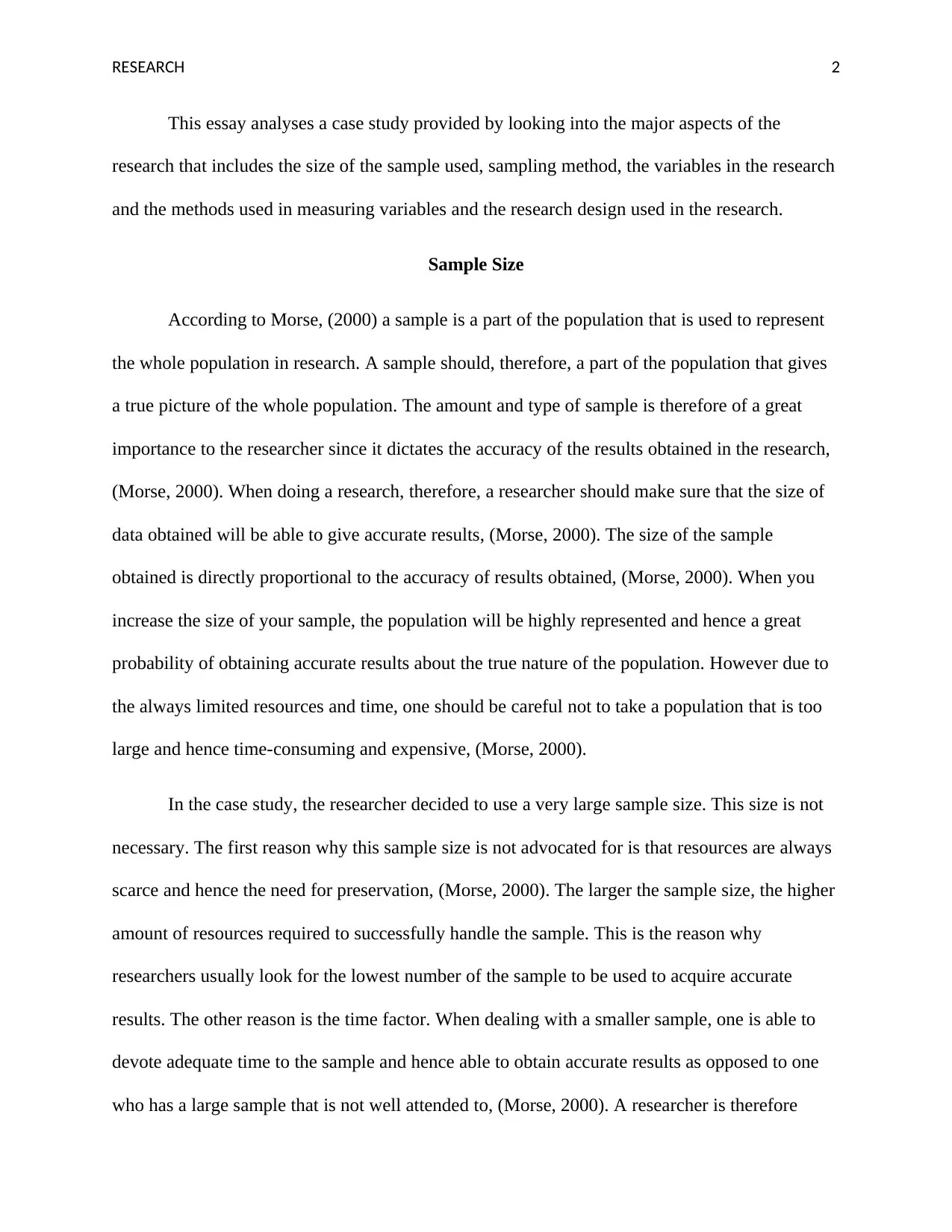
This essay analyses a case study provided by looking into the major aspects of the
research that includes the size of the sample used, sampling method, the variables in the research
and the methods used in measuring variables and the research design used in the research.
Sample Size
According to Morse, (2000) a sample is a part of the population that is used to represent
the whole population in research. A sample should, therefore, a part of the population that gives
a true picture of the whole population. The amount and type of sample is therefore of a great
importance to the researcher since it dictates the accuracy of the results obtained in the research,
(Morse, 2000). When doing a research, therefore, a researcher should make sure that the size of
data obtained will be able to give accurate results, (Morse, 2000). The size of the sample
obtained is directly proportional to the accuracy of results obtained, (Morse, 2000). When you
increase the size of your sample, the population will be highly represented and hence a great
probability of obtaining accurate results about the true nature of the population. However due to
the always limited resources and time, one should be careful not to take a population that is too
large and hence time-consuming and expensive, (Morse, 2000).
In the case study, the researcher decided to use a very large sample size. This size is not
necessary. The first reason why this sample size is not advocated for is that resources are always
scarce and hence the need for preservation, (Morse, 2000). The larger the sample size, the higher
amount of resources required to successfully handle the sample. This is the reason why
researchers usually look for the lowest number of the sample to be used to acquire accurate
results. The other reason is the time factor. When dealing with a smaller sample, one is able to
devote adequate time to the sample and hence able to obtain accurate results as opposed to one
who has a large sample that is not well attended to, (Morse, 2000). A researcher is therefore
Document Page
RESEARCH 3
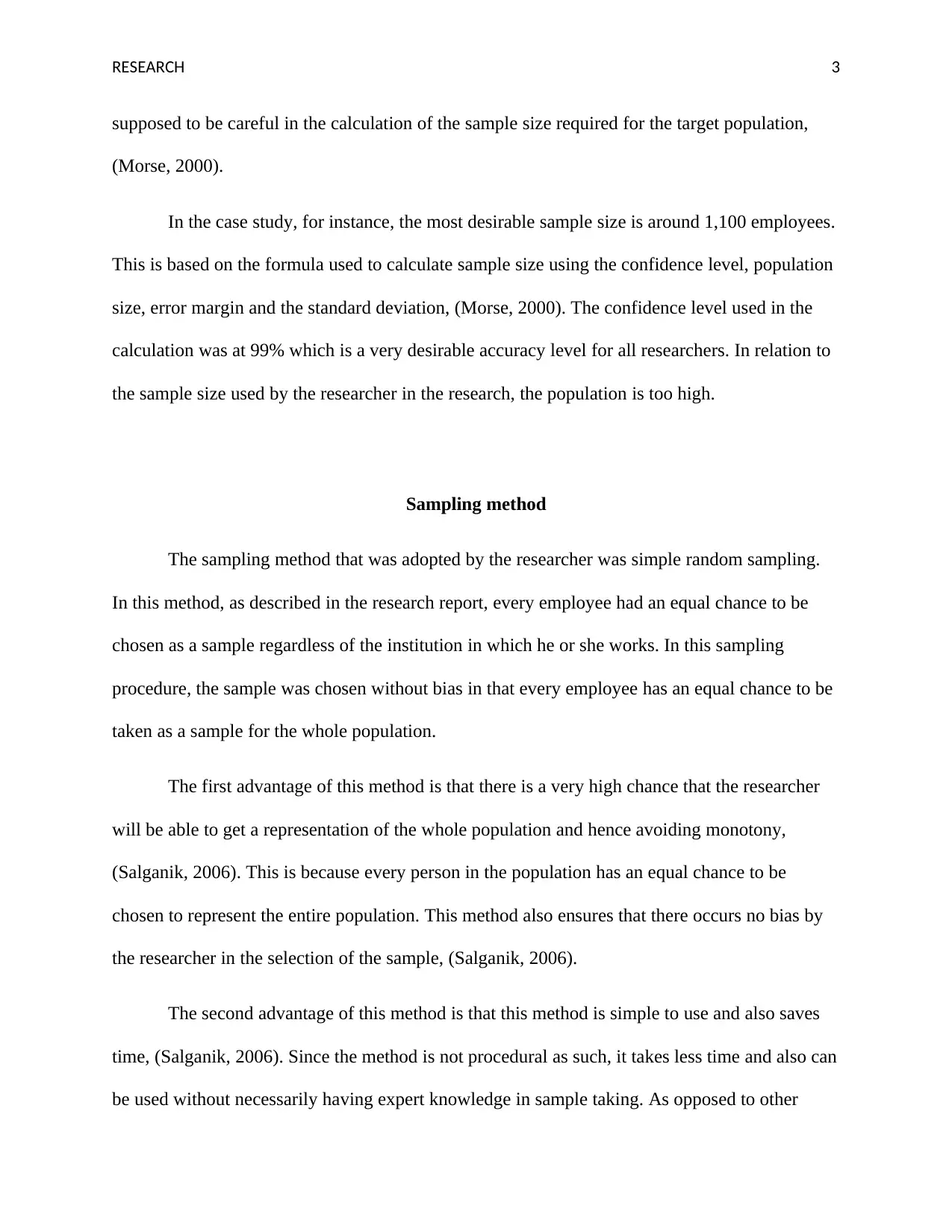
supposed to be careful in the calculation of the sample size required for the target population,
(Morse, 2000).
In the case study, for instance, the most desirable sample size is around 1,100 employees.
This is based on the formula used to calculate sample size using the confidence level, population
size, error margin and the standard deviation, (Morse, 2000). The confidence level used in the
calculation was at 99% which is a very desirable accuracy level for all researchers. In relation to
the sample size used by the researcher in the research, the population is too high.
Sampling method
The sampling method that was adopted by the researcher was simple random sampling.
In this method, as described in the research report, every employee had an equal chance to be
chosen as a sample regardless of the institution in which he or she works. In this sampling
procedure, the sample was chosen without bias in that every employee has an equal chance to be
taken as a sample for the whole population.
The first advantage of this method is that there is a very high chance that the researcher
will be able to get a representation of the whole population and hence avoiding monotony,
(Salganik, 2006). This is because every person in the population has an equal chance to be
chosen to represent the entire population. This method also ensures that there occurs no bias by
the researcher in the selection of the sample, (Salganik, 2006).
The second advantage of this method is that this method is simple to use and also saves
time, (Salganik, 2006). Since the method is not procedural as such, it takes less time and also can
be used without necessarily having expert knowledge in sample taking. As opposed to other
Document Page
RESEARCH 4
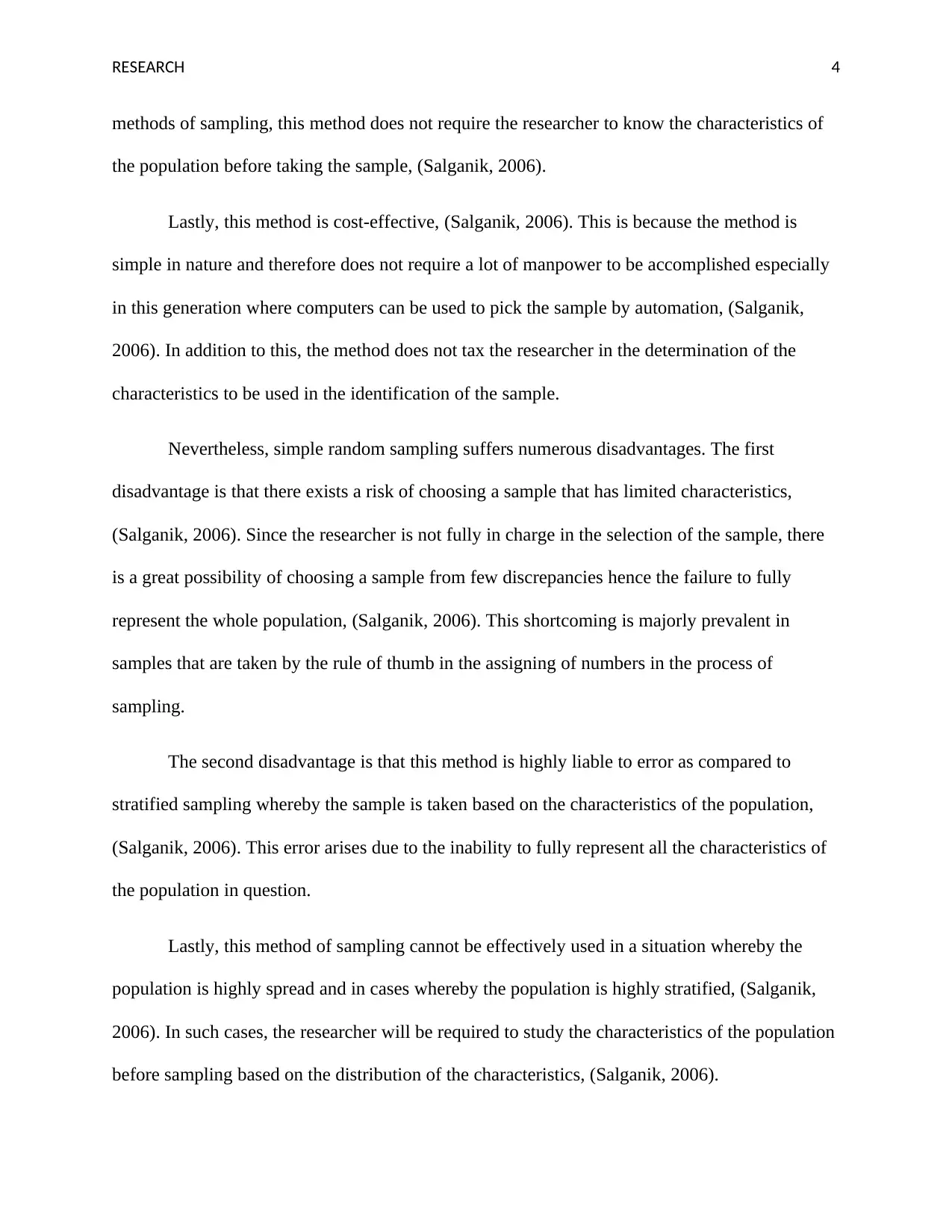
methods of sampling, this method does not require the researcher to know the characteristics of
the population before taking the sample, (Salganik, 2006).
Lastly, this method is cost-effective, (Salganik, 2006). This is because the method is
simple in nature and therefore does not require a lot of manpower to be accomplished especially
in this generation where computers can be used to pick the sample by automation, (Salganik,
2006). In addition to this, the method does not tax the researcher in the determination of the
characteristics to be used in the identification of the sample.
Nevertheless, simple random sampling suffers numerous disadvantages. The first
disadvantage is that there exists a risk of choosing a sample that has limited characteristics,
(Salganik, 2006). Since the researcher is not fully in charge in the selection of the sample, there
is a great possibility of choosing a sample from few discrepancies hence the failure to fully
represent the whole population, (Salganik, 2006). This shortcoming is majorly prevalent in
samples that are taken by the rule of thumb in the assigning of numbers in the process of
sampling.
The second disadvantage is that this method is highly liable to error as compared to
stratified sampling whereby the sample is taken based on the characteristics of the population,
(Salganik, 2006). This error arises due to the inability to fully represent all the characteristics of
the population in question.
Lastly, this method of sampling cannot be effectively used in a situation whereby the
population is highly spread and in cases whereby the population is highly stratified, (Salganik,
2006). In such cases, the researcher will be required to study the characteristics of the population
before sampling based on the distribution of the characteristics, (Salganik, 2006).
tabler-icon-diamond-filled.svg

Paraphrase This Document

Need a fresh take? Get an instant paraphrase of this document with our AI Paraphraser
Document Page
RESEARCH 5
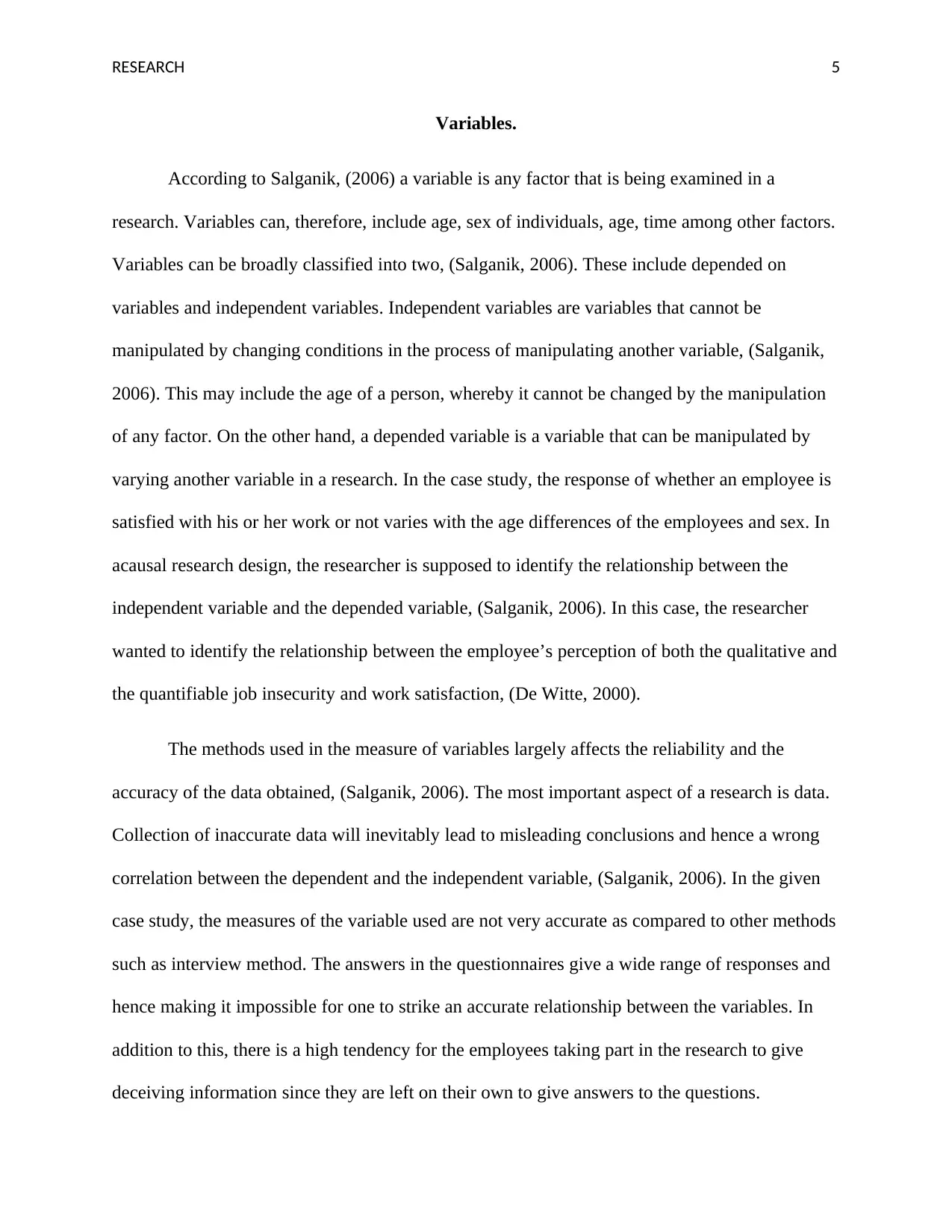
Variables.
According to Salganik, (2006) a variable is any factor that is being examined in a
research. Variables can, therefore, include age, sex of individuals, age, time among other factors.
Variables can be broadly classified into two, (Salganik, 2006). These include depended on
variables and independent variables. Independent variables are variables that cannot be
manipulated by changing conditions in the process of manipulating another variable, (Salganik,
2006). This may include the age of a person, whereby it cannot be changed by the manipulation
of any factor. On the other hand, a depended variable is a variable that can be manipulated by
varying another variable in a research. In the case study, the response of whether an employee is
satisfied with his or her work or not varies with the age differences of the employees and sex. In
acausal research design, the researcher is supposed to identify the relationship between the
independent variable and the depended variable, (Salganik, 2006). In this case, the researcher
wanted to identify the relationship between the employee’s perception of both the qualitative and
the quantifiable job insecurity and work satisfaction, (De Witte, 2000).
The methods used in the measure of variables largely affects the reliability and the
accuracy of the data obtained, (Salganik, 2006). The most important aspect of a research is data.
Collection of inaccurate data will inevitably lead to misleading conclusions and hence a wrong
correlation between the dependent and the independent variable, (Salganik, 2006). In the given
case study, the measures of the variable used are not very accurate as compared to other methods
such as interview method. The answers in the questionnaires give a wide range of responses and
hence making it impossible for one to strike an accurate relationship between the variables. In
addition to this, there is a high tendency for the employees taking part in the research to give
deceiving information since they are left on their own to give answers to the questions.
Document Page
RESEARCH 6
In addition to the data collected on the employee’s perception of both the qualitative and
the quantifiable job insecurity and work satisfaction, the researcher also measured other variables
including sexual category, age, academic level and additional income, (De Witte, 2000). These
variables are called confounding variables. Confounding variables are variables that are separate
from the independent variable but may alter the outcome of the dependent variable, (Salganik,
2006). These variables can, therefore, be used in the analysis of data whereby the researcher can
be able to identify how the responses on job satisfaction are altered by the said factors. The
relationship identified is of great importance in the future for prediction of an employee’s
satisfaction on the job based on these variables. These variables are of a great importance in
giving a suggestion on the areas needing research in the future, (Salganik, 2006).
Research Design
The current research uses causal design research. In this type of research, the researcher
seeks to identify the effect caused by the manipulation of one variable, (Kumar & Phrommathed,
2005). The logical conclusion of such research is therefore conditional statements showing the
relationship between one variable and the other, (Kumar & Phrommathed, 2005). In the said
research, the researcher’s objective was to identify the relationship between an employee’s
perception of his or her job security and job satisfaction, (De Witte, 2000). This kind of research
helps one to identify the effect of changing one variable to another variable. By identifying these
relationships, an individual is able to predict events with precision, (Kumar & Phrommathed,
2005). This type of research has its advantages and disadvantages.
The first advantage of the case study is the case study design is that it helps researchers to
understand things happen the way they do, (Kumar & Phrommathed, 2005). By identifying a
causal connection between variables, one is able to understand the forces behind events. Also,
Document Page
RESEARCH 7
this type of researchers in eliminating some possibilities of how things work by empirically
methods, (Kumar & Phrommathed, 2005).
The second advantage of the case study design is that it helps researchers know that
replication is possible, (Kumar & Phrommathed, 2005). The conclusions reached in these
research designs show that activities usually take place in a certain manner that cannot be evaded
and hence one can use such conclusions in making predictions.
Lastly, this design has a very high internal legitimacy, (Kumar & Phrommathed, 2005).
This is due to the way its conducted in that there is a high level of objectivity in the selection of
the subject and in the comparison of the variables involved. This method also suffers some
disadvantages.
The first disadvantage is that not all relations are causal in a way that some relations can
occur by chance, (Trochim & Donnelly, 2001). This is a major setback to this design since it is
majorly geared towards identifying a causal relation between two different variables, (Trochim
& Donnelly, 2001). In the case whereby a relationship occurs by chance, the researcher will most
probably make a conclusion that is misleading. To avoid this, the researcher should ensure that
the data collected fully represents the target population in all the aspects. The other thing that the
researcher has to look into is time factor so ascertain the applicability of the causal relation,
(Trochim & Donnelly, 2001).
The last limitation of the case study design is that a causal relation is usually highly
affected by confounding factors and hence very hard to make a logical conclusion, (Trochim &
Donnelly, 2001). In addition to this, it is also very hard to identify the variable that must happen
tabler-icon-diamond-filled.svg

Paraphrase This Document

Need a fresh take? Get an instant paraphrase of this document with our AI Paraphraser
Document Page
RESEARCH 8
to influence the dependent variable since some factors might change singly without the
occurrence of the other factor, (Trochim & Donnelly, 2001).
Reference
De Witte, H. (2000). Arbeidsethos en jobonzekerheid: meting en gevolgen voor welzijn,
tevredenheid en inzet op het werk (Work Ethic and Job Insecurity: Measurement and
Consequences for Well-Being, Satisfaction, and Performance at Work). In van groep naar
gemeenschap, ed. R. Bouwen, K. De Witte, H. De Witte, and T. Taillieu, 325–350.
Leuven: Garant. Goldberg, D. P. (1978). Manual of the General Health Questionnaire.
Windsor, UK: NFER-Nelson.
Kumar, S., & Phrommathed, P. (2005). Research methodology (pp. 43-50). Springer US.
Morse, J. M. (2000). Determining sample size.
Salganik, M. J. (2006). Variance estimation, design effects, and sample size calculations for
respondent-driven sampling. Journal of Urban Health, 83(1), 98.
Trochim, W. M., & Donnelly, J. P. (2001). Research methods knowledge base.
chevron_up_icon
1 out of 8
circle_padding
hide_on_mobile
zoom_out_icon
[object Object]