PUBH7016 Research Critique 1: Student ID 30009309 - Article Analysis
VerifiedAdded on 2023/03/20
|13
|3305
|90
Report
AI Summary
This report presents a critical analysis of two research articles. The first article, by Watkins et al. (2017), explores residents' experiences of mealtimes in care homes using a qualitative interview study. The critique examines the study's credibility, introduction, literature review, research design (descriptive qualitative), methodology (semi-structured interviews, purposive sampling), ethical considerations, and discussion, highlighting strengths such as the study's alignment with its aim and limitations, including the generalizability of findings. The second article, by Ahn, Park, and Kim (2018), investigates the effects of an individualized nutritional education and support program on older adults living alone, employing a quasi-experimental quantitative research design. The critique evaluates the article's credibility, introduction, literature review, research design, methodology (pre-test/post-test, convenience sampling), and ethical considerations, noting strengths such as the detailed methodology description and limitations such as the lack of purpose statement in the introduction. Both critiques assess the articles' general credibility, identify strengths and weaknesses across various sections, and evaluate the appropriateness of the research designs and methodologies.
Student ID: 30009309
RESEARCH CRITIQUE
1
RESEARCH CRITIQUE
1

Paraphrase This Document
Need a fresh take? Get an instant paraphrase of this document with our AI Paraphraser
Student ID: 30009309
Summary:
Research critique is a process of analysis of a research study and reported results
through focus on the strengths and limitations of the study. Research critique is
important because all the published research articles are scientifically not sound
and results might not be completely valid and might exhibit biasness. Critique is
useful to understand purpose and problem, to determine whether research design
and methodology are consistent with research problem, to determine if methodology
is appropriate, to determine if findings and conclusions are valid, robust and with
support through literature and to reflect on quality, strength and limitation of
research (Turner and Rosewall, 2011).
Aim of the qualitative research is to understand insight of residents’ perspectives on
mealtimes and to explore issues which influence residents’ enjoyment of meals, and
resulting health and wellbeing. In this study, qualitative study design, semi-
structured interview-based methodology and purposive sampling method were
implemented. From the results, it was evident that different aspects like emotional
and psychological connections with other residents, management of competing
interests with limited resources and familiarity and routine were important for
mealtime in residents. In this study, level of evidence is level 3 because it is a
descriptive qualitative study.
Aim of the quantitative was to assess the effect of individualised nutritional
education and support programme on dietary habits, nutritional knowledge and
nutritional status. In this study, quantitative research design, pre-test/post-test quasi
experimental, educational intervention and structured interview study design and
convenience sampling method were implemented. Intervention programme was
provided for the duration of 8 weeks through home visiting nurses and dieticians.
Intervention and control group were incorporated in this study. From the results, it
was evident that individualised nutritional education and support programme proved
effective in improving dietary habits, nutritional knowledge and nutritional status of
older alone people. It was evident that protein, iron and vitamins A and C intake was
significantly higher in intervention group in comparison to the control group at 8
weeks. In this study, level of evidence is level 3 because it is a quasi-experimental
study.
2
Summary:
Research critique is a process of analysis of a research study and reported results
through focus on the strengths and limitations of the study. Research critique is
important because all the published research articles are scientifically not sound
and results might not be completely valid and might exhibit biasness. Critique is
useful to understand purpose and problem, to determine whether research design
and methodology are consistent with research problem, to determine if methodology
is appropriate, to determine if findings and conclusions are valid, robust and with
support through literature and to reflect on quality, strength and limitation of
research (Turner and Rosewall, 2011).
Aim of the qualitative research is to understand insight of residents’ perspectives on
mealtimes and to explore issues which influence residents’ enjoyment of meals, and
resulting health and wellbeing. In this study, qualitative study design, semi-
structured interview-based methodology and purposive sampling method were
implemented. From the results, it was evident that different aspects like emotional
and psychological connections with other residents, management of competing
interests with limited resources and familiarity and routine were important for
mealtime in residents. In this study, level of evidence is level 3 because it is a
descriptive qualitative study.
Aim of the quantitative was to assess the effect of individualised nutritional
education and support programme on dietary habits, nutritional knowledge and
nutritional status. In this study, quantitative research design, pre-test/post-test quasi
experimental, educational intervention and structured interview study design and
convenience sampling method were implemented. Intervention programme was
provided for the duration of 8 weeks through home visiting nurses and dieticians.
Intervention and control group were incorporated in this study. From the results, it
was evident that individualised nutritional education and support programme proved
effective in improving dietary habits, nutritional knowledge and nutritional status of
older alone people. It was evident that protein, iron and vitamins A and C intake was
significantly higher in intervention group in comparison to the control group at 8
weeks. In this study, level of evidence is level 3 because it is a quasi-experimental
study.
2
Student ID: 30009309
Article 1: (Watkins, Goodwin, Abbott, Hall, and Tarrant, 2017)
Critique area Critique comment
General credibility of
research process and
conclusions
Credibility of the research mainly depends on the
identifying problem, developing research question and
mentioning aim of the study (Andrew, 2016). Aim of this
research was methodologically investigated. Findings of
the research demonstrated that results produced clear
understanding of the aim of the research. This research
was aimed to understand the perceptions and
experiences of residents about their mealtimes.
Moreover, this research was also aimed to get insight
into the factors affecting residents’ dining experiences.
It was evident that emotional and psychological
connections, competing interests and familiarity and
routine are the factors affecting their mealtime
experiences. However, these factors affect them on the
individual basis. Since, research design fulfil criteria of
aim, this research design is suitable for aim of the
study.
Introduction In the introduction section, different aspects of the
research problem were clearly mentioned. Problem
related to malnutrition in residential care homes was
addressed; moreover, interventions applicable for this
problem were also discussed. Outcome of this research
would be applicable for the improvement of mealtime
experiences of residents of other care homes.
Knowledge obtained through this study would be
beneficial in understanding the complexities of
mealtime and behavioural aspects of the residents
related to the mealtime.
Background/Literature
review
Adequate amount of literature search was carried out to
identify the research question and to state aim of the
study. Provided literature, did not provide detailed
analysis of the publications; however provided brief
outcome of the publications. Literature review identified
3
Article 1: (Watkins, Goodwin, Abbott, Hall, and Tarrant, 2017)
Critique area Critique comment
General credibility of
research process and
conclusions
Credibility of the research mainly depends on the
identifying problem, developing research question and
mentioning aim of the study (Andrew, 2016). Aim of this
research was methodologically investigated. Findings of
the research demonstrated that results produced clear
understanding of the aim of the research. This research
was aimed to understand the perceptions and
experiences of residents about their mealtimes.
Moreover, this research was also aimed to get insight
into the factors affecting residents’ dining experiences.
It was evident that emotional and psychological
connections, competing interests and familiarity and
routine are the factors affecting their mealtime
experiences. However, these factors affect them on the
individual basis. Since, research design fulfil criteria of
aim, this research design is suitable for aim of the
study.
Introduction In the introduction section, different aspects of the
research problem were clearly mentioned. Problem
related to malnutrition in residential care homes was
addressed; moreover, interventions applicable for this
problem were also discussed. Outcome of this research
would be applicable for the improvement of mealtime
experiences of residents of other care homes.
Knowledge obtained through this study would be
beneficial in understanding the complexities of
mealtime and behavioural aspects of the residents
related to the mealtime.
Background/Literature
review
Adequate amount of literature search was carried out to
identify the research question and to state aim of the
study. Provided literature, did not provide detailed
analysis of the publications; however provided brief
outcome of the publications. Literature review identified
3
⊘ This is a preview!⊘
Do you want full access?
Subscribe today to unlock all pages.

Trusted by 1+ million students worldwide
Student ID: 30009309
gaps in the research. Hence, these gaps were
addressed in this research. Literature also
demonstrated knowledge about the intervention for
research question (Vucea, Keller, and Ducak, 2014;
Reimer and Keller, 2009). Hence, literature search
helped in designing and implementing the current
study.
Research design Qualitative research methodology was implemented in
this study and it was adequately described. Descriptive
qualitative study was used in this study; however, it was
clearly not mentioned about the descriptive qualitative
study design. This study design is appropriate for the
answering the research question because perceptions
and experiences of residents can be understood though
description provided by the participants. This study
design is supported by grounded theory because this
theory is beneficial in generating data from both
inductive and deductive thinking and this theory is
related to the real concerns of the patients (Anderson,
2010; Bell, 2014).
Methodology Semi-structured interview was conducted to understand
the perceptions and experiences of the residents about
the mealtime. Data was collected from the eleven
residents of four care homes in South West UK. This
interview-based study design is appropriate for this
qualitative study because it helped in attaining the aim
of the study to understand perceptions and experiences
of residents about mealtime. However, it can be argued
about the validity of the questions used in interview
because there was no mention of method of
preparation of questionnaire. Questions in the semi-
structured interviews can be modifiable based on the
emerged themes (Berg and Lune, 2013). Hence,
emerged themes were included in next set of
interviews. Purposive sampling method was adequately
described and this method is most appropriate in this
study because this sampling method recruit participants
4
gaps in the research. Hence, these gaps were
addressed in this research. Literature also
demonstrated knowledge about the intervention for
research question (Vucea, Keller, and Ducak, 2014;
Reimer and Keller, 2009). Hence, literature search
helped in designing and implementing the current
study.
Research design Qualitative research methodology was implemented in
this study and it was adequately described. Descriptive
qualitative study was used in this study; however, it was
clearly not mentioned about the descriptive qualitative
study design. This study design is appropriate for the
answering the research question because perceptions
and experiences of residents can be understood though
description provided by the participants. This study
design is supported by grounded theory because this
theory is beneficial in generating data from both
inductive and deductive thinking and this theory is
related to the real concerns of the patients (Anderson,
2010; Bell, 2014).
Methodology Semi-structured interview was conducted to understand
the perceptions and experiences of the residents about
the mealtime. Data was collected from the eleven
residents of four care homes in South West UK. This
interview-based study design is appropriate for this
qualitative study because it helped in attaining the aim
of the study to understand perceptions and experiences
of residents about mealtime. However, it can be argued
about the validity of the questions used in interview
because there was no mention of method of
preparation of questionnaire. Questions in the semi-
structured interviews can be modifiable based on the
emerged themes (Berg and Lune, 2013). Hence,
emerged themes were included in next set of
interviews. Purposive sampling method was adequately
described and this method is most appropriate in this
study because this sampling method recruit participants
4
Paraphrase This Document
Need a fresh take? Get an instant paraphrase of this document with our AI Paraphraser
Student ID: 30009309
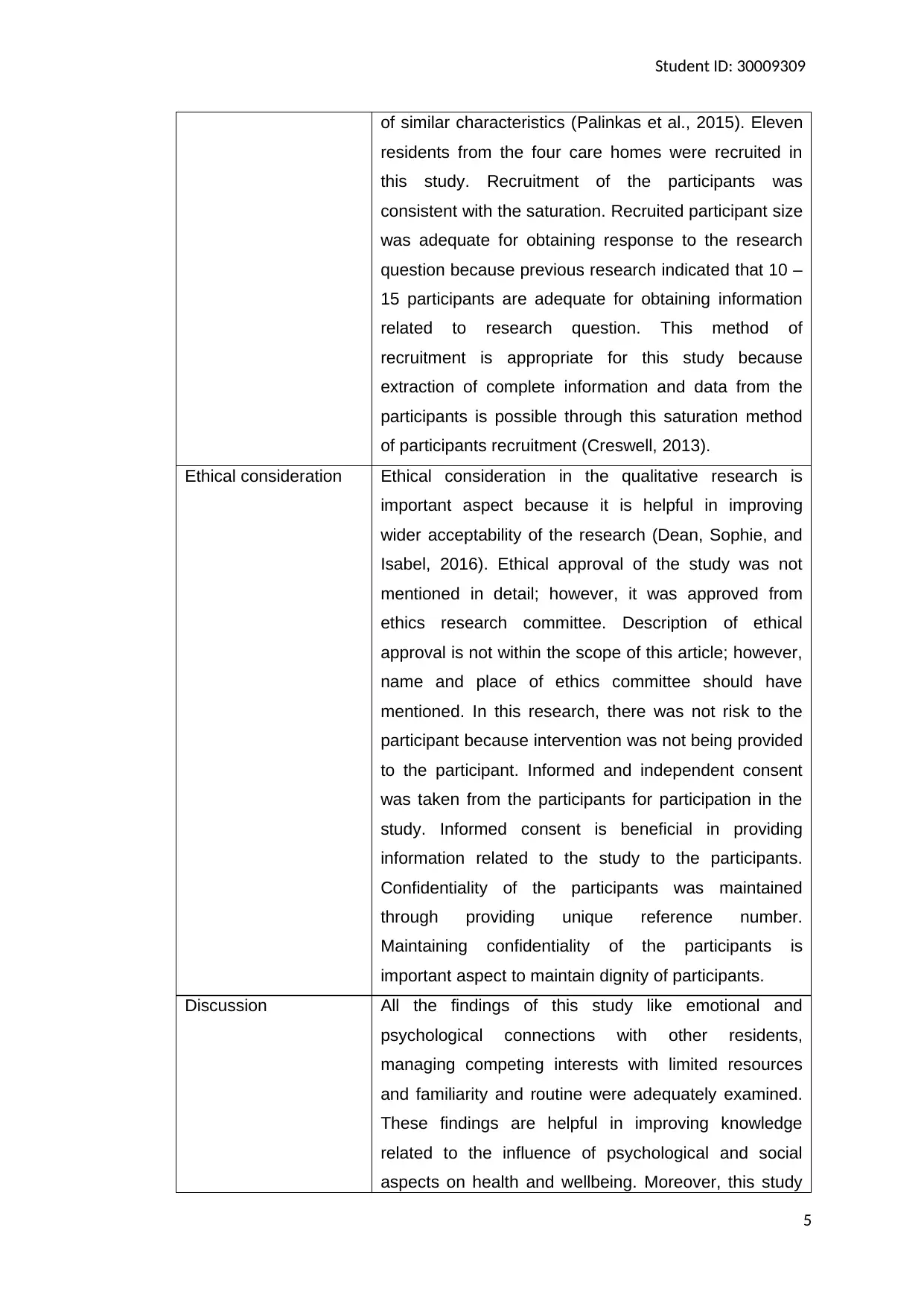
of similar characteristics (Palinkas et al., 2015). Eleven
residents from the four care homes were recruited in
this study. Recruitment of the participants was
consistent with the saturation. Recruited participant size
was adequate for obtaining response to the research
question because previous research indicated that 10 –
15 participants are adequate for obtaining information
related to research question. This method of
recruitment is appropriate for this study because
extraction of complete information and data from the
participants is possible through this saturation method
of participants recruitment (Creswell, 2013).
Ethical consideration Ethical consideration in the qualitative research is
important aspect because it is helpful in improving
wider acceptability of the research (Dean, Sophie, and
Isabel, 2016). Ethical approval of the study was not
mentioned in detail; however, it was approved from
ethics research committee. Description of ethical
approval is not within the scope of this article; however,
name and place of ethics committee should have
mentioned. In this research, there was not risk to the
participant because intervention was not being provided
to the participant. Informed and independent consent
was taken from the participants for participation in the
study. Informed consent is beneficial in providing
information related to the study to the participants.
Confidentiality of the participants was maintained
through providing unique reference number.
Maintaining confidentiality of the participants is
important aspect to maintain dignity of participants.
Discussion All the findings of this study like emotional and
psychological connections with other residents,
managing competing interests with limited resources
and familiarity and routine were adequately examined.
These findings are helpful in improving knowledge
related to the influence of psychological and social
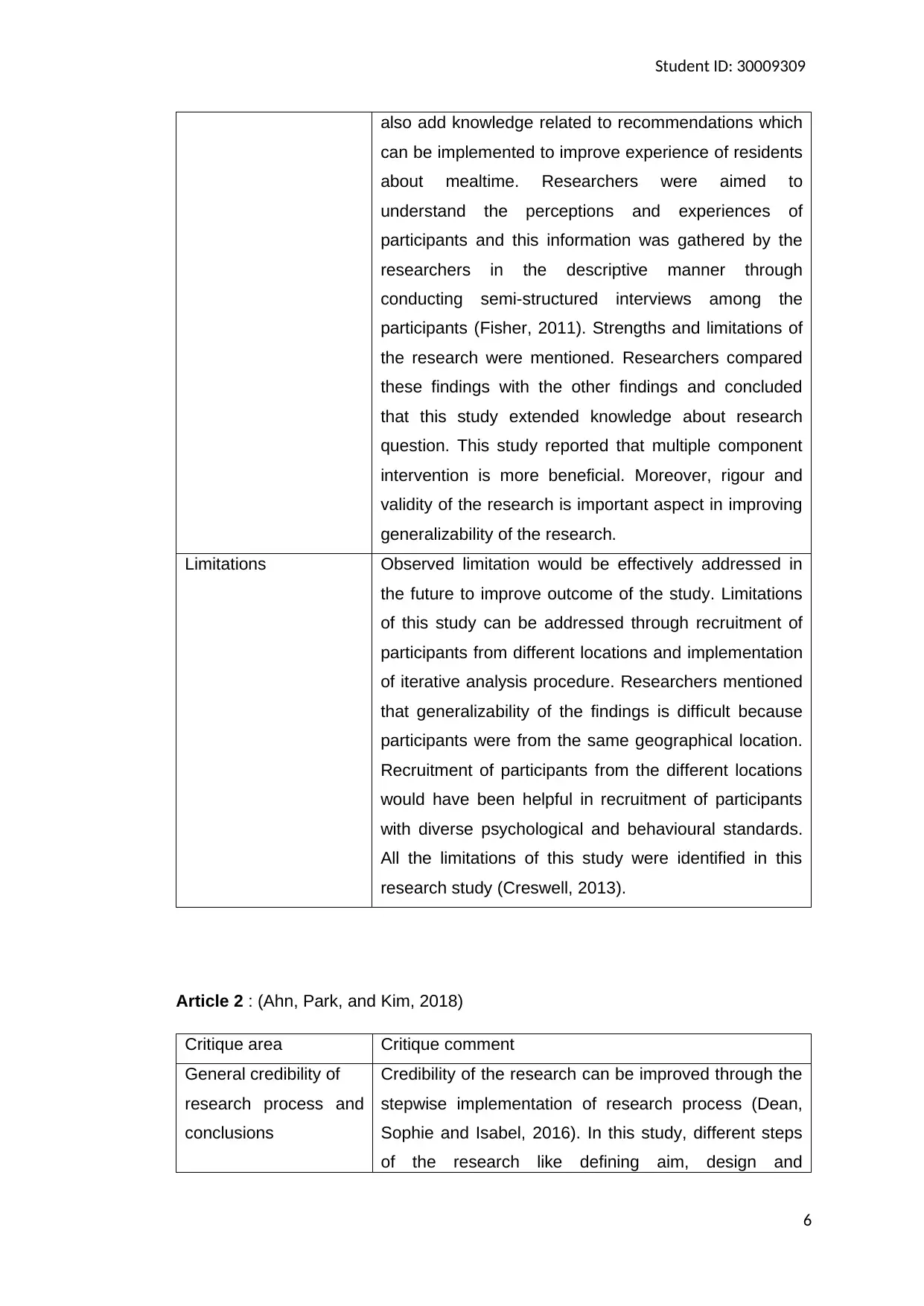
aspects on health and wellbeing. Moreover, this study
5
of similar characteristics (Palinkas et al., 2015). Eleven
residents from the four care homes were recruited in
this study. Recruitment of the participants was
consistent with the saturation. Recruited participant size
was adequate for obtaining response to the research
question because previous research indicated that 10 –
15 participants are adequate for obtaining information
related to research question. This method of
recruitment is appropriate for this study because
extraction of complete information and data from the
participants is possible through this saturation method
of participants recruitment (Creswell, 2013).
Ethical consideration Ethical consideration in the qualitative research is
important aspect because it is helpful in improving
wider acceptability of the research (Dean, Sophie, and
Isabel, 2016). Ethical approval of the study was not
mentioned in detail; however, it was approved from
ethics research committee. Description of ethical
approval is not within the scope of this article; however,
name and place of ethics committee should have
mentioned. In this research, there was not risk to the
participant because intervention was not being provided
to the participant. Informed and independent consent
was taken from the participants for participation in the
study. Informed consent is beneficial in providing
information related to the study to the participants.
Confidentiality of the participants was maintained
through providing unique reference number.
Maintaining confidentiality of the participants is
important aspect to maintain dignity of participants.
Discussion All the findings of this study like emotional and
psychological connections with other residents,
managing competing interests with limited resources
and familiarity and routine were adequately examined.
These findings are helpful in improving knowledge
related to the influence of psychological and social
aspects on health and wellbeing. Moreover, this study
5
Student ID: 30009309
also add knowledge related to recommendations which
can be implemented to improve experience of residents
about mealtime. Researchers were aimed to
understand the perceptions and experiences of
participants and this information was gathered by the
researchers in the descriptive manner through
conducting semi-structured interviews among the
participants (Fisher, 2011). Strengths and limitations of
the research were mentioned. Researchers compared
these findings with the other findings and concluded
that this study extended knowledge about research
question. This study reported that multiple component
intervention is more beneficial. Moreover, rigour and
validity of the research is important aspect in improving
generalizability of the research.
Limitations Observed limitation would be effectively addressed in
the future to improve outcome of the study. Limitations
of this study can be addressed through recruitment of
participants from different locations and implementation
of iterative analysis procedure. Researchers mentioned
that generalizability of the findings is difficult because
participants were from the same geographical location.
Recruitment of participants from the different locations
would have been helpful in recruitment of participants
with diverse psychological and behavioural standards.
All the limitations of this study were identified in this
research study (Creswell, 2013).
Article 2 : (Ahn, Park, and Kim, 2018)
Critique area Critique comment
General credibility of
research process and
conclusions
Credibility of the research can be improved through the
stepwise implementation of research process (Dean,
Sophie and Isabel, 2016). In this study, different steps
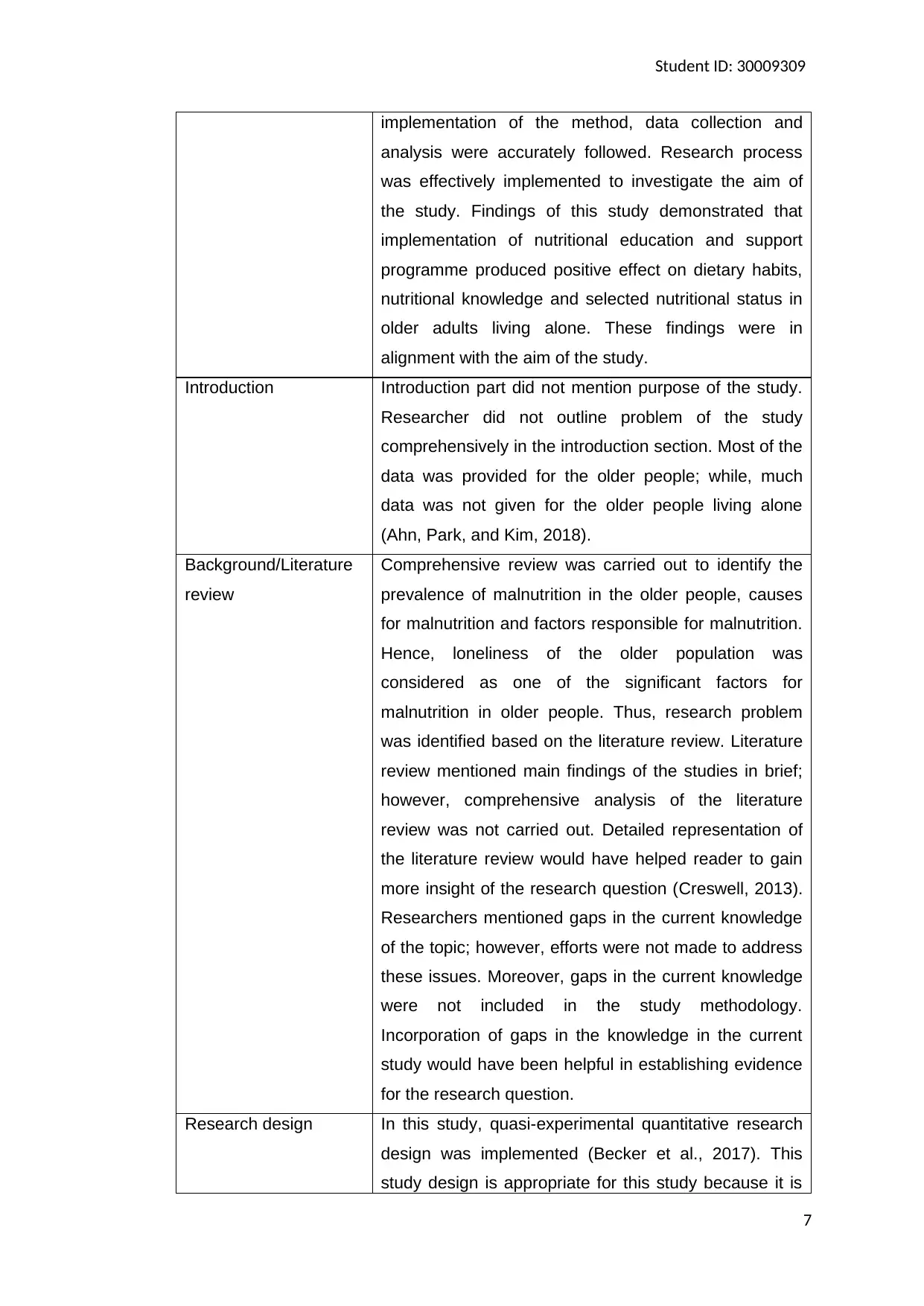
of the research like defining aim, design and
6
also add knowledge related to recommendations which
can be implemented to improve experience of residents
about mealtime. Researchers were aimed to
understand the perceptions and experiences of
participants and this information was gathered by the
researchers in the descriptive manner through
conducting semi-structured interviews among the
participants (Fisher, 2011). Strengths and limitations of
the research were mentioned. Researchers compared
these findings with the other findings and concluded
that this study extended knowledge about research
question. This study reported that multiple component
intervention is more beneficial. Moreover, rigour and
validity of the research is important aspect in improving
generalizability of the research.
Limitations Observed limitation would be effectively addressed in
the future to improve outcome of the study. Limitations
of this study can be addressed through recruitment of
participants from different locations and implementation
of iterative analysis procedure. Researchers mentioned
that generalizability of the findings is difficult because
participants were from the same geographical location.
Recruitment of participants from the different locations
would have been helpful in recruitment of participants
with diverse psychological and behavioural standards.
All the limitations of this study were identified in this
research study (Creswell, 2013).
Article 2 : (Ahn, Park, and Kim, 2018)
Critique area Critique comment
General credibility of
research process and
conclusions
Credibility of the research can be improved through the
stepwise implementation of research process (Dean,
Sophie and Isabel, 2016). In this study, different steps
of the research like defining aim, design and
6
⊘ This is a preview!⊘
Do you want full access?
Subscribe today to unlock all pages.
Trusted by 1+ million students worldwide
Student ID: 30009309
implementation of the method, data collection and
analysis were accurately followed. Research process
was effectively implemented to investigate the aim of
the study. Findings of this study demonstrated that
implementation of nutritional education and support
programme produced positive effect on dietary habits,
nutritional knowledge and selected nutritional status in
older adults living alone. These findings were in
alignment with the aim of the study.
Introduction Introduction part did not mention purpose of the study.
Researcher did not outline problem of the study
comprehensively in the introduction section. Most of the
data was provided for the older people; while, much
data was not given for the older people living alone
(Ahn, Park, and Kim, 2018).
Background/Literature
review
Comprehensive review was carried out to identify the
prevalence of malnutrition in the older people, causes
for malnutrition and factors responsible for malnutrition.
Hence, loneliness of the older population was
considered as one of the significant factors for
malnutrition in older people. Thus, research problem
was identified based on the literature review. Literature
review mentioned main findings of the studies in brief;
however, comprehensive analysis of the literature
review was not carried out. Detailed representation of
the literature review would have helped reader to gain
more insight of the research question (Creswell, 2013).
Researchers mentioned gaps in the current knowledge
of the topic; however, efforts were not made to address
these issues. Moreover, gaps in the current knowledge
were not included in the study methodology.
Incorporation of gaps in the knowledge in the current
study would have been helpful in establishing evidence
for the research question.
Research design In this study, quasi-experimental quantitative research
design was implemented (Becker et al., 2017). This
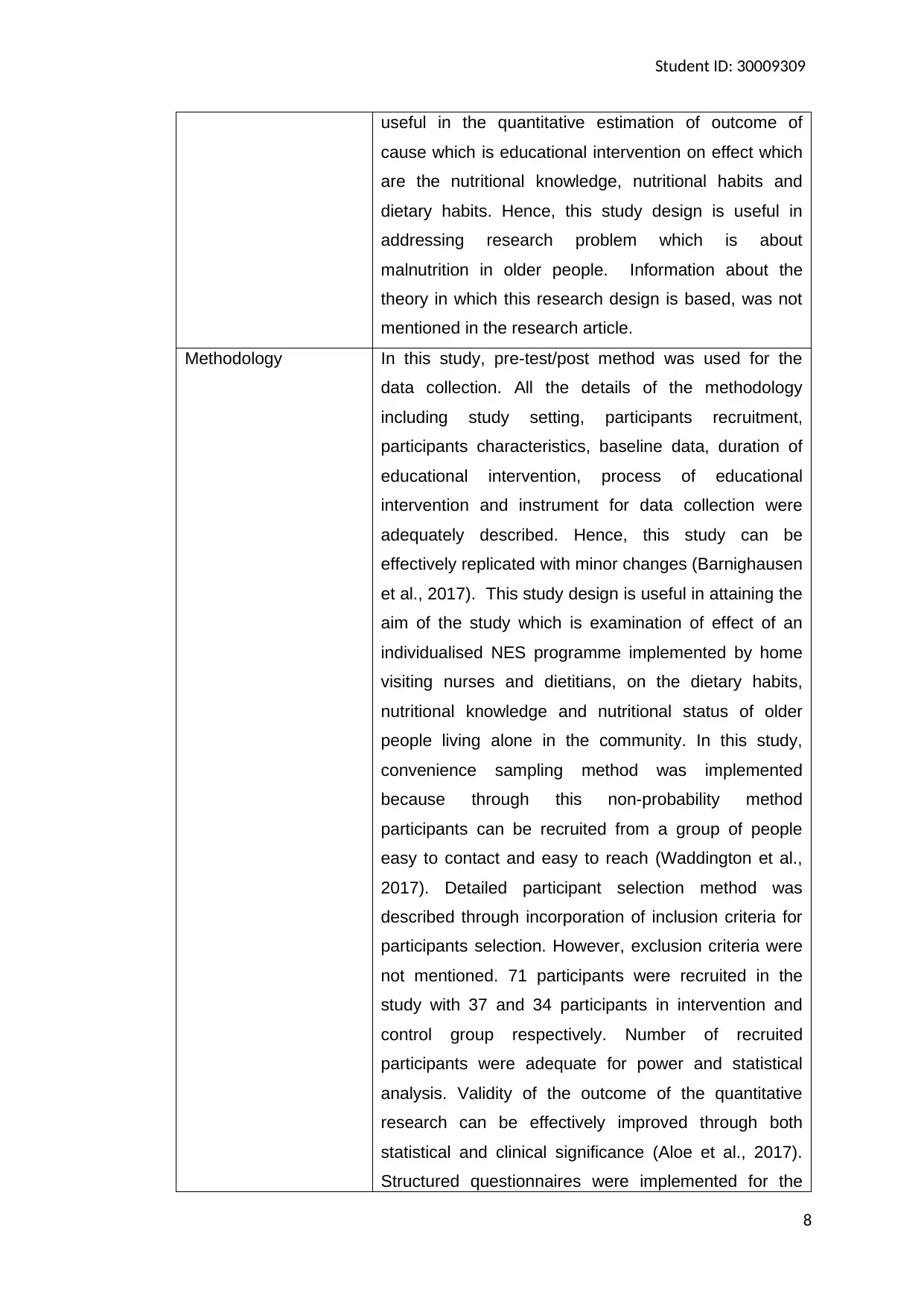
study design is appropriate for this study because it is
7
implementation of the method, data collection and
analysis were accurately followed. Research process
was effectively implemented to investigate the aim of
the study. Findings of this study demonstrated that
implementation of nutritional education and support
programme produced positive effect on dietary habits,
nutritional knowledge and selected nutritional status in
older adults living alone. These findings were in
alignment with the aim of the study.
Introduction Introduction part did not mention purpose of the study.
Researcher did not outline problem of the study
comprehensively in the introduction section. Most of the
data was provided for the older people; while, much
data was not given for the older people living alone
(Ahn, Park, and Kim, 2018).
Background/Literature
review
Comprehensive review was carried out to identify the
prevalence of malnutrition in the older people, causes
for malnutrition and factors responsible for malnutrition.
Hence, loneliness of the older population was
considered as one of the significant factors for
malnutrition in older people. Thus, research problem
was identified based on the literature review. Literature
review mentioned main findings of the studies in brief;
however, comprehensive analysis of the literature
review was not carried out. Detailed representation of
the literature review would have helped reader to gain
more insight of the research question (Creswell, 2013).
Researchers mentioned gaps in the current knowledge
of the topic; however, efforts were not made to address
these issues. Moreover, gaps in the current knowledge
were not included in the study methodology.
Incorporation of gaps in the knowledge in the current
study would have been helpful in establishing evidence
for the research question.
Research design In this study, quasi-experimental quantitative research
design was implemented (Becker et al., 2017). This
study design is appropriate for this study because it is
7
Paraphrase This Document
Need a fresh take? Get an instant paraphrase of this document with our AI Paraphraser
Student ID: 30009309
useful in the quantitative estimation of outcome of
cause which is educational intervention on effect which
are the nutritional knowledge, nutritional habits and
dietary habits. Hence, this study design is useful in
addressing research problem which is about
malnutrition in older people. Information about the
theory in which this research design is based, was not
mentioned in the research article.
Methodology In this study, pre-test/post method was used for the
data collection. All the details of the methodology
including study setting, participants recruitment,
participants characteristics, baseline data, duration of
educational intervention, process of educational
intervention and instrument for data collection were
adequately described. Hence, this study can be
effectively replicated with minor changes (Barnighausen
et al., 2017). This study design is useful in attaining the
aim of the study which is examination of effect of an
individualised NES programme implemented by home
visiting nurses and dietitians, on the dietary habits,
nutritional knowledge and nutritional status of older
people living alone in the community. In this study,
convenience sampling method was implemented
because through this non-probability method
participants can be recruited from a group of people
easy to contact and easy to reach (Waddington et al.,
2017). Detailed participant selection method was
described through incorporation of inclusion criteria for
participants selection. However, exclusion criteria were
not mentioned. 71 participants were recruited in the
study with 37 and 34 participants in intervention and
control group respectively. Number of recruited
participants were adequate for power and statistical
analysis. Validity of the outcome of the quantitative
research can be effectively improved through both
statistical and clinical significance (Aloe et al., 2017).
Structured questionnaires were implemented for the
8
useful in the quantitative estimation of outcome of
cause which is educational intervention on effect which
are the nutritional knowledge, nutritional habits and
dietary habits. Hence, this study design is useful in
addressing research problem which is about
malnutrition in older people. Information about the
theory in which this research design is based, was not
mentioned in the research article.
Methodology In this study, pre-test/post method was used for the
data collection. All the details of the methodology
including study setting, participants recruitment,
participants characteristics, baseline data, duration of
educational intervention, process of educational
intervention and instrument for data collection were
adequately described. Hence, this study can be
effectively replicated with minor changes (Barnighausen
et al., 2017). This study design is useful in attaining the
aim of the study which is examination of effect of an
individualised NES programme implemented by home
visiting nurses and dietitians, on the dietary habits,
nutritional knowledge and nutritional status of older
people living alone in the community. In this study,
convenience sampling method was implemented
because through this non-probability method
participants can be recruited from a group of people
easy to contact and easy to reach (Waddington et al.,
2017). Detailed participant selection method was
described through incorporation of inclusion criteria for
participants selection. However, exclusion criteria were
not mentioned. 71 participants were recruited in the
study with 37 and 34 participants in intervention and
control group respectively. Number of recruited
participants were adequate for power and statistical
analysis. Validity of the outcome of the quantitative
research can be effectively improved through both
statistical and clinical significance (Aloe et al., 2017).
Structured questionnaires were implemented for the
8
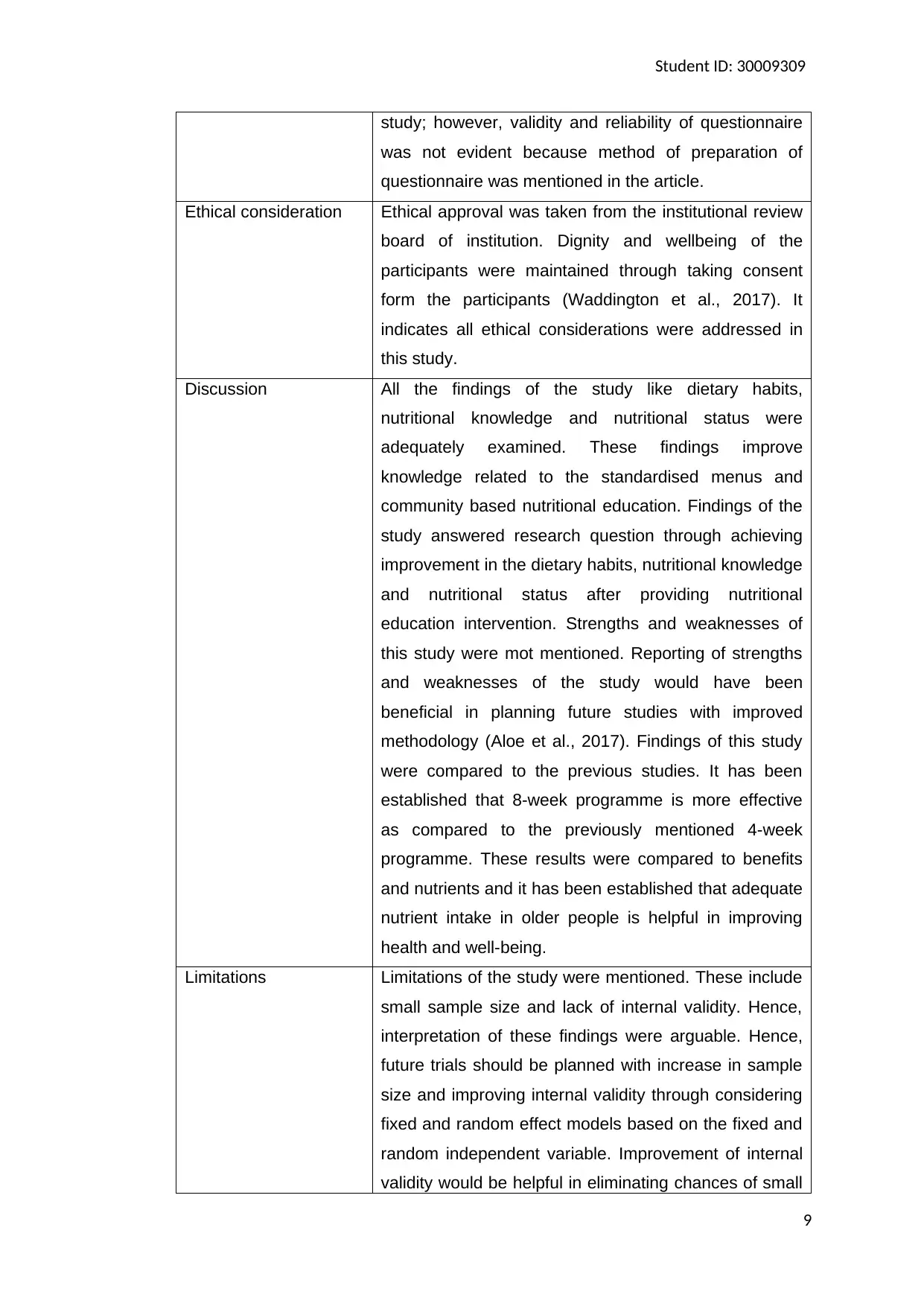
Student ID: 30009309
study; however, validity and reliability of questionnaire
was not evident because method of preparation of
questionnaire was mentioned in the article.
Ethical consideration Ethical approval was taken from the institutional review
board of institution. Dignity and wellbeing of the
participants were maintained through taking consent
form the participants (Waddington et al., 2017). It
indicates all ethical considerations were addressed in
this study.
Discussion All the findings of the study like dietary habits,
nutritional knowledge and nutritional status were
adequately examined. These findings improve
knowledge related to the standardised menus and
community based nutritional education. Findings of the
study answered research question through achieving
improvement in the dietary habits, nutritional knowledge
and nutritional status after providing nutritional
education intervention. Strengths and weaknesses of
this study were mot mentioned. Reporting of strengths
and weaknesses of the study would have been
beneficial in planning future studies with improved
methodology (Aloe et al., 2017). Findings of this study
were compared to the previous studies. It has been
established that 8-week programme is more effective
as compared to the previously mentioned 4-week
programme. These results were compared to benefits
and nutrients and it has been established that adequate
nutrient intake in older people is helpful in improving
health and well-being.
Limitations Limitations of the study were mentioned. These include
small sample size and lack of internal validity. Hence,
interpretation of these findings were arguable. Hence,
future trials should be planned with increase in sample
size and improving internal validity through considering
fixed and random effect models based on the fixed and
random independent variable. Improvement of internal
validity would be helpful in eliminating chances of small
9
study; however, validity and reliability of questionnaire
was not evident because method of preparation of
questionnaire was mentioned in the article.
Ethical consideration Ethical approval was taken from the institutional review
board of institution. Dignity and wellbeing of the
participants were maintained through taking consent
form the participants (Waddington et al., 2017). It
indicates all ethical considerations were addressed in
this study.
Discussion All the findings of the study like dietary habits,
nutritional knowledge and nutritional status were
adequately examined. These findings improve
knowledge related to the standardised menus and
community based nutritional education. Findings of the
study answered research question through achieving
improvement in the dietary habits, nutritional knowledge
and nutritional status after providing nutritional
education intervention. Strengths and weaknesses of
this study were mot mentioned. Reporting of strengths
and weaknesses of the study would have been
beneficial in planning future studies with improved
methodology (Aloe et al., 2017). Findings of this study
were compared to the previous studies. It has been
established that 8-week programme is more effective
as compared to the previously mentioned 4-week
programme. These results were compared to benefits
and nutrients and it has been established that adequate
nutrient intake in older people is helpful in improving
health and well-being.
Limitations Limitations of the study were mentioned. These include
small sample size and lack of internal validity. Hence,
interpretation of these findings were arguable. Hence,
future trials should be planned with increase in sample
size and improving internal validity through considering
fixed and random effect models based on the fixed and
random independent variable. Improvement of internal
validity would be helpful in eliminating chances of small
9
⊘ This is a preview!⊘
Do you want full access?
Subscribe today to unlock all pages.
Trusted by 1+ million students worldwide

Student ID: 30009309
standard errors and reduced possibility of
overestimation of results (Becker et al., 2017).
10
standard errors and reduced possibility of
overestimation of results (Becker et al., 2017).
10
Paraphrase This Document
Need a fresh take? Get an instant paraphrase of this document with our AI Paraphraser
Student ID: 30009309
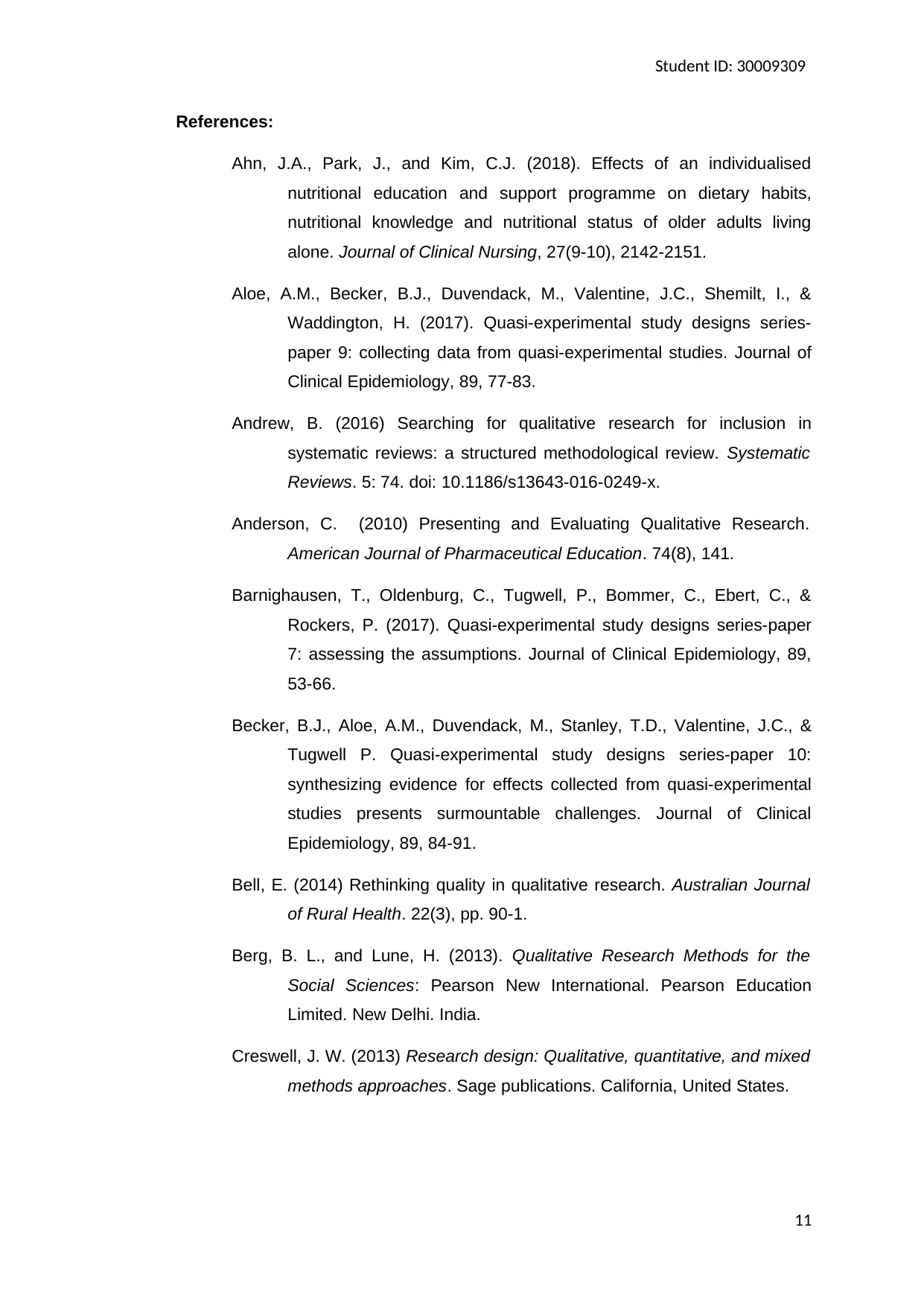
References:
Ahn, J.A., Park, J., and Kim, C.J. (2018). Effects of an individualised
nutritional education and support programme on dietary habits,
nutritional knowledge and nutritional status of older adults living
alone. Journal of Clinical Nursing, 27(9-10), 2142-2151.
Aloe, A.M., Becker, B.J., Duvendack, M., Valentine, J.C., Shemilt, I., &
Waddington, H. (2017). Quasi-experimental study designs series-
paper 9: collecting data from quasi-experimental studies. Journal of
Clinical Epidemiology, 89, 77-83.
Andrew, B. (2016) Searching for qualitative research for inclusion in
systematic reviews: a structured methodological review. Systematic
Reviews. 5: 74. doi: 10.1186/s13643-016-0249-x.
Anderson, C. (2010) Presenting and Evaluating Qualitative Research.
American Journal of Pharmaceutical Education. 74(8), 141.
Barnighausen, T., Oldenburg, C., Tugwell, P., Bommer, C., Ebert, C., &
Rockers, P. (2017). Quasi-experimental study designs series-paper
7: assessing the assumptions. Journal of Clinical Epidemiology, 89,
53-66.
Becker, B.J., Aloe, A.M., Duvendack, M., Stanley, T.D., Valentine, J.C., &
Tugwell P. Quasi-experimental study designs series-paper 10:
synthesizing evidence for effects collected from quasi-experimental
studies presents surmountable challenges. Journal of Clinical
Epidemiology, 89, 84-91.
Bell, E. (2014) Rethinking quality in qualitative research. Australian Journal
of Rural Health. 22(3), pp. 90-1.
Berg, B. L., and Lune, H. (2013). Qualitative Research Methods for the
Social Sciences: Pearson New International. Pearson Education
Limited. New Delhi. India.
Creswell, J. W. (2013) Research design: Qualitative, quantitative, and mixed
methods approaches. Sage publications. California, United States.
11
References:
Ahn, J.A., Park, J., and Kim, C.J. (2018). Effects of an individualised
nutritional education and support programme on dietary habits,
nutritional knowledge and nutritional status of older adults living
alone. Journal of Clinical Nursing, 27(9-10), 2142-2151.
Aloe, A.M., Becker, B.J., Duvendack, M., Valentine, J.C., Shemilt, I., &
Waddington, H. (2017). Quasi-experimental study designs series-
paper 9: collecting data from quasi-experimental studies. Journal of
Clinical Epidemiology, 89, 77-83.
Andrew, B. (2016) Searching for qualitative research for inclusion in
systematic reviews: a structured methodological review. Systematic
Reviews. 5: 74. doi: 10.1186/s13643-016-0249-x.
Anderson, C. (2010) Presenting and Evaluating Qualitative Research.
American Journal of Pharmaceutical Education. 74(8), 141.
Barnighausen, T., Oldenburg, C., Tugwell, P., Bommer, C., Ebert, C., &
Rockers, P. (2017). Quasi-experimental study designs series-paper
7: assessing the assumptions. Journal of Clinical Epidemiology, 89,
53-66.
Becker, B.J., Aloe, A.M., Duvendack, M., Stanley, T.D., Valentine, J.C., &
Tugwell P. Quasi-experimental study designs series-paper 10:
synthesizing evidence for effects collected from quasi-experimental
studies presents surmountable challenges. Journal of Clinical
Epidemiology, 89, 84-91.
Bell, E. (2014) Rethinking quality in qualitative research. Australian Journal
of Rural Health. 22(3), pp. 90-1.
Berg, B. L., and Lune, H. (2013). Qualitative Research Methods for the
Social Sciences: Pearson New International. Pearson Education
Limited. New Delhi. India.
Creswell, J. W. (2013) Research design: Qualitative, quantitative, and mixed
methods approaches. Sage publications. California, United States.
11
Student ID: 30009309
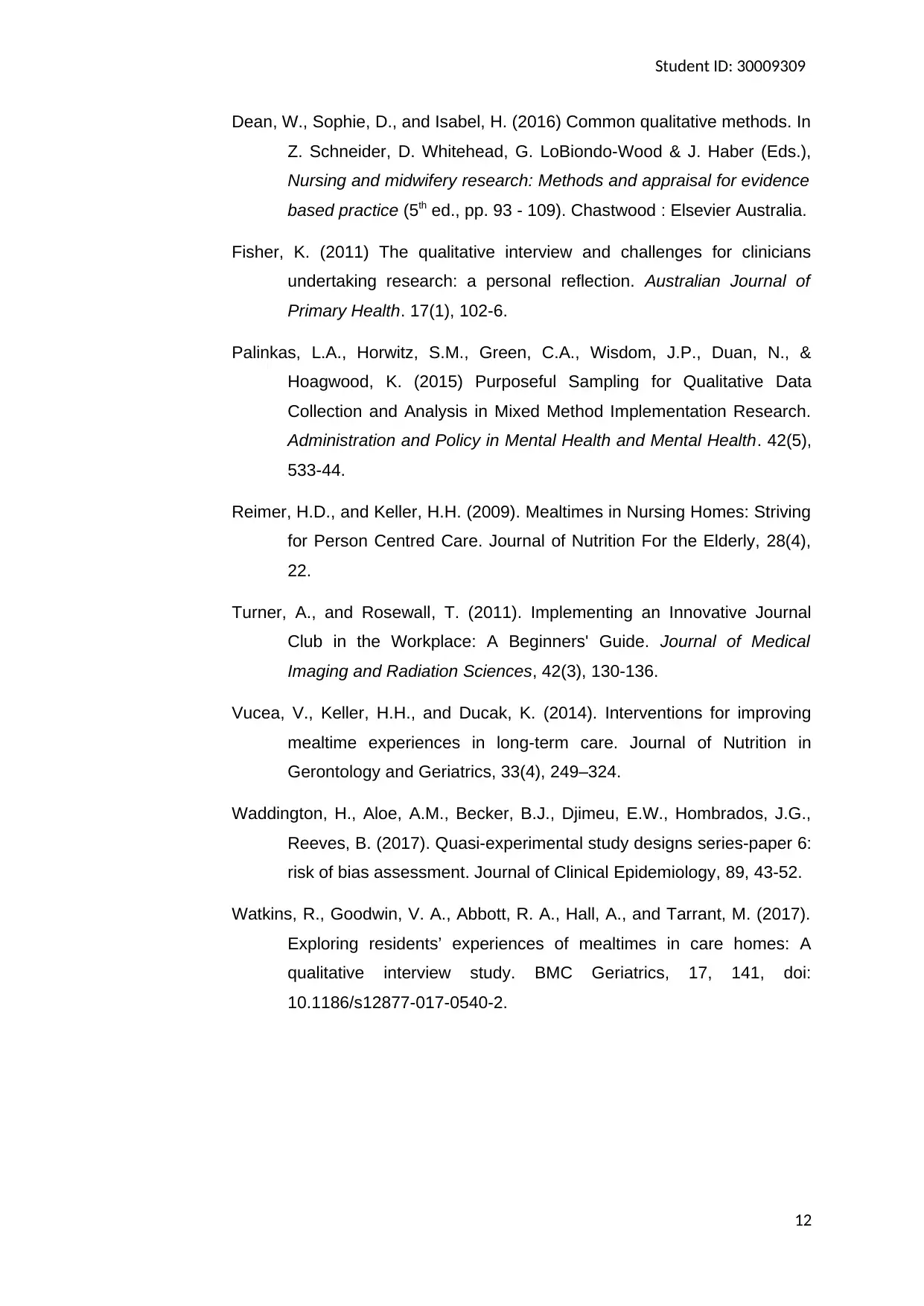
Dean, W., Sophie, D., and Isabel, H. (2016) Common qualitative methods. In
Z. Schneider, D. Whitehead, G. LoBiondo-Wood & J. Haber (Eds.),
Nursing and midwifery research: Methods and appraisal for evidence
based practice (5th ed., pp. 93 - 109). Chastwood : Elsevier Australia.
Fisher, K. (2011) The qualitative interview and challenges for clinicians
undertaking research: a personal reflection. Australian Journal of
Primary Health. 17(1), 102-6.
Palinkas, L.A., Horwitz, S.M., Green, C.A., Wisdom, J.P., Duan, N., &
Hoagwood, K. (2015) Purposeful Sampling for Qualitative Data
Collection and Analysis in Mixed Method Implementation Research.
Administration and Policy in Mental Health and Mental Health. 42(5),
533-44.
Reimer, H.D., and Keller, H.H. (2009). Mealtimes in Nursing Homes: Striving
for Person Centred Care. Journal of Nutrition For the Elderly, 28(4),
22.
Turner, A., and Rosewall, T. (2011). Implementing an Innovative Journal
Club in the Workplace: A Beginners' Guide. Journal of Medical
Imaging and Radiation Sciences, 42(3), 130-136.
Vucea, V., Keller, H.H., and Ducak, K. (2014). Interventions for improving
mealtime experiences in long-term care. Journal of Nutrition in
Gerontology and Geriatrics, 33(4), 249–324.
Waddington, H., Aloe, A.M., Becker, B.J., Djimeu, E.W., Hombrados, J.G.,
Reeves, B. (2017). Quasi-experimental study designs series-paper 6:
risk of bias assessment. Journal of Clinical Epidemiology, 89, 43-52.
Watkins, R., Goodwin, V. A., Abbott, R. A., Hall, A., and Tarrant, M. (2017).
Exploring residents’ experiences of mealtimes in care homes: A
qualitative interview study. BMC Geriatrics, 17, 141, doi:
10.1186/s12877-017-0540-2.
12
Dean, W., Sophie, D., and Isabel, H. (2016) Common qualitative methods. In
Z. Schneider, D. Whitehead, G. LoBiondo-Wood & J. Haber (Eds.),
Nursing and midwifery research: Methods and appraisal for evidence
based practice (5th ed., pp. 93 - 109). Chastwood : Elsevier Australia.
Fisher, K. (2011) The qualitative interview and challenges for clinicians
undertaking research: a personal reflection. Australian Journal of
Primary Health. 17(1), 102-6.
Palinkas, L.A., Horwitz, S.M., Green, C.A., Wisdom, J.P., Duan, N., &
Hoagwood, K. (2015) Purposeful Sampling for Qualitative Data
Collection and Analysis in Mixed Method Implementation Research.
Administration and Policy in Mental Health and Mental Health. 42(5),
533-44.
Reimer, H.D., and Keller, H.H. (2009). Mealtimes in Nursing Homes: Striving
for Person Centred Care. Journal of Nutrition For the Elderly, 28(4),
22.
Turner, A., and Rosewall, T. (2011). Implementing an Innovative Journal
Club in the Workplace: A Beginners' Guide. Journal of Medical
Imaging and Radiation Sciences, 42(3), 130-136.
Vucea, V., Keller, H.H., and Ducak, K. (2014). Interventions for improving
mealtime experiences in long-term care. Journal of Nutrition in
Gerontology and Geriatrics, 33(4), 249–324.
Waddington, H., Aloe, A.M., Becker, B.J., Djimeu, E.W., Hombrados, J.G.,
Reeves, B. (2017). Quasi-experimental study designs series-paper 6:
risk of bias assessment. Journal of Clinical Epidemiology, 89, 43-52.
Watkins, R., Goodwin, V. A., Abbott, R. A., Hall, A., and Tarrant, M. (2017).
Exploring residents’ experiences of mealtimes in care homes: A
qualitative interview study. BMC Geriatrics, 17, 141, doi:
10.1186/s12877-017-0540-2.
12
⊘ This is a preview!⊘
Do you want full access?
Subscribe today to unlock all pages.
Trusted by 1+ million students worldwide

1 out of 13


Related Documents


Your All-in-One AI-Powered Toolkit for Academic Success.
+13062052269
info@desklib.com
Available 24*7 on WhatsApp / Email
![[object Object]](/_next/static/media/star-bottom.7253800d.svg)
Unlock your academic potential
Copyright © 2020–2026 A2Z Services. All Rights Reserved. Developed and managed by ZUCOL.