6112ICT Research Methods: Critique of Image Processing Papers
VerifiedAdded on 2023/01/10
|9
|4336
|85
Report
AI Summary
This report presents a detailed critique of two research papers focused on image processing within the field of Artificial Intelligence. The first paper, "Parallel programming templates for remote sensing image processing on GPU architectures: design and implementation," is analyzed for its context, addressing developers in GPU programming and image sensing. The critique examines the paper's hypothesis, research questions, methodology, and significance, highlighting strengths such as the proposed model for efficient GPU utilization, and weaknesses including the lack of theoretical grounding and formatting issues in the references. The second paper, "Direct Testing of Methods for Computer Image Processing," is evaluated based on its context, thesis statement, and overall structure. The critique points out the flaws in the paper's statistical analysis and evaluation of the proposed algorithms, and the lack of comparison with existing solutions. Both critiques provide constructive criticism of the papers, assessing their novelty, significance, soundness, and relevance to the IT industry, with emphasis on the need for stronger theoretical foundations, clearer research questions, and comprehensive evaluations.
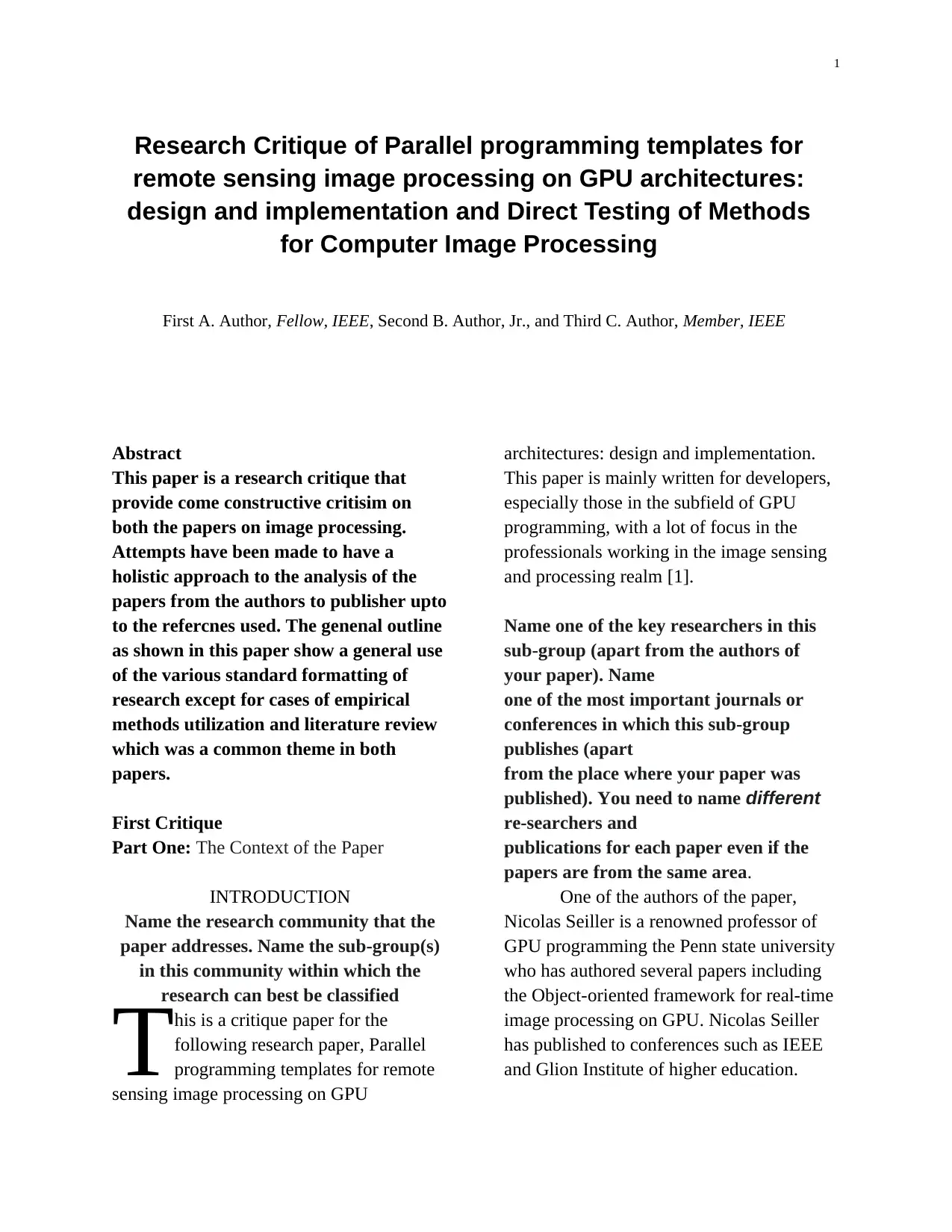
Abstract
This paper is a research critique that
provide come constructive critisim on
both the papers on image processing.
Attempts have been made to have a
holistic approach to the analysis of the
papers from the authors to publisher upto
to the refercnes used. The genenal outline
as shown in this paper show a general use
of the various standard formatting of
research except for cases of empirical
methods utilization and literature review
which was a common theme in both
papers.
First Critique
Part One: The Context of the Paper
INTRODUCTION
Name the research community that the
paper addresses. Name the sub-group(s)
in this community within which the
research can best be classified
his is a critique paper for the
following research paper, Parallel
programming templates for remote
sensing image processing on GPU
T
architectures: design and implementation.
This paper is mainly written for developers,
especially those in the subfield of GPU
programming, with a lot of focus in the
professionals working in the image sensing
and processing realm [1].
Name one of the key researchers in this
sub-group (apart from the authors of
your paper). Name
one of the most important journals or
conferences in which this sub-group
publishes (apart
from the place where your paper was
published). You need to name different
re-searchers and
publications for each paper even if the
papers are from the same area.
One of the authors of the paper,
Nicolas Seiller is a renowned professor of
GPU programming the Penn state university
who has authored several papers including
the Object-oriented framework for real-time
image processing on GPU. Nicolas Seiller
has published to conferences such as IEEE
and Glion Institute of higher education.
Research Critique of Parallel programming templates for
remote sensing image processing on GPU architectures:
design and implementation and Direct Testing of Methods
for Computer Image Processing
First A. Author, Fellow, IEEE, Second B. Author, Jr., and Third C. Author, Member, IEEE
1
This paper is a research critique that
provide come constructive critisim on
both the papers on image processing.
Attempts have been made to have a
holistic approach to the analysis of the
papers from the authors to publisher upto
to the refercnes used. The genenal outline
as shown in this paper show a general use
of the various standard formatting of
research except for cases of empirical
methods utilization and literature review
which was a common theme in both
papers.
First Critique
Part One: The Context of the Paper
INTRODUCTION
Name the research community that the
paper addresses. Name the sub-group(s)
in this community within which the
research can best be classified
his is a critique paper for the
following research paper, Parallel
programming templates for remote
sensing image processing on GPU
T
architectures: design and implementation.
This paper is mainly written for developers,
especially those in the subfield of GPU
programming, with a lot of focus in the
professionals working in the image sensing
and processing realm [1].
Name one of the key researchers in this
sub-group (apart from the authors of
your paper). Name
one of the most important journals or
conferences in which this sub-group
publishes (apart
from the place where your paper was
published). You need to name different
re-searchers and
publications for each paper even if the
papers are from the same area.
One of the authors of the paper,
Nicolas Seiller is a renowned professor of
GPU programming the Penn state university
who has authored several papers including
the Object-oriented framework for real-time
image processing on GPU. Nicolas Seiller
has published to conferences such as IEEE
and Glion Institute of higher education.
Research Critique of Parallel programming templates for
remote sensing image processing on GPU architectures:
design and implementation and Direct Testing of Methods
for Computer Image Processing
First A. Author, Fellow, IEEE, Second B. Author, Jr., and Third C. Author, Member, IEEE
1

Paraphrase This Document
Need a fresh take? Get an instant paraphrase of this document with our AI Paraphraser
How highly do you rate the
conference/journal in which the paper is
published? How highly do
you rate the author(s) of the paper. How
highly do you rate the institution(s) where
the
author(s) are based? Explain the basis of
these evaluations.
Although I IEEE highly rank high in
the rating and can effortlessly give a five-
star rating, the glion institute of higher
education seems noncredible publishing
center and rate it a three star based on the
maturity of journals and articles in their
collection. The main hypothesis of the paper
is the proposal of a more efficient algorithm
that can be used by the developer to
effectively and efficiently use the powers of
GPUs to process images.
B. The Details of the Paper
THESIS STATEMENT
lthough the paper research paper
presented tend to have a strong
technical foundation, the
limitations in its theoretical working, the
result analysis and explanations model used
was vaguely outlined forming key
components to this critique [2].
A
PAPER SUMMARY
he paper has in detail provided the
technical challenges that
programmers face while using the
current algorithms to write functions that the
high-performance GPU can execute and
process images more efficiently. The current
architecture provides machine dependent
algorithm which is not reusable hence
making programming the logic much
T
difficult [3]. The paper has proposed a
model that can interface between the GPU
and the development environment hence
providing templates that can be reused in a
different scenario. This has proved to be
beneficial due to the utilization of the
parallel processing powers of the GPUs. The
article has provided some result and analysis
suggesting the proposed model work much
better than the traditional GPU algorithms.
Critiques [3]
Name the research questions addressed
by the paper: Were they clearly stated?
What were they?
First, the research questions were not
formerly formulated to guide the readers of
the key questions the paper shall address in
the end. This was a key weakness of the
paper.
How well justified is the research? Is it
significant? Is the outcome of the research
worth
discovering? Why? Why not?
Second, the subject matter of the paper
generally is significant in the image
processing realm and if implemented shall
reduce the computational complexities that
exist in the current image processing
algorithms. The discovery made are very
critical for developers in the image
processing industry [4].
Connections with existing research: Is
there a clear discussion of the existing
2
conference/journal in which the paper is
published? How highly do
you rate the author(s) of the paper. How
highly do you rate the institution(s) where
the
author(s) are based? Explain the basis of
these evaluations.
Although I IEEE highly rank high in
the rating and can effortlessly give a five-
star rating, the glion institute of higher
education seems noncredible publishing
center and rate it a three star based on the
maturity of journals and articles in their
collection. The main hypothesis of the paper
is the proposal of a more efficient algorithm
that can be used by the developer to
effectively and efficiently use the powers of
GPUs to process images.
B. The Details of the Paper
THESIS STATEMENT
lthough the paper research paper
presented tend to have a strong
technical foundation, the
limitations in its theoretical working, the
result analysis and explanations model used
was vaguely outlined forming key
components to this critique [2].
A
PAPER SUMMARY
he paper has in detail provided the
technical challenges that
programmers face while using the
current algorithms to write functions that the
high-performance GPU can execute and
process images more efficiently. The current
architecture provides machine dependent
algorithm which is not reusable hence
making programming the logic much
T
difficult [3]. The paper has proposed a
model that can interface between the GPU
and the development environment hence
providing templates that can be reused in a
different scenario. This has proved to be
beneficial due to the utilization of the
parallel processing powers of the GPUs. The
article has provided some result and analysis
suggesting the proposed model work much
better than the traditional GPU algorithms.
Critiques [3]
Name the research questions addressed
by the paper: Were they clearly stated?
What were they?
First, the research questions were not
formerly formulated to guide the readers of
the key questions the paper shall address in
the end. This was a key weakness of the
paper.
How well justified is the research? Is it
significant? Is the outcome of the research
worth
discovering? Why? Why not?
Second, the subject matter of the paper
generally is significant in the image
processing realm and if implemented shall
reduce the computational complexities that
exist in the current image processing
algorithms. The discovery made are very
critical for developers in the image
processing industry [4].
Connections with existing research: Is
there a clear discussion of the existing
2
work in the ar-ea?
How does this work connect to the paper
under review? Is this made clear?
Third, related work sections were properly
undertaken. Something to note is the little
literature review was done to provide some
theoretical concepts that have made it
difficult to come up with development
frameworks for GPU image processing. The
existing algorithms according to the no
ability to take the parallel computing powers
of GPUs in order to accelerate their
performance. The proposed model outshines
them in this context. Despite the proper
connection made to the existing related
work, nothing much is said on the execution
mechanism of the existing algorithms in
comparison to the proposed model, making
it difficult for the readers to objectively give
a verdict on which algorithm is best for GPU
based images processing [5].
Was the research based on any theory?
Was this theory stated? If not, can you
uncover an
implicit theory? How was this theory
applied?
Fourth, the research was clearly not
theoretical hence not based on any theory.
This was one of the key weakness of the
paper as it made much more focus on the
technical parts and deliberately ignored the
theoretical working concepts of the GPU
and the image processing theories that make
it suitable for their proposed model to
flourish. A fundamental theory like the
theory of algorithm computation complexity
should have been a base guide to lay their
hypothesis [6].
What research method was adopted to
conduct the research project?
Fifth, the research relied on empirical
method approach to the research where real-
world data sets were used as the core to
testing the formulated hypothesis and the
results from the empirical investigation put
through the analysis and discussion.
The rigour of the research design: Does
the research clearly address the research
problems you
have identified? What answers does the
research provide? Are these answers
backed up with
sufficient evidence? Has too much been
claimed? Has something been missed?
Six, the general outlook of the research
design was sufficient enough as it provided
benchmarks to prove the hypothesis through
clear data collection and analysis
procedures. However, it can be noted that
the conventional algorithm currently in use
was not used as the benchmark to collect the
data which could have been used as the
baseline to test the hypothesis stated
hereinbefore [7]. This provides room for
critics as the reader doesn’t get a chance to
have compared the current and the proposed
models in terms of their [8] ease of use and
computational complexity of the algorithms
Relevance to other researchers and/or
practitioners including contribution to
theory and/or IT
practice.
3
How does this work connect to the paper
under review? Is this made clear?
Third, related work sections were properly
undertaken. Something to note is the little
literature review was done to provide some
theoretical concepts that have made it
difficult to come up with development
frameworks for GPU image processing. The
existing algorithms according to the no
ability to take the parallel computing powers
of GPUs in order to accelerate their
performance. The proposed model outshines
them in this context. Despite the proper
connection made to the existing related
work, nothing much is said on the execution
mechanism of the existing algorithms in
comparison to the proposed model, making
it difficult for the readers to objectively give
a verdict on which algorithm is best for GPU
based images processing [5].
Was the research based on any theory?
Was this theory stated? If not, can you
uncover an
implicit theory? How was this theory
applied?
Fourth, the research was clearly not
theoretical hence not based on any theory.
This was one of the key weakness of the
paper as it made much more focus on the
technical parts and deliberately ignored the
theoretical working concepts of the GPU
and the image processing theories that make
it suitable for their proposed model to
flourish. A fundamental theory like the
theory of algorithm computation complexity
should have been a base guide to lay their
hypothesis [6].
What research method was adopted to
conduct the research project?
Fifth, the research relied on empirical
method approach to the research where real-
world data sets were used as the core to
testing the formulated hypothesis and the
results from the empirical investigation put
through the analysis and discussion.
The rigour of the research design: Does
the research clearly address the research
problems you
have identified? What answers does the
research provide? Are these answers
backed up with
sufficient evidence? Has too much been
claimed? Has something been missed?
Six, the general outlook of the research
design was sufficient enough as it provided
benchmarks to prove the hypothesis through
clear data collection and analysis
procedures. However, it can be noted that
the conventional algorithm currently in use
was not used as the benchmark to collect the
data which could have been used as the
baseline to test the hypothesis stated
hereinbefore [7]. This provides room for
critics as the reader doesn’t get a chance to
have compared the current and the proposed
models in terms of their [8] ease of use and
computational complexity of the algorithms
Relevance to other researchers and/or
practitioners including contribution to
theory and/or IT
practice.
3
⊘ This is a preview!⊘
Do you want full access?
Subscribe today to unlock all pages.

Trusted by 1+ million students worldwide
Seven, on the matter of relevance, it is noted
that the paper has some key relevance to the
new field of image processing which has
seen tremendous growth due to the
multimedia and graphics era . The
proposed algorithm on a scale of 1 to 10,
will get an 8 [9]. This is because the
proposed model will most likely unlock the
difficulties experienced with using the GPUs
in processing the images. This will be a vital
contribution to future programmers and
image processing algorithm developers and
general IT industry.
Correct referencing – Has the paper miss
some important references in the field?
Last but not least, the IEEE referencing
used, in most citation followed the generally
accepted standard for citing various source
types. The key item missing in most of the
citation of the book is the unique DOI
number which the reader can use to read the
cited materials. It would be complete if the
writer includes the doi numbers for the
books cited.
CONCLUSION
n conclusion, the parallel programming
template has the remove the barrier the
developer of image processing
algorithms has faced due to the machine
dependence of most GPU cores. This has
made it difficult to have the multithreading
capabilities of the GPUs incorporated into
the computation of complex image
processing algorithms. The paper proposed a
model that can provide a template to the
programmers which if the user's will to a
greater extent ensures code reusability while
improving the computation efficiency of
I
these algorithms. The paper collected data
about the computational complexity of the
algorithm using the empirical method. The
paper concludes that from the results
obtained, the efficiency of image processing
algorithms improves substantially due to the
creation of an abstract layer between the
algorithm and GPU cores. Despite the paper
being of good quality and contribution to the
ICT industry, several criticisms such as not
including the existing models in the
empirical investigation, having less
theoretical theories to back the model and
general formatting issues of references
formed the basis of this critic.
Second Critique
Part One: The Context of the Paper
INTRODUCTION
Name the research community that the
paper addresses. Name the sub-group(s)
4
that the paper has some key relevance to the
new field of image processing which has
seen tremendous growth due to the
multimedia and graphics era . The
proposed algorithm on a scale of 1 to 10,
will get an 8 [9]. This is because the
proposed model will most likely unlock the
difficulties experienced with using the GPUs
in processing the images. This will be a vital
contribution to future programmers and
image processing algorithm developers and
general IT industry.
Correct referencing – Has the paper miss
some important references in the field?
Last but not least, the IEEE referencing
used, in most citation followed the generally
accepted standard for citing various source
types. The key item missing in most of the
citation of the book is the unique DOI
number which the reader can use to read the
cited materials. It would be complete if the
writer includes the doi numbers for the
books cited.
CONCLUSION
n conclusion, the parallel programming
template has the remove the barrier the
developer of image processing
algorithms has faced due to the machine
dependence of most GPU cores. This has
made it difficult to have the multithreading
capabilities of the GPUs incorporated into
the computation of complex image
processing algorithms. The paper proposed a
model that can provide a template to the
programmers which if the user's will to a
greater extent ensures code reusability while
improving the computation efficiency of
I
these algorithms. The paper collected data
about the computational complexity of the
algorithm using the empirical method. The
paper concludes that from the results
obtained, the efficiency of image processing
algorithms improves substantially due to the
creation of an abstract layer between the
algorithm and GPU cores. Despite the paper
being of good quality and contribution to the
ICT industry, several criticisms such as not
including the existing models in the
empirical investigation, having less
theoretical theories to back the model and
general formatting issues of references
formed the basis of this critic.
Second Critique
Part One: The Context of the Paper
INTRODUCTION
Name the research community that the
paper addresses. Name the sub-group(s)
4
Paraphrase This Document
Need a fresh take? Get an instant paraphrase of this document with our AI Paraphraser
in this community within which the
research can best be classified.
his critique paper for the following
research paper, Direct Testing of
Methods for Computer Image
Processing. The paper is written for the
professionals involved in the manipulation
of images during processing of such image
objects. The focus is on the developers of
image manipulation algorithms who can
benefit from the paper.
T
Name one of the key researchers in this
sub-group (apart from the authors of
your paper). Name
one of the most important journals or
conferences in which this sub-group
publishes (apart
from the place where your paper was
published). You need to name different
re-searchers and
publications for each paper even if the
papers are from the same area.
The author, Petr Petrovich Kol’tsov,
is a well-known professor in the Russia
Academy research and has received several
state commendations in the field of image
processing research. He has notably written
more than 80 paper in the technology field.
Some renowned scholar in this field includes
Uhlmann, Jeffrey, who has published
several papers including the A canonical
Image Set for Examining and Comparing
Image Processing Algorithms published in
several conferences such as the IEEE,
EBSCOhost and the Glion Institute of higher
education [10], [11]
How highly do you rate the
conference/journal in which the paper is
published? How highly do
you rate the author(s) of the paper. How
highly do you rate the institution(s) where
the
author(s) are based? Explain the basis of
these evaluations.
When critically analyzing the ranks
of the conferences where the author have
published, the only credible one I IEEE
based on the engineer's score of the same.
The remain publishers such as the Glion
Institute of higher education and
EBSCOhost reveal rather less ranking in
terms of the reviews making it objectively
questionable avenue to publish the papers
[12]. The main hypothesis is presented in the
paper is the proposal of algorithms that can
be used to efficiently manipulate images
during image processing of image objects
that result in more desired output relative to
the existing image manipulation algorithms.
The proposed algorithm has several use
cases for engineers working in the research-
intensive image processing field to come up
with better programs that can be used to
process images.
B. The Details of the Paper
THESIS STATEMENT
rom the onset, the paper had several
flaws which left many questions
unanswered when putting forth the
defense of the paper as it overlooked several
important factors of statistical analysis to
objectively come to a conclusion that the
proposed method works efficiently and
effectively compared to the existing
solution. This formed the basis of this
critique.
F
PAPER SUMMARY
5
research can best be classified.
his critique paper for the following
research paper, Direct Testing of
Methods for Computer Image
Processing. The paper is written for the
professionals involved in the manipulation
of images during processing of such image
objects. The focus is on the developers of
image manipulation algorithms who can
benefit from the paper.
T
Name one of the key researchers in this
sub-group (apart from the authors of
your paper). Name
one of the most important journals or
conferences in which this sub-group
publishes (apart
from the place where your paper was
published). You need to name different
re-searchers and
publications for each paper even if the
papers are from the same area.
The author, Petr Petrovich Kol’tsov,
is a well-known professor in the Russia
Academy research and has received several
state commendations in the field of image
processing research. He has notably written
more than 80 paper in the technology field.
Some renowned scholar in this field includes
Uhlmann, Jeffrey, who has published
several papers including the A canonical
Image Set for Examining and Comparing
Image Processing Algorithms published in
several conferences such as the IEEE,
EBSCOhost and the Glion Institute of higher
education [10], [11]
How highly do you rate the
conference/journal in which the paper is
published? How highly do
you rate the author(s) of the paper. How
highly do you rate the institution(s) where
the
author(s) are based? Explain the basis of
these evaluations.
When critically analyzing the ranks
of the conferences where the author have
published, the only credible one I IEEE
based on the engineer's score of the same.
The remain publishers such as the Glion
Institute of higher education and
EBSCOhost reveal rather less ranking in
terms of the reviews making it objectively
questionable avenue to publish the papers
[12]. The main hypothesis is presented in the
paper is the proposal of algorithms that can
be used to efficiently manipulate images
during image processing of image objects
that result in more desired output relative to
the existing image manipulation algorithms.
The proposed algorithm has several use
cases for engineers working in the research-
intensive image processing field to come up
with better programs that can be used to
process images.
B. The Details of the Paper
THESIS STATEMENT
rom the onset, the paper had several
flaws which left many questions
unanswered when putting forth the
defense of the paper as it overlooked several
important factors of statistical analysis to
objectively come to a conclusion that the
proposed method works efficiently and
effectively compared to the existing
solution. This formed the basis of this
critique.
F
PAPER SUMMARY
5
rocessing images objects have
always had problems for the
engineers working in the image
processing field. Such problems include
boundary destruction, image restoration, the
segmentation problem, and textual analysis.
This is due to algorithms which are not
responsive to change [13].This research
paper attempts to solve this problem by
proposing a new algorithmic model which
making alteration of image parameter
possible hence enhancing the effective
manipulation of such images. The paper has
provided theoretical and empirical methods
to obtain the data of the performance of the
algorithm and compare it to the proposed
models. The result and finding have shown
rather a remarkable improvement in the
images manipulation performance compared
to the existing models. In spite of these
incredible insights, several critiques were
noticed as explained in the subsequent
sections [14].
P
Name the research questions addressed
by the paper: Were they clearly stated?
What were they?
First, the on the research questions,
the paper failed in this area since no explicit
research questions were introduced by the
paper hence making it difficult for the reader
to objectively rate the success of the
research with no explicit questions elicitated
in the beginning. The problems statement
was however clear as it indicated the
difficulty in manipulating image objects.
This is due to restrictive algorithms.
How well justified is the research? Is it
significant? Is the outcome of the research
worth
discovering? Why? Why not?
Second, on matters of relevance and
justification, the paper is quite relevant to
the green field of image processing. More
research and studies have been conducted to
enable the future generation to have a better
understanding of the computations involved
in image processing. This can enable the
future comes up with products and services
that use image processing algorithms as its
driving engines. The outcomes of the paper
are intriguing since the current algorithms
actually limit image object manipulation
especially with regards to boundary
destruction, image restoration, segment
problems. The paper has suggested a more
reliable algorithm that uses the direct testing
method for computational image processing.
Connections with existing research: Is
there a clear discussion of the existing
work in the ar-ea?
How does this work connect to the paper
under review? Is this made clear?
Third, the paper has not made many
attempts to make a connection between the
current study and any related works or even
a literature review. This makes the reader
have difficulty in following up with what
other scholar have to say concerning the
subject matter [15]. The paper ought to
include some related works section and a bit
of a literature review to reveal the concerned
problems. It, however, made attempts to
include the technical problems that the
current image processing algorithms have
when it comes to manipulating images.
Was the research based on any theory?
Was this theory stated? If not, can you
6
always had problems for the
engineers working in the image
processing field. Such problems include
boundary destruction, image restoration, the
segmentation problem, and textual analysis.
This is due to algorithms which are not
responsive to change [13].This research
paper attempts to solve this problem by
proposing a new algorithmic model which
making alteration of image parameter
possible hence enhancing the effective
manipulation of such images. The paper has
provided theoretical and empirical methods
to obtain the data of the performance of the
algorithm and compare it to the proposed
models. The result and finding have shown
rather a remarkable improvement in the
images manipulation performance compared
to the existing models. In spite of these
incredible insights, several critiques were
noticed as explained in the subsequent
sections [14].
P
Name the research questions addressed
by the paper: Were they clearly stated?
What were they?
First, the on the research questions,
the paper failed in this area since no explicit
research questions were introduced by the
paper hence making it difficult for the reader
to objectively rate the success of the
research with no explicit questions elicitated
in the beginning. The problems statement
was however clear as it indicated the
difficulty in manipulating image objects.
This is due to restrictive algorithms.
How well justified is the research? Is it
significant? Is the outcome of the research
worth
discovering? Why? Why not?
Second, on matters of relevance and
justification, the paper is quite relevant to
the green field of image processing. More
research and studies have been conducted to
enable the future generation to have a better
understanding of the computations involved
in image processing. This can enable the
future comes up with products and services
that use image processing algorithms as its
driving engines. The outcomes of the paper
are intriguing since the current algorithms
actually limit image object manipulation
especially with regards to boundary
destruction, image restoration, segment
problems. The paper has suggested a more
reliable algorithm that uses the direct testing
method for computational image processing.
Connections with existing research: Is
there a clear discussion of the existing
work in the ar-ea?
How does this work connect to the paper
under review? Is this made clear?
Third, the paper has not made many
attempts to make a connection between the
current study and any related works or even
a literature review. This makes the reader
have difficulty in following up with what
other scholar have to say concerning the
subject matter [15]. The paper ought to
include some related works section and a bit
of a literature review to reveal the concerned
problems. It, however, made attempts to
include the technical problems that the
current image processing algorithms have
when it comes to manipulating images.
Was the research based on any theory?
Was this theory stated? If not, can you
6
⊘ This is a preview!⊘
Do you want full access?
Subscribe today to unlock all pages.
Trusted by 1+ million students worldwide
uncover an
implicit theory? How was this theory
applied?
Fourth, the research was more
technical based and failed to link the
research to any sound theoretical models or
theorems which can be used to validated the
outcomes of the paper. This luck of base for
theories such as the theory of possibility in
image processing should have guided the
author in making sound proofs of the
paper’s outcomes [16].
What research method was adopted to
conduct the research project?
Fifth, the research generally has
followed the research design standards and
made valid attempts to answer the problems
identified by the paper. It, however, did not
include an elaborate analysis mechanism
between the proposed solution and the
current models. The paper just made the
assumption that the current algorithms do
not manipulate images in term of image
restoration, boundary destructions, etc.
The rigour of the research design: Does
the research clearly address the research
problems you
have identified? What answers does the
research provide? Are these answers
backed up with
sufficient evidence? Has too much been
claimed? Has something been missed?
On a general scale, the research did not
follow the proper research design. No initial
argument made and no research questions
elicited. This, makes it difficult for reader to
know exactly what the author attempted to
achieve at the end of the paper. The
evidence was made using the empirical
method, but the current models were not
explicitly explained and their weaknesses
analyzed in the same environment as the
proposed solution
Relevance to other researchers and/or
practitioners including contribution to
theory and/or IT
practice.
Generaly, the paper generally is quite
relevant to the IT realm and many use cases
can be drawn from it. The manipulation
criteria suggested by this paper, frankly
speaking, is quite superb when applied to the
industry. However, the paper ought to have
done more empirical methods on the current
solutions relative to the proposed solutions
[7].
Correct referencing – Has the paper miss
some important references in the field?
Last but not least, the IEEE
referencing style is well formatted and in the
most citation, lacks any incomplete
references. It, however, lacks the doi
reference numbers for most of the books
cited the paper making it difficult to locate
and read some of the good books cited by
the author. This can easily be addressed by
having relevant sources which are peer-
reviewed and published by renowned
publisher
7
implicit theory? How was this theory
applied?
Fourth, the research was more
technical based and failed to link the
research to any sound theoretical models or
theorems which can be used to validated the
outcomes of the paper. This luck of base for
theories such as the theory of possibility in
image processing should have guided the
author in making sound proofs of the
paper’s outcomes [16].
What research method was adopted to
conduct the research project?
Fifth, the research generally has
followed the research design standards and
made valid attempts to answer the problems
identified by the paper. It, however, did not
include an elaborate analysis mechanism
between the proposed solution and the
current models. The paper just made the
assumption that the current algorithms do
not manipulate images in term of image
restoration, boundary destructions, etc.
The rigour of the research design: Does
the research clearly address the research
problems you
have identified? What answers does the
research provide? Are these answers
backed up with
sufficient evidence? Has too much been
claimed? Has something been missed?
On a general scale, the research did not
follow the proper research design. No initial
argument made and no research questions
elicited. This, makes it difficult for reader to
know exactly what the author attempted to
achieve at the end of the paper. The
evidence was made using the empirical
method, but the current models were not
explicitly explained and their weaknesses
analyzed in the same environment as the
proposed solution
Relevance to other researchers and/or
practitioners including contribution to
theory and/or IT
practice.
Generaly, the paper generally is quite
relevant to the IT realm and many use cases
can be drawn from it. The manipulation
criteria suggested by this paper, frankly
speaking, is quite superb when applied to the
industry. However, the paper ought to have
done more empirical methods on the current
solutions relative to the proposed solutions
[7].
Correct referencing – Has the paper miss
some important references in the field?
Last but not least, the IEEE
referencing style is well formatted and in the
most citation, lacks any incomplete
references. It, however, lacks the doi
reference numbers for most of the books
cited the paper making it difficult to locate
and read some of the good books cited by
the author. This can easily be addressed by
having relevant sources which are peer-
reviewed and published by renowned
publisher
7
Paraphrase This Document
Need a fresh take? Get an instant paraphrase of this document with our AI Paraphraser
Part 2
Research questions
1. What are some of the limiting factors
in image manipulation algorithms?
2. How can the development
environment of image manipulation
program, be improved?
3. What solution exists that offer better
image manipulations
4. Are there some limitations of
programs handling image
manipulation?
5. How can we leverage the power of
GPUs in remote sensing and image
processing?
Relevance
This question when answered by the
research will be key for the professional in
the IT industry as it will provide some
reference points for a future researcher. The
end result is more application of the
knowledge to benefit the industry.
Significance
The image processing industry is still
new hence has inadequate scholarly article
and research to help the business and
developers come up with solutions that can
benefit the industry. This paper seeks to
propose some solutions that can be applied
in the industry to increase the image
processing efficiencies.
Justification
This research shall be important as it
unlocks the mystery behind the non usage of
powerful processing tool such as GPU in
image manipulations. In addition, the
research will be applicable in real-world
cases studies where remote sensing and
image processing is used This will be made
possible by answering the research questions
stated above
Aims
1. To proposed new model for image
processing by leveraging on GPUS
2. Provide algorithms that efficient
manipulate image parameter
3. To empirically test the proposed
model against existing models
Research Methods Assignment
The research methods adopted is the theories
empirical method that justify the findings
through data and statistical analysis of result
to make the correct conclusion.
Relevant literature referenced
All the relevant literature have been citated
and. If the authors could have included the
theoretical frameworks under which the
proposed solution workd, it would be great.
The research outcomes discussed
On this subject, the two papaers extensively
discussed their outcomes using statistical
methods to have sound conclusion.
Contribution to theory and/or IT practice
discussed
The two theories are relevant to ICT
practices as they suggests workable
solutions to the problems facing
professionals in the image processing
industry such as algorithm efficiency
Correct referencing (APA or IEEE).
The two papers have adopted IEEE style in
their references. They howerver did not
include the doi fields fot their books sources.
8
Research questions
1. What are some of the limiting factors
in image manipulation algorithms?
2. How can the development
environment of image manipulation
program, be improved?
3. What solution exists that offer better
image manipulations
4. Are there some limitations of
programs handling image
manipulation?
5. How can we leverage the power of
GPUs in remote sensing and image
processing?
Relevance
This question when answered by the
research will be key for the professional in
the IT industry as it will provide some
reference points for a future researcher. The
end result is more application of the
knowledge to benefit the industry.
Significance
The image processing industry is still
new hence has inadequate scholarly article
and research to help the business and
developers come up with solutions that can
benefit the industry. This paper seeks to
propose some solutions that can be applied
in the industry to increase the image
processing efficiencies.
Justification
This research shall be important as it
unlocks the mystery behind the non usage of
powerful processing tool such as GPU in
image manipulations. In addition, the
research will be applicable in real-world
cases studies where remote sensing and
image processing is used This will be made
possible by answering the research questions
stated above
Aims
1. To proposed new model for image
processing by leveraging on GPUS
2. Provide algorithms that efficient
manipulate image parameter
3. To empirically test the proposed
model against existing models
Research Methods Assignment
The research methods adopted is the theories
empirical method that justify the findings
through data and statistical analysis of result
to make the correct conclusion.
Relevant literature referenced
All the relevant literature have been citated
and. If the authors could have included the
theoretical frameworks under which the
proposed solution workd, it would be great.
The research outcomes discussed
On this subject, the two papaers extensively
discussed their outcomes using statistical
methods to have sound conclusion.
Contribution to theory and/or IT practice
discussed
The two theories are relevant to ICT
practices as they suggests workable
solutions to the problems facing
professionals in the image processing
industry such as algorithm efficiency
Correct referencing (APA or IEEE).
The two papers have adopted IEEE style in
their references. They howerver did not
include the doi fields fot their books sources.
8
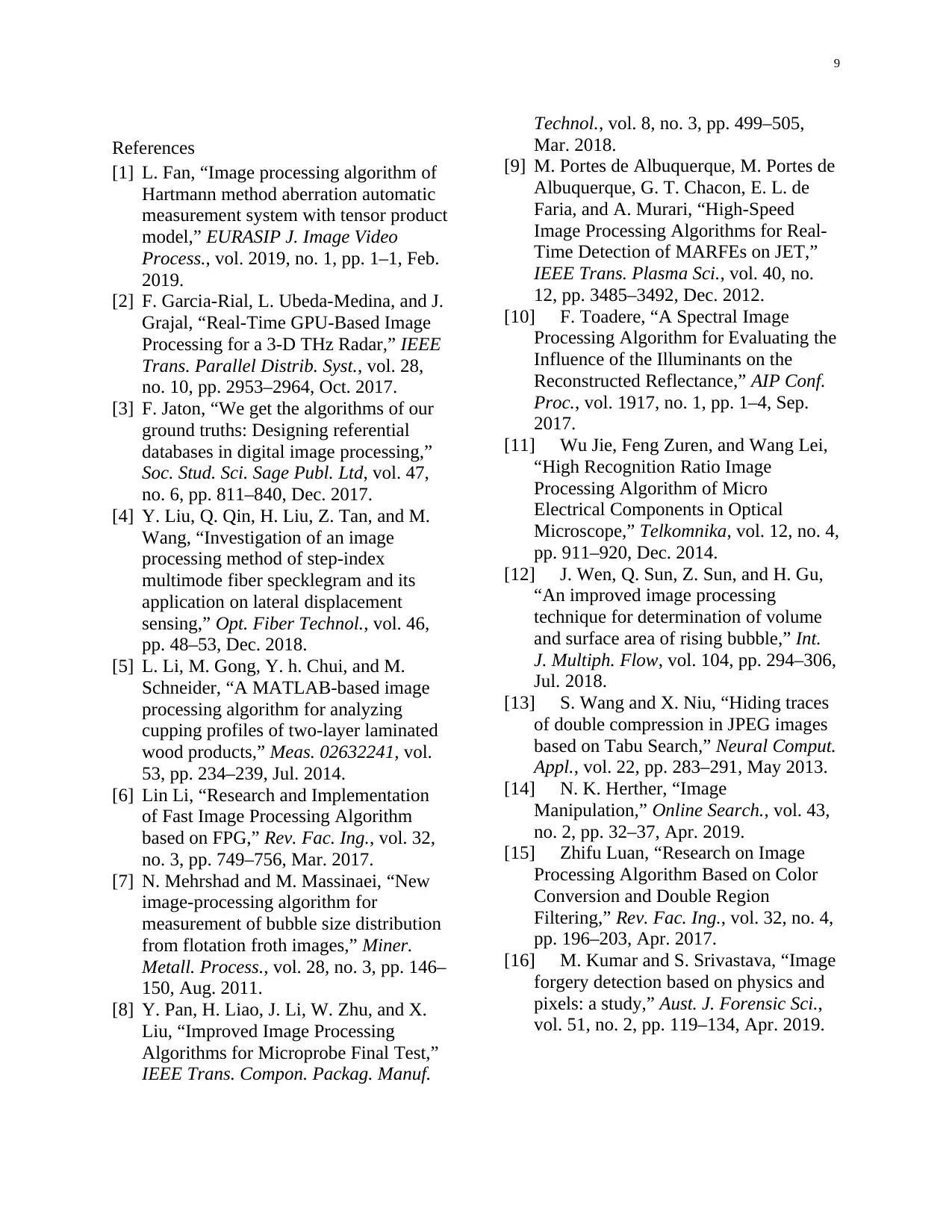
References
[1] L. Fan, “Image processing algorithm of
Hartmann method aberration automatic
measurement system with tensor product
model,” EURASIP J. Image Video
Process., vol. 2019, no. 1, pp. 1–1, Feb.
2019.
[2] F. Garcia-Rial, L. Ubeda-Medina, and J.
Grajal, “Real-Time GPU-Based Image
Processing for a 3-D THz Radar,” IEEE
Trans. Parallel Distrib. Syst., vol. 28,
no. 10, pp. 2953–2964, Oct. 2017.
[3] F. Jaton, “We get the algorithms of our
ground truths: Designing referential
databases in digital image processing,”
Soc. Stud. Sci. Sage Publ. Ltd, vol. 47,
no. 6, pp. 811–840, Dec. 2017.
[4] Y. Liu, Q. Qin, H. Liu, Z. Tan, and M.
Wang, “Investigation of an image
processing method of step-index
multimode fiber specklegram and its
application on lateral displacement
sensing,” Opt. Fiber Technol., vol. 46,
pp. 48–53, Dec. 2018.
[5] L. Li, M. Gong, Y. h. Chui, and M.
Schneider, “A MATLAB-based image
processing algorithm for analyzing
cupping profiles of two-layer laminated
wood products,” Meas. 02632241, vol.
53, pp. 234–239, Jul. 2014.
[6] Lin Li, “Research and Implementation
of Fast Image Processing Algorithm
based on FPG,” Rev. Fac. Ing., vol. 32,
no. 3, pp. 749–756, Mar. 2017.
[7] N. Mehrshad and M. Massinaei, “New
image-processing algorithm for
measurement of bubble size distribution
from flotation froth images,” Miner.
Metall. Process., vol. 28, no. 3, pp. 146–
150, Aug. 2011.
[8] Y. Pan, H. Liao, J. Li, W. Zhu, and X.
Liu, “Improved Image Processing
Algorithms for Microprobe Final Test,”
IEEE Trans. Compon. Packag. Manuf.
Technol., vol. 8, no. 3, pp. 499–505,
Mar. 2018.
[9] M. Portes de Albuquerque, M. Portes de
Albuquerque, G. T. Chacon, E. L. de
Faria, and A. Murari, “High-Speed
Image Processing Algorithms for Real-
Time Detection of MARFEs on JET,”
IEEE Trans. Plasma Sci., vol. 40, no.
12, pp. 3485–3492, Dec. 2012.
[10] F. Toadere, “A Spectral Image
Processing Algorithm for Evaluating the
Influence of the Illuminants on the
Reconstructed Reflectance,” AIP Conf.
Proc., vol. 1917, no. 1, pp. 1–4, Sep.
2017.
[11] Wu Jie, Feng Zuren, and Wang Lei,
“High Recognition Ratio Image
Processing Algorithm of Micro
Electrical Components in Optical
Microscope,” Telkomnika, vol. 12, no. 4,
pp. 911–920, Dec. 2014.
[12] J. Wen, Q. Sun, Z. Sun, and H. Gu,
“An improved image processing
technique for determination of volume
and surface area of rising bubble,” Int.
J. Multiph. Flow, vol. 104, pp. 294–306,
Jul. 2018.
[13] S. Wang and X. Niu, “Hiding traces
of double compression in JPEG images
based on Tabu Search,” Neural Comput.
Appl., vol. 22, pp. 283–291, May 2013.
[14] N. K. Herther, “Image
Manipulation,” Online Search., vol. 43,
no. 2, pp. 32–37, Apr. 2019.
[15] Zhifu Luan, “Research on Image
Processing Algorithm Based on Color
Conversion and Double Region
Filtering,” Rev. Fac. Ing., vol. 32, no. 4,
pp. 196–203, Apr. 2017.
[16] M. Kumar and S. Srivastava, “Image
forgery detection based on physics and
pixels: a study,” Aust. J. Forensic Sci.,
vol. 51, no. 2, pp. 119–134, Apr. 2019.
9
[1] L. Fan, “Image processing algorithm of
Hartmann method aberration automatic
measurement system with tensor product
model,” EURASIP J. Image Video
Process., vol. 2019, no. 1, pp. 1–1, Feb.
2019.
[2] F. Garcia-Rial, L. Ubeda-Medina, and J.
Grajal, “Real-Time GPU-Based Image
Processing for a 3-D THz Radar,” IEEE
Trans. Parallel Distrib. Syst., vol. 28,
no. 10, pp. 2953–2964, Oct. 2017.
[3] F. Jaton, “We get the algorithms of our
ground truths: Designing referential
databases in digital image processing,”
Soc. Stud. Sci. Sage Publ. Ltd, vol. 47,
no. 6, pp. 811–840, Dec. 2017.
[4] Y. Liu, Q. Qin, H. Liu, Z. Tan, and M.
Wang, “Investigation of an image
processing method of step-index
multimode fiber specklegram and its
application on lateral displacement
sensing,” Opt. Fiber Technol., vol. 46,
pp. 48–53, Dec. 2018.
[5] L. Li, M. Gong, Y. h. Chui, and M.
Schneider, “A MATLAB-based image
processing algorithm for analyzing
cupping profiles of two-layer laminated
wood products,” Meas. 02632241, vol.
53, pp. 234–239, Jul. 2014.
[6] Lin Li, “Research and Implementation
of Fast Image Processing Algorithm
based on FPG,” Rev. Fac. Ing., vol. 32,
no. 3, pp. 749–756, Mar. 2017.
[7] N. Mehrshad and M. Massinaei, “New
image-processing algorithm for
measurement of bubble size distribution
from flotation froth images,” Miner.
Metall. Process., vol. 28, no. 3, pp. 146–
150, Aug. 2011.
[8] Y. Pan, H. Liao, J. Li, W. Zhu, and X.
Liu, “Improved Image Processing
Algorithms for Microprobe Final Test,”
IEEE Trans. Compon. Packag. Manuf.
Technol., vol. 8, no. 3, pp. 499–505,
Mar. 2018.
[9] M. Portes de Albuquerque, M. Portes de
Albuquerque, G. T. Chacon, E. L. de
Faria, and A. Murari, “High-Speed
Image Processing Algorithms for Real-
Time Detection of MARFEs on JET,”
IEEE Trans. Plasma Sci., vol. 40, no.
12, pp. 3485–3492, Dec. 2012.
[10] F. Toadere, “A Spectral Image
Processing Algorithm for Evaluating the
Influence of the Illuminants on the
Reconstructed Reflectance,” AIP Conf.
Proc., vol. 1917, no. 1, pp. 1–4, Sep.
2017.
[11] Wu Jie, Feng Zuren, and Wang Lei,
“High Recognition Ratio Image
Processing Algorithm of Micro
Electrical Components in Optical
Microscope,” Telkomnika, vol. 12, no. 4,
pp. 911–920, Dec. 2014.
[12] J. Wen, Q. Sun, Z. Sun, and H. Gu,
“An improved image processing
technique for determination of volume
and surface area of rising bubble,” Int.
J. Multiph. Flow, vol. 104, pp. 294–306,
Jul. 2018.
[13] S. Wang and X. Niu, “Hiding traces
of double compression in JPEG images
based on Tabu Search,” Neural Comput.
Appl., vol. 22, pp. 283–291, May 2013.
[14] N. K. Herther, “Image
Manipulation,” Online Search., vol. 43,
no. 2, pp. 32–37, Apr. 2019.
[15] Zhifu Luan, “Research on Image
Processing Algorithm Based on Color
Conversion and Double Region
Filtering,” Rev. Fac. Ing., vol. 32, no. 4,
pp. 196–203, Apr. 2017.
[16] M. Kumar and S. Srivastava, “Image
forgery detection based on physics and
pixels: a study,” Aust. J. Forensic Sci.,
vol. 51, no. 2, pp. 119–134, Apr. 2019.
9
⊘ This is a preview!⊘
Do you want full access?
Subscribe today to unlock all pages.
Trusted by 1+ million students worldwide

1 out of 9


Your All-in-One AI-Powered Toolkit for Academic Success.
+13062052269
info@desklib.com
Available 24*7 on WhatsApp / Email
![[object Object]](/_next/static/media/star-bottom.7253800d.svg)
Unlock your academic potential
Copyright © 2020–2026 A2Z Services. All Rights Reserved. Developed and managed by ZUCOL.