Research Critique: Weight Management Barriers and Facilitators
VerifiedAdded on 2020/02/18
|6
|1544
|180
Report
AI Summary
This report presents a critical analysis of a research study by Abolhassani et al. (2012) that investigated the barriers and facilitators to weight management experienced by overweight and obese individuals. The study's background highlights the increasing prevalence of obesity and its associated health risks, emphasizing the need for effective weight management strategies. The research employed a qualitative content analysis method using purposive sampling and unstructured one-on-one interviews to collect data. Key findings revealed that participants often lacked professional guidance and faced physical, motivational, and social barriers. Psychological factors, however, served as facilitators. The report also assesses the study's ethical considerations and concludes by evaluating its credibility, transferability, and utility, particularly for nursing practice. It underscores the importance of addressing barriers and promoting active lifestyles to improve weight management outcomes and calls for further research on the role of healthcare professionals in this process.
Running head: RESEARCH CRITIQUE
Research critique
Name of the student:
Name of the University:
Author’s note
Research critique
Name of the student:
Name of the University:
Author’s note
Paraphrase This Document
Need a fresh take? Get an instant paraphrase of this document with our AI Paraphraser

1RESEARCH CRITIQUE
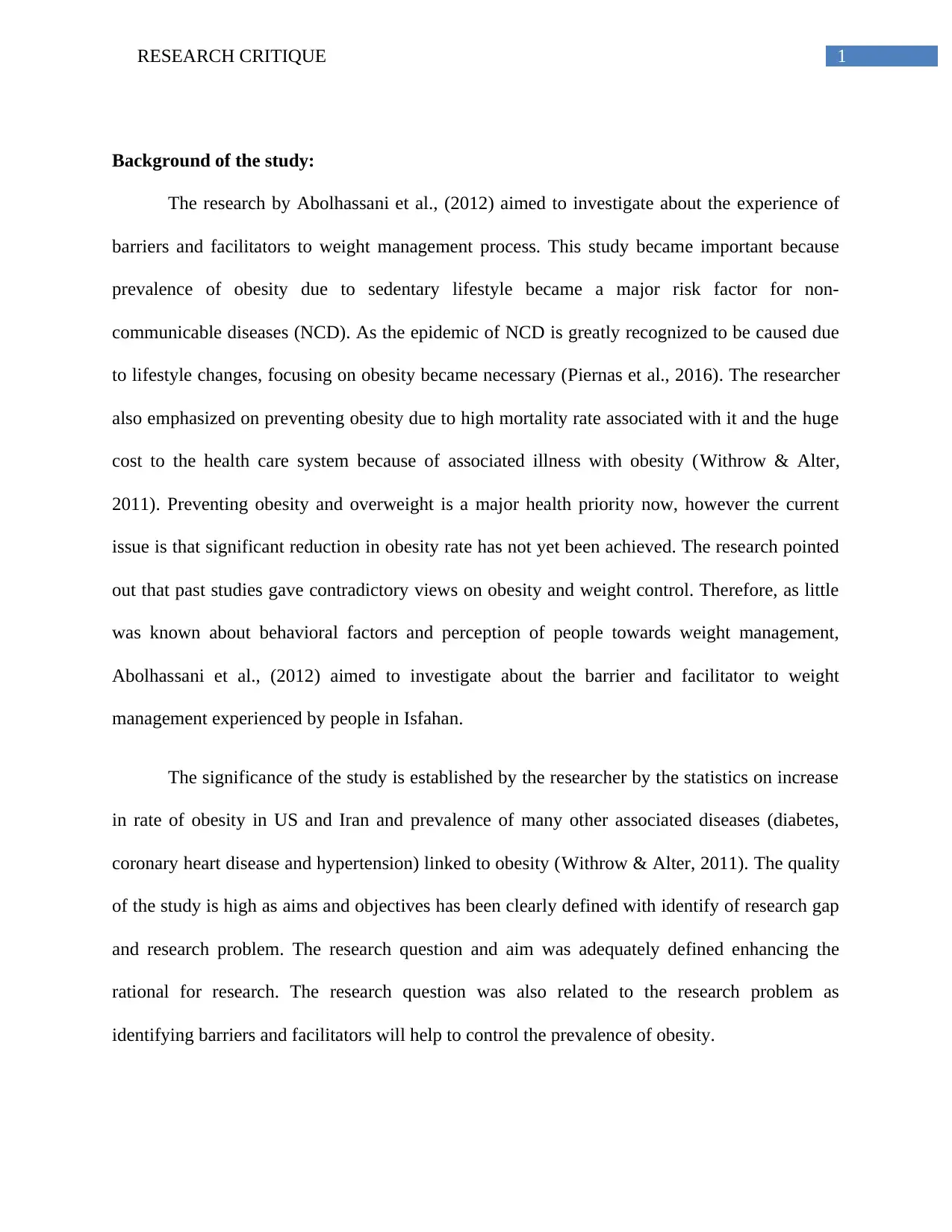
Background of the study:
The research by Abolhassani et al., (2012) aimed to investigate about the experience of
barriers and facilitators to weight management process. This study became important because
prevalence of obesity due to sedentary lifestyle became a major risk factor for non-
communicable diseases (NCD). As the epidemic of NCD is greatly recognized to be caused due
to lifestyle changes, focusing on obesity became necessary (Piernas et al., 2016). The researcher
also emphasized on preventing obesity due to high mortality rate associated with it and the huge
cost to the health care system because of associated illness with obesity (Withrow & Alter,
2011). Preventing obesity and overweight is a major health priority now, however the current
issue is that significant reduction in obesity rate has not yet been achieved. The research pointed
out that past studies gave contradictory views on obesity and weight control. Therefore, as little
was known about behavioral factors and perception of people towards weight management,
Abolhassani et al., (2012) aimed to investigate about the barrier and facilitator to weight
management experienced by people in Isfahan.
The significance of the study is established by the researcher by the statistics on increase
in rate of obesity in US and Iran and prevalence of many other associated diseases (diabetes,
coronary heart disease and hypertension) linked to obesity (Withrow & Alter, 2011). The quality
of the study is high as aims and objectives has been clearly defined with identify of research gap
and research problem. The research question and aim was adequately defined enhancing the
rational for research. The research question was also related to the research problem as
identifying barriers and facilitators will help to control the prevalence of obesity.
Background of the study:
The research by Abolhassani et al., (2012) aimed to investigate about the experience of
barriers and facilitators to weight management process. This study became important because
prevalence of obesity due to sedentary lifestyle became a major risk factor for non-
communicable diseases (NCD). As the epidemic of NCD is greatly recognized to be caused due
to lifestyle changes, focusing on obesity became necessary (Piernas et al., 2016). The researcher
also emphasized on preventing obesity due to high mortality rate associated with it and the huge
cost to the health care system because of associated illness with obesity (Withrow & Alter,
2011). Preventing obesity and overweight is a major health priority now, however the current
issue is that significant reduction in obesity rate has not yet been achieved. The research pointed
out that past studies gave contradictory views on obesity and weight control. Therefore, as little
was known about behavioral factors and perception of people towards weight management,
Abolhassani et al., (2012) aimed to investigate about the barrier and facilitator to weight
management experienced by people in Isfahan.
The significance of the study is established by the researcher by the statistics on increase
in rate of obesity in US and Iran and prevalence of many other associated diseases (diabetes,
coronary heart disease and hypertension) linked to obesity (Withrow & Alter, 2011). The quality
of the study is high as aims and objectives has been clearly defined with identify of research gap
and research problem. The research question and aim was adequately defined enhancing the
rational for research. The research question was also related to the research problem as
identifying barriers and facilitators will help to control the prevalence of obesity.

2RESEARCH CRITIQUE
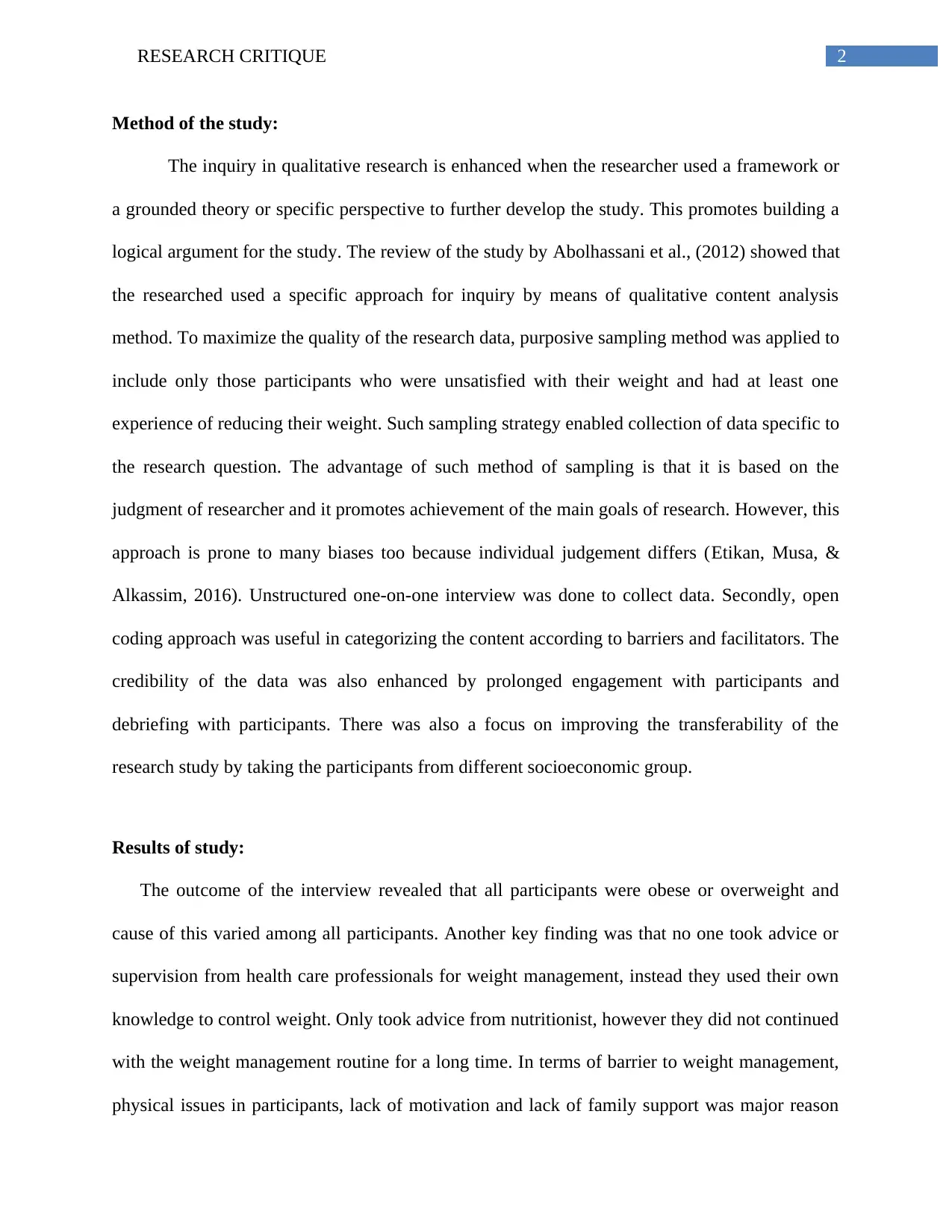
Method of the study:
The inquiry in qualitative research is enhanced when the researcher used a framework or
a grounded theory or specific perspective to further develop the study. This promotes building a
logical argument for the study. The review of the study by Abolhassani et al., (2012) showed that
the researched used a specific approach for inquiry by means of qualitative content analysis
method. To maximize the quality of the research data, purposive sampling method was applied to
include only those participants who were unsatisfied with their weight and had at least one
experience of reducing their weight. Such sampling strategy enabled collection of data specific to
the research question. The advantage of such method of sampling is that it is based on the
judgment of researcher and it promotes achievement of the main goals of research. However, this
approach is prone to many biases too because individual judgement differs (Etikan, Musa, &
Alkassim, 2016). Unstructured one-on-one interview was done to collect data. Secondly, open
coding approach was useful in categorizing the content according to barriers and facilitators. The
credibility of the data was also enhanced by prolonged engagement with participants and
debriefing with participants. There was also a focus on improving the transferability of the
research study by taking the participants from different socioeconomic group.
Results of study:
The outcome of the interview revealed that all participants were obese or overweight and
cause of this varied among all participants. Another key finding was that no one took advice or
supervision from health care professionals for weight management, instead they used their own
knowledge to control weight. Only took advice from nutritionist, however they did not continued
with the weight management routine for a long time. In terms of barrier to weight management,
physical issues in participants, lack of motivation and lack of family support was major reason
Method of the study:
The inquiry in qualitative research is enhanced when the researcher used a framework or
a grounded theory or specific perspective to further develop the study. This promotes building a
logical argument for the study. The review of the study by Abolhassani et al., (2012) showed that
the researched used a specific approach for inquiry by means of qualitative content analysis
method. To maximize the quality of the research data, purposive sampling method was applied to
include only those participants who were unsatisfied with their weight and had at least one
experience of reducing their weight. Such sampling strategy enabled collection of data specific to
the research question. The advantage of such method of sampling is that it is based on the
judgment of researcher and it promotes achievement of the main goals of research. However, this
approach is prone to many biases too because individual judgement differs (Etikan, Musa, &
Alkassim, 2016). Unstructured one-on-one interview was done to collect data. Secondly, open
coding approach was useful in categorizing the content according to barriers and facilitators. The
credibility of the data was also enhanced by prolonged engagement with participants and
debriefing with participants. There was also a focus on improving the transferability of the
research study by taking the participants from different socioeconomic group.
Results of study:
The outcome of the interview revealed that all participants were obese or overweight and
cause of this varied among all participants. Another key finding was that no one took advice or
supervision from health care professionals for weight management, instead they used their own
knowledge to control weight. Only took advice from nutritionist, however they did not continued
with the weight management routine for a long time. In terms of barrier to weight management,
physical issues in participants, lack of motivation and lack of family support was major reason
⊘ This is a preview!⊘
Do you want full access?
Subscribe today to unlock all pages.

Trusted by 1+ million students worldwide

3RESEARCH CRITIQUE
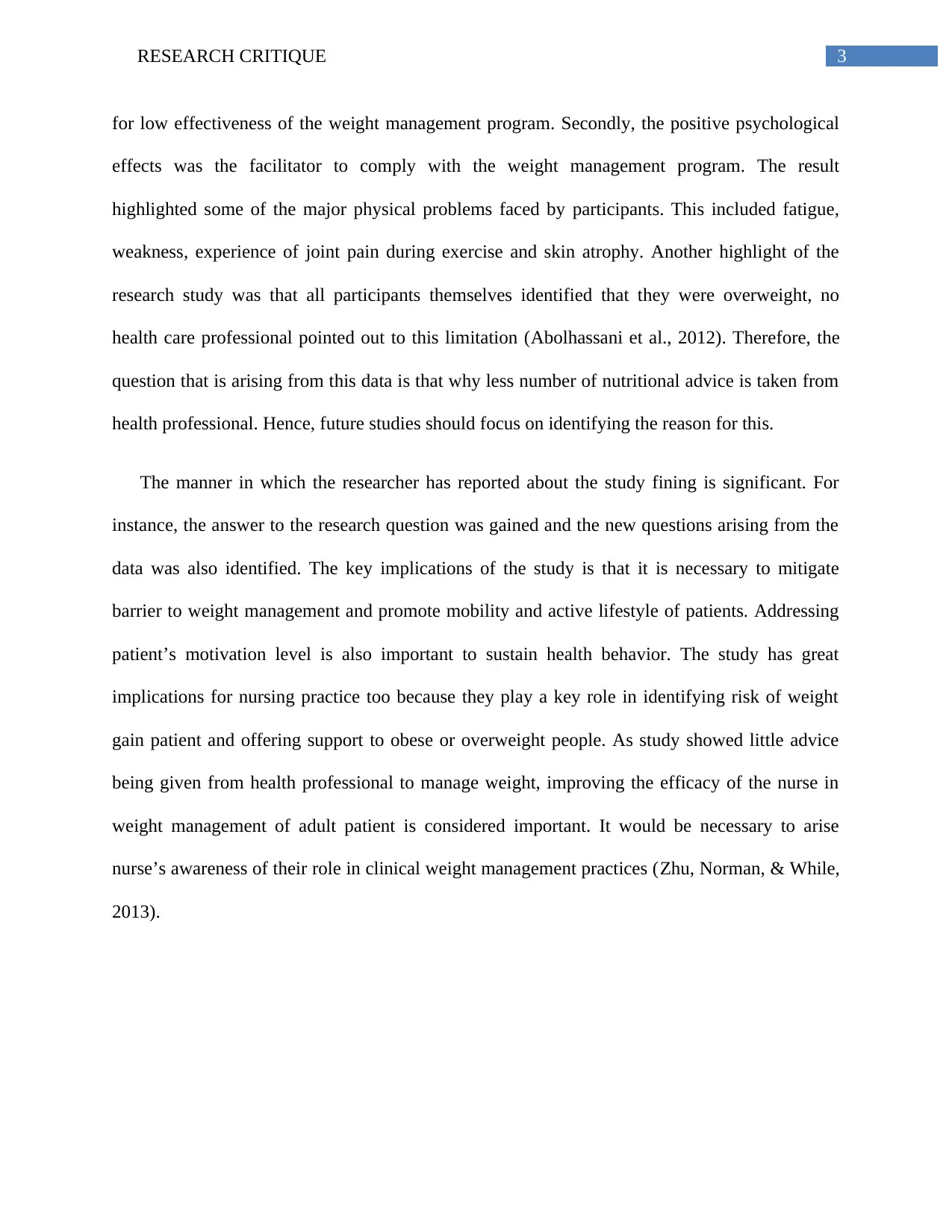
for low effectiveness of the weight management program. Secondly, the positive psychological
effects was the facilitator to comply with the weight management program. The result
highlighted some of the major physical problems faced by participants. This included fatigue,
weakness, experience of joint pain during exercise and skin atrophy. Another highlight of the
research study was that all participants themselves identified that they were overweight, no
health care professional pointed out to this limitation (Abolhassani et al., 2012). Therefore, the
question that is arising from this data is that why less number of nutritional advice is taken from
health professional. Hence, future studies should focus on identifying the reason for this.
The manner in which the researcher has reported about the study fining is significant. For
instance, the answer to the research question was gained and the new questions arising from the
data was also identified. The key implications of the study is that it is necessary to mitigate
barrier to weight management and promote mobility and active lifestyle of patients. Addressing
patient’s motivation level is also important to sustain health behavior. The study has great
implications for nursing practice too because they play a key role in identifying risk of weight
gain patient and offering support to obese or overweight people. As study showed little advice
being given from health professional to manage weight, improving the efficacy of the nurse in
weight management of adult patient is considered important. It would be necessary to arise
nurse’s awareness of their role in clinical weight management practices (Zhu, Norman, & While,
2013).
for low effectiveness of the weight management program. Secondly, the positive psychological
effects was the facilitator to comply with the weight management program. The result
highlighted some of the major physical problems faced by participants. This included fatigue,
weakness, experience of joint pain during exercise and skin atrophy. Another highlight of the
research study was that all participants themselves identified that they were overweight, no
health care professional pointed out to this limitation (Abolhassani et al., 2012). Therefore, the
question that is arising from this data is that why less number of nutritional advice is taken from
health professional. Hence, future studies should focus on identifying the reason for this.
The manner in which the researcher has reported about the study fining is significant. For
instance, the answer to the research question was gained and the new questions arising from the
data was also identified. The key implications of the study is that it is necessary to mitigate
barrier to weight management and promote mobility and active lifestyle of patients. Addressing
patient’s motivation level is also important to sustain health behavior. The study has great
implications for nursing practice too because they play a key role in identifying risk of weight
gain patient and offering support to obese or overweight people. As study showed little advice
being given from health professional to manage weight, improving the efficacy of the nurse in
weight management of adult patient is considered important. It would be necessary to arise
nurse’s awareness of their role in clinical weight management practices (Zhu, Norman, & While,
2013).
Paraphrase This Document
Need a fresh take? Get an instant paraphrase of this document with our AI Paraphraser

4RESEARCH CRITIQUE
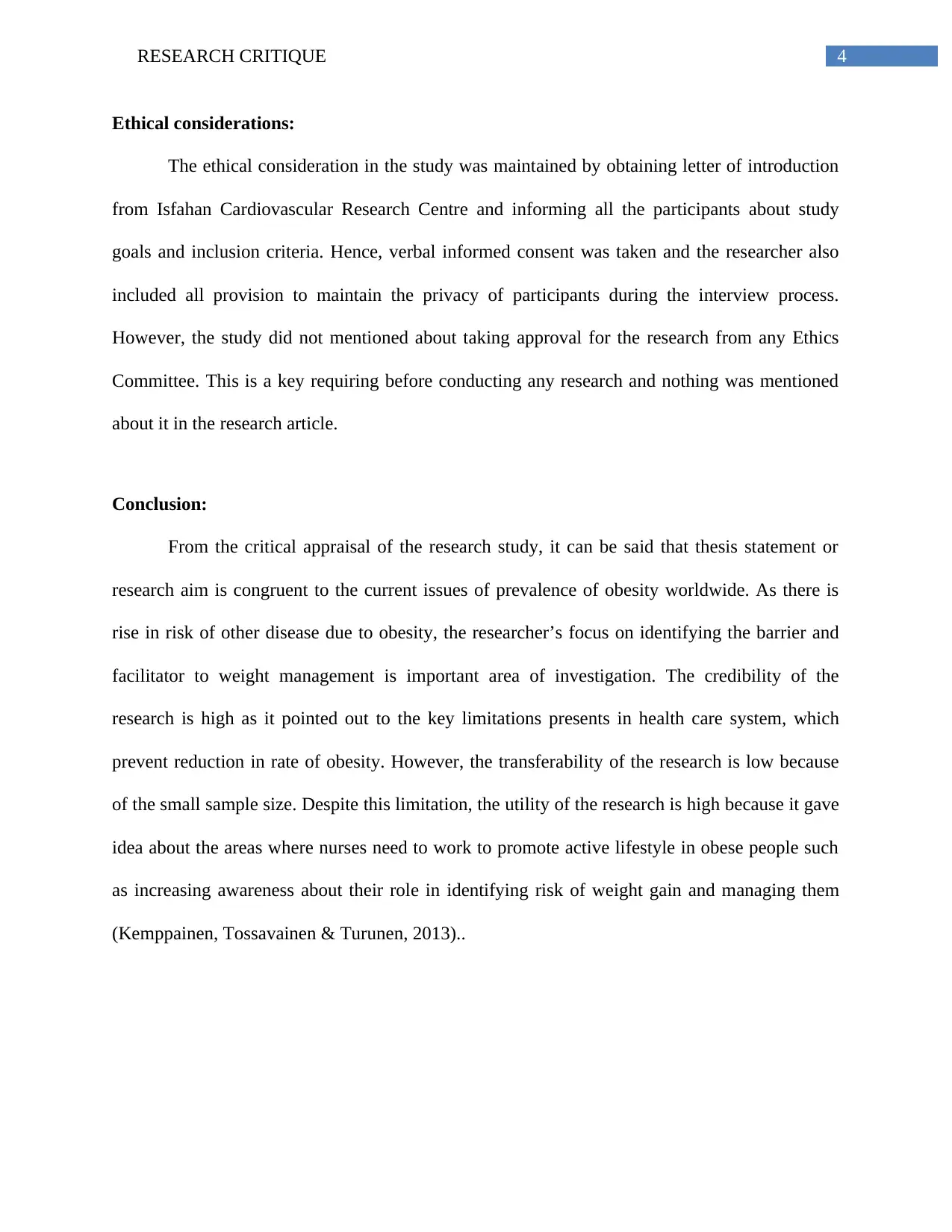
Ethical considerations:
The ethical consideration in the study was maintained by obtaining letter of introduction
from Isfahan Cardiovascular Research Centre and informing all the participants about study
goals and inclusion criteria. Hence, verbal informed consent was taken and the researcher also
included all provision to maintain the privacy of participants during the interview process.
However, the study did not mentioned about taking approval for the research from any Ethics
Committee. This is a key requiring before conducting any research and nothing was mentioned
about it in the research article.
Conclusion:
From the critical appraisal of the research study, it can be said that thesis statement or
research aim is congruent to the current issues of prevalence of obesity worldwide. As there is
rise in risk of other disease due to obesity, the researcher’s focus on identifying the barrier and
facilitator to weight management is important area of investigation. The credibility of the
research is high as it pointed out to the key limitations presents in health care system, which
prevent reduction in rate of obesity. However, the transferability of the research is low because
of the small sample size. Despite this limitation, the utility of the research is high because it gave
idea about the areas where nurses need to work to promote active lifestyle in obese people such
as increasing awareness about their role in identifying risk of weight gain and managing them
(Kemppainen, Tossavainen & Turunen, 2013)..
Ethical considerations:
The ethical consideration in the study was maintained by obtaining letter of introduction
from Isfahan Cardiovascular Research Centre and informing all the participants about study
goals and inclusion criteria. Hence, verbal informed consent was taken and the researcher also
included all provision to maintain the privacy of participants during the interview process.
However, the study did not mentioned about taking approval for the research from any Ethics
Committee. This is a key requiring before conducting any research and nothing was mentioned
about it in the research article.
Conclusion:
From the critical appraisal of the research study, it can be said that thesis statement or
research aim is congruent to the current issues of prevalence of obesity worldwide. As there is
rise in risk of other disease due to obesity, the researcher’s focus on identifying the barrier and
facilitator to weight management is important area of investigation. The credibility of the
research is high as it pointed out to the key limitations presents in health care system, which
prevent reduction in rate of obesity. However, the transferability of the research is low because
of the small sample size. Despite this limitation, the utility of the research is high because it gave
idea about the areas where nurses need to work to promote active lifestyle in obese people such
as increasing awareness about their role in identifying risk of weight gain and managing them
(Kemppainen, Tossavainen & Turunen, 2013)..

5RESEARCH CRITIQUE
Reference
Abolhassani, S., Irani, M. D., Sarrafzadegan, N., Rabiei, K., Shahrokhi, S., Pourmoghaddas,
Z., ... & Moattar, F. (2012). Barriers and facilitators of weight management in overweight
and obese people: Qualitative findings of TABASSOM project. Iranian journal of
nursing and midwifery research, 17(3), 205.
Etikan, I., Musa, S. A., & Alkassim, R. S. (2016). Comparison of convenience sampling and
purposive sampling. American Journal of Theoretical and Applied Statistics, 5(1), 1-4.
Kemppainen, V., Tossavainen, K., & Turunen, H. (2013). Nurses' roles in health promotion
practice: an integrative review. Health Promotion International, 28(4), 490-501.
Piernas, C., Wang, D., Du, S., Zhang, B., Wang, Z., Su, C., & Popkin, B. M. (2016). Obesity,
non-communicable disease (NCD) risk factors and dietary factors among Chinese school-
aged children. Asia Pacific journal of clinical nutrition, 25(4), 826.
Withrow, D., & Alter, D. A. (2011). The economic burden of obesity worldwide: a systematic
review of the direct costs of obesity. Obesity reviews, 12(2), 131-141.
Zhu, D. Q., Norman, I. J., & While, A. E. (2013). Nurses’ self-efficacy and practices relating to
weight management of adult patients: a path analysis. International Journal of
Behavioral Nutrition and Physical Activity, 10(1), 131.
Reference
Abolhassani, S., Irani, M. D., Sarrafzadegan, N., Rabiei, K., Shahrokhi, S., Pourmoghaddas,
Z., ... & Moattar, F. (2012). Barriers and facilitators of weight management in overweight
and obese people: Qualitative findings of TABASSOM project. Iranian journal of
nursing and midwifery research, 17(3), 205.
Etikan, I., Musa, S. A., & Alkassim, R. S. (2016). Comparison of convenience sampling and
purposive sampling. American Journal of Theoretical and Applied Statistics, 5(1), 1-4.
Kemppainen, V., Tossavainen, K., & Turunen, H. (2013). Nurses' roles in health promotion
practice: an integrative review. Health Promotion International, 28(4), 490-501.
Piernas, C., Wang, D., Du, S., Zhang, B., Wang, Z., Su, C., & Popkin, B. M. (2016). Obesity,
non-communicable disease (NCD) risk factors and dietary factors among Chinese school-
aged children. Asia Pacific journal of clinical nutrition, 25(4), 826.
Withrow, D., & Alter, D. A. (2011). The economic burden of obesity worldwide: a systematic
review of the direct costs of obesity. Obesity reviews, 12(2), 131-141.
Zhu, D. Q., Norman, I. J., & While, A. E. (2013). Nurses’ self-efficacy and practices relating to
weight management of adult patients: a path analysis. International Journal of
Behavioral Nutrition and Physical Activity, 10(1), 131.
⊘ This is a preview!⊘
Do you want full access?
Subscribe today to unlock all pages.

Trusted by 1+ million students worldwide
1 out of 6
Related Documents
Your All-in-One AI-Powered Toolkit for Academic Success.
+13062052269
info@desklib.com
Available 24*7 on WhatsApp / Email
Unlock your academic potential
Copyright © 2020–2026 A2Z Services. All Rights Reserved. Developed and managed by ZUCOL.