Research Literacy Report: Strategies for Domestic Violence Prevention
VerifiedAdded on 2023/06/10
|9
|2559
|133
Report
AI Summary
This report, titled "Research Literacy: Domestic Violence," examines various aspects of domestic violence, including intimate partner violence, dating abuse, and the impact of different intervention programs. The report begins with an introduction defining domestic violence and its different forms, followed by a description of the methods used to search for relevant peer-reviewed articles. The review section summarizes the findings of five selected articles, highlighting the effectiveness of community-based programs, dating abuse prevention campaigns, school-based interventions, and perinatal home visits in reducing domestic violence. The report also discusses the role of motivational interviewing in changing the behavior of perpetrators. The recommendations section focuses on the role of social workers in collaborating with victims, families, and agencies to ensure the safety of children and vulnerable individuals. The report concludes by emphasizing the importance of prevention strategies and promoting respectful relationships. References and an appendix are included for further information.
Running head- RESEARCH LITERACY
Domestic Violence
Name of the Student
Name of the University
Word Count- 1558
Author Note
Domestic Violence
Name of the Student
Name of the University
Word Count- 1558
Author Note

Paraphrase This Document
Need a fresh take? Get an instant paraphrase of this document with our AI Paraphraser
1RESEARCH LITERACY
Table of Contents
Introduction.................................................................................................................................2
Methods.......................................................................................................................................2
Review........................................................................................................................................2
Recommendations.......................................................................................................................5
Conclusion..................................................................................................................................5
References...................................................................................................................................6
Appendix.....................................................................................................................................8
Table of Contents
Introduction.................................................................................................................................2
Methods.......................................................................................................................................2
Review........................................................................................................................................2
Recommendations.......................................................................................................................5
Conclusion..................................................................................................................................5
References...................................................................................................................................6
Appendix.....................................................................................................................................8
2RESEARCH LITERACY
Introduction
Domestic violence is not only restricted to the lower and middle socioeconomic
households. Also referred to as family violence or domestic abuse, it refers to abuse by an
individual against another, which primarily takes place in a domestic setting. Such domestic
settings commonly encompass cohabitation and marriage (Root & Brown 2014, p.145).
Intimate partner violence is one kind of domestic violence that occurs when violent acts are
committed by partners or spouse in their intimate relationship. Furthermore, domestic
violence also takes place against parents, children and older adults. It occurs in different
forms namely, verbal, physical, economic, religious, emotional, sexual and reproductive
(Howard et al. 2013, p.e.1001452). This report will discuss five peer-reviewed articles that
elaborate on prevention of harm from this kind of violence.
Methods
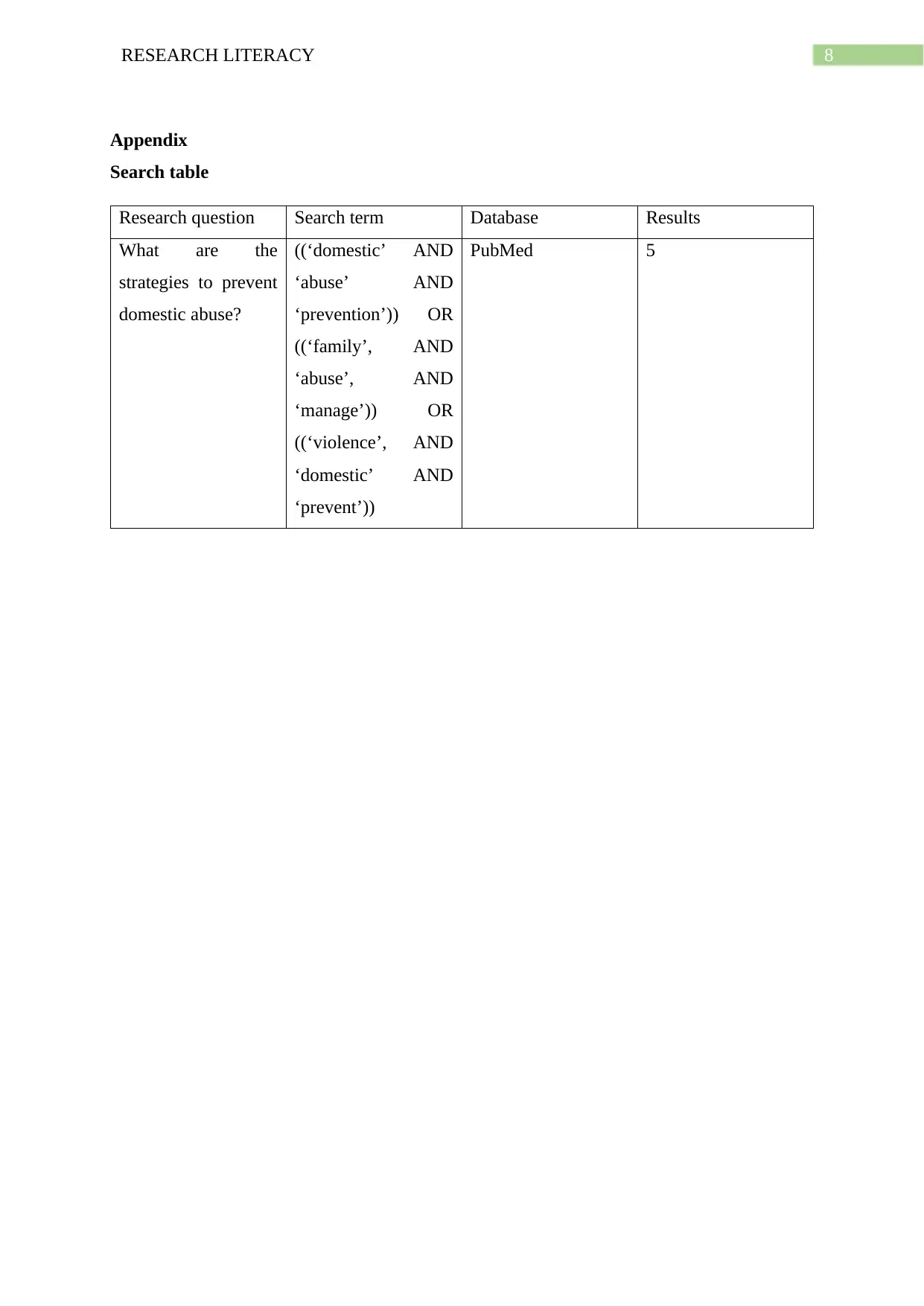
An organised pattern of search terms were used for retrieving relevant articles from
the electronic databases (Aromataris & Riitano 2014, p. 52). The search strategy was based on
a combination of different key words such as, ‘domestic’, ‘family’, ‘abuse’, ‘violence’,
‘manage’, ‘prevent’, ‘prevention’, ‘assault’, and ‘harm’. These key terms were combined with
the use of Boolean operators such as, AND, OR, and NOT. While AND narrowed down the
retrieved articles, use of OR helped in broadening the search results. NOT was used to extract
search hits that contained specific key terms and excluded others (McGowan et al. 2016,
p.42). Articles published in English, on or after 2013 were selected for the literature
discussion. A total of five articles were selected for the purpose (refer to appendix). The
rationale for selecting these five articles is that they identified the fact that domestic abuse
occurs when the abuser holds the belief that abuse is an acceptable, entitlement, and is
justified, without a likeliness for being reported.
Review
A study conducted a survey with the aim of gaining an understanding of the resources
and prevention services that were aimed at reducing rates of intimate partner violence in Los
Angeles. The study used certain community based programs and conducted the survey among
54 professionals, recruited from different agencies and programs, with the help of snowball
and purposive sampling. Findings from the survey indicate that most of the respondents did
not have any training or little training in the intimate partner violence among the LGBT.
Approximately 50% reported having helped LGBTs “often” or sometimes” in past years.
Introduction
Domestic violence is not only restricted to the lower and middle socioeconomic
households. Also referred to as family violence or domestic abuse, it refers to abuse by an
individual against another, which primarily takes place in a domestic setting. Such domestic
settings commonly encompass cohabitation and marriage (Root & Brown 2014, p.145).
Intimate partner violence is one kind of domestic violence that occurs when violent acts are
committed by partners or spouse in their intimate relationship. Furthermore, domestic
violence also takes place against parents, children and older adults. It occurs in different
forms namely, verbal, physical, economic, religious, emotional, sexual and reproductive
(Howard et al. 2013, p.e.1001452). This report will discuss five peer-reviewed articles that
elaborate on prevention of harm from this kind of violence.
Methods
An organised pattern of search terms were used for retrieving relevant articles from
the electronic databases (Aromataris & Riitano 2014, p. 52). The search strategy was based on
a combination of different key words such as, ‘domestic’, ‘family’, ‘abuse’, ‘violence’,
‘manage’, ‘prevent’, ‘prevention’, ‘assault’, and ‘harm’. These key terms were combined with
the use of Boolean operators such as, AND, OR, and NOT. While AND narrowed down the
retrieved articles, use of OR helped in broadening the search results. NOT was used to extract
search hits that contained specific key terms and excluded others (McGowan et al. 2016,
p.42). Articles published in English, on or after 2013 were selected for the literature
discussion. A total of five articles were selected for the purpose (refer to appendix). The
rationale for selecting these five articles is that they identified the fact that domestic abuse
occurs when the abuser holds the belief that abuse is an acceptable, entitlement, and is
justified, without a likeliness for being reported.
Review
A study conducted a survey with the aim of gaining an understanding of the resources
and prevention services that were aimed at reducing rates of intimate partner violence in Los
Angeles. The study used certain community based programs and conducted the survey among
54 professionals, recruited from different agencies and programs, with the help of snowball
and purposive sampling. Findings from the survey indicate that most of the respondents did
not have any training or little training in the intimate partner violence among the LGBT.
Approximately 50% reported having helped LGBTs “often” or sometimes” in past years.
⊘ This is a preview!⊘
Do you want full access?
Subscribe today to unlock all pages.

Trusted by 1+ million students worldwide
3RESEARCH LITERACY
Furthermore, 92% also reported on the lack of staff with enthusiastic responsibilities towards
prevention of LGBT IPV. Safe housing, counselling, legal aid, and support in traversing the
medical system were identified as some of the common strategies that worked in prevention
of violence against the LGBT community. The findings elaborated on the fact that people
belonging to the LGBT group should be provided adequate opportunities to rely on
intervention programs that are publicly available. The study also focused on the fact that
much attention is given towards the heterosexual female survivors whose partners (males) are
the perpetrators of the abuse (Ford et al. 2013, p.846).
Another study aimed to investigate the impacts of a dating abuse prevention
campaign, named the ‘Moms and Teens for Safe Dates’, and recruited mothers and adolescent
pairs with the help of community advertisement programs. Upon comparing the mothers and
the adolescents at the baseline and during a 6month follow-up time period, telephonic
interviews were conducted, in addition to delivery of booklets that had to be completed.
Program impacts on physical and psychological victimization, in addition to cyber and
psychological perpetration were found to get moderated by the extent of exposure of the
adolescents to different forms of domestic abuse. The results elaborate don the fact that dating
abuse plays an essential role in interfering with healthy mental and physical development of
adolescents. In addition to the harmful impacts that it creates on the physical and
psychological domains of the victim, it also acts as a major barrier in the path of trust, loyalty,
and attachment, thereby reducing competence and skills in personal life. Noteworthy effects
of the program were visible for the adolescents with increased acquaintance to family
violence. However, no main or moderated effects were found for perpetration, sexual violence
related victimization and/or cyber victimization. The results were encouraging and established
the use of the program for preventing dating abuse among the high risk population (Foshee et
al. 2015, p.997).
The role of schools in creating provisions for development of a setting where
interventions can aim at preventing intimate partner violence and all kinds of abuse were
identified in another study. The context in which the prevention strategies or interventions
were delivered was considered critical. Some of the contexts identified in the study included a
setting that comprises of wider policies, at a regional or national level, and the local culture
that helped in shaping the understanding of IPVA. Readiness of schools in implementing the
abuse prevention programs and/or interventions were also identified as vital. A shift in social
norms among peer groups appeared as a crucial mechanism that brought about a change.
Furthermore, 92% also reported on the lack of staff with enthusiastic responsibilities towards
prevention of LGBT IPV. Safe housing, counselling, legal aid, and support in traversing the
medical system were identified as some of the common strategies that worked in prevention
of violence against the LGBT community. The findings elaborated on the fact that people
belonging to the LGBT group should be provided adequate opportunities to rely on
intervention programs that are publicly available. The study also focused on the fact that
much attention is given towards the heterosexual female survivors whose partners (males) are
the perpetrators of the abuse (Ford et al. 2013, p.846).
Another study aimed to investigate the impacts of a dating abuse prevention
campaign, named the ‘Moms and Teens for Safe Dates’, and recruited mothers and adolescent
pairs with the help of community advertisement programs. Upon comparing the mothers and
the adolescents at the baseline and during a 6month follow-up time period, telephonic
interviews were conducted, in addition to delivery of booklets that had to be completed.
Program impacts on physical and psychological victimization, in addition to cyber and
psychological perpetration were found to get moderated by the extent of exposure of the
adolescents to different forms of domestic abuse. The results elaborate don the fact that dating
abuse plays an essential role in interfering with healthy mental and physical development of
adolescents. In addition to the harmful impacts that it creates on the physical and
psychological domains of the victim, it also acts as a major barrier in the path of trust, loyalty,
and attachment, thereby reducing competence and skills in personal life. Noteworthy effects
of the program were visible for the adolescents with increased acquaintance to family
violence. However, no main or moderated effects were found for perpetration, sexual violence
related victimization and/or cyber victimization. The results were encouraging and established
the use of the program for preventing dating abuse among the high risk population (Foshee et
al. 2015, p.997).
The role of schools in creating provisions for development of a setting where
interventions can aim at preventing intimate partner violence and all kinds of abuse were
identified in another study. The context in which the prevention strategies or interventions
were delivered was considered critical. Some of the contexts identified in the study included a
setting that comprises of wider policies, at a regional or national level, and the local culture
that helped in shaping the understanding of IPVA. Readiness of schools in implementing the
abuse prevention programs and/or interventions were also identified as vital. A shift in social
norms among peer groups appeared as a crucial mechanism that brought about a change.
Paraphrase This Document
Need a fresh take? Get an instant paraphrase of this document with our AI Paraphraser
4RESEARCH LITERACY
Consultation with the young people laid an emphasis on the prominence of authenticity,
which in turn could be attained with the usage of drama. The consultation also recognised an
increase in interest in directing at interventions on boys. Lack of appropriate prevention
materials that were intended for addressing abuse faced by the minority groups comprised of
young people such as, Lesbian, Bisexual, Gay, and Transgender were also identified. The
findings suggested that the response to local context can be increased by facilitating an
involvement of people who are held responsible for delivering and receiving the preventive
programmes at school level (Stanley et al. 2015, p.128).
A review aimed to illustrate the interventions that were aimed at preventing and/or
reducing all forms of domestic abuse against pregnant women. The review took into
consideration the concerns associated with domestic violence against women, in the context
of their health and human rights. Programs that comprise of perinatal home visits were
identified as a major form of intervention that showed an increased likelihood of lowering the
rates of incidence of physical abuse against pregnant women, thereby improving their infant
and pregnancy related outcomes. Counselling interventions were also considered effective in
showing promising results regarding prevention of abuse against pregnant females. Delivery
of cards, of the size of wallets that contain information on the list of community resources,
time spending in shelters and individual counselling were established as the major
intervention programs that can be implemented in a community, with the aim of preventing
domestic violence. Social support programs and intensive advocacy for the victims also
demonstrated significant impacts on preventing physical abuse, few years after
implementation. Additionally, referral to prenatal check-ups also provided clinicians with the
opportunity of screening women and referring them to a range of intervention programs.
Thus, screening and intervention plans for women were identified as helpful owing to the fact
that they were responsible for referring the identified victims to fitting healthcare agencies
and/or specialists for care, such as, shelters, social workers, and counselling. Referral to
’batterer’ treatment plans for the perpetrators were also recognized as vital (Jahanfar, Howard
& Medley 2014, p.61).
Similar findings were reported by another study that aimed to investigate the effects of
motivational interviewing on global functioning measures among males, involved in domestic
violence acts. Following recruitment of the male participants to a group therapy program
named Responsible Choices for Men (RCM), comparison was drawn between the groups
during pre-group, first-group and end of group sessions. The results of the study suggested
Consultation with the young people laid an emphasis on the prominence of authenticity,
which in turn could be attained with the usage of drama. The consultation also recognised an
increase in interest in directing at interventions on boys. Lack of appropriate prevention
materials that were intended for addressing abuse faced by the minority groups comprised of
young people such as, Lesbian, Bisexual, Gay, and Transgender were also identified. The
findings suggested that the response to local context can be increased by facilitating an
involvement of people who are held responsible for delivering and receiving the preventive
programmes at school level (Stanley et al. 2015, p.128).
A review aimed to illustrate the interventions that were aimed at preventing and/or
reducing all forms of domestic abuse against pregnant women. The review took into
consideration the concerns associated with domestic violence against women, in the context
of their health and human rights. Programs that comprise of perinatal home visits were
identified as a major form of intervention that showed an increased likelihood of lowering the
rates of incidence of physical abuse against pregnant women, thereby improving their infant
and pregnancy related outcomes. Counselling interventions were also considered effective in
showing promising results regarding prevention of abuse against pregnant females. Delivery
of cards, of the size of wallets that contain information on the list of community resources,
time spending in shelters and individual counselling were established as the major
intervention programs that can be implemented in a community, with the aim of preventing
domestic violence. Social support programs and intensive advocacy for the victims also
demonstrated significant impacts on preventing physical abuse, few years after
implementation. Additionally, referral to prenatal check-ups also provided clinicians with the
opportunity of screening women and referring them to a range of intervention programs.
Thus, screening and intervention plans for women were identified as helpful owing to the fact
that they were responsible for referring the identified victims to fitting healthcare agencies
and/or specialists for care, such as, shelters, social workers, and counselling. Referral to
’batterer’ treatment plans for the perpetrators were also recognized as vital (Jahanfar, Howard
& Medley 2014, p.61).
Similar findings were reported by another study that aimed to investigate the effects of
motivational interviewing on global functioning measures among males, involved in domestic
violence acts. Following recruitment of the male participants to a group therapy program
named Responsible Choices for Men (RCM), comparison was drawn between the groups
during pre-group, first-group and end of group sessions. The results of the study suggested
5RESEARCH LITERACY
that the readiness of an individual to change is most commonly evidenced via a change of
their stage, at the commencement of their therapy, which in turn is associated to global
treatment outcomes. Persons at the later stages of change demonstrated significant high OQ
scores, thereby suggesting recognition of specific domains in their lives, correlated to their
want for treatment. Thus, the impacts of motivational interviewing were considered as
clinically relevant for modifying the readiness of males to change their behaviour, with
respect to domestic abuse (Zalmanowitz et al. 2013, p.971).
Recommendations
The recommendations regarding domestic violence will be made in the context of
social work. Although social workers are entitled with the responsibility of working in
collaboration with the victims of domestic abuse, they should portray the skill of engaging
with the entire family and link with the experiences of all members that includes the
perpetrators, and the victims as well (Jewkes, Flood & Lang 2015, p.1585). Efforts must be
taken to ensure that children and all victims of domestic abuse are safe. Often, collaboration
needs to be formed with parents, with the aim of encouraging them to gain a sound
understanding of the perspectives and views of their children (Drijber, Reijnders & Ceelen
2013, p.175). Direct efforts must also be taken to strengthen the relationship between family
members and partners. Social workers are also required to establish strong links with different
agencies, with the aim of encouraging improved access to services for the victims and
vulnerable families (Hans et al. 2014, p.957).
Conclusion
Management of domestic abuse might be initiated with the introduction of law
enforcement, medical services, counselling, and legislation reforms. Owing to the private
nature of domestic abuse, most cases are unreported. These encompass violent acts between
people present in an intimate relationship in domestic settings. The acts have commonly been
identified as sexual, physical and emotional, and are commonly conducted by male
perpetrators against females, adolescents and children. Participants in domestic abuse should
also be provided with medical treatment, such as, examination by physician, and primary
care providers. Enforcing appropriate prevention strategies will help in the promotion of a
nonviolent and respectful relationships at the societal level.
that the readiness of an individual to change is most commonly evidenced via a change of
their stage, at the commencement of their therapy, which in turn is associated to global
treatment outcomes. Persons at the later stages of change demonstrated significant high OQ
scores, thereby suggesting recognition of specific domains in their lives, correlated to their
want for treatment. Thus, the impacts of motivational interviewing were considered as
clinically relevant for modifying the readiness of males to change their behaviour, with
respect to domestic abuse (Zalmanowitz et al. 2013, p.971).
Recommendations
The recommendations regarding domestic violence will be made in the context of
social work. Although social workers are entitled with the responsibility of working in
collaboration with the victims of domestic abuse, they should portray the skill of engaging
with the entire family and link with the experiences of all members that includes the
perpetrators, and the victims as well (Jewkes, Flood & Lang 2015, p.1585). Efforts must be
taken to ensure that children and all victims of domestic abuse are safe. Often, collaboration
needs to be formed with parents, with the aim of encouraging them to gain a sound
understanding of the perspectives and views of their children (Drijber, Reijnders & Ceelen
2013, p.175). Direct efforts must also be taken to strengthen the relationship between family
members and partners. Social workers are also required to establish strong links with different
agencies, with the aim of encouraging improved access to services for the victims and
vulnerable families (Hans et al. 2014, p.957).
Conclusion
Management of domestic abuse might be initiated with the introduction of law
enforcement, medical services, counselling, and legislation reforms. Owing to the private
nature of domestic abuse, most cases are unreported. These encompass violent acts between
people present in an intimate relationship in domestic settings. The acts have commonly been
identified as sexual, physical and emotional, and are commonly conducted by male
perpetrators against females, adolescents and children. Participants in domestic abuse should
also be provided with medical treatment, such as, examination by physician, and primary
care providers. Enforcing appropriate prevention strategies will help in the promotion of a
nonviolent and respectful relationships at the societal level.
⊘ This is a preview!⊘
Do you want full access?
Subscribe today to unlock all pages.
Trusted by 1+ million students worldwide
6RESEARCH LITERACY
References
Aromataris, E. & Riitano, D., 2014. ‘Systematic reviews: constructing a search strategy and
searching for evidence’, AJN The American Journal of Nursing, vol.114, no.5, pp.49-56.
Drijber, B.C., Reijnders, U.J. & Ceelen, M., 2013. ‘Male victims of domestic
violence’, Journal of Family Violence, vol.28, no.2, pp.173-178.
Ford, C.L., Slavin, T., Hilton, K.L. & Holt, S.L., 2013. ‘Intimate partner violence prevention
services and resources in Los Angeles: Issues, needs, and challenges for assisting lesbian, gay,
bisexual, and transgender clients’, Health Promotion Practice, vol.14, no.6, pp.841-849.
Foshee, V.A., Benefield, T., Dixon, K.S., Chang, L.Y., Senkomago, V., Ennett, S.T.,
Moracco, K.E. & Bowling, J.M., 2015. ‘The effects of Moms and Teens for Safe Dates: a
dating abuse prevention program for adolescents exposed to domestic violence’, Journal of
youth and adolescence, vol.44, no.5, pp.995-1010.
Hans, J.D., Hardesty, J.L., Haselschwerdt, M.L. & Frey, L.M., 2014. ‘The effects of domestic
violence allegations on custody evaluators’ recommendations’, Journal of family
psychology, vol.28, no.6, p.957.
Howard, L.M., Oram, S., Galley, H., Trevillion, K. & Feder, G., 2013. ‘Domestic violence
and perinatal mental disorders: a systematic review and meta-analysis’, PLoS
medicine, vol.10, no.5, p.e1001452.
Jahanfar, S., Howard, L.M. & Medley, N., 2014. ‘Interventions for preventing or reducing
domestic violence against pregnant women’, Cochrane Library, vol.11, pp.1-62.
Jewkes, R., Flood, M. & Lang, J., 2015. ‘From work with men and boys to changes of social
norms and reduction of inequities in gender relations: a conceptual shift in prevention of
violence against women and girls’, The Lancet, vol.385, no.9977, pp.1580-1589.
McGowan, J., Sampson, M., Salzwedel, D.M., Cogo, E., Foerster, V. & Lefebvre, C., 2016.
‘PRESS peer review of electronic search strategies: 2015 guideline statement’, Journal of
clinical epidemiology, vol.75, pp.40-46.
Root, M.P. & Brown, L., 2014. ‘An analysis of domestic violence in Asian American
communities: A multicultural approach to counseling’, In Diversity and complexity in
feminist therapy (pp. 143-164). Routledge.
References
Aromataris, E. & Riitano, D., 2014. ‘Systematic reviews: constructing a search strategy and
searching for evidence’, AJN The American Journal of Nursing, vol.114, no.5, pp.49-56.
Drijber, B.C., Reijnders, U.J. & Ceelen, M., 2013. ‘Male victims of domestic
violence’, Journal of Family Violence, vol.28, no.2, pp.173-178.
Ford, C.L., Slavin, T., Hilton, K.L. & Holt, S.L., 2013. ‘Intimate partner violence prevention
services and resources in Los Angeles: Issues, needs, and challenges for assisting lesbian, gay,
bisexual, and transgender clients’, Health Promotion Practice, vol.14, no.6, pp.841-849.
Foshee, V.A., Benefield, T., Dixon, K.S., Chang, L.Y., Senkomago, V., Ennett, S.T.,
Moracco, K.E. & Bowling, J.M., 2015. ‘The effects of Moms and Teens for Safe Dates: a
dating abuse prevention program for adolescents exposed to domestic violence’, Journal of
youth and adolescence, vol.44, no.5, pp.995-1010.
Hans, J.D., Hardesty, J.L., Haselschwerdt, M.L. & Frey, L.M., 2014. ‘The effects of domestic
violence allegations on custody evaluators’ recommendations’, Journal of family
psychology, vol.28, no.6, p.957.
Howard, L.M., Oram, S., Galley, H., Trevillion, K. & Feder, G., 2013. ‘Domestic violence
and perinatal mental disorders: a systematic review and meta-analysis’, PLoS
medicine, vol.10, no.5, p.e1001452.
Jahanfar, S., Howard, L.M. & Medley, N., 2014. ‘Interventions for preventing or reducing
domestic violence against pregnant women’, Cochrane Library, vol.11, pp.1-62.
Jewkes, R., Flood, M. & Lang, J., 2015. ‘From work with men and boys to changes of social
norms and reduction of inequities in gender relations: a conceptual shift in prevention of
violence against women and girls’, The Lancet, vol.385, no.9977, pp.1580-1589.
McGowan, J., Sampson, M., Salzwedel, D.M., Cogo, E., Foerster, V. & Lefebvre, C., 2016.
‘PRESS peer review of electronic search strategies: 2015 guideline statement’, Journal of
clinical epidemiology, vol.75, pp.40-46.
Root, M.P. & Brown, L., 2014. ‘An analysis of domestic violence in Asian American
communities: A multicultural approach to counseling’, In Diversity and complexity in
feminist therapy (pp. 143-164). Routledge.
Paraphrase This Document
Need a fresh take? Get an instant paraphrase of this document with our AI Paraphraser
7RESEARCH LITERACY
Stanley, N., Ellis, J., Farrelly, N., Hollinghurst, S. & Downe, S., 2015. ‘Preventing domestic
abuse for children and young people: A review of school-based interventions’, Children and
youth services review, vol.59, pp.120-131.
Zalmanowitz, S.J., Babins-Wagner, R., Rodger, S., Corbett, B.A. & Leschied, A., 2013. ‘The
association of readiness to change and motivational interviewing with treatment outcomes in
males involved in domestic violence group therapy’, Journal of interpersonal
violence, vol.28, no.5, pp.956-974.
Stanley, N., Ellis, J., Farrelly, N., Hollinghurst, S. & Downe, S., 2015. ‘Preventing domestic
abuse for children and young people: A review of school-based interventions’, Children and
youth services review, vol.59, pp.120-131.
Zalmanowitz, S.J., Babins-Wagner, R., Rodger, S., Corbett, B.A. & Leschied, A., 2013. ‘The
association of readiness to change and motivational interviewing with treatment outcomes in
males involved in domestic violence group therapy’, Journal of interpersonal
violence, vol.28, no.5, pp.956-974.
8RESEARCH LITERACY
Appendix
Search table
Research question Search term Database Results
What are the
strategies to prevent
domestic abuse?
((‘domestic’ AND
‘abuse’ AND
‘prevention’)) OR
((‘family’, AND
‘abuse’, AND
‘manage’)) OR
((‘violence’, AND
‘domestic’ AND
‘prevent’))
PubMed 5
Appendix
Search table
Research question Search term Database Results
What are the
strategies to prevent
domestic abuse?
((‘domestic’ AND
‘abuse’ AND
‘prevention’)) OR
((‘family’, AND
‘abuse’, AND
‘manage’)) OR
((‘violence’, AND
‘domestic’ AND
‘prevent’))
PubMed 5
⊘ This is a preview!⊘
Do you want full access?
Subscribe today to unlock all pages.
Trusted by 1+ million students worldwide

1 out of 9


Related Documents
![Research Proposal on Domestic Violence in Jamaica, [University Name]](/_next/image/?url=https%3A%2F%2Fdesklib.com%2Fmedia%2Fimages%2Fvm%2F9409e01f7b7b4bbcab39dc5b8f65bc8f.jpg&w=256&q=75)


Your All-in-One AI-Powered Toolkit for Academic Success.
+13062052269
info@desklib.com
Available 24*7 on WhatsApp / Email
![[object Object]](/_next/static/media/star-bottom.7253800d.svg)
Unlock your academic potential
Copyright © 2020–2026 A2Z Services. All Rights Reserved. Developed and managed by ZUCOL.