Research Proposal: Corporate Entrepreneurship Training Impact
VerifiedAdded on 2019/12/03
|21
|6324
|72
Report
AI Summary
This research proposal investigates the impact of corporate entrepreneurship training interventions on employee performance and innovation. The study begins with an introduction outlining the background, problem statement, research goals and objectives, research questions, scope, and rationale. Chapter 2 provides a comprehensive literature review, defining corporate entrepreneurship, exploring its training applications, and analyzing its relationship with employee performance, including conceptual frameworks. The methodology chapter, Chapter 3, details the research philosophies, approach, design, and techniques. It also covers the target population, sampling procedure, data collection and analysis methods, ethical considerations, and limitations of the study, with a timeline for completion. The study aims to assess the meaning and concept of corporate entrepreneurship training and innovation, the relationship between corporate entrepreneurship training and employee performance, and recommend ways to strengthen employee performance through innovative training interventions. The research emphasizes the importance of corporate entrepreneurship in adapting to a changing business environment and highlights the role of training in fostering employee creativity, innovation, and overall organizational success.

RESERCH
PROPOSAL
PROPOSAL

Paraphrase This Document
Need a fresh take? Get an instant paraphrase of this document with our AI Paraphraser
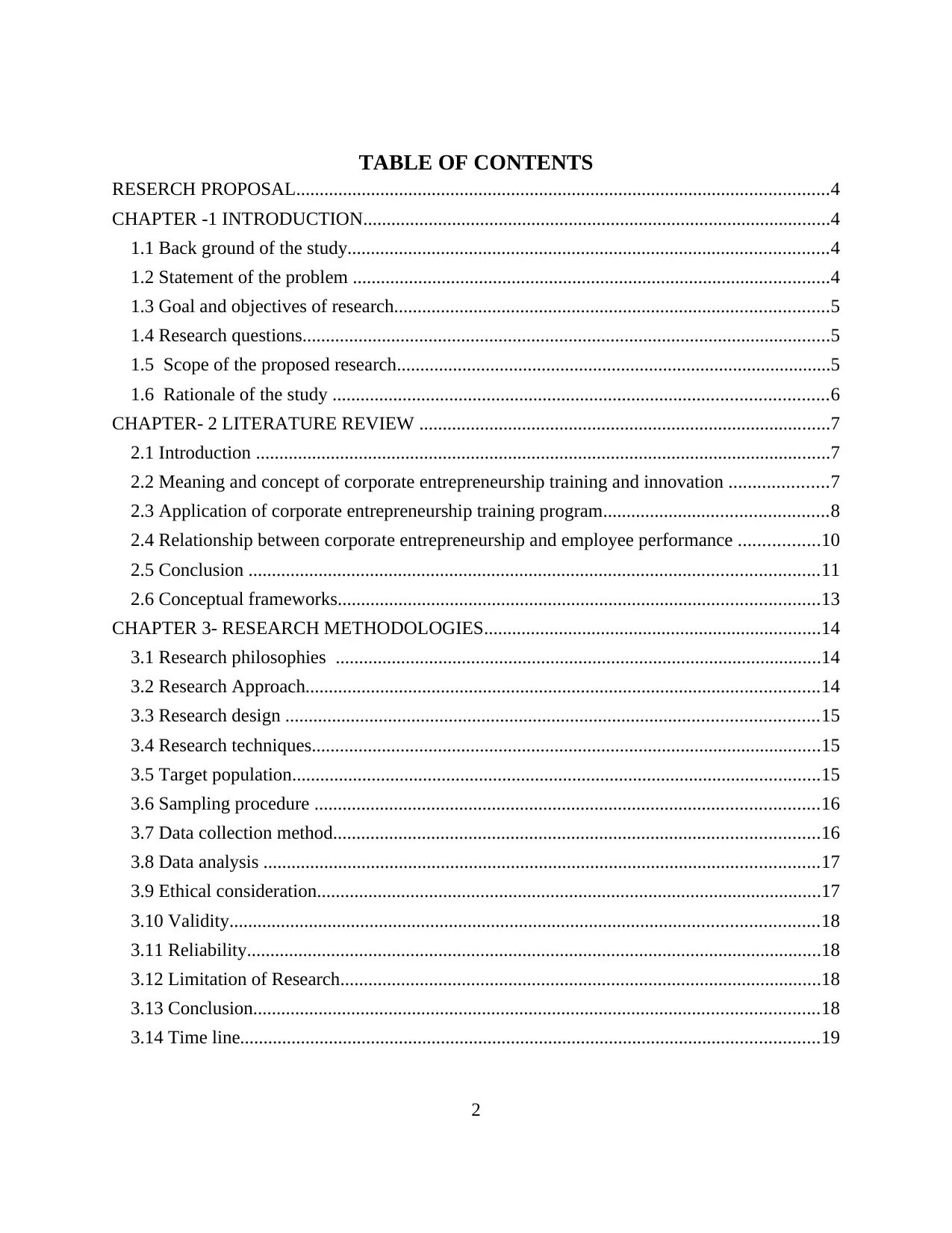
TABLE OF CONTENTS
RESERCH PROPOSAL..................................................................................................................4
CHAPTER -1 INTRODUCTION....................................................................................................4
1.1 Back ground of the study.......................................................................................................4
1.2 Statement of the problem ......................................................................................................4
1.3 Goal and objectives of research.............................................................................................5
1.4 Research questions.................................................................................................................5
1.5 Scope of the proposed research.............................................................................................5
1.6 Rationale of the study ..........................................................................................................6
CHAPTER- 2 LITERATURE REVIEW ........................................................................................7
2.1 Introduction ...........................................................................................................................7
2.2 Meaning and concept of corporate entrepreneurship training and innovation .....................7
2.3 Application of corporate entrepreneurship training program................................................8
2.4 Relationship between corporate entrepreneurship and employee performance .................10
2.5 Conclusion ..........................................................................................................................11
2.6 Conceptual frameworks.......................................................................................................13
CHAPTER 3- RESEARCH METHODOLOGIES........................................................................14
3.1 Research philosophies ........................................................................................................14
3.2 Research Approach..............................................................................................................14
3.3 Research design ..................................................................................................................15
3.4 Research techniques.............................................................................................................15
3.5 Target population.................................................................................................................15
3.6 Sampling procedure ............................................................................................................16
3.7 Data collection method........................................................................................................16
3.8 Data analysis .......................................................................................................................17
3.9 Ethical consideration............................................................................................................17
3.10 Validity..............................................................................................................................18
3.11 Reliability...........................................................................................................................18
3.12 Limitation of Research.......................................................................................................18
3.13 Conclusion.........................................................................................................................18
3.14 Time line............................................................................................................................19
2
RESERCH PROPOSAL..................................................................................................................4
CHAPTER -1 INTRODUCTION....................................................................................................4
1.1 Back ground of the study.......................................................................................................4
1.2 Statement of the problem ......................................................................................................4
1.3 Goal and objectives of research.............................................................................................5
1.4 Research questions.................................................................................................................5
1.5 Scope of the proposed research.............................................................................................5
1.6 Rationale of the study ..........................................................................................................6
CHAPTER- 2 LITERATURE REVIEW ........................................................................................7
2.1 Introduction ...........................................................................................................................7
2.2 Meaning and concept of corporate entrepreneurship training and innovation .....................7
2.3 Application of corporate entrepreneurship training program................................................8
2.4 Relationship between corporate entrepreneurship and employee performance .................10
2.5 Conclusion ..........................................................................................................................11
2.6 Conceptual frameworks.......................................................................................................13
CHAPTER 3- RESEARCH METHODOLOGIES........................................................................14
3.1 Research philosophies ........................................................................................................14
3.2 Research Approach..............................................................................................................14
3.3 Research design ..................................................................................................................15
3.4 Research techniques.............................................................................................................15
3.5 Target population.................................................................................................................15
3.6 Sampling procedure ............................................................................................................16
3.7 Data collection method........................................................................................................16
3.8 Data analysis .......................................................................................................................17
3.9 Ethical consideration............................................................................................................17
3.10 Validity..............................................................................................................................18
3.11 Reliability...........................................................................................................................18
3.12 Limitation of Research.......................................................................................................18
3.13 Conclusion.........................................................................................................................18
3.14 Time line............................................................................................................................19
2

REFERENCES..............................................................................................................................20
3
3
⊘ This is a preview!⊘
Do you want full access?
Subscribe today to unlock all pages.

Trusted by 1+ million students worldwide
RESERCH PROPOSAL
CHAPTER -1 INTRODUCTION
1.1 Back ground of the study
In the contemporary business environment, there has been significant change addressed
by the management related to technology, business operations, product development etc. All
these factors have direct impact on efficiency and performance of an organization and its market
position. Therefore, management has to implement several changes in business operations and
job roles and responsibilities of employees for managing the business as per the current market
trends (Gravells and Simpson, 2012). In this process, corporate entrepreneurship training plays
important role managing wide range of training program. Apart from that it has been analyzed
that corporate entrepreneurial training has found very effective to develop and encourage
employees to become more entrepreneurial so as employees become more creative and
innovative. In addition to that this approach also plays important role to encourage staff members
for acquisition of a certain set of skills which are essential for special project of company. It also
assists employees for application of creativity in different job operation (Reece and Walker,
2007). The present study will be carried out to assess the of corporate entrepreneurship training
interventions on employee performance and innovation. In this regard, this report will evaluate
various aspects of corporate entrepreneurship training.
1.2 Statement of the problem
In the contemporary business environment, companies associated with different sector
are facing tough competition. Therefore, organizations have to review practices by conducting
active research of different factors of business environment as per the current market trends. In
this process, organization requires to new ways of practical flexibility, increase its capacity with
the help of new innovations and show more competitiveness (Inkson, 2008). The strengthening
of entrepreneurship has been identified as a most important objective for any enterprise in which
management makes efforts for building its responsiveness to a globalised and changing
environment. Furthermore, it is evaluated that organization will not be able survive in the current
business environment without rapid mutation and innovation (Training in innovation and
corporate entrepreneurship at the Development Bank of Southern Africa, 2015). In this regard,
4
CHAPTER -1 INTRODUCTION
1.1 Back ground of the study
In the contemporary business environment, there has been significant change addressed
by the management related to technology, business operations, product development etc. All
these factors have direct impact on efficiency and performance of an organization and its market
position. Therefore, management has to implement several changes in business operations and
job roles and responsibilities of employees for managing the business as per the current market
trends (Gravells and Simpson, 2012). In this process, corporate entrepreneurship training plays
important role managing wide range of training program. Apart from that it has been analyzed
that corporate entrepreneurial training has found very effective to develop and encourage
employees to become more entrepreneurial so as employees become more creative and
innovative. In addition to that this approach also plays important role to encourage staff members
for acquisition of a certain set of skills which are essential for special project of company. It also
assists employees for application of creativity in different job operation (Reece and Walker,
2007). The present study will be carried out to assess the of corporate entrepreneurship training
interventions on employee performance and innovation. In this regard, this report will evaluate
various aspects of corporate entrepreneurship training.
1.2 Statement of the problem
In the contemporary business environment, companies associated with different sector
are facing tough competition. Therefore, organizations have to review practices by conducting
active research of different factors of business environment as per the current market trends. In
this process, organization requires to new ways of practical flexibility, increase its capacity with
the help of new innovations and show more competitiveness (Inkson, 2008). The strengthening
of entrepreneurship has been identified as a most important objective for any enterprise in which
management makes efforts for building its responsiveness to a globalised and changing
environment. Furthermore, it is evaluated that organization will not be able survive in the current
business environment without rapid mutation and innovation (Training in innovation and
corporate entrepreneurship at the Development Bank of Southern Africa, 2015). In this regard,
4
Paraphrase This Document
Need a fresh take? Get an instant paraphrase of this document with our AI Paraphraser
the present research will be carried out to examine the role of corporate entrepreneurship training
for promotion of innovation and handling of several elements associated with requirements of
different projects and business operations which are considered by management to assess
competitive position in market.
1.3 Goal and objectives of research
Goal of research:
“To assess the impact of corporate entrepreneurship training interventions on employee
performance and innovation”
Objectives:
The main objectives which will be followed by researcher are mentioned below:
To assess the meaning and concept of corporate entrepreneurship training and innovation.
To analyze the relationship between corporate entrepreneurship training and employee
performance.
To recommended the ways through which performance of employee can be strengthen
further through innovative training intervention.
1.4 Research questions
1. What is the meaning and concept of corporate entrepreneurship training and innovation?
2. How does corporate entrepreneurship training influence employee performance?
3. What are the ways through which performance of employee can be strengthen further
through innovative training intervention?
1.5 Scope of the proposed research
In the present investigation, investigator will evaluate different aspect corporate
entrepreneurship training and their application in organization through which management of
different companies can influence employees for managing with different job roles and roles and
responsibilities with an creative way (Eley and et.al., 2008). In this addition to that this report
will discuss the importance of corporate entrepreneurship training in order to enhance
organizational capabilities to carry out systematic researcher on new innovations and business
techniques that would lead positive impact on the competitive position of firm. Furthermore, the
present study will help manager for selection of appropriate skills development programs and
rewards for strengthen of employees capabilities and efficiency that would create positive impact
5
for promotion of innovation and handling of several elements associated with requirements of
different projects and business operations which are considered by management to assess
competitive position in market.
1.3 Goal and objectives of research
Goal of research:
“To assess the impact of corporate entrepreneurship training interventions on employee
performance and innovation”
Objectives:
The main objectives which will be followed by researcher are mentioned below:
To assess the meaning and concept of corporate entrepreneurship training and innovation.
To analyze the relationship between corporate entrepreneurship training and employee
performance.
To recommended the ways through which performance of employee can be strengthen
further through innovative training intervention.
1.4 Research questions
1. What is the meaning and concept of corporate entrepreneurship training and innovation?
2. How does corporate entrepreneurship training influence employee performance?
3. What are the ways through which performance of employee can be strengthen further
through innovative training intervention?
1.5 Scope of the proposed research
In the present investigation, investigator will evaluate different aspect corporate
entrepreneurship training and their application in organization through which management of
different companies can influence employees for managing with different job roles and roles and
responsibilities with an creative way (Eley and et.al., 2008). In this addition to that this report
will discuss the importance of corporate entrepreneurship training in order to enhance
organizational capabilities to carry out systematic researcher on new innovations and business
techniques that would lead positive impact on the competitive position of firm. Furthermore, the
present study will help manager for selection of appropriate skills development programs and
rewards for strengthen of employees capabilities and efficiency that would create positive impact
5
on overall performance of business entity (Kapp, 2012). In addition to that this assessment also
presents a distinct set of characteristics in a training program so as management can motivate
employees in order to innovate new products, new production process, creative marketing tactics
etc. so as overall performance of organization will be enhanced.
1.6 Rationale of the study
The emergence of globalization has provided various new opportunities of business
expansion for new as well as existing companies. It results huge business rivalry and market
competition among companies. In the situation, every organization makes efforts to enhance its
capabilities and market position with some unique products and business operation. This thing
has influenced importance innovation and creative approach with organization (King, Gulick and
Avery, 2010). Therefore, the present study will determine the impact of corporate
entrepreneurship training interventions on employee performance and innovation. In this context,
several studies have been carried out to assess the effect of employee training on their
performance. But, the present investigation will present some distinct views about training
methodology within business because it will pay extra attention ion corporate entrepreneurship
training interventions through management will be able to change behavior of workers and
employees will think creative while handling of different task (Corapi, 2012). Furthermore, the
current research will be found very useful in evaluation of impact of skills development process
on efficiency of staff along with productivity of company.
6
presents a distinct set of characteristics in a training program so as management can motivate
employees in order to innovate new products, new production process, creative marketing tactics
etc. so as overall performance of organization will be enhanced.
1.6 Rationale of the study
The emergence of globalization has provided various new opportunities of business
expansion for new as well as existing companies. It results huge business rivalry and market
competition among companies. In the situation, every organization makes efforts to enhance its
capabilities and market position with some unique products and business operation. This thing
has influenced importance innovation and creative approach with organization (King, Gulick and
Avery, 2010). Therefore, the present study will determine the impact of corporate
entrepreneurship training interventions on employee performance and innovation. In this context,
several studies have been carried out to assess the effect of employee training on their
performance. But, the present investigation will present some distinct views about training
methodology within business because it will pay extra attention ion corporate entrepreneurship
training interventions through management will be able to change behavior of workers and
employees will think creative while handling of different task (Corapi, 2012). Furthermore, the
current research will be found very useful in evaluation of impact of skills development process
on efficiency of staff along with productivity of company.
6
⊘ This is a preview!⊘
Do you want full access?
Subscribe today to unlock all pages.
Trusted by 1+ million students worldwide
CHAPTER- 2 LITERATURE REVIEW
2.1 Introduction
The literature review is second chapter of study and it helps a researcher to develop his
knowledge regarding the topic of study. In addition to this, this section depicts the views and
opinions of various authors regarding the topic under investigation. The major areas which are
covered in this report are meaning and concept of corporate entrepreneurship training and
innovation, relationship between corporate entrepreneurship training and employees
performance.
2.2 Meaning and concept of corporate entrepreneurship training and innovation
In modern era, the competition among businesses has become so intense that it is not easy
for them to grow and achieve adequate profits. Now organization can survive only by offering
new and unique products and services to the people in the market. As per the view Fante (2008)
of corporate entrepreneurship is defined as the process in which businesses develop new
opportunities and ideas. These ideas and concepts are developed with one of the prime objectives
of increasing the profits of business. On the other side of this, Pike (2003) has defined corporate
entrepreneurship trainings as a program which helps in enhancing the innovative abilities of
people within organization. Further such kind of programs also supports organizations to
increase their rate of corporate success as it results in creation of new ventures. According to
Amagada (2006), in the present scenario, the changing economy has forced organizations to
become flexible, speedy and innovative in order to grown and achieve success. Now a days the
concept of corporate entrepreneurship is helping companies to become flexible and innovative.
The process is termed as a renewal process for organization and has two main features which are
venturing and innovations. With the growing need of market many organizations have started to
organize corporate entrepreneurship to make their workers more innovative and productive. In
other terms Hurn (2011) defined corporate entrepreneurship as a process which goes inside an
existing firm and leads to a new venture. Such type of training programs are very essential for
large companies as it help in innovation and increasing the level of their degree of corporate
enterprising. However Lyons (2011) argued that it is not easy for businesses to design such kind
of trainings for employees and a lot of efforts are required for the same.
7
2.1 Introduction
The literature review is second chapter of study and it helps a researcher to develop his
knowledge regarding the topic of study. In addition to this, this section depicts the views and
opinions of various authors regarding the topic under investigation. The major areas which are
covered in this report are meaning and concept of corporate entrepreneurship training and
innovation, relationship between corporate entrepreneurship training and employees
performance.
2.2 Meaning and concept of corporate entrepreneurship training and innovation
In modern era, the competition among businesses has become so intense that it is not easy
for them to grow and achieve adequate profits. Now organization can survive only by offering
new and unique products and services to the people in the market. As per the view Fante (2008)
of corporate entrepreneurship is defined as the process in which businesses develop new
opportunities and ideas. These ideas and concepts are developed with one of the prime objectives
of increasing the profits of business. On the other side of this, Pike (2003) has defined corporate
entrepreneurship trainings as a program which helps in enhancing the innovative abilities of
people within organization. Further such kind of programs also supports organizations to
increase their rate of corporate success as it results in creation of new ventures. According to
Amagada (2006), in the present scenario, the changing economy has forced organizations to
become flexible, speedy and innovative in order to grown and achieve success. Now a days the
concept of corporate entrepreneurship is helping companies to become flexible and innovative.
The process is termed as a renewal process for organization and has two main features which are
venturing and innovations. With the growing need of market many organizations have started to
organize corporate entrepreneurship to make their workers more innovative and productive. In
other terms Hurn (2011) defined corporate entrepreneurship as a process which goes inside an
existing firm and leads to a new venture. Such type of training programs are very essential for
large companies as it help in innovation and increasing the level of their degree of corporate
enterprising. However Lyons (2011) argued that it is not easy for businesses to design such kind
of trainings for employees and a lot of efforts are required for the same.
7
Paraphrase This Document
Need a fresh take? Get an instant paraphrase of this document with our AI Paraphraser
One of the major drawback of such kind of programs is that the time is very limited and
employees can use the resources of only when company is not using them. Along with this, the
approval takes a very long time which is also a major limitation of corporate entrepreneurship
training. Has asserted that employees cannot just starting working the those ideas until and
unless it has been approved by their senior management (SKILLS TRAINING INTERVENTIONS,
2015 ). On the other side of this Zviran and et. al. (2011) have explained that businesses do not
have any kind of difficulty for setting up the new venture as the resources are ready available.
Such type of training also helps in creating a sense of satisfaction among them as a failure in
idea wont be putting their job at risk. In addition to this, mistake are not considered as costly and
organizations easily able to bear those cost. Large organizations have great benefits
2.3 Application of corporate entrepreneurship training program
The importance corporate entrepreneurship training program has been significantly
emerged due to significant change has been addressed in external business environment therefore
every organisation determines various strategies in order to enhance efficiency of workers that
leads positive impact on overall efficiency and productivity of company. In this regard, the study
of Gravells and Simpson (2012) have found that the management has to consider 4 element
during implementation of corporate entrepreneurship training program such a creative thinking
creatively, idea development process, evaluating the entrepreneurial culture along with detail
assessment of different barriers and facilitators associated with the entrepreneurial thinking and
action planning as per the requirement of current business environment (Designing effective
training interventions, 2015). The research of Reece and Walker (2007) has showed a significant
increase in all the factors is playing most crucial role during the Corporate Entrepreneurship
Training Programme. In this context, author further argued that this training programme cannot
be conducted only once and must be repeated in the organisation that leads signficant change in
behaviour of employees and their approach form managing different work related issues.
Inkson (2008) has determined that management needs to provide proper time and rewards
to employees for development of creative ideas that plays important role to encourage perception
of staff and promotion of creative thinking. Otherwise, lack of free time to develop new ideas is
limited the value of training programmes value and its effectiveness. In addition to that top
management has to formulate an integrated strategy for the change effort in working process of
8
employees can use the resources of only when company is not using them. Along with this, the
approval takes a very long time which is also a major limitation of corporate entrepreneurship
training. Has asserted that employees cannot just starting working the those ideas until and
unless it has been approved by their senior management (SKILLS TRAINING INTERVENTIONS,
2015 ). On the other side of this Zviran and et. al. (2011) have explained that businesses do not
have any kind of difficulty for setting up the new venture as the resources are ready available.
Such type of training also helps in creating a sense of satisfaction among them as a failure in
idea wont be putting their job at risk. In addition to this, mistake are not considered as costly and
organizations easily able to bear those cost. Large organizations have great benefits
2.3 Application of corporate entrepreneurship training program
The importance corporate entrepreneurship training program has been significantly
emerged due to significant change has been addressed in external business environment therefore
every organisation determines various strategies in order to enhance efficiency of workers that
leads positive impact on overall efficiency and productivity of company. In this regard, the study
of Gravells and Simpson (2012) have found that the management has to consider 4 element
during implementation of corporate entrepreneurship training program such a creative thinking
creatively, idea development process, evaluating the entrepreneurial culture along with detail
assessment of different barriers and facilitators associated with the entrepreneurial thinking and
action planning as per the requirement of current business environment (Designing effective
training interventions, 2015). The research of Reece and Walker (2007) has showed a significant
increase in all the factors is playing most crucial role during the Corporate Entrepreneurship
Training Programme. In this context, author further argued that this training programme cannot
be conducted only once and must be repeated in the organisation that leads signficant change in
behaviour of employees and their approach form managing different work related issues.
Inkson (2008) has determined that management needs to provide proper time and rewards
to employees for development of creative ideas that plays important role to encourage perception
of staff and promotion of creative thinking. Otherwise, lack of free time to develop new ideas is
limited the value of training programmes value and its effectiveness. In addition to that top
management has to formulate an integrated strategy for the change effort in working process of
8
employees so as company is able to take appropriate decisions for managing wide range skills
development and training activities (Training in innovation and corporate entrepreneurship at
the Development Bank of Southern Africa, 2015). The research of Kapp (2012) has evaluated that
the absence of intrapreneurial training programmes which are identified as an integral aspect of
corporate strategy decreases the opportunities for business to enhance efficiency of business and
challenge corporate objectives regarding product/idea development. Author has determined
several other factors that hamper the efficiency of training and restricted innovation within
business entity such as centralised decision-making, investment in short-term projects, inflexible
organisational structures along with the discouragement of risk-taking behaviours (King, Gulick
and Avery, 2010). All these elements have direct impact of intrapreneurial programmes and the
individual intrapreneur. Corapi (2012) has stated that corporate entrepreneurship training
programmes within an organisation has found effective in order separate organisations from
their competitors by creating distinct image of company. In this regard, the corporate
entrepreneurship training programme assists managers within business for launching
intrapreneur teams by organizing intrapreneurship workshops or seminars. In addition to that a
typical workshop plays important role for idea creation, upbringing the idea, researching the
specific target market, etc (Fante, 2008). Apart from that these workshop has found very
effective in order to carry out competitor analysis, evaluation of funding support and analysis of
various supportive factors that lead positive impact on the process of business planning and skills
of staff as per the current market trends.
The research of Pike (2003) has evaluated that organization has to implement a certain set
of strategies for implementation of change in perception and attitude of workers and make them
more creative and innovative. These factors lead positive impact on the performance
organization along with number of innovations with in business entity that influence capabilities
of company and provides competitive edge over other companies. In this process, first of all
management requires to assess attention of participants or employees during corporate
entrepreneurship training program that increases interest of employees within training activities
with the help of short stories (Amagada, 2006). The next session determines training objectives
which are varied for different business requirement such as new product development, project
planning, market planning etc. In the support of this, Hurn (2011) has determined that
9
development and training activities (Training in innovation and corporate entrepreneurship at
the Development Bank of Southern Africa, 2015). The research of Kapp (2012) has evaluated that
the absence of intrapreneurial training programmes which are identified as an integral aspect of
corporate strategy decreases the opportunities for business to enhance efficiency of business and
challenge corporate objectives regarding product/idea development. Author has determined
several other factors that hamper the efficiency of training and restricted innovation within
business entity such as centralised decision-making, investment in short-term projects, inflexible
organisational structures along with the discouragement of risk-taking behaviours (King, Gulick
and Avery, 2010). All these elements have direct impact of intrapreneurial programmes and the
individual intrapreneur. Corapi (2012) has stated that corporate entrepreneurship training
programmes within an organisation has found effective in order separate organisations from
their competitors by creating distinct image of company. In this regard, the corporate
entrepreneurship training programme assists managers within business for launching
intrapreneur teams by organizing intrapreneurship workshops or seminars. In addition to that a
typical workshop plays important role for idea creation, upbringing the idea, researching the
specific target market, etc (Fante, 2008). Apart from that these workshop has found very
effective in order to carry out competitor analysis, evaluation of funding support and analysis of
various supportive factors that lead positive impact on the process of business planning and skills
of staff as per the current market trends.
The research of Pike (2003) has evaluated that organization has to implement a certain set
of strategies for implementation of change in perception and attitude of workers and make them
more creative and innovative. These factors lead positive impact on the performance
organization along with number of innovations with in business entity that influence capabilities
of company and provides competitive edge over other companies. In this process, first of all
management requires to assess attention of participants or employees during corporate
entrepreneurship training program that increases interest of employees within training activities
with the help of short stories (Amagada, 2006). The next session determines training objectives
which are varied for different business requirement such as new product development, project
planning, market planning etc. In the support of this, Hurn (2011) has determined that
9
⊘ This is a preview!⊘
Do you want full access?
Subscribe today to unlock all pages.
Trusted by 1+ million students worldwide
management has to disclose all kind of information and data about the process of training and
their outcomes. Author has argued that trainers should have to check understanding of participant
during training sessions. In addition to that it has been evaluated as per understanding of staff
members and management needs to provide proper guidance that which business entity is able
change perception and attitude of workers as per the current market and develops creative
thinking (Zviran and et. al., 2011). This whole process helps business entity for scheduling of
various strategies and process for development of creative thinking among staff. This approach
enhances efficiency of company because organization has developed ability to carry out new
innovations as per changes found in market place.
2.4 Relationship between corporate entrepreneurship and employee performance
Corporate entrepreneurship has become one of the most important and a key tool for
organization in order to get competitive advantage. Amagada (2006) has explained that
employee performance can be enhanced only when they are motivated. The program of corporate
entrepreneurship helps employees to become more competent and innovative. Further it acts as a
driving force for them and results in enhancing their overall performance. Innovation is a stage in
which an organization have continues development or new development in process, operations
and products (SKILLS TRAINING INTERVENTIONS, 2015). Further it can happen only when
people in the organization suggest new ideas and information for development. In order to
survive in global competition, innovation has become key aspect. Hurn (2011) has stated that it
has been observed that the engagement of employees in the decision making and success of
business has lower down to a great extent. It has also resulted in increasing the rate of employee
turnover which is one of the major issue in front of organization. As per the view of Lyons
(2011) there is a direct relation between corporate entrepreneurship and employee performance.
corporate entrepreneurship results in increasing the financial performance of companies and also
assist in boosting up the morale of employees.
Such type of training programs have a direct impact on the performance of employees by
enhancing their skills set. On the other hand, the employee feel motivated and satisfied which act
a driving force for them. It encourages the workers to give their best towards the accomplishment
of the aim and objectives of businesses. This further results in improving the overall performance
of employees. On the other side of this, Gravells and Simpson (2012) have argued that such
10
their outcomes. Author has argued that trainers should have to check understanding of participant
during training sessions. In addition to that it has been evaluated as per understanding of staff
members and management needs to provide proper guidance that which business entity is able
change perception and attitude of workers as per the current market and develops creative
thinking (Zviran and et. al., 2011). This whole process helps business entity for scheduling of
various strategies and process for development of creative thinking among staff. This approach
enhances efficiency of company because organization has developed ability to carry out new
innovations as per changes found in market place.
2.4 Relationship between corporate entrepreneurship and employee performance
Corporate entrepreneurship has become one of the most important and a key tool for
organization in order to get competitive advantage. Amagada (2006) has explained that
employee performance can be enhanced only when they are motivated. The program of corporate
entrepreneurship helps employees to become more competent and innovative. Further it acts as a
driving force for them and results in enhancing their overall performance. Innovation is a stage in
which an organization have continues development or new development in process, operations
and products (SKILLS TRAINING INTERVENTIONS, 2015). Further it can happen only when
people in the organization suggest new ideas and information for development. In order to
survive in global competition, innovation has become key aspect. Hurn (2011) has stated that it
has been observed that the engagement of employees in the decision making and success of
business has lower down to a great extent. It has also resulted in increasing the rate of employee
turnover which is one of the major issue in front of organization. As per the view of Lyons
(2011) there is a direct relation between corporate entrepreneurship and employee performance.
corporate entrepreneurship results in increasing the financial performance of companies and also
assist in boosting up the morale of employees.
Such type of training programs have a direct impact on the performance of employees by
enhancing their skills set. On the other hand, the employee feel motivated and satisfied which act
a driving force for them. It encourages the workers to give their best towards the accomplishment
of the aim and objectives of businesses. This further results in improving the overall performance
of employees. On the other side of this, Gravells and Simpson (2012) have argued that such
10
Paraphrase This Document
Need a fresh take? Get an instant paraphrase of this document with our AI Paraphraser
type of programs can also create dissatisfaction among employees. The workers are required to
present their views and idea regarding the new venture and if the ideas are not taken into
consideration then a sense of dissatisfaction is created among the mind of employees. This has a
direct impact on employee performance and also lower down their morale (Fante, 2008).
Therefore, organizations are required to take care of this fact even if the ideas and views of
workers are not taken into consideration, they should be appreciated. corporate entrepreneurship
is a program which enhances the innovative abilities of people within organization. Thus, it has
direct impact on the performance of workers and by increasing their abilities and skills set(King,
Gulick and Avery, 2010). Further workers initiate participation by their own as they are well
aware of the fact that this will help them in finding better employment opportunities in future.
As per the research of Reece and Walker (2007) corporate entrepreneurship training
activities provide a distinct set of skills and knowledge which plays important role in career
development or growth so as employees pay extra attention on new skills which have essential
in contemporary of business environment. All these factors have influenced motivation level and
workers always try to apply some creative ideas and thought while handling different operations
as per the job roles and responsibilities. All these element help employee for improving his
performance and outcomes with reference to organisational gaols. Amagada (2006) has argued
that corporate entrepreneurship training process has found very effective for development of
creative thinking among staff member so as staff members develops different creative solutions
of wider range of work based issues that lead positive impact on their own performance along
with the productivity of organization.
2.5 Conclusion
On the basis of above assessment, it can be concluded that corporate entrepreneurship
trainings as a program has played important role for enhancing the innovative abilities and skills
of people within organization that supports organizations in order to increase rate of corporate
success with the help of new ventures that have been carried out by workers. This investigation
has found significant relationship between corporate entrepreneurship and employee
performance because corporate entrepreneurship has improved the financial performance of
companies and also assist in boosting up the morale of employees. This evaluation has examined
different aspects of corporate entrepreneurship have influenced motivation level so as workers
11
present their views and idea regarding the new venture and if the ideas are not taken into
consideration then a sense of dissatisfaction is created among the mind of employees. This has a
direct impact on employee performance and also lower down their morale (Fante, 2008).
Therefore, organizations are required to take care of this fact even if the ideas and views of
workers are not taken into consideration, they should be appreciated. corporate entrepreneurship
is a program which enhances the innovative abilities of people within organization. Thus, it has
direct impact on the performance of workers and by increasing their abilities and skills set(King,
Gulick and Avery, 2010). Further workers initiate participation by their own as they are well
aware of the fact that this will help them in finding better employment opportunities in future.
As per the research of Reece and Walker (2007) corporate entrepreneurship training
activities provide a distinct set of skills and knowledge which plays important role in career
development or growth so as employees pay extra attention on new skills which have essential
in contemporary of business environment. All these factors have influenced motivation level and
workers always try to apply some creative ideas and thought while handling different operations
as per the job roles and responsibilities. All these element help employee for improving his
performance and outcomes with reference to organisational gaols. Amagada (2006) has argued
that corporate entrepreneurship training process has found very effective for development of
creative thinking among staff member so as staff members develops different creative solutions
of wider range of work based issues that lead positive impact on their own performance along
with the productivity of organization.
2.5 Conclusion
On the basis of above assessment, it can be concluded that corporate entrepreneurship
trainings as a program has played important role for enhancing the innovative abilities and skills
of people within organization that supports organizations in order to increase rate of corporate
success with the help of new ventures that have been carried out by workers. This investigation
has found significant relationship between corporate entrepreneurship and employee
performance because corporate entrepreneurship has improved the financial performance of
companies and also assist in boosting up the morale of employees. This evaluation has examined
different aspects of corporate entrepreneurship have influenced motivation level so as workers
11
always try to apply some creative ideas and thought while handling job roles and operations that
leads positive impact on staff performance.
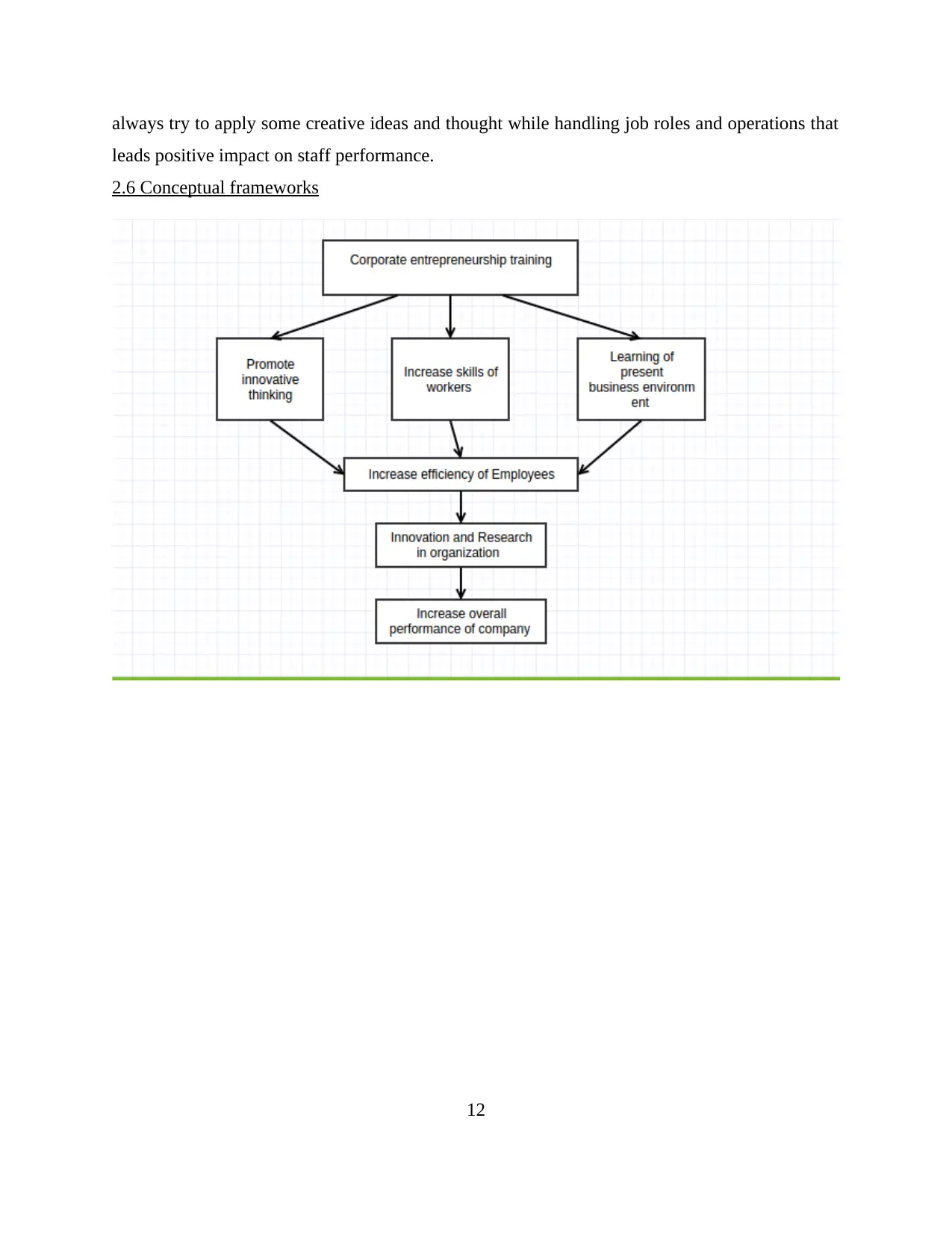
2.6 Conceptual frameworks
12
leads positive impact on staff performance.
2.6 Conceptual frameworks
12
⊘ This is a preview!⊘
Do you want full access?
Subscribe today to unlock all pages.
Trusted by 1+ million students worldwide

1 out of 21


Related Documents


Your All-in-One AI-Powered Toolkit for Academic Success.
+13062052269
info@desklib.com
Available 24*7 on WhatsApp / Email
![[object Object]](/_next/static/media/star-bottom.7253800d.svg)
Unlock your academic potential
Copyright © 2020–2026 A2Z Services. All Rights Reserved. Developed and managed by ZUCOL.