Social Research Report: An Analysis of Equality and Inequality
VerifiedAdded on 2022/11/15
|10
|2128
|176
Report
AI Summary
This report provides a comprehensive overview of social research, exploring its methods, importance, and application to understanding societal issues. It begins with an introduction to social research, defining its role in understanding people and society, and then delves into qualitative and quantitative research methods. The report highlights the significance of social research in various contexts, including knowledge acquisition, informing policy, fostering social cohesion, and addressing social problems. The core of the report focuses on the concepts of equality and inequality, examining their definitions, characteristics, and types. It presents different perspectives on inequality, including functionalist and conflict theories, and illustrates these concepts with real-world examples. The report concludes by summarizing the key findings and emphasizing the relevance of social research in analyzing and addressing issues related to equality and inequality.

Running Head: SOCIAL RESEARCH 0
Social Research
July 20
2019
Social Research
July 20
2019

Paraphrase This Document
Need a fresh take? Get an instant paraphrase of this document with our AI Paraphraser
Social Research 1
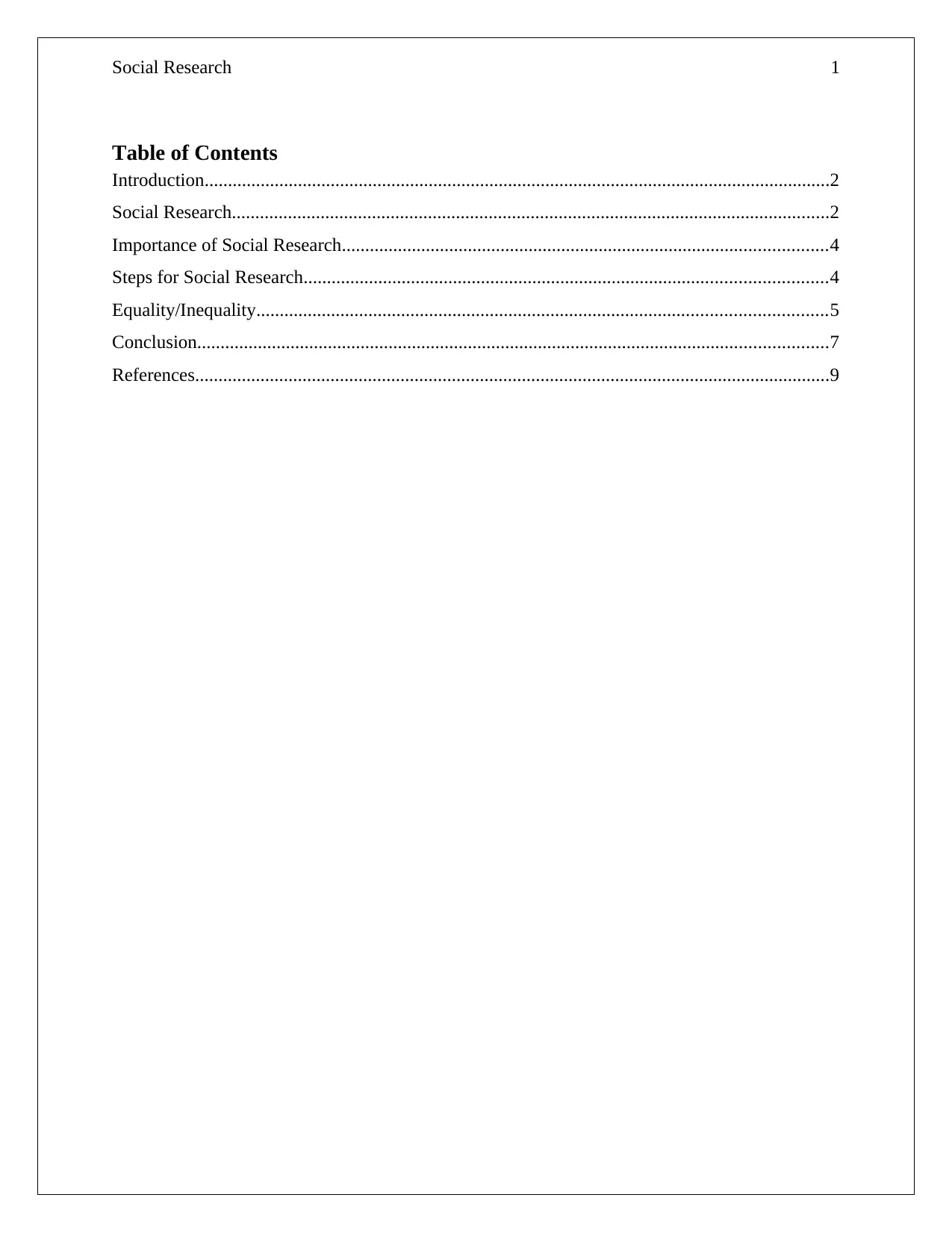
Table of Contents
Introduction......................................................................................................................................2
Social Research................................................................................................................................2
Importance of Social Research........................................................................................................4
Steps for Social Research................................................................................................................4
Equality/Inequality..........................................................................................................................5
Conclusion.......................................................................................................................................7
References........................................................................................................................................9
Table of Contents
Introduction......................................................................................................................................2
Social Research................................................................................................................................2
Importance of Social Research........................................................................................................4
Steps for Social Research................................................................................................................4
Equality/Inequality..........................................................................................................................5
Conclusion.......................................................................................................................................7
References........................................................................................................................................9
Social Research 2
Introduction
This paper includes information about the social research, which is described
conceptually in the research. The report summarizes about issue of equality and inequality in
human society, the research is conducted on the issue by analyzing the journal articles. The
report describes the importance of the social research and how it can help to minimize the
challenges which rise in society. There are many issues can be examined in society in which
family life, drugs, equality/inequality, social class, same sex marriage, mandatory detention etc.
are included. The main focus of the paper is based upon equality/inequality with the
implementation of social research the paper is completed.
Social Research
The method which is used by the social scientists and experts; that helps them to learn or
understood about people and the society. By the help of this method the experts get to know
about the need of products/type of service and they can be design according to demand. There
are many groups of socio economic linked to different parts of a particular county and they have
their own different ways to think. By using social research feedbacks about the thoughts about
the human behavior can be understand easily and can be identify as well (Haslam, McMahon,
Cruwys, Haslam, Jetten, & Steffens, 2018).
The method of social research is consist of two kind of analysis which are qualitative and
quantitative analysis. These observation methods are described below:
In qualitative method the communication is conducted directly with the members of
market. The results which are obtained through this method are considered accurately
instead of analyzing whole population.
The quantitative analysis is the method in which the statistics are examined by the data
which is collected by practicing the surveys, polls and other questionnaires (Aspers, &
Corte, 2019).
Introduction
This paper includes information about the social research, which is described
conceptually in the research. The report summarizes about issue of equality and inequality in
human society, the research is conducted on the issue by analyzing the journal articles. The
report describes the importance of the social research and how it can help to minimize the
challenges which rise in society. There are many issues can be examined in society in which
family life, drugs, equality/inequality, social class, same sex marriage, mandatory detention etc.
are included. The main focus of the paper is based upon equality/inequality with the
implementation of social research the paper is completed.
Social Research
The method which is used by the social scientists and experts; that helps them to learn or
understood about people and the society. By the help of this method the experts get to know
about the need of products/type of service and they can be design according to demand. There
are many groups of socio economic linked to different parts of a particular county and they have
their own different ways to think. By using social research feedbacks about the thoughts about
the human behavior can be understand easily and can be identify as well (Haslam, McMahon,
Cruwys, Haslam, Jetten, & Steffens, 2018).
The method of social research is consist of two kind of analysis which are qualitative and
quantitative analysis. These observation methods are described below:
In qualitative method the communication is conducted directly with the members of
market. The results which are obtained through this method are considered accurately
instead of analyzing whole population.
The quantitative analysis is the method in which the statistics are examined by the data
which is collected by practicing the surveys, polls and other questionnaires (Aspers, &
Corte, 2019).
⊘ This is a preview!⊘
Do you want full access?
Subscribe today to unlock all pages.

Trusted by 1+ million students worldwide
Social Research 3
The elements of both of these analyses are included in the social research which provides
support to analyze the results such as investigation of the historical sites, census of the country
etc.
Basically there are four types of social research which are defined below:
I. Qualitative Research: The method is defined to obtain the data through direct
communication or conversations. The qualitative analysis is categorized into five
main parts which are ethnographic research, focus groups, one-on-one online
interview, analysis of content and case study research.
II. Quantitative Research: The method which is responsible for the source of data which
is collected by through various mediums like surveys, polls, and questionnaires. The
data which get obtained is analyzed to conclude results that provide statistics. This
method is further classified in four different methods which are survey research,
correlational research, casual-comparative research and experimental research
(Howarth, Marteau, Coutts, Huppert, & Pinto, 2019).
III. Primary Research: This method is performed by the experts themselves. In this
method a list is prepared by the experts by considering audience which is on the
target of observers and these questions can be customized as well. By the polls, or
surveys the questions are forwarded to respondents which helps the researchers to
analyze. The data which is obtained through this method is much accurate and totally
according to the researchers.
IV. Secondary Research: The method where the information is available with the
research organizations or marketers. Newspapers, online communities, audio-video
evidences are included in the secondary research. From the source where the
information is already available get collected by the researchers once the topic of the
research get finalized.
Importance of Social Research
Knowledge Source: Social research plays key role as the source of knowledge, with the
help of it new opportunities can be determined. By the using social research a researcher can
obtain the knowledge of different unknown facts.
The elements of both of these analyses are included in the social research which provides
support to analyze the results such as investigation of the historical sites, census of the country
etc.
Basically there are four types of social research which are defined below:
I. Qualitative Research: The method is defined to obtain the data through direct
communication or conversations. The qualitative analysis is categorized into five
main parts which are ethnographic research, focus groups, one-on-one online
interview, analysis of content and case study research.
II. Quantitative Research: The method which is responsible for the source of data which
is collected by through various mediums like surveys, polls, and questionnaires. The
data which get obtained is analyzed to conclude results that provide statistics. This
method is further classified in four different methods which are survey research,
correlational research, casual-comparative research and experimental research
(Howarth, Marteau, Coutts, Huppert, & Pinto, 2019).
III. Primary Research: This method is performed by the experts themselves. In this
method a list is prepared by the experts by considering audience which is on the
target of observers and these questions can be customized as well. By the polls, or
surveys the questions are forwarded to respondents which helps the researchers to
analyze. The data which is obtained through this method is much accurate and totally
according to the researchers.
IV. Secondary Research: The method where the information is available with the
research organizations or marketers. Newspapers, online communities, audio-video
evidences are included in the secondary research. From the source where the
information is already available get collected by the researchers once the topic of the
research get finalized.
Importance of Social Research
Knowledge Source: Social research plays key role as the source of knowledge, with the
help of it new opportunities can be determined. By the using social research a researcher can
obtain the knowledge of different unknown facts.
Paraphrase This Document
Need a fresh take? Get an instant paraphrase of this document with our AI Paraphraser
Social Research 4
Research in informative: By the help of social research updated, appropriate, and useful
information can be examined. The results which are through social research are helpful and
reliable for the scientific analysis (Wiersema, Nishimura, & Suzuki, 2018).
Social cohesion and Unity: In human society unity is the most controversial topic because
there is kind of difference amongst the group and casts. The unity between two different groups
or casts is maintained or remains in control by the social research.
Social Planning: From the results which are obtained by the social research social planning can
be developed if someone wants to bring some growth or development in the society.
Solution of social problem: By the use of social research the solution can be identified which are
related to social problems (Newton, Stolle, & Zmerli, 2018).
Steps for Social Research
Social research is included with several steps which are followed when it is implemented
with any social issue. The steps are described below:
i. Selection of Research problem
ii. Executive survey
iii. Hypothesis making
iv. Preparation of Research design
v. Sampling
vi. Collection of Data
vii. Analysis of Data
viii. Testing of Hypothesis
ix. Generalization and interpretation
x. Preparation of Report (Pugach, Gomez-Najarro, & Matewos, 2019)
Equality/Inequality
In the discussion the discrimination which was faced by the various marginalized groups
for example economic, social and political discrimination is described.
Understanding of Equality: Main focus of the research is equality and Inequality, which
are introduced by the help of hypothetical analysis. Every human being is equal for when related
Research in informative: By the help of social research updated, appropriate, and useful
information can be examined. The results which are through social research are helpful and
reliable for the scientific analysis (Wiersema, Nishimura, & Suzuki, 2018).
Social cohesion and Unity: In human society unity is the most controversial topic because
there is kind of difference amongst the group and casts. The unity between two different groups
or casts is maintained or remains in control by the social research.
Social Planning: From the results which are obtained by the social research social planning can
be developed if someone wants to bring some growth or development in the society.
Solution of social problem: By the use of social research the solution can be identified which are
related to social problems (Newton, Stolle, & Zmerli, 2018).
Steps for Social Research
Social research is included with several steps which are followed when it is implemented
with any social issue. The steps are described below:
i. Selection of Research problem
ii. Executive survey
iii. Hypothesis making
iv. Preparation of Research design
v. Sampling
vi. Collection of Data
vii. Analysis of Data
viii. Testing of Hypothesis
ix. Generalization and interpretation
x. Preparation of Report (Pugach, Gomez-Najarro, & Matewos, 2019)
Equality/Inequality
In the discussion the discrimination which was faced by the various marginalized groups
for example economic, social and political discrimination is described.
Understanding of Equality: Main focus of the research is equality and Inequality, which
are introduced by the help of hypothetical analysis. Every human being is equal for when related
Social Research 5
to the voting but it is not the same when the matter is about the social and economic terms.
Origination of equality is from aequus, aequils, and aequalitas these are the old French words, all
they mean is equal (Marginson, 2018). Generally the term equality is defines the complete
treatment of equality and the rewards for all. It explains that every people have the right for equal
opportunities.
Characteristics of Equality
i. Equality does not mean about the absolute equality sometimes it is also linked with
natural dissimilarity.
ii. It stands for the manmade inequalities which are unnatural and develop classes in the
entire society.
iii. It provides support to equitable and totally fair distribution related to wealth and
resources.
iv. The principles of protective discrimination are helping the weaker section of human
community (Saebi, Foss, & Linder, 2019).
Equality has basically three elements which are described below:
When the special privileges are absent in the society.
Available of the opportunity which is totally adequate and equal.
The satisfaction should be equal even if it is related to basic need.
Types of Equality
i. Natural Equality
ii. Social Equality
iii. Civil Equality
iv. Political Equality
v. Economic Equality
vi. Legal Equality
vii. Equality of Opportunity and Education (Rawhouser, Cummings, & Newbert, 2019)
to the voting but it is not the same when the matter is about the social and economic terms.
Origination of equality is from aequus, aequils, and aequalitas these are the old French words, all
they mean is equal (Marginson, 2018). Generally the term equality is defines the complete
treatment of equality and the rewards for all. It explains that every people have the right for equal
opportunities.
Characteristics of Equality
i. Equality does not mean about the absolute equality sometimes it is also linked with
natural dissimilarity.
ii. It stands for the manmade inequalities which are unnatural and develop classes in the
entire society.
iii. It provides support to equitable and totally fair distribution related to wealth and
resources.
iv. The principles of protective discrimination are helping the weaker section of human
community (Saebi, Foss, & Linder, 2019).
Equality has basically three elements which are described below:
When the special privileges are absent in the society.
Available of the opportunity which is totally adequate and equal.
The satisfaction should be equal even if it is related to basic need.
Types of Equality
i. Natural Equality
ii. Social Equality
iii. Civil Equality
iv. Political Equality
v. Economic Equality
vi. Legal Equality
vii. Equality of Opportunity and Education (Rawhouser, Cummings, & Newbert, 2019)
⊘ This is a preview!⊘
Do you want full access?
Subscribe today to unlock all pages.
Trusted by 1+ million students worldwide
Social Research 6
Inequality: It defines that a state which defines about not being equal in which status,
relationships and opportunities were missing. Basically there are two different kind of theories
which are important planning and they are described below:
a. Funtionalist: Inequalities which plays key role in the function of society. The training is
still required for the important part of the position in society.
b. Conflict theorists: Inequality results from the groups which are less dominates in their
power to group who are in power. Through the ideology power the domination in the
work is achieved (MacLeavy, & Manley, 2018).
In all way through the different measures by which the issues of Inequality can arise. The
study about the importance of equality and inequality can be analyzed by the different methods
of social research. The experts reads the or examine the different research articles and on the
basis of that with the results the discussion and solution is identified. According to research U.K.
is the nation which has the highest rate of inequality.
Social research policy helps every individual who is suffering from any case related to inequality
will be completed as soon as possible.
Example of Inequality: The most common example of the inequality which can be
Observed in USA and there are many jobs available in the country and they are applicable
according to the gender, education and racial inequalities. Another example is income gap
between the people who are living in the same city.
Example of Equality: Gender Equality and Social Equality are the most common
examples which are observed and analyzed by the researchers for the analysis.
From all above examples through the applicable methods the solutions are provided or they get
eliminate so that a balance could be maintain in the human society (Wu, 2019).
Conclusion
In this report the research is conducted upon the research method which are used to
identi9fy the mental health issue by any user or player. In the theory types of the social research
are described including the characteristics of the social research. The repost is focused on the
importance of the social research policy. The type of methods is also described in the research
papers which are used to observe or to analyze it. It is explained that mostly the authors prfer two
Inequality: It defines that a state which defines about not being equal in which status,
relationships and opportunities were missing. Basically there are two different kind of theories
which are important planning and they are described below:
a. Funtionalist: Inequalities which plays key role in the function of society. The training is
still required for the important part of the position in society.
b. Conflict theorists: Inequality results from the groups which are less dominates in their
power to group who are in power. Through the ideology power the domination in the
work is achieved (MacLeavy, & Manley, 2018).
In all way through the different measures by which the issues of Inequality can arise. The
study about the importance of equality and inequality can be analyzed by the different methods
of social research. The experts reads the or examine the different research articles and on the
basis of that with the results the discussion and solution is identified. According to research U.K.
is the nation which has the highest rate of inequality.
Social research policy helps every individual who is suffering from any case related to inequality
will be completed as soon as possible.
Example of Inequality: The most common example of the inequality which can be
Observed in USA and there are many jobs available in the country and they are applicable
according to the gender, education and racial inequalities. Another example is income gap
between the people who are living in the same city.
Example of Equality: Gender Equality and Social Equality are the most common
examples which are observed and analyzed by the researchers for the analysis.
From all above examples through the applicable methods the solutions are provided or they get
eliminate so that a balance could be maintain in the human society (Wu, 2019).
Conclusion
In this report the research is conducted upon the research method which are used to
identi9fy the mental health issue by any user or player. In the theory types of the social research
are described including the characteristics of the social research. The repost is focused on the
importance of the social research policy. The type of methods is also described in the research
papers which are used to observe or to analyze it. It is explained that mostly the authors prfer two
Paraphrase This Document
Need a fresh take? Get an instant paraphrase of this document with our AI Paraphraser

Social Research 7
methods which are known as quantitative and qualitative analysis. In qualitative the direct
communication is developed between examiner and the girl. Including the social research the
term inequality and equality are examined. Both of the terms are briefly explained in the
research.
methods which are known as quantitative and qualitative analysis. In qualitative the direct
communication is developed between examiner and the girl. Including the social research the
term inequality and equality are examined. Both of the terms are briefly explained in the
research.
Social Research 8
References
Aspers, P., & Corte, U. (2019). What is Qualitative in Qualitative Research. Qualitative
sociology, 42(2), 139-160.
Haslam, S. A., McMahon, C., Cruwys, T., Haslam, C., Jetten, J., & Steffens, N. K. (2018). Social
cure, what social cure? The propensity to underestimate the importance of social factors
for health. Social Science & Medicine, 198, 14-21.
Howarth, D., Marteau, T. M., Coutts, A. P., Huppert, J. L., & Pinto, P. R. (2019). What do the
British public think of inequality in health, wealth, and power?. Social Science &
Medicine, 222, 198-206.
MacLeavy, J., & Manley, D. (2018). (Re) discovering the lost middle: intergenerational
inheritances and economic inequality in urban and regional research. Regional
Studies, 52(10), 1435-1446.
Marginson, S. (2018). Higher education, economic inequality and social mobility: Implications
for emerging East Asia. International Journal of Educational Development, 63, 4-11.
Newton, K., Stolle, D., & Zmerli, S. (2018). Social and political trust. The Oxford handbook of
social and political trust, 37.
Pugach, M. C., Gomez-Najarro, J., & Matewos, A. M. (2019). A review of identity in research
on social justice in teacher education: What role for intersectionality?. Journal of Teacher
Education, 70(3), 206-218.
Rawhouser, H., Cummings, M., & Newbert, S. L. (2019). Social impact measurement: Current
approaches and future directions for social entrepreneurship research. Entrepreneurship
Theory and Practice, 43(1), 82-115.
Saebi, T., Foss, N. J., & Linder, S. (2019). Social entrepreneurship research: Past achievements
and future promises. Journal of Management, 45(1), 70-95.
Wiersema, M. F., Nishimura, Y., & Suzuki, K. (2018). Executive succession: The importance of
social capital in CEO appointments. Strategic Management Journal, 39(5), 1473-1495.
Wu, X. (2019). Inequality and social stratification in Postsocialist China. Annual Review of
Sociology, 45.
References
Aspers, P., & Corte, U. (2019). What is Qualitative in Qualitative Research. Qualitative
sociology, 42(2), 139-160.
Haslam, S. A., McMahon, C., Cruwys, T., Haslam, C., Jetten, J., & Steffens, N. K. (2018). Social
cure, what social cure? The propensity to underestimate the importance of social factors
for health. Social Science & Medicine, 198, 14-21.
Howarth, D., Marteau, T. M., Coutts, A. P., Huppert, J. L., & Pinto, P. R. (2019). What do the
British public think of inequality in health, wealth, and power?. Social Science &
Medicine, 222, 198-206.
MacLeavy, J., & Manley, D. (2018). (Re) discovering the lost middle: intergenerational
inheritances and economic inequality in urban and regional research. Regional
Studies, 52(10), 1435-1446.
Marginson, S. (2018). Higher education, economic inequality and social mobility: Implications
for emerging East Asia. International Journal of Educational Development, 63, 4-11.
Newton, K., Stolle, D., & Zmerli, S. (2018). Social and political trust. The Oxford handbook of
social and political trust, 37.
Pugach, M. C., Gomez-Najarro, J., & Matewos, A. M. (2019). A review of identity in research
on social justice in teacher education: What role for intersectionality?. Journal of Teacher
Education, 70(3), 206-218.
Rawhouser, H., Cummings, M., & Newbert, S. L. (2019). Social impact measurement: Current
approaches and future directions for social entrepreneurship research. Entrepreneurship
Theory and Practice, 43(1), 82-115.
Saebi, T., Foss, N. J., & Linder, S. (2019). Social entrepreneurship research: Past achievements
and future promises. Journal of Management, 45(1), 70-95.
Wiersema, M. F., Nishimura, Y., & Suzuki, K. (2018). Executive succession: The importance of
social capital in CEO appointments. Strategic Management Journal, 39(5), 1473-1495.
Wu, X. (2019). Inequality and social stratification in Postsocialist China. Annual Review of
Sociology, 45.
⊘ This is a preview!⊘
Do you want full access?
Subscribe today to unlock all pages.
Trusted by 1+ million students worldwide

Social Research 9

1 out of 10


Related Documents


Your All-in-One AI-Powered Toolkit for Academic Success.
+13062052269
info@desklib.com
Available 24*7 on WhatsApp / Email
![[object Object]](/_next/static/media/star-bottom.7253800d.svg)
Unlock your academic potential
Copyright © 2020–2026 A2Z Services. All Rights Reserved. Developed and managed by ZUCOL.