University Healthcare: Synthesize Research Evidence Report

Verified

Added on  2021/09/09

|6
|1102
|56
Report
AI Summary
This report synthesizes research evidence related to improving patient healthcare, addressing the clinical problem of poor quality care and high costs. It utilizes the PICOT framework (Population, Intervention, Comparison, Outcome, Time) to examine interventions, such as empowering patients about their rights through advocacy and complaint systems, comparing interventions, and defining desired outcomes. The report emphasizes the importance of organization commitment, team members, and the Iowa model for implementing change, including identifying triggers, determining priorities, and analyzing the organization's readiness. A feasibility study involving 30 participants evaluated the intervention's impact on patient healthcare quality, functional status, and healthcare index. The results indicated that the intervention was feasible, though adjustments were needed. The report concludes with a discussion of the study's limitations and the importance of evidence-based practice in healthcare, referencing several relevant studies.

Document Page
Running head: SYNTHESIZE RESEARCH EVIDENCE 1
Synthesize research evidence
Name of the student:
Name of the University:
Authors Note:
tabler-icon-diamond-filled.svg

Paraphrase This Document

Need a fresh take? Get an instant paraphrase of this document with our AI Paraphraser
Document Page
1SYNTHESIZE RESEARCH EVIDENCE
Clinical problem
Poor quality of patient healthcare resulting in higher costs
PICOT
P=population, the population of interest to be affected are patients in healthcare facilities
I=intervention, the clinical problem can best be addressed by empowering patients about
their rights. This involves explaining to patients the different rights that they possess for
example by using a complaint system. The intervention also involves strengthening the
power of patients by using advocacy or legal entitlement (Orsmond and Cohn, 2015).
C=Comparison, for this clinical problem, I will compare one intervention with another so as
to achieve the intended outcomes. In this case, I will compare the various patient rights that
have been in place with the planned intervention (Orsmond and Cohn, 2015).
O = Outcomes; the intervention is intended at helping patients attain quality healthcare
T= for effective implementation, the change will take around two months
Organization commitment
Further, the organization commitment depends on the will of the members to take up the
intervention implemented. In this case, it will require a number of strategies to ensure that
organization members are committed to the implemented intervention (Orsmond and
Cohn, 2015). Therefore, the commitment of the organization towards the intervention can
best be achieved by education members about the importance of implementing the
intervention. Also, organization members can be given an opportunity to access information
Document Page
2SYNTHESIZE RESEARCH EVIDENCE
regarding the intervention so as achieve an effective implementation of the intervention
(Misumi et al., 2014).
Team members
In gathering and appraising evidence, various team members are required such as; the
healthcare providers and nurses ((Orsmond and Cohn, 2015). The team members will help
in translating various findings obtained from the research into clinical activities so as to
improve the healthcare of patients (Conner, 2014).
Reason clinical change evidence
In this case, reasonable organization evidence about change is very crucial for implementing
difficult healthcare changes (Orsmond and Cohn, 2015).To note, the failure to successfully
establish enough evidence leads to the unsuccessfully of the intervention(Orsmond and
Cohn, 2015). Using the lowa model, various steps have been prescribed so as to improve
the outcomes of patients (Misumi et al., 2014).
The model includes the following change steps; first; identification of the trigger of the
problem, this involves identifying different problems that result from financial data or risk
management information (Orsmond and Cohn, 2015). The step also involves knowledge
about the new guidance practices that are implemented. Second, determination of priority
of the problem; this involves making an analysis of the major problem that results in the
poor health care of patients in hospitals. This is important in designing the team members
that should support the development, evaluation, and implementation of the intervention.
Third, analysing the organization to determine if the intervention proposed is scientific in
Document Page
3SYNTHESIZE RESEARCH EVIDENCE
nature. The intervention should be in the position to solve the healthcare problem (Conner,
2014).
Implementation of a pilot change
In order to improve the health care of patients, an intervention was developed that involved
various organization members such as healthcare providers and nurses (Orsmond and Cohn,
2015). The study was developed to evaluate change by testing various intervention
feasibilities. In this case, the study involved 30 participants whereby; ten patients were
below 45 years and 20 patients were above 45 years. The interventions involved
consultation of patients about their health (Melnyk et al., 2012).
Outcome measure; this involved the assessments of the required time and intervention so
as to determine the feasibility (Orsmond and Cohn, 2015). The feasibility study involved the
assessment of the concerned aspects for achieving effective implementation of change
(Orsmond and Cohn, 2015). The exploratory study outcomes indicated the quality of a
patient's healthcare, functional status, and appropriate healthcare index. Further, the
feasibility study was done basing on the patients assessed (Conner, 2014).
Evaluation of the change/plan
The intervention of the change was feasible (Orsmond and Cohn, 2015). The pilot change
indicated various critical limitations that led to the proposal for implementing the
intervention. Further, the change involved highlighting the importance of the various
complex interventions (Orsmond and Cohn, 2015).
tabler-icon-diamond-filled.svg

Paraphrase This Document

Need a fresh take? Get an instant paraphrase of this document with our AI Paraphraser
Document Page
4SYNTHESIZE RESEARCH EVIDENCE
Results
The study involved 30 participants where ten of them were randomized with 10 practices.
The analysis involved one group at a time (Orsmond and Cohn, 2015). Out of the ten
people, 8 supported the intervention irrespective of the time required (Orsmond and Cohn,
2015). The study was appropriate for all patients. However, inclusion processes were
potentially inadequate and challenging which needed adjustment. However, outcomes
regarding service delivery and patient care were not feasible as a result of incorrect manual
or missing values (Conner, 2014).
Document Page
5SYNTHESIZE RESEARCH EVIDENCE
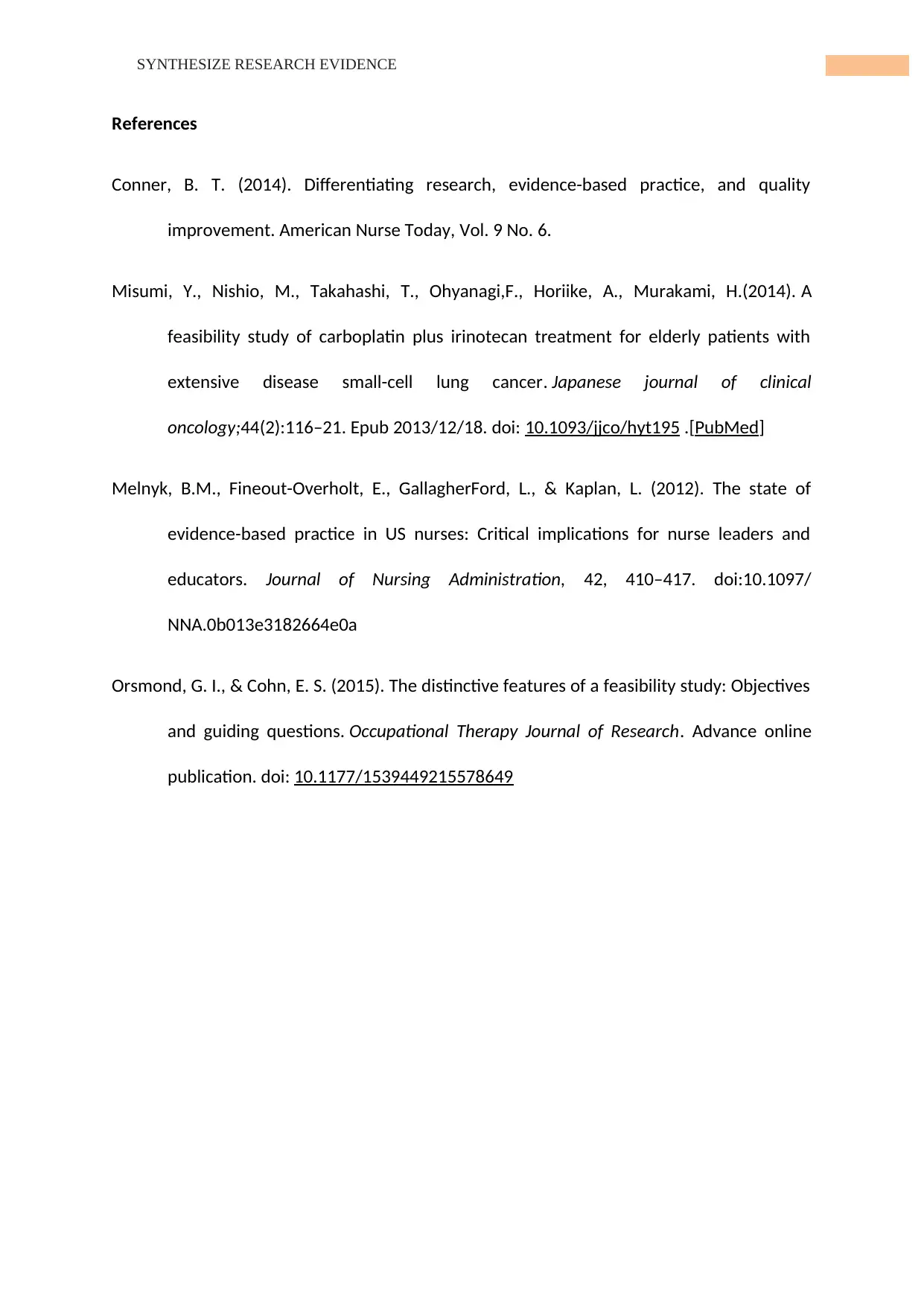
References
Conner, B. T. (2014). Differentiating research, evidence-based practice, and quality
improvement. American Nurse Today, Vol. 9 No. 6.
Misumi, Y., Nishio, M., Takahashi, T., Ohyanagi,F., Horiike, A., Murakami, H.(2014). A
feasibility study of carboplatin plus irinotecan treatment for elderly patients with
extensive disease small-cell lung cancer. Japanese journal of clinical
oncology;44(2):116–21. Epub 2013/12/18. doi: 10.1093/jjco/hyt195 .[PubMed]
Melnyk, B.M., Fineout-Overholt, E., GallagherFord, L., & Kaplan, L. (2012). The state of
evidence-based practice in US nurses: Critical implications for nurse leaders and
educators. Journal of Nursing Administration, 42, 410–417. doi:10.1097/
NNA.0b013e3182664e0a
Orsmond, G. I., & Cohn, E. S. (2015). The distinctive features of a feasibility study: Objectives
and guiding questions. Occupational Therapy Journal of Research. Advance online
publication. doi: 10.1177/1539449215578649
chevron_up_icon
1 out of 6
circle_padding
hide_on_mobile
zoom_out_icon
[object Object]