Strategies for Translating Research into Evidence-Based Practice
VerifiedAdded on 2023/06/10
|7
|2095
|448
Report
AI Summary
This report explores the crucial role of evidence-based practice (EBP) in enhancing the quality of nursing care. It identifies barriers and facilitators to EBP compliance, including challenges related to understanding research, lack of training, and time constraints, while highlighting the importance of academic training and effective management. The report proposes strategies to decrease non-compliance with clinical practice guidelines, such as stakeholder engagement and administrative support. Furthermore, it recommends maintaining adherence through continuous training, access to resources, and incorporating patient values. Ultimately, the report emphasizes that EBP enables nurses to include patients in their care plans by applying data-backed solutions and integrating clinical expertise with current research, promoting better decision-making processes. Desklib provides access to this and other valuable resources for students.
Translating research into
evidence based practice
evidence based practice

Paraphrase This Document
Need a fresh take? Get an instant paraphrase of this document with our AI Paraphraser
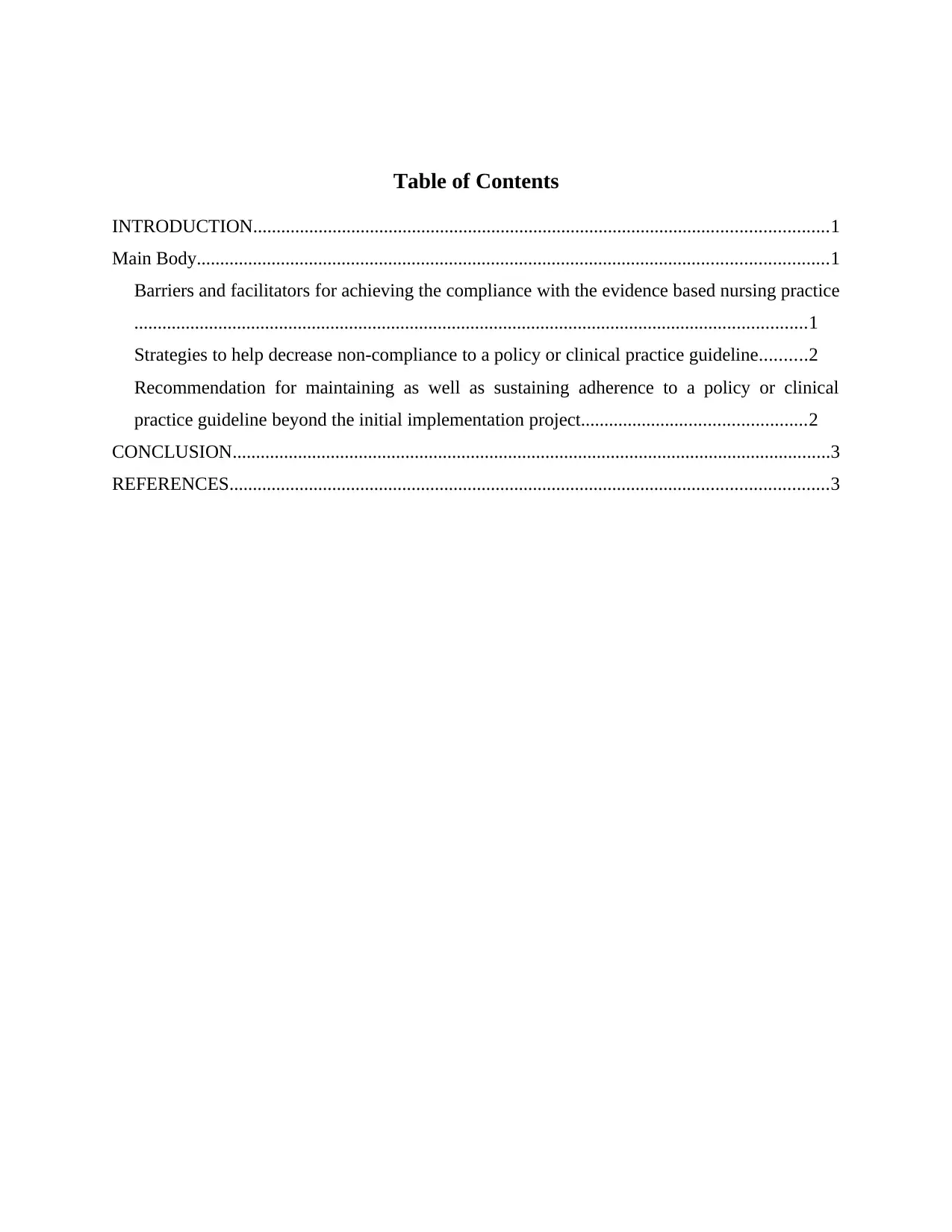
Table of Contents
INTRODUCTION...........................................................................................................................1
Main Body.......................................................................................................................................1
Barriers and facilitators for achieving the compliance with the evidence based nursing practice
................................................................................................................................................1
Strategies to help decrease non-compliance to a policy or clinical practice guideline..........2
Recommendation for maintaining as well as sustaining adherence to a policy or clinical
practice guideline beyond the initial implementation project................................................2
CONCLUSION................................................................................................................................3
REFERENCES................................................................................................................................3
INTRODUCTION...........................................................................................................................1
Main Body.......................................................................................................................................1
Barriers and facilitators for achieving the compliance with the evidence based nursing practice
................................................................................................................................................1
Strategies to help decrease non-compliance to a policy or clinical practice guideline..........2
Recommendation for maintaining as well as sustaining adherence to a policy or clinical
practice guideline beyond the initial implementation project................................................2
CONCLUSION................................................................................................................................3
REFERENCES................................................................................................................................3
INTRODUCTION
It has been seen and evaluated that it is Significance to have the evidence based practice
in providing quality nursing care as it tend to support and enables nurses to evaluate research so
they understand the risks or effectiveness of a diagnostic test or treatments.
Main Body
Barriers and facilitators for achieving the compliance with the evidence based nursing practice
It has been seen and find out the Evidence-based practice (EBP) tend to reflect and
supports an effective way of the problem-solving approach that tend to supports and lead to more
effective and better patient care that tend to supports the better integrates of the best evidence
from well-designed studies with clinicians' expertise, patient assessments, and patients' own
preferences, leads to better, safer care; better outcomes; and lower health care costs. But still it
has been seen and find out that the despite the fact that nurses report and have better results by
the way of the engaging in EBP it leads to greater professional satisfaction but still many
challenge sand difficulties are being faced in leading evidence based practices Coles, & Helme,
2022). They jay factors that act as the barriers for supporting evidence based practises tend to
comprises and includes of the having the difficulty based on the understanding research articles
and data that reflect about the lack of education and training about evidence based practises.
Apart from this, it has been also seen and find out that the lack of computer skills as well as not
being able for understanding the organization set rules and procedure are cited and find out as the
key barriers and challenges for the nurse participation in the process, but they are not the most
important. Further, based on the repot of the CNs it has been analsysed that nurse tend to had
positive attitudes toward EBP, but it has been seen and find out that the having the issue of the
insufficient knowledge as well as the challenge related with the unprepared implementation are
tend to acting as the main reasons that are creating barriers for the evidence based practises.
Along with this, it has been seen and find out that the factors that tend to supports and facilitate
the based implication and adoption of evidence based nursing practises tend to consists of the
having more systematic academic training along with supporting and leading an effective
management functions. On the other hand, the issue related with the inadequate time as well as
use of the unappropriated resources were tend to be recognized as main barriers which are
1
It has been seen and evaluated that it is Significance to have the evidence based practice
in providing quality nursing care as it tend to support and enables nurses to evaluate research so
they understand the risks or effectiveness of a diagnostic test or treatments.
Main Body
Barriers and facilitators for achieving the compliance with the evidence based nursing practice
It has been seen and find out the Evidence-based practice (EBP) tend to reflect and
supports an effective way of the problem-solving approach that tend to supports and lead to more
effective and better patient care that tend to supports the better integrates of the best evidence
from well-designed studies with clinicians' expertise, patient assessments, and patients' own
preferences, leads to better, safer care; better outcomes; and lower health care costs. But still it
has been seen and find out that the despite the fact that nurses report and have better results by
the way of the engaging in EBP it leads to greater professional satisfaction but still many
challenge sand difficulties are being faced in leading evidence based practices Coles, & Helme,
2022). They jay factors that act as the barriers for supporting evidence based practises tend to
comprises and includes of the having the difficulty based on the understanding research articles
and data that reflect about the lack of education and training about evidence based practises.
Apart from this, it has been also seen and find out that the lack of computer skills as well as not
being able for understanding the organization set rules and procedure are cited and find out as the
key barriers and challenges for the nurse participation in the process, but they are not the most
important. Further, based on the repot of the CNs it has been analsysed that nurse tend to had
positive attitudes toward EBP, but it has been seen and find out that the having the issue of the
insufficient knowledge as well as the challenge related with the unprepared implementation are
tend to acting as the main reasons that are creating barriers for the evidence based practises.
Along with this, it has been seen and find out that the factors that tend to supports and facilitate
the based implication and adoption of evidence based nursing practises tend to consists of the
having more systematic academic training along with supporting and leading an effective
management functions. On the other hand, the issue related with the inadequate time as well as
use of the unappropriated resources were tend to be recognized as main barriers which are
1
⊘ This is a preview!⊘
Do you want full access?
Subscribe today to unlock all pages.

Trusted by 1+ million students worldwide
hindering and creating barriers within the transforming from knowledge as well as attitudes to
implementation of the evidence based nursing practises (Lai, & Sinnema, 2022).
Thus, it has been seen and find out that the time mismanagement is tend to be a vital
barrier that carted and leads to the issues in achieving the compliance with the evidence based
nursing practice. Along with this, it has been also seen that the lack of knowledge among the
nurses and clinical practitioner is also a key barrier that has been while achieving the compliance
with the evidence based nursing practice. On the other hand, it has been seen that supporting and
having effective training and learning programmes for nurses and clinical practitioner along with
creating higher awareness about the evidence based practice are facilitating that supports the
achieving the compliance with the evidence based nursing practice.
Strategies to help decrease non-compliance to a policy or clinical practice guideline
With respect to the information provided by the Scheibel, G., Zane, T. L., & Zimmerman,
K. N. (2022), it has been seen that the evidence based practise tend to have a positive impact on
effectively meeting the set policy as well as follow up the clinical practice guideline. Some key
strategies that can be adopted by an organisation to help decrease non-compliance to a policy or
clinical practice guideline are listed and discussed as below:
Engagement of stakeholders- it has been that the engage the appropriate stakeholders
would tend to help decrease non-compliance to a policy or clinical practice guideline by the way
of leading and building the higher trust and enabling positive experience. It has been seen that
the involvement and engagement of the stakeholders plays a vital role in identifying the
measures and plan a better project and effective implementation strategy that supports
compliance of the clinical practical guideline.
Administration support- it has been seen that the support from the administration tend to be
also a helpful in decrease non-compliance to a policy or clinical practice guideline as
administration help to inform and lead better communication to support better implementation of
practises to have compliance of the practice guideline. Along with this, it has been seen and find
out that the involvement of the administration also plays a vital role in creating and developing
an organisational culture that leads to higher creation of evidence based clinical practice that is
helpful in leading the decrease in non-compliance to a policy or clinical practice guideline.
Thus, on the basis of above discussion, an analysis and implication can be made out that
the engagement of the stakeholders tend to supports the help decrease non-compliance to a
2
implementation of the evidence based nursing practises (Lai, & Sinnema, 2022).
Thus, it has been seen and find out that the time mismanagement is tend to be a vital
barrier that carted and leads to the issues in achieving the compliance with the evidence based
nursing practice. Along with this, it has been also seen that the lack of knowledge among the
nurses and clinical practitioner is also a key barrier that has been while achieving the compliance
with the evidence based nursing practice. On the other hand, it has been seen that supporting and
having effective training and learning programmes for nurses and clinical practitioner along with
creating higher awareness about the evidence based practice are facilitating that supports the
achieving the compliance with the evidence based nursing practice.
Strategies to help decrease non-compliance to a policy or clinical practice guideline
With respect to the information provided by the Scheibel, G., Zane, T. L., & Zimmerman,
K. N. (2022), it has been seen that the evidence based practise tend to have a positive impact on
effectively meeting the set policy as well as follow up the clinical practice guideline. Some key
strategies that can be adopted by an organisation to help decrease non-compliance to a policy or
clinical practice guideline are listed and discussed as below:
Engagement of stakeholders- it has been that the engage the appropriate stakeholders
would tend to help decrease non-compliance to a policy or clinical practice guideline by the way
of leading and building the higher trust and enabling positive experience. It has been seen that
the involvement and engagement of the stakeholders plays a vital role in identifying the
measures and plan a better project and effective implementation strategy that supports
compliance of the clinical practical guideline.
Administration support- it has been seen that the support from the administration tend to be
also a helpful in decrease non-compliance to a policy or clinical practice guideline as
administration help to inform and lead better communication to support better implementation of
practises to have compliance of the practice guideline. Along with this, it has been seen and find
out that the involvement of the administration also plays a vital role in creating and developing
an organisational culture that leads to higher creation of evidence based clinical practice that is
helpful in leading the decrease in non-compliance to a policy or clinical practice guideline.
Thus, on the basis of above discussion, an analysis and implication can be made out that
the engagement of the stakeholders tend to supports the help decrease non-compliance to a
2
Paraphrase This Document
Need a fresh take? Get an instant paraphrase of this document with our AI Paraphraser
policy or clinical practice guideline through leading and supporting a higher level of interaction
and communication both at internal as well as the external level (Haggman-Laitila, 2016).
Having proper engagement of the stakeholders tend to supports and brings out better preparation
of plan and ensuring that all set clinical practice guideline and strategies are properly implicated
thus it supports and brings to help decrease non-compliance to a policy or clinical practice
guideline. Along with this, it has been also seen and find out that the administration support is
also essentially needed and vital for the help decrease non-compliance to a policy or clinical
practice guideline as they tend to have the authority and power to set better meting and
accomplishment of set clinical practice. Along with this, systematic guidelines and rules could be
also lead out by the administration in order to help decrease non-compliance to a policy or
clinical practice guideline.
Recommendation for maintaining as well as sustaining adherence to a policy or clinical practice
guideline beyond the initial implementation project
As per the view point of the Haggman-Laitila_2016, it has been seen and find out that the
evidence based practice us a vital recommendation that supports and leads to the maintaining as
well as sustaining adherence to a policy or clinical practice guideline beyond the initial
implementation project. Beside this, it has been find out and seen that the best external evidence
are tend to be supported by the evidence based practise that started from the initial
implementation of the project that brings and leads to the evaluate and implement the most
current, clinically relevant, and scientifically sound research. Along with this, the evidence based
practice also tend to supports and brings out the individual clinical expertise based on the
personal experience of what has worked and not worked in your clinical practice which lead to
maintaining as well as sustaining adherence to a policy or clinical practice guideline beyond the
initial implementation project. Along with this, it has been also seen and find out that the patient
values and expectations are also tend to be consider and taken as the value the set a better
preferences for the individual patients thus it also helps in maintaining as well as sustaining
adherence to a policy or clinical practice guideline beyond the initial implementation project
(Mathieson_barriers facilitators EBP community nursing, 2018). Along with this, the
recommendation such as Form a clinical question to identify a problem along with Gather the
best evidence are also tend to set out an effective way to maintaining as well as sustaining
adherence to a policy or clinical practice guideline beyond the initial implementation project.
3
and communication both at internal as well as the external level (Haggman-Laitila, 2016).
Having proper engagement of the stakeholders tend to supports and brings out better preparation
of plan and ensuring that all set clinical practice guideline and strategies are properly implicated
thus it supports and brings to help decrease non-compliance to a policy or clinical practice
guideline. Along with this, it has been also seen and find out that the administration support is
also essentially needed and vital for the help decrease non-compliance to a policy or clinical
practice guideline as they tend to have the authority and power to set better meting and
accomplishment of set clinical practice. Along with this, systematic guidelines and rules could be
also lead out by the administration in order to help decrease non-compliance to a policy or
clinical practice guideline.
Recommendation for maintaining as well as sustaining adherence to a policy or clinical practice
guideline beyond the initial implementation project
As per the view point of the Haggman-Laitila_2016, it has been seen and find out that the
evidence based practice us a vital recommendation that supports and leads to the maintaining as
well as sustaining adherence to a policy or clinical practice guideline beyond the initial
implementation project. Beside this, it has been find out and seen that the best external evidence
are tend to be supported by the evidence based practise that started from the initial
implementation of the project that brings and leads to the evaluate and implement the most
current, clinically relevant, and scientifically sound research. Along with this, the evidence based
practice also tend to supports and brings out the individual clinical expertise based on the
personal experience of what has worked and not worked in your clinical practice which lead to
maintaining as well as sustaining adherence to a policy or clinical practice guideline beyond the
initial implementation project. Along with this, it has been also seen and find out that the patient
values and expectations are also tend to be consider and taken as the value the set a better
preferences for the individual patients thus it also helps in maintaining as well as sustaining
adherence to a policy or clinical practice guideline beyond the initial implementation project
(Mathieson_barriers facilitators EBP community nursing, 2018). Along with this, the
recommendation such as Form a clinical question to identify a problem along with Gather the
best evidence are also tend to set out an effective way to maintaining as well as sustaining
adherence to a policy or clinical practice guideline beyond the initial implementation project.
3
Besides this, it has been also find out and seen that the issue of the lack of the motivation as well
as the limited access to resources and ineffective training and learning are also the barriers
achieving the compliance with the evidence based nursing practice. Therefore, a
recommendation can be made for maintaining as well as sustaining adherence to a policy or
clinical practice guideline beyond the initial implementation project that comprise of leading and
providing regular training and access to vital information to support better clinical practice.
Beside this, the analysing the evidence as well as applying the evidence to clinical practice and
Assess the result are also set and effective recommendation for maintaining as well as sustaining
adherence to a policy or clinical practice guideline beyond the initial implementation project
(McConnell, & Biddle, (2022).
CONCLUSION
On the basis of current project, a conclusion can be made that the application of evidence
based practice also tend to enables nurses to include patients in their care plan through leading
and supporting the application of the data-backed solutions that tend to effectively supports and
incorporate clinical expertise as well as also lead to the current research into an effective set of
the decision-making process.
REFERENCES
Books and journal
Scheibel, G., Zane, T. L., & Zimmerman, K. N. (2022). An Economic Evaluation of Emerging
and Ineffective Interventions: Examining the Role of Cost When Translating Research
into Practice. Exceptional Children, 00144029211073522.
Coles, A., & Helme, R. (2022). Teaching for mastery in primary mathematics: A study of
translating research into policy and practice. Review of Education, 10(1), e3326.
Lai, M. K., & Sinnema, C. (2022). Evidence-Informed Practice in New Zealand. In The Emerald
Handbook of Evidence-Informed Practice in Education. Emerald Publishing Limited.
McConnell, E. A., & Biddle, C. (2022). Nurse Anesthesia Research: Empowering
DecisionChapter TitleMakingOne ThroughLine Evidence-Based Practice. Nurse
Anesthesia-E-Book, 32.
Mathieson_barriers facilitators EBP community nursing_2018.pdf Mathieson_barriers
facilitators EBP community nursing_2018.pdf - Alternative Formats
4
as the limited access to resources and ineffective training and learning are also the barriers
achieving the compliance with the evidence based nursing practice. Therefore, a
recommendation can be made for maintaining as well as sustaining adherence to a policy or
clinical practice guideline beyond the initial implementation project that comprise of leading and
providing regular training and access to vital information to support better clinical practice.
Beside this, the analysing the evidence as well as applying the evidence to clinical practice and
Assess the result are also set and effective recommendation for maintaining as well as sustaining
adherence to a policy or clinical practice guideline beyond the initial implementation project
(McConnell, & Biddle, (2022).
CONCLUSION
On the basis of current project, a conclusion can be made that the application of evidence
based practice also tend to enables nurses to include patients in their care plan through leading
and supporting the application of the data-backed solutions that tend to effectively supports and
incorporate clinical expertise as well as also lead to the current research into an effective set of
the decision-making process.
REFERENCES
Books and journal
Scheibel, G., Zane, T. L., & Zimmerman, K. N. (2022). An Economic Evaluation of Emerging
and Ineffective Interventions: Examining the Role of Cost When Translating Research
into Practice. Exceptional Children, 00144029211073522.
Coles, A., & Helme, R. (2022). Teaching for mastery in primary mathematics: A study of
translating research into policy and practice. Review of Education, 10(1), e3326.
Lai, M. K., & Sinnema, C. (2022). Evidence-Informed Practice in New Zealand. In The Emerald
Handbook of Evidence-Informed Practice in Education. Emerald Publishing Limited.
McConnell, E. A., & Biddle, C. (2022). Nurse Anesthesia Research: Empowering
DecisionChapter TitleMakingOne ThroughLine Evidence-Based Practice. Nurse
Anesthesia-E-Book, 32.
Mathieson_barriers facilitators EBP community nursing_2018.pdf Mathieson_barriers
facilitators EBP community nursing_2018.pdf - Alternative Formats
4
⊘ This is a preview!⊘
Do you want full access?
Subscribe today to unlock all pages.
Trusted by 1+ million students worldwide
McArthur_barriers and facilitators implement EB guidelines long erm care_2021.pdf
McArthur_barriers and facilitators implement EB guidelines long erm care_2021.pdf -
Alternative Formats
Barth_why are clinical practice guidelines not followed_2016.pdf Barth_why are clinical
practice guidelines not followed_2016.pdf - Alternative Formats
Mazrou_expected benefits CPGs_factors affecting adherence and methods implementation.pdf
Mazrou_expected benefits CPGs_factors affecting adherence and methods
implementation.pdf - Alternative Formats
Knudsen_realities of practice change_2021.pdf Knudsen_realities of practice change_2021.pdf -
Alternative Formats
Proctor_outcomes for implementation research conceptual distinctions_uses FAME_2011.pdf
Proctor_outcomes for implementation research conceptual distinctions_uses
FAME_2011.pdf - Alternative Formats
Yoo_clinical nurses beliefs knowledge organizational readingess of EBP creating
culture_2019.pdf Yoo_clinical nurses beliefs knowledge organizational readingess of
EBP creating culture_2019.pdf - Alternative Formats
Haggman-Laitila_2016_SR educational interventions to nurses strategies guideline
implementation_2016 .pdfHaggman-Laitila_2016_SR educational interventions to nurses
strategies guideline implementation_2016 .pdf - Alternative Formats
Implementation strategies to adopt integrate EB Nursing_2015.pdf Implementation strategies to
adopt integrate EB Nursing_2015.pdf - Alternative Formats
Kirchner_Getting clinical innovation into practice_strategies_2020.pdf Kirchner_Getting clinical
innovation into practice_strategies_2020.pdf - Alternative Formats
Owolabi_strategies implementation best practice guidelines in OTs_2021.pdf Owolabi_strategies
implementation best practice guidelines in OTs_2021.pdf - Alternative Formats
Reynolds_Implementation Strategies to Improve Evidence-Based Bathing Practices in a Neuro
ICU_2019.pdf Reynolds_Implementation Strategies to Improve Evidence-Based Bathing
Practices in a Neuro ICU_2019.pdf - Alternative Formats
Reynolds_Implementation Strategies to Improve Knowledge and Adherence Spinal Cord Injury
Guidelines.pdfReynolds_Implementation Strategies to Improve Knowledge and
Adherence Spinal Cord Injury Guidelines.pdf - Alternative Formats
Saunders_Translating knowledge into best practice care bundles_2015.pdf
Saunders_Translating knowledge into best practice care bundles_2015.pdf - Alternative
Formats
Spoon_implementation strategies implement nursing guidelines_2020.pdf
Spoon_implementation strategies implement nursing guidelines_2020.pdf - Alternative
Formats
5
McArthur_barriers and facilitators implement EB guidelines long erm care_2021.pdf -
Alternative Formats
Barth_why are clinical practice guidelines not followed_2016.pdf Barth_why are clinical
practice guidelines not followed_2016.pdf - Alternative Formats
Mazrou_expected benefits CPGs_factors affecting adherence and methods implementation.pdf
Mazrou_expected benefits CPGs_factors affecting adherence and methods
implementation.pdf - Alternative Formats
Knudsen_realities of practice change_2021.pdf Knudsen_realities of practice change_2021.pdf -
Alternative Formats
Proctor_outcomes for implementation research conceptual distinctions_uses FAME_2011.pdf
Proctor_outcomes for implementation research conceptual distinctions_uses
FAME_2011.pdf - Alternative Formats
Yoo_clinical nurses beliefs knowledge organizational readingess of EBP creating
culture_2019.pdf Yoo_clinical nurses beliefs knowledge organizational readingess of
EBP creating culture_2019.pdf - Alternative Formats
Haggman-Laitila_2016_SR educational interventions to nurses strategies guideline
implementation_2016 .pdfHaggman-Laitila_2016_SR educational interventions to nurses
strategies guideline implementation_2016 .pdf - Alternative Formats
Implementation strategies to adopt integrate EB Nursing_2015.pdf Implementation strategies to
adopt integrate EB Nursing_2015.pdf - Alternative Formats
Kirchner_Getting clinical innovation into practice_strategies_2020.pdf Kirchner_Getting clinical
innovation into practice_strategies_2020.pdf - Alternative Formats
Owolabi_strategies implementation best practice guidelines in OTs_2021.pdf Owolabi_strategies
implementation best practice guidelines in OTs_2021.pdf - Alternative Formats
Reynolds_Implementation Strategies to Improve Evidence-Based Bathing Practices in a Neuro
ICU_2019.pdf Reynolds_Implementation Strategies to Improve Evidence-Based Bathing
Practices in a Neuro ICU_2019.pdf - Alternative Formats
Reynolds_Implementation Strategies to Improve Knowledge and Adherence Spinal Cord Injury
Guidelines.pdfReynolds_Implementation Strategies to Improve Knowledge and
Adherence Spinal Cord Injury Guidelines.pdf - Alternative Formats
Saunders_Translating knowledge into best practice care bundles_2015.pdf
Saunders_Translating knowledge into best practice care bundles_2015.pdf - Alternative
Formats
Spoon_implementation strategies implement nursing guidelines_2020.pdf
Spoon_implementation strategies implement nursing guidelines_2020.pdf - Alternative
Formats
5

1 out of 7


Related Documents


Your All-in-One AI-Powered Toolkit for Academic Success.
+13062052269
info@desklib.com
Available 24*7 on WhatsApp / Email
![[object Object]](/_next/static/media/star-bottom.7253800d.svg)
Unlock your academic potential
Copyright © 2020–2026 A2Z Services. All Rights Reserved. Developed and managed by ZUCOL.