Research Methodology Assignment: Factors in Parental Immunisation
VerifiedAdded on 2022/11/13
|16
|3874
|197
Homework Assignment
AI Summary
This assignment addresses research methodology in the context of immunisation, specifically focusing on parental vaccine hesitancy. The student formulates a research question exploring the factors contributing to hesitancy and potential interventions, identifying the PICO elements. A qualitative methodology is chosen and justified, emphasizing its ability to provide in-depth understanding of the social phenomenon. The assignment identifies reliable sources of information, including databases like Pubmed, and provides details of a specific publication as an example of best available evidence. Keywords and search strategies are developed for literature searches, and actions to refine search results are suggested. Furthermore, the assignment analyzes two research articles, summarizing their study types, aims, methods, findings, and conclusions, focusing on influenza vaccination. The assignment concludes with a discussion on how the studies could inform nurses or midwives in discussions with pregnant women about vaccinations.
RESEARCH METHODOLOGY 1
Research Methodology
By Student's Name
Course Code and Name
Professor’s Name
University Name
City, State
Date of Submission
Version 3 AKAXJWKB
Research Methodology
By Student's Name
Course Code and Name
Professor’s Name
University Name
City, State
Date of Submission
Version 3 AKAXJWKB

Paraphrase This Document
Need a fresh take? Get an instant paraphrase of this document with our AI Paraphraser
RESEARCH METHODOLOGY 2
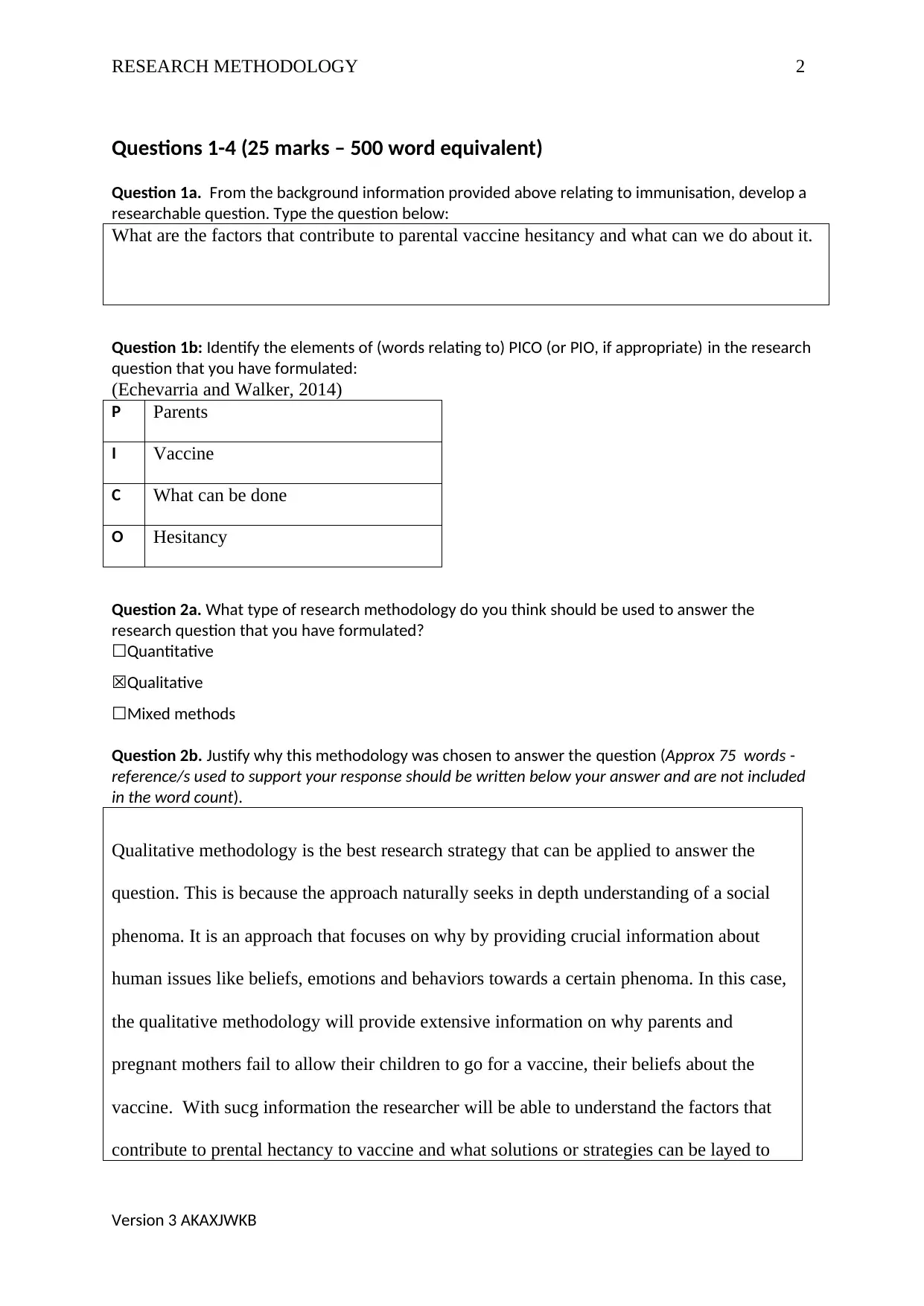
Questions 1-4 (25 marks – 500 word equivalent)
Question 1a. From the background information provided above relating to immunisation, develop a
researchable question. Type the question below:
What are the factors that contribute to parental vaccine hesitancy and what can we do about it.
Question 1b: Identify the elements of (words relating to) PICO (or PIO, if appropriate) in the research
question that you have formulated:
(Echevarria and Walker, 2014)
P Parents
I Vaccine
C What can be done
O Hesitancy
Question 2a. What type of research methodology do you think should be used to answer the
research question that you have formulated?
☐Quantitative
☒Qualitative
☐Mixed methods
Question 2b. Justify why this methodology was chosen to answer the question (Approx 75 words -
reference/s used to support your response should be written below your answer and are not included
in the word count).
Qualitative methodology is the best research strategy that can be applied to answer the
question. This is because the approach naturally seeks in depth understanding of a social
phenoma. It is an approach that focuses on why by providing crucial information about
human issues like beliefs, emotions and behaviors towards a certain phenoma. In this case,
the qualitative methodology will provide extensive information on why parents and
pregnant mothers fail to allow their children to go for a vaccine, their beliefs about the
vaccine. With sucg information the researcher will be able to understand the factors that
contribute to prental hectancy to vaccine and what solutions or strategies can be layed to
Version 3 AKAXJWKB
Questions 1-4 (25 marks – 500 word equivalent)
Question 1a. From the background information provided above relating to immunisation, develop a
researchable question. Type the question below:
What are the factors that contribute to parental vaccine hesitancy and what can we do about it.
Question 1b: Identify the elements of (words relating to) PICO (or PIO, if appropriate) in the research
question that you have formulated:
(Echevarria and Walker, 2014)
P Parents
I Vaccine
C What can be done
O Hesitancy
Question 2a. What type of research methodology do you think should be used to answer the
research question that you have formulated?
☐Quantitative
☒Qualitative
☐Mixed methods
Question 2b. Justify why this methodology was chosen to answer the question (Approx 75 words -
reference/s used to support your response should be written below your answer and are not included
in the word count).
Qualitative methodology is the best research strategy that can be applied to answer the
question. This is because the approach naturally seeks in depth understanding of a social
phenoma. It is an approach that focuses on why by providing crucial information about
human issues like beliefs, emotions and behaviors towards a certain phenoma. In this case,
the qualitative methodology will provide extensive information on why parents and
pregnant mothers fail to allow their children to go for a vaccine, their beliefs about the
vaccine. With sucg information the researcher will be able to understand the factors that
contribute to prental hectancy to vaccine and what solutions or strategies can be layed to
Version 3 AKAXJWKB
RESEARCH METHODOLOGY 3
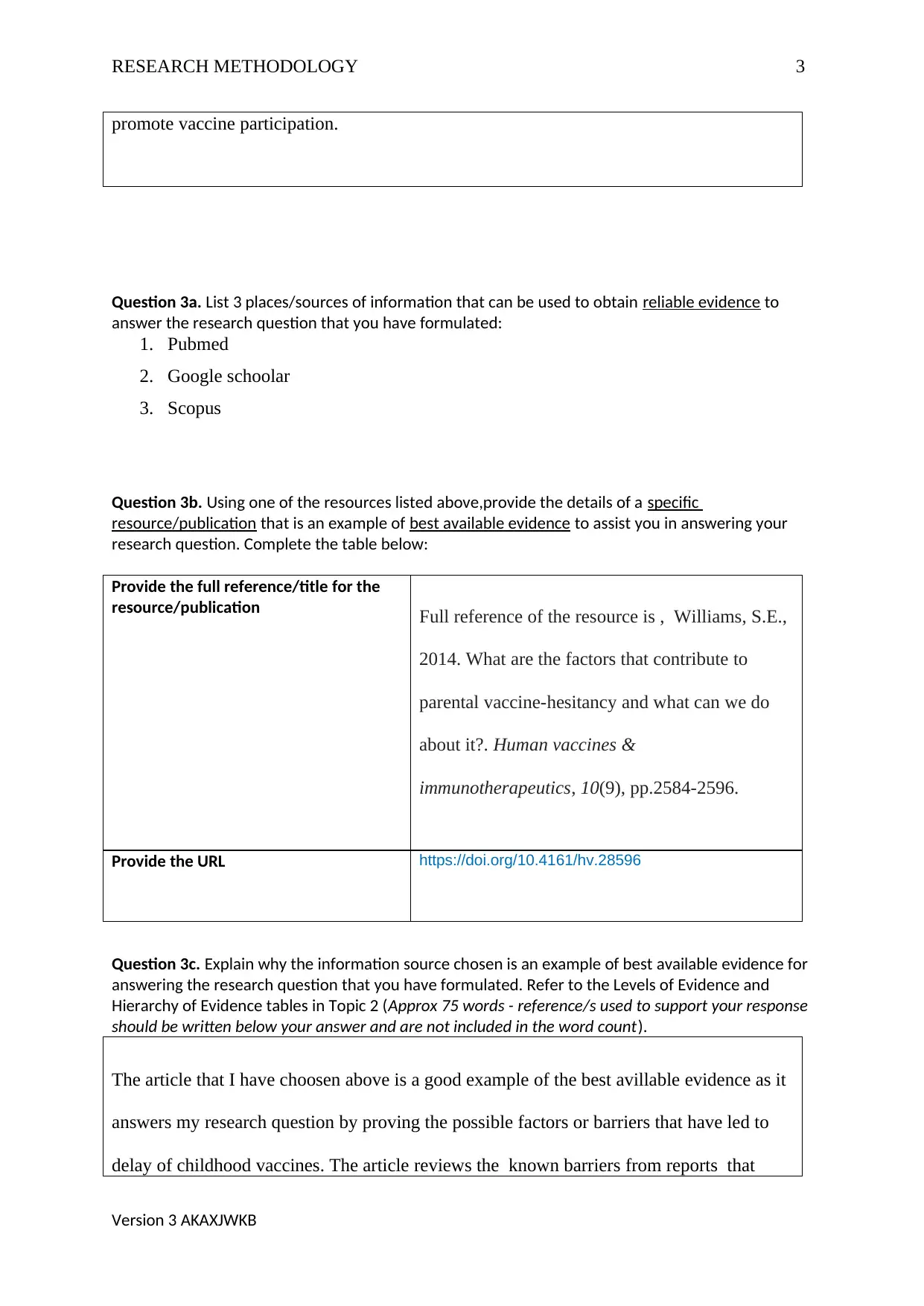
promote vaccine participation.
Question 3a. List 3 places/sources of information that can be used to obtain reliable evidence to
answer the research question that you have formulated:
1. Pubmed
2. Google schoolar
3. Scopus
Question 3b. Using one of the resources listed above,provide the details of a specific
resource/publication that is an example of best available evidence to assist you in answering your
research question. Complete the table below:
Provide the full reference/title for the
resource/publication Full reference of the resource is , Williams, S.E.,
2014. What are the factors that contribute to
parental vaccine-hesitancy and what can we do
about it?. Human vaccines &
immunotherapeutics, 10(9), pp.2584-2596.
Provide the URL https://doi.org/10.4161/hv.28596
Question 3c. Explain why the information source chosen is an example of best available evidence for
answering the research question that you have formulated. Refer to the Levels of Evidence and
Hierarchy of Evidence tables in Topic 2 (Approx 75 words - reference/s used to support your response
should be written below your answer and are not included in the word count).
The article that I have choosen above is a good example of the best avillable evidence as it
answers my research question by proving the possible factors or barriers that have led to
delay of childhood vaccines. The article reviews the known barriers from reports that
Version 3 AKAXJWKB
promote vaccine participation.
Question 3a. List 3 places/sources of information that can be used to obtain reliable evidence to
answer the research question that you have formulated:
1. Pubmed
2. Google schoolar
3. Scopus
Question 3b. Using one of the resources listed above,provide the details of a specific
resource/publication that is an example of best available evidence to assist you in answering your
research question. Complete the table below:
Provide the full reference/title for the
resource/publication Full reference of the resource is , Williams, S.E.,
2014. What are the factors that contribute to
parental vaccine-hesitancy and what can we do
about it?. Human vaccines &
immunotherapeutics, 10(9), pp.2584-2596.
Provide the URL https://doi.org/10.4161/hv.28596
Question 3c. Explain why the information source chosen is an example of best available evidence for
answering the research question that you have formulated. Refer to the Levels of Evidence and
Hierarchy of Evidence tables in Topic 2 (Approx 75 words - reference/s used to support your response
should be written below your answer and are not included in the word count).
The article that I have choosen above is a good example of the best avillable evidence as it
answers my research question by proving the possible factors or barriers that have led to
delay of childhood vaccines. The article reviews the known barriers from reports that
Version 3 AKAXJWKB
⊘ This is a preview!⊘
Do you want full access?
Subscribe today to unlock all pages.

Trusted by 1+ million students worldwide
RESEARCH METHODOLOGY 4
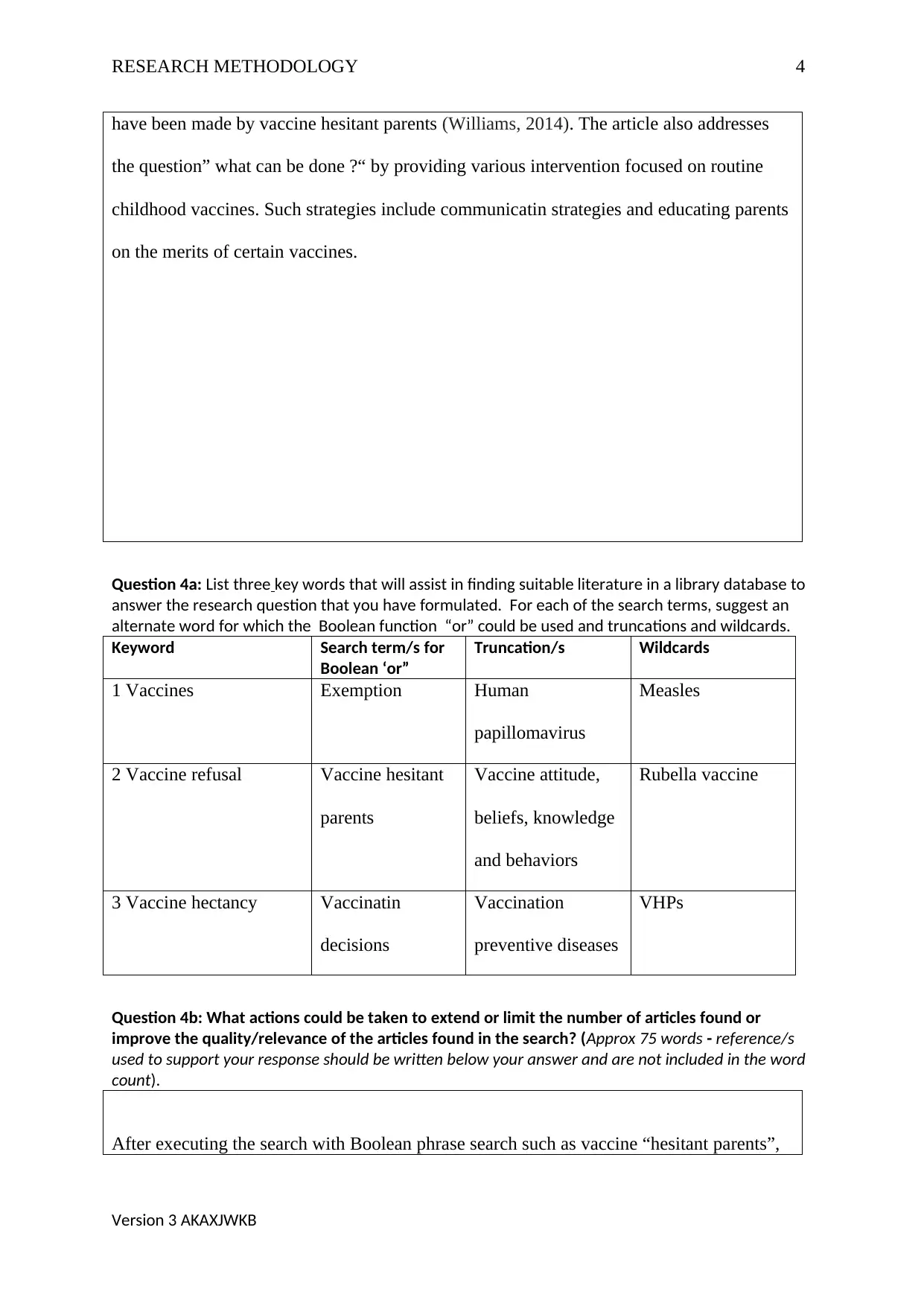
have been made by vaccine hesitant parents (Williams, 2014). The article also addresses
the question” what can be done ?“ by providing various intervention focused on routine
childhood vaccines. Such strategies include communicatin strategies and educating parents
on the merits of certain vaccines.
Question 4a: List three key words that will assist in finding suitable literature in a library database to
answer the research question that you have formulated. For each of the search terms, suggest an
alternate word for which the Boolean function “or” could be used and truncations and wildcards.
Keyword Search term/s for
Boolean ‘or”
Truncation/s Wildcards
1 Vaccines Exemption Human
papillomavirus
Measles
2 Vaccine refusal Vaccine hesitant
parents
Vaccine attitude,
beliefs, knowledge
and behaviors
Rubella vaccine
3 Vaccine hectancy Vaccinatin
decisions
Vaccination
preventive diseases
VHPs
Question 4b: What actions could be taken to extend or limit the number of articles found or
improve the quality/relevance of the articles found in the search? (Approx 75 words - reference/s
used to support your response should be written below your answer and are not included in the word
count).
After executing the search with Boolean phrase search such as vaccine “hesitant parents”,
Version 3 AKAXJWKB
have been made by vaccine hesitant parents (Williams, 2014). The article also addresses
the question” what can be done ?“ by providing various intervention focused on routine
childhood vaccines. Such strategies include communicatin strategies and educating parents
on the merits of certain vaccines.
Question 4a: List three key words that will assist in finding suitable literature in a library database to
answer the research question that you have formulated. For each of the search terms, suggest an
alternate word for which the Boolean function “or” could be used and truncations and wildcards.
Keyword Search term/s for
Boolean ‘or”
Truncation/s Wildcards
1 Vaccines Exemption Human
papillomavirus
Measles
2 Vaccine refusal Vaccine hesitant
parents
Vaccine attitude,
beliefs, knowledge
and behaviors
Rubella vaccine
3 Vaccine hectancy Vaccinatin
decisions
Vaccination
preventive diseases
VHPs
Question 4b: What actions could be taken to extend or limit the number of articles found or
improve the quality/relevance of the articles found in the search? (Approx 75 words - reference/s
used to support your response should be written below your answer and are not included in the word
count).
After executing the search with Boolean phrase search such as vaccine “hesitant parents”,
Version 3 AKAXJWKB
Paraphrase This Document
Need a fresh take? Get an instant paraphrase of this document with our AI Paraphraser
RESEARCH METHODOLOGY 5
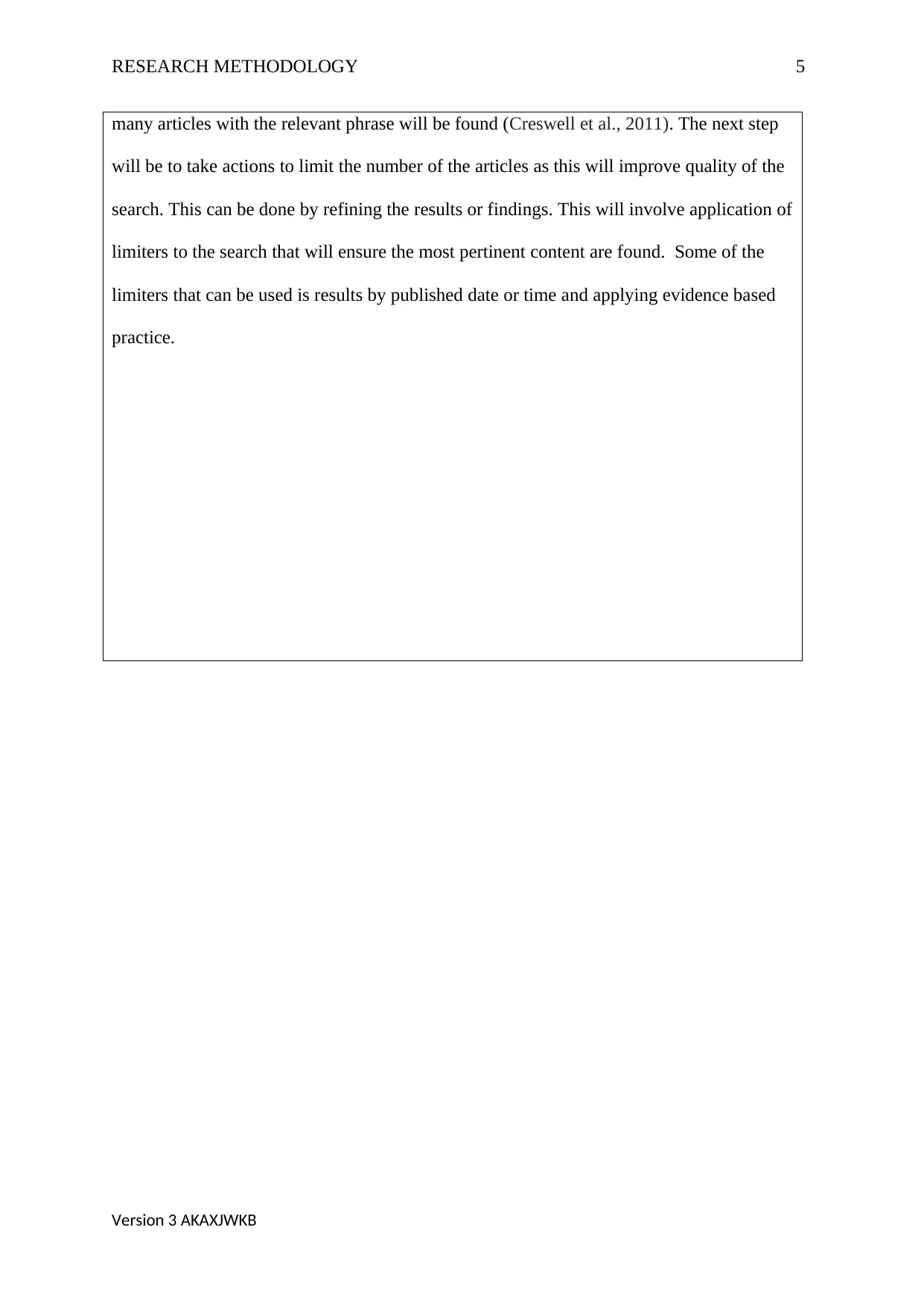
many articles with the relevant phrase will be found (Creswell et al., 2011). The next step
will be to take actions to limit the number of the articles as this will improve quality of the
search. This can be done by refining the results or findings. This will involve application of
limiters to the search that will ensure the most pertinent content are found. Some of the
limiters that can be used is results by published date or time and applying evidence based
practice.
Version 3 AKAXJWKB
many articles with the relevant phrase will be found (Creswell et al., 2011). The next step
will be to take actions to limit the number of the articles as this will improve quality of the
search. This can be done by refining the results or findings. This will involve application of
limiters to the search that will ensure the most pertinent content are found. Some of the
limiters that can be used is results by published date or time and applying evidence based
practice.
Version 3 AKAXJWKB
RESEARCH METHODOLOGY 6
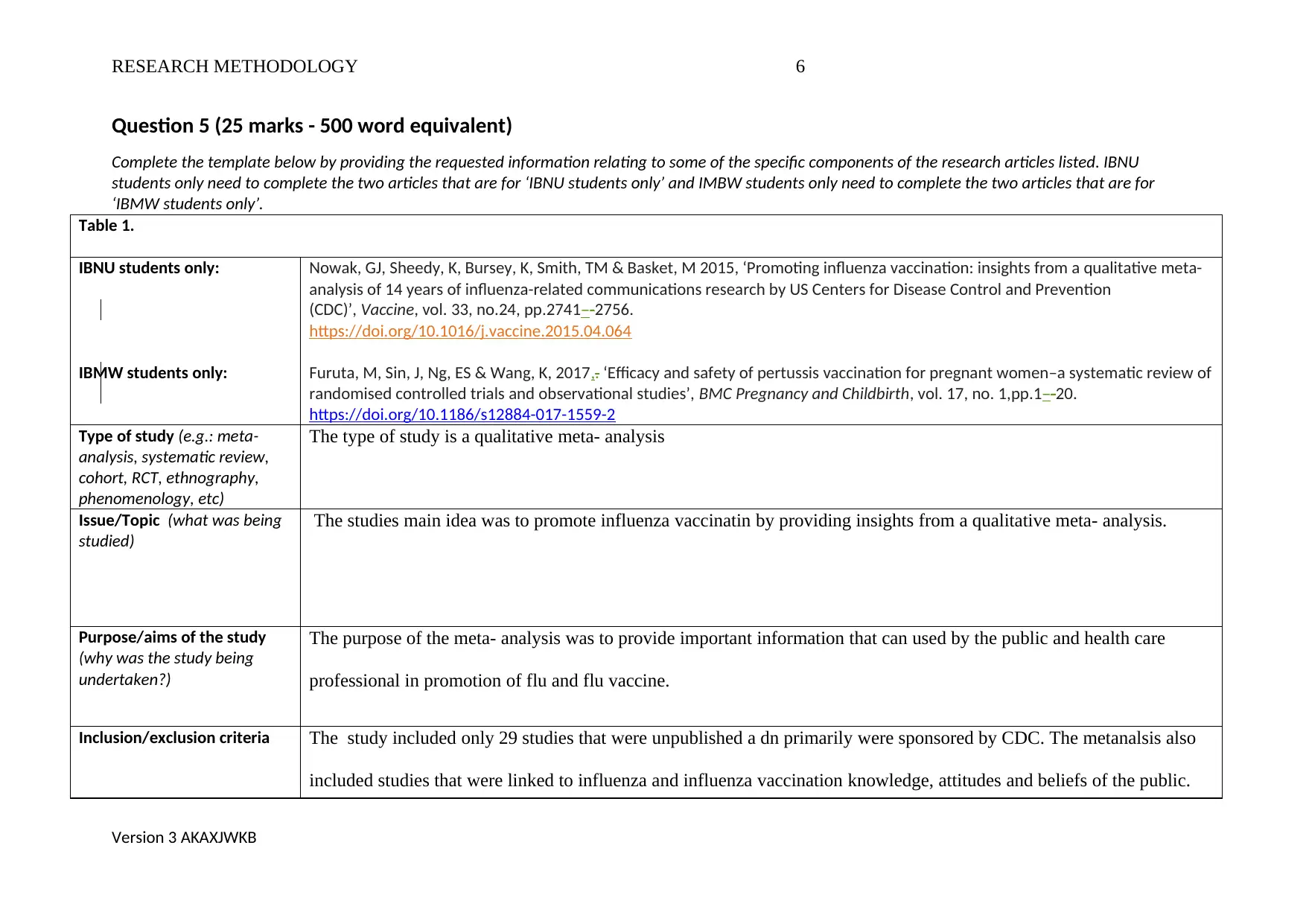
Question 5 (25 marks - 500 word equivalent)
Complete the template below by providing the requested information relating to some of the specific components of the research articles listed. IBNU
students only need to complete the two articles that are for ‘IBNU students only’ and IMBW students only need to complete the two articles that are for
‘IBMW students only’.
Table 1.
IBNU students only:
IBMW students only:
Nowak, GJ, Sheedy, K, Bursey, K, Smith, TM & Basket, M 2015, ‘Promoting influenza vaccination: insights from a qualitative meta-
analysis of 14 years of influenza-related communications research by US Centers for Disease Control and Prevention
(CDC)’, Vaccine, vol. 33, no.24, pp.2741–-2756.
https://doi.org/10.1016/j.vaccine.2015.04.064
Furuta, M, Sin, J, Ng, ES & Wang, K, 2017,. ‘Efficacy and safety of pertussis vaccination for pregnant women–a systematic review of
randomised controlled trials and observational studies’, BMC Pregnancy and Childbirth, vol. 17, no. 1,pp.1–-20.
https://doi.org/10.1186/s12884-017-1559-2
Type of study (e.g.: meta-
analysis, systematic review,
cohort, RCT, ethnography,
phenomenology, etc)
The type of study is a qualitative meta- analysis
Issue/Topic (what was being
studied)
The studies main idea was to promote influenza vaccinatin by providing insights from a qualitative meta- analysis.
Purpose/aims of the study
(why was the study being
undertaken?)
The purpose of the meta- analysis was to provide important information that can used by the public and health care
professional in promotion of flu and flu vaccine.
Inclusion/exclusion criteria The study included only 29 studies that were unpublished a dn primarily were sponsored by CDC. The metanalsis also
included studies that were linked to influenza and influenza vaccination knowledge, attitudes and beliefs of the public.
Version 3 AKAXJWKB
Question 5 (25 marks - 500 word equivalent)
Complete the template below by providing the requested information relating to some of the specific components of the research articles listed. IBNU
students only need to complete the two articles that are for ‘IBNU students only’ and IMBW students only need to complete the two articles that are for
‘IBMW students only’.
Table 1.
IBNU students only:
IBMW students only:
Nowak, GJ, Sheedy, K, Bursey, K, Smith, TM & Basket, M 2015, ‘Promoting influenza vaccination: insights from a qualitative meta-
analysis of 14 years of influenza-related communications research by US Centers for Disease Control and Prevention
(CDC)’, Vaccine, vol. 33, no.24, pp.2741–-2756.
https://doi.org/10.1016/j.vaccine.2015.04.064
Furuta, M, Sin, J, Ng, ES & Wang, K, 2017,. ‘Efficacy and safety of pertussis vaccination for pregnant women–a systematic review of
randomised controlled trials and observational studies’, BMC Pregnancy and Childbirth, vol. 17, no. 1,pp.1–-20.
https://doi.org/10.1186/s12884-017-1559-2
Type of study (e.g.: meta-
analysis, systematic review,
cohort, RCT, ethnography,
phenomenology, etc)
The type of study is a qualitative meta- analysis
Issue/Topic (what was being
studied)
The studies main idea was to promote influenza vaccinatin by providing insights from a qualitative meta- analysis.
Purpose/aims of the study
(why was the study being
undertaken?)
The purpose of the meta- analysis was to provide important information that can used by the public and health care
professional in promotion of flu and flu vaccine.
Inclusion/exclusion criteria The study included only 29 studies that were unpublished a dn primarily were sponsored by CDC. The metanalsis also
included studies that were linked to influenza and influenza vaccination knowledge, attitudes and beliefs of the public.
Version 3 AKAXJWKB
⊘ This is a preview!⊘
Do you want full access?
Subscribe today to unlock all pages.
Trusted by 1+ million students worldwide
RESEARCH METHODOLOGY 7
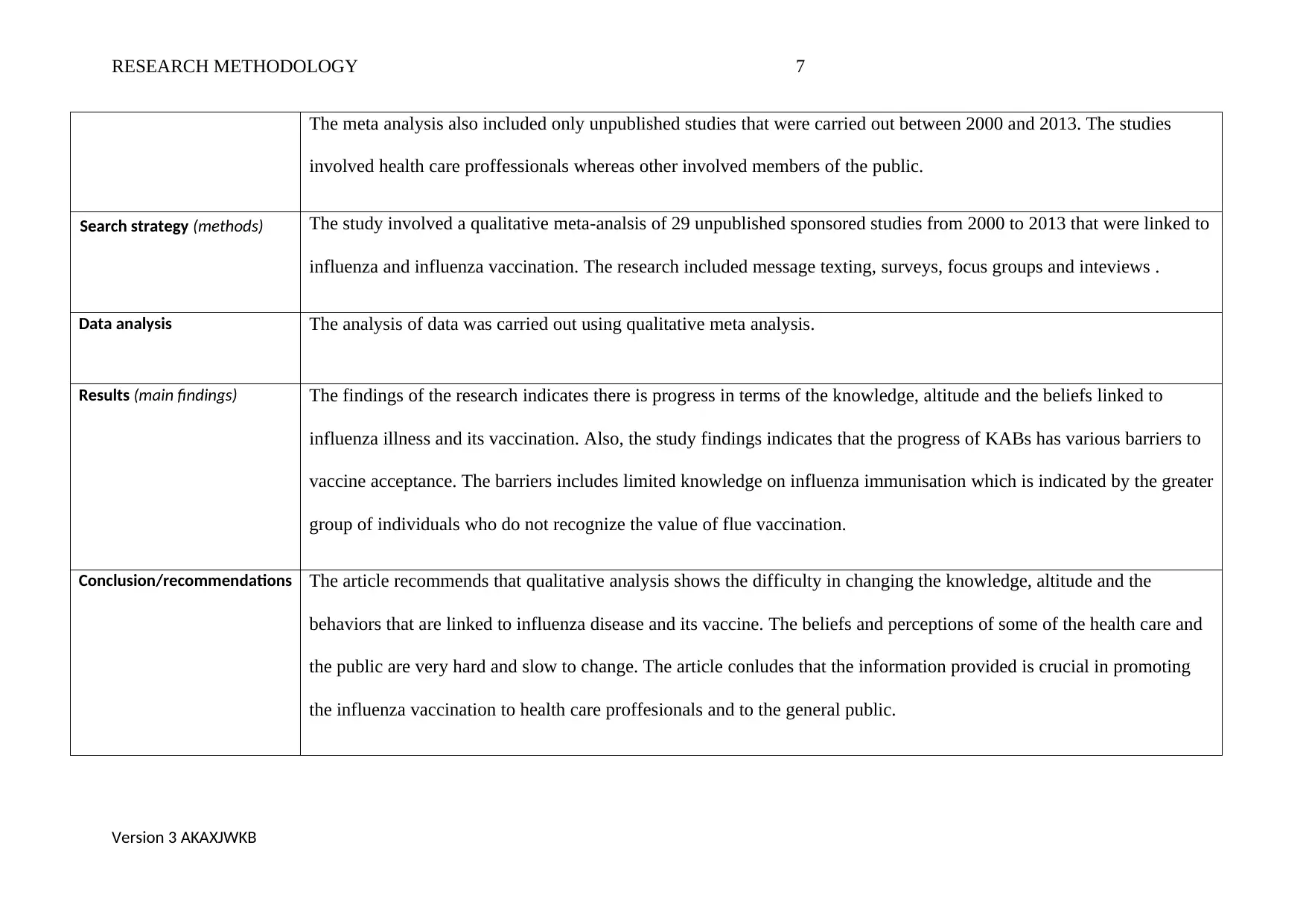
The meta analysis also included only unpublished studies that were carried out between 2000 and 2013. The studies
involved health care proffessionals whereas other involved members of the public.
Search strategy (methods) The study involved a qualitative meta-analsis of 29 unpublished sponsored studies from 2000 to 2013 that were linked to
influenza and influenza vaccination. The research included message texting, surveys, focus groups and inteviews .
Data analysis The analysis of data was carried out using qualitative meta analysis.
Results (main findings) The findings of the research indicates there is progress in terms of the knowledge, altitude and the beliefs linked to
influenza illness and its vaccination. Also, the study findings indicates that the progress of KABs has various barriers to
vaccine acceptance. The barriers includes limited knowledge on influenza immunisation which is indicated by the greater
group of individuals who do not recognize the value of flue vaccination.
Conclusion/recommendations The article recommends that qualitative analysis shows the difficulty in changing the knowledge, altitude and the
behaviors that are linked to influenza disease and its vaccine. The beliefs and perceptions of some of the health care and
the public are very hard and slow to change. The article conludes that the information provided is crucial in promoting
the influenza vaccination to health care proffesionals and to the general public.
Version 3 AKAXJWKB
The meta analysis also included only unpublished studies that were carried out between 2000 and 2013. The studies
involved health care proffessionals whereas other involved members of the public.
Search strategy (methods) The study involved a qualitative meta-analsis of 29 unpublished sponsored studies from 2000 to 2013 that were linked to
influenza and influenza vaccination. The research included message texting, surveys, focus groups and inteviews .
Data analysis The analysis of data was carried out using qualitative meta analysis.
Results (main findings) The findings of the research indicates there is progress in terms of the knowledge, altitude and the beliefs linked to
influenza illness and its vaccination. Also, the study findings indicates that the progress of KABs has various barriers to
vaccine acceptance. The barriers includes limited knowledge on influenza immunisation which is indicated by the greater
group of individuals who do not recognize the value of flue vaccination.
Conclusion/recommendations The article recommends that qualitative analysis shows the difficulty in changing the knowledge, altitude and the
behaviors that are linked to influenza disease and its vaccine. The beliefs and perceptions of some of the health care and
the public are very hard and slow to change. The article conludes that the information provided is crucial in promoting
the influenza vaccination to health care proffesionals and to the general public.
Version 3 AKAXJWKB
Paraphrase This Document
Need a fresh take? Get an instant paraphrase of this document with our AI Paraphraser
RESEARCH METHODOLOGY 8
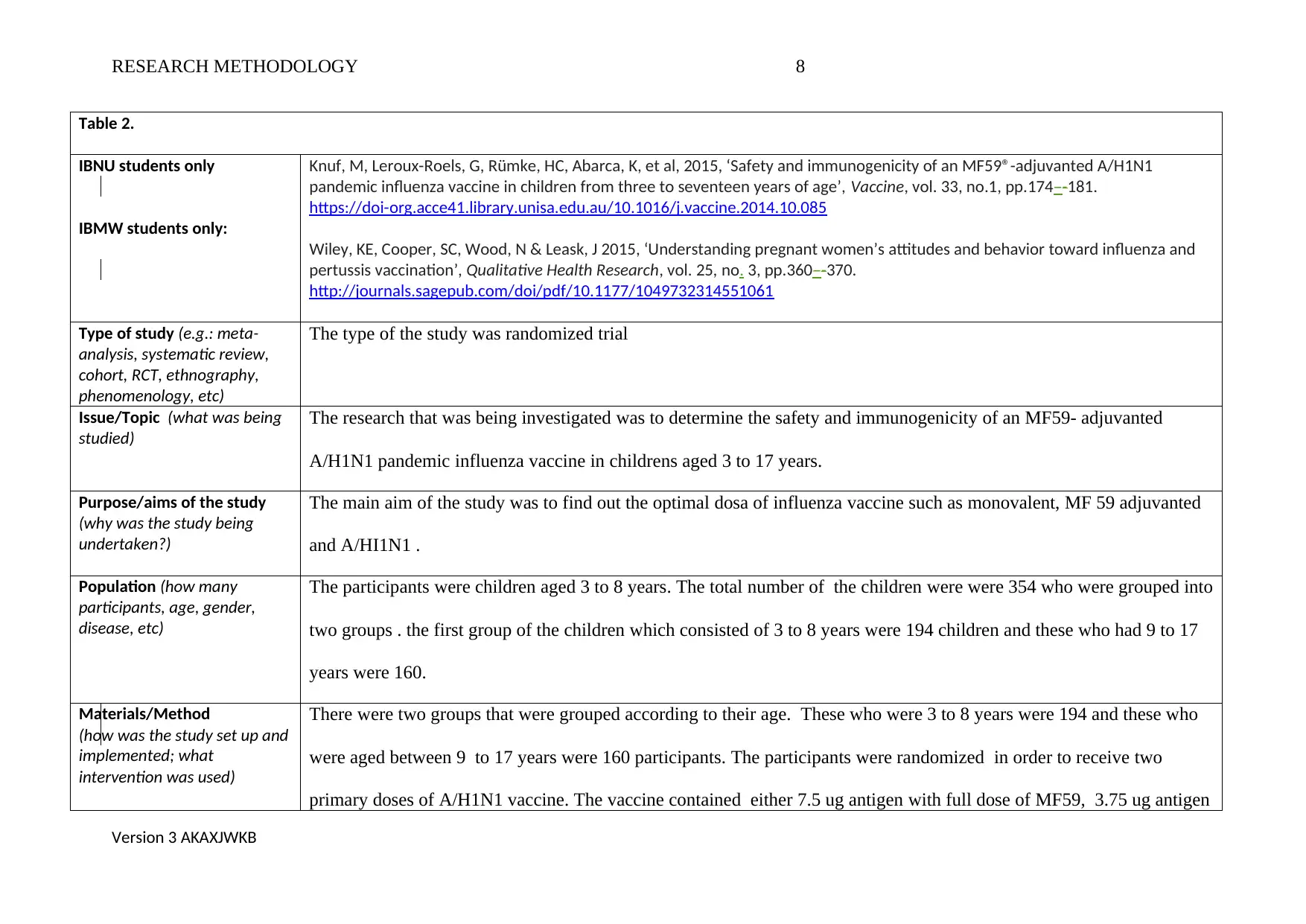
Table 2.
IBNU students only
IBMW students only:
Knuf, M, Leroux-Roels, G, Rümke, HC, Abarca, K, et al, 2015, ‘Safety and immunogenicity of an MF59®-adjuvanted A/H1N1
pandemic influenza vaccine in children from three to seventeen years of age’, Vaccine, vol. 33, no.1, pp.174–-181.
https://doi-org.acce41.library.unisa.edu.au/10.1016/j.vaccine.2014.10.085
Wiley, KE, Cooper, SC, Wood, N & Leask, J 2015, ‘Understanding pregnant women’s attitudes and behavior toward influenza and
pertussis vaccination’, Qualitative Health Research, vol. 25, no. 3, pp.360–-370.
http://journals.sagepub.com/doi/pdf/10.1177/1049732314551061
Type of study (e.g.: meta-
analysis, systematic review,
cohort, RCT, ethnography,
phenomenology, etc)
The type of the study was randomized trial
Issue/Topic (what was being
studied)
The research that was being investigated was to determine the safety and immunogenicity of an MF59- adjuvanted
A/H1N1 pandemic influenza vaccine in childrens aged 3 to 17 years.
Purpose/aims of the study
(why was the study being
undertaken?)
The main aim of the study was to find out the optimal dosa of influenza vaccine such as monovalent, MF 59 adjuvanted
and A/HI1N1 .
Population (how many
participants, age, gender,
disease, etc)
The participants were children aged 3 to 8 years. The total number of the children were were 354 who were grouped into
two groups . the first group of the children which consisted of 3 to 8 years were 194 children and these who had 9 to 17
years were 160.
Materials/Method
(how was the study set up and
implemented; what
intervention was used)
There were two groups that were grouped according to their age. These who were 3 to 8 years were 194 and these who
were aged between 9 to 17 years were 160 participants. The participants were randomized in order to receive two
primary doses of A/H1N1 vaccine. The vaccine contained either 7.5 ug antigen with full dose of MF59, 3.75 ug antigen
Version 3 AKAXJWKB
Table 2.
IBNU students only
IBMW students only:
Knuf, M, Leroux-Roels, G, Rümke, HC, Abarca, K, et al, 2015, ‘Safety and immunogenicity of an MF59®-adjuvanted A/H1N1
pandemic influenza vaccine in children from three to seventeen years of age’, Vaccine, vol. 33, no.1, pp.174–-181.
https://doi-org.acce41.library.unisa.edu.au/10.1016/j.vaccine.2014.10.085
Wiley, KE, Cooper, SC, Wood, N & Leask, J 2015, ‘Understanding pregnant women’s attitudes and behavior toward influenza and
pertussis vaccination’, Qualitative Health Research, vol. 25, no. 3, pp.360–-370.
http://journals.sagepub.com/doi/pdf/10.1177/1049732314551061
Type of study (e.g.: meta-
analysis, systematic review,
cohort, RCT, ethnography,
phenomenology, etc)
The type of the study was randomized trial
Issue/Topic (what was being
studied)
The research that was being investigated was to determine the safety and immunogenicity of an MF59- adjuvanted
A/H1N1 pandemic influenza vaccine in childrens aged 3 to 17 years.
Purpose/aims of the study
(why was the study being
undertaken?)
The main aim of the study was to find out the optimal dosa of influenza vaccine such as monovalent, MF 59 adjuvanted
and A/HI1N1 .
Population (how many
participants, age, gender,
disease, etc)
The participants were children aged 3 to 8 years. The total number of the children were were 354 who were grouped into
two groups . the first group of the children which consisted of 3 to 8 years were 194 children and these who had 9 to 17
years were 160.
Materials/Method
(how was the study set up and
implemented; what
intervention was used)
There were two groups that were grouped according to their age. These who were 3 to 8 years were 194 and these who
were aged between 9 to 17 years were 160 participants. The participants were randomized in order to receive two
primary doses of A/H1N1 vaccine. The vaccine contained either 7.5 ug antigen with full dose of MF59, 3.75 ug antigen
Version 3 AKAXJWKB
RESEARCH METHODOLOGY 9
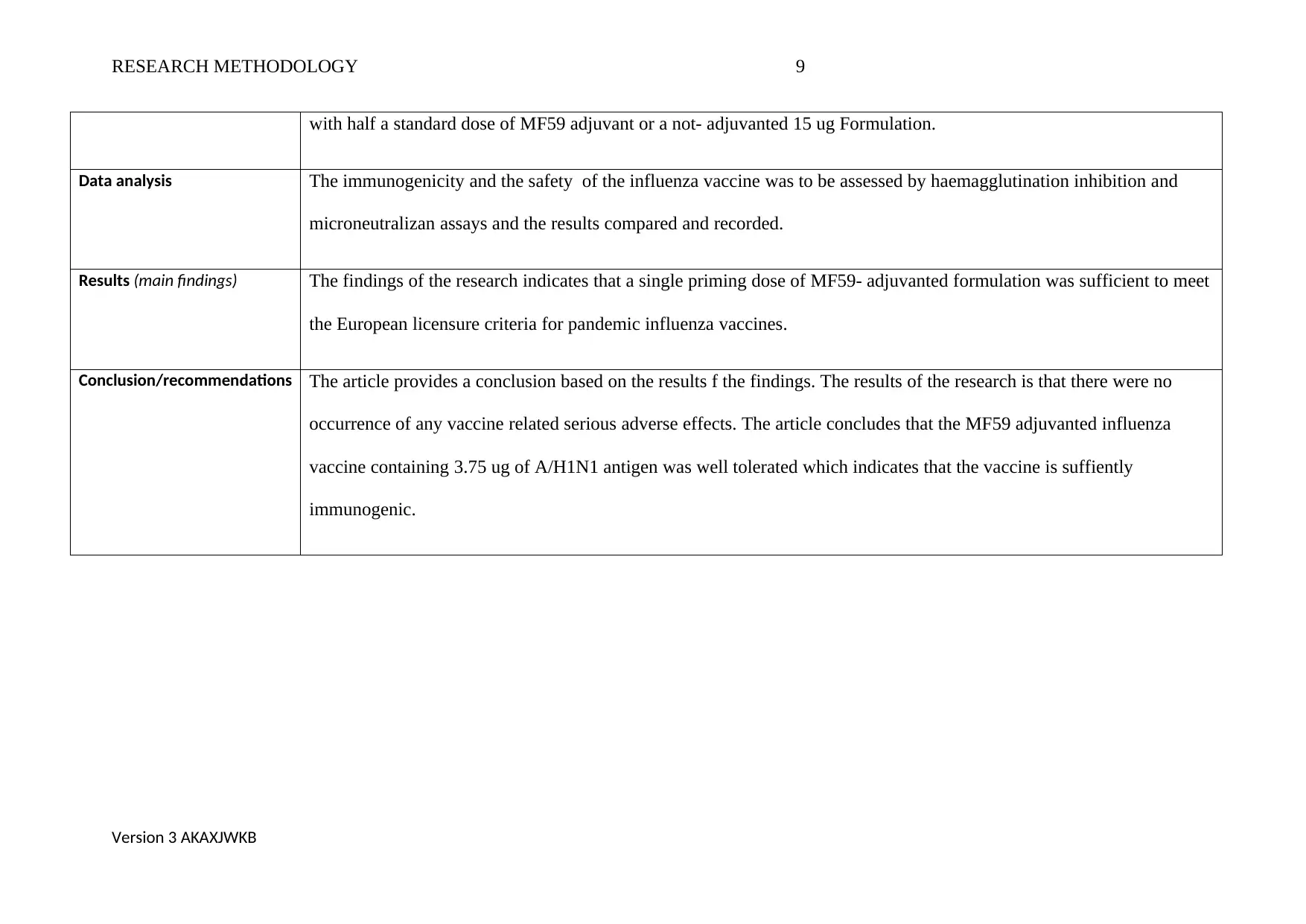
with half a standard dose of MF59 adjuvant or a not- adjuvanted 15 ug Formulation.
Data analysis The immunogenicity and the safety of the influenza vaccine was to be assessed by haemagglutination inhibition and
microneutralizan assays and the results compared and recorded.
Results (main findings) The findings of the research indicates that a single priming dose of MF59- adjuvanted formulation was sufficient to meet
the European licensure criteria for pandemic influenza vaccines.
Conclusion/recommendations The article provides a conclusion based on the results f the findings. The results of the research is that there were no
occurrence of any vaccine related serious adverse effects. The article concludes that the MF59 adjuvanted influenza
vaccine containing 3.75 ug of A/H1N1 antigen was well tolerated which indicates that the vaccine is suffiently
immunogenic.
Version 3 AKAXJWKB
with half a standard dose of MF59 adjuvant or a not- adjuvanted 15 ug Formulation.
Data analysis The immunogenicity and the safety of the influenza vaccine was to be assessed by haemagglutination inhibition and
microneutralizan assays and the results compared and recorded.
Results (main findings) The findings of the research indicates that a single priming dose of MF59- adjuvanted formulation was sufficient to meet
the European licensure criteria for pandemic influenza vaccines.
Conclusion/recommendations The article provides a conclusion based on the results f the findings. The results of the research is that there were no
occurrence of any vaccine related serious adverse effects. The article concludes that the MF59 adjuvanted influenza
vaccine containing 3.75 ug of A/H1N1 antigen was well tolerated which indicates that the vaccine is suffiently
immunogenic.
Version 3 AKAXJWKB
⊘ This is a preview!⊘
Do you want full access?
Subscribe today to unlock all pages.
Trusted by 1+ million students worldwide
RESEARCH METHODOLOGY 10
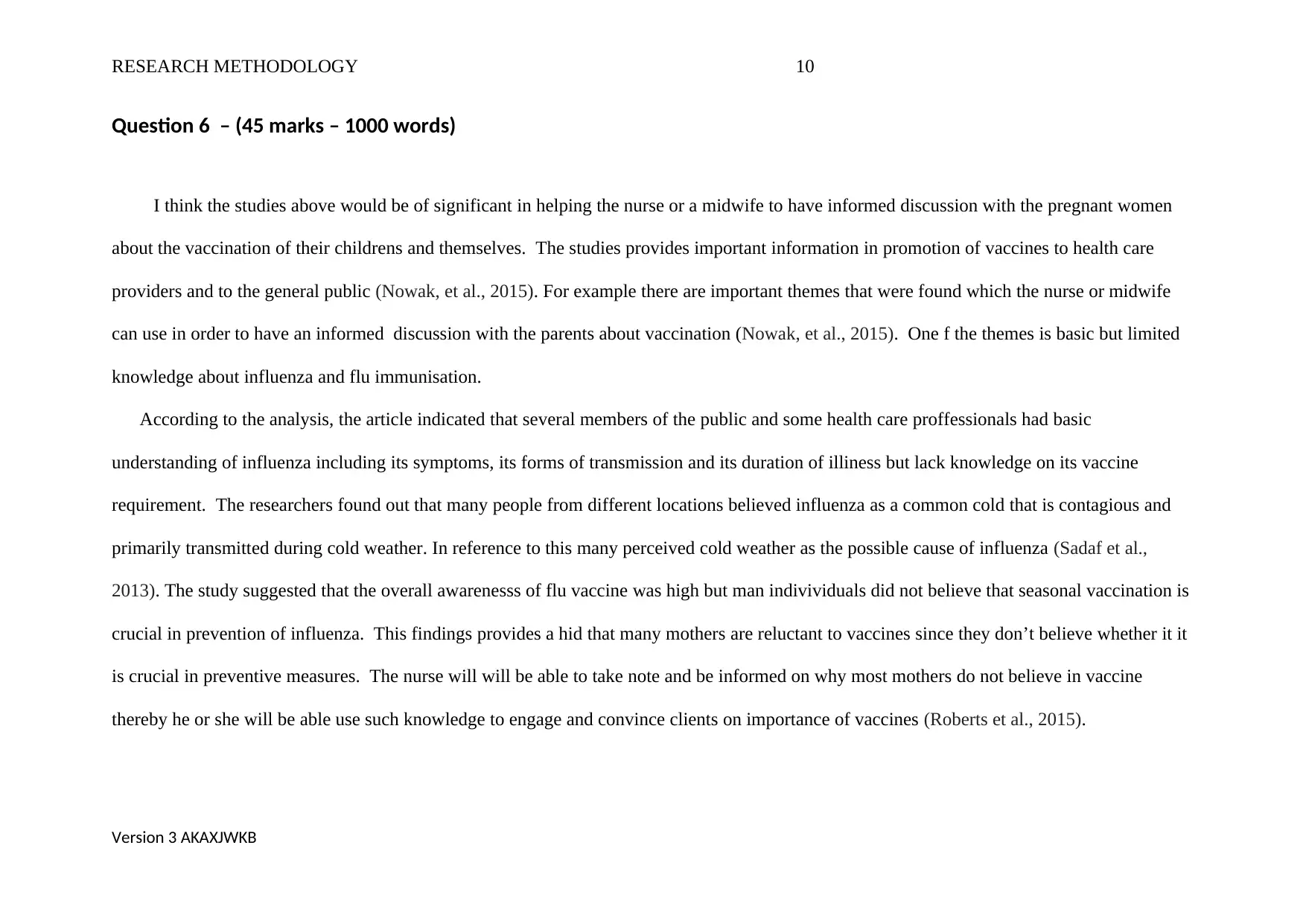
Question 6 – (45 marks – 1000 words)
I think the studies above would be of significant in helping the nurse or a midwife to have informed discussion with the pregnant women
about the vaccination of their childrens and themselves. The studies provides important information in promotion of vaccines to health care
providers and to the general public (Nowak, et al., 2015). For example there are important themes that were found which the nurse or midwife
can use in order to have an informed discussion with the parents about vaccination (Nowak, et al., 2015). One f the themes is basic but limited
knowledge about influenza and flu immunisation.
According to the analysis, the article indicated that several members of the public and some health care proffessionals had basic
understanding of influenza including its symptoms, its forms of transmission and its duration of illiness but lack knowledge on its vaccine
requirement. The researchers found out that many people from different locations believed influenza as a common cold that is contagious and
primarily transmitted during cold weather. In reference to this many perceived cold weather as the possible cause of influenza (Sadaf et al.,
2013). The study suggested that the overall awarenesss of flu vaccine was high but man indivividuals did not believe that seasonal vaccination is
crucial in prevention of influenza. This findings provides a hid that many mothers are reluctant to vaccines since they don’t believe whether it it
is crucial in preventive measures. The nurse will will be able to take note and be informed on why most mothers do not believe in vaccine
thereby he or she will be able use such knowledge to engage and convince clients on importance of vaccines (Roberts et al., 2015).
Version 3 AKAXJWKB
Question 6 – (45 marks – 1000 words)
I think the studies above would be of significant in helping the nurse or a midwife to have informed discussion with the pregnant women
about the vaccination of their childrens and themselves. The studies provides important information in promotion of vaccines to health care
providers and to the general public (Nowak, et al., 2015). For example there are important themes that were found which the nurse or midwife
can use in order to have an informed discussion with the parents about vaccination (Nowak, et al., 2015). One f the themes is basic but limited
knowledge about influenza and flu immunisation.
According to the analysis, the article indicated that several members of the public and some health care proffessionals had basic
understanding of influenza including its symptoms, its forms of transmission and its duration of illiness but lack knowledge on its vaccine
requirement. The researchers found out that many people from different locations believed influenza as a common cold that is contagious and
primarily transmitted during cold weather. In reference to this many perceived cold weather as the possible cause of influenza (Sadaf et al.,
2013). The study suggested that the overall awarenesss of flu vaccine was high but man indivividuals did not believe that seasonal vaccination is
crucial in prevention of influenza. This findings provides a hid that many mothers are reluctant to vaccines since they don’t believe whether it it
is crucial in preventive measures. The nurse will will be able to take note and be informed on why most mothers do not believe in vaccine
thereby he or she will be able use such knowledge to engage and convince clients on importance of vaccines (Roberts et al., 2015).
Version 3 AKAXJWKB
Paraphrase This Document
Need a fresh take? Get an instant paraphrase of this document with our AI Paraphraser
RESEARCH METHODOLOGY 11
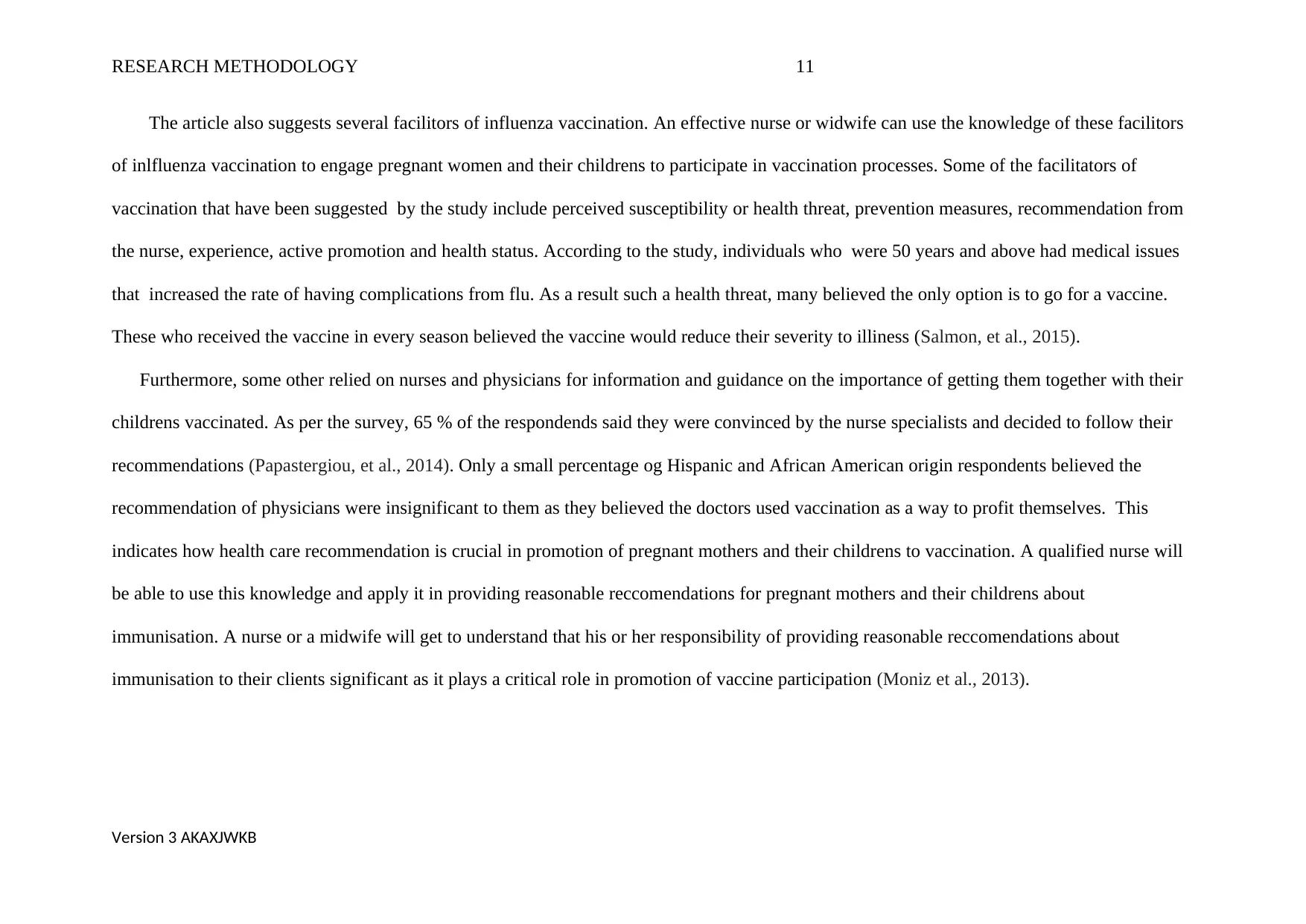
The article also suggests several facilitors of influenza vaccination. An effective nurse or widwife can use the knowledge of these facilitors
of inlfluenza vaccination to engage pregnant women and their childrens to participate in vaccination processes. Some of the facilitators of
vaccination that have been suggested by the study include perceived susceptibility or health threat, prevention measures, recommendation from
the nurse, experience, active promotion and health status. According to the study, individuals who were 50 years and above had medical issues
that increased the rate of having complications from flu. As a result such a health threat, many believed the only option is to go for a vaccine.
These who received the vaccine in every season believed the vaccine would reduce their severity to illiness (Salmon, et al., 2015).
Furthermore, some other relied on nurses and physicians for information and guidance on the importance of getting them together with their
childrens vaccinated. As per the survey, 65 % of the respondends said they were convinced by the nurse specialists and decided to follow their
recommendations (Papastergiou, et al., 2014). Only a small percentage og Hispanic and African American origin respondents believed the
recommendation of physicians were insignificant to them as they believed the doctors used vaccination as a way to profit themselves. This
indicates how health care recommendation is crucial in promotion of pregnant mothers and their childrens to vaccination. A qualified nurse will
be able to use this knowledge and apply it in providing reasonable reccomendations for pregnant mothers and their childrens about
immunisation. A nurse or a midwife will get to understand that his or her responsibility of providing reasonable reccomendations about
immunisation to their clients significant as it plays a critical role in promotion of vaccine participation (Moniz et al., 2013).
Version 3 AKAXJWKB
The article also suggests several facilitors of influenza vaccination. An effective nurse or widwife can use the knowledge of these facilitors
of inlfluenza vaccination to engage pregnant women and their childrens to participate in vaccination processes. Some of the facilitators of
vaccination that have been suggested by the study include perceived susceptibility or health threat, prevention measures, recommendation from
the nurse, experience, active promotion and health status. According to the study, individuals who were 50 years and above had medical issues
that increased the rate of having complications from flu. As a result such a health threat, many believed the only option is to go for a vaccine.
These who received the vaccine in every season believed the vaccine would reduce their severity to illiness (Salmon, et al., 2015).
Furthermore, some other relied on nurses and physicians for information and guidance on the importance of getting them together with their
childrens vaccinated. As per the survey, 65 % of the respondends said they were convinced by the nurse specialists and decided to follow their
recommendations (Papastergiou, et al., 2014). Only a small percentage og Hispanic and African American origin respondents believed the
recommendation of physicians were insignificant to them as they believed the doctors used vaccination as a way to profit themselves. This
indicates how health care recommendation is crucial in promotion of pregnant mothers and their childrens to vaccination. A qualified nurse will
be able to use this knowledge and apply it in providing reasonable reccomendations for pregnant mothers and their childrens about
immunisation. A nurse or a midwife will get to understand that his or her responsibility of providing reasonable reccomendations about
immunisation to their clients significant as it plays a critical role in promotion of vaccine participation (Moniz et al., 2013).
Version 3 AKAXJWKB
RESEARCH METHODOLOGY 12
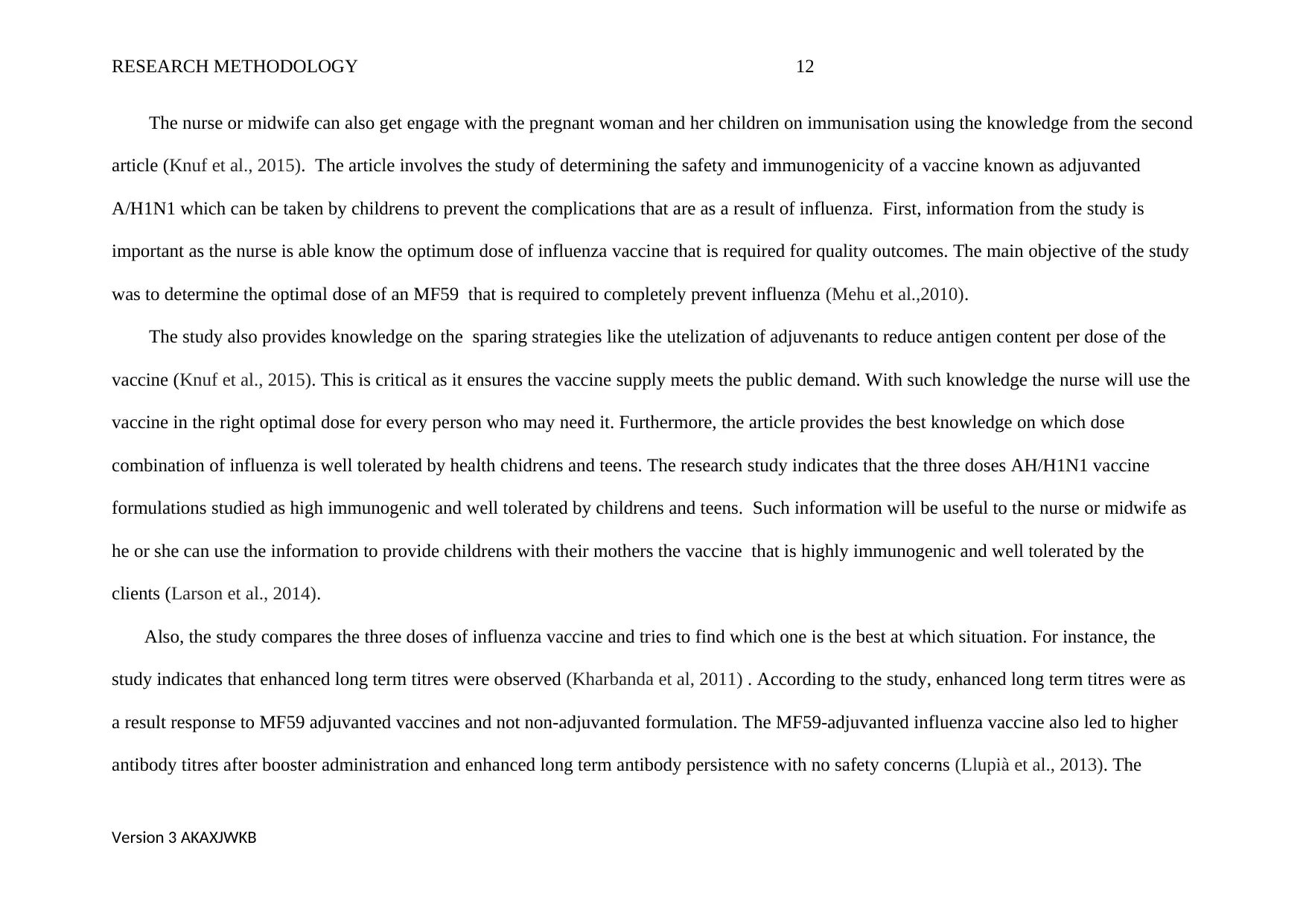
The nurse or midwife can also get engage with the pregnant woman and her children on immunisation using the knowledge from the second
article (Knuf et al., 2015). The article involves the study of determining the safety and immunogenicity of a vaccine known as adjuvanted
A/H1N1 which can be taken by childrens to prevent the complications that are as a result of influenza. First, information from the study is
important as the nurse is able know the optimum dose of influenza vaccine that is required for quality outcomes. The main objective of the study
was to determine the optimal dose of an MF59 that is required to completely prevent influenza (Mehu et al.,2010).
The study also provides knowledge on the sparing strategies like the utelization of adjuvenants to reduce antigen content per dose of the
vaccine (Knuf et al., 2015). This is critical as it ensures the vaccine supply meets the public demand. With such knowledge the nurse will use the
vaccine in the right optimal dose for every person who may need it. Furthermore, the article provides the best knowledge on which dose
combination of influenza is well tolerated by health chidrens and teens. The research study indicates that the three doses AH/H1N1 vaccine
formulations studied as high immunogenic and well tolerated by childrens and teens. Such information will be useful to the nurse or midwife as
he or she can use the information to provide childrens with their mothers the vaccine that is highly immunogenic and well tolerated by the
clients (Larson et al., 2014).
Also, the study compares the three doses of influenza vaccine and tries to find which one is the best at which situation. For instance, the
study indicates that enhanced long term titres were observed (Kharbanda et al, 2011) . According to the study, enhanced long term titres were as
a result response to MF59 adjuvanted vaccines and not non-adjuvanted formulation. The MF59-adjuvanted influenza vaccine also led to higher
antibody titres after booster administration and enhanced long term antibody persistence with no safety concerns (Llupià et al., 2013). The
Version 3 AKAXJWKB
The nurse or midwife can also get engage with the pregnant woman and her children on immunisation using the knowledge from the second
article (Knuf et al., 2015). The article involves the study of determining the safety and immunogenicity of a vaccine known as adjuvanted
A/H1N1 which can be taken by childrens to prevent the complications that are as a result of influenza. First, information from the study is
important as the nurse is able know the optimum dose of influenza vaccine that is required for quality outcomes. The main objective of the study
was to determine the optimal dose of an MF59 that is required to completely prevent influenza (Mehu et al.,2010).
The study also provides knowledge on the sparing strategies like the utelization of adjuvenants to reduce antigen content per dose of the
vaccine (Knuf et al., 2015). This is critical as it ensures the vaccine supply meets the public demand. With such knowledge the nurse will use the
vaccine in the right optimal dose for every person who may need it. Furthermore, the article provides the best knowledge on which dose
combination of influenza is well tolerated by health chidrens and teens. The research study indicates that the three doses AH/H1N1 vaccine
formulations studied as high immunogenic and well tolerated by childrens and teens. Such information will be useful to the nurse or midwife as
he or she can use the information to provide childrens with their mothers the vaccine that is highly immunogenic and well tolerated by the
clients (Larson et al., 2014).
Also, the study compares the three doses of influenza vaccine and tries to find which one is the best at which situation. For instance, the
study indicates that enhanced long term titres were observed (Kharbanda et al, 2011) . According to the study, enhanced long term titres were as
a result response to MF59 adjuvanted vaccines and not non-adjuvanted formulation. The MF59-adjuvanted influenza vaccine also led to higher
antibody titres after booster administration and enhanced long term antibody persistence with no safety concerns (Llupià et al., 2013). The
Version 3 AKAXJWKB
⊘ This is a preview!⊘
Do you want full access?
Subscribe today to unlock all pages.
Trusted by 1+ million students worldwide

1 out of 16


Related Documents


Your All-in-One AI-Powered Toolkit for Academic Success.
+13062052269
info@desklib.com
Available 24*7 on WhatsApp / Email
![[object Object]](/_next/static/media/star-bottom.7253800d.svg)
Unlock your academic potential
Copyright © 2020–2026 A2Z Services. All Rights Reserved. Developed and managed by ZUCOL.