Research Methodology Report: Data Collection, Analysis, and Ethics
VerifiedAdded on 2022/11/17
|9
|2465
|271
Report
AI Summary
This report details a research methodology study, covering the entire process from initial design to data analysis and ethical considerations. The study employs a qualitative research design, utilizing experiments and questionnaires for data collection. The process includes participant selection, data gathering, and rigorous analysis to ensure reliable results. Ethical issues, such as confidentiality and honesty, are addressed, along with the limitations encountered during the research, including sampling challenges and data analysis difficulties. The report also highlights the measures taken to avoid sampling errors and the importance of ethical considerations in business research. The study concludes with a reanalysis of data and identification of common patterns, providing valuable insights into the research process and its outcomes.

Running Head: RESEARCH METHODOLOGY
1
Research Methodology
Name
Institution
Date
1
Research Methodology
Name
Institution
Date

Paraphrase This Document
Need a fresh take? Get an instant paraphrase of this document with our AI Paraphraser
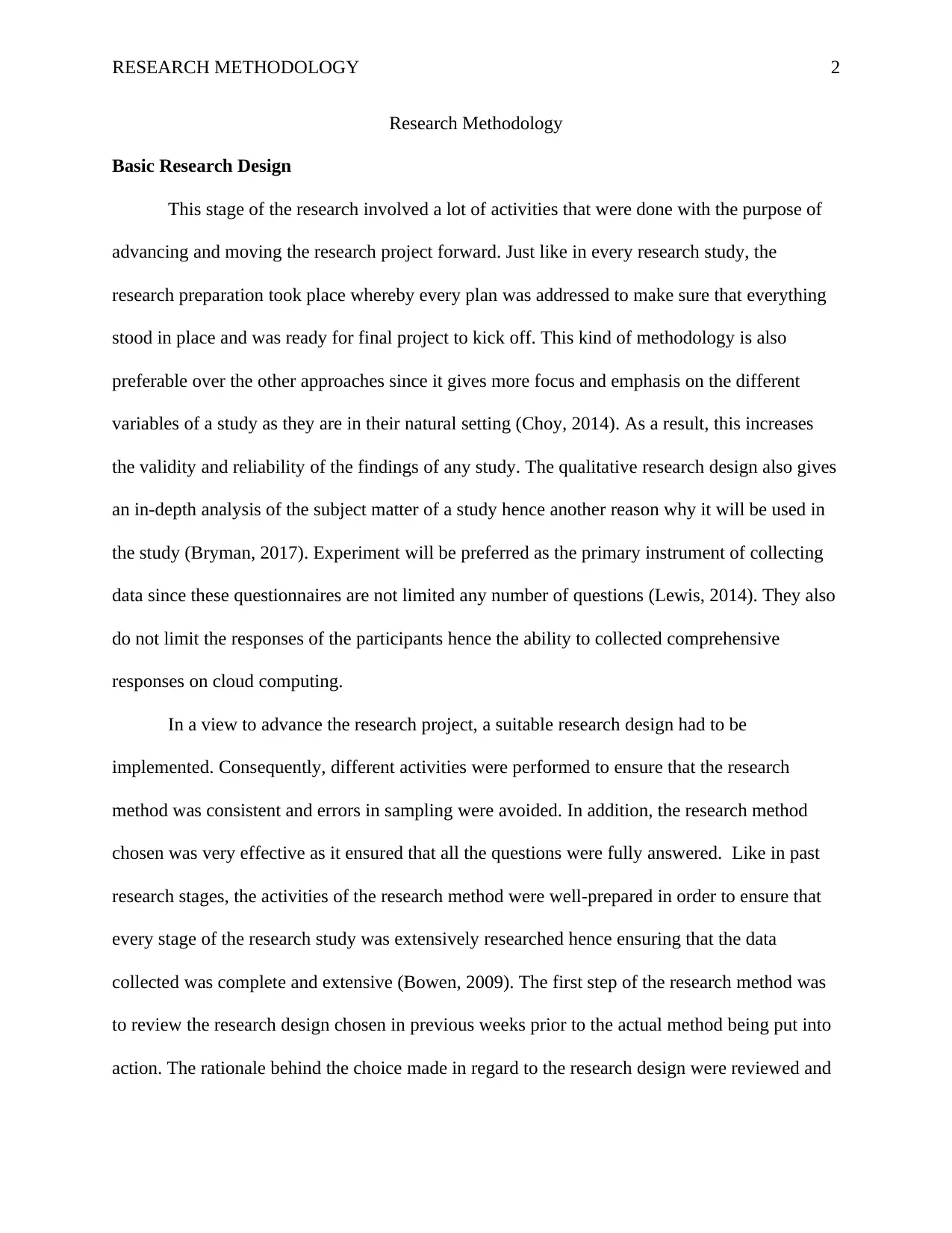
RESEARCH METHODOLOGY 2
Research Methodology
Basic Research Design
This stage of the research involved a lot of activities that were done with the purpose of
advancing and moving the research project forward. Just like in every research study, the
research preparation took place whereby every plan was addressed to make sure that everything
stood in place and was ready for final project to kick off. This kind of methodology is also
preferable over the other approaches since it gives more focus and emphasis on the different
variables of a study as they are in their natural setting (Choy, 2014). As a result, this increases
the validity and reliability of the findings of any study. The qualitative research design also gives
an in-depth analysis of the subject matter of a study hence another reason why it will be used in
the study (Bryman, 2017). Experiment will be preferred as the primary instrument of collecting
data since these questionnaires are not limited any number of questions (Lewis, 2014). They also
do not limit the responses of the participants hence the ability to collected comprehensive
responses on cloud computing.
In a view to advance the research project, a suitable research design had to be
implemented. Consequently, different activities were performed to ensure that the research
method was consistent and errors in sampling were avoided. In addition, the research method
chosen was very effective as it ensured that all the questions were fully answered. Like in past
research stages, the activities of the research method were well-prepared in order to ensure that
every stage of the research study was extensively researched hence ensuring that the data
collected was complete and extensive (Bowen, 2009). The first step of the research method was
to review the research design chosen in previous weeks prior to the actual method being put into
action. The rationale behind the choice made in regard to the research design were reviewed and
Research Methodology
Basic Research Design
This stage of the research involved a lot of activities that were done with the purpose of
advancing and moving the research project forward. Just like in every research study, the
research preparation took place whereby every plan was addressed to make sure that everything
stood in place and was ready for final project to kick off. This kind of methodology is also
preferable over the other approaches since it gives more focus and emphasis on the different
variables of a study as they are in their natural setting (Choy, 2014). As a result, this increases
the validity and reliability of the findings of any study. The qualitative research design also gives
an in-depth analysis of the subject matter of a study hence another reason why it will be used in
the study (Bryman, 2017). Experiment will be preferred as the primary instrument of collecting
data since these questionnaires are not limited any number of questions (Lewis, 2014). They also
do not limit the responses of the participants hence the ability to collected comprehensive
responses on cloud computing.
In a view to advance the research project, a suitable research design had to be
implemented. Consequently, different activities were performed to ensure that the research
method was consistent and errors in sampling were avoided. In addition, the research method
chosen was very effective as it ensured that all the questions were fully answered. Like in past
research stages, the activities of the research method were well-prepared in order to ensure that
every stage of the research study was extensively researched hence ensuring that the data
collected was complete and extensive (Bowen, 2009). The first step of the research method was
to review the research design chosen in previous weeks prior to the actual method being put into
action. The rationale behind the choice made in regard to the research design were reviewed and
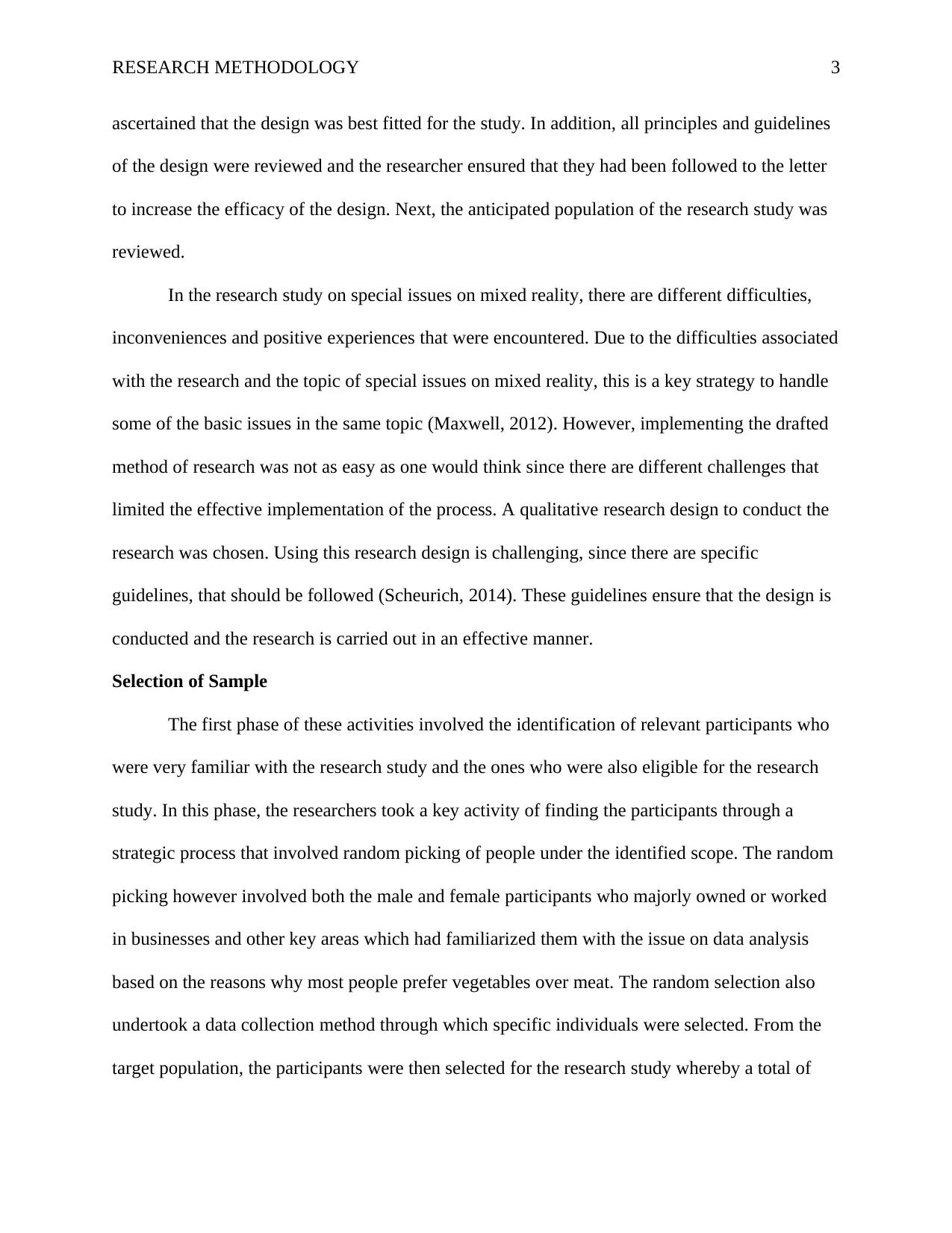
RESEARCH METHODOLOGY 3
ascertained that the design was best fitted for the study. In addition, all principles and guidelines
of the design were reviewed and the researcher ensured that they had been followed to the letter
to increase the efficacy of the design. Next, the anticipated population of the research study was
reviewed.
In the research study on special issues on mixed reality, there are different difficulties,
inconveniences and positive experiences that were encountered. Due to the difficulties associated
with the research and the topic of special issues on mixed reality, this is a key strategy to handle
some of the basic issues in the same topic (Maxwell, 2012). However, implementing the drafted
method of research was not as easy as one would think since there are different challenges that
limited the effective implementation of the process. A qualitative research design to conduct the
research was chosen. Using this research design is challenging, since there are specific
guidelines, that should be followed (Scheurich, 2014). These guidelines ensure that the design is
conducted and the research is carried out in an effective manner.
Selection of Sample
The first phase of these activities involved the identification of relevant participants who
were very familiar with the research study and the ones who were also eligible for the research
study. In this phase, the researchers took a key activity of finding the participants through a
strategic process that involved random picking of people under the identified scope. The random
picking however involved both the male and female participants who majorly owned or worked
in businesses and other key areas which had familiarized them with the issue on data analysis
based on the reasons why most people prefer vegetables over meat. The random selection also
undertook a data collection method through which specific individuals were selected. From the
target population, the participants were then selected for the research study whereby a total of
ascertained that the design was best fitted for the study. In addition, all principles and guidelines
of the design were reviewed and the researcher ensured that they had been followed to the letter
to increase the efficacy of the design. Next, the anticipated population of the research study was
reviewed.
In the research study on special issues on mixed reality, there are different difficulties,
inconveniences and positive experiences that were encountered. Due to the difficulties associated
with the research and the topic of special issues on mixed reality, this is a key strategy to handle
some of the basic issues in the same topic (Maxwell, 2012). However, implementing the drafted
method of research was not as easy as one would think since there are different challenges that
limited the effective implementation of the process. A qualitative research design to conduct the
research was chosen. Using this research design is challenging, since there are specific
guidelines, that should be followed (Scheurich, 2014). These guidelines ensure that the design is
conducted and the research is carried out in an effective manner.
Selection of Sample
The first phase of these activities involved the identification of relevant participants who
were very familiar with the research study and the ones who were also eligible for the research
study. In this phase, the researchers took a key activity of finding the participants through a
strategic process that involved random picking of people under the identified scope. The random
picking however involved both the male and female participants who majorly owned or worked
in businesses and other key areas which had familiarized them with the issue on data analysis
based on the reasons why most people prefer vegetables over meat. The random selection also
undertook a data collection method through which specific individuals were selected. From the
target population, the participants were then selected for the research study whereby a total of
⊘ This is a preview!⊘
Do you want full access?
Subscribe today to unlock all pages.

Trusted by 1+ million students worldwide
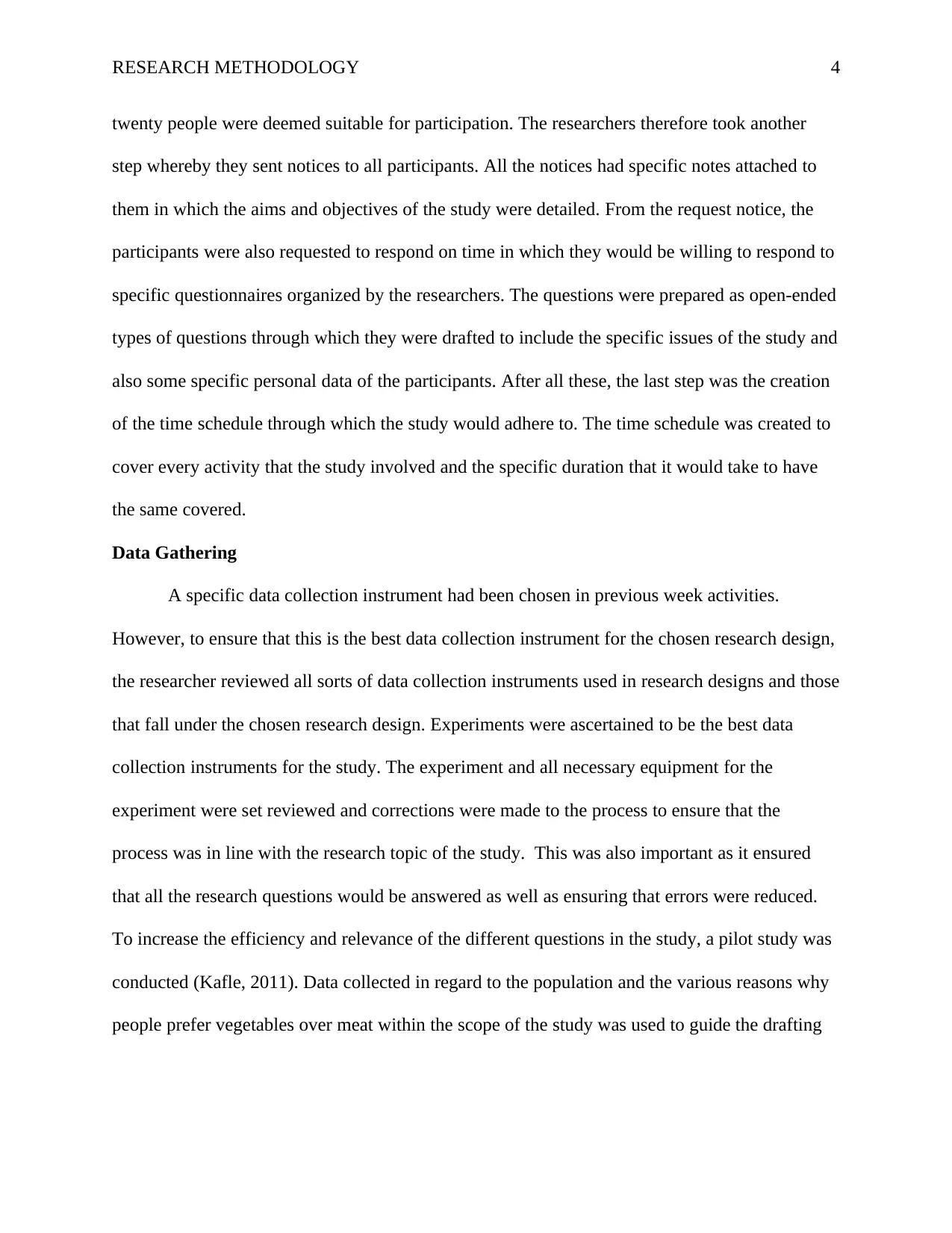
RESEARCH METHODOLOGY 4
twenty people were deemed suitable for participation. The researchers therefore took another
step whereby they sent notices to all participants. All the notices had specific notes attached to
them in which the aims and objectives of the study were detailed. From the request notice, the
participants were also requested to respond on time in which they would be willing to respond to
specific questionnaires organized by the researchers. The questions were prepared as open-ended
types of questions through which they were drafted to include the specific issues of the study and
also some specific personal data of the participants. After all these, the last step was the creation
of the time schedule through which the study would adhere to. The time schedule was created to
cover every activity that the study involved and the specific duration that it would take to have
the same covered.
Data Gathering
A specific data collection instrument had been chosen in previous week activities.
However, to ensure that this is the best data collection instrument for the chosen research design,
the researcher reviewed all sorts of data collection instruments used in research designs and those
that fall under the chosen research design. Experiments were ascertained to be the best data
collection instruments for the study. The experiment and all necessary equipment for the
experiment were set reviewed and corrections were made to the process to ensure that the
process was in line with the research topic of the study. This was also important as it ensured
that all the research questions would be answered as well as ensuring that errors were reduced.
To increase the efficiency and relevance of the different questions in the study, a pilot study was
conducted (Kafle, 2011). Data collected in regard to the population and the various reasons why
people prefer vegetables over meat within the scope of the study was used to guide the drafting
twenty people were deemed suitable for participation. The researchers therefore took another
step whereby they sent notices to all participants. All the notices had specific notes attached to
them in which the aims and objectives of the study were detailed. From the request notice, the
participants were also requested to respond on time in which they would be willing to respond to
specific questionnaires organized by the researchers. The questions were prepared as open-ended
types of questions through which they were drafted to include the specific issues of the study and
also some specific personal data of the participants. After all these, the last step was the creation
of the time schedule through which the study would adhere to. The time schedule was created to
cover every activity that the study involved and the specific duration that it would take to have
the same covered.
Data Gathering
A specific data collection instrument had been chosen in previous week activities.
However, to ensure that this is the best data collection instrument for the chosen research design,
the researcher reviewed all sorts of data collection instruments used in research designs and those
that fall under the chosen research design. Experiments were ascertained to be the best data
collection instruments for the study. The experiment and all necessary equipment for the
experiment were set reviewed and corrections were made to the process to ensure that the
process was in line with the research topic of the study. This was also important as it ensured
that all the research questions would be answered as well as ensuring that errors were reduced.
To increase the efficiency and relevance of the different questions in the study, a pilot study was
conducted (Kafle, 2011). Data collected in regard to the population and the various reasons why
people prefer vegetables over meat within the scope of the study was used to guide the drafting
Paraphrase This Document
Need a fresh take? Get an instant paraphrase of this document with our AI Paraphraser
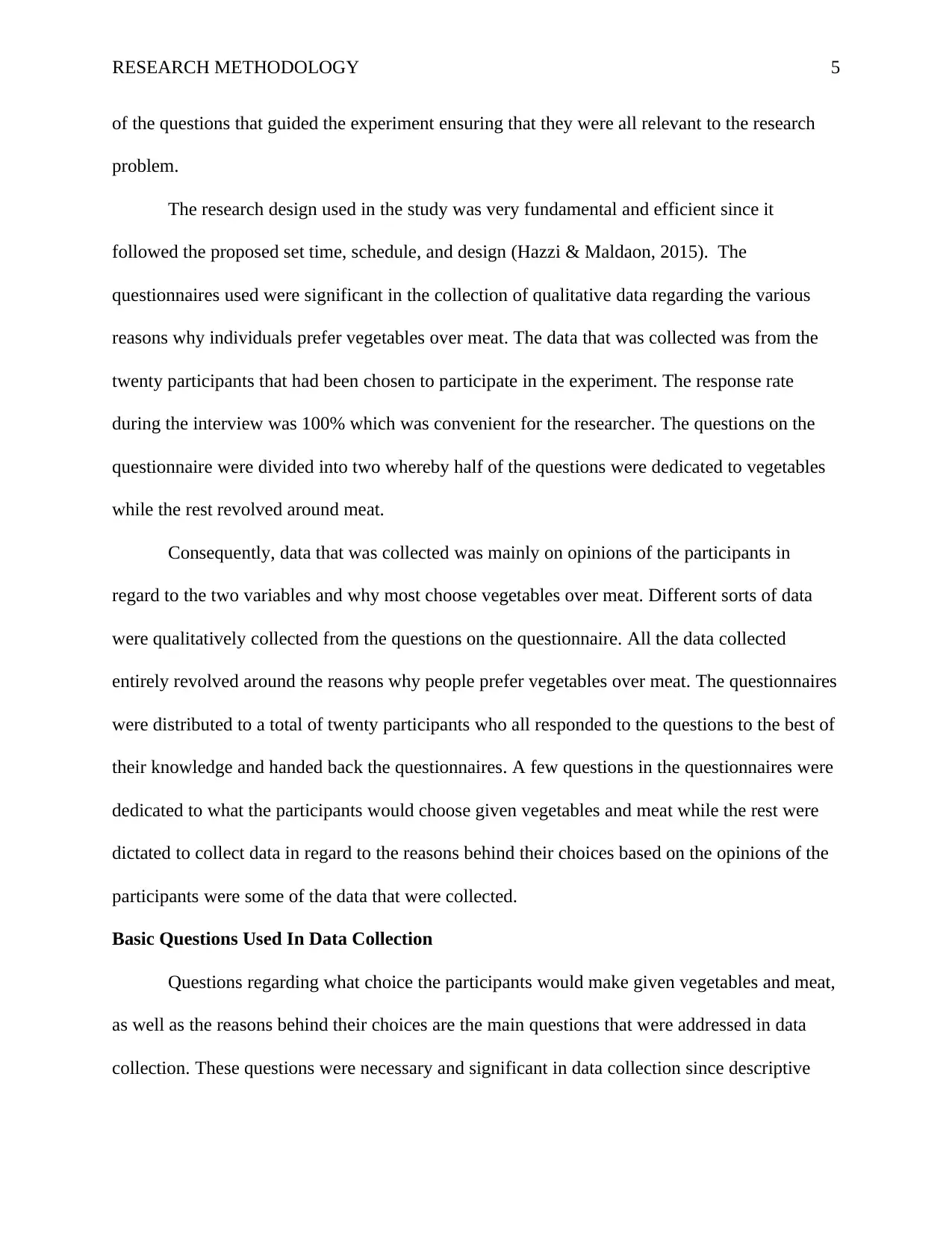
RESEARCH METHODOLOGY 5
of the questions that guided the experiment ensuring that they were all relevant to the research
problem.
The research design used in the study was very fundamental and efficient since it
followed the proposed set time, schedule, and design (Hazzi & Maldaon, 2015). The
questionnaires used were significant in the collection of qualitative data regarding the various
reasons why individuals prefer vegetables over meat. The data that was collected was from the
twenty participants that had been chosen to participate in the experiment. The response rate
during the interview was 100% which was convenient for the researcher. The questions on the
questionnaire were divided into two whereby half of the questions were dedicated to vegetables
while the rest revolved around meat.
Consequently, data that was collected was mainly on opinions of the participants in
regard to the two variables and why most choose vegetables over meat. Different sorts of data
were qualitatively collected from the questions on the questionnaire. All the data collected
entirely revolved around the reasons why people prefer vegetables over meat. The questionnaires
were distributed to a total of twenty participants who all responded to the questions to the best of
their knowledge and handed back the questionnaires. A few questions in the questionnaires were
dedicated to what the participants would choose given vegetables and meat while the rest were
dictated to collect data in regard to the reasons behind their choices based on the opinions of the
participants were some of the data that were collected.
Basic Questions Used In Data Collection
Questions regarding what choice the participants would make given vegetables and meat,
as well as the reasons behind their choices are the main questions that were addressed in data
collection. These questions were necessary and significant in data collection since descriptive
of the questions that guided the experiment ensuring that they were all relevant to the research
problem.
The research design used in the study was very fundamental and efficient since it
followed the proposed set time, schedule, and design (Hazzi & Maldaon, 2015). The
questionnaires used were significant in the collection of qualitative data regarding the various
reasons why individuals prefer vegetables over meat. The data that was collected was from the
twenty participants that had been chosen to participate in the experiment. The response rate
during the interview was 100% which was convenient for the researcher. The questions on the
questionnaire were divided into two whereby half of the questions were dedicated to vegetables
while the rest revolved around meat.
Consequently, data that was collected was mainly on opinions of the participants in
regard to the two variables and why most choose vegetables over meat. Different sorts of data
were qualitatively collected from the questions on the questionnaire. All the data collected
entirely revolved around the reasons why people prefer vegetables over meat. The questionnaires
were distributed to a total of twenty participants who all responded to the questions to the best of
their knowledge and handed back the questionnaires. A few questions in the questionnaires were
dedicated to what the participants would choose given vegetables and meat while the rest were
dictated to collect data in regard to the reasons behind their choices based on the opinions of the
participants were some of the data that were collected.
Basic Questions Used In Data Collection
Questions regarding what choice the participants would make given vegetables and meat,
as well as the reasons behind their choices are the main questions that were addressed in data
collection. These questions were necessary and significant in data collection since descriptive
RESEARCH METHODOLOGY 6
findings were required in this research study. Data used for the study was sourced from the
participants’ responses to the research questions as well as from past literature discussed in the
literature review.
Data Analysis
Specific data analysis tools were ascertained and prepared so as to make sure that they
are all available upon the onset of the actual and final research study. The researcher also
acquainted himself with the necessary knowledge in regard to the data analysis tools so as to
ensure that it was easy to correctly use the tools. Despite the fact that all questions were
answered, during the first stage of analysis which involved sorting out the questionnaires, the
researcher realized that some questions had been ambiguously answered. As a result, the
researcher marked all the questions that had been answered wrongly. The correctly answered
questions were entered in MS Excel files and given specific codes that would make it easy to
retrieve them. The data collected was then reanalyzed inferentially and differentially to ensure
that the analysis process had been done correctly. Upon reanalyzing data again, some sets of data
that had been included in the research were excluded while others that had been excluded were
included in the study.
It was found out that some responses that were deemed ambiguous had a close
relationship with the questions asked and upon extensive analysis the researcher was able to
draw a conclusion of what the participants meant. As a result, this data was included in the
research. Other sets of data had been wrongly entered in the research which was excluded.
Specific patterns were made from the results that had been analyzed from the data included in the
research. Common causes of why most people choose vegetables over meat were identified from
the results. A common pattern was identified from the results whereby it was identified that
findings were required in this research study. Data used for the study was sourced from the
participants’ responses to the research questions as well as from past literature discussed in the
literature review.
Data Analysis
Specific data analysis tools were ascertained and prepared so as to make sure that they
are all available upon the onset of the actual and final research study. The researcher also
acquainted himself with the necessary knowledge in regard to the data analysis tools so as to
ensure that it was easy to correctly use the tools. Despite the fact that all questions were
answered, during the first stage of analysis which involved sorting out the questionnaires, the
researcher realized that some questions had been ambiguously answered. As a result, the
researcher marked all the questions that had been answered wrongly. The correctly answered
questions were entered in MS Excel files and given specific codes that would make it easy to
retrieve them. The data collected was then reanalyzed inferentially and differentially to ensure
that the analysis process had been done correctly. Upon reanalyzing data again, some sets of data
that had been included in the research were excluded while others that had been excluded were
included in the study.
It was found out that some responses that were deemed ambiguous had a close
relationship with the questions asked and upon extensive analysis the researcher was able to
draw a conclusion of what the participants meant. As a result, this data was included in the
research. Other sets of data had been wrongly entered in the research which was excluded.
Specific patterns were made from the results that had been analyzed from the data included in the
research. Common causes of why most people choose vegetables over meat were identified from
the results. A common pattern was identified from the results whereby it was identified that
⊘ This is a preview!⊘
Do you want full access?
Subscribe today to unlock all pages.
Trusted by 1+ million students worldwide
RESEARCH METHODOLOGY 7
almost all participants gave similar causes of the social phenomenon. They also gave closely
related solutions to the different causes of their choices. In this section of the research study,
several improvements were made from previous sections of the research study. Data was also
reanalyzed hence increasing the reliability of the results and conclusions made.
Ethical Issues in Business Research
In this, the ethical consideration were upheld through the specifics of the topic so that the
data would be obtained honestly rather than been fabricated or false. However, the issue of
confidentiality, honesty, and integrity were a great challenge. Ethical considerations were the key
fact behind the credible analysis which at the end made sure that public participation was also
attained in the study (Georgakis et al., 2017). The researcher visited them to ensure that they
were well acquainted with the purpose and significance of the study. They were also enlightened
and reminded of all the activities that took place in regard to data collection. In addition, they
were reminded of all the ethical considerations enhanced in the research study with a view to
make them comfortable when participating in the study.
Limitations and How Sampling Errors Were Avoided
Due to the subjective nature of the topic, major problems include the sampling of
population and key ethical considerations that pertain this topic. Experiment and questionnaires
were used as the primary data collection instrument. Prior to conducting the research, I thought
that use of questionnaires would be very easy. However, upon issuing the questionnaires to the
sample population, it turned out contrary to my expectations. It was difficult to convince the
sample population that their confidentiality would be maintained. Most of the participants were
afraid that their identity would be exposed to the management of their organizations if they gave
private information about how their respective organizations carried out their businesses. In
almost all participants gave similar causes of the social phenomenon. They also gave closely
related solutions to the different causes of their choices. In this section of the research study,
several improvements were made from previous sections of the research study. Data was also
reanalyzed hence increasing the reliability of the results and conclusions made.
Ethical Issues in Business Research
In this, the ethical consideration were upheld through the specifics of the topic so that the
data would be obtained honestly rather than been fabricated or false. However, the issue of
confidentiality, honesty, and integrity were a great challenge. Ethical considerations were the key
fact behind the credible analysis which at the end made sure that public participation was also
attained in the study (Georgakis et al., 2017). The researcher visited them to ensure that they
were well acquainted with the purpose and significance of the study. They were also enlightened
and reminded of all the activities that took place in regard to data collection. In addition, they
were reminded of all the ethical considerations enhanced in the research study with a view to
make them comfortable when participating in the study.
Limitations and How Sampling Errors Were Avoided
Due to the subjective nature of the topic, major problems include the sampling of
population and key ethical considerations that pertain this topic. Experiment and questionnaires
were used as the primary data collection instrument. Prior to conducting the research, I thought
that use of questionnaires would be very easy. However, upon issuing the questionnaires to the
sample population, it turned out contrary to my expectations. It was difficult to convince the
sample population that their confidentiality would be maintained. Most of the participants were
afraid that their identity would be exposed to the management of their organizations if they gave
private information about how their respective organizations carried out their businesses. In
Paraphrase This Document
Need a fresh take? Get an instant paraphrase of this document with our AI Paraphraser
RESEARCH METHODOLOGY 8
addition, some participants failed to hand over their questionnaires after filing them. Some
questionnaires that were filed and returned had either ambiguous answers or unanswered
question or even both. This made it hard for me as a researcher to collect data that would be
fundamental to the research. Population sampling was another process and stage in the research
process that was important. Data analysis is another stage in the research process that was very
difficult for me. Coming up with the necessary data analysis methods is very crucial. As a result,
it was important for me to come up with an effective analysis method and also pool all the
required resources needed for the data analysis. Acquiring some tools and software of the data
analysis was also challenging for me which hindered effective data analysis.
addition, some participants failed to hand over their questionnaires after filing them. Some
questionnaires that were filed and returned had either ambiguous answers or unanswered
question or even both. This made it hard for me as a researcher to collect data that would be
fundamental to the research. Population sampling was another process and stage in the research
process that was important. Data analysis is another stage in the research process that was very
difficult for me. Coming up with the necessary data analysis methods is very crucial. As a result,
it was important for me to come up with an effective analysis method and also pool all the
required resources needed for the data analysis. Acquiring some tools and software of the data
analysis was also challenging for me which hindered effective data analysis.
RESEARCH METHODOLOGY 9
References
Bowen, G. A. (2009). Document analysis as a qualitative research method. Qualitative research
journal, 9(2), 27-40.
Bryman, A. (2017). Quantitative and qualitative research: further reflections on their integration.
In Mixing methods: Qualitative and quantitative research (pp. 57-78). Routledge.
Choy, L. T. (2014). The strengths and weaknesses of research methodology: Comparison and
complimentary between qualitative and quantitative approaches. IOSR Journal of
Humanities and Social Science, 19(4), 99-104.
Georgakis, M. K., Protogerou, A. D., Kalogirou, E. I., Tousoulis, D., & Petridou, E. T. (2017).
Advanced statistical methodologies to address inherent study limitations. Author
Response to Ayubi and Saeid. The Journal of Clinical Hypertension, 19(9), 923-924.
Hazzi, O., & Maldaon, I. (2015). A pilot study: Vital methodological issues. Business: Theory
and Practice, 16, 53.
Kafle, N. P. (2011). Hermeneutic phenomenological research method simplified. Bodhi: An
interdisciplinary journal, 5(1), 181-200.
Lewis, S. (2015). Qualitative inquiry and research design: Choosing among five
approaches. Health promotion practice, 16(4), 473-475.
Maxwell, J. A. (2012). Qualitative research design: An interactive approach (Vol. 41). Sage
publications.
Scheurich, J. (2014). Research method in the postmodern. Routledge.
References
Bowen, G. A. (2009). Document analysis as a qualitative research method. Qualitative research
journal, 9(2), 27-40.
Bryman, A. (2017). Quantitative and qualitative research: further reflections on their integration.
In Mixing methods: Qualitative and quantitative research (pp. 57-78). Routledge.
Choy, L. T. (2014). The strengths and weaknesses of research methodology: Comparison and
complimentary between qualitative and quantitative approaches. IOSR Journal of
Humanities and Social Science, 19(4), 99-104.
Georgakis, M. K., Protogerou, A. D., Kalogirou, E. I., Tousoulis, D., & Petridou, E. T. (2017).
Advanced statistical methodologies to address inherent study limitations. Author
Response to Ayubi and Saeid. The Journal of Clinical Hypertension, 19(9), 923-924.
Hazzi, O., & Maldaon, I. (2015). A pilot study: Vital methodological issues. Business: Theory
and Practice, 16, 53.
Kafle, N. P. (2011). Hermeneutic phenomenological research method simplified. Bodhi: An
interdisciplinary journal, 5(1), 181-200.
Lewis, S. (2015). Qualitative inquiry and research design: Choosing among five
approaches. Health promotion practice, 16(4), 473-475.
Maxwell, J. A. (2012). Qualitative research design: An interactive approach (Vol. 41). Sage
publications.
Scheurich, J. (2014). Research method in the postmodern. Routledge.
⊘ This is a preview!⊘
Do you want full access?
Subscribe today to unlock all pages.
Trusted by 1+ million students worldwide

1 out of 9


Related Documents


Your All-in-One AI-Powered Toolkit for Academic Success.
+13062052269
info@desklib.com
Available 24*7 on WhatsApp / Email
![[object Object]](/_next/static/media/star-bottom.7253800d.svg)
Unlock your academic potential
Copyright © 2020–2026 A2Z Services. All Rights Reserved. Developed and managed by ZUCOL.